
Editor’s note from Resumen: for the next 2 weeks Resumen Latinoamericano in English will be reporting from Havana, facing the same obstacles of connectivity and power outages, sponsored by the US blockade, that the Cuban media faces on a daily basis.
By Thalia Fuentes Puebla, Marxlenin Perez Valdes, Enrique Gonzalez Diaz Enro on August 10, 2026
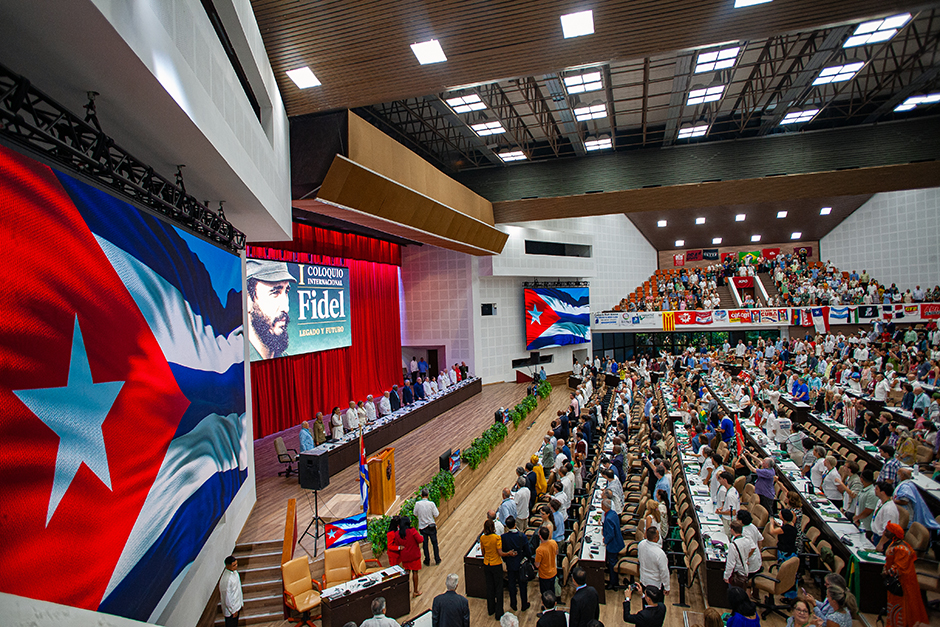
On Monday morning, as part of the commemoration of the 100th anniversary of the birth of Commander-in-Chief Fidel Castro Ruz, the First International Colloquium “Fidel: Legacy and Future” opened in the Cuban capital. The opening session was attended by more than 1,500 delegates, including more than 900 foreigners from 63 countries, who braved threats and dangers to stand with the Cuban people in this tribute to the historic leader of the Revolution.
The event was attended by the First Secretary of the Central Committee of the Communist Party of Cuba and President of the Republic, Dr. C. Miguel Díaz-Canel Bermúdez, who delivered the opening address at this major event.
Dr. René González Barrios, Director of the Fidel Castro Ruz Center, delivered the welcoming remarks, in which he framed the gathering within a global context of profound upheaval.
“We are gathered here by the historic leader of the Cuban Revolution; Fidel Castro calls upon us at a crucial moment in the history of humanity,” said González Barrios, who warned that never before had the planet been so close to self-destruction.
The Center’s Director noted that the world is going through dark times, in which a clique of outdated fascists governs the richest country on the planet with styles and methods that increasingly resemble the establishment of the Third Reich in Adolf Hitler’s Germany.
In his remarks, he also denounced the passivity with which the world is watching in real time the extermination of the Palestinian people and the wars imposed on Iraq and Libya.
The Center’s Director acknowledged that this gathering is taking place at a difficult time for the Cuban people, amid a highly complex socioeconomic situation. However, he emphasized that the presence of hundreds of friends from around the world—brave men and women who, in solidarity with Cuba and its emancipatory project, have decided to stake their fate on ours—serves as an incentive to continue fighting for the dream of Martí and Fidel: a country that stands in solidarity with and is sovereign for all, and for the good of all.
In his remarks, González Barrios called for a return to Fidel, to his legacy, and for drawing on his ideas and revolutionary practice to confront the challenges of the present.
“Together with him, let us reflect on how to face a future that inevitably belongs to our people,” he urged.
The Center’s Director recalled that the Fidel Castro Ruz Center was officially inaugurated on November 25, 2021, and that, since then, it has become a landmark for people of good will interested in appreciating the emancipatory work that a noble and resolute people built alongside their historic leader, forging a new, free, and sovereign homeland.
Díaz-Canel: “Fidel taught us that dreams are achieved by defending our ideas”
Miguel Díaz-Canel Bermúdez, First Secretary of the Central Committee of the Communist Party of Cuba and President of the Republic, delivered the opening address at the First International Colloquium “Fidel: Legacy and Future” with an extensive and profound speech in which he traced the life, thought, and enduring relevance of the historic leader of the Cuban Revolution, as part of the commemorations marking his centennial.
Díaz-Canel began his remarks by placing the tribute owed to Fidel in the context of pre-1959 Cuba—“a country marked by injustice, inequality, and dependence”—a painful reality that Fidel set out to change.
He recalled the young lawyer who turned his self-defense into the political program of the July 26 Movement; the prisoner who transformed his prison cell into a school of combat; and the Commander-in-Chief who, at just 34 years old, delivered at the United Nations General Assembly “the longest and most significant speech ever given in support of the Republic.”
The Cuban leader painted a detailed portrait of pre-revolutionary Cuba: 600,000 unemployed Cubans, three million people without access to electricity, 37.5% of the population illiterate, 60% of children in rural areas without teachers, an extremely high infant mortality rate, and a very low life expectancy.
“Eighty-five percent of small farmers paid rent for their land, while a single landowner controlled 46% of the population,” he explained. He noted that most public services, the banking sector, commerce, refineries, and Cuba’s best farmland were owned by U.S. companies.
“That state of affairs demanded the most radical transformation of the 20th century in this country,” he stated.
Against that backdrop, Díaz-Canel highlighted Cuba’s current indicators in health, education, science, culture, and sports, which—even under the U.S. economic, financial, and commercial blockade—remain superior to those of other countries on the continent. He noted that Cuba has the highest ratio of doctors per capita—more than nine per thousand—and ranks among the top ten countries in the Americas for life expectancy, at 77.7 years. “And it is the country that has contributed the most to the health and education of its own people and those of other nations,” he added.
The president then quoted one of Fidel’s most accurate insights into the world’s problems, expressed in September 1960: that these problems would worsen with the collapse of the socialist camp and the imposition of the Soviet Union. “Since the dawn of humanity, they have arisen fundamentally for one reason: the desire of one to overthrow another for their own interests. Let the philosophy of the mirror disappear, and the philosophy of war will have disappeared. Let the colonies disappear; let the exploitation of countries for their territories disappear; and then humanity will have crossed into a true era of indefinite progress,” he recalled from the Commander’s words.
Díaz-Canel then shared what he considered to be Fidel’s fundamental legacies: “He bequeathed to us the certainty that dreams are achieved by defending ideas. He left us with the conviction that internationalism is an attitude that must set us apart. He taught us the conviction that socialism is the only path to lift humanity out of poverty.”
He recalled that Fidel was the first to denounce neoliberal globalization as “the empire of death” and also the first to advocate for “a world for everyone.” He also highlighted the environmental legacy, the legacy of revolutionary unity, and the legacy of science in the service of the people.
“In Fidel, we find not only a historic leader but also a school of revolutionary practice: to study, analyze, live, and listen to the people,” he affirmed. And he emphasized that Fidel did not leave behind formulas, but rather a method—“a method that emerged not only from the minority faction.”
He recalled the speech delivered on October 17, 1953, in which Fidel formulated the five revolutionary laws—agrarian reform, labor rights, labor reform, the nationalization of unclaimed property, and fiscal participation—and noted that he was not speaking about an introductory university course, but rather diagnosing the cultural ills of an underdeveloped and dependent economy. “That combination—rigorous diagnosis, programmatic proposals, and decisive action—was repeated at every opportunity,” he emphasized.
The president highlighted Fidel’s idea that “the economy is not an autonomous sphere separate from politics, but rather its material expression. Without considering its accounting, there is no economy without politics, nor politics without the economy.” He also underscored the legacy of poverty and ethics: “He led by example. He did not accumulate wealth, he did not betray his principles, he lived as he thought, and he died as he lived.”
Díaz-Canel also addressed the legacies of internationalism, revolutionary optimism, and military strategy. “Fidel led the Cuban Revolution with unwavering dedication; for him, the homeland was Cuba. That is why he supported the causes for the liberation of the African peoples and of Palestine, denounced genocide, and raised his voice against war and against the colonial occupation of any people in the world,” he affirmed.
Regarding optimism, he noted that “in the darkest days, when the socialist camp was collapsing, he maintained his faith in humanity and in history.” And regarding his military thinking, he described him as “a master of guerrilla warfare who led us to victory on January 1, 1959” and “a profound scholar of contemporary military art.”
The Cuban president outlined Fidel’s approach to work, based on four principles: the priority of politics—“every economic decision is a political decision”—, the tactical-strategic sequence—“tactics change, but principles do not”—, popular mobilization as a strategic resource, and innovation under constraint—“scarcity is not just a lack; it is a stimulus for creativity”—.
Díaz-Canel paid tribute to the generation of José Martí’s centennial, “that generation that brought together young people with historic figures: Fidel, Raúl, Che, Allende, Camilo, Celia, and so many others—an entire people willing to give their lives for the unity they had won.” He recalled that Fidel understood the need to combine ideological firmness with practical sensitivity, and quoted Lenin: “Marxism is not a dead doctrine; it is not capitalism, but a guide for completely resolving the problems of life.”
The president highlighted Fidel’s insatiable curiosity, his passion for history and knowledge, and recalled an excerpt from a letter written from prison on Isla de Pinos: “My greatest struggle, ever since I’ve been here, has been to insist—and never tire of insisting—that I need absolutely nothing. Books were necessary, and I consider books to be spiritual assets.”
He noted that Fidel recorded his reflections in 84 texts published between March 28, 2007, and October 9, 2016, and that ten years after his physical passing, nine books compile his thoughts. He quoted a reflection from July 22, 1976: “I did not begin this work as part of a premarital plan, but out of a strong desire to engage with the main protagonist of our resistance.”
Díaz-Canel recalled the achievements of the Revolution: the literacy campaign that mobilized more than 150,000 people; the most advanced universal healthcare system in the Third World; the more than 600,000 healthcare professionals sent to 165 countries; the free education system from elementary school through university; and the cultural and sports system that serves as a model for the world. “The events that, in a very short time, transformed relations between governments and peoples with the most unequal outlook in the world have undoubtedly gone down in the history of the 20th century as defining moments,” he stated.
The president then set the stage for the current context. “The world is in a state of crisis: a climate crisis and a crisis of non-renewable resources, a financial crisis, forced migration that turns the seas into graveyards, and a social divide where the wealth of the poor is accumulated at the expense of the misery of many. The international order is in crisis. Imperial multilateralism seeks to impose its will by force, but the multipolar world is here to stay,” he stated.
He denounced that the empire is intensifying its attacks and that Cuba remains one of the prime targets of imperial fury, with the tightening of the blockade, the arbitrary inclusion on the list of state sponsors of terrorism, and massive media campaigns.
“Along with economic, political, and financial aggression, the economic and cultural war, digital subversion, and the mobilization of internal mercenaries who, with funding from the Miami right wing, are attempting to fracture our country,” he noted.
He denounced that the United States has allocated millions of dollars to promote regime change and cited statements by the U.S. Secretary of State that he considered an “open threat by the U.S. government against the entire people if they do not submit to the empire’s yoke.”
However, he affirmed that Cuba has responded “with the dignity that characterizes us, the resistance that is inherent to us.” He acknowledged the hardships: “the power outages that disrupt family life, the water shortages, the erosion of the purchasing power of wages, the fuel shortages that paralyze the economy and transportation, and the difficulty in obtaining the basic food ration.” But he emphasized that “we are not here to lament these hardships, but to change the things that cause us pain.”
He highlighted the achievements made amid the crisis: the sovereign response to the pandemic, the strengthening of urban and suburban agriculture, and the ability to turn adversity into opportunity.
Díaz-Canel announced that more than 30,000 professionals have graduated in recent days, including 705 from other countries.
“The people’s response, under the leadership of the Communist Party of Cuba, has been one of firm and creative resistance through unity, the defense of their achievements, and the updating of the model in a social world that has evolved toward the principles of socialism—without yielding to pressure or blackmail,” he stated.
The president emphasized that it is necessary to produce and generate wealth in order to distribute it with as much social justice as possible and to preserve the historic achievements of the Revolution. He clarified that the process of economic modernization “is intended to revitalize the economy, not to restore capitalism. There will be no privatization of enterprises; the fundamental means of production will remain under the control of the people, and the country’s sovereignty and independence will be fully preserved.”
Díaz-Canel called on the symposium participants to discuss the truth about Cuba and all the peoples of our America. “We call on you to discuss the truth about Cuba and all the peoples of our America in a world where great challenges lie ahead, and as those coming from outside, you have the responsibility to be the ones to confront them,” he stated.
Addressing the youth, he said: “Every young Cuban, every young person at every conference in your countries, is a bastion of the Revolution. The battle of ideas has become the most vital bastion against ideological obscurantism and the forces of everything that opposes progress.”
He concluded with a statement of principles: “The future of our children, the dreams we must achieve, are in our hands.” And he concluded by quoting Fidel: “We are prepared to resist the imperialist blockade with dignity and on a grand scale for as many years as necessary. Cuba will know how to stand firm, following the example of a Revolution that does not surrender.”
China Highlights Fidel Castro’s Historic Contribution to Bilateral Ties
Liu Haixing, a member of the Central Committee of the Communist Party of China and head of the International Department of the Central Committee of the Communist Party of China, highlighted on Monday the historic legacy of the leader of the Cuban Revolution, Fidel Castro, and his contribution to the development of relations between China and Cuba during the International Colloquium “Fidel: Legacy and Future.”
At the event, Liu conveyed the admiration and respect of the Chinese people for the Cuban leader, whom he described as a great leader of the Cuban Revolution and a longtime friend of the Chinese people.
During his remarks, Liu read a letter sent by Xi Jinping, General Secretary of the Central Committee of the Communist Party of China and President of the People’s Republic of China, to Raúl Castro, leader of the Cuban Revolution, and Miguel Díaz-Canel, First Secretary of the Central Committee of the Communist Party of Cuba and President of Cuba, on the occasion of the 100th anniversary of Fidel Castro’s birth.
In the letter, Xi Jinping extended his greetings to the members of the Communist Party of Cuba and the Cuban people, and emphasized that Fidel Castro dedicated his life to the struggle for national liberation, the defense of sovereignty, and the construction of socialism.
The Chinese leader noted that Fidel Castro’s historic achievements in defense of justice and national dignity have been etched into Cuba’s history and continue to inspire the Cuban people in their efforts to preserve sovereignty, promote development, and improve social welfare.
Xi Jinping also recalled that Fidel Castro made historic contributions to the establishment and development of relations between China and Cuba, thanks to his strategic vision and personal drive, while highlighting that Cuba was the first country in Latin America to establish diplomatic relations with the People’s Republic of China.
Liu Haixing noted that his meetings with Fidel Castro left a deep impression on him due to Castro’s broad international vision, intellectual capacity, and firm political commitment. He added that, through the joint efforts of both sides over decades, the ties between China and Cuba have become a model of solidarity-based cooperation among socialist countries and of mutual assistance among nations of the Global South.
The Chinese leader affirmed that, in the face of a complex and changing international situation, China maintains its support for Cuba as it pursues a path of socialist development in accordance with its national conditions, as well as in the defense of its sovereignty, national security, and rejection of external interference.
Liu maintained that Fidel Castro represents a symbol of the Cuban Revolution and that his life’s journey stands as a testament to his loyalty to his ideals, his revolutionary struggle, and his commitment to friendship between China and Cuba.
He recalled that Fidel Castro wrote in the foreword to the Chinese edition of the book *One Hundred Hours with Fidel* that the social revolutions that took place first in China and later in Cuba had forged a bond between the two peoples in the struggle for socialism.
He also quoted words from Chinese leader Mao Zedong in a letter addressed to Fidel Castro, in which Mao expressed that their shared experiences and struggles had closely united the peoples of China and Cuba.
Liu emphasized that for 66 years, relations between the two parties and countries have weathered changes on the international stage and strengthened mutual strategic trust, yielding fruitful results in bilateral cooperation across various sectors.
The Chinese representative noted that both nations maintain firm support on issues related to their core interests and major concerns, while also moving forward together on the path of socialist construction and addressing current challenges.
Referring to the international scene, Liu stated that the world is undergoing profound transformations, marked by the rise of unilateralism and increasing challenges in the areas of peace, development, security, and governance.
In this context, he highlighted the initiatives proposed by Xi Jinping regarding a community with a shared future for humanity, global development, global security, global civilization, and global cooperation as proposals to respond to international changes and promote global governance based on cooperation.
Liu stated that, in the face of a changing international environment, it is necessary to strengthen trust and solidarity, and he affirmed that the Communist Party of China is willing to work with political parties and organizations around the world to defend the international system centered on the United Nations, promote multilateralism, and reject hegemonic practices and external interference.
The Chinese leader called for advancing a more just and orderly global multipolarization, as well as inclusive economic globalization, with the aim of promoting a future of peace, security, prosperity, and progress.
At the conclusion of his remarks, Liu recalled a quote from Fidel Castro: “The revolution is an eternal undertaking,” and affirmed that honoring his memory not only preserves the legacy of his life’s work but also allows us to carry forward his ideas and spirit in the face of new historical challenges.
“The spirit of Fidel Castro is eternal, and long live the friendship between China and Cuba,” concluded Liu Haixing.
“Cuito Cuanavale is the eternal flame that will never die”
As part of the First International Colloquium “Fidel: Legacy and Future,” held in Havana as part of the commemorations marking the centennial of the Commander-in-Chief’s birth, the Prime Minister of the Republic of Namibia, the Hon. Dr. Tjitunga Elijah Ngurare, delivered a moving speech in which he paid tribute to Fidel Castro and to Cuba’s decisive role in the liberation of Southern Africa.
The Namibian representative began by expressing his gratitude for the opportunity to speak and conveyed warm greetings and solidarity from the President of Namibia, Dr. Netumbo Nandi Naitwa, the first woman to lead the SWAPO Party and the first female president of the Republic of Namibia. “I also convey greetings from your friends, your families, and in particular from the Namibian people who love peace,” he said, noting that President Nandi Naitwa had already expressed her solidarity with Cuba at the United Nations.
The speaker highlighted that the Namibian Parliament had unanimously approved a resolution in support of Cuba, and that among the 136 countries that recently called for an end to the blockade against the island, Namibia proudly counted itself among those nations. “Namibia and Cuba have been inseparable,” he affirmed, recalling the bond between Namibia’s founding president, Sam Nujoma, and Commander Fidel Castro—a relationship he described as “inseparable.”
“As we know, he passed away in 2016, just a decade before turning 100. Fidel Castro was a monumental figure who, in many ways, shaped the world we know today,” the prime minister noted.
“He withstood enormous trials; his leadership transformed Cuba’s social and economic reality in unexpected ways. He made the impossible possible,” he added.
“Fidel is Fidel,” repeated the Namibian representative, emphasizing the Cuban leader’s status as “a symbol of international solidarity, an emblem of patriotism” who “embodied unparalleled courage and determination.”
“For us in Namibia, Commander Fidel Castro is a revered hero. Today, no one can speak of freedom in Southern Africa without mentioning Cuba.”
The speech then turned to its most moving chapter: Cuba’s participation in the struggle for Namibia’s independence and the end of apartheid in South Africa. “Stories are told, steeped in the living memory of Cuban internationalist fighters who fought shoulder to shoulder with Namibians and Angolans under the leadership of SWAPO,” he recounted. “The goal was to secure Angola’s independence and ensure that SWAPO had a strong position to carry on the armed struggle.”
“Dignity Cannot Be Suppressed”: Walter Baier
“Today we celebrate the life and legacy of Fidel Castro, a revolutionary, a statesman, an internationalist, a man who changed history,” said Walter Baier, president of the European Left Party (ELP), who recalled the impact that the victory of the Cuban Revolution had on his generation.
“For my generation, the victory of the Cuban Revolution was more than a political event. It changed history; it put an end to the myth that dignity cannot be challenged,” he said, referring to the lesson that the people can change history and that ideas are more important than military power.
The European leader recalled that, for more than 60 years, Cuba has defended its sovereignty, faced U.S. invasion, sabotage, and terrorism, and endured an economic blockade that he described as “an energy siege, financial persecution, and extraterritorial sanctions.”
“Many believed that the Cuban people would surrender, that they would abandon their principles. They were wrong, because the Cuban people never surrendered. Because dignity cannot be blockaded. Because the will of the Cuban people could not be broken,” he emphasized.
“That is why Cuba is respected throughout the world—not because it is the largest country or the richest, but because it has defended its dignity,” stressed Baier, who added that, today more than ever, Cuba needs international solidarity.
“The U.S. economic blockade is collective punishment; it is economic warfare; it is silent genocide,” he denounced, asserting that, for more than six decades, the empire has tried to break the will of the Cuban people and has failed, “because of the resolve of a proud people who are stronger than sanctions. Because solidarity is stronger than weapons.”
“This struggle for Cuba is not just Cuba’s struggle. It is the struggle of all who believe in national sovereignty. It is the struggle of all who believe in international law. It is the struggle of all who believe that peace is stronger than war,” he emphasized.
Baier concluded his speech with a message of unity and hope. “In this struggle, comrades, solidarity is our main weapon, our most important motivation. Fidel understood this better than anyone. He knew that revolutions are defended with courage and also with ideas, with dedication, with culture, and with international solidarity,” he affirmed.
“His legacy is not merely a memory; it is a responsibility for all of us: to defend peace, justice, sovereignty, and human dignity. That legacy is in Cuba; it lives on in the Americas, in Asia, in Africa, in Europe—it lives wherever there are people who refuse to accept injustice, wherever workers are fighting for freedom.”
Source: Cubadebate, translation Resumen Latinoamericano – English
Join the Struggle-La Lucha Telegram channel