
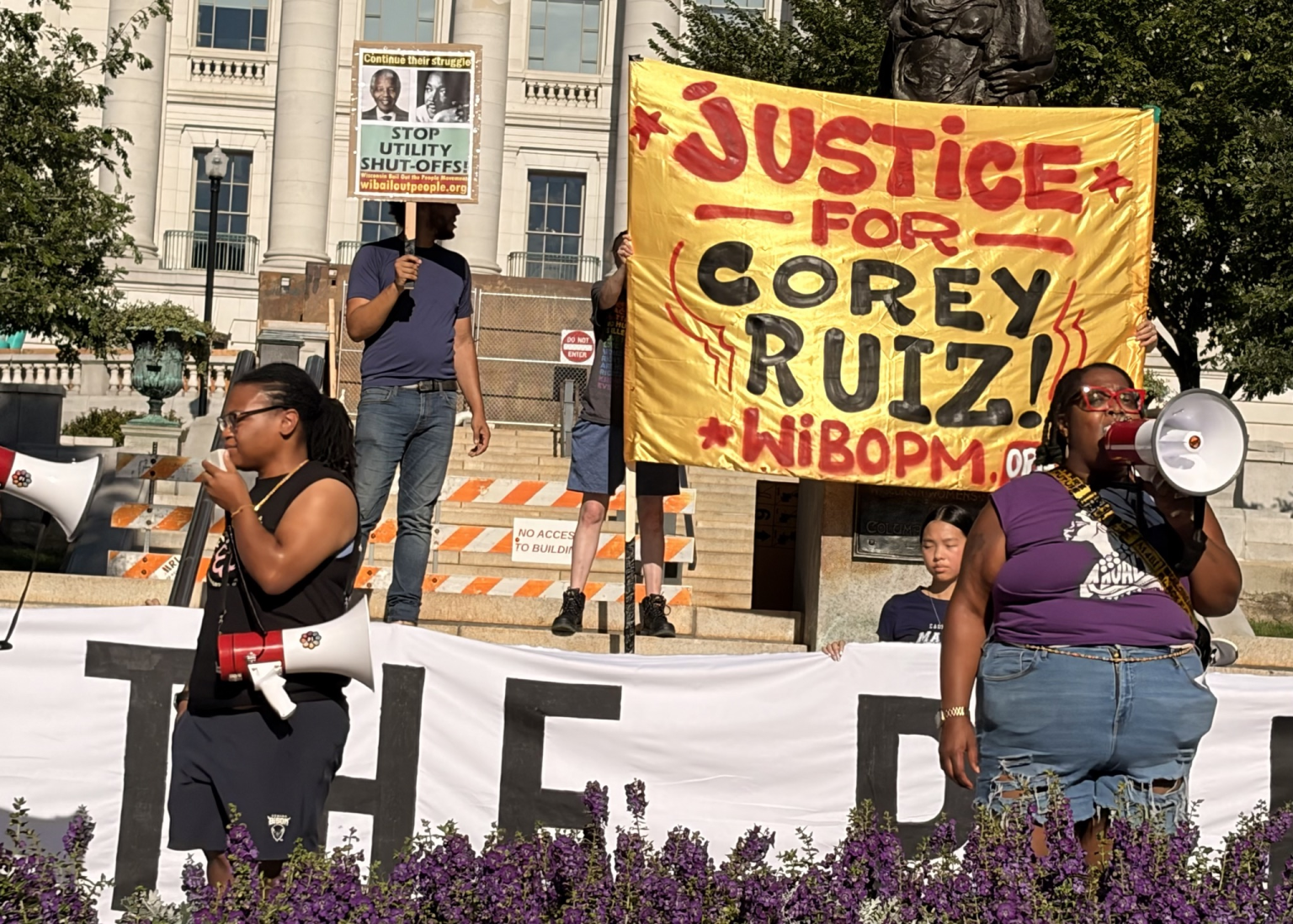
Struggle-La Lucha spoke with Dorothy Brown of the Madison-based Wisconsin Bail Out the People Movement (WiBOPM) about the racist police murder of Corey Ruiz and how the people’s movement there is resisting state repression.
Struggle – La Lucha: What happened in Madison after police killed Corey Ruiz?
Dorothy Brown: A rainbow of people immediately set up a vigil at what became known as Corey’s Corner, at the intersection of Williamson and S. Baldwin streets, where Corey Ruiz was publicly executed by Madison Police on July 22. The vigil led to the people setting up barricades on each street in every direction leading to the vigil site. The entry points to the barricades were staffed by people’s volunteers.
Since then, mass protests have taken place with marches, actions at City Hall and the jails to bail protesters out, and much more.
Corey’s Corner became a special community, with contributions of food and water, a People’s Library, barbers and hair stylists giving free cuts, a medical tent, assistance for the unhoused, and much more. The encampment was a place for community members to grieve, meet friends and to develop relationships with those that are horrified and outraged by the killers of Corey Ruiz and many others.
Many traveled from across Wisconsin and beyond – including from George Floyd Square in Minneapolis — to pay their respects to Corey and his family.
SLL: Who is participating in the movement for Justice for Corey? What are the movement’s demands?
DB: A diverse range of participants were at the encampment 24 hours a day, including union members, students, parents, teachers, workers of all kinds, and organizations such as Freedom Inc. Even after the encampment was destroyed by the city on Aug. 4, when many were arrested, people still hold space daily at the site where Corey was murdered by the cops. And the cops continue to menace the people and arrest some at the site.
The family of Corey Ruiz is presenting these demands:
- Arrest the officer responsible for Corey Ruiz’s killing [identified as Kiel Baitinger-Peterson, a 10-year police veteran].
- Require the Madison Police Department (MPD) and Wisconsin Department of Justice Division of Criminal Investigation (DCI) to fully comply with the Office of the Independent Police Monitor by providing any information, evidence, and materials requested for an independent review.
- Give the Civilian Oversight Board meaningful disciplinary authority so it can hold officers accountable for misconduct.
The family has retained the firm of civil rights attorney Benjamin Crump to represent them.

SLL: How have the Madison Police and local government responded to the people’s protests and demands?
DB: Mayor Satya Rhodes-Conway and the police are in full opposition to the movement. The police in Madison and the surrounding metro area have murdered and brutalized many over the years – mostly Black and Brown people, but also poor white workers as well.
The mayor’s attack on Corey’s Corner confirmed her role as the bankers’, speculators’, developers’ and corporations’ representative in City Hall to keep the profits rolling at the expense of the people. Gentrification in Madison is reaching an extreme level. Rents in particular have skyrocketed.
There were numerous opportunities for the mayor to visit the site, but she never did. Instead she chose to send in the police, the protectors of the rich.
SLL: Why did the police target the memorial at Corey’s Corner last week?
DB: The area where Corey Ruiz was murdered by the police is quickly being gentrified, with many forced to move out of this historically student and working-class neighborhood. This neighborhood has been a stronghold of people’s resistance for decades.
Despite the challenges in Wisconsin due to capitalism and imperialism, including personal challenges present at times at the Corey’s Corner encampment, there was also a depth of real conversations and relationships building and evolving hour-by-hour and day-by-day.
With social media in the hands of many people’s fighters at the site, people around the world were watching. People of all nationalities, genders, sexualities and ages were working together to cook, to have poetry readings, to take notes, share, produce art and to love and grieve with each other – and to organize on a working-class basis. The unhoused had tents and supporters at the encampment.
Corey’s Corner also had an international component, with Palestinians and others educating participants about the intimate connections between the Israeli Occupation Forces in occupied Palestine and police of all kinds in the U.S.
The potential for future organizing is what scared the mayor, her capitalist backers, and their police servants.
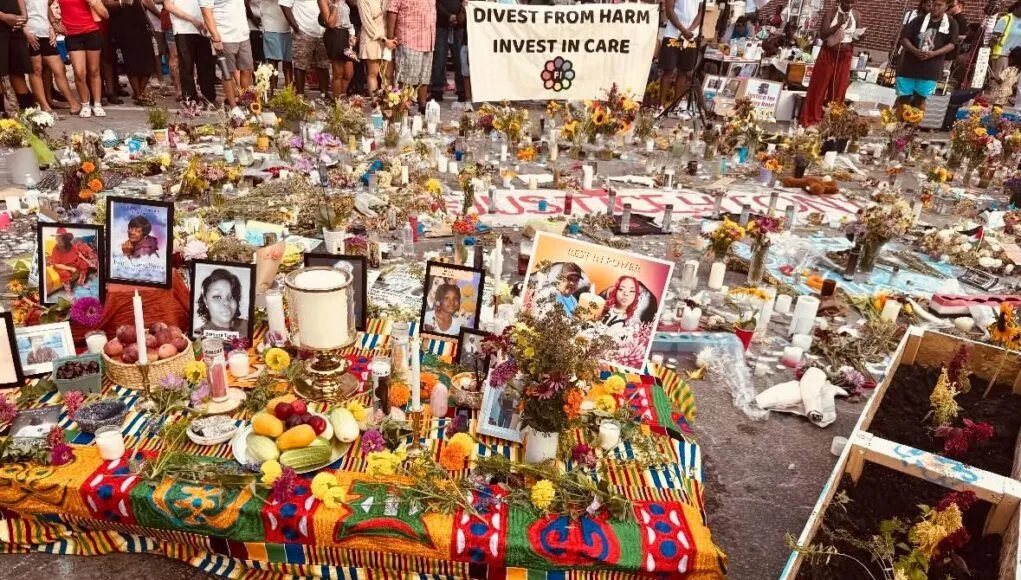
Photo: WiBOPM
SLL: What kind of social and economic conditions are working-class people confronting in the city and state?
DB: In Madison, Black and Brown residents face a variety of structurally racist obstacles, including lack of access to living-wage union jobs, adequate and safe housing and public education that meets the needs of oppressed people’s communities. Wisconsin has some of the highest rates of incarceration and infant mortality for Black people.
Since the implementation of Act 10 in June 2011, Wisconsin has faced some of the most unrelenting austerity in U.S. history. Act 10 eliminated almost all collective bargaining rights for public-sector workers statewide and stipulated that public workers had to pay for their health care and pension contributions – amounting to big wage cuts.
In addition to this, Wisconsin became a right-to-work-for-less state in 2015 when the right-wing legislature and governor signed this Jim Crow-based law into existence. These two anti-worker and racist laws ushered in a period of austerity. Most tenant rights laws were eviscerated. Attacks on the LGBTQIA+ community and women’s rights were rampant.
The right-wing Bradley Foundation used Milwaukee as a laboratory for the implementation of charter schools and so-called “welfare reform” in the 1990s, and then Wisconsin as a whole was used as a laboratory for what’s now being done federally.
Madison and Milwaukee residents have faced a variety of other racist and anti-worker attacks from the right-wing legislature, including a massive drop in state shared revenue (taxes) sent back to these cities for desperately needed services. This austerity by the rich since 2011 has resulted in the robbery of tens of billions of dollars from working-class communities throughout the state in the form of increasing debt service to the banks, privatization and other IMF/World Bank-type procedures similar to what Wall Street did in Eastern Europe after the collapse of the USSR.
SLL: What’s next for the fightback? How can people outside Madison support the struggle?
DB: The struggle for justice for Corey is taking place daily in a variety of ways. Many continue to visit Baldwin and Williamson streets to pay their respects and to resist the cops.
Those arrested and brutalized after the encampment was raided are healing and getting back into the streets to organize. Educational events and protest events are in the planning stages. Much more is ongoing.
We urge people to call the Dane County district attorney and demand action: (608) 266-1221.
Supporters can make contributions to Corey Ruiz’ family here: https://www.gofundme.com/f/justice-for-corey-telling-his-story
People can also elevate the demands of the family, share information about upcoming protests, join them or hold solidarity ones in their communities, and raise up Corey’s name.
For coverage of actions in Wisconsin and more information about the ongoing struggle for justice for Corey Ruiz, follow WiBOPM on Instagram and wibopm.org, Freedom Inc. and Madison 365.
Join the Struggle-La Lucha Telegram channel