
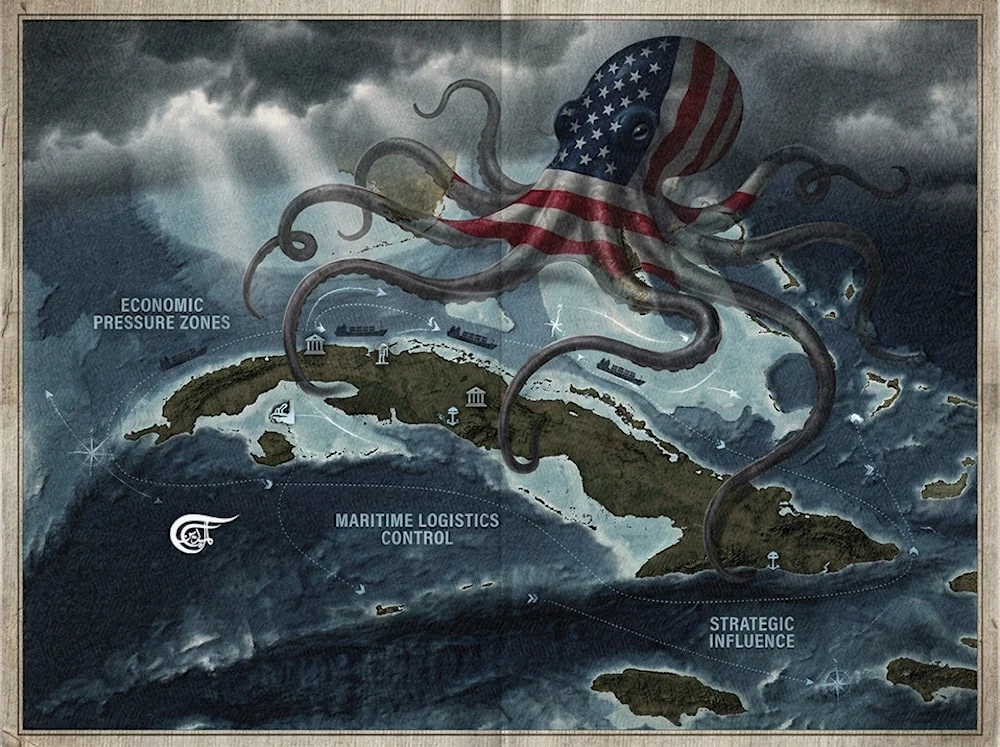
In Washington policy circles, Cuba is framed as a destabilizing actor. Official language speaks of malign influence, hostile alignment, and strategic risk. But beyond executive orders and national security memoranda lies another reality: families preserving what little food they have through prolonged power cuts, elderly residents enduring suffocating nights without fans, and young professionals struggling to imagine a future under relentless economic pressure.
That reality became impossible to ignore again this week. Cuba’s national electrical grid collapsed late on August 2, plunging an island of roughly 10 million people into darkness. The system failed again the following day while authorities were attempting to restore it. The August 2 outage was the sixth islandwide blackout since the beginning of the year, while rolling power cuts in some areas have lasted more than 20 hours. In Havana, residents have resorted to sleeping along the Malecón to escape the heat inside powerless homes.
Daily life increasingly revolves around the availability of electricity and fuel. Meals must be prepared before power disappears. Water cannot be pumped into apartment buildings when electricity is absent. Refrigerators remain empty because food cannot reliably be preserved. Public transportation and basic services falter as fuel supplies tighten.
Cuba’s electrical system is unquestionably old, underfunded, and vulnerable. Internal planning failures and delayed maintenance cannot simply be dismissed. Yet neither can the external conditions under which the system operates. Cuba is attempting to maintain an aging, fuel-dependent grid while facing restrictions on financing, spare parts, maritime transport and energy imports.
These scenes are routinely invoked in Washington as evidence of internal dysfunction or inevitable collapse. Far less acknowledged is that Cuba functions under one of the most sweeping, punitive and enduring sanctions regimes in modern history.
Cuba’s fuel crisis has become a waste crisis as many garbage trucks don’t have enough gas to pick up rubbish which is piling up on Havana’s street corners https://t.co/AQ50L5j9KG pic.twitter.com/3BhugSOcJJ
— Reuters (@Reuters) February 16, 2026
The sanctions architecture
For more than six decades, the United States has constructed an extensive sanctions regime targeting Cuba’s trade, banking, shipping, investment and fuel supply.
The Helms-Burton Act codified the embargo into U.S. law. The Cuba Restricted List limits transactions involving numerous state-linked entities, while Cuba’s continuing designation as a State Sponsor of Terrorism heightens compliance risks for banks, insurers and foreign firms. Title III of Helms-Burton creates additional deterrence by allowing lawsuits over property nationalized following the Revolution.
Containment now operates primarily through financial and legal leverage. Dollar dominance, secondary exposure, banking restrictions and litigation risks encourage institutions outside the United States to avoid transactions that may be legally permissible but commercially dangerous.
On June 30, 2025, U.S. President Donald Trump signed National Security Presidential Memorandum-5, restoring and strengthening the hardline Cuba policy of his first administration. It instructed U.S. agencies to restrict transactions involving military-linked Cuban entities, tighten travel enforcement and oppose measures that could strengthen the Cuban state.
The pressure intensified sharply in 2026.
On January 29, Trump issued Executive Order 14380, declaring Cuba an “unusual and extraordinary threat” to U.S. national security and foreign policy. The order established a mechanism through which additional tariffs could be imposed on imports from countries that directly or indirectly supplied oil to Cuba.
The additional tariff actions authorized under that order were terminated on February 20. The national emergency itself, however, remained in effect, as did the wider campaign to prevent Cuba from obtaining fuel. Venezuelan shipments had already been cut off following the U.S. operation that removed President Nicolás Maduro, while Mexico subsequently halted deliveries amid mounting pressure from Washington.
On May 1, Trump signed Executive Order 14404, substantially broadening Washington’s sanctions authority. The order allowed measures against foreign companies and individuals operating in Cuba’s energy, mining, financial, defense and security sectors. It also authorized secondary sanctions against foreign financial institutions facilitating significant transactions involving targeted entities.
Successive rounds of designations followed. Cuban officials, state enterprises, fuel distributors, financial networks, tourism institutions and other entities were targeted throughout May, June and July. The most recent round, announced on July 23, designated another nine entities and two individuals.
The humanitarian consequences are no longer merely theoretical. United Nations experts have described the fuel restrictions as a form of “energy starvation”, warning that they have pushed essential services toward the brink and directly harmed Cubans’ enjoyment of basic rights.
These measures constrain fuel access, interrupt financial flows and increase transportation and insurance costs. Yet Cuba remains a small Caribbean nation without anything resembling conventional military parity with the United States.
Why, then, is it persistently framed as a strategic threat?
Why Cuba has always mattered
Cuba’s strategic significance predates the 1959 Revolution.
Positioned near the maritime crossroads of the Gulf of Mexico, the Caribbean and major Atlantic shipping lanes, the island has long occupied a central place in U.S. regional security thinking. Control over, or alignment with, Havana was historically linked to protecting southern sea routes, securing Gulf Coast access and dominating the approaches to the U.S. mainland.
By the early 20th century, that strategic interest had translated into extensive economic penetration. U.S. capital controlled or held major interests in Cuba’s sugar industry, railroads, utilities, refineries and banking sector, embedding the island within a U.S.-centered economic order.
Preferential trade arrangements tied Cuban exports overwhelmingly to the U.S. market, reinforcing dependence on sugar and restricting economic diversification. Havana displayed modern infrastructure, foreign investment and a profitable tourism economy, while rural regions endured land concentration, seasonal unemployment and entrenched poverty.
By the 1950s, Havana’s tourism industry had also become closely associated with gambling, organized crime and commercialized sex. Economic dynamism existed, but it was externally anchored and profoundly unequal.
The nationalizations that followed the Revolution therefore disrupted more than individual foreign corporate holdings. They dismantled an entrenched structure of ownership and dependency, transferring control over land, industry and finance while redefining sovereignty in material terms.
Under doctrines such as the Monroe Doctrine, the Caribbean had long been treated as a sphere of expected U.S. alignment. The Cuban Revolution overturned that presumption.
Land reform, nationalization and the rejection of U.S. economic dominance challenged not only particular commercial interests but the broader political order Washington sought to preserve across the hemisphere. An example had to be made, and the Cuban people were subjected to an economic blockade designed to ensure that defiance carried an unbearable price.
The threat of example
Cuba’s “model problem” for Washington was never only what Havana represented internally, but what it appeared to make possible elsewhere.
During the 1960s, Cuba aligned itself with anti-colonial struggles and presented this commitment as internationalist solidarity. U.S. policymakers interpreted the same activity as the export of subversion.
Algeria became an early emblem. Cuba supported the National Liberation Front during Algeria’s struggle against French colonialism and, after independence, sent a medical mission to assist a health system depleted by the departure of French doctors.
The significance was not merely the size of the mission. A recently liberated, economically pressured Caribbean country was sending medical workers across the Atlantic to another newly independent state. Cuba was demonstrating that international influence did not have to take the form of financial domination, military bases or resource extraction.
Angola further cemented this perception.
In November 1975, as Portuguese colonial rule collapsed and foreign-backed movements fought for power, Cuba launched Operation Carlota in support of the Popular Movement for the Liberation of Angola. Havana portrayed the intervention as an act of anti-imperialist defense and solidarity with African liberation.
Cuba’s role cannot be separated from the wider Cold War. But reducing it entirely to superpower alignment also obscures its independent political and ideological motivations, including its support for African independence and opposition to apartheid South Africa.
For Washington, the conclusion was unmistakable: Cuba was capable of shaping political outcomes beyond its size, particularly in decolonizing societies where competing models of sovereignty and development remained in contention.
Axis, allies, solidarity
Cuba’s contemporary relevance to Washington also lies in its relations with states that resist U.S. regional and international policy, particularly Venezuela and Iran.
Cuba’s diplomatic relationship with Iran dates back more than four decades. Formal relations were re-established following the 1979 Iranian Revolution and developed through political dialogue, commercial agreements and mutual opposition to unilateral sanctions.
Havana has supported Iran’s right to peaceful nuclear technology and repeatedly opposed military threats against the Islamic Republic. Cuba is not formally part of the Axis of Resistance, but Washington increasingly interprets its relationship with Tehran through a wider security framework.
Executive Order 14380 invoked Cuba’s relations with Iran and purported ties to Hamas and Hezbollah to manufacture a national security justification for escalating pressure on the island. The May sanctions order repeated the same narrative, portraying Cuba’s solidarity with Iran and the Palestinian and Lebanese Resistance movements as evidence of hostility rather than opposition to imperialism, occupation, and unilateral coercion.
Cuba’s relationship with Venezuela was considerably more extensive and institutionalized.
Under the Comprehensive Cooperation Agreement signed by Fidel Castro and Hugo Chávez in 2000, Caracas supplied oil to Cuba on preferential terms, while Havana sent doctors, educators and technical personnel to Venezuela. The partnership later expanded through the Bolivarian Alliance for the Peoples of Our America, or ALBA, intertwining the two countries’ social programs, political projects and energy security.
That relationship entered a radically different phase on January 3, 2026, when U.S. forces attacked Venezuela and captured Maduro. Cuba said 32 of its military and intelligence personnel were killed during the operation. Their remains were repatriated to Havana, where they were honored in a state ceremony. Díaz-Canel condemned the U.S. action as “state terrorism.”
The attack also severed Cuba from its most important source of subsidized oil. Washington subsequently warned Havana that Venezuelan fuel and financial assistance would no longer reach the island.
The consequences are now visible across Cuba’s streets, homes, hospitals and electrical system. Venezuela was not simply an ideological ally. It was a central component of Cuba’s energy security, and its forced removal from that relationship intensified an already severe national crisis.
The cultural power of the revolution
Cuba’s cultural influence presents another challenge to U.S. power because it operates outside conventional measures of military or economic strength.
In 1961, the newly victorious Revolution launched a nationwide literacy campaign, mobilizing young volunteers to teach reading and writing across the island. The campaign dramatically reduced illiteracy within a single year and became an international reference point for mass education.
Its significance extended far beyond literacy figures. Education was established as a collective right rather than a privilege, giving rural workers, women, and historically marginalized communities greater access to knowledge and a stronger ability to shape their own lives.
Cuba carried this principle beyond its borders through medical internationalism. Over subsequent decades, Cuban doctors and health workers served in dozens of countries, frequently reaching communities affected by war, natural disasters, epidemics, and severe shortages of medical personnel.
These missions embodied the Revolution’s understanding of healthcare as both a human right and an act of international solidarity. They also provided Cuba with vital income that helped sustain its public health system and social programs under the pressure of the U.S. blockade. By serving populations often neglected by wealthier powers, Cuban medical workers forged lasting relationships with communities and governments that decades of sanctions and political hostility could not erase.
20 countries to which #Cuban doctors have been invited to help deal with the #COVID19 pandemic. pic.twitter.com/25xCaxthAJ
— tim anderson (@timand2037) April 22, 2020
The island also emerged as an important cultural center. Casa de las Américas, established shortly after the Revolution, provided Latin American and Caribbean artists and writers with a space to collaborate, confront dictatorship and explore ideas of liberation and social justice.
Havana’s International Book Fair developed into one of the region’s largest cultural gatherings, bringing authors, publishers and readers together in an event centered on public access to literature and political debate.
Revolutionary figures reinforced this international cultural presence. Fidel Castro became a symbol of endurance through invasion attempts, assassination plots and decades of economic pressure. Ernesto “Che” Guevara became a global icon of rebellion, his image detached at times from the complexities of his life but permanently associated with the possibility of challenging entrenched power.
20 countries to which #Cuban doctors have been invited to help deal with the #COVID19 pandemic. pic.twitter.com/25xCaxthAJ
— tim anderson (@timand2037) April 22, 2020
This legacy matters because culture can project political possibility where armies and markets cannot. Cuba showed that a small country could invest heavily in education, medicine, culture and international solidarity and, through those priorities, influence movements far beyond its shores.
What is the real threat?
If Cuba has neither the capacity nor the intent to challenge U.S. supremacy, why is it labeled an “unusual and extraordinary threat” in Washington’s political imagination?
The answer lies not in Cuba’s military or economic power, but in the precedent set by its survival.
U.S. policy has long assumed that isolation, sanctions and deprivation would eventually force political submission. Cuba’s continued resistance undermines that expectation. More than six decades of blockade, covert pressure and economic coercion have failed to end the Revolution or force the surrender of Cuban sovereignty.
The resulting hardship is severe: deteriorating infrastructure, shortages of food, medicine and fuel, declining purchasing power and outward migration. But these conditions cannot be understood without recognizing the U.S. blockade as a central factor.
Cuba is denied normal access to international credit, banking services, energy supplies, shipping networks and investment, while foreign firms face penalties and commercial risks for engaging with the island. This system raises costs, restricts development and deepens scarcity. Washington then cites the resulting crisis as proof of systemic failure, turning the effects of coercion into justification for further pressure.
Despite these constraints, Cuba has continued adapting rather than capitulating. Recent measures have included allowing private firms to import fuel and medicines, expanding non-state participation in tourism, easing restrictions on agricultural land use and authorizing foreign-backed fuel imports. These reforms aim to address urgent shortages while preserving the Revolution’s central social achievements.
Cuban leaders have emphasized that such changes do not entail the privatization of healthcare, education or other strategic sectors. The objective is adjustment under pressure, not the dismantling of the Revolution’s foundations.
This adaptability challenges the portrayal of Cuba as incapable of change. Havana is pursuing reform on its own terms rather than accepting externally imposed models enforced through sanctions and economic coercion.
A genuine strategic threat would imply military expansion, territorial ambition or an aggressive doctrine directed against another state. Cuba displays none of these toward the United States. The actual imbalance runs in the opposite direction.
The security framing of Cuba therefore reveals less about the island’s capabilities than about Washington’s expectation that geographic proximity should produce political compliance.
Sovereignty as security
At the center of the conflict lies the question of sovereignty.
Cuba has repeatedly adjusted its economic policies, pursued international trade and expanded space for private activity without relinquishing its political independence or the social foundations of the Revolution. It adapts to changing conditions but refuses to accept Washington’s authority over its political system or economic direction.
In traditional power politics, small states located near superpowers are expected to limit their independence and accept alignment as the price of security and economic survival.
Cuba has defied that expectation for more than six decades.
Washington’s portrayal of Cuba as hostile serves a clear political function: it justifies sanctions, frames economic coercion as defense and sustains policy continuity across administrations. It also allows the consequences of those sanctions to be weaponized—shortages and hardship are cited as proof that Cuba’s political system has failed and must be replaced.
The coercion thus generates the very conditions used to justify further coercion.
Stripped of inflated security rhetoric, the imbalance is clear: a global military and economic superpower has labeled a heavily sanctioned Caribbean island of approximately 10 million people an “unusual and extraordinary” threat.
Cuba does not encircle the United States with military bases, restrict its access to international trade or seek to dictate its political system. It is Washington that has long sought to isolate Cuba, weaken its economy and define the limits of its sovereignty.
The conflict is therefore not fundamentally about a military threat or economic competition. It is about authority: whether the United States is entitled to determine which political and economic systems are acceptable within the Western Hemisphere.
Cuba’s answer has remained consistent. Its sovereignty is not conditional on Washington’s approval, and its political independence is not negotiable under pressure.
In that refusal to submit—not in any capacity or intention to threaten the United States—lies the core of the dispute.
What Washington calls a threat is, in reality, the endurance of a small nation insisting on choosing its own path.
Source: Al Mayadeen
Join the Struggle-La Lucha Telegram channel