
Notes on surviving attempted murder and trans realism as a site of perpetual violence by Badly Licked Bear
My dear friend Thalia Vacha ⚢, writing about her experience as a transsexual woman who has become a refugee in Thailand, writes, “The erasure of transsexuals, in particular—those for whom gender affirming care is life-saving medicine—is one of the quietest in history, easy to frame as a peaceful return to a prior norm.”1
Erasure, exclusion, eradication, these words get used a lot, these days.
Trans people are, by definition, absent from most of society. We represent 1-2% of the general population, and at most, what 10% of the LGBTQIA+ population? We’re a minority within a minority. Some of us are Indigenous or Black, or of color, and a smaller minority, still, in most places. Some of us are diced even finer within the population of the United States and other colonial societies — adoption survivors, Jews, Muslims, the disabled, sex workers, and all manner of marginalized and intersectional identities.
Some of us are, quite literally, one in a million.
When you’re one in a million you stand out, but it also feels like the world could go on just fine, if you were erased, excluded, or eradicated.
When we talk about the genocide of transgender and transsexual people, what I’m talking about is “the return to a peaceful norm,” the maintenance of a perpetual genocide of a population deemed undesirable.
When we talk about genocide, the images in our heads are piles of gold teeth in the storehouses of Auschwitz, villages on fire in the Pale of Settlement, the one-armed survivors of Belgium’s Congo butchery, bounties on Native Americans in Gold Rush California, smallpox blankets, the rubble of Gaza, where children play and die in the sights of Israeli snipers, witches burning at the stake. What we imagine is traincars and barbed wire and gas chambers and medical experimentation and food riots and what it must be like to dig your own grave, knowing you will soon kneel in front of it.
We think of genocide, and we can smell it.
You have never smelled genocide, but you know exactly what it smells like, don’t you?
There is another kind of genocide, a genocide that has already happened, and that the state or the culture that the state protects at all costs, must maintain, the perpetual maintenance of a genocide already carried out.
There are many such genocides.
Despite the fear-driven fantasies of its architects, genocide is never perfect. In most cases, some body of refugees survives to make a home and build a new culture in new places. In some cases, like that of Queer, transgender and gender diverse folks, our nature is essential to the human species. It is in the bones, so to speak, and, in the expression of our genes, quite literally. In societies where our existence is forbidden, criminal, taboo, we must be, when our survival has been discovered, erased, excluded, eradicated.
It is the systems that ensure this perpetual cycle, the proverbial “boot stomping on a human face — forever” that becomes the maintenance of genocide, a genocide that must be perpetually maintained as a core value of society, and, ultimately one of the background functions of the state or, as Americans are coming to understand, empire.
It does not matter if the course of our perpetual genocide is the state-sponsored erasure of our existence in census forms and official documents and accompanying doublethink of us as ever-present gender terrorists, or the slow strangulation that is exclusion from work and public life, or the eradication of our bodies in the flames, the end result is the same, death, death, death.
That which was never there has no right to be, is the logic.
The methods are many, baked into society at all levels.
There are more trans people alive, today, than at any point in prior human history. While we remain a superminority in every culture, there are millions of us in the United States, alone. The emergence of our collective identity over the last six or so decades, and the manifestation of levels of medical transition that have no prior precedent and that represent the whole power of the future many of us have dreamed of since our earliest days, cannot be ignored.
Likewise, our deaths cannot be ignored, and, as much as I fear what the state might do to me, in the dramatic sense of a genocide, I fear the social murder of the perpetual maintenance of the genocide of my kin, to a greater extent.
Why? Because for those of us of a certain age, we have survived that attempted social murder…so far. We have eluded all attempts to destroy us, and not without scars and wounds that do not heal.
Emergent, established, and explosive with potential, the mechanisms of and calls for our erasure, exclusion, and eradication are very, very loud.
Those of us who lived in the time of the maintenance of our genocide and fear its return, hear the bells ringing, like the echoes of memories that we wish we didn’t have and that we don’t want those we often think of as our children, to carry as we have.
Yesterday, I received a surprise, but not-unexpected, phone call from two performance art legends, Jerri Allyn and Linda Frye Burnham.
Jerri and Linda are my Elders, and dear friends. Linda and I have never met in person, but she has taken some kind of interest in me, and she has asked me rather frank questions about my gender and about my transition over the years. Jerri is, like me, a professional curious person, and has a habit of asking abrupt and frank questions about all manner of things. Both ask the kinds of questions that it is a tenderness to learn how to receive from an Elder, that one would not entertain from others.
Jerri called because Linda wanted to know when I first transitioned, or first considered myself trans, but I didn’t talk about the death drive of some very young trans children, the very well-worked-out fantasies some of us have about dying and coming back as…ourselves. I didn’t talk about being five or six years old, dead certain of the unwelcome circumstance of my gender, and imagining suicide not as an end, but as a pathway to at least a chance at life.
If you must imagine an unflattering image of a pre-adolescent me, picture a very short, brown, pudgy kid, wearing the cheapest clothes, often with darned knees, screaming, screaming, screaming about how they want to die. Somewhere, there are middle-aged, former children, who remember witnessing this kind of scene.
I did mention how young transfolk are often informed, sometimes violently, of their transness by others. About how, at eleven or twelve, sitting on the hot concrete of my P.E. class, witnessing me drop, effortlessly, into full split, some boy yelled out, “______ must be a girl, because they have a vagina.”
I didn’t talk about the endless games of Smear the Queer, where I was always, always, always thrown the ball, or, how, at the gateway to my adolescence, my casual intimacy with other girls aroused such envy and confusion in at least one boy, that a club was formed for the sole purpose of eradicating me as a human being.
I was ten when that happened. I was ten when I watched everyone I had grown up with watch me get held down by six boys as the oldest, biggest boy in my school mounted my torso and started punching, punching, punching. I was ten when I learned how to watch my own suffering in the eyes of others.
Everyone was screaming, screaming, screaming, screaming.
I was ten when I learned that no one would stop the screaming, unless I stopped it, myself. I didn’t talk about the fight clubs, the circles in the dirt, the near-drownings at the bottom of pools, gladiatorial arenas made of the bodies of older boys where I made hard choices about hurting people I didn’t even know, or the accumulation of knowledge about what men are, and how men become what they are.
I didn’t talk about how, part of my journey was, and remains, the certain knowledge that, whatever men are, I’m not one of them. I suspect the feeling is mutual.
Instead I talked with Linda and Jerri about the events of a series of months, when I was about sixteen.
“I think I want a sex change,” is exactly what I said to my ex-girlfriend, Debbie, in the dark, bongwater-scented cavern of a stall in the pot-smoking bathroom of our continuation high school.2
By this time, at least one of my teachers, Stephanie, had suggested to me that I could be a drag queen — that never felt right. As a performance artist, I’m not really much of a performer, I just kind of “do things.” My English teacher, Mr. Plumley, handed me a copy of J.G. Ballard’s Crash, saying, “This one’s for you.”
Boys and men, the enforcers of the state, had seen me for what I was. Other folks were starting to see me, too. The way others saw me opened doors to lives I might live. Society’s enforcers saw me and knew their orders were to close the door on my life.
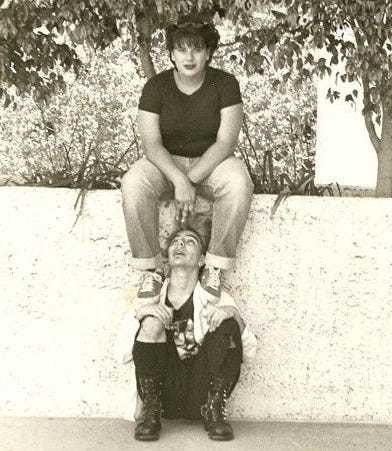
“I think I want to have a sex change” was followed by a trip to San Francisco, alone. Somehow, I managed to get myself to San Francisco for a week, probably during spring break. Nine days on the outside.
Nine days away from the not-home of the house I grew up in.
Those days in San Francisco were the first time I could wear women’s clothing as what it is…clothing. And if there’s a young version of me that I could visit like a ghost and advise, it’s the me that fingered full-length, leather hobble dresses at Stormy Leather on Howard Street.
If I could whisper in her ear, I would tell her to run, run, run toward whatever her heart desires.
I was already trying to flee the home of the people who bought me and didn’t know what to do with me. I didn’t belong where I never belonged in the first place. I left San Francisco determined to move there as soon as I could. A few years later, I did. It didn’t go the way I wanted.
I returned to Los Angeles on a Sunday evening. The following morning, standing in the driveway of my adoptive family’s home, I saw it, or, rather the shadow of it. It being another kind of being seen, the part where what you are is shown to others, against your will.
Across the twenty-something feet of flaking, brown paint on the garage door of my home, “__________ is a transsexual.”
Once again, I felt like I was being held down, for a lesson that would be told in blood, fractured bones, and screams.
Lessons like these are part of the maintenance of genocide, the social murder of trans people, carried out again and again and again, on and on and on, generation after generation after generation.
I think of it as a particular branch of trans realism.
Trans realism is the knowledge that, in the 1990s, if you were a trans child, as I was, that you would arrive home to death threats on the microcassette in the family answering machine, and you would delete those messages before anyone else could hear them. Decades later, I assume that there were messages erased by my adoptive parents before I heard them, too.
You will never know all the things, even the nasty things, that affirmed your gender that you never saw, heard, smelled, touched, or tasted.
Trans realism in the 1990s was the knowledge that if you told a single adult in your life you would be shunted, rapidly, into a mental health facility, or thrown out into the street. You will not know how to access any kind of gender-affirming care. You don’t even know what gender-affirming care is. You want the mythical “sex change,” the magical “sex change,” the unimaginable “sex change.”
You swallow your adoptive mother’s progesterone like a magic potion, and you will lie at night with your genitals tucked between your thighs and feel the parts of you that aren’t there, like ghost limbs. Trans realism is the fact that you have been doing this and so much more, in absolute secrecy, as long as you remember.
Trans realism in the 1990s is the knowledge that, if you take any affirmative steps toward your existence, you will end up doing survival sex work, and this work will kill you. You will contract HIV. You will die of AIDS before the year 2000. Trans realism in the 1990s may mean that you have watched people you love die of AIDS, possibly numerous people that you love. You will learn that no amount of love can stop a moving train.
How convenient is that death, for a society that wants to use you (for sex), and that wants to dispose of you (out of shame)?
Trans realism in the 1990s is the understanding that Large White Men® will assault you without warning, or, as the catspaw of Small White Men®, who dare not fight you, themselves. They will threaten you in front of scores or even hundreds of witnesses, without any fear of consequence. The school you go to will protect them. They are, after all, the foot soldiers of a Christian Nation®.
You will spend the rest of your life, primed for violence in the presence of the men who hold all power in this society. You will hear the violence in their words. Some of us, like me, learn to match it with our own violence.
Trans realism in the 1990s is the knowledge that it would be so, so convenient if, instead of being beaten to death, you were to let folks push you into taking your own life. It would save the state so much money, and you would just kind of disappear, and everyone could say you were crazy, depressed, whatever they need to say to keep the genocide machine going, forever.
If you make it to eighteen, you’ll be shocked. You’ll be shocked at twenty-one, twenty-five, thirty, thirty-five, which was once the average lifespan of a transsexual woman. You might be like me, once upon a time, thirty-five, untransitioned, wracked with the things that happen to a body after decades of violence and a life half-lived, not knowing what to do with yourself. Trans realism is finding yourself alive in a future that you didn’t plan to see, with no ground beneath you — in freefall.
Trans realism in the 1990s is being moved from house to house on Halloween, in response to rumors of your scheduled murder. It is being assaulted at school and suspended for being assaulted, and then hearing the rumors of your actual death in your friend’s laughing voice, on the corded phone, in the days that follow. You were apparently run over by Preston in his lifted pink Toyota with the FEAR sticker in the back window in the parking lot of the Burger King.
Trans realism in the 1990s is the knowledge that society has constructed a gauntlet of violence and hate, and that you are not meant to survive. If you’re like me, you will meet other transsexuals as a teen, and you will see them and pity the poverty in which they live. You will see the pain in them, and you will know that in order to live more fully, you must be able to endure new kinds of pain.
These are some of the things I talked with my dear friends Jerri and Linda about, yesterday. As rough as things are, these days, for all of us, the hands that hold us across generations are sometimes the true force of gravity in our lives.
Hold your Elders close.
So…when I talk about trans genocide, what I’m coming to think of as the maintenance of genocide, the processes I know too well and so much more haunt me. One must consider what it would be like if one were, as a child, blasted clean out of history, having never really lived at all.
Amidst the horrors, I’ve become numb to some things. I’ve become slightly numb to the violent murders of my sisters and siblings, because, well, I’ve become highly sensitized to the notion that it is the social murder of whole generations of my ancestors whose return I fear, and whose return I fear there is no escape from our exterior. Trans realism has a way of hovering a little too close to that seductive branch of fiction we call “true crime.”
It’s a numb era. The Pandemic fucked us all up, and, as far as I can tell, the planet is literally on fire from pole to pole and no one is doing fuck-all about it. The future is refugees, transfolk are just one class of refugees fleeing the genocidal death furies of capitalism and colonialism, after all. If this is a look inward, don’t forget to look outward, when you can. Transfolk are by no means the only people whose genocide is or has been maintained by a constant, crushing, organized pressure whose action is assumed as totally normal by nearly every living person.
Breathe, cast off the numbness when you can, but…
…this is all what I’m talking about when I talk about the maintenance of genocide, a terror thousands of years in the making, of long, dark centuries, of lives spent in abject horror, of the external silences of voices locked inside the skulls of people who know that there is a way out, and that the way out is watched, guarded, trapped, so that certain voices can be erased, excluded, exterminated, tomorrow, tomorrow, and tomorrow.
If you are a transsexual and have not considered your refugee options, you should.
If you want to know how old I am, I’m exactly, “middle and high schools have smoking areas for students” years old, or, as we’re sometimes referred to, Gen X.
Source: Read Me (To Filth)
Join the Struggle-La Lucha Telegram channel