
Completely ignored for over a decade, the Donbass war resurfaces in the media whenever it serves to demonize Russia or glorify new Ukrainian heroes. In 2014, the press focused on Slavyansk and Donetsk with two objectives: to be there to document firsthand the arrival of the “little green men” they assumed Russia would send to repeat the Crimean scenario, and to demonize anyone participating in the protests or the occupation of buildings.
Barely two months had passed since the Maidan victory in Kiev, which had been forged on the basis of the occupation of public buildings against a legally-elected government, the leader of which, Yanukovych, had won a clear and clean election.
In Donetsk, the media mocked the mix of working-class people, factory workers, and pro-Kremlin technocrats in what they called the “Republic of Two Buildings”—the city hall and the regional administration building, for which the new Ukrainian government had appointed an oligarch from the mining employers’ association who never even took up his post.
In Slavyansk, the media followed the popular mayor with a mixture of astonishment and disdain, a man who years later would end up as a private fighting on the Russian side against Ukraine. It was Ponomaryov who, along with Strelkov—now imprisoned in Russia on charges of nationalist extremism for advocating a far more radical solution for Ukraine than the Kremlin’s—organized the May 9th Victory Day celebration, where the entire city and its guests from the world press were able to hear the original recording of the Soviet announcement of the German invasion and also of the victory.
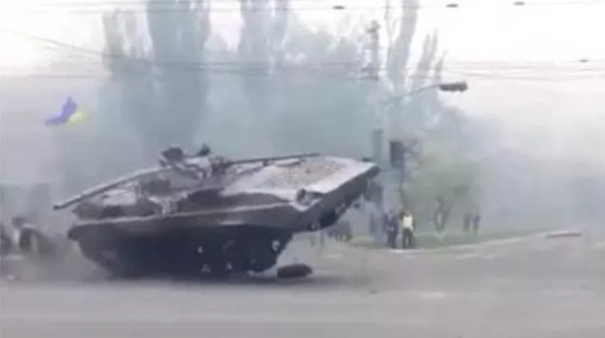
“Terrible news is coming from Mariupol,” wrote Alberto Sicilia, a journalist for La Sexta, who is still a regular reporter of the war, albeit from the Kiev side. The terrible news and images the journalist was referring to were the assault on Mariupol by Ukrainian troops—among whom was likely the Azov Battalion, officially formed that same week to be incorporated into Avakov’s Interior Ministry forces. Part of that episode has resurfaced this week with the appointment of its leader, Mykhailo Drapaty, as commander-in-chief of the Armed Forces of Ukraine, the army’s top brass. Twelve years ago, Drapaty led that assault, which, with the epic grandeur of those who have forgotten the consequences, has been recounted again this week, emphasizing the courage of having stormed in at full speed over the rebel barricades.
The episode ended with the police station burned down and several civilians dead, killed at point-blank range by Ukrainian heroes—a detail omitted by the media, which prefers to focus solely on the side view of an armored vehicle speeding over makeshift roadblocks made of tires and whatever else the civilians manning these completely improvised and isolated checkpoints could muster. These details are also ignored.
The epic nature of the event would be diminished if it were acknowledged that, meters away, the armored vehicle was stopped by men and women who positioned themselves in the road and blocked it with their own bodies, as had also happened in Slavyansk. Western media only value such bravery in contexts like Tiananmen Square and when it involves tanks from opposing countries. When the armored vehicles belong to a friendly nation, the epic narrative focuses not on the civilian population defending themselves without even the most basic weapons, but on the heavily armed soldiers firing point-blank at their own people.
‘No right to exist’
Actually, that last part is debatable, judging by the words of the now-lauded Mykhailo Drapaty. “The new commander-in-chief of Ukraine claims that Russians are a nation that has no right to exist,” wrote Nexta, a Belarusian media outlet that publishes from Poland and flaunts its hatred of Russia, this week. There was no critical intent in its words. Like many other media outlets, Nexta was echoing statements made by Mykhailo Drapaty in 2023. The now-commander-in-chief has not disavowed those statements, which reflect a widespread sentiment within Ukrainian nationalism and perfectly define the current head of the army’s viewpoint, one that is entirely consistent with the official ideology that has been institutionalized by the new Ukraine since its victory in Maidan.
Drapaty’s words were recorded in 2023, but the full interview wasn’t published, according to the Russian opposition outlet Meduza, until July 22 of this year—that is, until his appointment as head of the Ukrainian army. “At the beginning, to be honest, there may have been some fear because everything was very uncertain: what was going to happen, how it was going to happen,” Drapaty says regarding the early stages of the Donbass war. This fear wasn’t due to the possibility of a Russian invasion in 2014, since, after the annexation of Crimea, both the words and actions of the Russian Federation were aimed at achieving internal dialogue in Ukraine that would maintain the east-west balance that had reversed the Orange Revolution.
The failure of that mission, since Maidan had already defeated Yanukovych’s faction and the intention was to impose a new form of controlled democracy in which only nationalist parties would have a place, condemned Ukraine to conflict. The resistance of the Donbass population, for whom Ukraine had only insults, recriminations, the army, and later the blockade, gave way to civil war and finally to the partition that Kiev continues to try to reverse by force.
The “Special Military Operation” was not the first euphemism for this war. The Anti-Terrorist Operation launched by Ukraine’s Turchynov-Yatsenyuk government is the material reflection of Drapaty’s words, who, like the Ukrainian state, feared that the army would not be willing to fire on its own population. For this reason, groups were recruited that, led by Drapaty himself, committed the first massacres in Donbass. Surprised by the resistance, Ukraine decided to label what was in reality a civil war — one that Kiev never intended to prevent or stop — as a Russian invasion.
“In the end, we saw the result. They can’t even be called neighbors. This is a nation, along with its leaders, that has no right to exist. Nothing civilized there has changed over millennia, neither in their mentality nor in their imperial ambitions,” Drapaty insists, referring to Russia, adding that “they are a nation that, with its leaders, has no right to exist.”
According to him, this contempt for Russia predates 2014. The now-head of the Ukrainian army claims to have been convinced there would be a war with Russia many years earlier and traces its origins back to 1991. In reality, Drapaty’s contempt extends to the population of Donbass, which explains the ease with which the nationalists attacked the towns and cities of what they continue to claim as their country.
The population of Donbass is “unaware” and the territory has always been plagued by “criminal elements,” asserts Drapaty, who attributes this inferiority, the desire to “live off subsidies,” and the “refusal to work” to the “lack of attention” Ukraine had given the region in terms of “Ukrainization.”
Donbass: working-class, multinational
Donbass, a working-class and proletarian region, emerged as an industrial center in the late 19th century. The steppe, with its harsh climate, was less densely populated, which meant Ukrainian peasants had more land to cultivate. Without significant incentives to move to the industrial centers, where the exploitation Engels denounced in Manchester was even more brutal in the overcrowded cities lacking basic services, the Ukrainian population remained rural and agricultural.
Both in the 19th century and after World War II, the working-class population arrived from various places, east and west, from other Ukrainian territories as well as from regions of Russia. Donbass, as an industrial region, has always been multicultural, but Russian language and culture have dominated, something that Ukrainian nationalism has never been able to forgive and has tried to change, first with several waves of Ukrainianization and later through military means.
“The people of Donbass hate you for what you have done to them, for the way you speak about them, and for the contempt you have always shown them. Stop pretending you are their liberators,” commented Ukrainian historian Marta Havryshko. However, Drapaty’s rhetoric — that he wants to reclaim the territory but not the people, whom he considers Russian and for whom he wants the same thing Israel does for the people of Gaza—is not only not going to disappear, but is one of the ideological foundations of present-day Ukraine.
It is no coincidence that Zelensky recommended that those in Donbass or Crimea who feel Russian and not Ukrainian should leave their homelands and move to Russia. The state’s discourse involves characterizing the population of Donbass as manipulated, brainwashed by Russia, and dependent—a view of the population that renders it practically inert, irrecoverable, and inferior to the heroic Ukrainian population that attacked them in 2014 and never regretted starting a war of aggression based on their hatred, whose perfect representation is the Drapaty armored vehicle waving its blue and yellow flag over makeshift barricades erected by the organized civilian population.
Translated by Melinda Butterfield
Source: Slavyangrad.es
Join the Struggle-La Lucha Telegram channel