
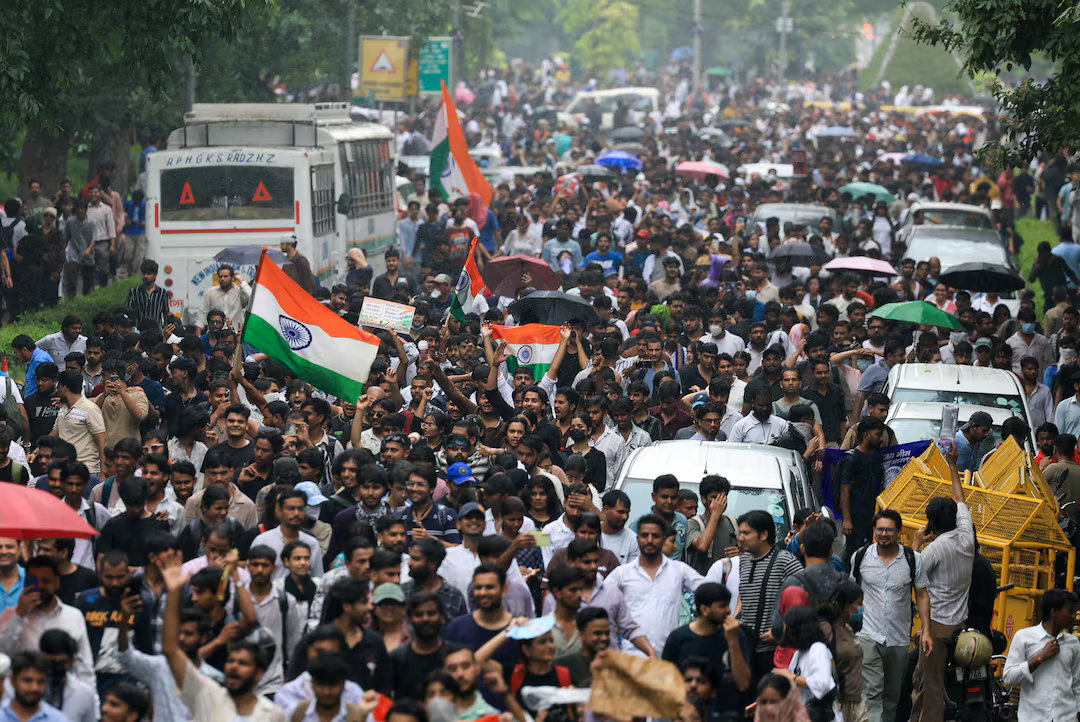
Baton-swinging police waded into crowds of students and young workers in New Delhi on July 20, firing tear gas and beating marchers who are posing the most serious challenge to the rule of Narendra Modi’s government in years.
Protesters tried to reach Parliament under the banner of the Cockroach Janata Party — a name the movement took, in mockery, from a Supreme Court justice’s reported remark likening India’s jobless youth to cockroaches. Abhijeet Dipke, who harks from one of India’s oppressed classes, coined the name in a fury of exchanges on social media.
The initial demand was for the resignation of Dharmendra Pradhan, the education minister who is responsible for a corrupt system of public exams. He is seen as responsible for leaks of the exams that ruin the opportunities of millions who spend years preparing for them. Parents even sell their homes to pay for the right to participate. In May, more than a dozen students took their own lives; organizers put the number above 20. Pradhan answered by calling the protesters “the B-team of terrorists.”
The July 20 protest march, led by students, gathered on the grounds of the historic Jantar Mantar observatory in New Delhi. The march swelled as tens of thousands of Muslims, Hindus, Christians, Sikhs, Buddhists, people belonging to every caste and class flooded into the capital to join the students and to introduce their own grievances. The march rapidly escalated into a confrontation with Modi’s government. Prime Minister Modi fled the city, and members of Parliament were trapped inside the new Parliament building.
In the preceding days, on July 18, the movement broadened in scope when police disguised as medical staff seized Sonam Wangchuk, the 59-year-old engineer and climate activist, dragging him from his hunger strike at the Jantar Mantar grounds where university students were joining his fast. He had come from Ladakh in the Kashmir region to join the student protest. From his hospital bed, Wangchuk called it illegal detention.
The young people who initiated the movement are, for the most part, students, graduates, and professionals. Among the marchers on July 20 was a commercial pilot who swapped his flying duties to be there; among the movement’s backers, there were even civil servants who had voted for Modi’s Bharatiya Janata Party. At its inception, the movement was led not by factory workers from the industrial belts or landless laborers from the countryside, but mainly by students, graduates and professionals.
That is worth saying clearly, because it marks both the movement’s strength and its limit.
There is nothing new in a revolt that begins with the more privileged rather than the poorest. Writing in 1857, as the Indian soldiers of the East India Company rose against their British masters, Karl Marx observed that the first blow against the French monarchy came from the nobility, not the peasants, and that India’s revolt began not with the ryots “tortured, dishonoured and stripped naked by the British,” but with the sepoys “clad, fed, petted, fatted and pampered by them.” Those who are better off may strike the first blow. The rising becomes a national revolt only when the broad masses enter. The sepoys sparked 1857, and it took the peasants and townspeople joining them to shake the empire. Where the privileged leadership stayed in command — the princes and the landholders — it made its deals and betrayed the cause.
The same question hangs over the Cockroach revolt now: whether it stays a rising of the educated middle class, or draws in the workers whose labor the whole country runs on — the one force that can bring it to a standstill. There are signs of the second. In Nashik, in Maharashtra, members of the Centre of Indian Trade Unions and the All-India Trade Union Congress marched on July 20 alongside sanitation workers and farmers, condemning Wangchuk’s seizure as an attack on democratic rights. Student federations have been an organizing backbone of the Jantar Mantar encampment since it went up on June 20.
The lesson is close at hand. In neighboring Bangladesh in 2024, a student revolt met the same official violence — hundreds killed — and could not be beaten down. When the students called for a general strike, and the working class answered, the government of Sheikh Hasina fell. A movement of students can shake a government. It takes the working class to bring one down.
India’s rulers understand this, which is why the batons came out. According to a report on the developments by Arundhati Roy, there are “thousands of paramilitary troops” being flown in from other states.
The whole edifice of the billionaire Raj — its exam mills, its worthless degrees, its poisonous class system — rests on the labor of hundreds of millions of workers and peasants who have not yet had their say. The cockroaches, as the court called them, have struck the first blow. Whether it becomes more than that depends on whether they can create the opening for the broader layer of society to fight in their own name.
Join the Struggle-La Lucha Telegram channel