
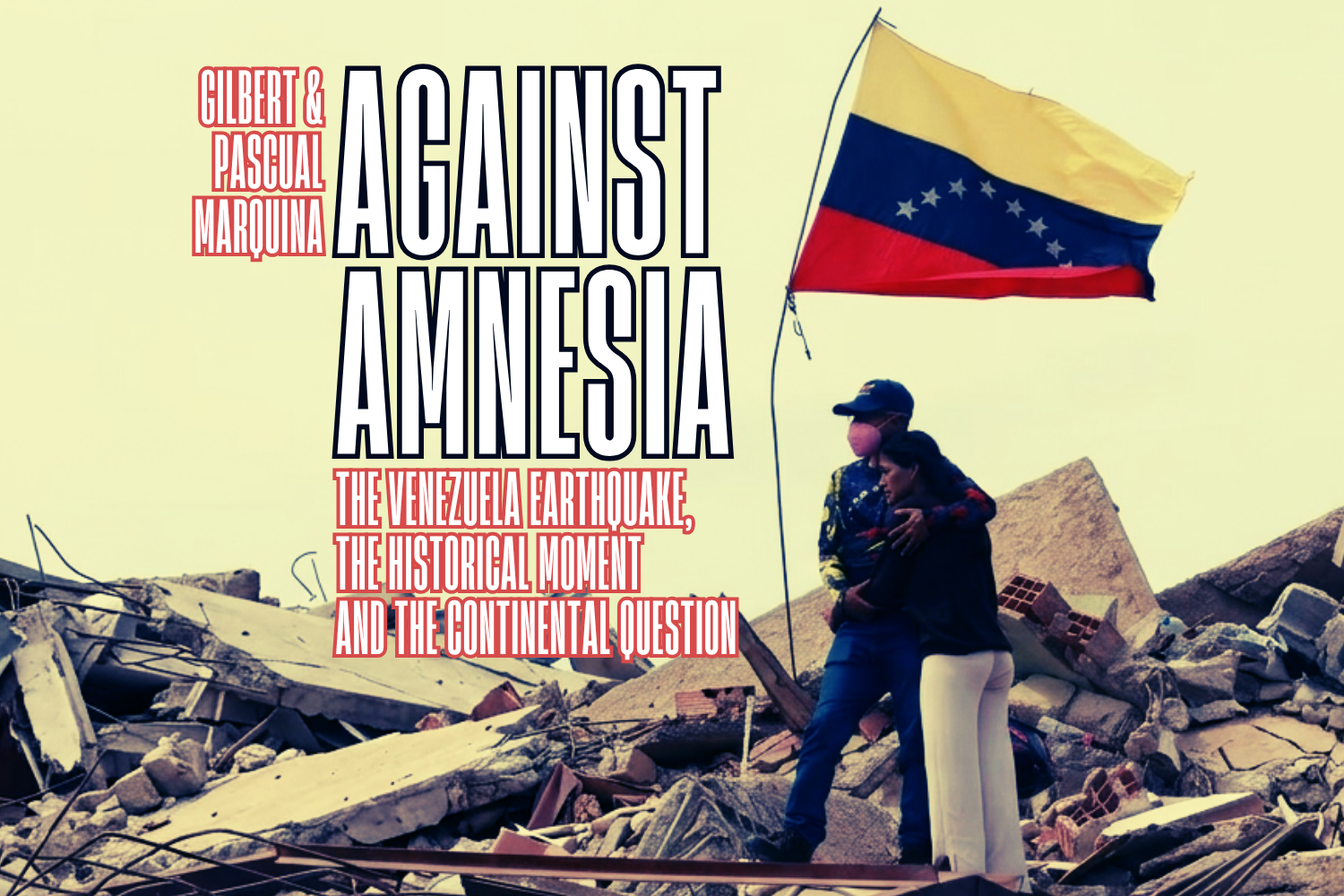
Earthquakes interrupt everyday life, but not history. Nor do they suspend politics. If anything, they compress history into a few dramatic days, revealing social relations, political projects, and geopolitical forces that ordinarily remain beneath the surface. The Venezuelan earthquake is no exception.
As we argued in a recent article, the quake’s impact spread along material and social fractures that were already carved deep by a decade of crippling sanctions and other imperialist aggressions. In its wake came inevitable struggles over sovereignty and meaning. Although centered in Venezuela, these struggles belong to a broader historical picture: the increasingly aggressive attempt to reassert U.S. domination over Latin America.
The ground had hardly stopped shaking before Washington began advancing its agenda. A naive or hopeful observer might have expected the U.S.-led campaign against the Venezuelan government to ease at this point. After all, Caracas had made a series of concessions to the U.S. under extraordinary military and economic pressure in the post–Jan. 3 period. Instead, the opposite happened.
Within hours of the earthquake, an intense information war got going. Even as thousands of firefighters, civil protection personnel, members of the Venezuelan armed forces, health workers, communal organizations, and volunteers were being deployed to the hardest-hit areas, most of the international media moved in lockstep to deny it. Against all evidence, they insisted that the Venezuelan government was absent—that there was no state response, no civil defense, no organized rescue effort.
Of course, no country is ever fully prepared for a disaster of this magnitude, much less one that has endured years of imperialist economic war. Yet the actual response, impressive in both scale and commitment, was systematically erased from public view. Later, corporate media portrayed every government measure—from coordinating rescue operations and organizing shelters to regulating the flow of humanitarian aid—as evidence of “authoritarianism.”
To be clear, these narratives did not emerge only from the pro-imperialist corporate press. They also spread through social media and ostensibly “independent” voices. Yet the remarkable uniformity of these messages points to their being part of an organized campaign. That is the only way to account for their employing the same framing devices, containing the same omissions, and arriving at the same conclusions.
Moreover, the corporate media lost no time in amplifying the most aggressive social media posts as part of its effort to delegitimize the Venezuelan government and sow political discontent amid legitimate grief and mourning, thereby reinforcing the notion that only external intervention could rescue the country.
This reveals that Washington’s objective has never been limited to the extensive economic concessions it obtained after Jan. 3. In fact, it pursues the complete dismantling of Venezuela’s revolutionary project, which integrates state power and organized popular forces. What is ultimately at stake is the unfinished project of recolonizing Venezuela—and, in a broader sense, the Latin American region.
That is why the information war matters. It is not simply about dominating the news cycle. It is about preparing the political ground for further advances in the project of recolonization. The pattern is familiar. Throughout the history of U.S. intervention in Latin America and elsewhere, before it intervenes, a story must first be fabricated: that the state has collapsed and what remains of it is authoritarian, that the government has abandoned its people—in short, that sovereignty itself has become an obstacle to humanitarian relief.
The battle over narratives is therefore not secondary or superficial—it is one of the principal theaters through which imperialist power seeks to manufacture political consent for intervention against a Global South nation.
Washington wants the whole nine yards
In 1999, longtime anti-imperialist Muammar Gaddafi started a process of reconciliation with the U.S. and Europe. This came after a long period of cruel sanctions and other imperialist aggressions against the Libyan people. The first step Gaddafi took was handing over the Lockerbie suspects for trial in the Netherlands. Then came the diplomatic normalization that happened in 2002–03 and further rapprochement in the years to come.
The outcome represents an important lesson for anti-imperialist projects ever since. In 2011, Libya—concessions and rapprochement notwithstanding—would be bombed by NATO and Gaddafi murdered by British special forces. This occurred as U.S. Secretary of State Hillary Clinton pronounced, “We came, we saw, and he died!”
The parallels between Libya and Venezuela are many, but it is important to locate the historical moment with precision. As in Libya before 2011, Venezuela has, in recent months, responded to sanctions and other attacks with concessions and rapprochement, but it has not been defeated, and it continues to represent a symbolic and material threat. Washington knows this very well. For its leaders and strategists, the persistence of a Venezuelan revolutionary bloc that connects the leadership and masses remains unacceptable. That is the next target of imperialism, and it is also what we must defend.
There is ample evidence that the Chavista revolutionary bloc still survives in Venezuela today. Despite years of sanctions, financial siege, military threats, the naval blockade, and the traumatic events of Jan. 3, the essential architecture of the Bolivarian Process remains in place. The state has not collapsed. The armed forces have not fractured. The communal movement continues to organize social life and participate in governance all across the country. Thousands of middle-level cadres serve as a conveyor belt between the masses and the leadership. Thus, Chavismo continues to constitute a mass political subject tempered in three decades of revolutionary experience.
This explains why the corporate media offensive following the earthquake has been so relentless. The objective is not simply to criticize the government’s response. It is to weaken the entire Bolivarian Process by driving a wedge between the organized people and the state, while preparing the ground to justify a permanent ground invasion nationally and internationally. For imperialism, it is the people-state relationship—not merely a president, a party, or any particular policy—that constitutes the decisive target.
For all these reasons, people who cry out, “All is lost and Venezuela is a mere U.S. protectorate” are failing to understand the concrete situation and historical moment. All is not lost, and imperialism knows this very well. Our enemies understand the shape of the current battlefield. Too bad so many opinion-makers historically on our side—alleged leftists and anti-imperialists—are helping them destroy the revolutionary bloc by attempting to turn the masses against the leadership.
A continental turning point
The Venezuelan earthquake and the events surrounding it must be understood within a broader continental context: an increasingly rapacious U.S. effort to reassert its hegemony over Latin America through economic coercion, military pressure, and political intervention. The arrival of U.S. Marines under the banner of humanitarian assistance to Venezuela is not an isolated episode. Across the continent, imperialist domination is becoming more direct, more overtly military, and less inclined to hide behind the language of cooperation and development.
It is precisely under these conditions that Latin America must recover Simón Bolívar’s project of continental integration as the Patria Grande and remember José Martí’s warning about “the giant with seven-league boots.” Both understood that true independence could never be secured by fragmented republics confronting imperialist power one by one. Sovereignty required the unity of Nuestra América (Latin America and the Caribbean). That lesson has lost none of its urgency.
What is changing today is not imperialism’s substance but its form. The United States is increasingly abandoning the pretense that hemispheric control can be exercised through trade agreements and soft power. Economic coercion remains central, but it is now accompanied by naval blockades, military deployments, kidnappings, extraterritorial bombings, lawfare, shameless electoral intervention, and an increasingly explicit willingness to project brute force throughout the region.
Venezuela illustrates this with particular clarity, but it is not unique. Cuba is living through a cruel tightening of the already genocidal U.S. blockade and facing new levels of military threat. In Ecuador, the restoration of a U.S. military foothold signals the country’s reintegration into Washington’s regional strategic architecture. Meanwhile, newfangled forms of dictatorship and fascism (Bukele, Milei, de la Espriella) promise complete prostration of their countries before imperialism and Zionism. These developments are pieces of a larger imperialist agenda and speak to Latin America’s urgent need to defend its sovereignty collectively against an aggressive project of de facto recolonization.
Solidarity with awareness
Solidarity with earthquake-stricken Venezuela has taken many forms, and most of it has been valuable both materially and in raising morale. However, friendly nations, organizations, and individuals who wish to help Venezuela in the most effective way should not do so with historical amnesia or political naïveté. In the current context, meaningful solidarity can take material form, but it also requires challenging narratives that erase the work of the Venezuelan government and the organized people, thereby facilitating further imperialist domination.
It is therefore important to emphasize that, even if the earthquake exposed the devastating consequences of the U.S. sanctions regime and other aggressions, it also brought to light the potential of the emerging social metabolism of communal organization. The rapid mobilization of communes, workers, and volunteers did not emerge spontaneously from the disaster itself. It was the product of a long process of political organization whose significance extends well beyond emergency response.
More broadly, defending Venezuela’s sovereignty is not simply a Venezuelan question. It is part of a broader struggle over whether Latin America will remain a collection of isolated republics each confronting imperialist power alone or become, at last, the Patria Grande envisioned by Bolívar and defended by Martí, Fidel, Chávez, and so many others.
The earthquake did not interrupt that history. It merely reminded us that, even amid tragedy, the continent’s unfinished struggle continues. The essential task is to ensure that the peoples of Latin America emerge from both the literal and metaphorical rubble of the broader imperialist offensive with their sovereign projects and emancipatory goals intact.
Chris Gilbert is a professor of political studies at the Universidad Bolivariana de Venezuela, contributing editor at Monthly Review, and the author of Commune or Nothing! Venezuela’s Communal Movement and Its Socialist Project (Monthly Review Press), among other books and articles. With Cira Pascual Marquina, he is founder and co-host of Escuela de Cuadros, a Marxist educational program and podcast.
Cira Pascual Marquina is a popular educator at the Pluriversidad Patria Grande, the educational initiative of El Panal Commune. She is also a member of the International Communal Democracy Network. With Chris Gilbert, Pascual Marquina is coauthor of Venezuela, the Present as Struggle: Voices from the Bolivarian Revolution (Monthly Review Press), the book series Resistencia comunal frente al bloqueo imperialista (Observatorio Venezolano Antibloqueo), and Protagonistas: construcción comunal en tiempos de bloqueo imperialista (Observatorio and PT). They are also founders and hosts of Escuela de Cuadros.
First published at MROnline, July 6, 2026.
Join the Struggle-La Lucha Telegram channel