
“Complete silence!”
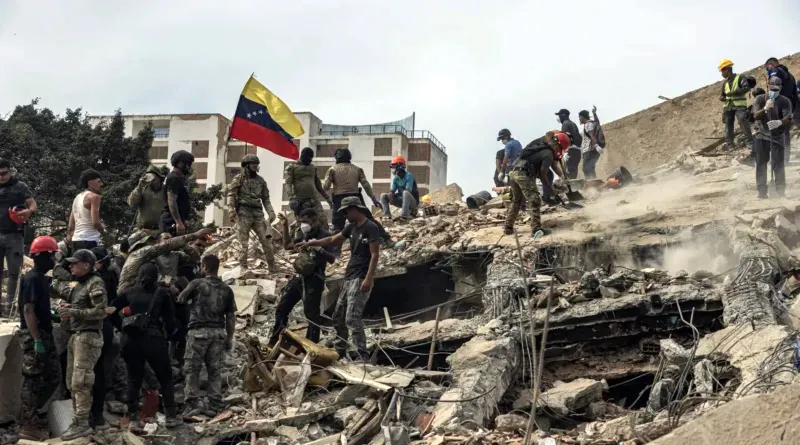
The order is repeated over and over again in front of the collapsed building in La Guaira. Those watching from the street stop talking. Engines are turned off. No one moves. A rescue team has just detected a tiny vibration beneath tons of concrete. The Pass Band — a device capable of detecting imperceptible movements — confirms what everyone has been hoping to hear after three days of searching: there is still life.
Rescuers are working atop what was once an 11-story building. Six concrete slabs below, trapped amid the rubble of her home, an 11-year-old girl waits. She is not alone. Beside her lies the lifeless body of her mother. Nearby, her nine-year-old brother, Moisés, is still breathing, though seriously injured.
A race against time begins. Every slab removed takes hours of work. Every move must be calculated to prevent another collapse. Making their way through the structure takes more than 10 hours. Meanwhile, the girl does something no child should ever be forced to do: she becomes the guide for her own rescue.
From the darkness, she describes what she can make out, explains the layout of the structure, points out where her mother and brother are, and guides the rescuers as they manage to advance.
“When the light came on, she told us she could see our hands, that she could see our silhouettes. She guided us the whole time,” recalls one of the rescue team members.
Communication never breaks down. They explain to her what they’re doing from above. She responds from below. The rescuers work to stabilize the structure, prevent more concrete blocks from falling, and clear a safe path to where the family is trapped.
“We were working to keep the concrete from falling on her so we could get her out without a scratch. She was guiding us through everything,” said the rescuer, his voice still breaking.
The girl knew her mother had died. She also knew her brother was still alive. She used every ounce of energy she had left to ensure the rescue teams reached him first. When they finally managed to reach him, Moisés was pulled out alive and rushed to the hospital.
Only then was it the girl’s turn. But she was no longer breathing. She had held on long enough to ensure that her brother would be saved. “Her sister handed him over alive. She gave everything so that he could live. Our commitment was to get him to the hospital. And we did it,” said one of the rescuers through tears.
Thanks to her, her mother wasn’t reduced to an unidentifiable body under the rubble, and her brother will have a second chance at life. Her story is heartbreaking because it seems impossible to ask more of a little girl.
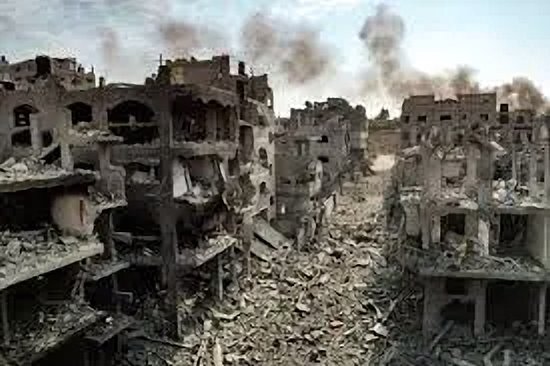
That image of a childhood forced to grow up amid the rubble inevitably connects to another tragedy. The scene in La Guaira — with dust, silence, buildings gaping like wounds, and rescuers searching for the faintest signs of life — brings to mind Gaza, where children have also been pushed to the limits of what is bearable. There, it wasn’t the earth that shook — it was the bombs. But the result is all too similar. Homes reduced to ruins, families torn apart, unidentified bodies beneath mountains of concrete, and children forced to survive before they fully understand what death means.
In Venezuela, a girl trapped beneath a collapsed building used her last ounce of strength to save her brother. In Gaza, another image made its way around the world in September 2025: Jadoua, an eight-year-old Palestinian boy, walking barefoot through the rubble while carrying his two-year-old brother, Khaled, on his shoulders.
The video, recorded by photojournalist Ahmed Younis, condensed into a few seconds the full weight of a war resting on a child’s back. Jadoua walked barefoot, exhausted and crying, searching for a safe place while shouting “ya ama” and “mama” in Arabic. He had walked kilometers with his brother on his back — not as a chosen act of heroism, but as the only possible way to protect him amid displacement, fear, and destruction.
The stories of La Guaira and Gaza are not the same. One stems from a natural disaster; the other, from a sustained war against a besieged population. But both reveal the same unbearable truth: when everything collapses, it is all too often the children who bear the burden of what adults, governments, and the world failed to prevent.
That is why it is not enough to call them heroes. The word is moving, but it can also obscure what is essential. No child should have to organize a rescue under a mountain of rubble. No child should have to walk kilometers with a younger sibling on their back to escape the bombs. No child should have to learn so early how to assess danger, manage fear, or choose whom to save first.
None of them chose heroism. They simply did the only thing they could do when everything came crashing down around them. The real tragedy is not that there are child heroes. The real tragedy is that there are tragedies that force them to become heroes.
Alejandra García Elizalde is a Cuban journalist working in Venezuela as an evening anchor for teleSUR English and a Latin American correspondent for Resumen Latinoamericano in English.
Source: Resumen Latinoamericano — English, June 30, 2026.
Join the Struggle-La Lucha Telegram channel