
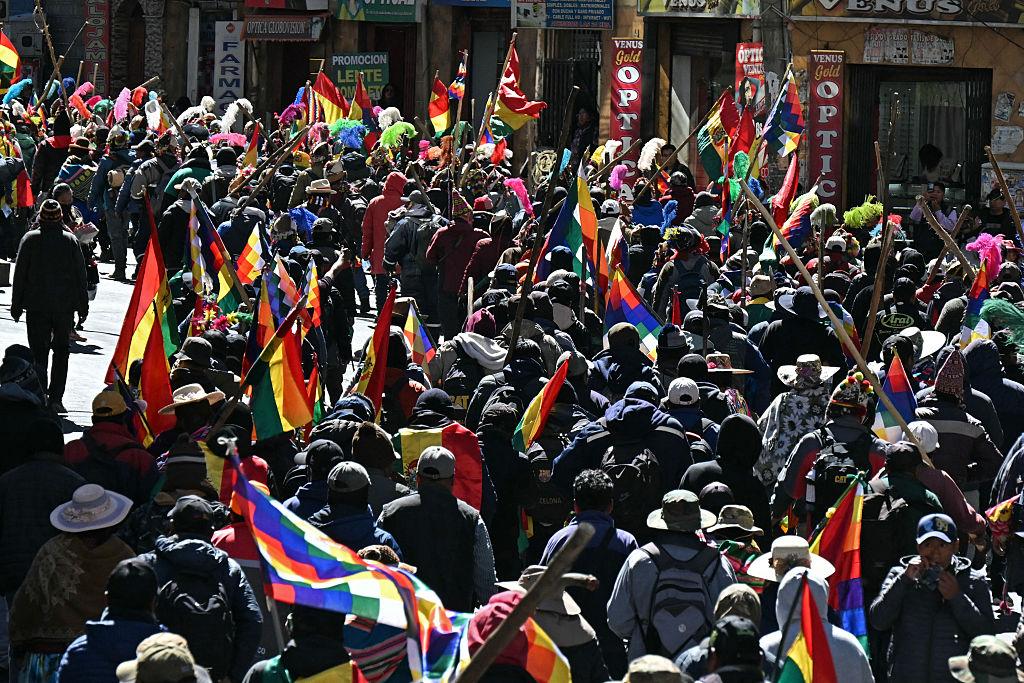
The general strike in Bolivia has eclipsed the 45 day mark. The main demand of the strike is the resignation of right-wing President of Bolivia, Rodrigo Paz Pereira. Paz is aligned with the Trump administration as corporations from the United States seek to control Bolivia’s natural resources, particularly lithium, as well as tin, copper, zinc, silver, and natural gas. Currently, the areas of Bolivia rich in resources are surrounded by Indigenous territories.
To get around this to access the resources, Paz’s government created Law 1720, which essentially allows corporations to take over land that is currently in the hands of peasant farmers and Indigenous communities. This brings us to another demand of the general strike: repeal Law 1720.
The other demands of the strike are higher wages and pensions, ending privatization plans, and lower taxes for small businesses. The general strike began just five months into Paz’s presidency. His first legislative act as president was to end taxation on large fortunes, essentially giving cuts to the rich while leaving the working class without relief as prices soared.
The general strike has been led by trade unions and Indigenous communities. Over 70 labor unions have joined the strike. Indigenous protesters from Northern Bolivia marched 600 miles from April 8th to May 4th to the capital of La Paz. During the strike, workers and peasant farmers have established over 90 roadblocks across Bolivia to shut down the country until the demands of the strike are met. Workers and peasant farmers have also blocked airport runways, such as El Alto International Airport, halting passengers and cargo from entering or leaving.
In retaliation, Paz’s government has arrested over 300 protestors. The government has also issued arrest warrants on terrorism charges for 25 union and Indigenous leaders. They have already charged Mario Argollo, the executive secretary of Bolivia Workers Central and Indigenous women’s leader and ex-senator Simona Quispe. Additionally, on June 9, Rodrigo Paz signed Law 1740 into effect, which authorizes armed forces and police to carry out joint operations to suppress the protests.
The working class of Bolivia has not backed down as government oppression has increased during the duration of the strike. On May 23, a 3,000 person police and military force attempted to force open the road block on the La Paz-Oruro highway. The Aymara Indigenous community managing and supporting the road block held their position strong and eventually, the military forces withdrew. During the operation to break the road block, a 24-year-old Indigenous man, Victor Cruz Quispe, was shot and killed, 28 other protesters were injured and admitted to the hospital, and 321 protestors were arrested. Similarly, on June 6, police and paramilitary forces tried to force open the roadblock on a major highway in San Julian, but again the workers stood strong. The workers held off the attack for five hours before forcing the police and paramilitary forces to retreat. At least one worker was killed and 27 were injured and admitted to the hospital.
Former Bolivian President Evo Morales Ayma has been outspoken during the strike and declared that the strike is against neoliberalism and a government that subjugates itself to the United States. In the middle of the strike on May 16, a leaked document confirmed that Bolivian police in coordination with the U.S. Drug Enforcement Administration and U.S. Southern Command had plans to kidnap Evo Morales. In response, workers and Indigenous community members surrounded Morales’ residence to protect him. Protesters also occupied the nearby airport to prevent U.S. helicopters and planes from landing.
Bolivia’s general strike serves as an example of the power of the working class. When there is solidarity among the working class and across communities, the working class has the power to demand and force change.
Join the Struggle-La Lucha Telegram channel