
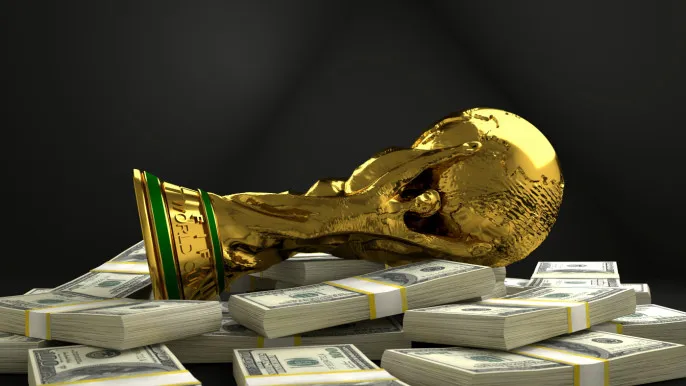
Soccer has always been a game of numbers. Fans count goals, victories, and championships. Officials measure pitches and regulate every detail of the sport. But in the 21st century, the most important figures in soccer are not found on the scoreboard. Numbers are measured in billions of dollars, multinational investments, and global markets. Behind every World Cup lies an economic structure so vast that it rivals the wealth of entire nations and influences political decisions far beyond the boundaries of the game.
On June 11, the biggest World Cup tournament in history kicked off in North America. From Mexico City to New York to Toronto, millions of spectators draped in their country’s colors will gather as of June 11 until July 19, to watch 48 national soccer teams compete at the 2026 FIFA Men’s World Cup. It’s the first time the tournament will use the newly expanded field, up from the previous 32-team format that had been in place since 1998.
The major event is on track to become the largest commercial undertaking in FIFA’s history. Behind the excitement, the national rivalries, and the spectacle watched by billions, lies an economic machine operating on a scale that rivals the budgets of nations. FIFA is expected to spend more than $3.7 billion to simply organize the month-long tournament, according to statements from FIFA president Gianni Infantino.
To put that figure into perspective, it is comparable to, and in some cases exceeds, the annual gross domestic product of countries such as Andorra, Saint Vincent and the Grenadines, Burundi, Belize, Barbados, and Sierra Leone. Such an amount could finance food assistance programs for millions of vulnerable families for an entire year or fund the construction of more than a dozen world-class hospitals.
And this figure is yet modest when compared with the scale of contemporary military expenditure. According to various estimates of U.S. military operational costs in West Asia, approximately 100 hours of military deployment can consume resources equivalent to the entire organizational budget of a World Cup. In other words, 100 hours of war can cost as much as one month of soccer.
FIFA expects the 2026 World Cup to generate approximately $11 billion in revenue, Infantino stated. This unprecedented projection is closely linked to the decision to expand the tournament from 32 to 48 participating teams and from 64 matches, as played in 2022, to 104 matches. This expansion is not simply a sporting decision. It is an economic one.
More teams mean more television rights to sell. More matches mean more sponsorship opportunities. More host cities mean more commercial partnerships. And millions of spectators are expected to purchase what may become the most expensive World Cup tickets in history.
FIFA has stated that billions of dollars generated through the tournament will be reinvested into soccer development projects around the world. However, the allocation of these funds raises important political and ethical questions. Decisions about where investments are directed, which projects receive support, and how soccer infrastructure connects with geopolitical realities prove that soccer cannot be isolated from broader political and economic decisions.
This reality suggests that FIFA is no longer merely a sports federation. It increasingly operates as a transnational institution with the capacity to negotiate with governments, shape regulatory environments, influence urban development, and affect public policy through the leverage of sporting investment. The numbers, therefore, matter.
Source: Resumen Latinoamericano – English
Join the Struggle-La Lucha Telegram channel