
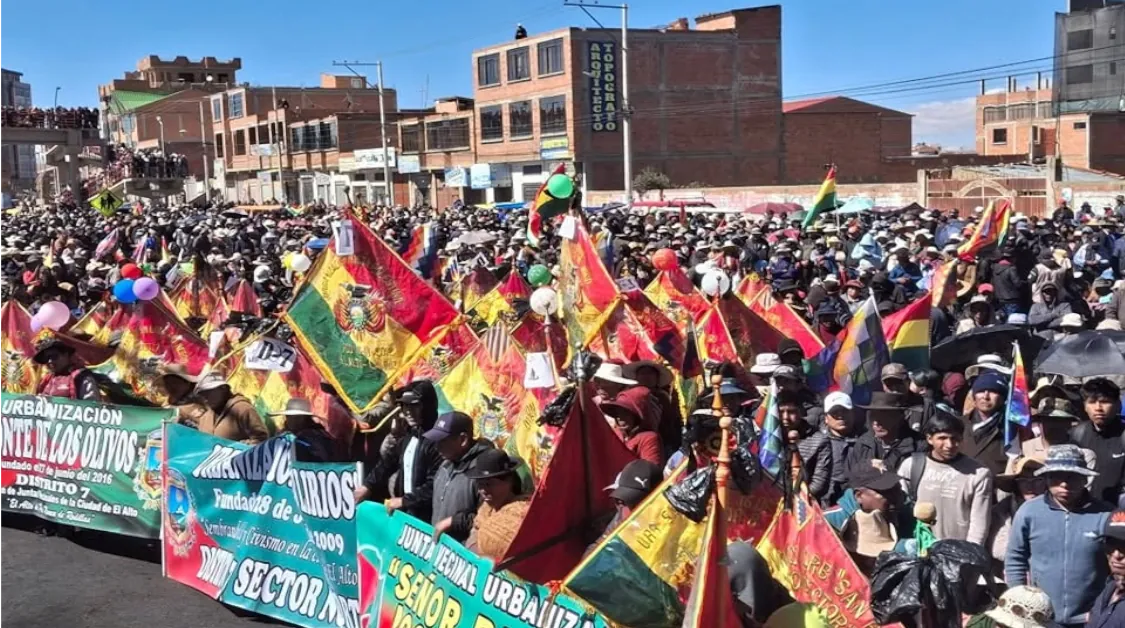
June 11 — Since the early hours of June 10, the Bolivian cities of La Paz and Cochabamba have been the scene of a massive mobilization by social organizations, labor unions, and indigenous groups demanding the resignation of President Rodrigo Paz.
The main demonstration was organized by the Tupac Katari Single Departmental Federation of Peasant Workers, which gathered its members at the Multifuncional de la Ceja in El Alto, a strategic point from which they began their march toward downtown La Paz.
This march was joined by columns that arrived in the district of Senkata carrying sticks and monteras — traditional leather helmets — in response to a call from the Bolivian Workers’ Confederation (COB), which mobilized the 20 provinces of the region, the Federations of Neighborhood Councils (Fejuve) of El Alto and La Paz, groups of “self-organized” citizens, and the heavy and interprovincial transport unions.
Due to the scale of the mobilization, the La Paz Police declared a state of alert and proceeded to drastically reinforce security cordons around Murillo Square, safeguarding the Executive and Legislative palaces.
“On behalf of the government, we do not penalize or criminalize social mobilizations or the right to protest. What we will not allow, however, are acts of vandalism or crime committed by people being brought to La Paz from other areas,” stated Interior Minister Marco Antonio Oviedo.
Meanwhile, as the situation worsens, President Paz signed into law on June 9 the controversial Law 1740 regulating states of emergency, which authorizes the Armed Forces and police to carry out joint operations with the aim of suppressing the social protests that have been demanding his resignation since May 1.
Evo Morales in the Cochabamba tropics
In parallel with the events in La Paz, Evo Morales led a massive march alongside members of the Six Federations of the Cochabamba Tropics. The column of protesters moved from Lauca Ñ toward the municipality of Chimoré, the designated site for the so-called rally for life to save Bolivia.
Coca growers, labor unions, and transport workers in the region also protested the severe supply crisis and deteriorating fuel quality across the country.
The June 10 protests mark 41 days of intense conflict — a situation that has kept multiple interdepartmental highways closed and directly impacts the economies of Cochabamba, La Paz, Potosí, Oruro, Chuquisaca, and Santa Cruz.
Blockade resumes in San Julián
In the department of Santa Cruz, protesters resumed road blockades in the municipality of San Julián on June 10 following a brief four-hour hiatus. The brief pause provided temporary relief to hundreds of stranded truckers and travelers, but after the blockade resumed, lines of trucks and buses began to grow again.
The closure marks 28 days of uninterrupted blockade on the main highway connecting Santa Cruz with the Chiquitania region and the department of Beni.
Despite the resumed protest, a diplomatic opening is emerging. Interior Minister Oviedo, alongside Defense Minister Ernesto Justiniano, reported that they remain hopeful about establishing a formal negotiating table. Oviedo indicated that productive communities and neighborhood associations in the urban area of San Julián were set to hold general assemblies the afternoon and evening of June 10 to define terms and provide a response allowing direct talks with the central government.
Source: Resumen Latinoamericano — Buenos Aires
Join the Struggle-La Lucha Telegram channel