

“The strength of the working class is organization. Without the organization of the masses, the proletariat is nothing. Organized, it is everything.”
— Vladimir Lenin
The Consolidation of Labor Laws (CLT) in Brazil was enacted in 1943 as a landmark victory for Brazilian workers. It established a 48-hour workweek, paid vacation, protections against arbitrary dismissal, and the right to organize. Despite being a win, it was also a political calculation by President Getúlio Vargas, tainted by a corporatist maneuver that tied unions to the state and limited independent labor organizing. It also excluded rural and domestic workers, deepening a racial disparity that labor legislation never meaningfully addressed. The 1988 Constitution cut the workweek from 48 to 44 hours, the last reduction before this year.
But the law still permitted the workweek to be spread across six days, a model known as the 6×1 schedule. It remained the standard for millions of workers in Brazil after the 1988 reduction, with the burden falling heavily on Black and poor workers in retail, food service, lodging, transportation and other service jobs.
The 6×1 schedule does not just make workers tired. It cuts them off from a meaningful life outside of work. A day off might fall on a Tuesday, which means missing out on social and family life on the weekend. Workers are too exhausted to study. For workers with children, especially women, there is no real day off anyway. They come home from one job and start another: cooking, cleaning and taking care of children with no rest in between. None of it is accidental. It is a schedule that keeps the proletariat worn down and immobilized by capitalism.
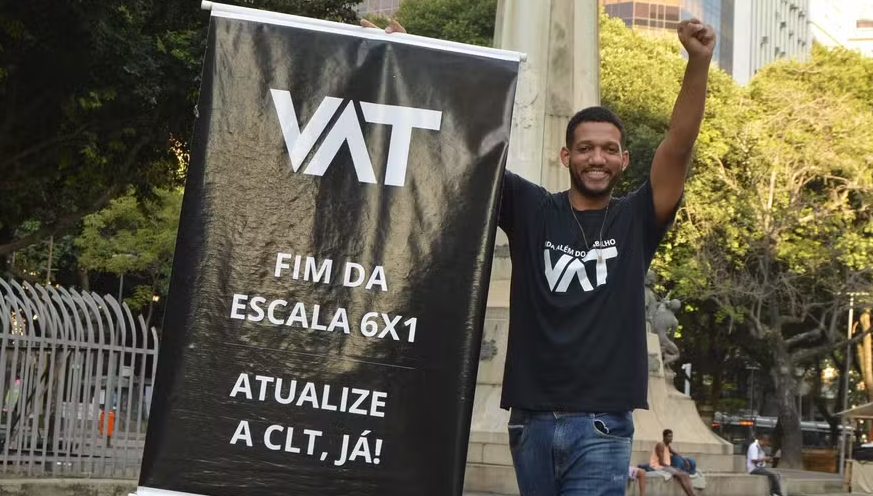
In September 2023, Rick Azevedo, who then worked as a pharmacy cashier in Rio de Janeiro, published a TikTok about working the 6×1 schedule: “I’m here outraged by the 6×1 schedule. … When are we, the working class, going to make a revolution in this country over the 6×1 schedule? It’s modern, outdated slavery. I keep thinking: I don’t have children, I have nothing, I am alone, I can’t get things done.” As is the case for many Brazilians, Azevedo worked six days a week, from 2:00 p.m. to 11:00 p.m., and in the mornings sold popsicles at the beach to complement his income, since his full-time job only paid minimum wage. In addition to working these two jobs, Azevedo had attempted to pursue higher education more than once but had been forced to drop out.
When his TikTok went viral, Azevedo had a modest following of 40,000, mostly built around posts about Beyoncé. He had never organized with a union or a political party. After the viral TikTok, he created a WhatsApp group, started connecting with labor lawyers and activists, and within weeks, they created Vida Além do Trabalho, VAT (Life Beyond Work). A public petition for the end of the 6×1 schedule followed shortly after. In May 2024, Federal Deputy Erika Hilton of the Partido Socialismo e Liberdade formally announced a Proposed Constitutional Amendment calling for a four-day workweek, filed in partnership with VAT.
By October 2024, Azevedo won election to the Rio de Janeiro City Council as the 12th most voted candidate out of 51 seats. Despite having received less funding than other candidates from his party, PSOL, he was the party’s most voted candidate. He went from a viral TikTok to a public political platform that carried the fight against the 6×1 schedule into national debate.
In less than three years, the movement never lost momentum, despite the right’s attempts to argue that ending the 6×1 schedule would increase unemployment. That is the bosses’ old threat: every gain for workers, they say, will bring ruin. But public support has been overwhelming. A Senate poll on the reduction received 92.6% support and only 7.4% opposition.
On May 27, 2026, the Chamber of Deputies voted to approve a constitutional amendment phasing out the 6×1 schedule, the first reduction to Brazil’s workweek since the Constitution was enacted in 1988. Now, the amendment goes to the Senate, where the fight continues.
In the 83 years since the CLT was enacted, few amendments have carried this much meaning for the Brazilian working class. The end of the 6×1 schedule is not just a labor reform. It is proof that organization works.
Join the Struggle-La Lucha Telegram channel