
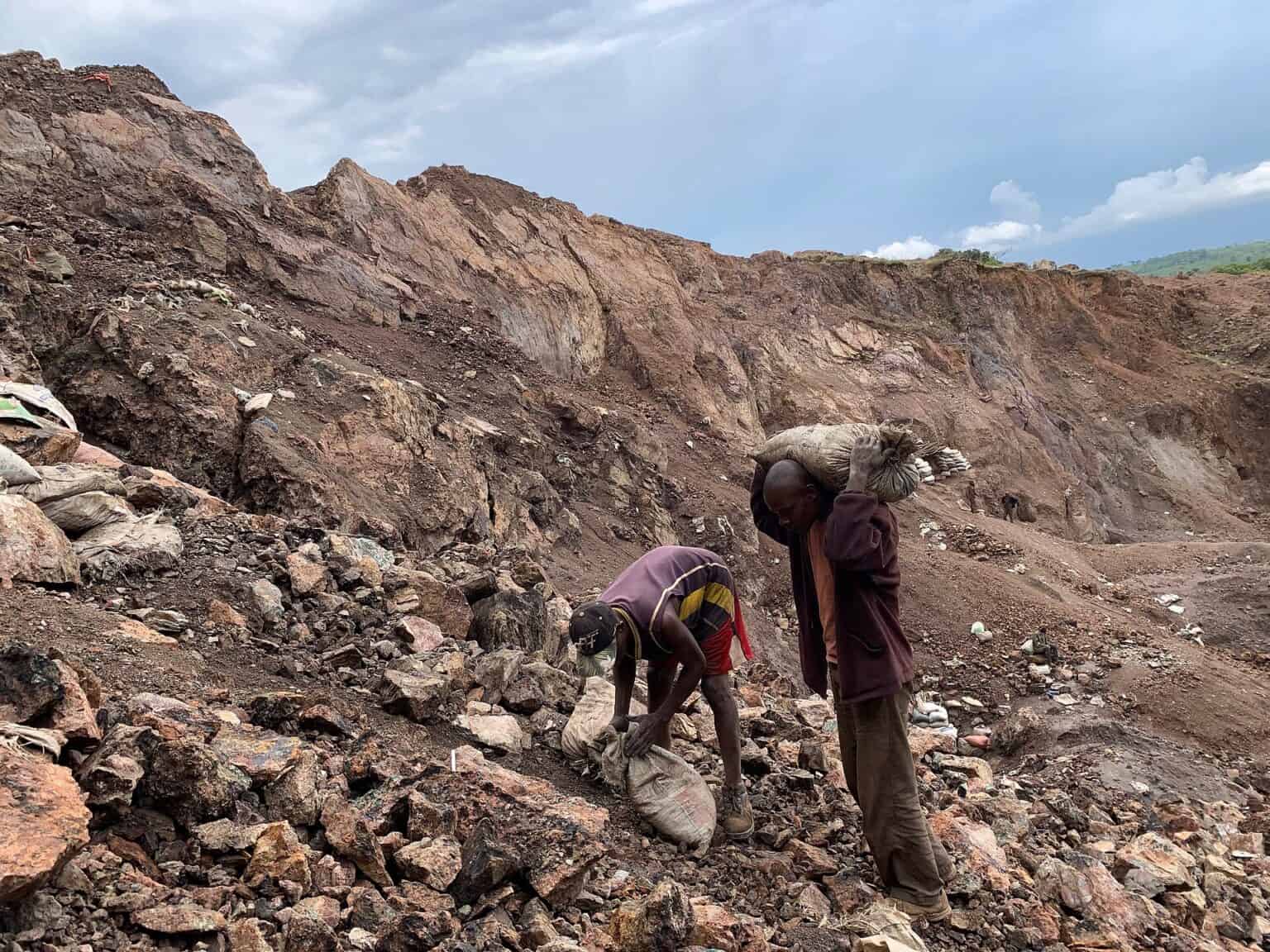
Shops looted, police stations ransacked, roads barricaded, buses damaged, lorries burnt. The artisanal miners of Lualaba and Haut-Katanga provinces — the cobalt and copper heartland of the Democratic Republic of the Congo (DRC) — are angry. In January 2026, Congolese media outlet Kilalopress reported: “Kolwezi has almost ground to a standstill. Workers no longer dare to go to work for fear of being ambushed.” In the neighbourhood of Kisanfu in Kolwezi, artisanal miners beat to death an employee of an industrial mining company who was returning home after his shift on Dec. 28, 2025.
Elsewhere, in the ‘5 Ans’ neighborhood, protesters barricaded roads and stoned trucks, causing significant property damage. The immediate trigger for the miners’ anger was a ministerial decree, signed on Dec. 19, suspending the processing and marketing of ore from artisanal mining, together with the closure of artisanal mining sites and traders’ storage depots. However, as we argue in this article, the real causes run as deep as the cobalt pits: economic and political marginalization, and the violent concentration of wealth and power.
In this contribution, we examine how the ‘problem’ of the miners is presented in public discourse, as well as the ‘solution’ that is put forward. The criminalization of miners’ activities in this region serves to mask the structural dynamics of marginalization. The ironic result of all this is that the discourse criminalizing artisanal mining activities, in turn, leads to further violence. Our analysis is based on a systematic review of an original database compiling some 200 documented security incidents between 2018 and 2025.
‘The problem’: the criminalization of miners
In November 2025, 49 artisanal miners perished in a trench at the Kalando site in the village of Mulondo, Lualaba. The victims had found themselves on a makeshift bridge whilst attempting to escape soldiers who were firing ammunition at them so as to chase them from the industrial concession where they were working.
This BBC article reporting on the Mulondo disaster illustrates a discursive mechanism that blames the artisanal miners for their own death: the mining companies, not the miners, are cast as “victims” of “invasion.” The article mentions that the artisanal miners had “built the makeshift bridge themselves,” suggesting they could have prevented their own deaths by taking “alternative training programmes offered to them by the government.” In reality, such alternative livelihood programs are extremely limited and don’t offer sufficiently attractive options. Besides, the “makeshift bridge” was not built to carry the weight of all these miners in panic and running away from bullets.
This discursive criminalization is a recurring pattern. For example, in July 2022 in Kambove (Haut-Katanga), security guards at an industrial mining company shot dead two artisanal miners and wounded several others. Radio Okapi’s report on the incident first states that the artisanal miners “had entered the concession illegally” before recounting the acts of violence. In the same article, the territorial administrator deplores the events and calls for the protection of “investors who come to work with us,” thereby confirming the narrative priority given to the security of capital over the lives of the artisanal miners. These tactics serve to minimize the responsibility of the company and the security forces and to sidestep the fundamental issue of the lack of legal options for the artisanal miners’ livelihoods.
This criminalizing framing can also be understood as a symbolic whitewashing of industrial actors. Indeed, as Katz-Lavigne demonstrates, mining companies and commercial groups capitalize on media narratives that portray artisanal mining as ‘dirty’, dangerous and illegitimate, in order to make their own activities appear ‘clean’, responsible and compliant with international standards. This binary framing, however, obscures the predatory practices that these same industrial companies engage in — corruption, violent exploitation by security forces, land grabbing — and serves to justify increasing intervention under the guise of formalization and “responsible cobalt.”
Of the 200 incidents we analyzed, more than two-thirds of violent physical acts (clashes, shootings, repression) were centered on the perimeters of major industrial concessions rather than informal artisanal mining areas. This happened for instance around Kolwezi (where the expulsion of miners from an industrial concession triggered a violent crackdown by security forces in July 2021) and around Kisanfu (where soldiers and miners clashed over a dispute concerning the management and operation of a mine).
At the same time, mine sites are becoming areas of marginalization where silent but deadly disasters occur. Examples from the last few years alone include two landslides at an artisanal mine site in Lualaba (17 deaths in July 2024 and 11 deaths in February 2026); an accident in an underground mine operated by an industrial mining company in February 2024 causing 1 death and 3 injuries; the disaster in a major industrial concession in June 2019, with around 40 deaths; the rockfall at another artisanal mine site in Lualaba in February 2024, which left 6 dead and 16 rescued; the accident at another mine site in Lualaba in July 2021, with 2 dead and 3 injured; the incident at an industrial mining concession in Lualaba in May 2019, which caused 10 deaths and several injuries; and a landslide in Safi on March 11, 2026, resulting in at least 9 deaths.
‘The solution’: formalization and securitization
Following the Mulondo disaster, the national Minister for Mines swiftly intervened with a firm promise: the establishment of the 64 artisanal mining zones (ZEA or Zones d’exploitation artisanale) already announced and presented as viable. The creation of these zones is presented as the solution to the tensions between companies and miners.
The Mining Code does indeed stipulate that artisanal mining must take place within ZEA zones. It must also be overseen by mining cooperatives and state agencies such as SAEMAPE (Service d’assistance et d’encadrement de l’exploitation minière artisanale et à petite echelle — the Service for Assistance and Supervision of Artisanal and Small-Scale Mining) and the Mining Division. The formalization of artisanal and small-scale mining is thus presented as the magic solution to all problems of violence, human rights violations, and working conditions in the mines. But is this really the solution?
Empirical studies on mining cooperatives in the DRC highlight that formalization can be paradoxical: it tends to institutionalize, or even ‘legalize’, pre-existing forms of exploitation, integrating predatory actors into official channels without altering the underlying dynamics. In our recent research we have demonstrated that cooperatives in Lualaba and Haut-Katanga are becoming increasingly crucial for facilitating access to artisanal mining sites. Due to their role as ‘glocal gatekeepers’ in between external investors and responsible sourcing initiatives, and local administration and artisanal miners, they gain more and more influence. All this results in the establishment of a very hierarchical, ‘vertical’ form of governance in the artisanal mines, which looks nothing like a grassroots, bottom-up form of organization.
Furthermore, as Katz-Lavigne demonstrates, certain private security firms commissioned to protect industrial concessions simultaneously organize the clandestine extraction of minerals, charging miners for access and cracking down on those who circumvent this payment system. This predatory logic also extends to armed state actors, who appear not only as a tool of repression but above all as predatory actors and accomplices in accumulation through dispossession.
The military occupation of a concession held by a mining company by the FARDC in Lualaba in September 2024, the illegal and armed presence of soldiers at another mining site in Haut-Katanga in February 2025, and repeated allegations of collusion between the military and ‘Chinese and Lebanese’ mining networks (incidents in Kisankala), all demonstrate the militarization of access to cobalt.
This situation creates a climate of impunity in which ‘security’ has an asymmetrical mandate: to protect industrial capital’s assets and predatory networks, to the systematic detriment of human security. The privatization of force is evident, with private security guards and mine police intervening brutally. Importantly, violence is not limited to artisanal miners — it also targets company workers and private security personnel. For example, in July 2024 in Kambove, a soldier opened fire on the head of security at a mining company, killing two of the company’s security guards, following a dispute over the surveillance of the mining site. In July 2025 in Luisha, security forces violently suppressed a strike by mining company workers in Haut-Katanga, leaving several demonstrators injured. These cases show that impunity cuts across different groups, including those formally employed by the industry.
The depoliticization of the conflict and its effects
By reducing the conflict to a matter of a lack of ZEA and illegal behaviour, the dominant narrative depoliticizes it. This depoliticization is also at work in ‘responsible cobalt’ initiatives, which focus on visible and emotional risks (such as child labour) to avoid addressing the structural causes of poverty and exclusion. Our research shows that this depoliticization legitimizes the status quo and repression. Despite the recurring promises made by governors and ministers after each tragedy, violence relentlessly resumes in the same places.
This criminalizing discourse thus avoids addressing the central issues: the unequal distribution of mining titles (access to rich deposits remains the preserve of industrial companies), the meager local benefits, the absence of fair dispute resolution mechanisms, and the state’s role as a partner of capital rather than an impartial regulator.
This narrative undermines artisanal miners’ fundamental demands for the recognition of their socioeconomic rights, transforming issues of survival and justice into matters of illegality. For artisanal mining communities, insecurity is multidimensional: physical (use of force by private security forces, the police and the military), geographical (landslides), social (forced displacement) and environmental (pollution).
Towards governance based on rights and human security
Our findings call for a shift in perspective. Rather than viewing formalization as the solution, it should be considered as a potential tool within a broader framework of mining justice. Thus, the allocation of ZEAs could be guided by a rights-based approach. Mechanisms could be put in place to redistribute mining revenues at the local level and to fund economic diversification and social services, thereby breaking the cycle of dependence on subsistence artisanal mining.
Security arrangements will also need to be reformed to prioritize the protection of people. This entails independent monitoring and complaints mechanisms, the strict enforcement of mining and labor codes, and investment in the physical security of sites, whether industrial or artisanal. For years, NGOs and civil society organizations have been denouncing the increasing militarization of mine sites, documenting how the presence of armed forces serves primarily to protect industrial capital rather than local communities. The Congolese government itself has repeatedly ordered the military to withdraw from mining concessions, issuing directives to this effect on several occasions — yet these orders have consistently gone unenforced, with no visible results on the ground. Following repeated incidents, civil society organizations have been demanding that the FARDC (Forces Armées de la République Démocratique du Congo — Armed Forces of the Democratic Republic of the Congo) be withdrawn from concessions and replaced by civilian forces under civilian control. The risk of an increasingly militarized approach to mining security is no longer just a theoretical concern. In late April 2026, the Congolese government announced a $100 million initiative, supported by the United States and the United Arab Emirates, to create a “paramilitary mining guard” explicitly tasked with protecting the country’s vast mining assets. This force is expected to eventually number over 20,000 personnel and take over duties currently handled by regular army units. While officials present this as a measure to reassure investors and fight illegal mineral trading, it raises troubling questions about the direction of mining governance.
Due diligence initiatives by international buyers must cease to validate the mere formalities of the ZEA and make their purchases conditional on verifiable progress on these political and rights-related dimensions. The parliamentary fact-finding mission dispatched to Kolwezi, tasked with investigating the Mulondo disaster and the violence that followed the ministerial decree suspending artisanal mining, marks an official acknowledgment of the scale of the crisis. This initiative follows the Minister of Mines’ promise of “exemplary sanctions against all those involved” in the Mulondo tragedy — a response focused on punishment and individual accountability.
To move beyond mere observation, its conclusions must imperatively address the structural causes of the conflict: organized economic marginalization, militarized predation and the violent concentration of rent. The stated objective of ‘sharing responsibility’ and ‘establishing social peace’ will only be achieved by challenging the extractive regime itself, and not by a mere overhaul of its control mechanisms.
Espérant Mwishamali Lukobo is a Ph.D. student at Ghent University and the University of Antwerp, working on mining governance, conflicts, and security in the DRC. He is also a research assistant at Université de Kolwezi, DRC, and researcher at CEGEMI (Centre d’expertise en Gestion Minière) at the Catholic University of Bukavu.
Sara Geenen is assistant professor at the Institute of Development Policy (IOB), University of Antwerp, Belgium. She is project leader of the Centre d’Expertise en Gestion Minière (CEGEMI) at the Université Catholique de Bukavu, DRC. Her research focuses on the global and local development dimensions of extract
Source: ROAPE
Join the Struggle-La Lucha Telegram channel