
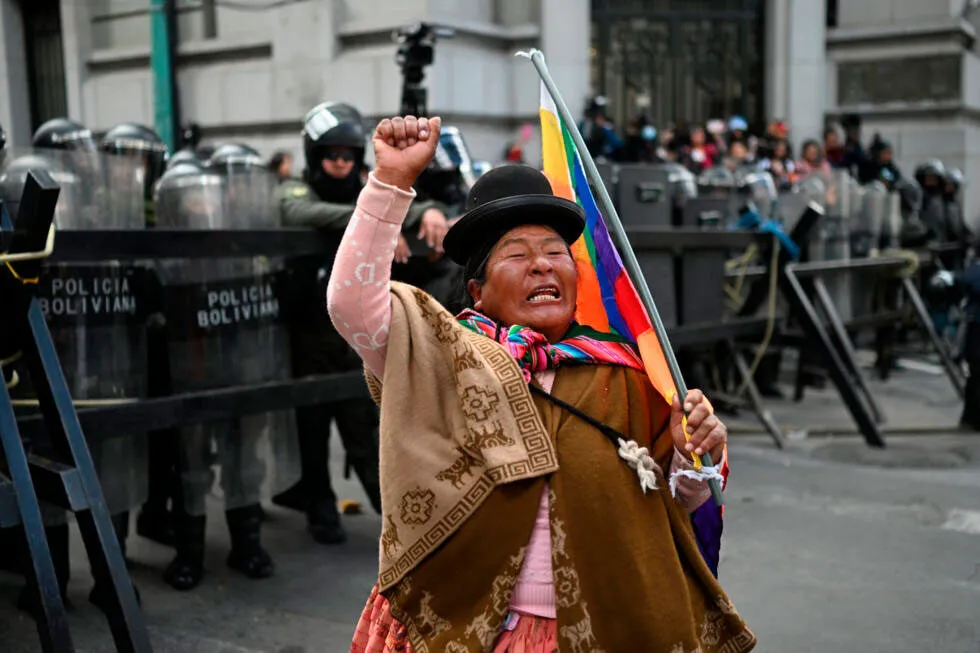
On May 28, former Bolivian President Evo Morales Ayma declared that the protests shaking Bolivia for the past month represent a popular rebellion against neoliberalism and a government that subordinates itself to the United States.
In an interview with an international news agency, Morales, who governed Bolivia from 2006 to 2019, spoke from the coca-growing region of Chapare, his political stronghold in central Bolivia. From there, he praised the determination of the social sectors mobilized against the neoliberal policies implemented by the right-wing government of President Rodrigo Paz since his rise to power.
It is important to note that Morales’ statements came shortly after an unusual blackout in the Chapare region, which raised alarm among Indigenous organizations and rural movements fearing that the outage could have been part of a maneuver by the Paz administration to facilitate his arrest.
During the interview, Morales emphasized that the demonstrations — involving miners, transport workers, teachers, farmers, Indigenous communities, and other social groups — are aimed at defending workers’ and families’ economies, democracy, the Constitution, and Bolivia’s natural resources.
President Rodrigo Paz has accused Morales of orchestrating the protests, which are demanding his resignation amid Bolivia’s worst economic crisis in four decades. In response, Morales rejected the accusations and stated that “it is a government completely subordinate to the United States. I believe the time has come to decide who rules: the empire or the people. I am absolutely convinced that this rebellion is against the neoliberal model and against the neocolonial state.”
Paz is widely seen as a new Latin American ally of Washington. The United States has publicly backed his administration and warned that Bolivia is facing an alleged “attempted coup d’état.”
“The Paz government is completely subordinate to the U.S.”
At 66 years old, Morales is sheltered by thousands of Indigenous people and peasant supporters who are preventing police from executing an arrest warrant, as part of Paz’s political persecution against the former president. “I would like to accompany the demonstrations, but this judicial harassment prevents me from doing so,” Morales stated.
The leader also denounced an ongoing U.S.-backed plan, supported by the Paz government, to carry out a military operation involving the U.S. Drug Enforcement Administration (DEA) and the U.S. Southern Command to arrest him. We’ve seen this excuse before, as in Venezuela, with the narrative of the nonexistent Cartel of the Sun, which led to the kidnapping of President Nicolás Maduro on Jan. 3, 2026.
“Hunger is what is driving this mobilization,” Morales insisted, recalling his role as Bolivia’s first Indigenous president.
On May 26, Bolivia’s Congress repealed a law that would have allowed President Paz to declare states of emergency and deploy the military to control protests without parliamentary approval. Morales warned that if such measures were imposed, “I doubt the people would back down.”
Barred from running in the 2025 presidential elections by a ruling from Bolivia’s Constitutional Court, Morales has proposed that the current government call new elections within 90 days. He also stated that he has no personal ambition to return as a presidential candidate.
“Now is no longer my time,” Morales concluded. “But I still have the responsibility to accompany the political movement that I lead.”
Source: Resumen Latinoamericano – English
Join the Struggle-La Lucha Telegram channel