
China and Russia deepen cooperation, issue joint statement on multipolarity
The May 20 meeting in Beijing between Xi Jinping and Vladimir Putin came only days after Donald Trump’s trip to China with a planeload of oligarchs drawn from tech and finance – Trump’s true base. While little of substance came out of the Trump-Xi meeting, Russia and China signed more than 40 cooperation agreements on trade, technology, media, education, and nuclear security.
These agreements are the result of long-term, deepening relationships, not a single trip. China is Russia’s largest trading partner, including in oil and gas. In February 2026, Chinese buyers accounted for 50% of Russia’s fossil fuel revenue, according to a report by the nonprofit Center for Research on Energy and Clean Air.
Also, despite Trump’s insistence on the importance of his meeting with Xi, the U.S. and China did not issue a joint statement demonstrating any shared understanding. But Russia and China did issue one. The document articulates their vision for a new multipolar framework in international relations and economy.
Multipolarity and global class struggle
These days, people across the political spectrum and across society are talking about multipolarity. The discussion is not just happening among diplomats and academics, but within political movements and on YouTube channels, in blogs and comments sections across the internet. People are talking about it because they recognize that global power dynamics are changing rapidly. They recognize that U.S. power is declining.
How else can we explain the fact that China just challenged the system of U.S. sanctions when its Ministry of Commerce ordered Chinese firms and individuals to ignore U.S. penalties targeting Chinese refineries importing Iranian oil? China is now strong enough to ignore the sanctions, and Washington can not do anything about it. Things have changed.
But what exactly is multipolarity?
The Cambridge online dictionary defines multipolarity in international relations as “the quality or fact of several countries or areas having power.” That is in contrast to a situation where a single state monopolizes power in the international arena, as the U.S. attempted to do after the 1991 destruction of the USSR.
This historical event already suggests that something beyond geopolitics is at stake here. The USSR was not a competing capitalist – much less an imperialist – power. Rather, it was a very large socialist state, that is to say, a state whose power is based in the working class and laying the foundations for a post-capitalist future. As such, the USSR was the single biggest obstacle to U.S. imperialist domination.
And why was U.S. imperialism so formidable?
With its capitalist competitors in Western Europe and Japan devastated by the Second World War, the U.S. emerged as the dominant capitalist power in the postwar period, with a massive and ever-growing global military presence. As Britain had been before, the U.S. became the manufacturer of the world, with monopolies in top industries like auto manufacturing. Monopoly status brought monopoly profits. In the postwar period, Wall Street overtook London as the world capital of finance. Western Europe, Canada, Australia, New Zealand, and Japan submitted to U.S. leadership, while still being imperialist themselves: they became junior partners, still competitors, but subordinates in an established hierarchy.
Throughout the postwar period, the U.S. amassed tremendous power.
If the USSR had not been there to check U.S. imperialism, the latter’s so-called “unipolar moment” might have come much sooner, with disastrous results for most of humanity. The destruction of the USSR was, therefore, a counterrevolutionary world event that opened the road for a U.S.-led imperialist offensive: that is the substance of the post-1991 unipolar moment.
In this period, Washington launched many wars, particularly in West Asia, but also increasingly used sanctions and economic strangulation to punish any country not willing to submit to being plundered by U.S. corporations and banks. Washington used the international financial system it controlled to impose austerity (cuts to social spending), particularly in the Global South and in the formerly socialist countries of Europe. Post-1991, Washington and its junior partners also ramped up austerity at home. The pattern was set in the 1980s during the Reagan and Thatcher periods in the U.S. and Britain, respectively: cut corporate taxes, run up deficits, and claim that there simply is no money for the people. Particularly in the U.S., this was done while continually increasing military spending.
This was a historic offensive of the capitalist class against the working class. The ruling class clawed back many of the gains previously won by working-class and oppressed people. This offensive continues into the present. There is a direct line from Reaganism to Elon Musk’s hated DOGE cuts.
So, what is at issue here is not simply a shift in power among states, but what class forces are shaping the world situation. U.S. imperialism represents the interests of the monopoly-capitalist class (like the billionaires who accompanied him to Beijing). Opposed to that are the forces of the working class and oppressed peoples – that is, movements for socialism and national liberation. To explain multipolarity and unipolarity, we need a class lens, not just a geopolitical one.
U.S. defeat in Iran demonstrates and accelerates imperialist decline
Perhaps the most significant thing about Trump’s China visit is that it demonstrated how far U.S. standing has diminished and how much China’s has risen. This was already the trend before Trump and Netanyahu launched the current war on Iran on Feb. 28, but the war accelerated it. There has been a weakening of the machinery U.S. imperialism has used to dominate the world since the destruction of the USSR, and the imperialist camp itself is starting to register the defeat.
Notably, on May 10, Robert Kagan – the neoconservative architect of the U.S. war on Iraq – wrote in the Atlantic that Iran had defeated the U.S. This might seem a shocking admission from the likes of Kagan, but the evidence is hard to deny.
In late April, U.S. big media outlets like the Washington Post and NBC began reporting on the widespread damage to U.S. imperialism’s infrastructure in West Asia. At least 16 U.S. bases were damaged in eight countries, particularly in the U.S.-backed Gulf oil monarchies. These constitute the majority of U.S. bases in the region. Israeli military sites were also hit repeatedly. Because of tight censorship, it is difficult to ascertain the extent of damage across Israel, but Zionist forces are facing stiff resistance from Hezbollah in Lebanon, with Hezbollah increasingly using drones to destroy Zionist tanks and other military assets.
Meanwhile, the partial closure of the Strait of Hormuz resulting from the U.S. and Israel’s attacks on Iran has destabilized global supply chains, risking global recession. Prices of oil, gas, diesel, fertilizer and helium have gone up, including in the U.S. Workers are paying more for groceries and other goods. The ruling class always shifts the burdens of the capitalist system’s crises onto the working class.
Revolutions of 20th century laid the groundwork
We have already considered how the USSR kept U.S. imperialism in check in the post-war period. The USSR was the largest and most powerful socialist state, but it was not alone. A tremendous wave of socialist and national liberation movements pushed U.S. imperialism back. This revolutionary wave also made possible the emergence of all the Global South countries currently organizing trade and financial relations outside U.S. control. China’s industrial power results from the 1949 socialist revolution. Iran’s 1979 Islamic Revolution was also part of that wave, as are the traditions of resistance in Palestine, Yemen, and Lebanon: these are the forces currently challenging U.S. imperialism militarily.
China and Russia’s statement on multipolarity touches upon this history. It reads:
“Since the end of World War II, the international landscape and balance of power have evolved at an accelerated pace.
“On the one hand, the wave of decolonization and the end of the Cold War have led to a significant increase in the number of sovereign states around the world, a more diverse and complex international community, a leap in the development level and international influence of countries in Asia, Africa, the Middle East, Latin America and the Caribbean, and a surge in the number of regional and interregional organizations covering various fields such as international politics, security, economic and cultural cooperation. And its role in global affairs continues to grow. World-wide connectivity and interdependence have reached unprecedented levels in human history. The reckless manipulation of international affairs by certain countries, the imposition of their own interests on the entire world with colonial-era thinking, and the restriction of the development of other sovereign countries have completely failed.”
To reiterate: it was the revolutions of the 20th century – starting with the Bolshevik Revolution of 1917 and picking up steam again with World War II – that laid the foundations for a multipolar transformation of the world.
Through World War II and after, the Chinese, Korean, Vietnamese, and other peoples rose up under the leadership of their respective communist parties and were victorious, breaking with colonial domination. With the defeat of Nazism, Eastern and some Central European countries joined the socialist camp. They materially supported liberation struggles in Asia, Africa, and Latin America.
Wars for national independence were kicked off from Algeria to Mozambique. In the 1950s, many countries that didn’t have full-scale socialist revolutions nevertheless began to break with imperialism in one way or another. Popular movements brought leaders to power who realized that they had to throw off foreign domination if they were to develop their countries and bring adequate health care, education, and other necessities to the people. Often, large and very popular communist parties in these countries pushed their governments to bring about progressive policies — as in Guatemala, Indonesia, and Iran.
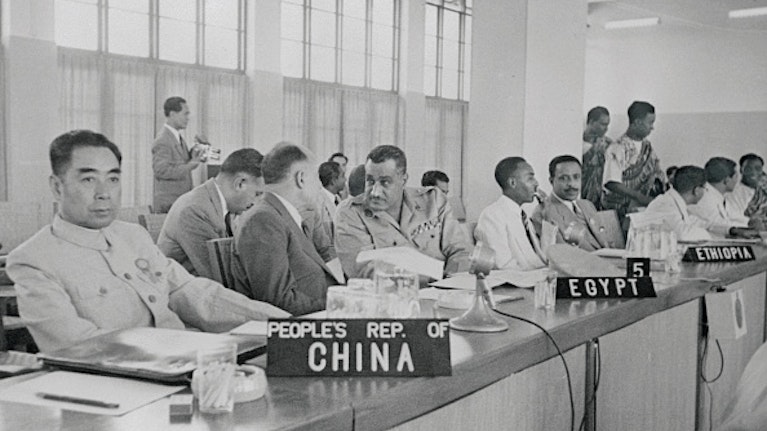
A pivotal moment in that period was the 1955 Bandung Conference in Indonesia, the first intercontinental meeting of leaders from Africa and Asia. Bandung showed that the peoples in the colonized and formerly colonized world could come together and assert themselves on the world stage.
It should be noted that one of the primary objectives of these national-popular movements was to bring natural resources — like oil and gas — under the control of national governments, or even under the control of the capitalists of those countries, instead of under the control of British or French capitalists. The struggle for sovereign control over resources continues today, and is a major cause of U.S. aggression against Iran, which took back control of its oil first in the early 1950s (then thwarted by a U.S.-British-backed coup) and then again in 1979 with the Islamic Revolution.
In the post-World War II period, the main trend in the world was socialist revolution and national liberation. That is what broke the hold of colonialism. That is what made the current multipolar trajectory possible. And this history shows us what is still required today: organized struggle and revolution. Only that can break the imperialist system.
Join the Struggle-La Lucha Telegram channel