
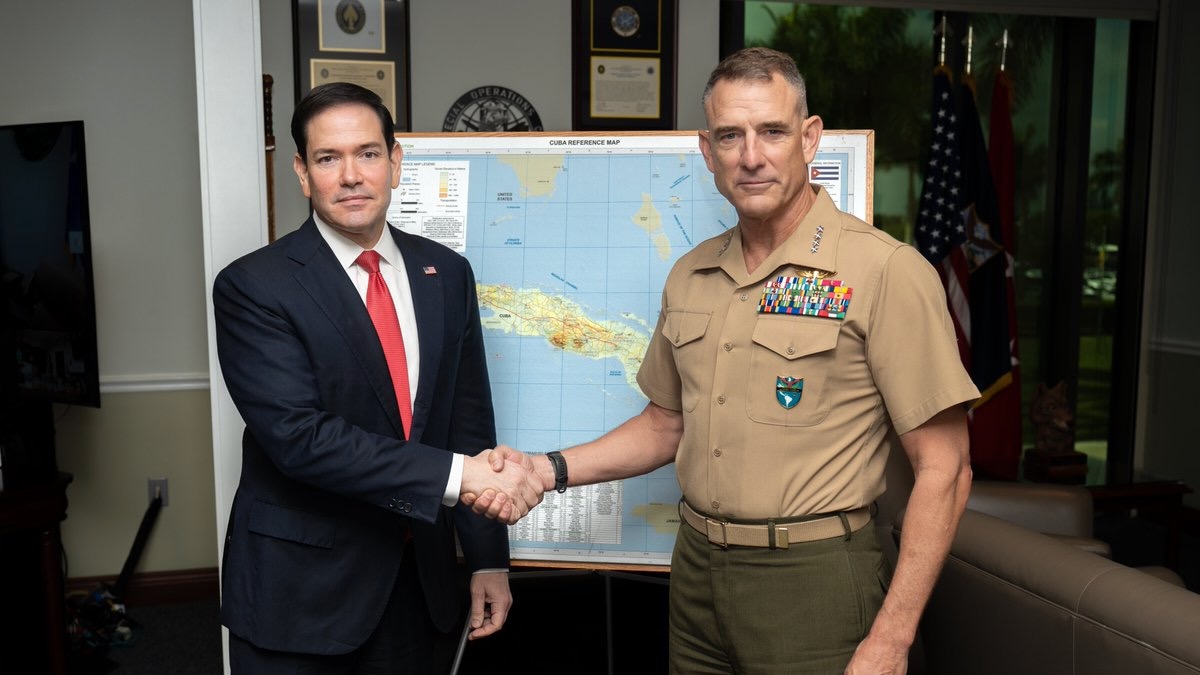
The United States government appears to be shifting its military attention toward Cuba, as negotiations with Iran continue. U.S. Secretary of State Marco Rubio visited SOUTHCOM commander Gen. Francis L. Donovan on May 5, to discuss “threats that undermine security, stability and democracy in our hemisphere” and posted a photo with the commander in front of a map of Cuba.
On May 1, while the Cuban people were preparing the iconic march to commemorate International Worker’s Day, U.S. President Donald Trump announced a new package of sanctions against Cuba. Washington announced that officials, entities, and individuals involved in Cuba’s energy, defense, mining, and financial sectors would be sanctioned.
Furthermore, the U.S. administration announced that any foreign bank or company doing business with Cuban entities could be completely barred – through the freezing of their assets – from participating in U.S. markets, which control nearly the entire global financial system.
Finally, Washington claimed that it will sanction any entity or individual complicit in acts of corruption or human rights violations, a vague measure that the U.S. administration could use selectively to target specific entities.
Cuba is currently undergoing a severe energy crisis that is impacting all sectors of society. Following the January 3 attack and the imprisonment of Nicolás Maduro and Cilia Flores, the U.S. banned the sale of Venezuelan oil to Cuba and on January 31, threatened to sanction any country that sells crude oil to the island, which lies 150 kilometers off the coast of Florida.
These new attempts to strangle Cuba are part of a sustained, long-term strategy that many people have deemed inhumane, a violation of human rights, and clearly imperialist in nature.
Since the 1960s, Washington has imposed a series of economic and financial sanctions against Cuba (the economic blockade being the best known of all), in addition to sponsoring armed invasions, CIA operations, and hundreds of (failed) plans to assassinate the historic leader of the Revolution, Fidel Castro.
All these measures are aimed at destroying the revolutionary process launched in 1959 by the Cuban people, which has been sustained against the wishes and plans of the most powerful military in history, both during and after the Cold War.
New threats from Trump
Added to these new sanctions are the recent threats from President Trump, who stated that he will “take control of Cuba almost immediately.” According to Trump, once the conflict with Iran is over, he could send the aircraft carrier USS Abraham Lincoln to the Caribbean, “about 100 meters off the coast of Cuba.”
On April 28, a group of Democratic senators attempted to pass a resolution that would limit Trump’s ability to launch a unilateral attack against Cuba, but the motion failed to secure the necessary votes.
Cuba vows to defend itself
In the face of these new threats, Cuban President Miguel Díaz-Canel said: “The U.S. president is escalating his threats of military aggression against Cuba to a dangerous and unprecedented level. The international community must take note and, together with the people of the United States, determine whether such a drastic criminal act will be allowed to satisfy the interests of a small but wealthy and influential group, eager for revenge and domination.”
In addition, the Cuban leader insisted that Cuba will be able to defend itself against any aggression from Washington: “No aggressor, no matter how powerful, will find Cuba willing to surrender. They will face a people determined to defend their sovereignty and independence in every inch of the national territory. The homeland defends itself.”
For his part, Cuban Foreign Minister Bruno Rodríguez said: “The U.S. government insists that it intends to take military action against Cuba because ‘the country is devastated … and it would be an honor to liberate it.’ What is cynical and hypocritical is that the U.S. has been trying for decades to devastate the country with an economic war.”
Rodríguez called Washington’s recent executive orders against the Caribbean island “genocidal”, condemning the protracted U.S. campaign:
“Both the economic and energy blockades, the new extraterritorial coercive measures, the threat of military aggression, and the aggression itself are international crimes.”
Source: Peoples Dispatch
Join the Struggle-La Lucha Telegram channel