
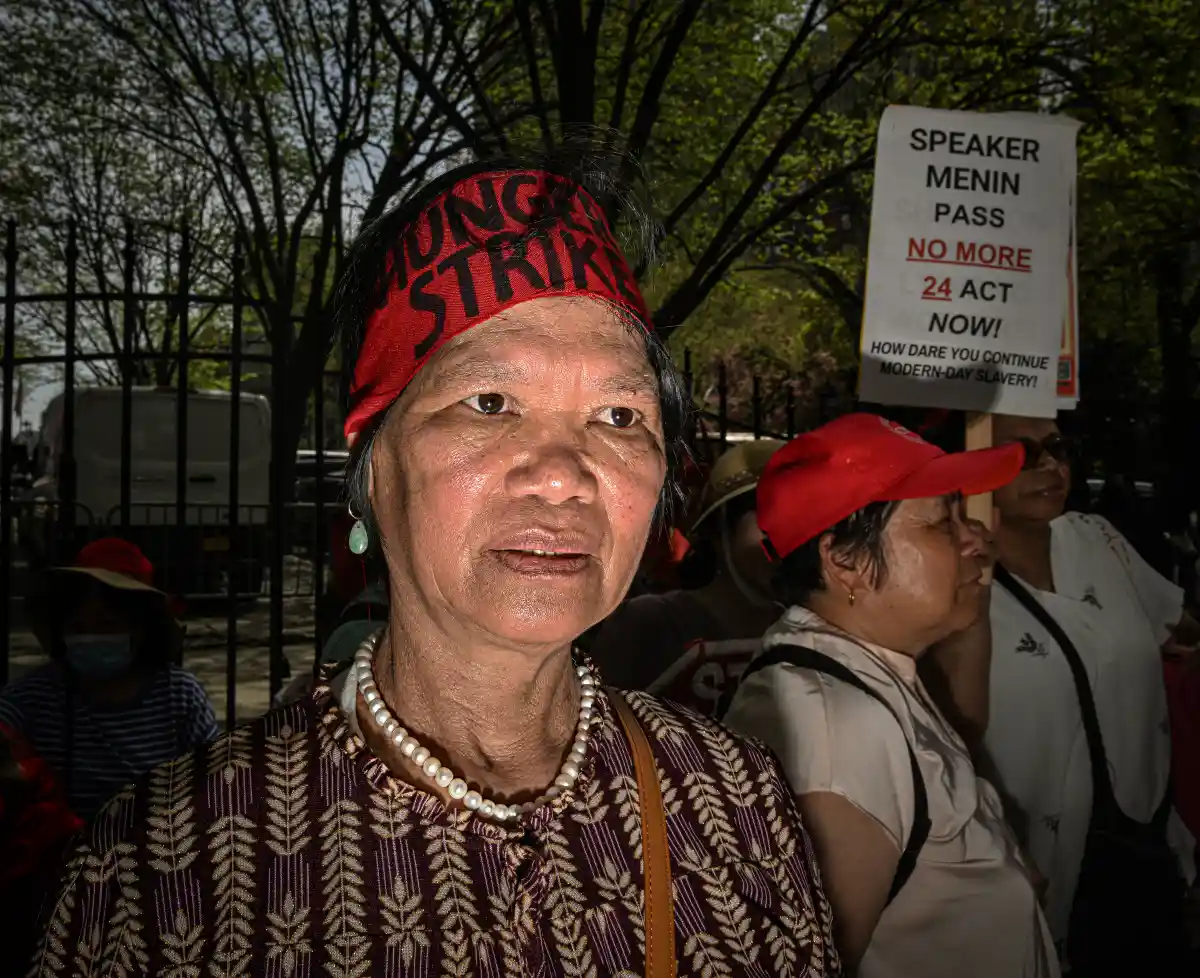
On May Day, home care workers and their supporters protested at the gates of City Hall, fighting for New York State funding to end their 24-hour workday. They demanded that Mayor Mamdani fulfill his election promise to end the 24-hour workday and “recognize the immense labor of home care workers.” Protesters called on District Council 37, the large public-sector union, and Mamdani to press Governor Hochul to pay for 12-hour shifts performed by two different workers.
Earlier, on April 16, the home health workers said they had been pushed to take the desperate step of going on a hunger strike. About 15 workers ended the hunger strike while mobilizing for the May Day demonstration. A previous hunger strike by about two dozen home care workers in 2024 ended after six days.
The hunger strike began after the City Council failed to advance a bill banning 24-hour shifts. About 40 workers holding “Stop the 24 Hr Workday” signs sat on folding chairs beside the gates of City Hall. The home care aides, who are mostly immigrant women, care for those whose lives often depend on round-the-clock care.
The pay of live-in home care workers is subsidized by state Medicaid funds. They are only paid for 13 hours a day. Often, they are forced to maintain 24-hour shifts. During that time, job regulations allowed only three hours of mealtime and five hours of sleep.
Home care workers report that they are working up to 96 straight hours without rest — while getting paid for only a fraction of that time.
Home health aide Yunfang Zhang, 70, said through an interpreter that she joined the hunger strike because “home care workers cannot wait any longer, and our health has been destroyed. We cannot allow this to continue to the next generation,” she said.
It should be a surprise to no one that the catastrophic lack of health care in the U.S. leads to results such as having the low-paid workers forced to compete for funds with disabled workers who have to rely on home care.
A stalled bill, introduced by Councilmember Christopher Marte of Chinatown, seeks to replace the 24-hour shifts with 12-hour shifts performed by two different workers. This improvement in home care has to come from state funds.
Estimates from 1199 SEIU, a union representing home care workers statewide, say that split shifts under the present Medicaid system would cost an estimated $450 million annually in the five boroughs. To understand how much this amounts to in government spending, consider that the U.S. fired more than 850 Tomahawk missiles at Iran in the first month of Operation Epic Fury alone; the annual cost of split shifts equals just 125 such missiles. What they fired off in one week against Iran would have paid for home care worker costs for a full year in New York.
Join the Struggle-La Lucha Telegram channel