
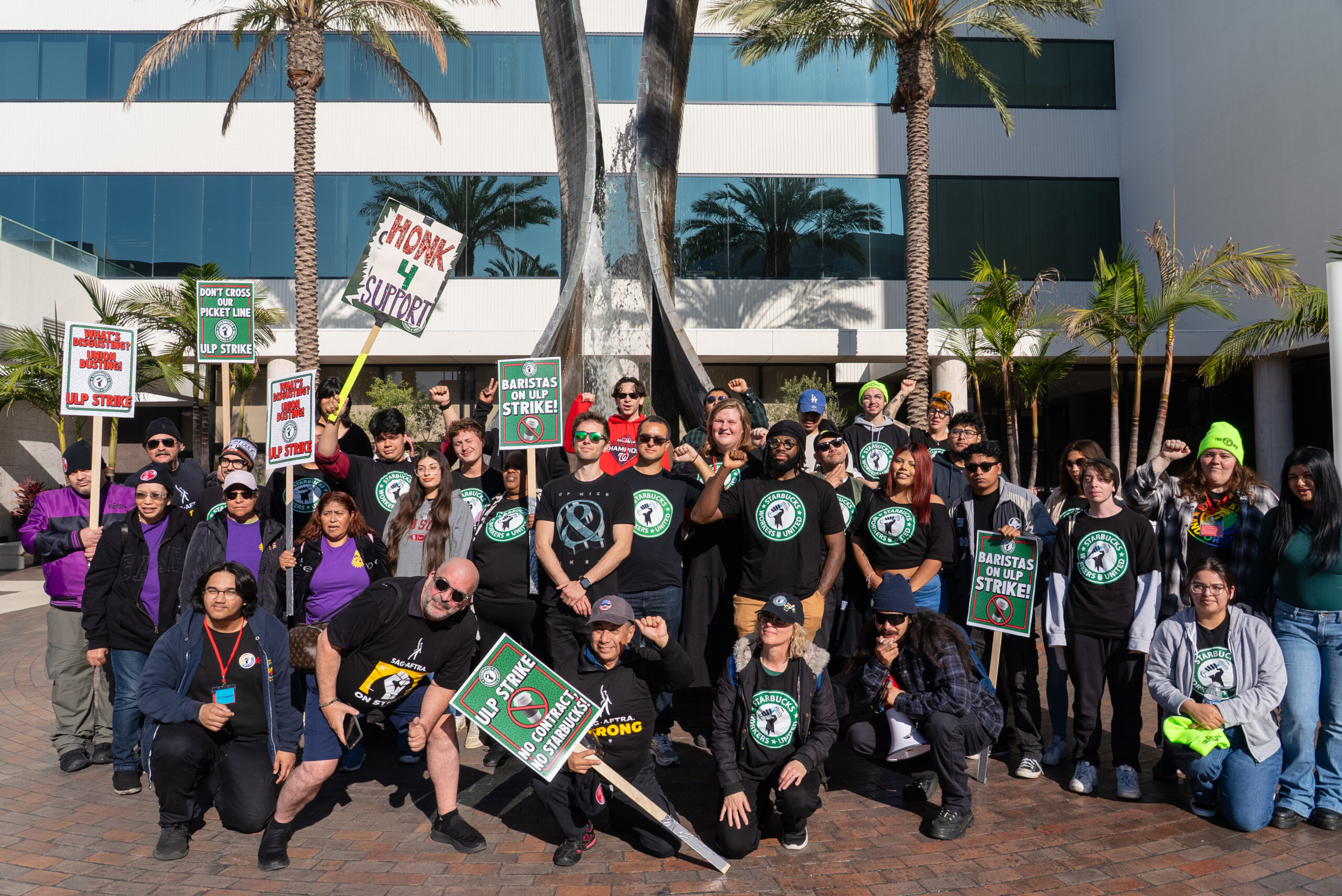
Starbucks returned to the bargaining table with its baristas in April 2026 after the longest nationwide strike in company history forced the company back. Days into the renewed talks, management delivered its answer: a $100 million corporate expansion in Nashville, Tennessee — a right-to-work state — with up to 2,000 jobs promised over five years.
The April 21 announcement landed alongside a fresh round of layoffs in Starbucks’ Seattle-based technology workforce. Starbucks Workers United (SWU) represents more than 600 of the roughly 10,000 Starbucks stores in the U.S.
The strike began on Nov. 13, 2025, and ran into early February 2026. At its peak, about 4,500 baristas picketed at 230 stores across more than 130 cities. Management refused throughout to move on the workers’ wage and staffing demands.
The contract fight centers on pay, hours, and staffing. The union originally pushed for a $20 starting wage across the company. In its February 2026 contract proposal, it scaled that back to a $17 floor for the lowest-paid workers, with 4% annual raises. Starbucks’ current starting wage sits at or below $16 an hour in 43 states.
Inflation has eaten the raises. Baristas report turning to food stamps to cover groceries. Many enroll in Medicaid because Starbucks keeps their hours below the 20-per-week threshold needed to qualify for the company health plan.
Staffing is the other issue. The union wants at least three workers on the floor at all times — a demand aimed at overwork, long customer wait times, and safety on closing shifts. It also wants existing baristas to be offered open hours before the company hires anyone new. Starbucks has long preferred the reverse, adding part-time staff while keeping individual workers below the hours needed to qualify for benefits.
Bargaining resumed in April 2026 after the union’s strike, and a continuing consumer boycott pressured management back to the table. The opening move, according to the workers, was to reopen contract terms that the two sides had already agreed on.
“They’re trying to move backwards on issues we’ve already settled instead of settling the few that we have left,” Mina Leon, a barista in downtown Manhattan who struck for two months, told Labor Notes. Jasmine Leli, a Buffalo, New York, barista on the union’s bargaining team, said the company was reopening terms “that we had already fought for and won after months in bargaining in 2024.”
The union has filed fresh unfair labor practice charges over the regressive bargaining. They add to hundreds of outstanding unfair labor practice charges against Starbucks, including millions of dollars in back pay owed to fired workers.
Management brings relocation plans to the bargaining table
Starbucks said it had reopened agreed contract terms to “reflect current business realities.” Days later, it announced its own new realities. On April 21, 2026, the company unveiled the $100 million Nashville office — up to 2,000 jobs over five years — and a same-day round of layoffs in its Seattle-based technology workforce.
The company insists its Seattle headquarters stays put. Nashville will serve as a Southeast hub, housed in a newly built 250,000-square-foot office tower that Starbucks is leasing downtown. A company blog post said that most Nashville roles would be new hires, with some Seattle-based teams — in supply chain and technology — asked to relocate. Bloomberg reports the company has had little success persuading Seattle staff to make the move.
Tech staff offered the Nashville move were told they could take a pay cut or leave. Bloomberg reports they were initially given less than a month to decide.
The Nashville announcement landed against a specific political backdrop. Washington State allows union-security clauses in collective bargaining agreements — contract provisions requiring workers covered by a union contract to pay dues or fees that support the representation they receive. That legal framework has helped unions like SWU build durable footholds in Seattle.
The Seattle political climate has shifted. On Nov. 13, 2025, Mayor-elect Katie Wilson joined striking Starbucks workers on the picket line outside the shuttered Capitol Hill Reserve Roastery. “I am not buying Starbucks, and you should not either,” she told the crowd. Wilson took office Jan. 1, 2026.
Starbucks has been pulling back from its hometown for months. On Sept. 25, 2025, the company closed the Capitol Hill Reserve Roastery and the Reserve Store inside its SoDo headquarters, along with other Seattle locations, and announced 900 corporate layoffs. On March 30, 2026, Governor Bob Ferguson signed the state’s new Millionaires’ Tax — a 9.9% levy on household income above $1 million, effective in 2028. Starbucks founder Howard Schultz announced the same day that he was moving to Florida.
Anti-labor laws in Tennessee
Tennessee is a right-to-work state. The law has been on the books since 1947, further enforced in 2022 by additional anti-union measures in the state constitution. Workers cannot be required to join a union or pay fees to one, even when a union represents their workplace and negotiates on their behalf.
Tennessee is also an at-will employment state. Management can fire or discipline workers at any time, for any reason or no reason, as long as the reason is not specifically prohibited by law.
The phrase “right to work” was coined by Vance Muse, who founded the Christian American Association in 1936. Muse was openly white supremacist, antisemitic, and anti-communist. He pitched right-to-work laws to Southern planters and industrialists as a way to keep the CIO — which was organizing Black and white workers together — out of the South and to preserve Jim Crow labor relations. His own grandson described him as “a white supremacist, an antisemite, and a Communist-baiter, a man who beat on labor unions not on behalf of working people, as he said, but because he was paid to do so.”
For Starbucks baristas, the Nashville move fits a template. Employer relocation to a right-to-work state is how U.S. companies have punished organizing for nearly a century. The union’s answer is the one it has been making since 2021: at the bargaining table, on the picket line, and at the registers that customers are asked to walk past. No contract, no coffee.
Join the Struggle-La Lucha Telegram channel