
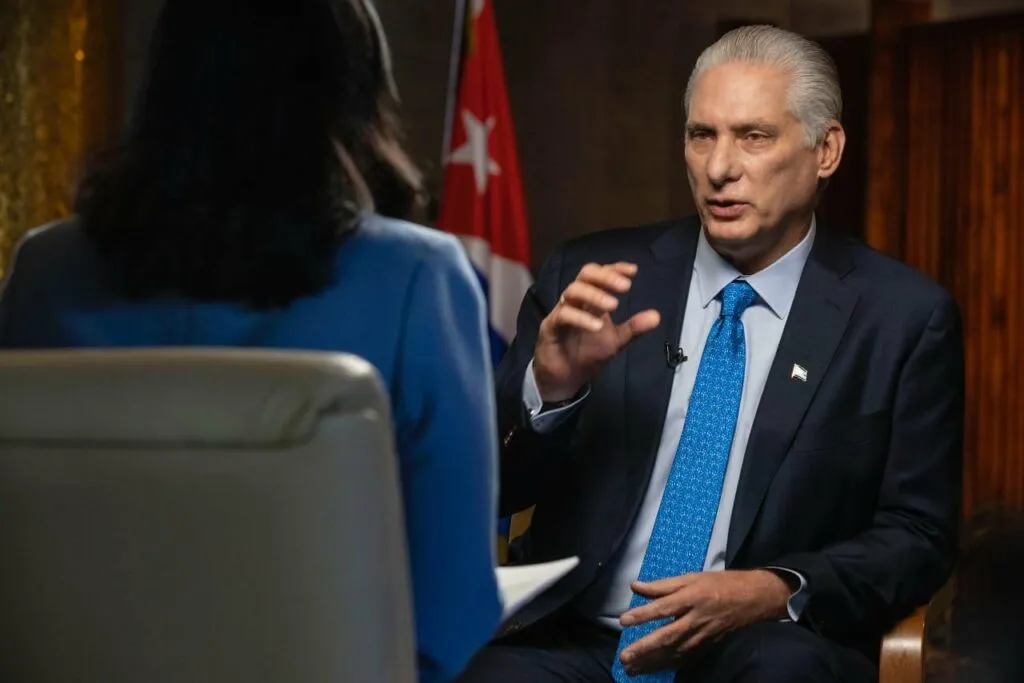
April 13, 2026 — from the office of the President of Cuba
Source: Cuba en Resumen
Kristen Welker: President Díaz-Canel, welcome to Meet the Press.
Miguel M. Díaz-Canel: Thank you very much. Thank you for the opportunity, and thank you for being in Cuba.
Kristen Welker: Thank you for inviting us to your beautiful country; it is an honor.
Miguel M. Díaz-Canel: It is a pleasure for us to have you here.
Kristen Welker: Thank you, thank you very much.
I would like to start with President Trump. He said he has plans to take over Cuba in some way. He said: I think I can do whatever I want with Cuba. Do you take Trump’s threats seriously?
Miguel M. Díaz-Canel: I believe that in recent days many things have been said, not only by the President but also by other U.S. government officials, that truly reflect aggressive language and rhetoric toward Cuba.
One must understand our country’s history. Our country is one whose identity is deeply rooted in the values of sovereignty and independence. For 150 years, Cuba fought, first to free itself from colonial rule and then from neocolonialism. And with the Cuban Revolution, with its triumph in January 1959, a whole range of dependencies was eradicated; subjugation and subordination to a foreign power were eradicated, and this brought a whole range of beneficial consequences for the country, which the Cuban people are not willing to give up.
One of the most brilliant generals of our wars of independence, Antonio Maceo, once said: “Whoever attempts to seize Cuba will only gather the dust of its blood-soaked soil, if they do not perish in battle.”
We are a country of peace. We do not promote war; we do not like war; we foster solidarity and cooperation among peoples, but we are prepared to defend the peace we desire; therefore, we are not intimidated, and we do not want to be caught off guard or defeated. That is one interpretation of this threat and Cuba’s position.
Another possible interpretation is when they claim that Cuba will collapse on its own, and they try to label us a failed state or a country headed for collapse — a claim refuted by reality: how has a country like this, over the past 67 years, withstood all manner of pressures and aggressions, including, for more than sixty years, the longest-running blockade in history — a criminal, genocidal blockade. There is much to discuss on these topics, but I will tell you that the Cuban people and the Cuban Revolution are prepared to defend themselves.
Kristen Welker: Let’s move on to the next question.
President Trump wants to deal with Cuba as he has done with President Maduro in Venezuela, as he has done in Iran where he has targeted the Supreme Leader. Do you think you could be arrested or assassinated by the U.S. government?
Miguel M. Díaz-Canel: That is a very interesting question. I never like it when parallels are drawn between Cuba and other nations, because we have our own history, we operate under our own circumstances, and it also shows a lack of understanding of our history, the strength of our unity, and the strength of our institutions.
Those of us who assume responsibilities within the Revolution have a commitment to the Revolution, above all to our heroic people. And that sense of responsibility includes the conviction that we are willing to give our lives for the Revolution, for the cause we defend. Therefore, for me, that is not a concern.
If the time comes, I do not believe there is any justification for the United States to provoke an attack on Cuba or for the United States to attempt a surgical strike or the kidnapping of a president in Cuba. If that were to happen, there would be combat, there would be a fight. We will defend ourselves, and if we must die, we will die, because as our National Anthem says: “To die for the Fatherland is to live.”
But there is a misunderstanding here, and that is that the leadership of the Cuban Revolution is always personalized with a single individual. At one time it was personified by the Commander-in-Chief, at another time by the Army General; now they try to personify it with me. The fact is that we have a collective leadership in which there is unity, cohesion, ideological unity as well, and revolutionary discipline. Therefore, eliminating one person from the Revolution’s leadership structure does not solve any problem; on the contrary, there are hundreds of people who are capable of assuming that responsibility and making decisions collectively. And we are prepared to face any kind of situation.
Kristen Welker: What you say is very powerful, but are you afraid for yourself, for your family? Are you prepared, as you say, to make the ultimate sacrifice if you were attacked?
Miguel M. Díaz-Canel: I am not afraid; I am willing to give my life for the Revolution. Of course, I would not want that to be the attitude of the United States government. I do not believe that the American people — who are a sensitive people — would allow or approve of their country, their government, invading a small island that poses no national security concern for the United States government; an island that wants peace, an island that wants dialogue, an island where the people want to have a direct relationship with the American people — would look favorably upon that.
Furthermore, what would be the justification for doing that? But, moreover, an attack on Cuba would have costs; it would have costs for both countries in terms of unnecessary loss of human life, which could be avoided; it would have material costs; it would affect the security and stability of the United States, Cuba, and the region.
I believe we must approach matters with great responsibility when making a decision of such magnitude. And, above all, before making that decision — which is totally illogical and irrational — there is a more just approach: that of engaging in dialogue, discussion, and debate, and of trying to reach agreements that steer us away from confrontation.
Kristen Welker: Is Cuba actively preparing for the possibility of an attack by the United States?
Miguel M. Díaz-Canel: Look, as I have always stated in other meetings, in other interviews, and also when we speak to the Cuban people, it is evident that there is a threat; it is present in the rhetoric of the United States government. Cuba has done nothing to offend the United States. Cuba has never at any time proposed attacking the United States, nor interfering in the internal affairs of the United States. However, it is constantly being said that Cuba is next, that Cuba is going to be attacked, that there are plans for Cuba, that they are going to take over Cuba. Therefore, from the standpoint of responsibility in leading the country, this is a warning, and we must responsibly protect our people, protect our project, and protect our country. So, yes, we are preparing for defense.
Now, what is the concept behind our defense preparations? We have a defense doctrine that is entirely defensive; it is not aggressive, it poses no danger to anyone — it is simply a doctrine known as the War of the Entire People, which has been collectively built upon the experience of our history, and was fully conceived and structured precisely during a very difficult period in our history when we were also under serious threat from the United States government. And it is based on popular participation: every Cuban woman and every Cuban man has a mission, a purpose, a goal to defend, a place and a position to occupy in the defense. And it is based on popular participation, voluntary participation, and, of course, it includes preparation for the defense of all levels and all links that make up our territorial defense; but it is a totally defensive and non-aggressive concept. And, furthermore, because we also start from a fact: that preparing to defend ourselves is the best way to avoid war and the best way to preserve peace.
I would go further: I believe that what both the American people and the Cuban people deserve in their relationship is neither aggression nor the language of war. What the American people and the Cuban people deserve is peace — a peace that allows us to have an atmosphere of trust, cooperation, collaboration, solidarity, and, of course, understanding.
Kristen Welker: Do you think the Cuban military could succeed in a confrontation with the United States if one were to occur?
Miguel M. Díaz-Canel: When we speak of Cuba’s defense, we speak of our glorious Revolutionary Armed Forces, but also of our people, who are organized into different links of that territorial defense. Yes, we would succeed; yes, we can succeed. There is no enemy that cannot be defeated.
Kristen Welker: But against the United States, the world’s greatest power?
Miguel M. Díaz-Canel: The United States has a concept of waging war. Our concept of territorial defense is based on irregular, asymmetric warfare, where they might achieve successes at a given moment; but it would become unsustainable for them to invade and, moreover, occupy Cuban soil, because there is a decision — and that decision, that conviction, I refer once again to Maceo’s phrase: he will only gather the dust of his blood-soaked soil, if he does not perish in the struggle. And it is not a slogan, it is not a catchphrase. If you go out on the street now and mention or show the first part of that phrase to a child, an elderly person, a Cuban, a young person, they will immediately complete it for you, because that is how we have been raised, and that is in our hearts.
I repeat that this is not what we want. We do not want a war; we do not want a confrontation. It would come at a great cost to everyone.
Kristen Welker: Well, I’m going to ask you about this extraordinary moment.
The United States has suspended fuel supplies to Cuba; but Russia has resumed them. Do you think the Russians have obtained permission to help Cuba? How did this work?
Miguel M. Díaz-Canel: I believe that never before has such a common occurrence — such as trade between two countries — been followed so closely by the media and the public, in different parts of the world, as the arrival of the Russian ship carrying fuel, which came as humanitarian aid. In other words, it was not a commercial transaction.
I believe that Cuba has the right, like any country, to import oil. And all countries also have the right to export oil to Cuba. Therefore, this energy blockade is very unjust, as it further intensifies the U.S. blockade against Cuba. In other words, declaring an energy blockade against Cuba demonstrates once again that there is a full-scale multidimensional aggression by the U.S. government against Cuba. With an economic war that has lasted 67 years, with a blockade that has lasted more than 60 years, with a blockade that intensified in 2019 under the first Trump administration, which was maintained by the Biden administration even amid the COVID-19 pandemic, and which now, once again, is being enforced with maximum pressure, causing devastating harm to the Cuban population through this energy blockade.
The Russian Federation was able to send that ship as humanitarian aid. The United States has persisted in maintaining the energy blockade; therefore, we have no certainty as to when another oil tanker might enter Cuba, even though we have the right to ensure that happens. And this ship that has arrived should not give rise to false expectations, although it is an important aid at a time like this, which we acknowledge, but it only covers one-third of Cuba’s monthly fuel demand. In other words, we cannot believe now that this has already saved the situation.
Now we have crude oil that we must refine, that we must distribute throughout the country, and a significant portion of which we will dedicate to utilizing an electricity generation capacity of over 1,200 megawatts that has been idle for four months — this could improve our energy supply situation and also support certain economic activities.
Kristen Welker: How long can you survive until the next shipment of oil from Russia arrives?
Miguel M. Díaz-Canel: That is an extremely interesting question, and it must be answered at a very difficult time. No country in the world can develop a thriving, prosperous economy without fuel. That is why I tell you that there is an element of perversity, of malice, when a power that plays the role of an aggressor subjects a small nation — one that is constantly under attack — to a situation like this.
But we have not stood idly by. What have we committed to? We have a comprehensive Strategy and Program to revitalize the energy sector in the country: first, to rely more on domestic crude oil rather than on imports. In Cuba, we have oil fields, though they are not sufficient to meet all our needs; but we can — and in fact are — increasing oil production, and we are exploring more fields; we are open to foreign investment in Cuba for oil well drilling and exploration. In fact, this would be an opportunity for U.S. businesspeople who could also participate in Cuba through investments in the energy sector. The problem is that the blockade prevents this, but Cuba would welcome U.S. companies wishing to participate in the energy business in Cuba, without any prejudice. That is one approach.
On the other hand, we have turned to science and innovation. Our scientists have discovered and developed technologies so that this Cuban crude oil — which is very heavy due to its high sulfur content — can be refined. Therefore, if we increase production, we could achieve a certain level of availability — which would not meet all our demands, but a certain level of availability that we do not have today — with products derived from the refining of that Cuban crude oil.
And on the other hand, we have developed a comprehensive energy transition strategy with more intensive use of renewable energy sources and, of course, also with an energy efficiency strategy. All of that combined is going to lead us — or is already leading us — to a different situation. It is still complex, it takes time, but we will be able to hold out.
Kristen Welker: But what can be said about the strength of the Cuban regime at this moment, when it needs Russia’s support to survive?
Miguel M. Díaz-Canel: Above all, we rely on our own people and our own capabilities. I believe the first thing to highlight is the creativity with which our people have faced the adversities imposed by the blockade — the intensified blockade — and now the energy blockade.
I always describe the attitude of our people — of whom I am utterly proud — because they are constantly teaching lessons in resistance, demonstrating a spirit of creative resistance. The Cuban people do not resist by merely enduring, suffering, and submitting in humiliation. On the contrary, they resist and rise to the occasion; they are capable of innovating, capable of creating, and through this they can overcome adversity. Therefore, it is the people, and our strength lies in our people and in the unity we share with them.
Now, for us, we welcome the help from Russia, the help from China, the help from Vietnam, the help from Mexico, and the help from other countries. The United States could also adopt a different approach toward Cuba — one that isn’t based on confrontation, aggression, and the blockade — and could also help Cuba.
Does that hinder Cuba’s development?
Kristen Welker: President Trump says this is a country on the brink of collapse.
Miguel M. Díaz-Canel: It’s very curious, because in relations between Cuba and the United States, especially in times of tension, there is a heavy reliance on media narratives, on representations of stereotypes, and even, for global public opinion, certain views are almost imposed. And in this case, it’s the narrative of collapse.
I would ask, what country in the world would be capable, as Cuba has been, as the Cuban people have been, of withstanding 67 years of sustained aggression from the world’s most powerful nation, with over 60 years of a blockade, with the last six or seven years seeing an intensified blockade, and now with an energy blockade, and still not collapse? We have not collapsed; we maintain an organized country, a country in harmony.
In 67 years of Revolution, we have achieved many social gains; and while we are sometimes criticized for our economic performance, the fact is that we have had to face a war economy, and in the midst of that war economy, our economy has been able to withstand the pressure and move forward with social projects. We have more than 32 social projects to address vulnerabilities and inequalities. Sixty-seven years of the Revolution have prevented the country from collapsing — and it will not collapse! — and the country has made significant strides.
We have a universal healthcare system that reaches everyone, providing free healthcare for the entire population. We have an education system, from general education to university education, that includes everyone and is also free. We have achievements in culture and sports; we are one of the countries with the highest ratio of Olympic medals per capita. We have developed human resources, and we also have the potential for a skilled workforce and scientists. We have developed science and innovation. The advances in Cuban biotechnology and the biopharmaceutical industry are well known. We have achieved equity, justice, and equality.
We have a society where tranquility reigns, a safe society; a society that does not tolerate corruption, drug trafficking, or organized crime; a society capable of offering solidarity to other peoples based on its own potential. And that cannot be viewed as a collapse.
They try to impose the narrative of collapse on us when, due to an aggressive policy — a genocidal blockade policy — they force us to live through a complex situation. We are living through a complex situation; our people face very difficult circumstances every day, which are on a national scale, but we can bring them down to the family level. But our country has not collapsed.
Kristen Welker: No one would dispute that the blockade or embargo has had an impact, but let’s discuss the situation here in Cuba.
The Cuban people are suffering; there are shortages of energy and food. Do you bear any responsibility for the suffering the people are experiencing right now? As President, don’t you feel responsible for it?
Miguel M. Díaz-Canel: Look, the Cuban people are suffering. And that suffering, as I was saying, can be seen in two spheres: at the national level and at the family level, because it’s all part of daily life.
Now, what is the fundamental cause of that suffering? Is it the mistakes I may have made, or, as I said, collective leadership?
Kristen Welker: Or the government?
Miguel M. Díaz-Canel: Or the government.
Or is that suffering due above all to the intensified blockade policy, maintained and sustained by the United States? I believe the answer — and the people, the majority of our people, can provide it — lies in that policy of permanent hostility by the United States government.
Look, at the national level: we are a country that, after 2019, when the blockade was intensified — when the U.S. administration implemented 240 measures that intensified that blockade and also included us on a spurious list accusing Cuba of being a country that supposedly supports terrorism — had all our sources of external financing cut off.
We do not receive loans from any bank. There is financial and energy persecution. Anyone who comes to conduct a commercial, financial, or banking transaction with Cuba is subjected to coercive measures and pressure. They do the same with shipping companies; they do it with oil agencies.
They exerted pressure and took measures to cut off tourism to Cuba. For example, a European citizen holds a visa called an ESTA visa to visit the United States; if that European citizen comes to visit Cuba as a tourist, the United States automatically revokes their ESTA visa. In other words, these are a whole series of situations that do not apply to any other country in the world.
We lack funding to purchase food; to acquire supplies for our main production and services; to obtain the medicines we need; and to make the repairs we need to our national power grid and our industrial infrastructure. Now, how is that playing out right now? On our people.
Kristen Welker: And yet the people of Cuba say you can’t just blame the United States, because the economy has been in decline for the past ten years. Thousands of people have left the country.
Miguel M. Díaz-Canel: So, as I was saying, how does that play out in family life today? There are food shortages, there are medicine shortages; early mornings become laborious because, when you’ve gone 20 hours without electricity due to a blockade — not because of a government’s incompetence — that’s when you have to do the household chores.
Kristen Welker: But this was before the blockade; people were suffering even before the blockade.
Miguel M. Díaz-Canel: No, no, no, let me explain. There’s a misunderstanding here, there’s a misunderstanding!
We were already living under the conditions of the blockade, but the blockade intensified and took on a different character in the second half of 2019 with these 240 measures and with Cuba’s inclusion on a list of countries that supposedly support terrorism. Therefore, everything intensified.
So, here we have the cumulative effect of the blockade, plus the effect of the intensified blockade, plus the effect that this energy blockade is now adding to and amplifying. I’m telling you this responsibly: it’s not the Cuban government’s fault. It’s not the Cuban government’s fault!
It has also created discontent, because living through the last 10 years under those conditions — which are extreme compared to other times … The Cuban people have frustrations, the Cuban people have grievances, the Cuban people are facing very complex situations; but the majority of the Cuban people do not blame the government for this. There has also been a lot of manipulation in the media; the aim is to ignore the effects that blockade has had over all these years.
And I’m going to give you some concrete examples so you can see the brutality of that blockade and what it has meant for the Cuban people, and yet, what the response has been from that government that you supposedly want to condemn as the culprit. And I’m going to refer to the COVID-19 period.
When COVID-19 entered our country, we realized early on that we would not have access to the global vaccine market, which was dominated by large transnational corporations, and therefore, given the economic restrictions we were already suffering due to the intensified impact of the blockade, we did not have the necessary funds to purchase those vaccines. Consequently, we were denied access to vaccines. We had to turn to Cuban science.
This government, condemned by some, dedicated all its efforts to protecting the lives of Cubans. We turned to our scientists, and in a short time they were able to develop Cuban vaccines that allowed us to achieve one of the highest levels of effectiveness in combating COVID-19.
Our indicators for combating COVID-19, in terms of effectiveness, are better than those of the United States, which is a power that is not subject to any blockade.
Later, we faced a crisis due to a breakdown at the medical oxygen production plant. At that time, the U.S. government refused to allow companies to sell us oxygen, which is a completely criminal act, but through international solidarity and a massive organizational effort, we managed to overcome that crisis.
And when we needed to expand our intensive care units, the U.S. government banned the sale of ventilators to Cuba. We turned to young scientists, and those scientists developed the ventilators.
Now, you know that to make a ventilator, you need U.S. parts and components. The blockade prevents any equipment containing more than 10% U.S. components from being sold to Cuba. So, we had to go to different places to buy a small part, to buy a wire, to buy a servomotor to get those things. No one else in the world has had these things imposed on them.
The blockade is very aggressive, it is very genocidal; therefore, it is unjust to blame a government whose sole purpose is a dedication to its people, to serving its people, to seeking social justice, and to finding solutions — and in complex situations, we do find them — to blame it for these evils.
I believe the U.S. government should reflect on how cruel it has been toward Cuba and the Cuban people. And it shouldn’t come presenting itself as the savior of the Cuban situation — it has no right to do so, no right at all, nor does it have the moral authority!
Kristen Welker: But in terms of what the Cuban people are experiencing — we saw it with our own eyes — there are people suffering on the streets of Havana, the capital city. Isn’t it time for Cuba to take responsibility, to look in the mirror, and to change Cuba’s economic system in favor of the people who are suffering?
Miguel M. Díaz-Canel: We always conduct very self-critical analyses of our realities and are constantly trying to transform, to revolutionize what we do in pursuit of improvement, but this has nothing to do with the political system.
Our political system is not the one that prevents us from moving forward. I repeat that the blame lies with the blockade imposed by the United States government. That very same people who are suffering these conditions today — and a significant portion of whom understand who the real culprit is — are the people who have approved, through various popular consultations and referendums, the political system we defend.
Our political system is designed for the people; it is designed for social justice; it is designed so that we can all move forward. And it seems to bother others in the world because of what it might represent, because it is a system for us — it is not a system we want to impose on anyone — and so they block it in this way; because, you see, we are not just talking about a blockade; we are talking about a blockade that is unusual — it has been the longest in human history, the most severe.
A blockade that, moreover, is not only against the Cuban people, but against the American people as well, and has also become internationalized. American businesspeople cannot invest in Cuba — why? American citizens cannot freely visit Cuba — why? Citizens of other countries, businesspeople from other countries, are also subject to sanctions.
Source: Cuba en Resumen
Join the Struggle-La Lucha Telegram channel