
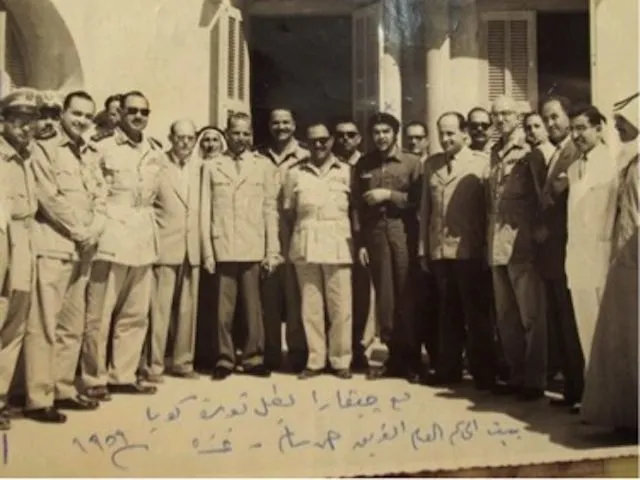
Ernesto Che Guevara traveled from Cuba to the Gaza Strip in 1959. A photograph immortalizes that moment. He wore the olive drab uniform from the struggles in the Sierra Maestra, which led to the victory of the Barbudos rebels in January of that year. At his side stood Palestinian leaders; in the background, a land marked by resistance and dignity.
The Argentine revolutionary had arrived at the invitation of Gamal Abdel Nasser, then president of Egypt, in the years following the Nakba, when hundreds of thousands of Palestinians were expelled from their land after the 1948 war that led to the creation of the Zionist regime of Israel. ccording to multiple accounts, Che was the first international revolutionary to set foot in Gaza after that catastrophe.
Those who accompanied him recall his probing gaze. Faced with devastation, he asked: “Where are the training camps? Where is the people organizing themselves for their liberation?” He was not only seeking to understand suffering, but also the capacity for resistance.
Since then, his figure has remained linked to Palestine in enduring ways: in Palestinian students trained in Cuba, in networks of solidarity, and in a shared idea of struggle against occupation and dispossession.
Decades later, that legacy of solidarity has multiplied. In 2025, the Global Sumud Flotilla brought together thousands of people — doctors, builders, human rights defenders — in an attempt to break the siege on Gaza. More than a hundred vessels and hundreds of trucks mobilized with humanitarian aid and a broader goal: to sustain an international civilian presence alongside the Palestinian people.
Israeli forces blocked the attempt. Far from fading, the initiative amplified visibility of a prolonged crisis and reaffirmed a conviction: that international solidarity can be a form of resistance.
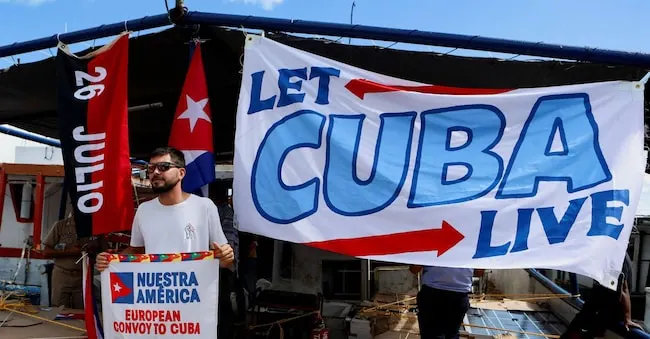
That conviction takes shape again on March 19, 2026. From Yucatan, Mexico, a new flotilla sets sail, this time bound for Cuba. Under the name “Nuestra América,” the mission seeks to challenge the economic and energy blockade the United States has imposed on the island.
The journey across Caribbean waters inevitably recalls the Granma, the yacht that in 1956 carried Fidel Castro, Che, and other expeditionaries who would go on to launch the Cuban Revolution. The context is different today, but the narrative of resistance endures.
Organizers say current restrictions, intensified under Donald Trump, have limited access to fuel, flights, and essential goods — with severe consequences for the most vulnerable: newborns, the sick, and the elderly. “That is why we are launching the Nuestra América Flotilla,” they said, framing the initiative as an urgent act of solidarity.
From Gaza to Cuba, these stories are separated by distance but connected in meaning. In both, the sea serves as a bridge. Blockades function as instruments of pressure and punishment against entire populations. Flotillas emerge as collective responses to break isolation.
More than six decades after that visit to Gaza, Che’s figure reappears not as nostalgia, but as a thread connecting a tradition: that of those who, in the face of the suffering of other peoples, choose not to remain still.
Source: Resumen Latinoamericano – English
Join the Struggle-La Lucha Telegram channel