
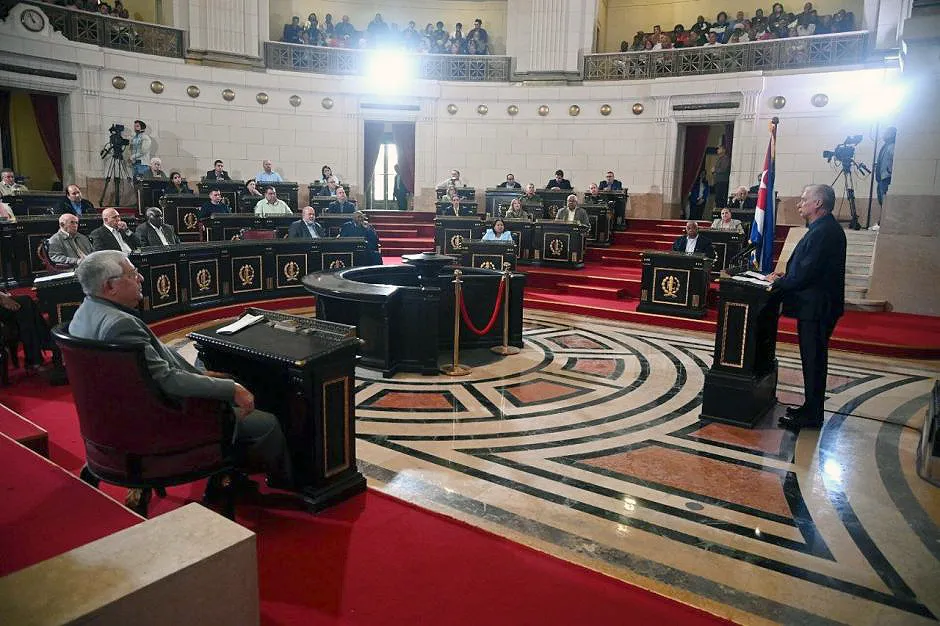
Speech delivered by Miguel Mario Díaz-Canel Bermúdez, First Secretary of the Central Committee of the Communist Party of Cuba and President of the Republic, at the Parliamentary Public Hearing, at the National Capitol, on Feb. 24, 2026, “Year of the Centennial of Commander in Chief Fidel Castro Ruz.”
Dear comrade Esteban Lazo Hernández, President of the National Assembly of People’s Power and the Council of State;
Comrades:
Today, Feb. 24, we are gathered on a date that transcends the calendar. In the history of Cuba, this day is charged with profound meanings that are intertwined like threads of the same fabric: that of our sovereignty.
On Feb. 24, 1895, the necessary war was restarted with the cry of independence or death, thus fulfilling Martí’s design. On that same day, but in 1899, Generalissimo Máximo Gómez entered Havana victorious, and in 1956 José Antonio Echeverría founded the Revolutionary Directorate. Two years later, in 1958, from the heart of the Sierra Maestra, Radio Rebelde began broadcasting; and in 1976, the continent’s first socialist constitution was born. In 2008, Army General Raúl Castro Ruz assumed the presidency of the Council of State and the Council of Ministers. And in 2019, the people ratified the new Constitution of the Republic at the polls.
Exactly half a century ago, on this very day, the Local Organs of People’s Power were born. With them, an essential principle of the Revolution took concrete form: that power emanates from the people, is exercised in their name, and is owed, above all, to their needs and hopes.
It was and is the most authentic expression of socialist democracy and of the will that it be the citizens, from their communities, who decide the destiny of the homeland.
This is a day to look back with deep respect, but above all, to look forward with the clarity that these times demand, because in today’s world, a 50-year celebration can never be an exercise in nostalgia; it must be, above all, a call to action.
The historic decision of 1976 was not an isolated act; it was the organic continuation of a tradition of struggle and participation, rooted in the independence movement, in resistance in the face of adversity, and in the deepest conviction that the destiny of the nation is built with the voice and action of the people. It is a concrete expression of the political thinking of Commander in Chief Fidel Castro Ruz.
The Organs of People’s Power were created to be a school of citizenship, a space for debate and collective solutions. For five decades, these Organs have been the direct link between the aspirations and demands of each neighborhood and State policies.
Half a century ago, we set in motion a profound idea, which is that power, to be legitimate, must come from the neighborhood, from the People’s Council, from the block and the community.
Our local bodies are not simply an administrative design of the chosen form of government. They are our answer to the essential question of how to build a democracy where the people are the real and indisputable protagonists of their destiny.
We are celebrating half a century. May so many years of hard work not be a burden that leads to inertia, but rather a motivation that propels us toward the future we deserve! We want a more agile, more participatory, more daring, more inclusive, and younger People’s Power. A People’s Power that has the capacity to listen to even the slightest whisper of the citizens and enough sensitivity to act quickly in response to their legitimate demands.
The people do not ask us for miracles. They ask us for honesty, good management and, above all, that we never lose sight of them, that we march together, shoulder to shoulder, through good times and bad.
We are living in a complex national context, marked by economic difficulties, in a turbulent global scenario.
There is accumulated pain in our neighborhoods, legitimate discontent, impatience weighed down by the burden of the criminal blockade and inclusion in a spurious and manipulated list of countries that supposedly support terrorism; maximum economic pressure to suffocate us, the application of unilateral coercive measures, the aggressive pressure of hatred as a fundamental component of the incessant media war that seeks to discredit and divide us; the issuance of a genocidal Executive Order that seeks to deprive the country of vital energy supplies, and, along with that long list of attacks and threats, our own mistakes and shortcomings, which we are obliged to acknowledge and amend without excuses, because only what is first faced head-on and with total honesty can be transformed.
We will fight, we will struggle, we will resist, we will transform, and we will grow and overcome all adversities and imperial threats! (Applause.)
The anniversary we are celebrating invites us to reflect on the validity of that project of love for the nation, based on unity. It reminds us that democracy is not an abstract concept, but a daily practice that is strengthened by the active participation of all and for the good of all, with transparency in management and shared responsibility.
People’s Power is, in essence, the certainty that no problem is too big if it is faced with unity, solidarity, and confidence in our own strength.
Celebrating these 50 years also means renewing our commitment to the future. It means recognizing that the Cuba we dream of is built from the local level, from each People’s Council, from each delegate who listens and acts, from each citizen who contributes ideas and effort. It is reaffirming that social justice, equity, and dignity are inalienable values and fundamental guides on the path to the prosperity we deserve.
In accordance with this will, this Solemn Session is called upon to transcend the well-deserved act of remembrance and tribute. It cannot be a succession of slogans. Above all, it must and should be an exercise in awareness and commitment.
Today we pay tribute to the founders, to the delegates of these five decades, who, almost always without resources and without rest, have knocked on doors, listened to complaints, stood up in difficult assemblies, and defended, from the modesty of their constituencies, the great idea that no one can be left to fend for themselves in a revolutionary and socialist state.
And the best tribute we can offer them is not a diploma or applause, but the will to do better what we now have to do.
What do 50 years of People’s Power mean at this moment in our history?
First, it means appreciating the essence of closeness.
In these 50 years, the delegate has not only been a representative, but also the voice of a small community in the big statistics. In today’s Cuba, that role is more vital than ever. In the delegate, citizens should find not a bureaucrat, but a neighbor who is a community leader who resolutely and boldly tackles common problems, from concerns about what is not arriving at the grocery store, potholes in the street, transformer breakdowns, or worries about young people who neither study nor work and elderly people without close family support. Our strength does not lie in grand proclamations, but in our ability to resolve the small but enormous and always challenging issues of everyday life.
Second: it means understanding that participation is not just another name on the list of attendees at an event. It is the engine of collective progress.
For too long, we have sometimes confused People’s Power with a transmission belt for decisions already made. The 50th anniversary requires us to take a qualitative leap in this narrow interpretation of a genuine, very Cuban work that is greater than ourselves.
We need the municipalities, the true guarantors of the rights enshrined in our Constitution, to exercise their autonomy. The country is saved from the local level, from the ability of each territory to find its own solutions, to promote its enterprises, to manage its culture and economy with creativity and without unnecessary constraints.
Third: it means honesty in analysis and courage in criticism.
We cannot look back on the path we have traveled without questioning our shadows. We have suffered greatly from the consequences of formalism and improvisation, which very often distort and undermine strategic planning. And we are still held back too much by centralism, that is, excessive centralization that restricts the creative initiative of individuals, groups, and municipalities. Recognizing this does not weaken us; it strengthens us. The true revolution is one that constantly criticizes itself so as not to grow old.
Fourth: it means shielding hope.
Amidst external hostility, the blockade that seeks to suffocate us, the noise and manipulation that seeks to weaken us, the work of the People’s Power is the most effective antidote. Because when a delegate manages, when neighbors participate, when a community organizes to clean up a vacant lot or restore a children’s circle, we are demonstrating that here there is a project of social justice capable of constantly renewing itself with its own forces.
We are not a democracy for show; we are a democracy of trenches, built with enormous sacrifices, it is true, but also with impressive creativity and unsurpassed dignity in the heat of the most difficult combat: that of day to day and hour to hour.
In this context, the call is clear.
To the delegates:
It is not enough to be elected; we must be chosen every day by the respect and trust of our fellow citizens who are our neighbors. We must be more on the street than behind our desks, more in line than in meetings, more listening than talking. We must turn every complaint into concrete action, every criticism into a proposal, every problem into an opportunity to join forces and move forward, move forward without tiring. We will not always have resources, but we can always have the sensitivity and willingness to change what needs to be changed. And the truth, even when it hurts, always builds more than silence or automatic justification.
To local administrations:
People’s Power is not a formality or a signature at the end of a resolution. Government management must be coordinated with the priorities that emanate from local bodies, municipal assemblies, people’s councils, and direct analysis with the community. We cannot allow bureaucracy, routine, or lack of control to render the agreements that arise from the will of the people meaningless. Serving the people means governing with the people in mind, being accountable with data and results, explaining when things cannot be done, and rectifying when mistakes have been made.
To our people:
Today, we must also look within ourselves. Participatory democracy does not end with going to vote when the polls are open. It is exercised in accountability assemblies, in volunteer work, in neighborhood meetings organized to maintain peace in the neighborhood and mobilize support for the most vulnerable. Criticism is necessary, but it is more powerful when accompanied by a willingness to get involved, to propose, and to collaborate. The power of the people is not an abstract concept; it is built with names and surnames, with concrete faces, with hands that get to work, more valuable the more adverse the situation.
Fifty years later, we can proudly say that the People’s Power system has been a genuine creation of ours, the result of the experience and political thinking that sustains the Revolution, of the legacy of José Martí, of the ideas of the commander in chief and the army general. But we must also admit, with humility, that it is an unfinished work, one that needs to be perfected and adapted to the challenges of our time: an aging population, migration, new technologies, new forms of participation, new ways in which human groups form their opinions and expectations.
The Local Organs of People’s Power must be capable of dialoguing with a country that is not the same as it was in 1976, and of doing so without renouncing their founding principles.
May this 50th anniversary then be a turning point, not the goal. A moment to reaffirm that we will not renounce the idea that the people decide, control, demand, and participate. A moment to say, calmly and firmly, that we are willing to change everything that needs to be changed in the way institutions function, as long as it is to strengthen social justice, equity, and conscious participation.
On behalf of all those who have dedicated their lives to public service from a constituency, all those who have shouldered the concerns of their neighborhoods, all those who have opened their doors in the early hours of the morning to attend to the urgent needs of others, let us reaffirm today a simple and profound commitment:
Never lose touch with the people.
To take on the pain of others as our own.
Not to settle for explanations that do not resolve issues. To insist on finding solutions.
Not to give up on the ideal that, despite the difficulties, power in Cuba will continue to belong to the people.
Honor to those who started this journey fifty years ago!
Responsibility for those of us who continue it today.
May history, in another 50 years, look back on this moment and recognize that we rose to the challenge.
May this anniversary, then, be a call to revitalize participation, defend sovereignty, and keep alive the hope for a better tomorrow.
People’s Power is not just a structure. It is the expression of a people who, with their history and their will, continue to be the protagonists of their own destiny.
For those 50 years of shared history; for the delegate who walks the neighborhood every day transforming spaces and mentalities, without tiring no matter how hot the sun beats down on his back; for the people who are the only sovereign:
Long live People’s Power!
(Exclamations of: “Long live!”)
Long live Fidel and Raúl! (Exclamations of: “Long live!”)
And so that it will always be so, let us reaffirm our unyielding conviction:
Socialism or Death!
Homeland or Death!
We shall overcome! (Applause.)
Source: Cubadebate, translation Resumen Latinoamericano – English
Join the Struggle-La Lucha Telegram channel