
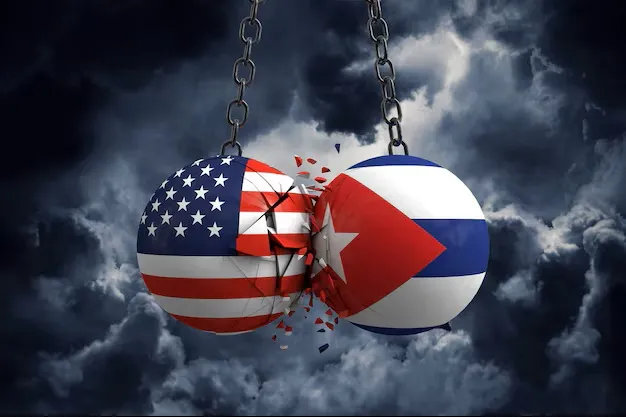
Havana — During the rest of 2026, the relationship between the U.S. and Cuba will be at a point of maximum tension and strain, which will escalate depending on the critical factors that are developing today.
The Executive Order entitled “Addressing Threats to the United States by the Government of Cuba,” signed by the president of that country on January 29, states, among other things: “I consider that the policies, practices, and actions of the Government of Cuba directly threaten the national security and foreign policy of the United States.”
Such a statement goes beyond absurdity. How can an island with a population of barely 10 million, which has suffered an economic blockade for more than 60 years, be a danger to the world’s leading military power, which possesses nuclear weapons and is also the only country to have used them?
Materially, Cuba is not a threat to Washington, but morally, perhaps, empires do not forgive those who commit the crime of insubordination.
It is highly likely that Cuba will remain on the spurious list of State Sponsors of Terrorism, which blocks almost any international financial transaction and stifles foreign investment.
Due to the full activation of Title III (Helms-Burton), an increase in lawsuits against companies that “traffic,” in Washington’s language, in nationalized properties is expected, driving away European and Asian partners.
The closure of consular services and the reduction of diplomatic missions to minimum levels will be the norm, although alternative channels of contact for secret negotiations could be sought.
The Cuban economy faces a deep crisis, with projected growth of just one percent for 2026, foreign currency shortages, and severe energy restrictions, exacerbated by the recent executive order declaring Cuba a “national threat” and punishing countries that supply oil to the island with tariffs.
As if that were not enough, Donald Trump extended for one year the executive order authorizing the detention and inspection of U.S. and foreign ships bound for Cuba.
A likely scenario for 2026 would be an intensification of unilateral U.S. coercive measures, with the effective application of tariffs on third countries that trade with Cuba, especially in energy.
The Cuban energy crisis, by limiting the government’s operational capacity, could further affect the population, leading to increased irregular migration to the US. This situation would lead to Cuba moving closer to allies such as Russia and China to counteract its isolation.
Another possible scenario this year is that the Donald Trump administration will attempt to bring about “regime change” in Cuba through the use of military force, emboldened by the success of the operation in Venezuela.
The US has demonstrated both the logistical capacity and the political will to carry out operations of this type, as evidenced by the Venezuelan case. Although a large-scale invasion is unlikely due to the political and human costs, a limited military operation, such as a commando or “surgical strike”—similar to that in Venezuela—is possible.
The most likely scenarios could be an attempt at a massive surprise air strike to destroy basic infrastructure, command and communications centers, and densely populated urban centers in order to cause “shock and awe,” or a limited (surgical) attack with the aim of assassinating the top leadership of the Cuban government and its armed forces.
However, either of these scenarios could end in disaster for the White House. The Cuban government and people have historically demonstrated resilience in the face of sanctions and aggression, and geographical proximity is a factor that affects both sides. The island’s forces can respond effectively and destroy economic and military targets of strategic importance to Washington.
Relations with the Russian Federation and the People’s Republic of China, and the concrete support of these two nations, constitute an important element of material and moral support for Cuba. Recent statements and actions by dignitaries from both nations show an increase in that support.
Regional actors such as Mexico and Caribbean countries could mediate and, as is happening with Mexico, provide effective solidarity with Cuba. Global solidarity would be a significant factor of support.
Negotiation or surrender?
There are factors that radically differentiate Cuba from other countries, such as the structure of the state. For example, there is no internal institutional counterpart that the United States can use as a “parallel government.”
There is no government figure who has the power to act alone in favor of the United States and bring about “change.” The Cuban system is based on collective leadership, with high popular participation.
The Revolutionary Armed Forces (FAR) are deeply integrated into the economy, politics, and the people. They have a long tradition of struggle, combat experience in various regions of the world, and high qualifications. An internal breakdown or mass desertion is highly unlikely.
On the other hand, the Pentagon knows that Cuba has been preparing for decades for the “War of the Whole People.” A military occupation would be costly, lengthy, and would generate total rejection in Latin America, breaking the US’s strategic alliances in the region.
Although there is no formal mutual defense pact, military aggression in the Caribbean could escalate into a global conflict that the US would prefer to avoid.
Instead of marines landing, the scenario for 2026 points to an intensification of the multifaceted unconventional war. The goal would be total financial suffocation, deepening the blockade to force a collapse of the basic services system (electricity and water).
This is a scenario where military aggression could be disguised. If an extreme health or food crisis occurs, the US could attempt to establish a “humanitarian corridor” or “exclusion zone,” which would be a technical military entry without being a full-scale invasion.
When the US sanctions third parties for selling oil (applying secondary sanctions), it is sending a direct message to the island’s leadership: “The cost of maintaining the current system is the total paralysis of the country.”
The White House could try to use backchannels—possibly through intermediaries such as Norway, Venezuela, Mexico, or the Vatican—to offer a negotiated exit if Cuba facilitates a transition or profound reform.
Currently, the media and some diplomatic sources, including the US president himself, are talking about talks with actors within the island, which is repeatedly denied by the Cuban government. The Oval Office assures that Secretary of State Marco Rubio is in charge of the secret negotiations.
We cannot help but wonder: Is the Secretary of State deceiving the president? Could it be that such a dialogue does not exist? Rubio could certainly be lying, preventing any kind of exchange between the two sides in order to make the failure of diplomacy obvious and provoke an escalation leading to armed intervention, a dream long cherished by those of his ilk.
What is absolutely true is that Cuba does not negotiate under pressure. It has always been open to dialogue on equal terms, but it does not accept conditions that affect its sovereignty and freedom.
Cuba is preparing for the worst-case scenario. Cubans do not want this, but we have lived for more than 60 years with the sword of Damocles of military aggression hanging over our heads. We know how to resist, and we will know how to win.
Source: Cuba en Resumen
Join the Struggle-La Lucha Telegram channel