
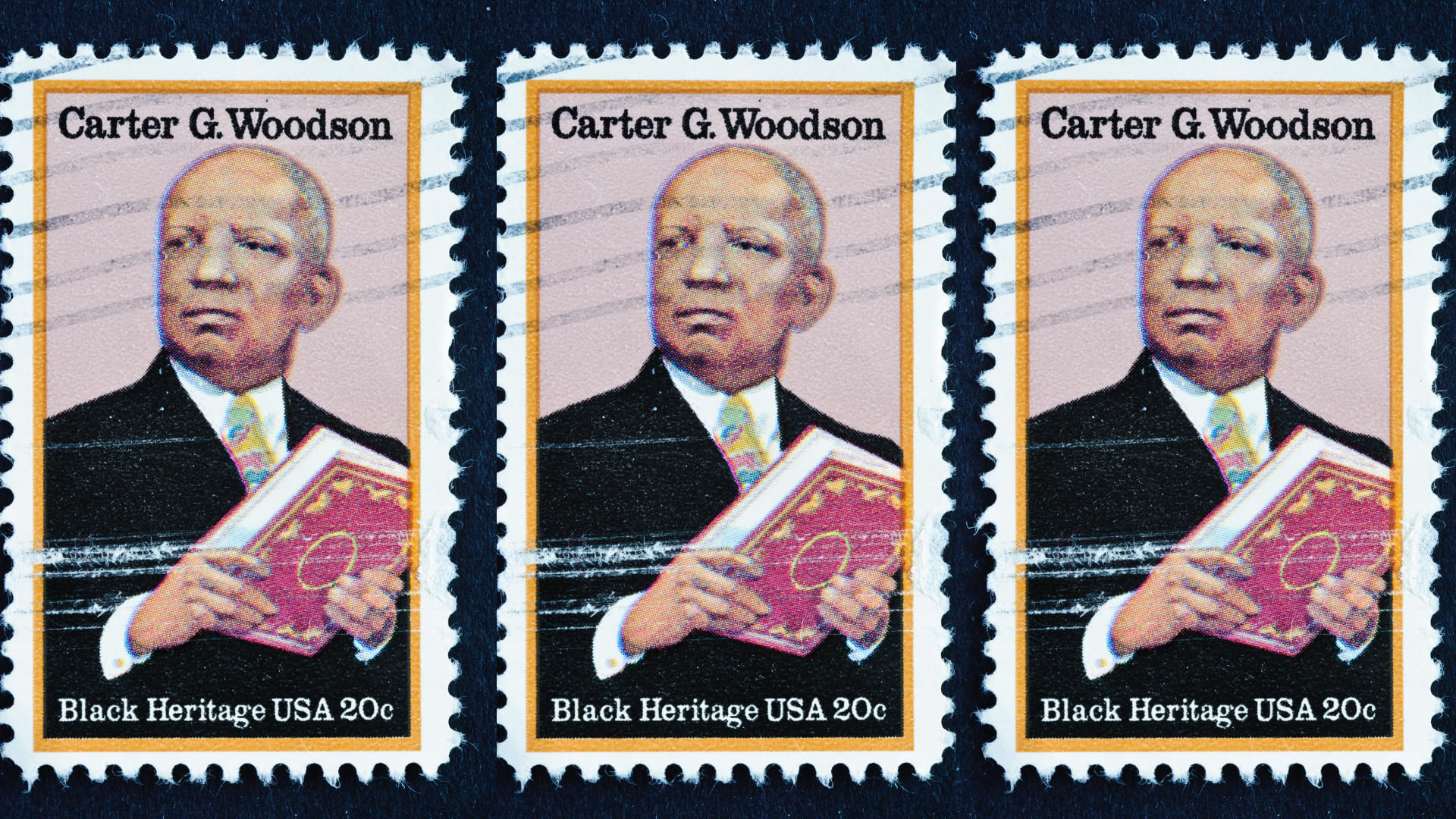
Carter G. Woodson (1875-1950): Father of Black History
“Those who have no record of what their forebears have accomplished lose the inspiration which comes from the teaching of biography and history.” – Carter G. Woodson
Carter G. Woodson played a pivotal role in advancing the education of Black individuals within the field of history. His efforts led to historians worldwide recognizing the study of African American and African descendant histories as an important and legitimate academic discipline.
The year 2026 will commemorate a century of Black history, a legacy founded by Carter G. Woodson. It presents the perfect opportunity to honor Woodson’s remarkable intellect and dedication, which gave rise to the field of Black history.
Woodson pioneered Black history, bringing academic rigor to its study. He dedicated his career to documenting and promoting African American achievements, believing that knowing one’s history inspires future generations.
Born in 1875 in New Canton, Virginia, Woodson grew up in poverty as the child of recently freed slaves. Despite limited schooling opportunities, he graduated high school at 20 and earned an honors Bachelor of Literature from Berea College, Kentucky. He worked as a school supervisor in the Philippines for four years, traveled through Asia, North Africa, and Europe, and studied history at the Sorbonne University in Paris, becoming fluent in French.
After returning to the U.S., Woodson earned a master’s degree in history from the University of Chicago in 1908. He completed his Ph.D. in history at Harvard in 1912, conducting research in Washington, DC at the Library of Congress. His doctoral thesis reflected his view that history should encompass culture, circumstances, and social conditions, stating, “If a race has no history, if it has no worthwhile tradition, it becomes a negligible factor in the thought of the world, and it stands in danger of being exterminated.”
He helped found the Association for the Study of Negro Life and History in 1915, along with its quarterly publication, now known as “The Journal of African American History.” Initially, Woodson had several white philanthropists, such as Julius Rosenwald, elected to the board of the Association. Woodson preferred white patrons such as Rosenwald who were willing to finance his Association without being involved in the research. Some of the white board members that Woodson recruited were not content to play the passive role that Woodson wanted. Woodson emphasized that only Negros research and write about Black history. Those white board members who did not agree resigned.
Woodson served as Dean and Head of Graduate Faculty at Howard University from 1919 to 1920. In 1926, he established Negro History Week, which evolved into Black History Month.
Woodson described the aim of Negro History Week as follows:
“It is not so much a Negro History Week as it is a History Week. We should emphasize not Negro History, but the Negro in History. What we need is not a history of selected races or nations, but the history of the world void of national bias, race hatred and religious prejudice.”
Black educators and Black United Students at Kent State University first proposed Black History Month in February 1969. The first celebration of Black History Month took place at Kent State a year later, from Jan. 2 to Feb. 28, 1970.
Six years later, Black History Month was being celebrated all across the country in educational institutions, centers of Black culture, and community centers, both great and small. President Gerald Ford recognized Black History Month in 1976, during the celebration of the United States Bicentennial.
Carter Woodson’s organization, now known as the Association for the Study of African American Life and History (ASALH), designates a theme each year. The theme for 2026 is “A Century of Black History Commemorations.” This theme encourages reflection on how Black history has been commemorated over the past century.
This writer examined the last hundred years through the lens of U.S. Postal Stamps featuring Black American faces, beginning with Booker T. Washington’s stamp issued in 1940. Early stamps mostly recognized conservative figures, but the introduction of the Black Heritage series, starting with Harriet Tubman, issued in 1978, broadened the honorees to include prominent activists like Pan-Africanist W.E.B. Du Bois, Human Rights Activist Malcolm X, Anti Lynching crusader Ida B. Wells, and Civil Rights activist Martin Luther King Jr. The seventh stamp in this series, Carter G. Woodson, was released in February 1984. Today, there are 49 Black Heritage stamps, including one for Phillis Wheatley, which was issued on Jan. 29, 2026. There are over 150 U.S. Postal stamps with Black faces.
Did Woodson hope that Negro History Week would someday become unnecessary?
While opinions vary, there is currently no national curriculum requiring Black history to be taught from elementary through high school. Ethnic Studies is becoming increasingly popular in school districts across the country. Thanks to the internet and AI technology, people are sharing historical achievements of Africans worldwide. Each day brings new opportunities to learn with just a few keystrokes, yet much more progress is needed to make the teaching of Black History vital to the survival of Black people — both physically and intellectually — within society at large.
Woodson died on April 3, 1950. He left behind such important published works as “The Negro in Our History,” “The History of the Negro Church,” and most famously “The Miseducation of the Negro,” in addition to more than 30 other books, more than 100 published articles, and 125 book reviews. The NAACP awarded Woodson its distinguished Spingarn Medal in 1926, honoring outstanding Black Americans. The National Council for the Social Studies established the Carter G. Woodson Book Awards in 1974.
Woodson dedicated his life to his mission, having said, “I don’t have time to marry. I’m married to my work.” And while he left no children to survive him, he was literally the Father of Black History.
Join the Struggle-La Lucha Telegram channel