
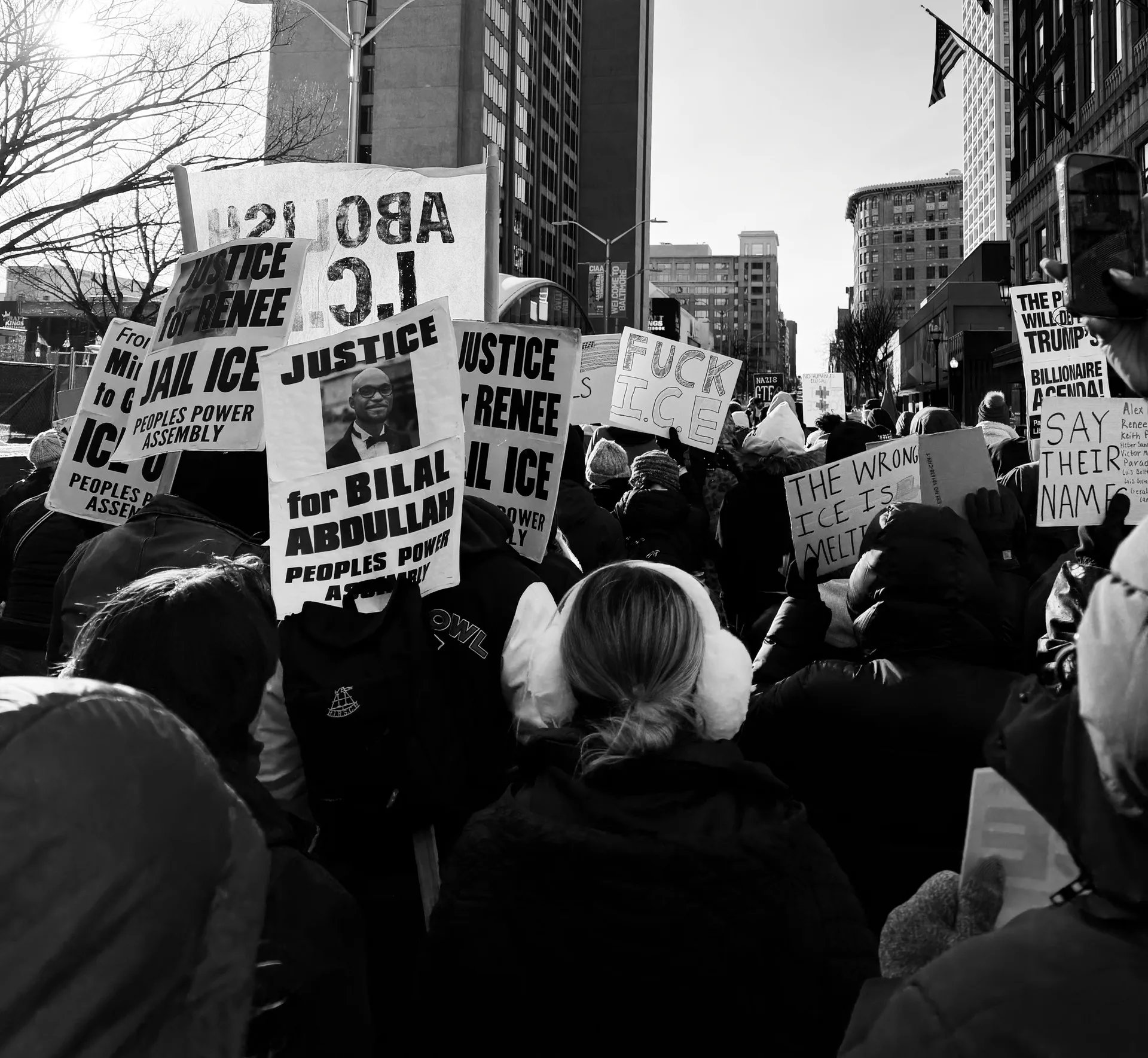
Jan. 31 — Yesterday afternoon, thousands gathered at the George H. Fallon building in Baltimore to join nationwide protests calling for an end to ICE’s reign of terror.
The building, which houses ICE’s field office in the state, gained attention last week when a video spread on Reddit, depicting a cramped space where detained men were clustered together in foil blankets. In the video, they said they’ve been subject to beatings and have had limited access to food, water, and restrooms.
Annelise Estepp, an organizer for People’s Power Assembly (one of the many groups that united to plan the protest), said that watching the video made them feel “disgusted.” But that doesn’t mean they were surprised. “When I saw that video circulating, it was a crucial reminder that no one is coming to save us — ourselves, the folks at 31 Hopkins Plaza, or our targeted neighbors — but us.”
Evidently, people across the country felt the same as they answered National Shutdown’s — the grassroots organizers behind the day’s strike efforts — call. The national efforts are an extension of Minnesota’s statewide strike, which saw 50,000 people marching on Jan. 23, and its directive was simple: “No work. No school. No shopping.”
Earlier this week, Greater Baltimore DSA began an online letter-writing campaign to city and state officials that has sent over seventeen thousand letters.
“We want officials at every level to use whatever power they have to shut down 31 Hopkins,” said Ida K., an organizer for GBDSA who asked that her full last name not be printed due to privacy concerns. “We want our officials to commit to abolishing ICE.”
Support for abolishing ICE — which was created in 2003 — has sharply increased this past month, with more Americans now supporting abolition than not, according to a recent YouGov poll. According to that same poll, abolition is overwhelmingly popular among Democrats, with 76% support among the party.
While some have expressed shock in previous weeks at the overt abuses of power by law enforcement officials, to many in the majority-Black city, ICE is simply an extension of America’s long legacy of racist policing.
Protest signs and speakers drew connections between the willful lethality of ICE enforcement and last summer’s police killings of three of Baltimore’s Black citizens: Dontae Melton Jr., Bilal Abdullah, and 70-year-old Pytorcarcha Brooks. In all but the death of Brooks, for which the investigation is ongoing, Maryland Attorney General Anthony Brown declined to prosecute the police involved.
For the people of this community, ICE’s brutality is not theoretical. It is not hidden behind the reinforced concrete walls of the Fallon building.
It is close, it is personal, and it could be them.
It is their neighbors, their friends, and their loved ones.
And it needs to end.
Source: The Backbone
Join the Struggle-La Lucha Telegram channel