
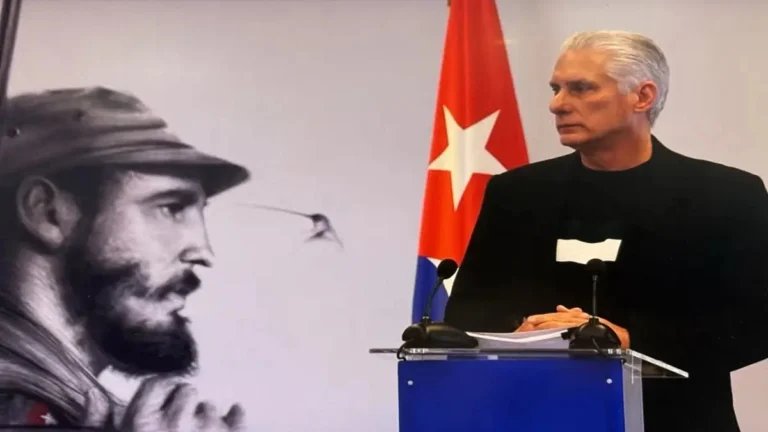
President Diaz-Canel says no fuel has reached his country since December.
On Feb. 5, President Miguel Diaz-Canel announced that Cuba has a strategy to expand the use of its own energy sources in response to the crisis caused by the U.S. blockade on oil shipments to the island.
Since Dec. 3, when the U.S. began a naval blockade against Venezuela, Cuba has not received a single drop of fuel. This situation has had a broad impact on public health, the economy, transportation and electricity generation.
Diaz-Canel denounced an intensification of U.S. pressure as part of an “economic suffocation” strategy, which is aimed at sowing fear among oil shipping companies and international suppliers. Nevertheless, his administration is working to ensure that this new form of external aggression has the least possible impact on the Cuban people and economy.
“Cuba will not renounce receiving fuel. It is a sovereign right,” Diaz-Canel stressed, adding that surrender is not an option and making clear that the U.S. has no right to impose its economic warfare on the Caribbean island or on third countries.
The Council of Ministers approved guidelines for a contingency plan designed to confront attempts at economic strangulation. Diaz-Canel acknowledged that while temporary restrictions on consumption and increased energy savings will be necessary, those measures will not be permanent.
The Cuban government’s response is based on a comprehensive strategy to transform the energy matrix, including the recovery of electricity generation capacity — more than 900 megawatts have been restored — the use of domestic energy sources, increased storage capacity affected by the accident at the Matanzas supertanker base, higher national crude oil production, electricity generation from associated petroleum gas and the development of a national shipping fleet.
In 2025, Cuban authorities completed the construction of 49 photovoltaic solar parks, adding about 1,000 megawatts to the country’s energy supply. Currently, those parks are generating 38% of the national energy, at a time when Cuba has been unable for several weeks to rely on distributed generation due to fuel shortages.
Diaz-Canel said 5,000 photovoltaic systems of 2 kilowatts each are being installed in an equal number of homes that previously lacked electricity, which will allow Cuba to reach 100% electrification.
Another 5,000 photovoltaic systems are also being installed at prioritized service centers, including maternity homes, nursing homes, senior centers, polyclinics, residences for vulnerable children and bank branches, among others.
Authorities are also distributing another 10,000 photovoltaic systems to workers in the education and health sectors, while new investments in wind power generation capacity are underway. The Cuban government also expects to increase production of associated petroleum gas and supply manufactured gas to 20,000 new customers in Havana.
The Cuban president recalled that successful tests were conducted in December for refining crude oil and producing derivatives, as well as for acquiring engines capable of using that fuel.
While none of these actions alone solves the problem immediately, they allow for changes in the energy matrix and help prevent the situation from becoming more severe. “The will to resist, recover and create will include expanding local production of goods and services,” Diaz-Canel said.
His remarks come amid a growing diplomatic offensive in international forums, where Cuba has systematically denounced the economic, social and humanitarian impacts of the U.S. blockade, which has been in place for 64 years as a policy of “collective punishment.”
“What does it mean to prevent fuel from reaching a country?” Diaz-Canel asked, before pointing out that it is a measure that directly affects the lives of millions of people. He reiterated, however, that surrender is not an option and that Cuba will not renounce its sovereign right to receive fuel.
In his most recent report to the United Nations General Assembly, Foreign Minister Bruno Rodriguez denounced that between March 2024 and February 2025, damages caused by the U.S. blockade totaled $7.5 billion, representing a 49% increase over the previous period. Cumulative losses now exceed $171 billion.
Source: teleSUR
Join the Struggle-La Lucha Telegram channel