
Keith Porter. Parady La. Heber Sánchez Domínguez. Victor Manuel Diaz. Luis Beltran Yanez-Cruz. Luis Gustavo Núñez Cáceres. Geraldo Lunas Campos. Renee Nicole Good. Alex Pretti.
Some names you know. Others you may not have seen before. All were killed by federal agents of Immigration and Customs Enforcement (ICE), U.S. Customs and Border Protection (CBP), and the Department of Homeland Security (DHS) in the first weeks of 2026.
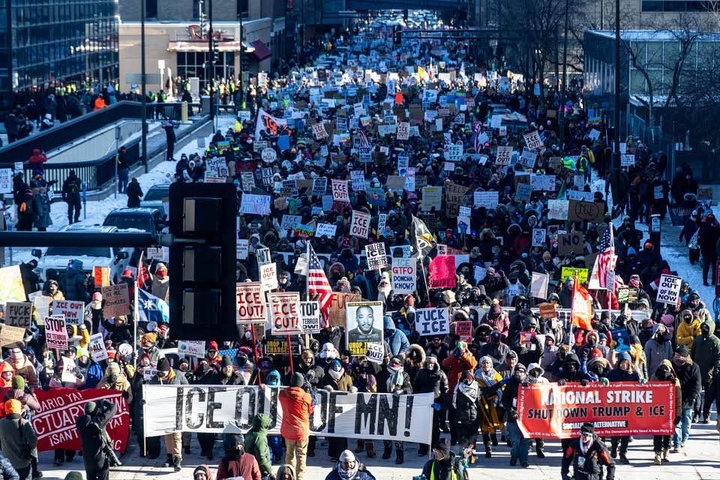
People are fighting back, most visibly in Minneapolis, where a citywide general strike – dubbed “Day of Truth and Freedom: No Work, No School, No Shopping” – took place on Friday, Jan. 23, including a massive march in subzero weather.
Struggle-La Lucha spoke with people who were on the ground during those events and the aftermath, including the retaliatory murder of union nurse Alex Pretti on the morning of Jan. 24.
Mira Altobell-Resendez is an organizer with the Minnesota Immigrant Rights Action Committee (MIRAC), a group at the forefront of the local fight against the federal siege. Bryan G. Pfeifer, a Steelworkers union member and activist with WI Bail Out the People Movement, traveled from Madison, Wisconsin, to support the general strike. Ava Ball is a trans woman who recently moved to Minneapolis as part of the “Pink Wave” of LGBTQIA+ refugees fleeing far-right-controlled states.
Struggle-La Lucha: What was your impression of the turnout on Jan. 23? What was the mood of the crowd?
Mira Altobell-Resendez: The turnout on Friday was incredible! Well over 100,000 Minnesotans took off work and school and braved those ridiculously low temps to demand “ICE out!”
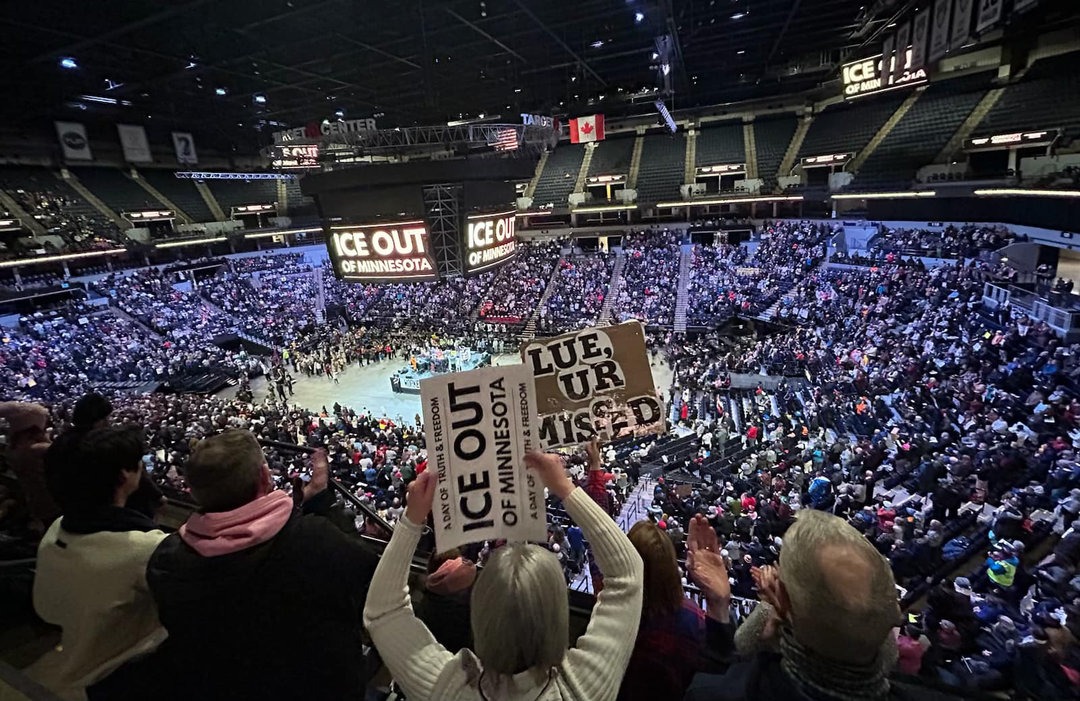
Bryan G. Pfeifer: After a march at minus 20 degrees, marchers filed into a downtown arena for a mass rally, thousands strong. The composition was very multinational, with many unions participating. The Minnesota AFL-CIO endorsed the march, as did the Minneapolis Regional Labor Federation and other labor federations statewide.
Numerous community and faith-based organizations, LGBTQIA+ organizations, and Indigenous communities also participated and built for the Jan. 23 action. Participants came from many cities in Minnesota and from across the country, representing a rainbow of unions and community organizations.
MAR: The crowd was very spirited and full of righteous anger.
BGP: The mood was a mix of sadness but defiance against ICE. Immigrants and workers of many nationalities spoke about the daily cruelty, brutality and outright terror of ICE agents working on behalf of the rich. They also spoke of the courage and creativity of everyday workers and community members fighting back against ICE terror – neighborhood patrols, dispatch systems to enable workers to get to work, school and medical appointments, mutual aid networks in many forms, and a variety of protest actions.
April Verrett, the first Black woman to serve as national president of the Service Employees International Union (SEIU), stated that in her view, Minneapolis was the Selma moment for the United States and ground zero for people’s resistance. She concluded that serious social justice organizing, rooted in the working class and in unions, must be a priority in the coming period.
MAR: Since Friday’s shutdown, ICE has killed again in south Minneapolis. This time, it was 37-year-old ICU nurse Alex Pretti, who had been defending a fellow community observer from federal brutality.
The National Guard has arrived to protect agents and property in Minneapolis and at the Whipple Federal Building. They’ll be weaponized against the people of Minnesota rather than protecting us, as they claim to. We foresee their deployment to escalate as ICE agents continue to agitate our communities with state-sanctioned violence.
Vigils for Alex Pretti
SLL: Vigils were held around the city for Alex Pretti on Saturday evening. What was it like, and what did people have to say about the latest atrocity?
Ava Ball: The vigil I attended Saturday was solemn but uplifting. There was a bonfire on my street corner, with approximately 20-30 people coming out to connect. Some neighbors brought food, hand warmers, and firewood for anyone to use. It was frigid, but everyone was eager to be there.
We held candles and talked about the death of Alex, and expressed our grief and upset. We also got to know each other better, talked about our community, and discussed what we can do to help each other feel more prepared and ensure our neighbors are taken care of.
After a while, we walked two blocks down to where another bonfire was happening, with just as many people or more. From there, we could see another bonfire further down the street. My understanding is there were similar small gatherings every few blocks across the city.
SLL: Ava, can you describe what it’s been like for you, as a queer newcomer to Minneapolis, living through the siege of the past month? How are you and your friends and neighbors coping?
AB: It’s been intense living through the siege. We (me, my partner, and their other partner) just finished fleeing the increasing persecution of trans people in Oklahoma and moved to Minnesota seeking a safer place. Unfortunately, we arrived right as the invasion was occurring, making it difficult to find work, get to know the area, or connect with people.
Thankfully, our neighbors have been welcoming and friendly, making it less isolating and easier to find a sense of belonging. Gradually, we’ve also been connecting with other queer folks, which has helped make us feel more at home. Still, it has been a difficult and overall isolating time.
SLL: Besides Renee Good and her wife Becca, there have been several instances of queer couples being targeted by ICE for their solidarity with the immigrant community. What have you observed that would be helpful for queer people in other cities that may be targeted next?
AB: Coming from somewhere where we often felt targeted for being visibly queer, we were very concerned about how federal agents and agitators have been targeting queer people.
Initially, we limited going out in general, but we collectively decided that wasn’t sustainable. Instead, our polycule made it a rule that none of us go out alone, unless it was for work or volunteering. While this only does so much, it helped us feel a little more safe and allowed us to get back to living our lives in spite of the crackdown.
My best advice to queer people living in cities that may soon see heightened ICE activity is to do your best to travel together and look out for your queer friends. Carpool, walk together, and don’t hesitate to give each other rides to ensure no one is left vulnerable.
‘People show up and demand justice’
SLL: What are the next steps for the movement in Minneapolis?
MAR: Trump and his ilk have shown time and time again that they don’t care what it takes — they will do anything to remain in power and keep their pockets full. We know that the people of the Twin Cities will show up and demand justice at every turn. Every time one of us is struck down, a thousand rise in their place.
BGP: The Somali community is a pillar of organization, discipline and resistance in many ways and for many communities, as are the Hmong and other people of Asian descent in the Minneapolis-St. Paul area. In Little Earth, an Indigenous stronghold in the city, there are neighborhood defense networks organized, food pantries and much more. The American Indian Movement (AIM) — formed in Minneapolis in the 1960s — plays an important role in these networks.
Unions such as SEIU Local 26 are very multinational, with many of its leaders being women, LGBTQIA+, and from various nationalities. A few of the leaders of this local, who’ve helped win many concessions for workers, have been kidnapped and been deported or are in concentration camps.
Women Against Military Madness (WAMM), with many independent organizations in its building its network, is also making many contributions to the people’s resistance. The Veterans for Peace chapter in the Minneapolis-St. Paul area is one of the largest in the U.S. and assists in many ways, including defense work.
Many who can’t be in the streets are making food and providing much-needed assistance to the people in many forms. Due to ICE terror, thousands in the Minneapolis-St. Paul metro area and beyond are not going to work (some for weeks now), so there’s a variety of networks fundraising for basic needs such as groceries, rent, mortgage and car payments. Many city and suburban supporters are assisting.
Many people remember the role of police and National Guard over the decades of people’s battles, from the 1934 general strike to the rebellion in response to the police murder of George Floyd and today’s battles against ICE. Whether consciously or unconsciously, the general feeling seems to be that the people of Minneapolis-St. Paul must continue to organize together and as independently as possible, with unions as a base but also much broader and deeper, with support from national and international networks.
MAR: We will keep hitting the streets for justice for all of those who have had their lives stolen by ICE and other federal thugs.
Events are unfolding rapidly. Since these conversations, Border Patrol head Gregory Bovino has been demoted and left Minneapolis as the Trump regime finds itself on the defensive after Alex Pretti’s videoed murder. But the ICE assault continues, with community members reporting increased attacks on parents and children outside schools and at bus stops. Mira Altobell-Resendez has been targeted by the FBI after an online hate campaign.
At the initiative of Somali student groups, a call has gone out for a U.S.-wide national shutdown and day of protest on Friday, Jan. 30. Readers are urged to join local actions and visit Struggle-La Lucha for updates.
Join the Struggle-La Lucha Telegram channel