
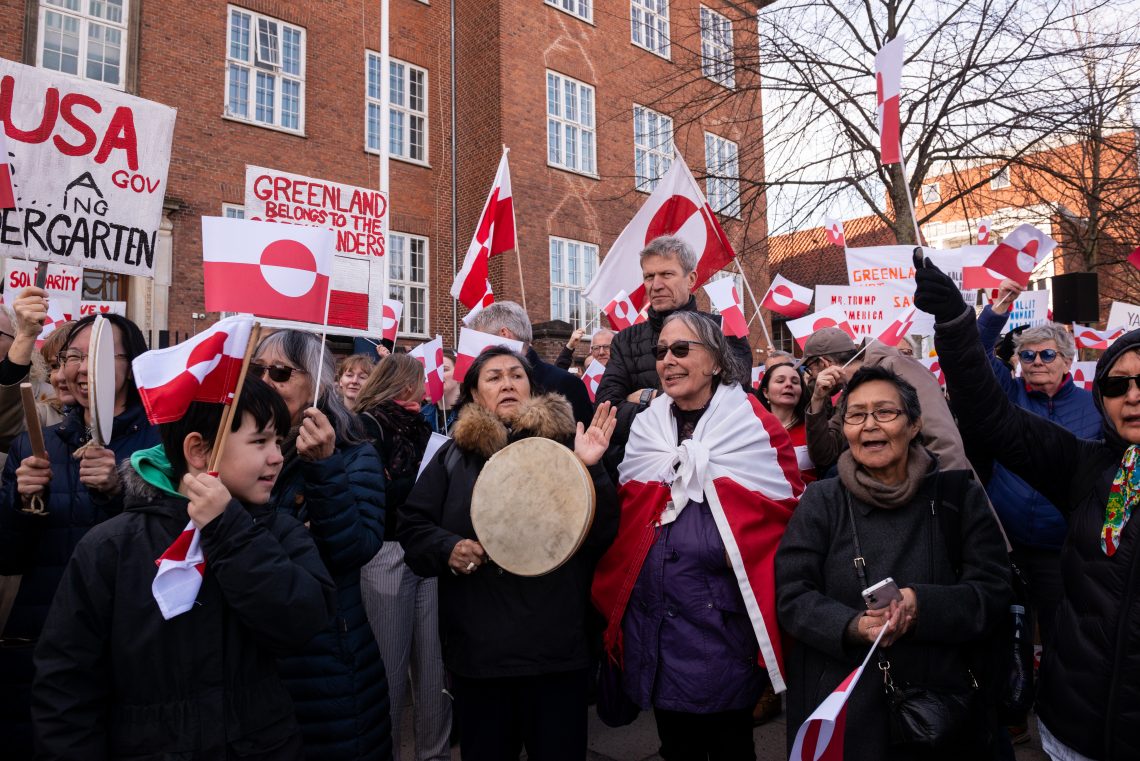
On 14 January, a few hours before the historic meeting in Washington between representatives from Greenland and Denmark and their U.S. counterparts, J. D. Vance and Marco Rubio, Denmark and several of its NATO allies reinforced their military presence in Greenland and announced that more reinforcements would follow.
Some interpreted this move as pressure on the Trump Administration before the meeting. But anyone familiar with NATO-Denmark politics would recognize that appeasement with the empire is the more likely explanation.
At the Washington meeting, the U.S. reiterated its firm demand for “having Greenland”: ““It is clear that the president wants to conquer Greenland,”” declared the Danish foreign minister after the meeting. The parties agreed to establish a “high level working group” in an effort to contain the crisis.
But the crisis continues, and its magnitude is huge.
The reality is that for over a year, the nearly 57,000 Greenlanders and their vast island have been turned into a bargaining chip, a pawn to be moved at will on the great chessboard of U.S. imperialism.
Trump has repeatedly stated that the U.S. seeks to control and own Greenland, by military means if necessary. The brutally effective aggression against Venezuela on January 3 and the kidnapping of the country’s head of state and his wife have erased any doubt that the White House administration is capable of putting Trump’s words into action.
The threat is imminent, and it is felt acutely among the Greenlandic people. The population is stuck in a vice, and the country’s politicians must fight hour by hour simply to get a seat at the table and be heard., Not only by the U.S., but also by Denmark.
Greenland, or Kalaallit Nunaat, has been inhabited for 4500 years, and its people are linked to the Inuit communities across the Arctic. It is the world’s largest island, with an area larger than France, Germany, Spain, Great Britain, Italy, Greece, Switzerland and Belgium combined. It became a Danish colony with the establishment of the state-owned Royal Greenland Trading Company in 1774. The Royal Greenland Trading Company functioned as the de facto colonial administration until the early 1900s, when trade and administration were separated. During this period, Danish companies extracted various minerals, including cryolite, iron, zinc, lead and silver.
The colonial era formally ended in 1953, but political equality with Denmark did not follow. Following a referendum, so-called home rule was introduced in 1979, which was replaced in June 2009 by the current status of self-government. Under self-government, Greenlanders hold the rights to the island’s subsoil and the minerals found there. However, foreign and security policies remain decided in Denmark, which is why Greenland is considered NATO territory.
Greenland is not a member of the European Union. In a 1982 referendum, 53 percent of the Greenlandic people voted to leave the European Economic Community, now the EU. Today, Greenland is classified as one of the EU’s Overseas Countries and Territories.
In 1951, a secret agreement between the U.S. government and Denmark’s envoy to the United States granted U.S. military involvement in Greenland. The agreement was highly controversial and in detriment to official Danish policies at the time. Nevertheless, it remains in force today and has been repeatedly confirmed. In practice, it grants unlimited U.S. military rights over Greenland.
Thus, for decades, the U.S. has maintained several military facilities in Greenland. The history of these facilities includes forced evictions of Inuit families in 1953, the crash of an American B-52 plane carrying four atomic bombs in 1968, and other harms inflicted on the local population.
The Danish government repeatedly states that Greenland belongs to the Greenlanders and is not for sale. But in reality, Denmark has been selling off Greenland to the U.S. for decades. “We already have a defence agreement between the Kingdom and the United States today, which gives the United States wide access to Greenland,” the Danish Prime Minister stated in an official statement earlier this week.
This raises the question: Why does the Trump Administration seek an annexation of Greenland, when the U.S. empire already holds extensive rights over Greenland? The answer lies in a new security strategy and the demand for unquestioned and unlimited control over oil, control over minerals, and military dominance.
Greenland possesses at least 25 of the 34 minerals designated as “critical raw materials” by the European Commission. Greenland has significant deposits of rare earths, copper, nickel, zinc, gold, diamonds, iron ore, titanium, tungsten and uranium. Trump wants U.S. companies, many of which have invested heavily in his re-election, to have unfettered access to Greenland’s mineral deposit resources.
Moreover, Greenland’s geographic position near the Arctic is important. Control over northern sea routes, such as the Northeast Passage, is becoming increasingly important as climate change advances. A fully controlled, militarized and rearmed Greenland is also intended to serve as an advanced base against both Russia and China. Beyond the prospect of super-profits, keeping socialist China far away from Greenland is a strategic goal for both the U.S. and Denmark.
Until a few years ago, Greenland was undergoing a process of independent decision-making and freeing itself from neocolonialism. But the current era of intensified imperialism emanating from the White House has caused a serious setback to Greenland’s ability to determine its own destiny. The threats and pressures are enormous.
It is so important to hold on to the principle of right to self-determination. How Greenland organizes its society, with whom it collaborates, and what alliances it enters to realise its self-determination in practice should be determined solely in Nuuk.
Lotte Rørtoft-Madsen is the chair of the Danish Communist Party. She was the editor-in-chief of Arbejderen.
This article was produced by Globetrotter and No Cold War Perspectives.
Join the Struggle-La Lucha Telegram channel