
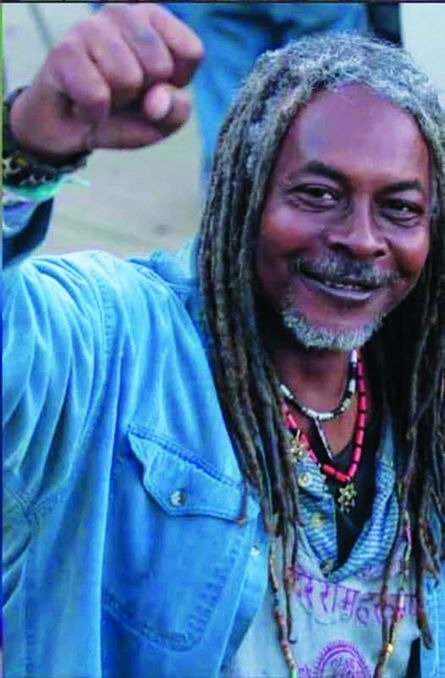
Lee Patterson died peacefully in his sleep on Dec. 21, during a short stay in hospice care for complications from renal and heart failure. He was surrounded in his final days by loving comrades and family.
Until his last day, Lee remained a fighter. From his bedside, he recorded a message against Trump’s visit to Baltimore, since he wasn’t able to attend the protest in person. Patterson had dedicated his life to the struggle for the liberation of the working class and all oppressed people.
Lee was born March 27, 1955, in Baltimore, Maryland. His mother was a domestic worker, and his father a veteran of the Korean War. Over the next 70-plus years of his life, Patterson would give his heart and soul to the struggle for socialism.
After graduating from Northwestern High School in 1973, Lee worked at various jobs, including as a cook at McDonald’s. He had a passion for Jimi Hendrix in his early youth and later set up street vending tables to supplement his income.
While working at Eastern Products, a local factory that manufactured Venetian blinds, Lee became involved with the United Furniture Workers Local 75. In 1977, Lee’s shop steward approached him and asked Lee to attend a march for civil rights and affirmative action. Lee attended that march and spent the entire afternoon and evening marching through downtown Baltimore.
The revolutionary political struggle and Lee were a perfect match from the beginning. It was during this period that Lee met Vince Copeland, a co-thinker of Sam Marcy, who won Patterson to revolutionary socialism. Copeland was not only a revolutionary thinker but also an organizer, and became active in the union struggle of the workers at Lee’s factory, advising young worker activists, of which Lee was one.
As a revolutionary socialist, Patterson became more broadly involved in fighting against all forms of oppression – advocating for the Black community and all oppressed groups. He helped to form the All Peoples Congress in Baltimore, which was founded in Detroit in 1981 to fight the Reagan administration’s cuts to social services and jobs.
In his final days, Lee reflected on the different campaigns he participated in during the late 1970s – and through the 1980s – advocating for working-class power and the material needs of oppressed communities. Lee was particularly proud of his work on the campaign demanding rent control for the Black and working-class community and fighting against high utility rates.
About the March on Baltimore City Hall for rent control, Lee said: “I felt more powerful that day than I had ever felt in my whole life.” Lee truly loved the working-class struggle. Lee saw the oppression of the working class firsthand in Baltimore’s Black community, and it drove him to embrace the struggle for a communist world.
During this period, Lee worked with the Welfare Rights organization, led locally by Rev. Annie Chambers. The group, which also included Sharon Black, Ray Ceci, Andre Powell, Stephen Millies, Doug Lawson and Bob Cheeks, formed the People’s Campaign for Rent Control.
One of Lee’s fondest memories was hand-drawing signs for not only the rent control campaign but almost every movement that took place in Baltimore City. “Those signs made me feel like a big human being. I couldn’t wait to march downtown with those.”
Lee took his advocacy and revolutionary spirit to the airwaves. Rarely a day went by where Lee was not calling into a local talk radio station to challenge homophobia, anti-abortion ministers, and pro-capitalist thought. Lee was incredibly proud to stand in solidarity with women fighting for their basic reproductive rights.
In 2012, after Trayvon Martin’s murder, Lee and other Baltimore organizers, including Rev. CD Witherspoon, former president of the Baltimore Southern Christian Leadership Conference, founded the Peoples Power Assembly (PPA). Witherspoon became a lifelong friend of Patterson and his family.
Until his death, Lee marched, tabled, and organized fiercely with the PPA on a range of issues from public housing rights to police brutality to “serve the people” initiatives. 2015 saw Baltimore rise up against years of racist apartheid and police terror after the Baltimore police murdered Freddie Gray in northwest Baltimore.
There are a multitude of pictures of marches where Lee can be seen thrusting his fist in the air — pictured prominently in the media as symbols for the rebellion.
However, Lee wasn’t just a fighter for the working class at home. He stood in solidarity with the colonized people of the world. This solidarity extended to the people of Cuba, Venezuela, Iran, Russia, China, Nicaragua, Palestine, Grenada, Iraq, Vietnam, Burkina Faso, Angola, and many others, against imperialist exploitation and war.
Anyone who saw comrade Lee at a protest would immediately notice his myriad of buttons demanding “Disband NATO” and “U.S. out of everywhere.” This same sense of solidarity is what drove Lee to join the counter-protest against the Unite the Right nazi march in Charlottesville in 2017.
In 2018, Lee was a founding member of the Struggle for Socialism Party. As a member, Lee continued the fight in the streets for working-class liberation and socialism even as his health began to decline.
Lee Patterson brought much to the working-class struggle. He brought passion, humor, and fire. And he brought his self-taught artistic skills to countless drawings on banners and signs depicting messages of fightback. More than anything, Comrade Lee Patterson will be remembered for his unwavering dedication to fight for the working class at every turn.
Lee Patterson loved the working-class revolution. Lee Patterson loved Black liberation. Lee Patterson loved Jimi Hendrix. Lee Patterson will be carried in memory by his comrades.
Lee is survived by his spouse and companion, Hollee Patterson, two daughters, Valencia Spruell and Safayi Jackson, loving granddaughter Danasia Patterson and other grandchildren and great-grandchildren. He is also survived by his brother Leonard Patterson and by Terence Lambirth, a loyal and loving friend who acted as brother and his many comrades in the struggle who continue his legacy.
A commemoration of Lee Patterson’s life is set for Saturday, Feb. 7, 5 p.m. to 7 p.m. at St. Mark’s Lutheran Church Fellowship Hall, 1900 St. Paul St., Baltimore, MD 21218.
Lee Patterson ¡Presente!
Join the Struggle-La Lucha Telegram channel