
Dec. 20 — Intense fighting has again erupted along the roughly 500-mile border between Thailand and Cambodia, marking the second major outbreak of hostilities between the two countries in 2025.
Since February, clashes between the two armies have become increasingly frequent, first escalating into full-scale combat on July 24. That round of fighting lasted four days and included air strikes, artillery exchanges, and sustained small-arms fire across the border. Dozens of soldiers and civilians were killed, and tens of thousands of people were forced to flee their homes.
Hostilities again intensified on Dec. 8 and continue as this article is being written.
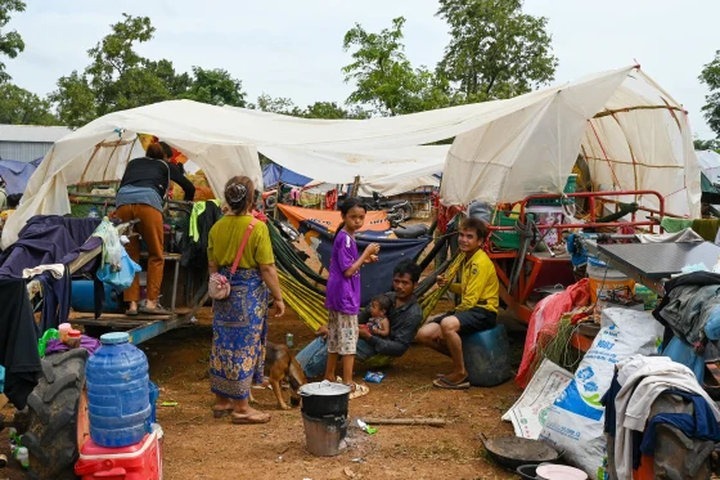
The current escalation is significantly more severe than the July fighting. Over the past week, Thai Royal Air Force jets have carried out large-scale air strikes on Cambodian military installations. Both governments accuse the other of targeting civilian areas with long-range missile systems. Fighting continues along much of the border, driving a growing refugee crisis.
Conflict rooted in colonial rule
Mainstream media and official commentary often portray the conflict between Thailand and Cambodia as the result of ancient, unchangeable hostilities. The fighting is frequently reduced to a territorial dispute over the Preah Vihear temple, an ancient Hindu site near the border. Reducing the conflict to an ancient temple dispute hides its real origins.
While Thailand and Cambodia do dispute the precise location of their border, the disagreement is rooted in colonial boundaries, not ancient ones. France and Britain carved up much of the Indochinese peninsula in the late 19th and early 20th centuries, dividing the region with little regard for existing kingdoms, ethnic territories, or historical claims.
The 1896 Anglo-French Declaration effectively split mainland Southeast Asia into spheres of influence, with the Mekong River serving as the primary dividing line. This agreement treated the entire region as colonial property to be parceled out between European powers.
Thailand, never formally colonized, functioned as a buffer state between British-ruled Myanmar and French-ruled Cambodia. Britain exercised substantial diplomatic and economic influence over Thailand, using it as a counterweight to French power in the region.
Thai kings were forced to cede territory, sign unequal treaties, and grant extraterritorial rights to European powers in exchange for maintaining nominal independence. This “independence” came at a steep price: Thailand lost significant territory to both French Indochina and British Burma through a series of coerced agreements.
French colonial rule in Cambodia was marked by repression and systematic resource extraction. The colonial administration transformed Cambodia into an economic appendage of France, exploiting its agricultural wealth, labor, and natural resources.
The border region between Cambodia and Thailand is rich in rice, fisheries, timber, gemstones, and — more recently — oil and gas. In the early 20th century, France used diplomatic pressure to impose a series of treaties on Thailand, transferring large areas of territory to French-controlled Cambodia.
The 1904 and 1907 Franco-Siamese treaties were particularly significant, forcing Thailand to relinquish provinces including Battambang, Siem Reap, and Sisophon — areas that had been under Siamese control or influence for generations. These colonial-era agreements, drawn up in Paris and imposed on the region, form the basis of today’s boundary dispute.
The colonial powers drew borders with deliberate imprecision in certain areas, creating zones of ambiguity that could be exploited later. Maps produced by French colonial cartographers often differed from agreed treaty language, and the location of watersheds and mountain ranges — used as boundary markers — remained disputed. This was not accidental. Ambiguous borders served colonial interests by keeping local populations divided and dependent on European arbitration.
France ruled Cambodia for nearly 90 years, until independence in 1953. British-colonized Myanmar gained independence in 1948, and Thailand asserted greater formal autonomy during the same period. Yet imperialist influence did not disappear.
The United States, alongside former colonial powers France and Britain, has maintained neocolonial relationships with all three countries through economic investment, military aid, and regional security arrangements. The withdrawal of formal colonial administration did not erase the borders, economic structures, or political divisions that colonialism created — divisions that continue to generate conflict today.
Imperialism sows chaos among ASEAN countries
Today, imperialist powers are less likely to launch large-scale invasions than to fuel instability through proxy wars, economic pressure, and military escalation. This can be seen in Ukraine, Yemen, Syria, Lebanon, Palestine, Libya, Bolivia, Honduras, and Guyana.
The hand of U.S. imperialism can be clearly seen in the conflict between Thailand and Cambodia. The U.S. has no interest in peace between these countries. Instead, Washington seeks to counter China’s growing economic influence in Southeast Asia by flooding the region with U.S. weapons and military advisors. The result is instability, conflict, and war – weakening both countries while U.S. weapons manufacturers profit.
The post-pandemic years have seen economic developments in Southeast Asia that run counter to U.S. imperialist goals. First, the Association of Southeast Asian Nations (ASEAN) has consistently grown its GDP and regional diplomatic influence since the easing of the COVID pandemic in 2022.
Second, China has played a major role in ASEAN’s economic growth. The China-ASEAN Free Trade Agreement was updated in 2025 to deepen trade ties through joint investment in e-commerce and AI. The updated agreement was signed in October of this year and is in part a response to growing U.S. tariffs.
Third, Thailand has been diversifying its military suppliers, with a recent surge in purchases of tanks and armored vehicles from China.
Thailand practices a “balancing act.” While they bought Chinese tanks, they recently purchased U.S. Stryker infantry carrier vehicles and continue to fly U.S. F-16s. They are actively trying to ensure they are not dependent on any single country — China or the U.S.
In response to these developments, the U.S. has intensified its military and economic presence throughout the region. Washington has deepened military ties with both Thailand and Cambodia in recent years, selling weapons to both sides and conducting joint military exercises with each country. For a relatively transparent summary of U.S. goals in the region, read the testimony of Barbara Weisel before the House Foreign Affairs Committee, titled “Building Bridges, Countering Rivals: Strengthening US-ASEAN Ties to Combat Chinese Influence.“
All of this points to a deliberate U.S. strategy: Flood the region with weapons, deepen military ties with both sides, and create the conditions for conflict. War may be good for U.S. billionaires and their benefactors, but it is terrible for everyone else it touches. Societies find incredible difficulty in establishing healthy economic and political life while embroiled in war. This is a stick that the U.S. has used consistently and effectively for years to weaken its enemies and open markets to its predatory investment.
War profits
Whenever a war erupts – such as the one between Thailand and Cambodia – workers should ask: Who benefits?
The answer to this question is certainly not Cambodia or Thailand. Both countries will face the awful toll of war. This imperialist-fueled conflict will mean death, destruction, and underdevelopment for both countries.
Prolonged conflict could mean economic collapse. Factories will close. Agricultural production will fall. Trade will decline.
Both countries buy weapons from foreign arms dealers, with U.S. companies like General Dynamics, Lockheed Martin, and Raytheon supplying both sides. Neither country manufactures its own tanks, jets, or artillery. Every bomb dropped and every bullet fired means more profits for U.S. weapons manufacturers.
Only U.S. imperialism benefits from war between Thailand and Cambodia.
Donald Trump has claimed that the United States is committed to peace in the region. At a recent rally, he declared, “I’m going to make a phone call and stop a war of two very powerful countries. We’re making peace through strength.”
This is empty talk. War is unpopular with most in the U.S., including parts of Trump’s own base that are weary of “entanglement in foreign conflicts.” But Trump’s talk about peace does not change the fact that U.S. weapons manufacturers will make billions from this war.
Just like in Ukraine and Syria, the people of Thailand and Cambodia will suffer while billionaire shareholders in New York and Washington grow richer from war.
Join the Struggle-La Lucha Telegram channel