
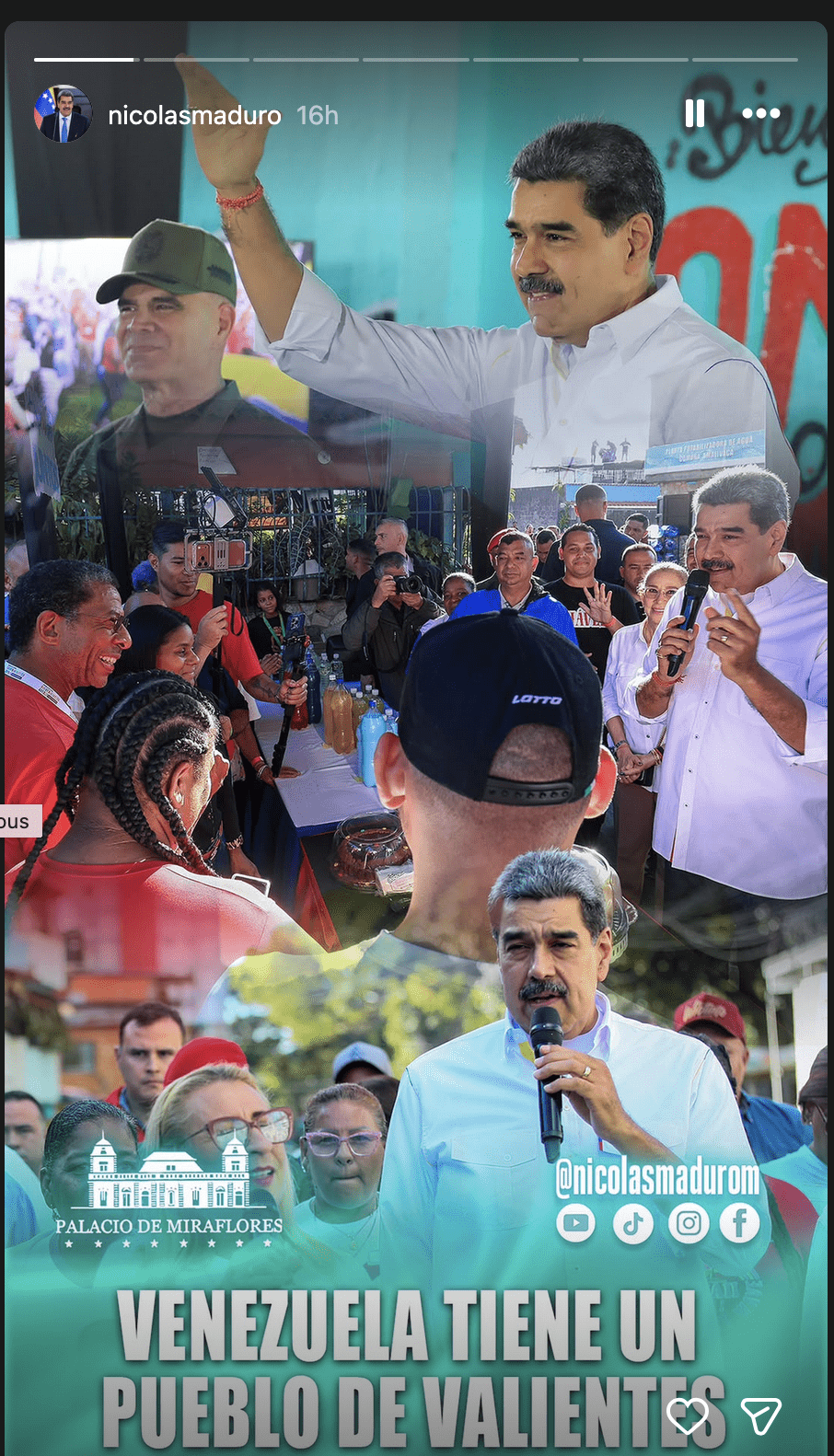
Caracas, Venezuela — From Dec. 9-11, Venezuela hosted the Assembly of the Peoples for Sovereignty and Peace of Our America. The gathering aimed to reshape government structures to more directly reflect the will of the Venezuelan people. Central to the Assembly were the communes — organizations designed to place production under the control and direction of workers themselves.
The communes evolved from the co-operatives. Both represent experiments of the Bolivarian Revolution that began in 1999 with the election of President Hugo Chávez. For the first time in Venezuelan history, government priorities centered on the needs of poor and working-class people — victims of centuries of colonialism, neo-colonialism, and imperialism under the Monroe Doctrine, the 1823 U.S. policy declaration that became an ideology justifying the exploitation and theft of Venezuela’s oil, gold, and sovereignty.
The Chávez era: building revolutionary infrastructure
During Chávez’s presidency, Venezuela saw record housing construction and the eradication of illiteracy in the mid-2000s. By 2005, this writer witnessed Cuban doctors establishing clinics in mountain communities that had previously been completely ignored by the government.
At the 2005 World Social Forum, President Chávez declared that humanity’s survival now depended on developing socialism worldwide — that climate catastrophe and poverty threatened human existence, and only the working class could stop the profit-driven imperialist countries.
Like current President Nicolás Maduro, Chávez used culture to inspire. He led delegates in singing “The Internationale.” Today, Maduro often opens conferences with the Bobby McFerrin song “Don’t Worry, Be Happy” — not to encourage apathy, but to meet U.S. imperialist terror and war threats with the calculated confidence of an empowered people.
Reporting from the ground
This writer attended the Assembly as a delegate representing the U.S. West Coast, a member of the Struggle for Socialism Party and the Harriet Tubman Center for Social Justice. At one commune gathering, I got President Maduro’s attention with a message of solidarity. He responded by singing “Don’t Worry…” The encounter was televised.
The conference was organized by the Simón Bolívar Institute with strong representation from youth, African, and Indigenous community organizations. The goal was not only to heal the disempowerment that Spanish colonialism and U.S. imperialism had enforced, but to recover and center the knowledge of these communities.
Presenters reminded attendees about the contributions of the 1804 Haitian Revolution — the first successful slave revolution that inspired enslaved Africans throughout the diaspora, including in North America. That revolution, under the leadership of Alexandre Pétion, president of the Republic of Haiti, provided warriors and military training for Simón Bolívar, who went on to liberate much of Latin America from Spanish colonial rule — from Panama to Colombia, Ecuador, Venezuela, Bolivia, and Peru. All these nations remain targets of U.S. imperialism today.
On Dec. 10, the U.S. seized an oil tanker off the coast of Venezuela carrying fuel to socialist Cuba, making clear the continuing motives of U.S. imperialism.
Trump’s white supremacy vs. Bolívar’s vision
On the second day, Vice President Delcy Rodríguez spoke about the stark contrast between Trump’s white supremacy and class war agenda and Simón Bolívar’s goals of equality and respect for enslaved and formerly enslaved Africans and Indigenous peoples. Bolívar understood their central position in the fight for self-determination and sovereignty. Trump’s plans for renewed colonialism revive the Monroe Doctrine to justify continued theft of Latin American resources and the profits of exploited labor.
Another delegate discussed socialism with a Venezuelan character — the goal of freeing society from dependence on imperialism and developing infrastructure for sustainable production.
That sustainable production, less dependent on global capitalism, was the vision Chávez pursued with passionate respect for Latin American peoples. In Venezuela, over half the population is of mixed (mestizo) African, Indigenous, and European ancestry. To benefit from the wisdom and moral priorities especially visible in African and Indigenous communities — lessons learned through 500 years of brutal repression — Chávez spent much of his presidency visiting previously isolated communities. Like Maduro’s continuing experiments, much of his time was spent listening, learning, and creating structures to ensure greater control by the majority of Venezuelans.
From co-ops to communes: fixing a contradiction
The Co-operatives were an experiment involving tens of thousands of projects intended to place Venezuela’s production more directly under the control of those doing the work, rather than generating profits through private ownership. Simon Bolivar Institute spokespersons explained that the government provided resources and funding to launch community projects.
Unfortunately, many co-op leaders saw an opportunity to secure government subsidies and appropriate the surplus produced by community workers’ labor. The social surplus — what remained after covering production costs and workers’ needs — was not, as intended, collectively controlled by the community for reinvestment and social priorities.
The communes were designed to control the direction of production, with community members deciding how profits would be distributed and reinvested. In other words, the means of production would belong to commune members.
The communes were part of a process to socialize the surplus from the workers in the collectives, discouraging privatization. Said one of the organizers of the Peoples Assembly for Peace and Sovereignty in Our America: “The communes didn’t replace cooperatives. Cooperatives prevailed as organizational attempts for popular power up until 2010. In parallel, Community Councils started to appear in 2008, Social Owned Businesses, started to emerge in 2010, and Communes started to appear in 2012 as alternative ways for people to obtain popular power. In Venezuela, cooperatives exist even today as a form of organization.” The communes have representatives coordinating with the government.
The Bolivarian government committed to being socialist in this manner, with the commune representing the face of Venezuelans and, most importantly, the historically marginalized mixed majority. This model enabled more sustainable production with genuine self-determination.
There are now more than 4,000 communes in Venezuela, representing more than 13 million people, nearly half of the population.
Many communes are producing more than they receive from the government and can contribute to national needs, paying taxes to support national management, planning, and military defense.
Witnessing decision-making in action
This writer observed the functioning and decision-making process up close at the El Panal Socialist Commune, where members explained they organize according to Marxist-Leninist principles. Committee meetings began with African drums and dance, followed by a roundtable discussion and debate.
Before dismissing the dance, drums, and music as merely supplemental, remember how Fidel Castro and many African liberation and Indigenous leaders recognized culture as the ruling class’s primary tool of ideological control — denying the oppressed and working class the ability to think independently, distracting them and directing them toward their own disempowerment.
When we were encouraged to participate in the dance before discussions and presentations, we learned how different leg movements historically expressed the reality of legs shackled under slavery, with the ball and chain creating a forced limp. That limp was given rhythmic expression in dance movements. This reminded me of how the Irish, under British repression, were forced to keep their dance confined to movement below the waist.
Ryan Coogler did a great job of putting that in the movie “Sinners,” showing the liberating role of dance and music from Africa and Asia to Ireland. There is a scene in that movie that expresses that so well – and made this writer shed a tear. Also, shed a tear when being greeted by the African/Indigenous and predominantly women members of the council in that Commune. I can tell you that when we are hit with the joy of seeing oppressed peoples fighting back with confidence and purpose – and I’m not alone in this – the tears of joy are shared by especially people of color, usually denied in so many seconds of the day.
The Indigenous and African dance we saw at the Commune was a beautiful expression of rhythm and dance and song that are another form of documenting history, and a documentation that was not a surrender – it was taking what you were forced to take from the oppressors and putting your spin on it. A spin that would build your dignity, your way of fighting back, your way of building endurance of mind and body and the confidence to ultimately dance on the graves of the rulers of U.S. imperialism.
Join the Struggle-La Lucha Telegram channel