
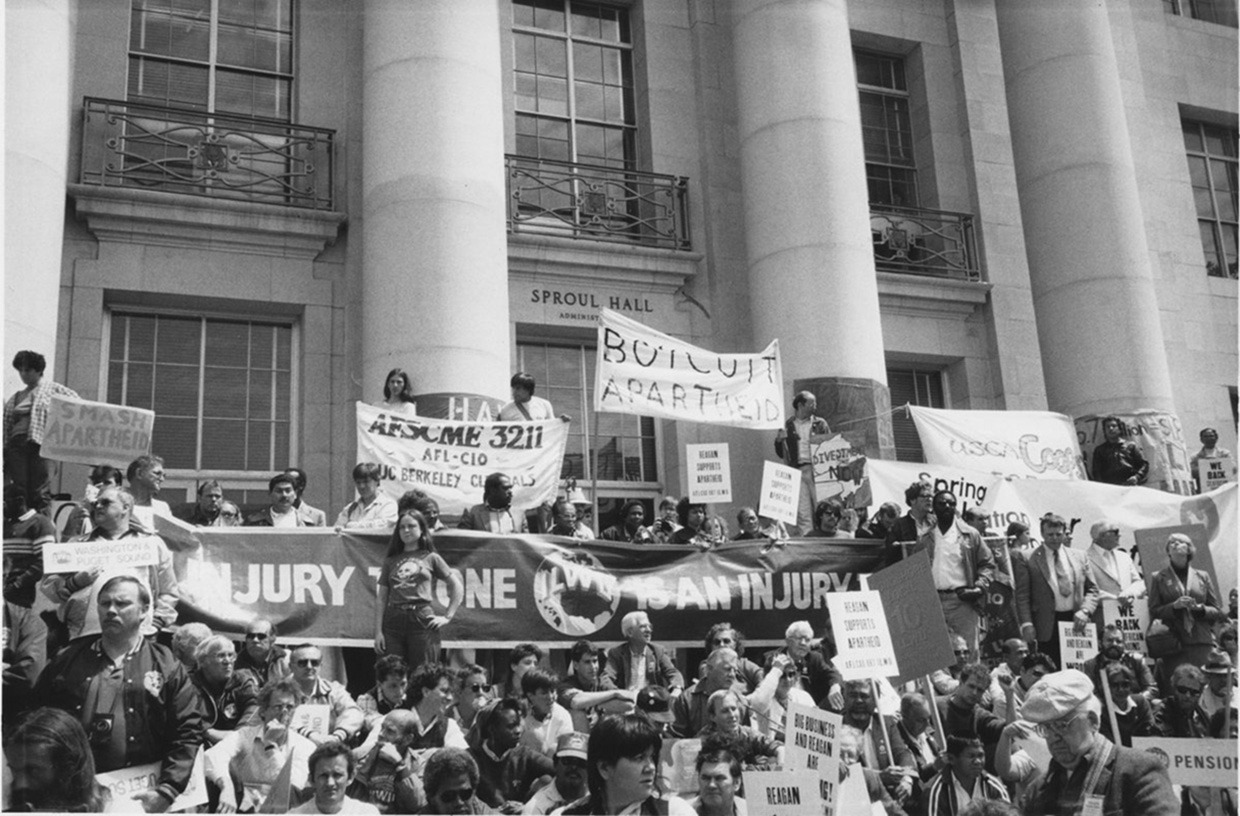
Clarence Thomas Jr. is a retired third-generation longshore worker from ILWU Local 10, co-founder of the Million Worker March Movement, and co-founder of DeClare Publishing. In this presentation to students, Thomas told them that his activism began in 1967 at San Francisco State College as a member of the Black Student Union, which initiated the longest student strike in U.S. history to establish a Black Studies Department and a School of Ethnic Studies.
On Oct. 30, I had the honor of speaking at the University of California, Berkeley’s Department of African American Studies about a subject close to my heart: the International Longshore & Warehouse Union (ILWU) Local 10’s pivotal role in the anti-apartheid movement of the 1980s.
Longshore workers are responsible for the loading and discharging of maritime cargo on shipping vessels. The cars we drive, the clothes we wear, and the food we eat all pass through the hands of dockworkers, also known as longshore workers. ILWU longshore workers move maritime cargo at all 29 ports on the West Coast, including Hawaii, Alaska, and ports represented by ILWU Canada in Vancouver, BC. We are responsible for making the ports productive, safe, and efficient.
These workers are critical to the global economy. The hands of dockworkers move the commerce of the world, giving them enormous power through collective action. Over the years, ILWU Local 10 has taken historic rank-and-file action in support of domestic and international social justice issues.
A tradition of international solidarity
Beginning in 1935, less than a year after the monumental 1934 West Coast Maritime Strike, Local 10 refused to load nickel and brass destined for the Italian fascist war machine ravaging Ethiopia. Shortly thereafter, members refused to load scrap iron destined for Japan. The union’s motto, adopted from the Industrial Workers of the World, is “An injury to one is an injury to all.”
Harry Bridges, one of the founders of ILWU and its first international president, said: “Interference with foreign policy of the country? Sure, as hell! That’s our job! That’s our privilege, that’s our right, that’s our duty.” He made those remarks after President Franklin Delano Roosevelt told him to stay out of U.S. foreign policy matters.
Local 10 activists refused to load U.S.-made military supplies intended for Pinochet’s military in Chile and for dictatorships in El Salvador, South Korea, and the Philippines. The positions Local 10 took against apartheid South Africa belong to this tradition spanning more than 80 years.
Understanding apartheid
Apartheid was a system of institutionalized racial segregation and discrimination in South Africa from 1948 to 1994, enforcing the political, social, and economic domination of the white minority over the non-white majority. The word apartheid means “apartness” in Afrikaans (a West Germanic language spoken in South Africa). The system is characterized by racist laws in housing, public facilities, and social events, treating non-white South Africans as inferior and stripping them of all rights.
The method of enforcement was the use of pass laws. Black South Africans had to carry passbooks that included photographs, fingerprints, addresses, the length of time the person had been employed, and other identifying personal information. Employers often entered an evaluation of the pass holder’s behavior.
As defined by law, an employer could only be a white person. The passbook also documented when permission was required to enter a certain region and whether the request was denied or granted. Urban areas were considered “white“, so a non-white person needed a passbook to be inside a city.
Under the law, any governmental employee could remove these entries, effectively denying permission to remain in the area. If a passbook didn’t have an entry, officials could arrest its owner and put them in prison. Colloquially, these passes were called the dompas — Afrikaans for “stupid pass” — a name Black South Africans used to describe the most hated and despicable symbol of apartheid.
Black South Africans often violated the pass laws to find work and support their families, and thus lived under constant threat of fines, harassment, and arrests. Protests against the suffocating laws brought the anti-apartheid struggle, including the Defiance Campaign in the early ‘50s, and the huge women’s protest in Pretoria in 1956.
My wife, Delores Lemon-Thomas, and I recently visited the Apartheid Museum in Johannesburg, where we learned of this brutal period of South Africa’s history, the injustices and hardships of people’s lives under apartheid. We also learned about people, organizations, and events that helped to end apartheid.
ILWU Local 10’s role in the anti-apartheid movement
Dockworkers play a crucial role in shipping, a key global industry that contributed to capitalism’s emergence. These workers amass power through collective action, ideological commitment, and sheer force of will. They can deploy their power on behalf of an array of social movements in their own unions, cities, and countries, as well as beyond their shores. Such a movement was launched when ILWU Local 10 started its solidarity actions to dismantle the apartheid system in South Africa. This movement was led by leftists, both Black and white, in a predominantly African American local.
Dockworkers in Durban, South Africa, conducted work stoppages from the 1940s into the early 1970s. These actions proved to be among the most important forces against apartheid in Durban. ILWU Local 10 rank-and-filers were in the vanguard in the labor movement in the U.S. fighting apartheid.
Sharpeville massacre
The Sharpeville massacre occurred on March 21, 1960. Some 6,000 people had gathered to protest the injustices of apartheid when police opened fire on the crowd. Sixty-nine people were killed and nearly 200 were wounded — many of them shot in the back as they fled.
Following these events, the American Committee on Africa (ACOA), the leading U.S. organization involved in South African liberation solidarity work, called for a boycott of South African goods and the enactment of U.S. sanctions in 1962. The ILWU Longshore Caucus endorsed such boycotts.
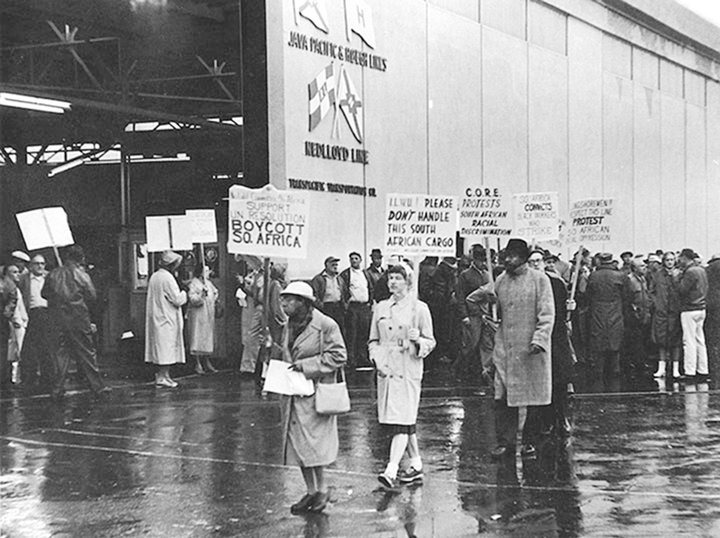
On Dec. 17, 1962, ACOA picketed the Dutch ship Raki, which arrived at San Francisco’s Pier 19 loaded with asbestos, coffee, and wool from South Africa. They sought to raise awareness of the horrors of apartheid and to encourage the U.S. to join a global boycott of South African goods.
Local 10 dockers stopped work to protest apartheid. ILWU traditionally doesn’t cross picket lines. William Bill Chester, the union’s Regional Director for Northern California, the highest-ranking African American in the ILWU, had worked closely with Mary Louise Hooper, the head of ACOA, in planning the boycott. Almost certainly, the Local 10 boycott was the first anti-apartheid action undertaken by a labor union in U.S. history.
The global struggle against apartheid surged in the 1970s. In 1976, the uprising of Black students in Soweto, despite ferocious repression, took the movement to the next level. Black freedom movements in Mozambique and Angola achieved freedom in 1975, and the armed struggle in southern Rhodesia heated up.
The freedom struggles in Africa resulted in the dramatic expansion of global solidarity in the San Francisco Bay Area. Radical rank-and-filers in ILWU Local 10 created the Southern African Liberation Support Committee (SALSC) to support these struggles. Black and white longshore workers’ efforts catapulted them to the front of the burgeoning global anti-apartheid movement. San Francisco dockworkers proved deeply committed and ultimately contributed to the downfall of white minority rule in South Africa.
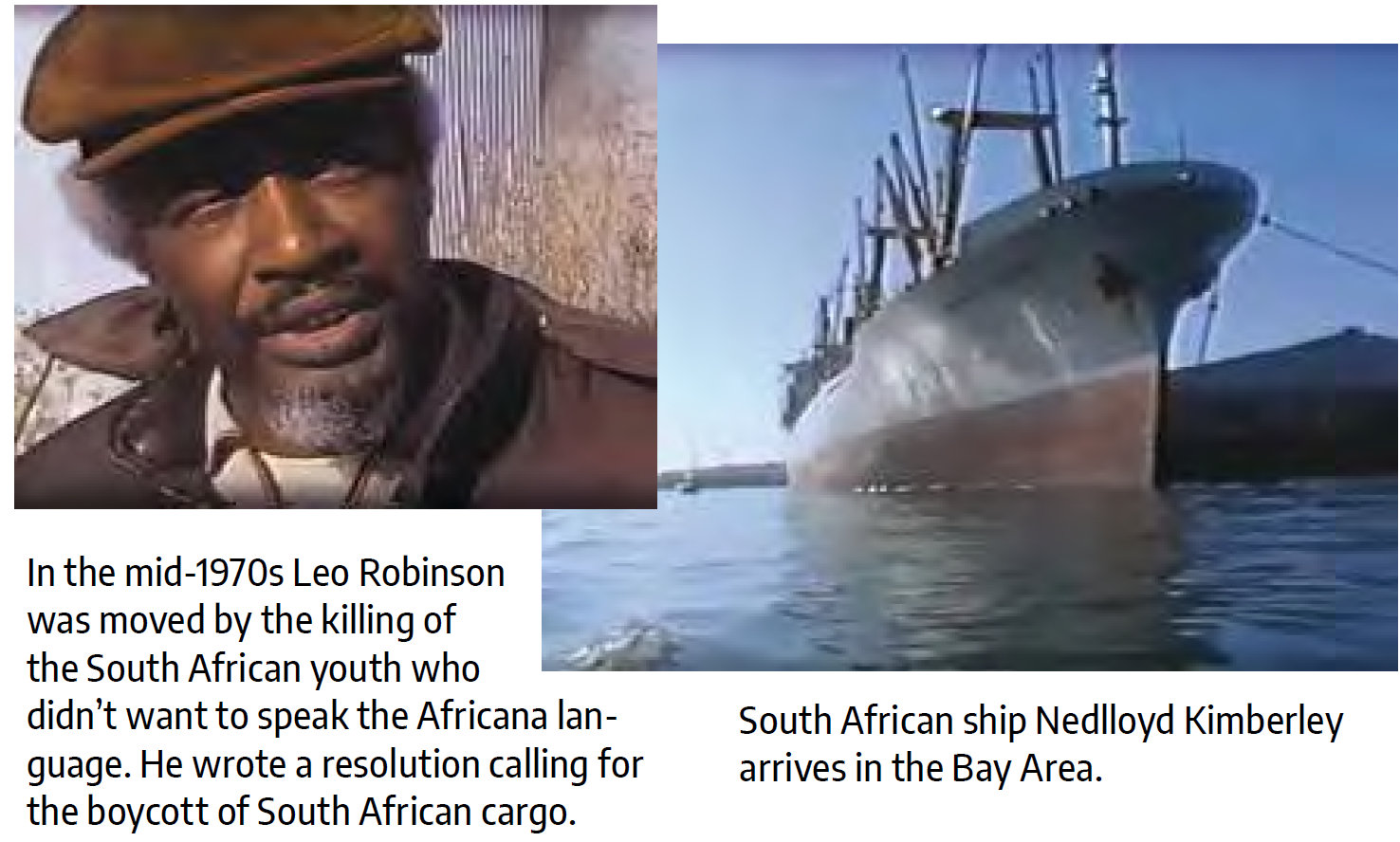
Brother Leo Robinson, an African American and communist who regularly critiqued capitalism, imperialism, and racism, became interested in South Africa during the Soweto uprising. He wrote a resolution to establish SALSC and boycott South African cargo, which Local 10’s Executive Board passed.
SALSC members included David Stewart, Bill Proctor, Larry Wright, Howard Keylor, Charlie Jones, and Leroy “Ned” Ingram — Black and white activists who were socialists or radical unionists who saw South Africans as fellow members of the global working class. They believed working-class power was strongest on the job and pushed for a boycott of South African cargo.
In July 1976, the ILWU International Executive Board issued communications to all locals regarding a boycott of South African cargo. SALSC helped Local 10 members to pass a resolution condemning the white minority governments of South Africa and Rhodesia, which had laws denying basic human rights to the Black majority of people in both nations.
In 1977, SALSC coordinated a two-day Easter Sunday boycott of the ship, Nedlloyd Kimberley. Approximately 500 people, many from churches, cheered the ILWU members and hoisted banners. That same year, SALSC collected tons of supplies for South Africans, Mozambicans, and Zimbabweans in liberation struggles, loading two 40-foot containers with goods for African National Congress ANC exiles in Tanzania and Zimbabwean refugees in Mozambique.
ILWU activists also screened the documentary “Last Grave at Dimbaza,” secretly filmed in 1973 and smuggled out of South Africa, showing the horrible suffering of Black people under apartheid. Wright and Robinson showed the film to dozens of audiences up and down the Pacific Coast in the 1970s and ’80s, laying the groundwork for future actions.
The historic 1984 boycott
In October 1984, a screening of “Last Grave at Dimbaza” before almost 400 Local 10 members sparked the longest and most important workplace boycott against apartheid in U.S. history. A motion to boycott only South African cargo on the next Nedlloyd ship passed resoundingly.
The timing was right because a group of Black South African miners had been arrested and faced long prison sentences. Bay Area longshore workers had been educated about apartheid for nearly a decade and were primed to act in solidarity with persecuted unionists.
On Nov. 24, 1984, the Nedlloyd Kimberley arrived at San Francisco’s Pier 80 carrying South African cargo. Local 10 activists knew of its arrival thanks to Brother Alex Bagwell, an African American in the clerk’s ILWU Local 34. A sympathetic job dispatcher assigned workers committed to the boycott.
For the next 10 days, many Bay Area residents gathered daily at the pier’s gate. On Dec. 2, about 700 people, many from unions, religious groups, and civil rights organizations, rallied at the dock. Brother Leo Robinson described how, “You couldn’t get from Army and Third Street to the gate of Pier 80 because it was jam-packed with community organizations and people.” Among those who spoke were legendary activist Angela Davis and Congressman Ron Dellums, the most radical member of the House of Representatives.
As employers sought to end the boycott, dockworkers remained steadfast. The Pacific Maritime Association (PMA) proposed unloading the ship elsewhere, but ILWU locals in Stockton, Portland, and Seattle expressed solidarity by refusing to handle “hot cargo.”
The PMA then filed a federal injunction calling the work stoppage illegal. The judge declared Local 10 would be fined $200,000 per day for noncompliance. By the end of the standoff, Local 10 faced fines totaling more than $2 million. The injunction singled out Robinson and Keylor for fines of thousands of dollars a day. Local 10 officials maintained the boycott was not union-sanctioned — plausible deniability to prevent financial catastrophe.
Finally, on the 11th day, Local 10 members unloaded the South African cargo. Despite activists’ disappointment that the boycott did not expand, SALSC and Local 10 members felt they had greatly raised awareness of what could be done to oppose apartheid. Bay Area activist and photojournalist David Bacon said, “That was the real birth of the anti-apartheid movement in Northern California.”
National impact
The dockworkers’ boycott helped inspire students at UC Berkeley to expand their protests in 1985, the largest activism there since the Vietnam War. Thousands rallied, and hundreds erected shantytowns resembling South African townships, leading to repeated clashes with police and heightened public awareness. Wright and Keylor spoke at rallies with a large ILWU banner displaying “an injury to one is an injury to all.” The protests ultimately forced a very reluctant Board of Regents to divest relevant portions of its $3 billion endowment.
The ILWU embraced the divestment campaigns. In 1986, Oakland closed its account with Bank of America, which conducted business in South Africa, in the most dramatic application of the city’s rigorous new South Africa divestment ordinance to date. Bank of America lost the city’s $150 million investment portfolio and $120 million annual payroll.
Local 10 exerted influence on Representative Ron Dellums, whose father was a Local 10 member. His uncle, C.L. Dellums, was probably one of the most important Black labor and civil rights leaders in California in the mid-20th century. He was a leader in the BSCP (Brotherhood of Sleeping Car Porters), the first Black union to be affiliated with the AFL-CIO. He succeeded A. Philip Randolph as its president.
Dellums introduced a sanctions bill and joined the Washington, D.C.-based Free South Africa Movement, which in 1984 launched sit-ins at the South African embassy just three days before the Nedlloyd boycott. Local 10’s action had a national impact, perhaps never more so than when Congress, led by Dellums, overrode President Ronald Reagan’s veto and passed sanctions.
Nelson Mandela’s acknowledgment
The ILWU and the Bay Area proved so important that Nelson Mandela visited Oakland during his first U.S. tour in 1990. He spoke before 60,000 people at the Oakland Coliseum, saying: “We salute members of the International Longshore & Warehouse Union Local 10 who refused to unload a South African cargo ship in 1984. In response, other workers, church people, community activists, and educators gathered each day at the docks to express their solidarity with the dockworkers. They established themselves as the frontline of the anti-apartheid movement in the Bay Area.”
Mandela later described how this action belongs to the larger fight: “We are part of a worldwide movement. Just as we watched and learned from the continuing struggle within the United States, so too did activists there gain strength from our struggles.” That no less a figure than Nelson Mandela praised Local 10 speaks volumes about the role of unions in the movement.
In 2013, I chaired a Local 10 committee to organize a memorial recognizing Leo Robinson’s contributions to the struggle to end apartheid. I invited members of the South African Consulate General’s Office in Southern California to attend.
Much to our surprise, Ambassador Rasool also attended the Memorial, presenting the Nelson Mandela Humanitarian Award posthumously to Leo’s widow, Johnnie Robinson. Consul General Cyril S. Ndaba presented the Nelson Mandela Freedom Award and a South African flag to Local 10. In his remarks at the memorial, the ambassador acknowledged the contributions of the entire Bay Area for its solidarity. Many activists from the anti-apartheid struggle attended.
The history of ILWU Local 10’s anti-apartheid activism demonstrates the power of international working-class solidarity. From the first boycott in 1962 to the historic 11-day action in 1984, San Francisco dockworkers proved that organized labor could be a decisive force in global struggles for justice. Their actions inspired a nationwide movement that helped bring down the apartheid regime. This legacy reminds us that “an injury to one is an injury to all.”
Peter Cole’s book, “Dockworker Power: Race and Activism in Durban and the San Francisco Bay Area,” was a contributing resource to this report. For speaking engagements or to purchase books from DeClare Publishing — “Mobilizing in Our Own Name – Million Worker March,” “Cleophus Williams – My Life Story in the ILWU, Local 10” and “The Year of Good Trouble, 1934” — visit millionworkermarch.com
Join the Struggle-La Lucha Telegram channel