
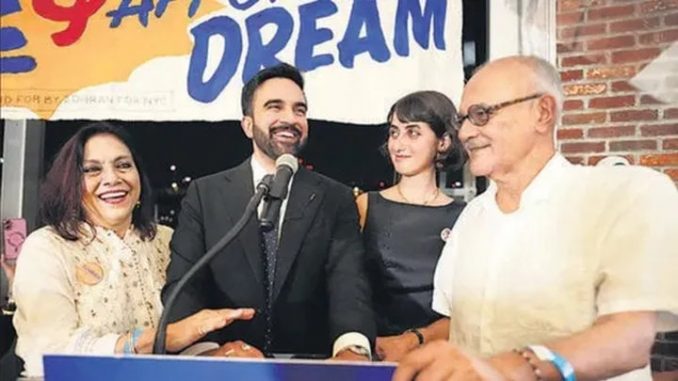
A new generation, a deep inheritance
The new mayor of New York, Zohran Mamdani, embodies a new political generation — but also a singular intellectual legacy: that of his parents.
His mother, Mira Nair, is one of the greatest contemporary Indian filmmakers, author of acclaimed films such as Salaam Bombay! and Monsoon Wedding.
His father, Mahmood Mamdani, is a historian, political scientist, and professor at Columbia University whose work has transformed our understanding of the relationship between colonization, modernity, and political violence.
Their son thus grew up at the crossroads of two inheritances: engaged cinema and critical thought — two forms of resistance to oblivion and to the established order.
The making of a postcolonial thinker
Born in 1946 in Bombay, Mahmood Mamdani grew up in Uganda, within an Indian-origin community that had settled in East Africa during the colonial era.
He studied in the United States, at Harvard, before returning to teach in Africa, notably at Dar es Salaam, a vibrant center of intellectual ferment in the 1970s.
Exiled after the expulsion of Asians by Idi Amin in 1972, he became a central figure of postcolonial thought. His personal experience fueled his reflection: to understand how colonial power survived decolonization — under other forms — within the structures of the state, of memory, and of violence.
Citizen and subject
In his major work, Citizen and Subject: Contemporary Africa and the Legacy of Late Colonialism (1996), Mamdani shows that the African states born from independence never truly broke with the colonial system.
Colonial power, he explains, divided societies into two worlds: urban citizens governed by civil law, and rural subjects ruled by customary law and “administrated” chiefs.
This split between “modernity” and “tradition” — between citizen and subject — survived independence and continues to structure political and social inequality.
This book established Mamdani as one of the most lucid thinkers of African postcolonialism — an author intent on revealing the continuities of domination hidden beneath the language of freedom.
When victims become killers
A few years later, in When Victims Become Killers: Colonialism, Nativism and the Genocide in Rwanda (2001), Mamdani challenged the dominant interpretation of the Rwandan genocide.
Rejecting moralizing or culturalist readings, he shows that the categories “Hutu” and “Tutsi” were not ancestral identities but the product of colonial racial classifications imposed by European powers — administrative inventions that froze hierarchies and fueled violence.
Mamdani advanced a disturbing thesis: genocide is not a regression into barbarism but the culmination of a colonial modernity that naturalized difference.
Those whom the West depicts as “peoples without history” are, in truth, both the victims — and at times the products — of its own racial order.
Good Muslim, bad Muslim
It was, however, with Good Muslim, Bad Muslim: America, the Cold War and the Roots of Terror (2004) that Mamdani gained worldwide recognition.
Published in the aftermath of September 11, the book dismantles the new ideology of the age: the “clash of civilizations.”
Mamdani demonstrates that the division between “good” and “bad” Muslims is not religious but geopolitical.
The “good Muslim” is the one who conforms to Western order; the “bad” is the one who resists it.
This dichotomy, he writes, was born during the Cold War, when the United States — seeking to weaken the Soviet Union — financed, armed, and supported the Afghan mujahideen, transforming jihad into a political weapon.
Political Islam, he argues, was created by empire before being demonized by it. The “freedom fighters” of the 1980s became, twenty years later, the “terrorists” of the War on Terror.
What Mamdani denounces is the moralization of politics. Instead of explaining violence through historical and geopolitical causes, the West attributes it to the “culture” of others — never asking what it has done, only who “they” are.
This reversal of the gaze — where the politics of domination becomes a defense of civilization — constitutes, for Mamdani, the heart of modern imperial ideology.
“When we explain the behavior of others by their culture, we justify our own by our politics,” he writes.
Good Muslim, Bad Muslim is therefore far more than a critique of post-9/11 Americanism; it is a genealogy of imperial lies.
Mamdani exposes the continuity linking colonial wars, the Cold War, and the so-called “War on Terror”: a single moral narrative in which the West imagines itself the guardian of reason and freedom, while the dominated peoples are reduced to primitive passions — to threats that must be civilized.
His work calls on us to repoliticize violence, to break with the discourse of fear, and to recognize the West’s historical responsibility for the very disasters it condemns.
The struggle against amnesia
All of Mahmood Mamdani’s work can be read as a struggle against amnesia. It lays bare the persistence of colonial power within the institutions, discourses, and wars of the present.
And so we grasp the symbolic weight of the fact that his son, Zohran Mamdani — heir to such an intellectual and activist lineage — has today become the mayor of New York, the capital of global capitalism and of the American narrative itself.
It is an irony of history, but also a promise: that a world critical of empire might finally speak from its very center.
Zohran Mamdani once appeared in one of his mother’s films, Queen of Katwe (2016), contributing to its soundtrack as the rapper Young Cardamom, later known as Mr. Cardamom.
Translated from the French using AI. Originally published in Investig’Action (6 November 2025). This work is distributed under a Creative Commons license (CC BY-NC-SA 4.0).
Abbas Fahdel is an Iraqi-French filmmaker and writer. Born in Babylon, Iraq, he moved to France as a young man and studied cinema at the Sorbonne. His acclaimed documentaries Retour à Babylone and Homeland: Iraq Year Zero explore memory, war, and the enduring legacies of empire. Fahdel’s work, rooted in personal experience and political reflection, has been honored at international festivals for its anti-imperialist vision.
Join the Struggle-La Lucha Telegram channel