March for LGBTQ youth at Louisiana Capitol

SLL photos

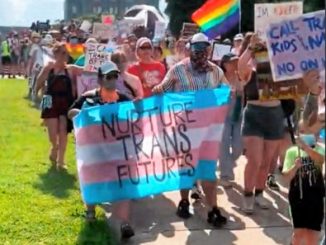
Baton Rouge, LA – On May 27, almost 300 people gathered at the Louisiana State Capitol to protest the attacks on LGBTQ rights. The demonstrators then marched to Governor John Bel Edwards’ mansion and listened to several speakers. Protests like this are sweeping the nation as states move to pass anti-LGBTQ legislation. Many of the attendees and speakers were students and young people who these reactionary bills directly attack.

Protesters demanded that Edwards, a Democrat, veto all anti-LBGTQ legislation. They condemned bills such as “Don’t Say Gay” (HB 466), which would ban teachers from discussing gender identity and sexuality. Other targets included the “Deadname Bill” (HB 81), banning the use of gender-affirming names and pronouns, and bills that censor LGBTQ-themed books in libraries (SB 7, HB 102, and HB 628).

Before the march began, organizers outlined the necessity for the people to exercise their political power to defend LGBTQ rights. “The Republicans are playing a numbers game, they think that if they throw enough bills at the wall, then something will stick. But those numbers aren’t the ones that matter, the numbers that matter are the people who are out in the streets!” emphasized Serena Sojic-Borne, an organizer with Real Name Campaign.

This method of resistance has already proven successful at defeating these bills. HB 648, which would have banned gender-affirming care for minors, was defeated in the state senate committee. It took a coalition of many grassroots organizations and collective action by LGBTQ people in Louisiana to make this happen.

During the march, chants like “Trans kids are here to stay, GOP, go away!” and “We’re here, we’re queer, we’re fabulous, don’t mess with us!” kept protesters lively as they approached the mansion. Outside Governor Edward’s mansion, Blu DiMarco, a student organizer with Loyola Young Democratic Socialists of America, spoke on his experiences as a trans person in the state. “We will not be pushed back into the closet, instead, we will break the door, because we are the children, the parents, the teachers, the past and the future, trans people make this country thrive!” DiMarco said.

Governor Edwards has stated support for LGBTQ youth but has not committed to vetoing any legislation by the Republican-dominated legislature. Last year, he allowed a ban on trans kids playing sports to pass into law.

The diversity of speakers and organizations at the protest goes to show that this is an all-hands-on-deck struggle. The fight for LGBTQ rights, women’s rights, and education are increasingly interwoven as the right-wing gains momentum in the United States. Sojic-Borne highlighted the importance of continuing this struggle: “We do this by keeping our eyes on the prize, not just this or that bill, but building a movement,” she concluded.

Source: FightBack! News

Strugglelalucha256


Hundreds gather in Atlanta in support of arrested Atlanta Solidarity Fund activists

Three face outrageous money laundering and charity fraud charges

Atlanta – On May 31, roughly 150 people gathered outside the DeKalb County Jail for a noise demonstration in support of three activists arrested that morning by the Georgia Bureau of Investigation and the Atlanta Police Department. The three Georgian activists – Marlon Kautz, Savannah Patterson, and Adele Maclean, who are associated with the Atlanta Solidarity Fund (ASF), were arrested for money laundering and charity fraud, according to a statement made by the Georgia Bureau of Investigation (GBI) on Twitter.

ASF has been instrumental in raising bail, providing jail support, and providing access to representation for arrested protesters since 2017. In the past several months, they have raised bail for individuals charged with domestic terrorism over their protests against the construction of the $90 million police training facility commonly known as Cop City.

In February, the ASF, along with Community Movement Builders, released a statement that they expected RICO charges to be levied against Stop Cop City participants. Governor Brian Kemp published a statement shortly after the arrests on May 31, referring to the activists as “criminals who facilitated and encouraged domestic terrorism.” He promised to “track down every member of a criminal organization, from violent foot soldiers to their uncaring leaders.”

In the protracted struggle over the construction of Cop City, the state has continually escalated repression. Forty-two people have been charged with domestic terrorism in connection with protests against the construction of Cop City, and one person (Manuel Esteban Paez Terán, nicknamed Tortuguita) was murdered by a combined task force of GBI, Atlanta Police Department, and Georgia State Patrol officers. The arrests made on Wednesday are yet another attempt to discredit and intimidate the movement and designate its supporters as criminal.

“This intervening event is again a distinct attempt to steal back the narrative, to criminalize the movement, to stop people from protesting against Cop City,” said Kamau Franklin, the founder of Community Movement Builders. “We think this is very much an attempt by the state to chill dissent and stop our movement, but we will not let it happen.”

Wednesday’s event at the DeKalb County Jail began with a short press conference held by Kamau Franklin. Shortly afterward, there was a series of speeches from community leaders, including Franklin and the Reverends Matt Johnson and Keyanna Jones, who spoke about the motivations behind the arrests and the negative societal impact of jails. Various call-and-response chants broke out throughout the speeches: “Stop Cop City,” “Viva, viva, Tortuguita” and “No justice, no peace.” Inmates of the DeKalb County Jail could be seen waving their hands through windows and occasionally heard cheering.

The Stop Cop City movement has, despite the state’s best efforts, remained popular with people in Atlanta. On May 15, the Atlanta city council held a meeting regarding additional funding for Cop City, and more than 300 people attended to protest. For seven hours, those who had been able to sign up to speak, nearly 200 people, provided thoughtful arguments against the construction of the police training facility. In the wake of the revelation last week that Atlanta taxpayers will foot $67 million of the Cop City bill, despite Mayor Andre Dickens’ claim of $30 million, activists are ramping up their outreach efforts and encouraging residents of Atlanta to attend the June 5 meeting of the Atlanta City Council and provide public comment.

Source: FightBack! News

Strugglelalucha256


ILWU contract talks: Pandemic profits at the forefront

FOR IMMEDIATE RELEASE: June 2, 2023
CONTACT: media@ilwu.org

ILWU Remains Committed to Negotiating a Good Agreement for ILWU Workers as Contract Talks Continue

Pandemic profits at the forefront

SAN FRANCISCO, CA (June 2, 2023) – The Pacific Maritime Association (PMA) represents over 70 multinational ocean carriers and maritime companies in contract negotiations with the International Longshore and Warehouse Union (ILWU). PMA member carriers and terminal operators made historic profits of $510 billion during the pandemic. In some cases, profits jumped nearly 1000%. Even as shipping volumes return to normal in 2023, PMA members have continued to post revenues that far exceed pre-pandemic times by billions of dollars.

ILWU workers risked and lost their lives during the pandemic to ensure grocery store shelves were stocked, PPE was made available, essential medical supplies were reaching our hospitals, and record volumes of consumer goods continued to reach the doorsteps of American consumers while also enabling the shipping industries’ astronomical revenues. Despite this fact, from pre-pandemic levels through 2022, the percentage of ILWU wages and benefits continued to drop compared to PMA rising revenues. The ILWU is committed to bargaining a contract that is fair and equitable, including wages and benefits that reflect the dedication of the ILWU workforce and its contributions to the shipping industry’s success.

“Any reports that negotiations have broken down are false,” stated International President Willie Adams, “We are getting there but it’s important to understand that West Coast dockworkers kept the economy going during the pandemic and lost their lives doing so. We aren’t going to settle for an economic package that doesn’t recognize the heroic efforts and personal sacrifices of the ILWU workforce that lifted the shipping industry to record profits.”

The collective bargaining agreement that the ILWU and PMA are negotiating covers more than 22,000 longshore workers at 29 U.S. West Coast ports. The previous agreement expired on July 1, 2022, and talks began on May 10, 2022. The ILWU and PMA continue to negotiate the collective bargaining agreement and are committed to reaching an agreement.

Strugglelalucha256


Cleophas Williams: My Life Story in the ILWU Local 10

A book review 

When I received this beautiful book from Delores Lemon-Thomas and Clarence Thomas, I could not wait to begin reading it.

I had the honor of meeting and talking with Sadie Williams, wife of Cleophas Williams, on two occasions. Once in Oakland at her home at the Cleophas Williams Rose Garden dedication shortly after the book “Mobilizing in Our Own Name: Million Worker March” was published and again about a year later at the ILWU Pacific Coast Pensioners Association convention in Long Beach, Calif. 

Each time she was surrounded by ILWU Local 10 members engaging and embracing her presence with love and respect. I was surprised when I went to introduce myself in Long Beach, and she said, “I remember you,” and opened her arms for a hug.

In Long Beach, Delores let me glimpse some of the scanned pages of Cleophas Williams’ handwritten journal. I held it in my hand and immediately began to read it. Delores left the journal with me for a little while. 

As I examined it, I was impressed with his handwriting or, more formally, his penmanship. There are a few samples of his handwriting in the book, one on page 52 at the beginning of Chapter 2, “A Longshore Worker’s Life Story.”

Delores told me about Clarence’s intention of editing and publishing Cleophas Williams’ story. The pages would have to be scanned, which required them to keep the original transcript for a while. It was hard for Mrs. Sadie Williams to part with it, even for a short time, but she could rest assured that it was in good hands. This journal is a treasure that will be valued for generations to come.

I read through the book quickly the first time and reread it, reflecting on my own life and making connections. I was also brought up in the South, and one of the many things that resonated with me was when Williams wrote about the Booker T. Washington High School that he and his sister attended. The school was built by the Julius Rosenwald Fund, which builds schools for Black Students throughout the South where there were no Black schools.” 

The segregated school my eight siblings and I attended, Carver School, named after George Washington Carver, was built in 1915 using the same fund. It was renamed Carver-Hill School in 1955 after Reverend Edward Hill, who fought for well-funded schools for Black students.

There is much to be learned from this biography; the history of how Cleophas Williams was elected by popular vote the first African American president of ILWU Local 10, the most militant, progressive union in the United States, if not the world.

In the book, Cleophas explains that he was discharged from the army due to a knee injury after serving three months and 19 days. He heard a fellow “telling a barber that he was a Longshoreman; pay was good, and it had peacetime possibilities.” So he applied, followed the steps needed, and was hired with no idea that, in his words, “I was about to embark on a journey that not only brought me employment, but a place in the sun that I would have never dreamed of.”

Williams knew nothing about the ILWU when he was hired, but he was a fast learner and followed all the rules. After the 6-month probationary period, he was promoted to full union membership. Williams worked as a rank-and-file worker for 15 years, working out of the hall, attending union meetings, enrolling in the California Labor School, and just continuing to learn before deciding to run for president of ILWU.

Williams acknowledged the shoulders of those ancestors who paved the way and those that gave him much-needed support; apologized to people he hurt along the way. He took responsibility for his mistakes, not blaming his parents or the tragic experiences of growing up in the “Jim Crow” South.

Williams was a courageous working-class organizer, a fighter for social justice and the rights of workers nationally and internationally. He believed the struggle for social justice, equality, and dignity was a workers’ struggle.

I highly recommend employed, unemployed, organized, and unorganized workers read Cleophas Williams’ “My Life Story in the International Longshore & Warehouse Union Local 10.”

Use this Link to purchase your copy at Autumn Press.

Strugglelalucha256


Aleida Guevara advocates greater support for the Palestinian cause

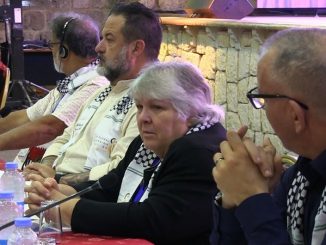
Aleida Guevara, daughter of the eternal Argentinean-Cuban commander Ernesto Che Guevara, called on Monday in Lebanon for greater support for the cause of the Palestinian people.

In the context of her participation in the event of the ambassadors of the Palestinian return, the internationalist doctor questioned the silence of the world in the face of the crimes against humanity committed against the Palestinian population.

During her intervention in the morning session, she insisted on the need to achieve unity and coordinate actions in all latitudes and in different spaces to reach as many people as possible in order to defend the dignity and integrity of the Palestinians.

On the occasion,  Aleida hoped to work as part of an expressed human bloc in pursuit of a common goal, the sovereignty, stability, and development of the people.

In her opinion, Palestine requires the solidarity of all, as Che asked, in the sense of living together with the people, sharing the daily reality, and facing their own lives side by side.

How many images pass through our conscience when we speak of this people, how much abuse, how much injustice, how much impotence, he said.

Incidentally, Aleida Guevara spoke of the steadfastness and struggle of the Palestinians in more than seven decades of Israeli occupation. In her words, she defended a full-fledged Palestine as a free and sovereign people where their children grow up with peace and joy.

The speech endorsed the right of self-determination for a nation owning its lands and borders and, in this line of thought, signified the continuation of the struggle until victory is achieved.

The daughter of the heroic guerrilla Che Guevara together with other personalities from Bahrain, Spain, South Africa, Tunisia, India, Algeria, and Lebanon, will receive in Beirut the distinction of Ambassadors of the Palestinian cause with the aim of strengthening the defense of this people for their independence, sovereignty, and freedom.

The event, organized by the Global Campaign for the Right of Return of the Palestinian People, was also attended by representatives from Chile, Australia, France, Indonesia, Jordan, Switzerland, Syria, Venezuela, Iran, Pakistan, Scotland, Kuwait, Argentina, and Iraq.

The following is Aleida Guevara’s full speech at the act of solidarity with the Palestinian cause held in Beirut, the Lebanese capital.

Dear comrades.

Brothers and sisters.

For me, it is very difficult to talk about Palestine in a calm way, the truth is that at this stage of life, it bothers me to talk about the Return of Palestine when we should be talking about the development of Palestine, about the new projects for the construction of houses in its national territory, about plans for the enrichment of its soils to make them more fertile, about the projects of plans for the feeding of the Palestinian people, in short, we should be talking in the middle of Palestinian land.

How many years of confrontations, how many years of suffering, how many crimes against humanity committed against a people whose only crime was to be forced to share part of their territory with another people who had practically been wiped off the face of the earth and who gradually used their wealth and international influence to displace them.

I feel very sorry for the loss of memory of an entire people who completely forgot the crimes committed against them for the simple fact of being Jews and that today they practice them with total impunity on their neighboring people.

Why do we still talk today about the return of Palestine? Why have we not been able to support more this brotherly people? Why the world seems to be deaf and blind to such a crime? What do we lack? Strength we lack strength, and to reach that necessary strength, we need unity, to coordinate actions in all latitudes, in all possible spaces, to reach the greatest possible number of people, to touch their feelings; if we are not capable of this, we will not be able to change the reality that day by day consumes the joy of a people, their dignity and their integrity.

The Peruvian poet César Vallejo said that there was a body that was dying, people were joining around it, but the body continued to die until all humanity was by its side, and it was only then that the body reacted and began to walk and that is what Palestine needs, that all of us are at its side and that is the solidarity that Che asked us, not that which was offered to a gladiator in the Roman circus, but to live with that people their daily reality and face side by side their own lives.

This is my greatest wish, that as a human bloc, we work towards a common goal, the sovereignty, stability, and development of the Palestinian people.

How many images pass through our conscience when we speak of this people, how many outrages, how many injustices, how much impotence? For all those who are not physically present, for the comrades unjustly imprisoned, for those who mourn their loved ones but remain firm and standing up for the struggle, I commit myself.

For a Palestine in full capacity as a free and sovereign people, for a Palestine where its children grow with tranquility and joy, for Palestine as the owner of its lands and its borders, for that Palestine, we will fight until victory, and we will win.

Source: Al Mayadeen, translation Resumen Latinoamericano – US

Strugglelalucha256


Biden calls Cuba ‘terrorist’ while the people demand an end to U.S. terrorism against Cuba

On Tuesday, May 23rd, the State Department reported that Cuba — along with Iran, Syria, the Democratic People’s Republic of Korea, and Venezuela — are not “not cooperating fully” in the United States’ supposed fight against terrorism. The Biden administration officially designates Cuba as a “State Sponsor of Terrorism” (SSOT), as well as Iran, Syria, and the DPRK.

Literally, 0% of Americans view Cuba as a serious threat, and the Biden administration has provided no evidence of Cuba supporting terrorism in any way. Cuban and American officials even met earlier this month in Havana to discuss cooperating on anti-terrorism measures. So why is Biden keeping Cuba on the “State Sponsors of Terrorism” list?

Sixty-four years after the triumph of the Cuban Revolution, the United States is still waging an economic and media war against Cuba. The administrations of Trump and now Biden have weaponized the “State Sponsors of Terrorism” list to isolate Cuba internationally and justify continuing the genocidal American blockade.

The impacts of being labeled a ‘State Sponsor of Terror’

It goes without saying that the United States is the biggest “State Sponsor of Terrorism” in the world. The U.S. is the only country with over 800 foreign military bases and spends more on its military than 144 countries combined. The U.S. has launched 251 foreign military interventions since 1991. A report recently published by Brown University shows that the post-9/11 wars the U.S. waged in Iraq, Afghanistan, Syria, Yemen, and Pakistan killed at least 4.5 million and displaced 38 to 60 million people. But the word “terrorist” is almost never applied to the U.S. government. The term is highly politicized and subjective in the United States, used to demonize internal and external enemies and justify waging war on them, be it by bombs or blockades.

Designating Cuba as “terrorist” exacerbates the already devastating impacts of the American blockade, which has stolen an estimated $144.4 billion from the Cuban economy from the early 1960s to 2020, according to the United Nations. The United Nations Economic Commission for Latin America and the Caribbean (ECLAC) determined that U.S. sanctions on Cuba “constitute the most severe and prolonged system of unilateral coercive measures ever applied against any country.”

On top of the blockade, Cuba’s “terrorist” designation restricts American foreign assistance, exports of dual-use items, and loans from the World Bank. It has also prevented Cuban Americans from transferring money to families in Cuba, stopped faith-based groups from shipping humanitarian supplies, and inhibited American universities from working with Cuban academics and institutions. Non-U.S. citizens who have traveled to Cuba, a supposedly “terrorist” country, also have restrictions on visas to enter or visit the United States.

Despite being a list created and maintained only by the United States, because of its enormous power over the global financial system, the designation inhibits the ability of Cuba — and the other countries listed — to trade normally with the rest of the world. Banks don’t want to risk giving loans to a country labeled as “terrorist” by the hegemonic United States. The United States has sued foreign companies and banks for hundreds of millions of dollars for violating American sanctions on Cuba, and many major international banks no longer provide services to Cuba for fear of retaliation. The blockade as a whole is extraterritorial and thus violates international law.

The history of Cuba’s ‘terrorist’ designation and U.S. terrorism against Cuba

President Ronald Reagan first added Cuba to the terror list in 1982, citing Cuba’s support for national liberation movements across the world, such as giving military aid to Angola to defeat a U.S.-backed invasion by the South African apartheid regime. Meanwhile, the United States was backing violent terrorism to sabotage the Cuban Revolution.

As Cuba expert Professor William LeoGrande said, Cuba’s “terrorist” designation “is ironic because in the 1960s, the CIA sponsored assassinations attempts, sabotage and paramilitary raids against Cuba—what today would be called state-sponsored terrorism—and CIA-trained Cuban exiles continued such attacks for the next several decades.”

Luis Posada Carriles, the mastermind behind many of these U.S.-backed terrorist attacks — including the bombing of Cubana Flight 455 in 1976 and a series of hotel bombings in 1997 — died peacefully in Florida in 2018, protected by the U.S. government and lionized by the right-wing Cuban-American community in Miami. But Cuba, according to the State Department, was the real terrorist.

During President Barack Obama’s second term, he pursued a policy of “rapprochement” with Cuba, restoring diplomatic relations and lifting some travel and trade restrictions. The Obama administration removed Cuba from the terror list, saying, “we will continue to have differences with the Cuban government, but our concerns over a wide range of Cuba’s policies and actions fall outside the criteria that is relevant to whether to rescind Cuba’s designation as a State Sponsor of Terrorism.”

Obama’s “friendly” policy was still aimed at regime change through a new set of tactics, and he continued funding covert operations and “democracy promotion” programs aimed at undermining the Cuban Revolution. Nevertheless, rapprochement had positive effects for the Cuban and American people, especially renewed travel and people-to-people exchanges between the two countries. All of this was undone by Donald Trump.

Trump tightened the blockade and added an additional 243 sanctions on Cuba. Then, just four days after the January 6th insurrection, Trump and his neoconservative Secretary of State Mike Pompeo redesignated Cuba as a “State Sponsor of Terrorism.” They made this last-minute move in bitter spite of Cuba, but also to create a political obstacle for President Biden, who would be pressured from different sides to keep or remove Cuba’s “terrorist” designation.

Biden and Trump’s Hawkish Cuba Policy

Many Cubans and Americans alike hoped Biden would re-normalize U.S.-Cuba relations as he promised during his campaign, when he said he would “promptly reverse the failed Trump policies that have inflicted harm on the Cuban people and done nothing to advance democracy and human rights.” But Biden has changed little. He slightly eased some Trump-era restrictions in May 2022 but has also renewed his predecessor’s harshest measures. As a result, Cuba — also impacted by the pandemic and the war in Ukraine — is experiencing its worst economic crisis and fuel shortages in decades.

The economic crisis in Cuba is fueling a political crisis for Biden at the border, as more Cubans than ever are leaving for the United States to escape the crushing impacts of sanctions. A group of Democratic lawmakers is urging Biden to lift Trump-era sanctions on Cuba and Venezuela to slow the surge of migration, but Biden has not moved a finger. Instead, he follows the line of conservative Cuban-American lawmakers on Cuba policy, especially Chairman of the Senate Foreign Relations Committee, Democratic Senator Bob Menendez of New Jersey, who Biden needs to push his appointments through the confirmation process.

Menendez, who is currently under investigation for corruption, lambasted his fellow Democrats’ push against Trump-era sanctions and claimed that the Cuban and Venezuelan governments — not U.S. policy — were solely responsible for the economic crises in those countries. The Washington Post reported that “Privately, senior Biden officials have conceded that picking a fight with [Menendez] is not worth whatever benefit might come from relaxing sanctions on [Cuba and Venezuela], even if it would fulfill a campaign promise Biden made to restore President Barack Obama’s policies toward Cuba.”

Despite Biden claiming to care about “human rights” and “supporting the Cuban people,” he is not changing his internationally condemned policy — which violates Cuba’s sovereignty and human rights — because doing so is not politically expedient.

Activists who support normalizing U.S.-Cuba relations have concentrated on pressuring Biden to remove Cuba from the terror list because, as Noam Chomsky and Vijay Prashad wrote in Peoples Dispatch, “Biden can remove Cuba from this list with a stroke of his pen. It’s as simple as that” — unlike the blockade, which is a complex amalgamation of hundreds of different laws in the hands of Congress.

In the State Department’s most recent public remarks on Cuba, they have doubled down on Trump’s policy of keeping Cuba on the list. Earlier this year, far-right Florida Republicans Maria Salazar and Marco Rubio introduced the FORCE Act in the House and Senate, respectively, to codify into law Cuba’s “terrorist” designation so that it could only be removed by Congress, not the President alone.

And not only that. Cuba would have to meet impossible criteria, completely changing their political and economic system to be what the United States defines as “free,” in order for the designation to be lifted. As People’s Dispatch wrote, “Essentially, Salazar is demanding that the Cuban people overthrow their own government and overturn the Cuban political system which has been built by the people and for the people over the last 60 years.”

It could not be more clear that the terror list has nothing to do with preventing actual terrorism; rather, it is about harming enemy states of the U.S.. In March, when Salazar interrogated Secretary of State Antony Blinken about Cuba’s “terrorist” designation, he said that Cuba would have to “meet a very high bar” to be removed from the list and the State Department had no plans to do so.

Earlier this month, Cuban journalist Liz Oliva Fernandez stumped State Department Spokesperson Vedant Patel when she asked him “Why is Cuba on the State Sponsors of Terrorism list if you are trying to work with them to fight against terrorism?” He completely dodged the question, refusing to provide any examples of Cuban terrorism.

Even anti-Cuba mainstream U.S. media has reported that the “terrorist” designation is “bogus.” NBC News wrote, “according to half a dozen interviews with former intelligence analysts and officials who worked on Cuba policy in both Republican and Democratic administrations, the ‘consensus position’ in the U.S. intelligence community has for decades been that the communist-led nation does not sponsor terrorism.”

Larry Wilkerson, chief of staff to then-Secretary of State Colin Powell in the George W. Bush administration said that “‘Cuba is not a state sponsor of terrorism’ was a mantra from the moment I walked into the State Department to the moment I walked out. It’s a fiction that we have created…to reinforce the rationale for the blockade.”

Similarly, Congressman Jim McGovern (Democrat-Massachusetts) and Senator Patrick Leahy (Democrat-Vermont) published an op-ed in The Boston Globe explaining that “[i]t’s an open secret in Washington that Cuba does not belong on the list and that the previous false justification by the Trump administration was politically motivated.”

The #OffTheList campaign

The U.S. government does not represent the American people on most issues — especially Cuba. The blockade of Cuba persists against the democratic will of the American people, a majority of whom have consistently opposed the blockade, especially restrictions on trading medicine and food with Cuba.

In the United States, Cuban-Americans, solidarity activists, labor unions, and local governments, have organized resistance to Biden’s designation of Cuba as a “State Sponsor of Terrorism.” Since January 2023, the National Network on Cuba (NNOC), a coalition of over 50 organizations across the U.S. working to end the blockade, has been leading an international campaign to get Cuba #OffTheList.

On June 25th, this movement will rally at the White House — and in other locations around the world — to demand Biden take Cuba off the list, lift all U.S. sanctions, and end U.S. terrorism against Cuba. The NNOC is organizing these rallies alongside the Canadian Network on Cuba, ANSWER Coalition, CODEPINK, IFCO/Pastors for Peace, the Alliance for Cuba Engagement and Respect (ACERE), the International People’s Assembly, and over 70 other groups.

The voices of the American people and our progressive movements are clear: we want normalized relations with Cuba. Just in the past couple of years…

  • Labor unions and city councils have passed over 80 resolutions supporting an end to the blockade, promoting scientific collaboration with Cuba, and urging that Cuba be removed from the terror list. And, just last week, the Washington, DC Council unanimously voted to pass a Cuba solidarity resolution and sent copies to Biden and key congresspeople urging them to end the blockade. Combined, these resolutions represent well over 50 million Americans.
  • The 33 member states of the Community of Latin American and Caribbean States (CELAC) demanded that the United States remove Cuba from the terror list and “reiterated their rejection of the U.S. unilateral lists and certifications that affect Latin American countries.”
  • Across the world, there have been monthly rallies and car caravans initiated by Cuban-Americans calling to end the blockade, take Cuba off the list, and build Puentes de Amor (bridges of love) between the American and Cuban people.
  • Over 100 Democratic House members urged Biden to remove Cuba from the SSOT list and normalize U.S.-Cuba relations. Their open letter was signed by big names like Appropriations Subcommittee on Foreign Operations Chair Barbara Lee of California, Rules Committee Chair James McGovern of Massachusetts, and Foreign Affairs Committee Chair Gregory Meeks of New York.
  • Nearly 9,000 Cuban and American business owners sent a letter to Biden demanding he lift Trump-era sanctions and deliver on promises to help Cuba’s private sector, with the main demand being to take Cuba off the terror list.
  • Over 10,000 people and 100 progressive advocacy groups signed an open letter organized by CODEPINK urging Biden to reverse Trump’s terrorism designation for Cuba and to reinstate Obama-era policy with the island.
  • Hundreds of U.S. lawyers wrote to Biden urging him to take Cuba off the list.
  • We are rallying at the White House — and around the world — to tell Biden that Cuba is not a terrorist state, and the American people won’t stand for U.S. terrorism against Cuba.

Calla Walsh is an anti-imperialist organizer and writer. She is a co-chair of the National Network on Cuba, a coalition of 50+ organizations across the United States working to end the U.S. war on Cuba.

Source: Hampton Institute

Strugglelalucha256


Honduras: Psychological operations against Xiomara Castro’s government

The right-wing wars in Latin America are waged, to a great extent in the minds of people, especially those who still think they are part of the privileged class, even though neoliberalism is gradually making them lose purchasing power. Psychological operations, whose spearheads are in the media and social networks, have been relentless against the progressive government of President Xiomara Castro since the very day she took office.

In Honduras, private media constitute 98% of all media, and the number of troll and bot farms created by the narco-regime of the National Party of Juan Orlando Hernandez, occupy a huge space, which has the strong support of the most virulent communities of the right-wing in

the United States

. For that reason, for example, it is almost impossible to get a social network, such as Twitter, to unsubscribe a fake account in the name of the Government of Honduras.

During the last few weeks, the current administration has undertaken a fight to change the rules of the game in tax matters. Basically, the idea is to put an end to the special regimes that have exempted a small group of businessmen from paying taxes for the last fifty years. Thanks to this system of tax exemptions, things as dissimilar as fast food, the media, fossil fuel energy generators, and even drug trafficking companies have been able to flourish while poverty and inequality have accelerated.

In the eyes of public opinion, this is a battle won by the government in spite of a costly campaign by the elites, including the political sector of the right that is bent on fulfilling its task of preventing the richest from losing their privileges and competing with an immense number of companies that not only pay taxes but also pay infinitely higher rates for loans from local banks. Fundamentally, for a small entrepreneur to get a loan, he or she must prove that he or she does not need the money. There is nothing further from the panacea of the free market than what is happening in Honduras; the rich are getting rich by plundering the poor.

The other hot issue is the entry of Honduras into the Andean Development Community, CAF, which must be ratified by the National Congress, with a predominance of the right, from the opportunist to the fascist. The point here is not to ratify the adhesion in order to prevent the government from accessing new sources of financing. If we look at the big picture, the purpose is to prevent access to funds and the reordering of finances that would help to bear the burden of the social debt accumulated after twelve years post-coup d’état.

In the current context, the steps taken by President Castro’s government tend to favor the great majorities, and the public opinion matrices, at least the regular ones, are insufficient to convince the population that it is a good idea to continue maintaining a parasitic system in which, in the name of competitiveness, the country’s economy has been destroyed. With an economically active population of 4 million people, the richest 5% of the country barely generates 6% of the jobs. Moreover, it is to this sector that we owe the largest corruption construction existing for many years. Even at the end of 2021, after the right wing had lost the elections, the outgoing Congress approved 4 new regulations of privileges for the same 25 families.

The government of the republic has taken giant steps in a number of areas, some of them historic and, until recently, unthinkable, such as the opening of diplomatic relations with China, from which favorable agreements are expected while being conducted within the framework of the up most of respect. Although it maintains many difficulties, mainly in Education and Health, the current administration has many relief programs for the crisis that comes from the global transition to multipolarity and the disastrous legacy of the 12 most fateful years in our history.

Unable to achieve a favorable balance in the public opinion, the elites, stimulated by political sectors of the United States, activated spokespersons with a multi-directional campaign, in which the most significant part has been the presentation by the National Anticorruption Council (NGO financed by State funds and controlled by the United States), of a pseudo report on “Nepotism and Excess of Concentration of Power”. In the midst of a Disneyland-like light show, a propagandistic display has been made against the government, without presenting a single concrete case of corruption, under the premise that Nepotism produces corruption.

Enemies have surfaced, both outside and inside the government, who have tried to throw a layer of slime over public officials, all activated in unison, in what is clearly a psychological operation to displace from the national discussion the fundamental problem of the privileges of the ruling class, the complicity of the right-wing in this unequal relationship, and above all, the class struggle implicit in this process. It is worth noting that, to date, there had been no cases with indications of corruption until, in the same week of the psychological operation, audios of an official appeared that leave little to the imagination and that point to corruption in the DINAF, the entity in charge of dealing with children’s issues in the country.

The question of the concentration of power omits an inscrutable fact: power is the capacity of a class to impose its interests, even by force if necessary. That power, real power, in Honduras continues to be wielded by the elites, with the firm support of the United States. Nevertheless, this government is accused of being intolerant, of not respecting freedom of expression, although every journalist in the pay of the right-wing rants against the government and even disrespects the president, at any time of the day, without any restraint to date on the immense amount of mass of slander and lies that they throw out every day.

This being a popular government, which, in spite of obtaining a landslide victory in the last presidential elections, it is correct to say that it is in an unequal battle, in which the ruling class is trying to generate conditions of discontent among the population, perhaps with the intention of generating conditions for a color revolution type movement. To date, however, its social support base remains very poor and depends more on fake news, memes, or poorly made montages.

The fundamental mission of government communications must be to reach the majorities with the truth, who must now understand that we are in a real struggle for power, in which those who drowned us in unthinkable poverty have an infinity of resources and have no scruples to lie, to steal, or to kill. This is what history teaches us; we have seen this in other parts of the world.

They accuse us of polarizing as if the poor were happy to be screwed all their lives. We must not forget that the only field of consensus that the oligarchy accepts is that in which the working class surrenders and accepts to sign the unconditional surrender, which favors and increases their already obscene privileges.

Today we are facing a smokescreen type of psychological operation, but the slogan continues to be that we all pay taxes, that those who earn more pay more. Whoever tries to distract us from that truth is our enemy.

Source: Telesur, translation Resumen Latinoamericano – US

Strugglelalucha256


Pride 2023: Resist the ban on trans lives! March on Florida

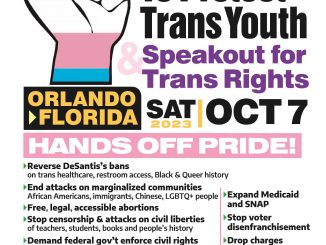
As Pride Month begins, last year’s anti-trans panic has grown into a full-blown campaign for trans extermination. We call on the whole movement for social and economic justice, against war and racism, for civil rights and immigrants’ rights, to join the mobilization for a National March to Protect Trans Youth and Trans Lives in Orlando, Florida, on Oct. 7, 2023. 

Queer people are under attack in the U.S. like never before, with Pride festivities curtailed and even canceled in Florida and other states at the instigation of bigots like Republican Governor Ron DeSantis, a candidate for the presidency in 2024 running on a platform of hate. 

Among a raft of hate legislation DeSantis signed into law on May 17 – the International Day Against Homophobia, Biphobia, and Transphobia – is one that supports kidnapping trans children across state lines to forcibly detransition them.

Fear is widespread among trans people and the broad LGBTQ2S community across the U.S., especially in those states that have enacted laws cutting off lifesaving gender-affirming health care, revoking trans people’s civil rights and the very ability to exist in public without threat of arrest or violence. 

The murderous attacks by far-right governments in state capitals and by neo-fascist gangs in the streets must be met with militant resistance in the spirit of the 1969 Stonewall Uprising and the movement to curb the spread of HIV/AIDS in the 1980s. 

Waiting for the next election, banking on the protection of a president and Democratic Party that show no inclination to defend even the most basic rights of LGBTQ2S people, women, immigrants, and BIPOC communities, is not an option. 

Only the people, organized and mobilized in the streets in a way that threatens the profits of Wall Street and the billionaire class’s ability to govern, can turn the situation around. 

And it is possible to do so – we need only look at the massive outpouring of anti-racist resistance following the police murder of George Floyd three years ago, which shook the political elites and their billionaire backers to the core.

In school, before the current wave of book and history bans, many of us learned a variation of the poem “First They Came” by Pastor Martin Niemöller about the rise of German fascism in the 1930s:

First they came for the Communists
And I did not speak out
Because I was not a Communist
Then they came for the Socialists
And I did not speak out
Because I was not a Socialist
Then they came for the trade unionists
And I did not speak out
Because I was not a trade unionist
Then they came for the Jews
And I did not speak out
Because I was not a Jew
Then they came for me
And there was no one left
To speak out for me.

Today they are coming for trans people – and the outlines of the next targets are already clearly drawn on the backs of cisgender queers, working women, immigrants, Black and Brown people, union members, socialists, communists, and ultimately every worker.

For many of our siblings, our rights and very lives are on the line today – and they are coming for you next. 

It’s time to fight. It’s time to resist with boldness and courage.

Join us in the streets – in the spirit of Stonewall!

Strugglelalucha256


Maduro’s historic meeting with Lula in Brazil is a step forward for all of Latin America

Yesterday, Venezuelan President Nicolas Maduro and Brazilian leader Luiz Inacio Lula da Silva shook hands again after eight years since they last met. Maduro traveled to Brasilia after almost a decade; the last time was to attend the inauguration of former President Dilma Rousseff (2011-2016). His arrival marks the restart of a path of peace and understanding for both countries and Latin America, truncated during the of far-right administration of Jair Bolsonaro, Lula’s predecessor.

“It is a pleasure to receive you again. It is difficult to conceive that so many years have passed without Brazil holding dialogues with the authority of an Amazonian and neighboring country, with whom we share an extensive border of 200 kilometers,” Lula declared after welcoming the visitor at the Planalto Palace, headquarters of the Executive Power in Brasilia.

Lula and Maduro had a private meeting and were joined later by ministers from both governments. Subsequently, they appeared before the media.

“I confronted fellow European social democrats, governments, and U.S. authorities for accepting that Juan Guaido was ‘Interim President’ of Venezuela. Maduro was elected by the people and to say otherwise is absurd. That’s how people who defend democracy think,” Lula remarked. He also warned that prejudices around Venezuela persist and that his government suffered unfair criticism during his electoral campaign for being a friend of Maduro.

“Venezuela needs to tell its story to change people’s opinion. Your narrative will be better than the one they have told against you,” the president of the largest country in the Americas said and urged the cessation of unilateral measures against Venezuela. “It is inexplicable that one country has 900 sanctions because another doesn’t like it.”

Maduro referred to Brazil with the same endearing affection professed by Lula towards his country. “We love the history of the Brazilian people and their strength and spiritual joy. Let no one else close the door. Brazil and Venezuela have to be united, from now on and forever,” the Bolivarian leader stressed.

“Today, a new era in relations between our countries, between our peoples, begins and in this new era, the building of a new map of cooperation and joint work must accompany it,” said Maduro before expressing Venezuela’s desire to apply for membership in the BRICS bloc.

The Brazilian president signaled his support for Venezuela’s entry into the development bloc comprised of Brazil, Russia, India, China, and South Africa. The alliance does not have a formal entry process but requires unanimous consent from existing members. While many countries have expressed interest, the last country to formally join was South Africa in 2010.

Relations between Venezuela and Brazil, which were suspended since 2019 with the arrival of Bolsonaro, were resumed with the return of Luiz Inácio Lula da Silva to the presidency on January 1. Since then, officials from the two nations have held multiple meetings to rebuild bilateral cooperation.

Cubans are following the news coming from the south with special attention. For Cuban President Miguel Díaz-Canel, this news illuminates the political horizon of Our America. This right path will lead us toward the development and integration of our Great Homeland, Latin America.

“This reunion is historic, transcendental, and a victory for the dignity of our peoples. Congratulations!” Díaz-Canel concluded.

2023 South American Summit

The visit of the Venezuelan president coincides with his invitation to participate in the 2023 South American Summit, convened by Lula and will include 11 countries of the region to participate in the summit: Argentina, Bolivia, Chile, Colombia, Ecuador, Guyana, Paraguay, Peru, Suriname, Uruguay, and Venezuela. The thrust of the meeting is to reinvigorate Latin American unity.

The summit, scheduled for today, has four main priorities on its agenda: revitalization of South American integration, repositioning South America on the global stage, rethinking South America as a region of peace and cooperation, and the reactivation of UNASUR. The “main objective is to resume dialogue” between the countries of the region “that have not met for many years,” explained Gisela Padovan, secretary of Latin America and the Caribbean for the Brazilian Foreign Ministry.

The Brazilian government expects the summit to discuss the possibility of “returning to a South American integration mechanism” that will be “permanent, inclusive and modern” and that will include the 12 countries of the region, regardless of the political ideology of the government of any of the countries.

This reinforcement of Latin American integration and regional cooperation with its promising possibilities has to be making those that want to continue the tired old Monroe Doctrine road of colonialism squirm in their seats.

Source: Resumen Latinoamericano – US

Strugglelalucha256


NATO war summit at G7 affair in Hiroshima

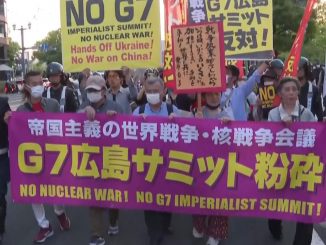
The imperialist global steering committee known as “G7” or “Group of Seven” recently met in Hiroshima to discuss the ongoing proxy war against Russia. G7 includes the United States, Britain, France, Germany, Canada, and Italy. Additionally, the European Union is a non-enumerated member. 

The U.S. claimed the summit’s purpose was to discuss “a number of challenges to peace and prosperity facing the global order while consulting with invited guests.” However, it quickly became apparent that the summit was nothing more than a proxy-war propaganda show. 

There is something sickeningly ironic about the United States holding a claimed peace summit in Hiroshima, where the U.S. Air Force dropped an atomic bomb, marking the first time a nuclear weapon was deployed. Hiroshima was not a military target at the time. The result of the atomic bombing was a wholesale slaughter of the local population. Over 126,000 Japanese civilians died that day. Gen. Leslie Groves, head of the Manhattan Project, said, “The real purpose was to subdue the Soviets.”

And now, the U.S., NATO, and their allies walk that same hallowed ground trolling for military aid for the fascist Ukrainian military. Joining the NATO parade was Volodymyr Zelensky, their actor-in-chief of Ukraine. 

Zelensky spent the week soliciting the G7 leaders to ramp up sanctions on Russia and military assistance to Ukraine. In particular, Ukraine is asking for F-16 fighter jets and advanced missile batteries. Over the past year, NATO’s aggression against Russia has created a boon for the U.S. defense industry. There is immense pressure to keep the missiles firing and the profits flowing. 

While in Hiroshima, Zelensky went as far as to compare the capture of Bakhmut by the Russian military and allied Wagner PMC to the U.S. genocidal destruction at Hiroshima in 1945. However, to draw parallels between forces set on the denazification of Ukraine and forces that murdered hundreds of thousands of innocent people to threaten the global working class is insanity at best and fascist propaganda at worst. 

The fascist fundraiser disguised as a peace summit sent the banks and defense magnates a clear message: We are open for business in Ukraine. Predictably, Zelensky and his U.S. backers had great success securing support from the other countries in attendance. By the end of the summit, all seven member countries committed to new sanctions against Russian individuals and increased weapons shipments to the Ukrainian military. 

Leading up to the G7 summit, Zelensky attacked Brazilian President Lula da Silva for his refusal to supply the NATO-backed Ukrainian nazi military. The Ukrainian government criticized Lula for attempts to broker a peace deal between Ukraine and Russia. In response, Lula agreed to meet with Zelensky at the G7 in Hiroshima. 

Revealing the true nature of this supposed peace summit, Zelensky snubbed Lula, intentionally missing their entire scheduled meeting. 

The U.S. isn’t interested in peace. NATO isn’t interested in peace. Zelensky isn’t interested in peace. The U.S. and NATO are only interested in the destruction of Russia, China, and, consequently, the ability of the global working class to organize itself against imperialism. Russia must be supported in its defense of the Donbass against Ukrainian fascism. 

No more NATO war! End military aid to Ukraine! Victory to the anti-fascist forces!

Strugglelalucha256
https://www.struggle-la-lucha.org/2023/page/45/