We must not look away: The escalating targeting of trans people

4
Photo by Karollyne Videira Hubert on Unsplash

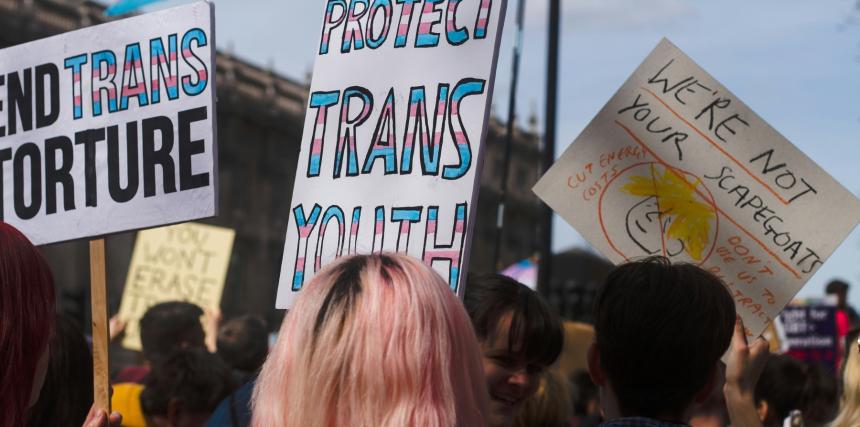
The Department of Health and Human Services’ chilling new regulatory actions seeking to impose a ban on trans healthcare (that HHS refers to as “sex-rejecting procedures”) for youth is the latest manifestation of the Trump administration’s violent, despotic position on trans youth. Per the Associated Press, the goal of the proposals is to: “restrict the use of puberty blockers, hormone therapy and surgical interventions for transgender children — include cutting off federal Medicaid and Medicare funding from hospitals that provide gender-affirming care to children and prohibiting federal Medicaid dollars from being used to fund such procedures.”

Twenty-seven states already have laws restricting or banning trans healthcare for youth. Only 15 have protections in place.

This is an established tactic of this regime: unconstitutionally weaponizing federal funding cuts to bully states and institutions into compliance, forcing them to choose between defending basic human dignity and crucial, often life-saving, funding needed to care for their constituents—a farcical Trump-era trolley problem. Like clockwork, the administration fires up state-sponsored propaganda machines to turn marginalized people against their neighbors through misinformation and fearmongering. The result? When it comes to trans folks, few if any officials hold the line and call his bluff.

As we know, trans healthcare is medically necessary, age-appropriate, and extremely safe and is backed by decades of research and supported by every major medical association (the American Medical Association, the American Psychiatric Association, the American Academy of Pediatrics, the American Academy of Child & Adolescent Psychiatry, the World Medical Association, and the World Health Organization, to name a few). Gender affirming surgical procedures are not new and are widely known to have lower regret rates than elective surgery operations (e.g. plastic surgery, knee replacements) and major non-surgical life decisions (e.g. tattoos or having children).

Every trans adult that you know today is here not by chance but through sheer grit; we were all once trans children and youth who at different points in our lives fought uphill battles against systems and institutions to receive the care that we need to exist in a country that increasingly wishes to see us genocided.

Trump’s anti-trans executive orders received a fair amount of attention, and but they were only the beginning of a steady onslaught. It’s difficult to understate just how bad things are (and how quickly they’re gaining momentum). In the past few weeks alone:

Is my passport still valid if I have an X marker on it, or if it lists a sex other than my sex at birth?
All passports are valid for travel until they expire, are replaced by the applicant, or are invalidated pursuant to federal regulations.

And this is just recent memory — there is so much more. There’s a whole Wikipedia page for Persecution of transgender people under the second Trump administration documenting the phenomenon.

I know many can relate because this is not unique to the trans community, as there are so many communities under threat inside and outside of this empire, but we need you to understand and internalize that trans people in this country, myself included, are under relentless psychic (and sometimes physical) attacks and chronic stress. We are fearing for our lives, the safety and wellbeing of our loved ones, friends, and community — and not just in places like Texas and Florida — but nationwide. Nobody I know is well right now.

This administration knows that if they can’t kill us directly (yet), that if they inundate the public with enough anti-trans rhetoric, they can propagandize and deputize anyone who might wish to cause us harm.

And if not that, they’ll slowly kill us through prolonged exposure to distress: fight or flight hormones, long-term exposure to elevated cortisol levels, and feelings of powerlessness and hopelessness that enable a crisis of mental health that has claimed so many, including some of my loved ones this year.

Trans death is on the rise: A4TE’s Trans Day of Remembrance report highlighted the 58 trans people we lost this year that we know of. Twenty-seven were lost to interpersonal violence (the majority of whom were Black, trans women) and 21 to suicide (61 percent were trans youth ages 15-24). We often say that “the cruelty is the point” — but, more specifically, the cruelty is killing us.

How do we quantify the many ways in which our bodies internalize the trauma of surviving in a country filled with complete strangers who want trans people, and specifically trans women, dead?

I don’t have words of inspiration or encouragement. I simply urge you to not turn away, put on blinders, give in to tunnel vision, or otherwise ignore the coordinated campaign taking place to erase and eradicate trans people from public life. We’ve passed most of the stages of genocide: classification, dehumanization, polarization, discrimination, persecution, and preparation — what’s next?

Lexi Webster is the Digital Engagement Manager at the Center for Constitutional Rights.

Source: CCR

Strugglelalucha256


Capitalist crisis and the attack on trans people

In May, the Struggle for Socialism Party (SSP) Los Angeles branch discussed the new book, “Against fascism: reclaiming populism’s legacy for today’s class struggle,” compiled by Louisiana socialist Gregory Williams. 

Following is the first presentation of the final class on the trans struggle. Melinda Butterfield gave the second presentation. 

BUY BOOK NOW  |  FREE PDF

Maggie Vascassenno: Today is our fourth in the four-part series on the book, “Against fascism: reclaiming populism’s legacy for today’s class struggle” by Gregory Williams.

And we have Gregory here, along with Melinda Butterfield. Melinda led the first national mobilization against this current wave of trans hate, taking place in one of the states at the epicenter of the attacks, Florida. And that was Oct. 7, 2023, so it kind of got lost in the shuffle a little bit.

We weren’t able to expand on it a lot then, but this is definitely a struggle that is really the focus of much of this fascist presidency. And Melinda organized a trip to Cuba of LGBTQ folk that learned there about how Cuba has advanced on the trans question and other LGBTQ+ questions, and really the question of families in general – family law.

So out of that came the book that Gregory put out called “Love is the Law: Cuba’s queer rights revolution.” I’ll turn this over to Gregory. 

Gregory Williams: Since this is the final class, I’ll start with a summary of the book and where we’ve been. Then I want to open up some questions about the current trans struggle. Melinda will tell us more. 

The book started with me writing about what was going on with governors like Ron DeSantis in Florida and Jeff Landry in Louisiana, in retrospect, leading up to Trump’s re-election.

I tried to expose what they’re really trying to do when they attack trans people or immigrants. Who do they really represent? And we tried to show in the book that they represent the rich ruling class and what they’re doing is fundamentally against the interests of the vast majority.

We looked at the question “what is populism?” because that word is used a lot. Almost every time I see a political commentary, somebody uses this word. And there’s no explanation usually. You have to really go out of your way to find any explanation of what the hell populism was historically.

They call people like Donald Trump a populist. And then they turn around and call somebody like Bernie Sanders a populist. Or even somebody who’s doing grassroots work for the people. So how could that be the same thing? How could somebody like Trump, who’s so clearly part of the ruling class and for the ruling class, how could that be the same as somebody who’s progressive, like the real movement organizers?

The original populist movement happened in the late 1800s, largely centered around farmers. And there was a large Black populist movement as well. It wasn’t just a white thing. The movement was overall anti-racist, and they were taking on the big monopolies developing at that time, as well as rich Southern landowners. They fought the big bank monopolies, the big industrialists, the people that farmers were indebted to, and so on.

They also tried to link up with organized labor, which was developing at that time. However, it was before the wave of socialist revolution that came to a head in 1917 with the Bolshevik Revolution and spread, not immediately, but through the anti-colonial, often socialist-oriented movements during and after World War II. 

The populist movement was before that social wave. But later on, by the 1950s, some historians began using the word populism without any reference to this original historical progressive movement, and they would call fascism populism.

And words change, but it’s a very political change because with this confusion, they take away that history of struggle. We can’t understand that history because it’s been distorted, and we’re trying to correct some of that through the book.

And I analyzed a pamphlet written in the 1970s by Vince Copeland, one of the founders of our political tendency. It’s called “Black Labor and Southern Populism” and is included in the book. He was looking at these same questions because, in the early ‘70s, the media was calling the racist governor, George Wallace, a populist, and he was running for president.

They also called George McGovern a populist, and he was the centrist Democrat running against Wallace. 

To me, “Black Labor” was really eye-opening. Copeland clearly spells out the interests of the rich, exposing why they make the attacks that they do.

Why trans panic? 

How did the trans struggle come into the book? Because I was assembling a section on contemporary Southern governors and their attacks. We had just participated in this trans youth march in Orlando that Melinda helped initiate. She did a lot of pioneering work, just sounding the alarm about what was happening with this rising crescendo of trans panic.

What was happening in Florida really was sort of the snake’s head. A lot of it was centered around what DeSantis was doing. So that action, I think, was really important, and we included a lot of the speeches from it in the book.

But a lot’s transpired since then. It’s gotten much worse. The trans panic has become a center of the fascist onslaught, and not just in the U.S. It’s happening in Italy and Brazil and other places. The far right is leading it but “liberal” politicians like California Governor Gavin Newsome have taken it up, too. The same Democratic governor who’s viciously attacked unhoused people..

Why are trans people such a target right now? Why is this so resonant for the right? Why is it working for them like this?

Oppressed people advance, and claws come out

I’ve started to make connections to other parts of the book. There’s a lengthy section about how populism was defeated in Wilmington, North Carolina, in 1898. At that time, Wilmington was still bucking the trend against Jim Crow by having Black and white people in the government together.

Black people were also relatively prosperous there. They were in skilled trades. They had a Black-owned newspaper. The city was governed by a coalition between the populist People’s Party and the Republican Party, which was still associated with the anti-slavery cause and had a strong Black base.

Wilmington was a beacon holding out against this onslaught of Jim Crow. The Democrats were still associated with the pro-slavery cause and were the party of the rich white ruling class in the South. They ultimately beat populism in Wilmington by organizing a White Supremacy Campaign. That’s actually what they called it.

They used all the media of the time, organizing groups throughout the state, arming Klan-type militias. They spent a lot of money, and it led to a massacre and a coup in Wilmington. That’s how they took over the reins again and installed an all-white, totally racist, fascistic government.

Sexist dimension of fascist hysteria

But also, there was a big sexual dimension to it, because what precipitated the massacre – what was especially potent – were these speakers and the newspaper editorials whipping up hysteria about Black men sexually seducing or assaulting white women.

Of course, these patriarchal racists weren’t concerned about women’s consent. The idea was like, “Black men are taking our women.” That’s the idea. But doesn’t this sound familiar? Because really, as far as I can tell, every fascist hysteria has this dimension to it.

The right wing says that queer and trans people are grooming children, seducing them into gender and sexual anarchy, so society must be protected.

In Britain right now, there is conspiratorial hysteria about immigrant “groomer gangs.” Not to mention the retro “Satanic Panic” fantasies of Q Anon, centering around ritualised child abuse. 

In India, the Hindu nationalists say Muslim men are seducing Hindu women, depleting the stock of the pure Hindu nation. And Trump and Musk are obsessed with fertility rates – white fertility rates. 

So there’s always a weird sex thing, as far as I can tell. And remember Comrade Gloria’s presentation in this class series about lynchings and the murder of Emmett Till. They claimed that this 14-year-old flirted with a white woman. And why is that so explosive? Just the idea of that in a racist, capitalist society.

Class society requires policing identities

The Marxist tradition coming out of Frederick Engels’ work in the late 1800s says that gender and sexual oppression come from the imposition of class society, which developed after the development of agriculture, in what is for us pre-history.

Once there was a surplus of food and goods, these conditions allowed some people to hoard the surplus and deny it to others. And this was the beginning of private property. Women’s oppression grew out of that.

Because an earlier egalitarian, communistic society gave way to a patriarchal, very hierarchical one, men became dominant in this scenario. And when there was property to pass down, they had to determine paternity, which wasn’t a factor before. They developed elaborate ways to control women and their sexuality.

I’m glad Bob McCubbin is on this Zoom call because he did pioneering work on this, writing about it back in the 1970s. So did Dorothy Ballan. That’s what I’m drawing from.

I think that with systems of private property and that type of hierarchy, there’s always going to be policing of identity. You have to know who you are, and you have to be able to put other people in a category.

When you have a society structured by racial oppression, you get anxiety about racial identity. You know, it’s totally absurd, really, that people in the Jim Crow South were worried about who used what water fountain or what bathroom.

It’s so ridiculous. But under that system, from the point of view of the ruling class, it made sense. Because when you’re policing people and keeping them down, the dominant group is afraid all the time. And they say, “What if my daughter falls in love with a Black man and has a baby?”

It’s this kind of status anxiety, fear of losing your status and falling down the rungs. I mean, not to mention the white slave-owning men – it’s all sort of projection, isn’t it? The white slave-owning men basically had harems and were committing all these sexual atrocities. So it’s all fine for them to do. But they’re paranoid that somebody’s going to do the same thing to them.

So by that same token, people say, “what if my child is trans? Then what? What does that mean for me? What does that do to my identity?” And the right-wing media plays this up seven days a week. Look at Elon Musk’s rejection of his trans daughter, Vivian, because he wants a son made in his own narcissistic vision as an heir. And Vivian has even stated that Musk used in vitro fertilization specifically to get boy children.

General crisis of gender and the family 

So, I want to pose these general questions about gender and sexuality in our moment.

Because the trans panic is obviously very useful for the capitalists and the fascist politicians, and now the liberal ones emulating them. And to some extent, it doesn’t really matter who they target. Any scapegoat, theoretically, can get the job done. You find a scapegoat, and you distract people from the real problems caused by capitalism.

On the other hand, why is targeting certain groups so effective in a particular period? The anti-trans people are totally obsessed. Like, they must wake up in the morning thinking about trans people. Get a life!

In part, yeah, that could be explained just in terms of the propaganda and grift-disinformation machine, the algorithms are pushing it, all the right-wing influencers say the same things, using the same buzzwords. 

But as Marxists, we tend to look for answers deeper in social structures. And I wonder if the current obsession with trans people is not an accident. Trans people have made advances, becoming visible in society. We saw the same dynamic in the populist period. Black people had made advances. And the rich ruling class tried to claw everything back.

And I also think that, right now, there’s a general crisis of gender and the family. That’s part of the crisis of capitalism. I think that’s part of this moment. And cisgender women – women who are not trans – they’re intensely under attack. So, what’s happening is all very gendered.

They’re trying to roll back everything that women have won through struggle, like with the abortion bans. Take the “trad wife” influencers and all this stuff that the right-wing is pushing. [These are social media accounts promoting “traditional” housewife roles, really “a world that only ever existed in 1950s vacuum cleaner commercials,” as a commenter said under one of their posts.] 

And I think trans panic is tied up with the policing of women’s gender expressions, women in general. Just look at how they treated Algerian boxer, Iman Khalif. The transphobic writer, JK Rowling, recently tweeted, and this is really rich, “I’ve never attacked any woman for not being woman enough. That’s a concept that I don’t recognize.”

Then an X user named Thomas Willett responded, “You literally launched a campaign of abuse and hate against the female boxer, Iman Khalif.” Transphobia is deeply tied up with misogyny.

Men and boys socially alienated

And I think there’s a crisis of masculine identity in society too. Cis-men and boys are suffering from, for example, body dysmorphia like never before, seeing unattainable images of steroid-powered superheroes, and all these models with good lighting on Instagram.

And they’re also alienated and socially isolated. And the algorithms push them to “manosphere” influencers like the sex trafficker, Andrew Tate. This is what’s being offered to them to deal with their alienation and the deep anxiety they feel. And this goes all the way up to mass shooters.

So that’s happening, and I think it has to do with capitalism making life so unlivable. People can’t afford to own a home anymore. So the old nuclear family model that existed, maybe in the 1950s, for some people, even that is becoming unattainable. People don’t know what family life is supposed to be.

And it’s capitalism that’s doing this. We as revolutionaries aren’t saying you can’t have the kind of family you want, or you’re bad if your family looks more like the nuclear model, or you’re bad because your family doesn’t look like that. 

Capitalism is making it hard for families to exist. And I think people are experiencing a lot of anxiety about what their role is. They don’t see a future for themselves. Then, coming out of that, there’s something very potent happening when these fascist influencers say, “I have an answer for you. The problem is feminism. The problem is trans people who are destroying the family.”

And if people don’t have an alternative from the left, then they are vulnerable to being pulled in that direction. They need to see an organized left that’s fighting, winning victories, and talking about a different kind of society, and explaining these things.

[. …]

Melinda Butterfield: I just wanna comment on what Gregory raised about why trans people are the targets right now, or how it’s happening. And I think he really hit on it with the focus on how they use the threat to children as a big way to influence people who wouldn’t otherwise necessarily be hostile or even care about the issue so much, if they didn’t have trans people in their own daily life.

But by making us into this bogey of corrupting children or stealing their children or something like that. Well, they did that also, particularly with gay men in an earlier period. And that fed a lot into the AIDS epidemic and how it was ignored by the official bodies and allowed to run rampant.

It also had to do with the scapegoating of Jewish people before the Holocaust. And also, as we talked about earlier, the lynching logic targeting Black men or people perceived as men having relations with white women, especially young white women and the daughters of the white supremacist class.

And this is a tactic that fascists use repeatedly when they’re targeting. And this was true 30 or 40 years ago of gay men and it’s true of trans people now is that, but when a movement pushes forward, that’s breaking a lot of the boundaries of what’s acceptable in society and pushing forward and winning people over and giving an example to people, that threatens the system. 

You know, bodily autonomy is an issue that’s shared by cisgender women, trans men, trans women, and non-binary people as well. Whether we’re talking about reproductive rights or our right to alter our bodies and our sex and our gender. These are all things that are considered a threat to the patriarchal class basis of capitalism, which still relies on what Gregory talked about, this idea of passing on wealth through the father from generation to generation.

And you can see that with Trump and Elon Musk and the rest of these scumbags, how focused they are on that. And so, people who break that cycle, who show how rotten-ripe the capitalist family structure is, how ready it is to be undone and replaced with something better and more beautiful and more inclusive. That also makes us an easier target for scapegoating.

Strugglelalucha256


SCOTUS Allows For Trans Discrimination In Medical Care: A Full Analysis Of Ruling

Education title ix sexual assault

On June 18, the Supreme Court issued a devastating 6-3 ruling in United States v. Skrmetti, upholding Tennessee’s ban on gender-affirming care for minors and delivering a major blow to transgender rights. The case raised foundational constitutional questions: whether transgender people constitute a class triggering higher constitutional scrutiny, whether laws targeting them violate equal protection, and whether the Constitution guarantees their right to access medically necessary treatment. The Court sidestepped nearly all of those questions, instead issuing a narrower opinion that carves out an exception permitting medical discrimination based on “gender dysphoria”—a distinction it bizarrely treats as separate from discrimination against transgender people. The ruling effectively greenlights medical care bans across the country and may pave the way for broader restrictions, including for adults, while leaving lower court rulings on bathrooms, schools, sports, and employment remain intact—for now.

In its ruling, the majority opinion of the Supreme Court states that it does not need to address whether or not discrimination against transgender people is sex discrimination because the Tennessee law banning gender affirming healthcare for trans youth is based on “gender dysphoria.” Similarly, the majority argues that it does not have to address whether or not transgender people represent a class that triggers heightened scrutiny, a higher level of scrutiny for constitutional review that has resulted in anti-trans laws being struck down by lower courts. The court states in its majority opinion:

“The plaintiffs argue that SB1 warrants heightened scrutiny because it relies on sex-based classifications. But neither of the above classifications turns on sex. Rather, SB1 prohibits healthcare providers from administering puberty blockers or hormones to minors for certain medical uses, regardless of a minor’s sex… By the same token, SB1 does not exclude any individual from medical treatments on the basis of transgender status. Rather, it removes one set of diagnoses—gender dysphoria, gender identity disorder, and gender incongruence—from the range of treatable conditions.”

In issuing such a ruling, the Court asserts that discrimination based on “gender dysphoria” is somehow distinct from discrimination on the basis of transgender status or sex—creating a loophole wide enough to drive a truck through. In her dissent, Justice Sotomayor calls out the contradiction directly, noting the majority’s logic would permit states to target transgender people while avoiding constitutional scrutiny simply by reframing the language of their laws:

“In addition to discriminating against transgender adolescents, who by definition ‘identify with’ an identity “inconsistent” with their sex, that law conditions the availability of medications on a patient’s sex. Male (but not female) adolescents can receive medicines that help them look like boys, and female (but not male) adolescents can receive medicines that help them look like girls.

Tennessee’s law expressly classifies on the basis of sex and transgender status, so the Constitution and settled precedent require the Court to subject it to intermediate scrutiny. The majority contorts logic and precedent to say otherwise, inexplicably declaring it must uphold Tennessee’s categorical ban on lifesaving medical treatment so long as “‘any reasonably conceivable state of facts’” might justify it. Ante, at 21. Thus, the majority subjects a law that plainly discriminates on the basis of sex to mere rational-basis review. By retreating from meaningful judicial review exactly where it matters most, the Court abandons transgender children and their families to political whims. In sadness, I dissent.”

The Tennessee law, Justice Sotomayor and the dissent argue, explicitly classifies on the basis of sex—so overtly that the majority’s attempt to sidestep that reality reads as disingenuous. The statute itself declares that one purpose of the ban is to “encourage minors to appreciate their sex,” and yet the majority still concludes it does not constitute sex-based classification. Sotomayor dismantles that claim with precision in her dissent, exposing the logical inconsistency at the heart of the Court’s reasoning:

“Consider the mother who contacts a Tennessee doctor, concerned that her adolescent child has begun growing unwanted facial hair. This hair growth, the mother reports, has spurred significant distress because it makes her child look unduly masculine. The doctor’s next step depends on the adolescent’s sex. If the patient was identified as female at birth, SB1 allows the physician to alleviate her distress with testosterone suppressants. See App. to Pet. for Cert. 266a (describing such treatments); App. 100 (same). What if the adolescent was identified male at birth, however? SB1 precludes the patient from receiving the same medicine.”

One of the more strained justifications in the majority opinion mirrors arguments once used to deny rights to same-sex and interracial couples: that the law does not discriminate against transgender people, but instead bars both cisgender and transgender people from receiving medication to treat gender dysphoria. It’s a tortured rationale—functionally absurd given that transgender people will need the medical treatment for gender dysphoria, not cisgender people.

Sotomayor compares this rationale to that used in Loving v. Virginia, a ruling which struck down laws against interracial marriage:

“But nearly every discriminatory law is susceptible to a similarly race- or sex-neutral characterization. A prohibition on interracial marriage, for example, allows no person to marry someone outside of her race, while allowing persons of any race to marry within their race….

In a passage that sounds hauntingly familiar to readers of Tennessee’s brief, Virginia argued in Loving that, should this Court intervene, it would find itself in a “bog of conflicting scientific opinion upon the effects of interracial marriage, and the desirability of preventing such alliances, from the physical, biological, genetic, anthropological, cultural, psychological, and sociological point of view.” … “In such a situation,” Virginia continued, “it is the exclusive province of the Legislature of each State to make the determination for its citizens as to the desirability of a policy of permitting or preventing such [interracial] alliances—a province which the judiciary may not constitutionally invade.” Id., at 7–8.

While the ruling is sweeping in its implications for transgender medical care—and could easily be used to justify future restrictions on adult care—the majority sidestepped key constitutional questions. The Court declined to answer whether discrimination against transgender people constitutes sex discrimination, whether transgender people qualify as a protected class warranting heightened scrutiny, or whether the Bostock decision applies beyond the Title VII employment context. A ruling on any of these issues could have turned an already devastating outcome into a catastrophic one, potentially overturning dozens of lower court decisions on bathroom access, forced outing in schools, and participation in sports. Though the majority avoided that outcome, three justices—Justices Samuel Alito, Clarence Thomas, and Amy Coney Barrett—wrote separately to express that they would have gone further, explicitly denying transgender people equal protection under the law.

Several rulings in recent months will remain unaffected by the Court’s decision. Just yesterday, a federal judge certified a class of transgender people in a lawsuit challenging a passport ban and opened the door for gender marker updates. Similarly, rulings blocking the government from stripping funding from organizations that mention transgender issues or gender identity are expected to remain intact, as are decisions involving school bathroom access and participation in sports. As a result, the impact of this ruling is likely to remain confined to the medical context—for now. Still, the decision provides a blueprint for future legislation targeting “gender dysphoria” as a proxy for discriminating against transgender people without explicitly naming transgender status or sex.

“Today’s ruling is a devastating loss for transgender people, our families, and everyone who cares about the Constitution,” said Chase Strangio, Co-Director of the ACLU’s LGBTQ & HIV Project. “Though this is a painful setback, it does not mean that transgender people and our allies are left with no options to defend our freedom, our health care, or our lives. The Court left undisturbed Supreme Court and lower court precedent that other examples of discrimination against transgender people are unlawful. We are as determined as ever to fight for the dignity and equality of every transgender person and we will continue to do so with defiant strength, a restless resolve, and a lasting commitment to our families, our communities, and the freedom we all deserve.”

The decision will send shockwaves through the transgender community. By embedding discrimination into Supreme Court precedent, the justices have ensured that transgender Americans will likely spend a generation clawing back rights now imperiled. And yet, the ruling leaves cracks in the foundation—enough space, for now, to regroup and keep fighting. Protective laws in many states remain on the books. Key court victories still stand. It is in those openings, however narrow, that hope persists—and where the fight continues.

Source: Erin In The Morning

Strugglelalucha256


From Sally-Tom to Charlotte Fosgate: populism and the fight for trans lives, then and now

In May, the Struggle for Socialism Party Los Angeles branch discussed the new book, “Against Fascism: Reclaiming Populism’s Legacy for Today’s Class Struggle,” compiled by Louisiana socialist Gregory Williams. 

Following is the closing presentation for the series of classes, given by trans activist Melinda Butterfield on May 31.

BUY BOOK NOW  |  FREE PDF

Since this is the eve of Pride Month, I thought it would be good to start with a little about the convergence of queer lives with the 19th-century Populist movement in the South. We know there were queer people involved in the Farmers’ Alliance and the People’s Party, because we have always existed, and today’s queer communities have strong roots throughout the South. 

No doubt some of those who joined the movement were closeted, some were stealth, and some were accepted for who they were, as part of their community. But because there was no queer movement as we understand it today, it can be difficult to find direct information on these intersections. We have to suss them out.

This week I’ve been reading a new book by activist and scholar Eli Erlick, “Before Gender: Lost Stories from Trans History, 1850-1950.” In this book, I learned about Sally-Tom and Mollie Wilson, trans women of color who lived in the South during the height of the Populist movement and the People’s Party. I’m going to share a little bit of their stories:

Sally-Tom was a Black woman who lived the first 26 years of her life in slavery. She took the new opportunities opened up by Emancipation to start living more fully and openly as her true feminine self. In 1869, when she came before the Freedmen’s Bureau on an unrelated matter, she was presented with the opportunity to choose her gender for the official records, and she chose to be legally recognized as a woman. According to Erlick, Sally-Tom was probably the first trans person in U.S. history to have her gender officially recognized.

Sally lived in several Georgia towns over the next four decades, working as a cook and household help, as many Black women did. “Sally refused to discuss her life with reporters, so we do not have a single word of her self-narrative,” Erlick writes. “Those who knew her described her to papers at length, however. With a high and crackly voice, Sally reportedly hid behind her straw hat and left events before conflict arose. 

“Her decision to avoid media made sense from the perspective of self-preservation; she likely did not want to draw attention to herself during such a violent era of increasing lynchings and attacks on the Black population.” She died on March 4, 1908, in Waycross, Georgia, at around the age of 69. According to a death notice in the local paper, none of her friends and neighbors knew she was trans.

Mollie Wilson was a Two-Spirit trans woman who was Choctaw and Black, born around 1865 in what was then the Choctaw Territory, which included parts of Mississippi, Alabama and Louisiana. Originally, she spoke only her Indigenous language. At the age of 19, she barely escaped a lynching, killing several of her would-be murderers in the process. She fled from home and took the opportunity of her escape from these traumatic events to embrace her womanhood.

Erlick writes: “Eventually, she moved to Kansas City, Missouri. She reportedly had a large group of friends, mostly Black residents of the city. Mollie always wore a dark dress and fascinator, and with a tall and thin frame, passed with ease. Her transition allowed her to blossom into a social butterfly without fear of lynch mobs.” She married a man and later lived with a woman.

As Jim Crow’s noose tightened, Mollie was arrested twice on police claims that she was a sex worker. Shortly after one of these arrests, she died of tuberculosis in 1901.

These long-hidden lives show how trans and queer people found ways to live as their true selves during the same era that the Populist struggles were pushing back against reaction.

Trump attacks trans health care

But let’s move to the here and now. Trump’s “big beautiful” budget bill recently passed in the House and is currently before the Senate. It attacks housing, Social Security and public health care to transfer funds to the war machine, ICE, and the 1%. Some 20% of Medicaid recipients are to be cut – nearly 14 million people. 

A rider attached to the House bill would eliminate all Medicaid and Affordable Care Act coverage for trans health care, both for youth and adults. At least 275,000 trans people currently depend on Medicaid. The likely knock-on effect would be to allow private insurance companies to dump gender-affirming care, affecting many more. 

In addition to Sally-Tom and Mollie Wilson, this week I have been thinking about Charlotte Fosgate. Charlotte was a 17-year-old trans girl who lived in Oregon. She disappeared May 1 and jumped from a bridge in Portland the next night. Her death was confirmed last week. 

Charlotte’s final social media posts, made from the bridge where she leapt to her death, became a lightning rod for bigots posting hateful memes and messages.

Charlotte represents all the trans youth and adults who are being forced out of public life and losing their hopes for the future because of health care bans, bathroom bans, sports bans, doxxing and violence.

Populism is supposed to represent the interests of those who have been left out, who are marginalized. What kind of “populism” is it that doesn’t include someone like Charlotte Fosgate and other queer youth who are completely stripped of their right to exist, to be themselves, to even dream of a better future?

What the media and politicians term “populism” now is something utterly different. Where populism in the 19th Century represented the desire of people at the margins – small farmers, formerly enslaved people, agricultural workers and all those left behind by the growth of capitalism – to work together to better their futures, now it usually means appealing to the most backward, atomized, anti-social elements that have completely swallowed the small-capitalist, white supremacist mentality. 

What they now call “populism” appeals mostly to the social base of fascism – the shock troops of the billionaire class.

Nazis co-opted socialist terms

It’s not the first time this has happened. The classical fascist movements and regimes in Europe in the first half of the 20th Century adopted some of the anti-establishment and even anti-capitalist rhetoric of their enemies, the communists and socialists, to attract people to their cause. Hitler even called his organization “National Socialists.” 

But they redirected the righteous anger at capitalism toward Jews, queers, people of color, and the left – much as we see ultra-corrupt capitalists like Donald Trump and Elon Musk railing against the “elites” and “Washington insider corruption” as stand-ins for marginalized communities, migrants, and the working class as a whole.

Like the followers of the Strasser brothers, who formed the “left” wing of the Germany Nazi movement, today we have formations like the so-called American Communist Party (ACP) and the Center for Political Innovation (CPI) that use leftist terminology and symbolism to draw disaffected people and those lacking class consciousness into the orbit of the fascist movement. 

While claiming to be socialists or communists, they adopt the exact same racist, misogynist, anti-trans and anti-queer arguments and bigotry as their MAGA inspirations do.

Where is the united movement from the grassroots that will give a voice to people like Charlotte Fosgate or to Sam Nordquist, a Black trans man who was tortured to death in upstate New York earlier this year? 

Where is the movement that will give a voice to the children whose parents are ripped away by masked ICE Gestapo at immigration hearings across the country? Or the migrants from Southeast Asia who were kidnapped and sent by the Trump regime to South Sudan? 

What about Mahmoud Khalil, who is being held thousands of miles from his wife and newborn child in a Louisiana prison? Or the queer youth who are being thrown away by their families or pushed into state-mandated conversion therapy torture?

Building united movement is our task

This united movement of the dispossessed, of the workers and oppressed, is not going to come from the Democratic Party or the established nonprofits that cling to the broken system. Fighting back in the courts and with other “official” methods, while important, is not going to save us or build the movement we need.

It’s up to us. We have to build this movement, this unity. We have to refuse to be siloed. We have to reach out and find ways to collaborate, even when there is not 100% mutual understanding yet. Working together against our common enemies, in our common interests, is the way to build that understanding.

Queer rights are under attack everywhere, including California. Gruesome Gavin Newsom just this week began the process of excluding trans students from athletic competitions, after months of pandering to the worst anti-trans bigots on his podcast. Trans youth have been under attack in schools throughout Southern California for the past few years. And last month, queer activists had to confront a fascist march in the streets of West Hollywood.

That brings us back to LGBTQIA+ Pride Month. This year especially, it’s important for people from all sectors of the working class, all communities, and all organizations of the real left to come out in support of trans rights, trans lives, and all queer people. This is the time to take good sentiments about being an ally and turn them into contacts, joint work, and real efforts to build a united movement. 

In Los Angeles, the Harriet Tubman Center, Struggle for Socialism Party, Trans Rescue Action, and others will be mobilizing for Pride events and queer resistance actions. If you’re not in LA, talk to us, and we can put you in touch with others doing the work in your area.

Let me close with this thought from the conclusion of Vince Copeland’s “Southern Populism and Black Labor,” a classic Marxist work included in the book we’re studying today: “[The Populists’] failure was not due nearly so much to the failure of their ideas, as to the failure to maintain their social position – to hold on to the material base of independent small and especially farming business, from which these ideas originated.

“The new class, the working class, does not yet have the ideas that correspond to its class position. But its class position is innately superior to that of the old Populists from the point of view of having the base to mount a serious and successful struggle. When the new ‘people-ism’ of the workers is born, it will soon grow powerful enough to really lead the people and rule in the name of practically the whole people – something the Populists could not have done, even if they had won.”

Strugglelalucha256


British Supreme Court rules against trans people

On 16 April 2025, the British Supreme Court decreed that the legal classifications of ‘woman’, ‘man’, and ‘sex’ refer only to biological sex and not gender identity in relation to the Equality Act of 2010. The decision was the conclusion of a challenge by the trans-exclusionary organisation For Women Scotland (FWS) to the Scottish parliament for its inclusion of trans women in their ‘gender representation objectives’ in March 2018. After seven years, several appeals, and £300,000 in crowd-funding — including £70,000 donated by JK Rowling — FWS has now achieved its goal. The Supreme Court’s decision will now open the door to trans-exclusionary practices across the board. In the days that followed, spontaneous demonstrations spread across the country as young people expressed their outrage at this reactionary step.

Previously, under the 2004 Gender Recognition Act, trans people in possession of gender recognition certificates (GRCs) were to be treated under their acquired genders ‘for all legal purposes’. This meant that, for example, trans women would correctly be counted under quotas aimed at increasing female representation in public boards or party shortlists. Now, trans people, even those with GRCs, can be legally barred from single-sex spaces including public toilets, changing rooms, hospital wards, shelters, prisons, etc, and also excluded from affirmative action programmes.

The exclusions will require case-by-case legal justification from the organisations which choose to enforce them, and must be based on ‘proportionate’ and ‘legitimate aims’. The Supreme Court judges sought to reassure trans people that they would still be protected from forms of discrimination based on the characteristic of ‘gender reassignment’ — meaning that it remains unlawful to discriminate against trans people in areas such as employment, education, and the provision of services. But this is of no consolation to the tens of thousands of trans people across Britain who are seeing the revocation of their health care  and legal rights, and who are subject to around 5,000 reported hate crimes a year from people emboldened by rulings such as these.

An early consequence of the ruling is the revision by the British Transport Police (BTP) of their procedures on strip searches. These will be henceforth conducted ‘in accordance with the biological birth sex of the detainee’. This would allow for male officers to conduct intimate searches on women whom they suspect are transgender. This will also force trans people working for BTP to conduct strip searches against detainees of the opposite gender. If a change as violent as this can be proved as just within the eyes of the law then it is clear that the law offers no serious protections for trans people at all.

On 25 April, the Equality and Human Rights Commission (EHRC) issued its own guidance in response to the ruling. This will apply to all schools, workplaces, sports bodies, public services, and associations of 25 people or more. Under this guidance, trans people ‘should not be permitted’ to use facilities in line with their gender identities. Not only this, but there are now also circumstances wherein trans people will be barred from using facilities that correspond with their biological sex! This is in the event of  the provision of a third, segregated space for use by transgender people. One wonders if we will next be forced to access services through our own ‘transgendered entrances’!

Despite claims from the Supreme Court’s supporters, including Keir Starmer and Women and Equalities minister Bridget Phillipson, that the ruling provides ‘real clarity’ for women and services, the decision clearly raises more questions than it answers. How will exclusions be enforced? How will a person’s sex be ascertained? How will intersex people be affected? Cabinet Office minister Pat McFadden has said that there ‘isn’t going to be toilet police’ but is that because they are instead going to rely on toilet vigilantes? The Supreme Court has bent the knee to the bio-essentialist, conspiratorial ideology of the trans-exclusionary radical feminists, while the Labour party is now able to distance itself from its supposed ‘wokeness’ on the issue, an important electoral consideration for the party as it seeks to compete with Reform UK for  the votes of the most reactionary sections of the electorate.

The Labour Party is not alone in capitulating to the most backward sections of the electorate. A  joint communiqué by the Communist Party of Britain (CPB) and the Young Communist League (YCL) issued two days after the ruling stated:

‘We welcome the Supreme Court’s clarification that “sex” means biological sex in the Equality Act 2010 . . . This materialist outcome corroborates our view that “sex” must mean biological sex for the purposes of the Act and any other interpretations would negate its single sex statutory protections. We reject any notion that the Supreme Court ruling was influenced by, or issued as a result of, a transphobic political climate and note Lord Hodge’s remark when delivering the judgment – that it should not be seen as victory of one side over another.’

Thus did supposed ‘communists’ welcome a decision by the guardians of bourgeois moral order, an essential component of the reactionary state apparatus: a hymn of praise for its supposed enlightenment. More than welcome the ruling, in fact, the CPB/YCL actually called for it. In March 2023 the CPB released a statement on the Scottish Parliament’s 2022 Gender Recognition Reform Bill which read:

‘Gender as an ideological construct should not be confused or conflated with the material reality of biological sex. Gender is the vehicle through which misogyny is enacted and normalised. Gender identity ideology is well-suited to the needs of the capitalist class, focusing as it does on individual as opposed to collective rights, enabling and supporting the super-exploitation of women. For these reasons, the Communist Party rejects gender self-ID as the basis for sex- based entitlements in law to women’s single-sex rights, spaces and facilities. The Party will continue to oppose any proposed legislation – whether at Scottish, Welsh or British level – that seeks to enact such a provision. We call for ‘sex’ as a protected characteristic under the 2010 Equality Act to be defined as biological sex.’

The implication is that trans people are ideological tools of the ruling class, they are misogynists, they are vehicles for the super-exploitation of women — something that real communists have always regarded not as an ideological question, but one rooted in the material conditions of capitalist production. Any idea of sex as an immutable, static binary completely falls apart when you bother to acknowledge the existence of intersex people. Any argument for a single determining factor in whether a person is male or female breaks under the slightest scrutiny. Moreover, we as Marxists examine the world through the scientific model of dialectical materialism, not through the mechanical materialism that the CPB subscribes to. In practice, the CPB/YCL are adapting to the sentiments of the most backward sections of the working class. The ruling has nothing to do with defending or advancing the rights of women: these will come under increasing attack by the Labour government as the crisis deepens.

We want to be clear: you cannot be a socialist, let alone a communist, and remain a member of the CPB/YCL. Nor can you be whilst attaching yourself to the thoroughly reactionary Labour party. The policies of socialist Cuba towards trans people, in particular its 2022 Family Code, are the negation of these parties’ reactionary standpoints. Fight Racism! Fight Imperialism! has and will always be an organisation that stands against all forms of discrimination. We will always completely encourage and welcome the involvement of trans people within the broader struggle towards socialism. The demonstrations across the country in the days that followed the judgment were a refreshing response to the ruling: dominated by young people, protests were democratic in spirit and conduct, with open mics being the norm rather than the exclusionary methods adopted by the official labour movement whose pre-selected platform speakers are intended to ensure passivity in any audience. In Brighton, Liverpool, London, Newcastle and elsewhere comrades of FRFI addressed the crowds to call for solidarity with trans people in the face of this attack by the British state. FRFI will continue to support these protests as they develop.

Another world is possible! Trans liberation now!

Source: Fight racism! Fight imperialism!

Strugglelalucha256


Honoring Remarkable Courageous Women

Tgpd3767

On March 15, African American Writers and Artists, San Diego (AAW&A) hosted a Women’s History event at the Malcolm X Library honoring “Remarkable Courageous Women,” whose shoulders we stand on. This was AAW&A’s first event since the hiatus that resulted from the COVID-19 pandemic.

The program highlighted Harriet Ross Tubman, and began with brief histories of International Women’s Day, Women’s History Month, and Harriet Tubman Day. A slide presentation, posters of women, and books by and about women were displayed throughout the Performance room. 

Many in attendance, including this writer, were not aware that March 10 is the official Harriet Tubman Day holiday. Approved as Public Law 101-252 by the 101st Congress in a joint resolution on March 13, 1990, and signed by President George H.W. Bush. 

The documentary “Harriet Tubman: They Call Her Moses” was previewed. AAW&A members and supporters read selections from “Scenes in the Life of Harriet Tubman” by Sarah H. Bradford. Overall, this women’s program armed people in attendance with knowledge of many remarkable women they didn’t know.

Img 5871

Strugglelalucha256


International Women’s Day 2025: Attempted trans genocide is a warning to the whole working class

Talk given by Melinda Butterfield of the Struggle for Socialism Party at the International Women’s Day March and Teach-In in Baltimore on March 8, 2025.

Video on Instagram

Hello friends, comrades and siblings. Happy International Women’s Day.

Thank you to the organizers for inviting me to speak today. I admit that I really struggled with what I would say. On an important occasion like this, I’d like to give an inspiring, hopeful message about historic victories women have won and the battles ahead. 

But as a trans woman living in Donald Trump’s United States, it’s hard to find anything positive to say. All of our communities are being attacked. The whole working class is under siege. 

My immigrant sisters are subject to ICE terror and deportation, with their families being ripped apart. My Palestinian sisters are engulfed in ongoing genocide in Gaza, despite the ceasefire agreement, with Israel not only making military attacks, but cutting off food, medicine and electricity. My Black sisters here in Baltimore are mourning spouses and children murdered by police or jailed.

And right now, transgender people hold the distinction of being targets for eradication.

Let me say it again: The fascists running the government plan to eradicate us.

It’s taking a toll.

About 10 days ago, an Indigenous trans woman from out west, someone I respect and admire, posted a suicide note on social media. She’d been targeted for months by white supremacist groups. They hung “wanted” posters with her photo in her neighborhood calling her a “groomer.” She was exhausted from fighting so hard for so long, she wrote. She was simply done.

My heart ached for her, for our community’s loss if she went through with it. But I understood. I’ve felt the same way more times than I care to admit recently.

A few days ago, a local friend posted an update to let us know she’s still alive and getting help.

One of the lawsuits challenging Trump’s executive order banning gender-affirming care for trans youth was brought by the parents of a young person who committed suicide out of fear of losing access to health care. It’s only been in the last several years that significant numbers of trans kids have been able to get the support and treatment they need, and to see it ripped away is horrifying for those of us who were forced to go through the wrong puberty.

Every trans suicide is a murder.

I’m not here to plead for sympathy and understanding. Pleading has never won queers anything. But I do want you to understand what it means if trans genocide is allowed to continue without resistance from the rest of the working class. 

It will not stop with us – the fascist death machine will come for you and yours, sooner or later.

Attack on trans lives

Trump and his Project 2025 handlers launched an all-out attack on trans lives his first day back in office. A steady stream of executive orders declared that the U.S. government does not recognize the existence of trans people; that we will be deprived of life-saving health care; that we may not use public restrooms; that trans women in federal prisons will be forcibly detransitioned and thrown into men’s prisons to face rape and torture.

Our ability to travel safely between states was already extremely limited, just like our pregnant cisgender sisters. Now our passports are being invalidated, too. The State Department is systematically making it impossible for trans people to leave or enter the country.

Government websites and facilities have been scrubbed of all references to trans people – even the Stonewall National Monument, where trans people of color like Marsha P. Johnson and Sylvia Rivera led one of the first great battles of the modern queer rights movement.

Trans students are not to be allowed to use school restrooms, play sports, or have their true names and identities acknowledged by school staff. Teachers who do so are threatened with arrest as sex offenders.

The brunt of these attacks will fall first and hardest on Black, Brown and Indigenous trans people, who are already the biggest targets of anti-trans violence. 

Trump’s executive orders are being challenged in court, and often have no legal basis. But what matters is that institutions and companies are rushing to comply anyway.

Hospital systems in New York, California and other states immediately fell in line, cancelling appointments and prescriptions for trans youth. Threatened with funding cuts, domestic violence and rape support groups dropped all reference to trans people.

DoorDash, the food delivery company, has ordered its workers to use their “legal name” when making deliveries instead of chosen names. Many trans people rely on this kind of work, and this decision puts their lives in danger. 

A friend in the South who works for DoorDash told me, “I’m so scared.”

First they came

What does it mean when official policy restricts one small group in society from existing in public, unable to access health care, find a job or hold onto one? What does it mean when this group is cut off from the ability to travel, while politicians and media relentlessly blame them for society’s ills? 

What does it mean when this group is deliberately isolated from other communities that should be natural allies? What does it mean when violence against them is not only tolerated, but encouraged?

I believe it’s a warning to every other marginalized group, the working class, and anyone who thinks about fighting back: You could be next.

Trans people make up an estimated 1% to 2% of the population. The vast majority of us are workers, but there’s no sector of the economy that is reliant on trans people in the way that agriculture, construction, and restaurants are dependent on immigrant labor. To the ruling class, we are expendable. We can be exterminated as an example to others, and since trans lives are so devalued, they believe few will rise to object on our behalf.

In my trans community, in New York, everyone is hurrying to secure whatever health care and documentation they can, establishing networks for DIY care, helping each other with mutual aid, and packing emergency go bags. We all know the moment is fast approaching when we may have to flee or be killed. It’s simply understood among trans people that this is the situation we face.

But I think it’s important for reproductive rights activists, community organizers, union members, Amazon workers, unemployed people to understand what’s happening. Because the only way any of us survive what’s coming is if we take seriously the need to protect and support each other.

The word is solidarity: An injury to one is an injury to all.

No more business as usual

We need the left to think bigger about how to fight back. It’s not just that electoralism and the Democratic Party have proven utterly bankrupt in the fight against fascism. Local work and mutual aid are crucial, BUT. If that work isn’t coupled with a larger, national and international fightback, one that seeks to mobilize millions and build alternative forms of political power, then all it amounts to is hospice care, not liberation.

Business as usual is over. Millions already have or soon will lose their jobs and benefits. Millions will be displaced. It’s already begun. 

What would it look like to mobilize the affected communities and movements all over the country to occupy Washington, D.C., and refuse to leave? How would that require us to think about things like self-defense and community defense, in ways we haven’t seen since the Black Panthers and the Civil Rights Movement?

We need to think more inclusively as our enemies try to make us more isolated from each other. We need to think about what kind of power we need to challenge fascism and genocide.

For me, hope lies in the example of the Palestinian people, and especially Palestinian women. I’m old enough to remember when having a Palestinian speaker at a movement event was rare and controversial. I remember when the inclusion of Palestine solidarity was considered a reason by many to split the anti-war movement. 

But in the last 18 months, the whole world rose up for Gaza – because against all odds, the Palestinians never surrendered. They never gave up on the dream of liberating their homeland, and never will.

Trans people will continue to be born. We walk through fire to be our true selves. Like the people of Palestine, trans people will struggle, will endure, generation after generation, until liberation.

Please repeat after me:
Trans women are women!
Trans men are men!
Nonbinary people are who they say they are!
Intersex people exist!
Reproductive rights, transition rights: Our bodies, our choice!
Death before detransition!

Strugglelalucha256


On International Women’s Day: Struggle against fascism

On many holidays recognizing people’s struggles and their leaders — for example, the civil rights movement and Dr. Martin Luther King Jr. — the present-day celebrations are both sweet and sour. 

The only reason for formal recognition is that protests and struggle made it so — and this is a victory. But the other, “give it the side-eye” part is that the actual history of how they originated is covered up in pink ribbons. 

The blood, sweat and tears that were shed have been washed away. 

International Women’s Day is like that. So much has been done to sterilize it, package it, market it, capitalism-it (my made up word) — foremost in the capitalist West, of which the U.S. is the capital. 

But the beating heart behind all of the fancy images and representations is still strong, red and has the potential to change the world. Its red tail pokes out from under all of the corporate debris. 

The courage of the Black women workers at Amazon’s Bessemer, Ala., warehouse standing up to Jeff Bezos, one of the richest men in the world — Indigenous women resisting gender violence, murder and plunderous oil pipelines — immigrant/migrant women fighting for their survival — teachers and nurses resisting COVID-19 — are the continuing heartbeat of International Women’s Day.

So too are the women in Haiti taking to the streets despite rightwing violence; the women in India resisting Modi and fighting for the rights of poor farmers; and the women of Brazil, Argentina, Ireland and Poland fighting for control of their bodies — they are its heartbeat. 

And no amount of praise can be spared for the women of Cuba, China, Zimbabwe, Iran, North Korea, Yemen and so many countries’ women who are resisting sanctions and U.S. imperialism. 

After all, International Women’s Day was founded on the idea of international solidarity of working and poor women around the globe, and recognized first by the world socialist movement on March 19, 1911.

International Women’s Day is 114 years old

Clara Zetkin was its original heartbeat, and she definitely had a red heart. 

While advances in human history are never the product of one person or leader, but rather the result of social and material conditions that compel the intervention of masses of people, leaders and their organizations are an indispensable product of that process. 

They can’t be separated from these earthquakes, placed above or below it, but rather play an indispensable role in guaranteeing its success. Intense struggle, in the form of huge strikes, protests in the streets, sit-downs at the workplace, occupations and ultimately insurrections and uprisings, are the engine of change. 

In the case of International Women’s Day, you could call Clara Zetkin the tireless driver of that engine. 

During this period, women in Europe and other parts of the world were emerging from feudalism and slave-like conditions, where they were subjugated to sexual abuse, isolated in their homes and villages as serfs and peasants; only to be forced into a new kind of slavery, toiling alongside their children in the brutal sweatshops of capitalism.

In these new conditions, revolutionary socialist and communist women agitated and organized women workers to resist even when this meant doing so under illegal conditions, subjecting them to jail and exile.

The First World War compounded suffering in unimaginable ways. It brought death and starvation, but it also brought resistance, especially by women.

While the declaration of International Women’s Day was made in Europe, Zetkin’s aim as a revolutionary socialist and communist was that it would be international in scope, uniting women across all boundaries. 

Inspiration from New York City

One of the earliest of women’s protests that helped fuel the movement took place in the United States on March 8, 1908. Thousands of women garment workers, mainly immigrants, took to the streets demanding their rights. 

This was followed a year later with the 1909 “Uprising of the 20,000,” also called the New York shirtwaist strike, a three-month garment workers’ strike. 

Women kick off a revolution

But the unforgettable turning point that sealed the deal was when the women of Russia touched off a revolution. 

On March 8, 1917, striking women textile workers joined other women attacking bakeries over high bread prices in Petrograd, Russia. They implored soldiers to put down their rifles. 

Some 90,000 protesters took to the streets demanding “peace, land and bread.”

This was the opening salvo that toppled Russia’s hated czar and in less than a year, the workers, peasants and the poor led by the Bolshevik Party took power in November 1917. 

While encircled and under attack by the imperialist powers, they formed the first socialist workers’ state. One of the very first things the new Soviet revolution did was codify women’s equality.

Zetkin the theoretician, organizer and doer

While Clara Zetkin dedicated much of her time and effort to the cause of working class women, she was simultaneously a thinker and writer, what we call a theoretician, and as a revolutionary, a doer, organizer and participant. 

Sometimes there were painful splits and conflict. Zetkin left the Socialist Party of Germany in 1916 because of its imperialist pro-war position and, along with Rosa Luxemburg, helped pave the way for the founding of the Communist Party of Germany. 

She was jailed repeatedly for opposing World War I. Remarkably, Lenin met with her to strategize on the question of women. 

Another part of Clara Zetkin’s story — fighting racism

Zetkin was fiercely opposed to Jim Crow and lynching in the U.S. South. 

She played a major role in building international support for the Scottsboro Case (1932) of nine Black teenagers falsely accused of raping two white women. They were found guilty and Alabama sought the death penalty for 8 members (the ninth member was only 12 years old). While they were eventually freed, it took years before the teenagers were released.

You can find Zetkin’s call, “Save the Scottsboro Black Youth,” in “Clara Zetkin: Selected Writings” edited by Philip Foner with a foreword by Angela Davis. 

Zetkin and right-wing putsch at U.S. Capitol

As we continue to discuss the January 6, 2021, events at the U.S. Capitol, we can evaluate and learn from Clara Zetkin.

Zetkin understood the causes of fascism, connecting it to the decay of capitalism, urging socialist and working class unity. Rather than poorly summarize it for you, you should read and study Zetkin’s report given on June 20, 1923, to the Communist International: “The Struggle Against Fascism.” 

Zetkin’s writings, presentations and polemics were not abstract. She did not have the luxury of looking back but rather had to write in the middle of the maelstrom. This makes her contributions sharp and even more remarkable.

At the age of 75, gravely ill and nearly blind, she spoke for an hour in the German Parliament (Reichstag) on August 30, 1932, as Nazis yelled death threats at her. 

When Hitler came to power, Zetkin was forced into exile and lived her last days in the Soviet Union. She was 76 when she died on June 20, 1933.

Clara Zetkin lived an amazing life, filled with hardship and struggle. She endured the murder of her close friends and comrades Rosa Luxemburg and Karl Liebknecht, but she also witnessed the birth of the Soviet Union and saw genuine advancements for women. 

This real history cannot be shoveled underground. 

Zetkin’s red heart will remain with us.

Strugglelalucha256


Transgender activists challenge Trump’s executive order

On Feb. 13, nearly 100 members of the LGBTQ community and allies held a protest rally outside the U.S. Federal Courthouse in Baltimore, Maryland, in response to Trump’s executive order stopping federal funding for trans youth health care. Following the rally they packed Courtroom 1A to capacity to hear the lawsuit filed to oppose this executive order.

U.S. District Court Judge Brendan Hurson presided over the lawsuit filed by PFLAG and parents of trans children in addition to a doctors’ organization. The executive order would immediately cut off all federal funding to hospitals and medical institutions, including for research purposes. The cut-off would even apply to funding procedures not related to trans care. The order prohibits Medicaid and Tricare for military families from paying for trans care.

Hospitals in Massachusetts, Maryland, Colorado, Virginia, and Washington have already begun canceling appointments and stopping treatments with hormones and puberty blockers according to ACLU.org. The order stops treatment for any patient under age 19.

During the hearings, the attorneys for the plaintiff opined that “these policies are holding a gun to the head of the hospitals that perform trans health care. It is the threat of stopping funding to the hospitals that makes them stop providing care.” 

The attorneys then argued that the order was unconstitutional due to the separation of powers with the president making funding decisions that should be made by Congress. They then explained that the order would ensure medical institutions receiving any grants would also be stopped if any trans health care is provided. This order, they continued, is in conflict with Equal Protection statutes. The government’s attorney replied to this by saying that the plaintiff’s attorneys’ arguments were too abstract.

During the course of the hearings, Judge Hurson often challenged both sides. Hurson remarked during discussions that these orders, as written, were intended to stop federal funding of trans care immediately. He stated to the court that stopping care in the middle of treatment does not show any concern for the patients. It seems to put the children at extreme risk for suicide, drug and alcohol addictions, depression, and other forms of mental illness.

After both sides completed their arguments the judge rendered his decision. He issued a 14-day temporary restraining order thereby allowing the funding to continue. After that time the order is able to be extended.

The next day, a second hearing was held 3,000 miles away in Washington state, which again challenged Trump’s executive order. The Democratic attorneys general of Washington State, Oregon, and Minnesota filed a lawsuit last week. Three doctors also joined the suit. 

This lawsuit addresses more specifically that the executive order violates equal rights protections, the separation of powers, and states’ powers to regulate what is not specifically delegated to the federal government. Following this hearing, U.S. District Court Judge Lauren King issued a second temporary restraining order.

The LGBTQ community members along with their allies have held multiple protests in response to Trump’s executive order. A movement is building around the country to counter these ongoing attacks as well as to fight back against the many outrageous policies of his administration that are detrimental to the working class. Ultimately, a movement that builds socialism will bring about the end of Trump, Musk, and all of the fascist policies that are part of this capitalist system. 

Strugglelalucha256


Trans rights activists hold sit-in at Capitol to protest Johnson’s bathroom ban

“Everyone deserves to use the restroom without fear of discrimination or violence,” an organizer of the protest said.

Dozens of transgender activists and their allies demonstrated at the U.S. Capitol on Thursday, staging a sit-in inside a public restroom in defiance of a new policy enacted by Republican Speaker of the House Mike Johnson.

Johnson implemented the policy two weeks ago, preempting plans from Rep. Nancy Mace (R-South Carolina) to force a bill to the House floor to formally ban transgender people from using restrooms that correspond with their gender inside the Capitol building. Mace’s planned bill was a direct attack on incoming Rep. Sarah McBride (D-Delaware), who is set to be the first openly trans lawmaker to serve in Congress.

McBride opposed the measure and the moves by Johnson, but chose not to focus on the issue, stating that she viewed the transphobic actions as a distraction.

“I’m not here to fight about bathrooms,” she said in a statement.

McBride also derided Mace’s attacks against her, saying at the time that it was proof that Republicans “have no real solutions to what Americans are facing.”

“We should be focused on bringing down the cost of housing, health care, and child care, not manufacturing culture wars,” she said.

The act of civil disobedience on Thursday was organized by the Gender Liberation Movement (GLM) and took place in a restroom near Johnson’s office. Protesters, including transgender advocate Chelsea Manning, directed their action not only at Republicans, but also Democrats, condemning the party for not doing enough to defend McBride’s rights.

“Speaker Johnson, Nancy Mace, our genders are no debate!” one chant from the demonstrators stated.

“Democrats, grow a spine, trans lives are on the line!” another chant asserted.

[embedpress]https://x.com/AnnaLissRoy/status/1864748640436162561[/embedpress]

Mace responded to the action by posting a video of herself on social media in which she used a slur against transgender people to describe the protesters.

Multiple studies show that Mace, who claims that cisgender women’s safety is at risk if transgender women are allowed to use the same restrooms, is wrong in her bigoted assessments — indeed, a study from UCLA found that there is no evidence of any adverse effects of trans-inclusive policies in public restrooms.

Around 15 individuals were arrested for the protest. They were arrested not because they violated the restroom policy, but because of a Washington, D.C. ordinance against “crowding, obstructing or incommoding,” according to reporting from Axios.

GLM co-founder Raquel Willis issued a statement regarding the demonstration, noting that transphobic fearmongering and attacks on trans people at the Capitol came following “nearly $200 million of attack ads [that] were disseminated across the United States” during the 2024 campaign.

“Everyone deserves to use the restroom without fear of discrimination or violence. Trans folks are no different,” Willis said. “We deserve dignity and respect and we will fight until we get it.”

Source: Truthout

Strugglelalucha256
https://www.struggle-la-lucha.org/oppressed-genders/