Never forget the Ludlow, Colorado, and Veracruz, Mexico, massacres

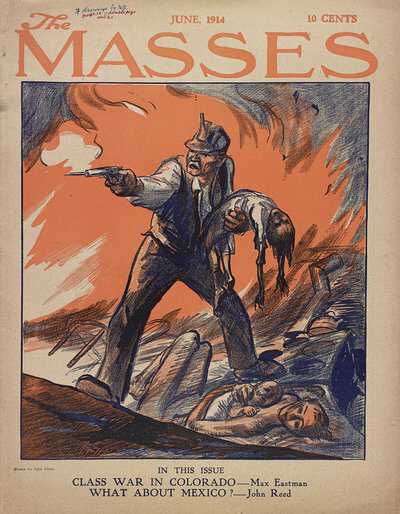
Cover illustration shows mine worker firing a gun after his wife and children were killed in a massacre at their tent camp by the Colorado National Guard. The Masses Publishing Co., 1914.

Over 20 people were killed by the Colorado National Guard in Ludlow on April 20, 1914, during a coal miners’ strike. Eleven of those murdered were children. They choked to death when the tent above them had been set on fire by soldiers.

The next day, April 21, 1914, the U.S. began a military occupation of Veracruz, Mexico. Hundreds of Mexicans were killed during the invasion.

These two atrocities 110 years ago were committed on behalf of Wall Street banksters who are still running the United States today. Their Pentagon war machine is supplying the bombs and shells that have killed over 14,000 Palestinian children in Gaza.

The coal miners in Colorado were on strike against the Colorado Fuel and Iron Company, which was controlled by the Rockefellers, the world’s first billionaire family and founders of Big Oil.

Nine thousand miners had walked out of the Colorado Fuel and Iron company-owned camps on Sept. 23, 1913. They struck against $1.68-a-day wages.

They revolted against the CF&I company stores, CF&I-controlled schools, and CF&I-censored libraries. Strike leader Louis Tikas, a Greek immigrant, was shot in the back and killed.

The U.S. attack on Veracruz was in response to the Mexican Revolution, which began in 1910. The United States had stolen half of Mexico in the late 1840s to expand slavery.

Thirteen years before the U.S. occupation of Veracruz, Los Angeles oil tycoon Edward Doheny opened his first oil well in Tampico, Mexico. President Woodrow Wilson invaded Mexico to protect the profits of U.S. oil outfits, mining, and railroad companies.

Wilson was a super bigot who segregated government lunchrooms. He had “Birth of a Nation,” a film that glorified the Ku Klux Klan, shown in the White House.

Wilson’s Navy Secretary, Josephus Daniels, helped overthrow Wilmington, North Carolina’s Black elected government in 1898. An estimated 300 Black people were killed.

Every worker needs a rifle

Just as Wilson refused to do anything about lynchings, he did nothing to stop miners and their families from being killed in Colorado. The Ludlow massacre horrified the country.

Victor Berger — the socialist member of Congress from Milwaukee — got up in the House of Representatives and urged every worker to get a rifle. The Cleveland Leader wrote, “The charred bodies of two dozen women and children show that Rockefeller knows how to win!”

Enraged strikers in Colorado attacked mines being operated by strikebreakers. President Wilson sent in U.S. troops to break the strike.

The heroic strike was finally defeated. But, the Colorado Fuel and Iron Company was forced to sign a contract with the United Mine Workers in 1933.

Decades later, New York Gov. Nelson Rockefeller, a grandson of Big Oil founder John D. Rockefeller, had 30 Attica prisoners massacred in 1971.

Poor and working people in Mexico, Palestine, and the United States have the same enemy: the billionaire class whose headquarters is Wall Street.

Always remember the Ludlow, Veracruz, and Attica massacres. Fight like hell for Gaza and all of Palestine.

Strugglelalucha256


Minneapolis rideshare drivers fight for justice as Lyft and Uber refuse minimum wage

Rideshare magnates Uber and Lyft announced on the afternoon of March 15 that both corporations would suspend all service in Minneapolis, Minnesota, as of May 1. Outside of the strange unity between supposed rideshare market rivals, the two companies issued a joint statement that announced the suspension of service and attacked the Minneapolis city government with one united voice of capitalist rage. 

The suspension will put 10,000 workers out of a job. What was Minneapolis’s great crime? The Midwest city had the unmitigated nerve to enact a minimum wage of $15 an hour for rideshare drivers. The minimum wage legislation actually had to overcome a veto from Jacob Frey, the city’s faux-progressive mayor. The City Council overrode Frey’s callous veto with a vote of 10-3. 

As a side note, Frey seems to be on a bit of a streak recently when it comes to vetoing progressive legislation. Just last month, the City Council was forced to override another Frey veto, this time on legislation demanding a ceasefire in Gaza and an end to all U.S. military aid to the Zionist regime. Frey claims to support a ceasefire but still vetoed the resolution and forced an override vote — some progressive. 

In response to the City Council’s approval of the $15 rideshare driver minimum wage legislation, Lyft and Uber immediately condemned the new law as “deeply troubling.” The two multi-billion corporations also asserted that the new minimum wage would make rideshare unaffordable for customers. 

Lyft, Uber lie

This is a classic capitalist red herring. They insist that any increase in working conditions will bring about the immediate and catastrophic collapse of the entire rideshare industry. But it isn’t true. The idea that wage increases will lead to unaffordable goods and services costs is based on total mythology

Labor is only one of the costs for producing a good or service. Lyft and Uber spend far more on licensing, insurance, and advertising than they ever would or could on drivers. Yes, the cost to provide a rideshare service in Minneapolis will increase under a new minimum wage law, but so would the purchasing power and morale of 10,000 rideshare drivers. 

Lyft and Uber’s pleas of poverty are even more ridiculous when juxtaposed to Minneapolis area rideshare drivers’ current working conditions. The Minneapolis Star Tribune investigated the economics of the rideshare magnates’ claims. The investigation found that Minneapolis drivers only take home 25% to 60% of their fares as is, compared to 70% to 80% when they first started. 

These workers drive the customers, maintain the cars, and provide their equipment … yet the capitalists keep at the minimum 40% of the drivers’ profits. Many drivers barely make a wage from their work after paying for maintenance and insurance on their vehicles. Meanwhile, Lyft and Uber make out like bandits. 

In 2023 alone, Lyft made $4.4 billion in revenue, up 7.5% from 2022. Uber had an even stronger 2023, with a revenue of $9.9 billion, a 15% increase from 2022. The drivers suffer, and the capitalist bosses roll around in the dough. 

It’s about maximizing profits

Uber and Lyft’s attempts to defeat the minimum wage law aren’t about sustainable business, and they aren’t about protecting the consumer. The cynical decision to withdraw from Minneapolis is simply about keeping the Minneapolis drivers at poverty wages while maximizing profits for rideshare shareholders as much as possible. 

That is the cold calculus of the capitalist class: Pay as little as possible to make as much as possible, no matter the cost in life or limb to the worker. This has always been their sole calculus. It will always be their sole calculus. This is how they maintain their system of greed. 

Meanwhile, over 10,000 workers will have to seek new ways to feed their families if the billionaire rideshare magnates follow through with their threat. This brutal development is just another chapter in a long list of reasons why we can no longer afford to live without socialism. 

If we want to end the reign of terror by greedy corporations like Uber and Lyft, then we have to end the capitalist system. Workers will find justice when workers control the system. 

In the meantime, we must support all workers who struggle for a better life and find themselves in the sights of the capitalist class. 

Stand with the Minneapolis rideshare drivers! Make Lyft and Uber pay their fare share! 

Strugglelalucha256


‘A slap in the face’: Trump meeting sparks outrage in Teamsters union

By acting in the role of the old racist and sexist business-unionism leadership, Teamsters union President Sean O’Brien made a sharp break with the new progressive union movement  — personally visiting Donald Trump in Mar-a-Lago, Florida, on Jan 26. Subsequently, O’Brien demanded the entire Teamsters General Executive Board meet with Trump at the union’s headquarters in Washington, D.C., on Jan. 31

Forming a vocal opposition, John Palmer, a Teamsters International vice president from Texas, refused to attend the meeting with an “insurrectionist.” In an interview with Steve Zeltser on WorkWeek Radio, Palmer said: “There’s zero – nothing on issues that affect labor that Donald Trump supports nor has he ever supported. Trump basically spits in our faces.”

The Teamsters National Black Caucus said in a statement about O’Brien’s meeting with Trump:  Trump’s “union-busting tactics, blatant disregard for government, and his bigotry are known  … as he has proudly touted his vile rhetoric to any listening audience.” 

Chris Silvera, a leader of Teamsters Local 808 and former chair of the Teamsters Black Caucus, said: “We’re not dealing with the Republican Party anymore. People should be very clear about this. They are confederates, people who think there needs to be a Civil War. You’ve got a president of the Teamsters union who’s consorting and is actually helping give credibility to this person who’s calling for a dictatorship.” 

Silvera explained: “O’Brien went to Mar-a-Lago, the place where people go to bow down there to ‘Kiss the Ring of Donald Trump.’ There’s something improper with our president making this trip to the headquarters of the confederacy.

“It is an affront to all those members who are not a party to this fascist movement. It sends a message to all the Black, Latin, Muslim, and women union members that you really don’t care about them. 

“O’Brien’s worrying about the racist elements within the union. Instead he should be trying to either convert those elements over to a newfound reality or to isolate them. To really believe that we had to play with them at this moment in history is troubling, to say the least.”

Gained appearance of militant leader

During Teamsters union organizing campaigns at Amazon and contract negotiations such as that with UPS last July, Sean O’Brien gained the appearance of a militant labor leader, covering up an earlier image of a tough guy with shady connections.

The Teamsters UPS contract campaign, “while notable for its bloviating, looked hollow compared with the UAW ‘Stand Up Strikes’ against the former Big Three automakers,” writes Joe Allen, author of “The Package King: A Rank and File History of United Parcel Service.” 

O’Brien comes from Teamsters Local 25 in Boston, which is reported to have a long history of racism. Silvera says there are no Black workers there. Strangely enough, Black workers sat on the Executive Board of Local 25 at the turn of the century. Silvera says, “Local 25 has fallen behind.”

Last February, former Black and Latino workers for the Teamsters International Union initiated a legal suit accusing the union of racism after O’Brien became the union’s president in March 2022. The lawsuit says that “rather than maintaining or increasing diversity, more than a dozen people of color were fired, setting back the Organizing Department’s goals of effectively recruiting and organizing non-whites, in favor of bolstering the majority white membership.”  

It also claims that O’Brien “publicly humiliated” the plaintiffs in the case, calling them “bad apples” and “lazy.” 

Teamsters for a Democratic Union (TDU), the promoters of O’Brien, were once seen as rank-and-file reformers in the union. At its November convention, the TDU tabled a motion for a ceasefire in Gaza. The motion for a ceasefire had been put forward by Teamsters Mobilize (TM) members, a much smaller network of Teamsters activists. One member of TM was banned from the TDU convention for criticizing it. TM has campaigned for $25 per hour starting pay for part-timers and for solidarity with Palestine.

‘A slap in the face’

Richard Hooker Jr., the secretary-treasurer of Teamsters Local 623 and vice-president of the Philadelphia AFL-CIO Board, said: “As leaders, we have to do a better job of explaining to our members that a vote for Trump is a vote against your pension, a vote for Trump is a vote against organizing workers, a vote for Trump is another vote against the working class.”

Jess Lister, a shop steward in Georgia and member of the Teamsters LGBTQ caucus, who has helped lead a campaign to organize part-time UPS workers, called the meeting “a slap in the face.” 

Lister added that she did not support Biden, but that she viewed the Trump meeting as especially galling given his record of stacking the courts with anti-union judges and overseeing a National Labor Relations Board (NLRB) that issued rulings making it harder for workers to organize.

“He has a longstanding history of racism, of hate towards women, towards minorities, towards the LGTBQ community – he is not accepting of other people,” Lister said. “Our union president shouldn’t even entertain the idea of a meeting. That shouldn’t have even been on the table.”

Strugglelalucha256


‘Black and a Red’: Rank-and-file ILWU Local 10 leader Leo Robinson linked local and global fights for justice

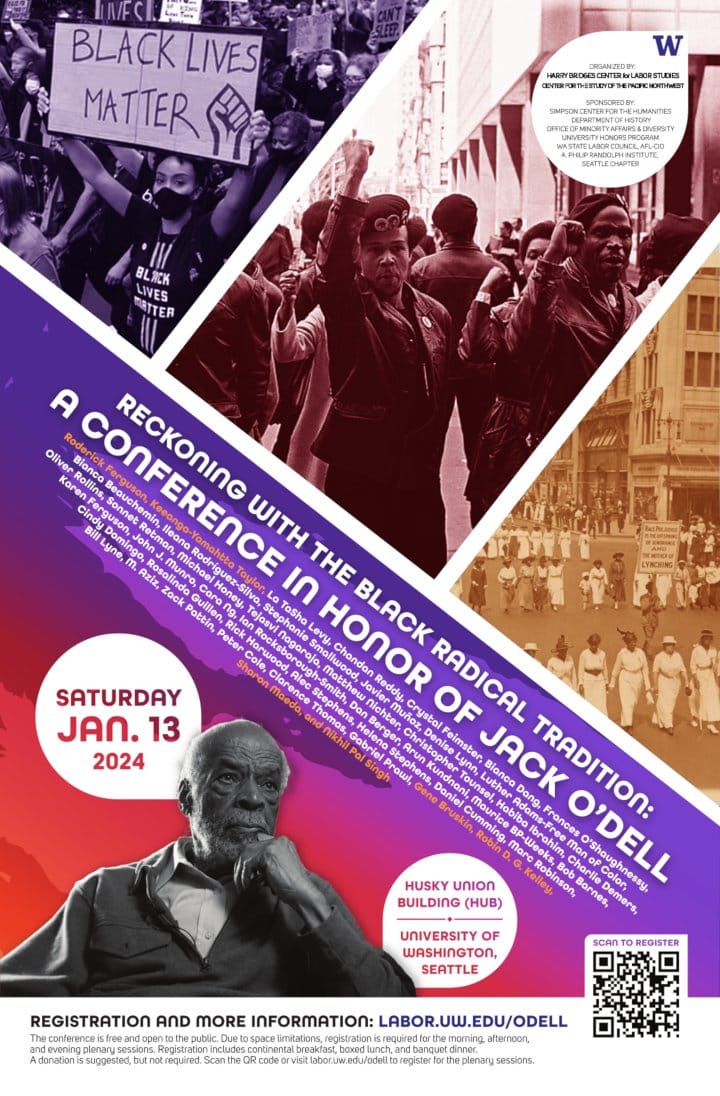
Following is a presentation by Clarence Thomas, a retired member of the International Longshore & Warehouse Union (ILWU) Local 10 in San Francisco. The event was “Reckoning with the Black Radical Tradition: A Conference in honor of Jack O’Dell on January 13, 2024, at the University of Washington in Seattle, sponsored by the Harry Bridges Center for Labor Studies.

Thomas was part of a Black and Red on the Waterfront workshop moderated by Zack Pattin (ILWU Local 23). Panel members included Peter Cole, professor (Western Illinois University), and Gabriel Prawl (ILWU Local 52, President, A. Philip Randolph Institute).

Jack O’Dell (1923-2019) was a visionary intellectual and an astute organizer who helped shape the course of the Black freedom movement in the second half of the 20th century.

Reckoning With the Black Radical Tradition: A Conference in Honor of Jack O’Dell

A profile of Leo L. Robinson

Solidarity greetings to all assembled here for this important conference in honor of Brother Jack Hunter O’Dell. 

I had the honor and privilege of meeting Brother O’Dell in Oakland, California, in 2012. The occasion was a lecture sponsored by Congresswoman Barbara Lee and former Oakland Mayor Elihu Harris. It was part of a series of civil rights lectures by veterans of the movement. I shall always remember our relatively brief but memorable and meaningful conversation about the ILWU and Local 10 specifically. He was very well acquainted with the history of our union, including our then-recent “Shut Down Wall Street on the Waterfront,” a coordinated West Coast Port Blockade in solidarity with the Occupy movement.

When reckoning with the Black radical tradition inside of the ILWU, particularly Local 10, the person who comes to mind is Leo L. Robinson — a second-generation Longshore worker. In my opinion, Robinson is one of the more important rank-and-file leaders in the union’s modern era (1970s-90s). I say that because he was in the tradition of the founders of the ILWU, leftists who were committed to rank-and-file democracy, as well as the working class at home and abroad. 

Like Jack O’Dell, Leo was “Black and a Red!”

Labor historian Peter Cole described Leo Robinson in an article following his passing in 2013 thusly: “Legendary Local 10 activist, recently passed away. His intellect, commitment, passion, and savvy allowed him to help lead Local 10, though he served as an elected official only once. He loved this union and fought to improve the lives of all working people, but Robinson might be best known for leading the ILWU and the fight against racial oppression, in South Africa.“

Born May 26, 1937, in Shreveport, Louisiana, to the proud parents of Arthur Robinson Jr. and Pearl Lee Young. His mother moved to the West Coast in 1942 to work at the Moore Shipyard in Oakland and prepare a place for his family. His father and four siblings moved to Oakland in 1943.

Leo’s dad also worked at Moore Shipyard and was hired on the waterfront in 1944. This was the same year my maternal grandfather found work on the docks during the second great migration of African Americans to the Bay Area.

Leo attended public schools in both Los Angeles and Oakland. George Washington Carver Junior High School’s motto stuck with him all of his life. Leo said, “I’ll never forget. I remember it as “a man educated is easy to lead but impossible to enslave.” The quote is from Henry Peter Brougham: “Education makes people easy to lead but difficult to drive; easy to govern, but impossible to enslave.” 

Brougham, a British statesman, played a prominent role in passing the Slavery Abolition Act of 1833.

Leo attended Oakland Technical High School and asked his mother for permission to join the Navy after completing the eleventh grade. Leo said, “I knew, running around with my hoodlum friends, that I wouldn’t graduate from the 12th grade.” 

He enlisted in the Navy in 1954 and spent three years, 11 months, 22 days, 11 hours, and 45 minutes of what he described as “wasted time.” He briefly worked for ILWU Local Two as a ship scaler. After working on an assembly line for General Motors, he became a longshore worker in 1963. 

When he came to the waterfront, he wasn’t that political. His issues were all local, and it was only later that it occurred to him that everything local was also national and international. During the Vietnam War, a question by a young longshore worker changed his political outlook for life and led him into activism. 

He said, “I want to ask you a question, and you don’t have to answer it now, but I want you to answer this question. Of what kind of threat do the Vietnamese pose to you?” Leo became politicized in the late ’60s, discussing the Vietnam War with fellow longshore workers and eventually joining the Communist party.

Photojournalist David Bacon wrote of Brother Robinson, “One of the things I learned about Leo was that he was not afraid of being called a Red. He took great pride in it.”

“When some people insult you and call you a Red,” Leo said, “that’s when you know you’re doing good work. When you’re hurting the racists, that’s their weapon of choice.“

With radical leaders on the docks, both Black and white, Leo’s emergence as a rank-and-file leader began to emerge in the early ‘70s. He became an active rank-and-file union member, vigilantly protecting workers’ rights, union democracy, and workers’ contracts. He was repeatedly elected to the local’s executive board and the union’s key decision-making body, the Longshore Caucus.

Local 10 predominantly African American

It is important to mention that ILWU Local 10 is the only predominantly African-American longshore local on the West Coast. It is also the most radical of all longshore locals in the ILWU. 

In the 1970s and 1980s, Leo’s leadership exercised the power of the rank and file of Local 10 and the U.S. working class on the side of the South African liberation struggle and against the racist apartheid regime. In July 1976, after the SOWETO uprising and youth were massacred, Leo introduced the resolution to Local 10 for a boycott of goods to and from South Africa. 

Leo assisted in forming Local 10’s South Africa Liberation Support Committee (SALSC), the first anti-apartheid group in a U.S. labor union. In April 1977, he put the resolution into action. A 5,000-person-strong community picket was honored by ILWU Local 10 members, stalling South African cargo at San Francisco’s Pier 27 for two days at a time when then-imprisoned Nelson Mandela and the African National Congress was slandered as terrorist by the U.S. government.

Leo was appointed by Local 10 to speak at rallies regarding anti-apartheid actions and the South African liberation movements, along with the Coalition of Black Trade Unionists (CBTU) and other community organizations. He organized the first trade union anti-apartheid conference at San Francisco State College and brought high officials from the African National Congress to San Francisco. 

The ILWU sponsored media events to bring the ANC and South African trade unionists involved in the liberation movement to the West Coast and beyond to speak on their struggles. They organized nightly meetings and radio interviews, traveled to other cities, raised funds, and worked with coalitions that raised money to build a clinic in Mozambique.

SALSC was successful in securing containers from longshore employers and collected tons of food and medical supplies for freedom fighters in Mozambique, South Africa, and Zimbabwe. The most impressive action of Local 10 occurred in 1984 when they initiated the longest boycott of South African cargo in U.S. history. 

When the Nedlloyd Kimberly docked at San Francisco Pier 80, Robinson and other longshore workers refused to touch the South African cargo, though they unloaded the rest of the ship’s contents. Thousands from the community rallied in support, and this cargo remained in the hold. Finally, on the 11th day, they unloaded it under pressure from the employers and a federal injunction that threatened massive fines on the union and leaders like Leo Robinson and others personally. 

This revolutionary, courageous act on the part of Local 10 and Local 34 immediately energized the Bay Area anti-apartheid movement, including students at the nearby University of California, Berkeley. It sparked a movement that spread throughout the West Coast and played a big part in anti-apartheid actions throughout the country.

Leo and his wife, Johnnie Pearl Robinson, opened their home to South African freedom fighters who were living underground in the U.S. They also provided financial support to some attending universities in the states. During this period, Leo, along with Sister Geraldine Johnson and several others, was a founding member of the Northern California chapter of the Coalition of Black Trade Unionists. It was the most radical of all the chapters in the country. 

Leo stated, “Sister Geraldine Johnson, my mentor, my sister and my teacher, was one of the most dynamic women I have ever laid eyes on. When Geraldine gave you your marching orders, you didn’t deviate, you didn’t equivocate, you just did it, even if you didn’t know how.” 

CBTU was one of the key coalition groups in the Bay Area in the anti-apartheid movement. It initiated broader support for the struggle within the ranks of Black labor.

Nelson Mandela thanked the ILWU

In 1990, when Nelson Mandela toured the United States after his release from 27 years in prison, he thanked the ILWU before a mammoth crowd at the Oakland Coliseum.

During the early 1980s, Leo, along with David Stewart and other local members of the CBTU, brought a resolution passed at its convention to Local 10 calling for all international unions to include in their union contracts, making Dr. Martin Luther King Jr.’s birthday a paid holiday. Local 10 adopted it as a contract caucus demand for the Longshore Caucus. The Longshore Division gained Dr. King‘s birthday as a paid holiday. 

Leo was a strong believer in rank-and-filers belonging to working-class organizations outside of their local, for the purpose of building coalitions, movements, and solidarity.

Leo Robinson was indeed an internationalist. He and others believed that Black people would not be free in the United States if they were not free in South Africa. They were determined to end support given by the U.S. government that kept the apartheid regime alive. 

Leo knew that workers in both countries had the potential to bring down apartheid. If longshore workers in San Francisco could find a way to support Black workers in South Africa, it would help the liberation movement there survive, win, and change the conditions for Black workers here at home.

Leo was a tremendous speaker. He possessed a commanding presence and voice. When he spoke, he had the full attention of every member of Local 10’s cavernous union hall. 

When he was once asked what the anti-apartheid struggle had to do with workers here at home, Leo responded by explaining that while plants were being shut down here, corporations were investing in industry in South Africa and taking advantage of the subjugation of Black workers under apartheid. He further highlighted that the cargo discharged from the boycotted ship Nedlloyd Kimberly in 1984 contained steel, glass, and apple juice concentrate, all products that had once been produced here in the U.S.

Leo had a way with words to hammer home a point. Here are some that come to mind:

  • “We have permanent interests, not permanent friends.”
  • “If you don’t know your rights, you don’t have any.”
  • “They’re not worth two dead flies on a syrup bucket.”
  • “Rank-and-file members should introduce resolutions that say if workers take a cut in wages, the leadership takes a cut in their wages as well.”
  • “The power of the rank-and-file resides in their back pockets.” (wallets)
  • “Only in unity is there strength. You will either organize or you will starve. It is as simple as that.”

Leo was a guy close to the members. They would come to him and express their concerns about matters on the job or in the community. They knew he could facilitate discussion of the issue at the executive board or union meetings. Members trusted his judgment because he believed in what was right as opposed to who was right. 

He was excellent at dominoes and played in the hall on occasions before dispatch. He was also effective in getting members who may have disagreed with his politics to support the efforts he initiated, such as volunteering to stuff and load containers with humanitarian supplies for freedom fighters in Southern Africa.

Leo was cited for heroism when he and two other Longshore workers rescued a fellow worker from sinking in tons of raw sugar. When a longshore brother and his family were being attacked by the KKK in Contra County in the Bay Area in 1981, Leo and others organized the ILWU Civil Rights Committee, which included interfaith, labor, and community forces. Longshore workers provided security for the brother and his family 24/7.

One day, while listening to a progressive radio station, he heard two Black women being interviewed about being harassed by the KKK and other racists in Oroville, California. Leo invited them to speak to the membership. The rank-and-file wanted to give support to their plight. He wrote a resolution to have the next membership meeting in Oroville, a “stop work meeting” with the employers’ approval. 

On the morning of the meeting, members loaded buses and cars to the city and marched through the town’s main thoroughfare to deliver a message to the police chief. Their message was to stop the harassment (cross burning, graffiti, etc.) of the single mothers.

Leo wrote the ILWU position paper on the Israeli-Palestinian question, calling for the recognition of the Palestine Liberation Organization as the sole representative of the Palestinian people and calling for the establishment of peace talks between Israeli and Palestinian governments.

In 1992, Leo and other rank-and-filers organized the African American Longshore Coalition to address racism, sexism, gender, and other forms of discrimination in the ILWU Longshore Division. Its objective was to resolve such problems internally. He believed such issues would ultimately lead to the demise of the union.

In 1994, while Leo was teaching middle school children in Berkeley the history of the ILWU, a former UC professor listened in the audience. They had previously worked together sending books to students in South Africa. The professor sought the union’s help to move his African Studies Library to Tanzania. A total of ten thousand books were sent. Many said, “This is a very unusual act of solidarity.” People from both continents called to find out how that was accomplished.

Call for a Million Worker March

Leo Robinson, in collaboration with Trent Willis and myself (Clarence Thomas of Local 10), wrote the resolution calling for a Million Worker March, an event that took place at the Lincoln Memorial on October 17, 2004, in Washington, D.C. The gathering, which took place a few weeks before the presidential election, faced tremendous opposition from the Democratic Party and the AFL-CIO. In fact, the latter instructed all labor councils and state labor federations not to endorse, support, or provide any financial support to the MWM. On June 28, 2004, Marilyn Sneiderman, Director of Field Operations, AFL-CIO, wrote a letter to all of its affiliates stating: “ While we agree with many of the aims and goals of the March, we are not endorsing this mobilization.”

On September 20, 2004, Mike Mathis, Director of the Teamsters’s government affairs, sent a memo to local unions and Joint Council principal officers, reading in part: “We agree, as does the AFL-CIO, in principle, with the idea of the Million Worker March. However, we also believe the timing of the March will divert valuable time and resources away from my efforts in the Battle Ground States.”

A month earlier, at the 29th Annual Educational Conference of the Teamsters National Black Caucus (TNBC) in Orlando, Florida, a motion was made to contribute $10,000 to the MWM. C. Thomas Keegel, General Secretary-Treasurer, IBT, assured TNBC delegates that this would get done, and it was.

Brother Gabriel Prawl, executive board member of ILWU Local 19 in Seattle and the MWM coordinator of the Pacific Northwest, introduced a motion to allow Brother Leo Robinson to address the membership. Prawl was motivated to do this because he was very disappointed at the local’s $500 donation for the MWM. Robinson had a reputation in the Longshore Division for speaking before audiences that did not necessarily share his political views. However, members never doubted his commitment to the ILWU and its rank and file. During Robinson‘s remarks to Local 19, he asserted, “I couldn’t stop the MWM even if I wanted to.“ He made such a compelling case for supporting the MWM that a white member of the local stood and made a motion that the local make a $5,000 contribution to the MWM. The motion passed unanimously!

On the weekend preceding the start of the 2004 Democratic Convention in Boston, Massachusetts, Senator Edward Kennedy, Democrat Massachusetts, hosted a mini-Labor summit, which included James P. Hoffa, General President of the International Brotherhood of Teamsters, Andy Stern, International President of SEIU, James Spinosa International President of the ILWU, and John Sweeney President of the AFL-CIO. One of the items on the agenda was the MWM. They said the MWM may be a good idea, but not at that time; maybe sometime later.

Brother Robinson contributed $50,000 towards the building of the MWM. He demonstrated his unwavering commitment to making MWM a reality, no matter what lengths the Democratic Party and the labor officialdom went to stop it. His contribution was truly revolutionary. Other pensioners also made significant contributions. I lost two qualifying years of retirement benefits due to my organizing for the MWM in 2004. and the subsequent MWMM in 2005. Leo demonstrated that the power of the rank-and-file resides in their hip pocket, as Harry Bridges (founding President of the ILWU) had pointed out many times.

Leo was also responsible for creating the MWM logo, which is emblazoned on tee-shirts and includes the MWM motto: “Mobilizing in Our Own Name,” with the joining of four hands of different hues, followed by a ribbon, which reads Million Worker March, encapsulates the beliefs and guiding principles of the intent of the MWM.

The MWM was initiated by the Black left of ILWU Local 10. Leo Robinson was the undisputed leader of that tendency in the entire ILWU.

Sister Brenda Stokely, a leading radical African American labor and community activist as well as the coordinator of the MWM Eastern Region, described Brother Leo in this way: “Leo embodied courage and commitment to his class and stood unwaveringly on the side of the aspirations of that class. His skills as an effective working-class strategist and organizer encouraged others never to falter in the face of opposition. He was vigilant in ensuring that ILWU Local 10 maintained its revolutionary character, remained capable of stopping their employers’ attacks on their contracts, and was able to exercise their right to carry out both political and economic strikes. Leo will forever be an inspiring model of revolutionary leadership.”

On March 23, 2013, a memorial service was held for Brother Leo Robinson at the William “Bill” Chester Hiring Hall of Local 10 in San Francisco. He was posthumously awarded the Nelson Mandela Humanitarian Award and the Nelson Mandela Freedom Award by the South African Ambassador, the Honorable Ebrahim Rasool, and Consul-General, the Honorable Cyril Ndaba respectively.

Submitted by: Clarence Thomas, ILWU Local 10 pensioner. Co-founder of the MWMM and DeClare Publishing. www.MillionWorkerMarch.com

Thomas is the author and co-publisher of “Mobilizing in Our Own Name: Million Worker March” and “Cleophas Williams: My Life Story in the International Longshore & Warehouse Union Local 10.”

Strugglelalucha256


‘We’ve learned power’ from labor – MLK on Longshore Union solidarity

If Martin Luther King Jr. still lived, he’d probably tell people to join unions.

King understood racial equality was inextricably linked to economics. He asked, “What good does it do to be able to eat at a lunch counter if you can’t buy a hamburger?”

Those disadvantages have persisted. Today, for instance, the wealth of the average white family is more than 20 times that of a Black one.

King’s solution was unionism.

Convergence of needs

In 1961, King spoke before the AFL-CIO, the nation’s largest and most powerful labor organization, to explain why he felt unions were essential to civil rights progress.

“Negroes are almost entirely a working people,” he said. “Our needs are identical with labor’s needs – decent wages, fair working conditions, livable housing, old age security, health and welfare measures, conditions in which families can grow, have education for their children and respect in the community.”

My book, “Dockworker Power: Race and Activism in Durban and the San Francisco Bay Area,” chronicles King’s relationship with a labor union that was, perhaps, the most racially progressive in the country. That was Local 10 of the International Longshoremen’s and Warehousemen’s Union, or ILWU.

ILWU Local 10 represented workers who loaded and unloaded cargo from ships throughout San Francisco Bay’s waterfront. Its members’ commitment to racial equality may be as surprising as it is unknown.

In 1967, the year before his murder, King visited ILWU Local 10 to see what interracial unionism looked like. King met with these unionists at their hall in a then-thriving portside neighborhood – now a gentrified tourist area best known for Fisherman’s Wharf, Pier 39.

While King knew about this union, ILWU history isn’t widely known off the waterfront.

Civil rights on the waterfront

Dockworkers had suffered for decades from a hiring system compared to a “slave auction.” Once hired, they routinely worked 24 to 36 hour shifts, experienced among the highest rates of injury and death of any job, and endured abusive bosses. And they did so for incredibly low wages.

In 1934, San Francisco longshoremen – who were non-union since employers had crushed their union in 1919 – reorganized and led a coast-wide “Big Strike.”

In the throes of the Great Depression, these increasingly militant and radicalized dockworkers walked off the job. After 83 days on strike, they won a huge victory: wage increases, a coast-wide contract and union-controlled hiring halls.

Soon, these “wharf rats,” among the region’s poorest and most exploited workers, became “lords of the docks,” commanding the highest wages and best conditions of any blue-collar worker in the region.

At its inception, Local 10’s membership was 99 percent white. But Harry Bridges, the union’s charismatic leader, joined with fellow union radicals to commit to racial equality in its ranks.

Originally from Australia, Bridges started working on the San Francisco waterfront in the early 1920s. It was during the Big Strike that he emerged as a leader.

Bridges coordinated during the strike with C.L. Dellums, the leading black unionist in the Bay Area, and made sure the handful of black dockworkers would not cross picket lines as replacement workers. Bridges promised they would get a fair deal in the new union. One of the union’s first moves after the strike was integrating work gangs that previously had been segregated.

Local 10 overcame pervasive discrimination

Cleophas Williams, a black man originally from Arkansas, was among those who got into Local 10 in 1944. He belonged to a wave of African-Americans who, due to the massive labor shortage caused by World War II, fled the racism and discriminatory laws of the Jim Crow South for better lives – and better jobs – outside of it. Hundreds of thousands of blacks moved to the Bay Area, and tens of thousands found jobs in the booming shipbuilding industry.

Black workers in shipbuilding experienced pervasive discrimination. Employers shunted them off into less attractive jobs and paid them less. Similarly, the main shipbuilders’ union proved hostile to black workers who, when allowed in, were placed in segregated locals.

A few thousand black men, including Williams, were hired as longshoremen during the war. He later recalled to historian Harvey Schwartz: “When I first came on the waterfront, many black workers felt that Local 10 was a utopia.”

During the war, when white foremen and military officers hurled racist epithets at black longshoremen, this union defended them. Black members received equal pay and were dispatched the same as all others.

For Williams, this union was a revelation. Literally the first white people he ever met who opposed white supremacy belonged to Local 10. These longshoremen were not simply anti-racists, they were communists and socialists.

Leftist unions like the ILWU embraced black workers because, reflecting their ideology, they contended workers were stronger when united. They also knew that, countless times, employers had broken strikes and destroyed unions by playing workers of different ethnicities, genders, nationalities and races against each other. For instance, when 350,000 workers went out during the mammoth Steel Strike of 1919, employers brought in tens of thousands of African-Americans to work as replacements.

Some black dockworkers also were socialists. Paul Robeson, the globally famous singer, actor and left-wing activist had several friends, fellow socialists, in Local 10. Robeson was made an honorary ILWU member during WWII.

Martin Luther King, union member

In 1967, King walked in Robeson’s footsteps when he was inducted into Local 10 as an honorary member, the same year Williams became the first black person elected president of Local 10. By that year, roughly half of its members were African-American.

King addressed these dockworkers, declaring, “I don’t feel like a stranger here in the midst of the ILWU. We have been strengthened and energized by the support you have given to our struggles. … We’ve learned from labor the meaning of power.”

Many years later, Williams discussed King’s speech with me: “He talked about the economics of discrimination. … What he said is what Bridges had been saying all along,” about workers benefiting by attacking racism and forming interracial unions.

Eight months later, in Memphis to organize a union, King was assassinated.

The day after his death, longshoremen shut down the ports of San Francisco and Oakland, as they still do when one of their own dies on the job. Nine ILWU members attended King’s funeral in Atlanta, including Bridges and Williams, honoring the man who called unions “the first anti-poverty program.”

Source: The Conversation

Strugglelalucha256


United Auto Workers call for ceasefire in Gaza

The United Auto Workers, one of the largest unions in North America, added its voice to the global call for a ceasefire in Gaza. The announcement was made hours after Israel resumed its attacks on the Gaza Strip following a seven-day pause.

On December 1, Brandon Mancilla, Director for United Auto Workers Region 9A, wrote on X that the UAW is calling for a ceasefire in Israel and Palestine and is creating “a Divestment and Just Transition working group to study the history of Israel and Palestine, our union’s economic ties to the conflict, and explore how we can have a just transition for US workers from war to peace.”

UAW President Shawn Fain stated shortly afterwards, “I am proud that the UAW International Union is calling for a ceasefire in Israel and Palestine. From opposing fascism in WWII to mobilizing against apartheid South Africa and the CONTRA war, the UAW has consistently stood for justice across the globe.”

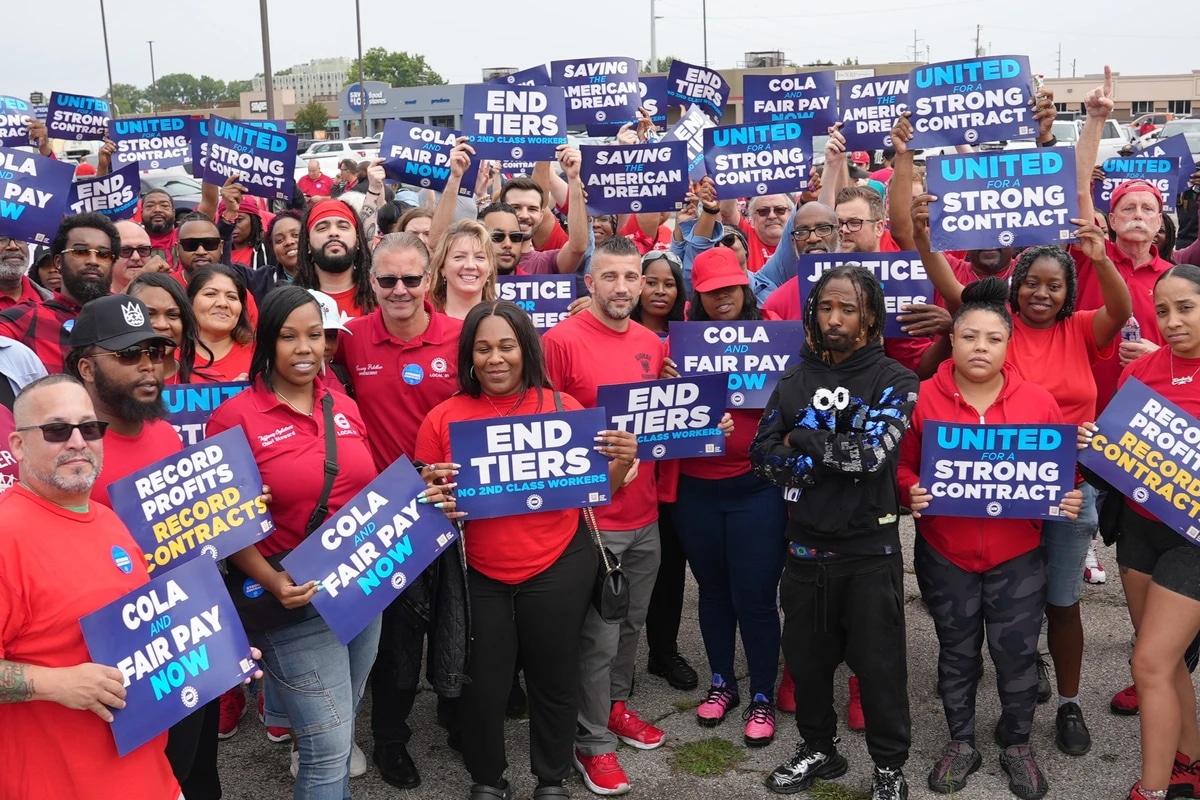
The United Auto Workers has risen in prominence with a historic victory over the three largest automakers in the US in their recent “big three” contract campaign, which mobilized all rank and filers in the union in an unprecedented way. Members partook in “practice pickets” and fought for a series of demands far more radical than anything the UAW had demanded of corporations in decades. 145,000 auto workers won historic pay raises that lifted everyone up, especially those at the lowest rungs of the workforce, eliminated divisive tiers, tied wage increases to inflation, among other victories.

This massive win had a ripple effect across the industry. Non-union automakers Toyota, Honda and Hyundai announced that they would increase workers’ pay shortly after the victory.

Speaking outside of the White House gates at a press conference on the morning of December 1, where a group of activists have been in a hunger strike since November 27 for a permanent ceasefire, Brandon Mancilla said, “For so long we’ve been silent and we’ve been ignorant in the labor movement to this issue.”

“That time is over,” he said. “I wanna thank all the rank and file members who have made this happen.”


Strugglelalucha256


UAW knocks out Big Three auto companies

Dumping cutbacks by fighting back 

The strike of the United Auto Workers against General Motors, Ford and Stellantis (Chrysler and Jeep) is a big step forward for all workers and poor people. The tentative agreements with these corporations — whose sales total $500 billion — signal an end to a decades-long retreat of givebacks and wage cuts.

UAW members won wage increases of at least 25%. More importantly, the lowest-paid auto workers will get increases of 150%.

Raising the pay more for those on the bottom largely eliminates the outrageous wage tiers that were implemented in 2008 during the Great Recession. These tiers resulted in big differences of pay for UAW members doing the same work simply because of the date they were hired. 

This victory for equality builds solidarity.

Cost-of-living wage increases, to compensate for inflation, have been restored. Pensions have increased. The UAW even forced the reopening of the Chrysler plant in Belvidere, Illinois, near Rockford.

Workers at any future electric battery or car plants will be brought under the UAW Big Three contract.

No wonder former Ford vice-president, Chrysler president and General Motors vice-chairman Bob Lutz hates the union contract. “This is not like other labor negotiations,” Lutz said. “This was a gun to the head from a government-sanctioned monopoly called the labor union.” 

The Washington Post — whose billionaire owner Jeff Bezos runs Amazon.com — didn’t like the UAW contract either. Listen up, Bezos: Your $160-billion stash won’t stop Amazon workers from getting a union.

Toyota, whose U.S. plants are non-union, promptly announced it was raising wages by at least $2.94 per hour. 

This wasn’t generosity. It’s trying to keep the UAW out of Toyota’s factories.

UAW President Shawn Fain announced that the union is planning organizing drives at Tesla, Toyota and other non-union outfits. Full speed ahead!

Ending a long retreat

Back in 1970, 321,000 UAW members in the United States struck General Motors for 67 days. Another 21,000 workers, now represented by Unifor, struck GM plants in Canada for 94 days.

They won retirement after 30 years on the job (“30 and out”), as well as getting 95% of their pay during layoffs. 

During the same period, mass demonstrations demanded an end to the Vietnam War. Access to food stamps, now called SNAP benefits, was expanded. Women and LGBTQ+ people demanded equality.

Despite Richard Nixon in the White House, both the Environmental Protection Agency (EPA) and the Occupational Safety and Health Administration (OSHA) were established.

On July 24, 1973, two Black workers — Larry Carter and Issac Shorter — had enough of Chrysler’s racist management and dangerous working conditions. They turned off the power at the company’s Jefferson Avenue assembly plant on the east side of Detroit in the first big sit-down strike in 36 years.

There were 6,074 strikes across the United States in 1974.

The wealthy and powerful counterattacked, taking advantage of recessions and job-killing automation. U.S. corporations make super-profits by exploiting millions of workers in other lands.

Today GM has 170,000 fewer workers in the U.S. than it did in 1970. While 29.1% of all workers belonged to unions in 1970, only 10.3% were union members in 2021.

Wall Street demanded 50,000 New York City public workers be fired during the 1975 municipal debt crisis.

When Chrysler got financial guarantees from the federal government in 1979, the deal resulted in 30,000 workers being fired in Detroit alone. Chrysler’s workforce went from 70% Black to 30%.

So much of the burden of 6 million manufacturing jobs being destroyed fell upon Black workers. 

White family median income fell in the Midwest by 7.1% from 1978 to 1982. That’s a recession.

During those same years Black family median income fell in the Midwest by 35.8%. That’s a great depression.

Instead of young workers getting jobs with union wages and benefits, many were railroaded to prisons instead. Two million prisoners are members of the working class, too.

Why aren’t Trump and the rest of the billionaire criminals locked up instead? The labor movement needs to demand “jobs, not jails!”

Palestine needs labor solidarity

The UAW strike and the election of Shawn Fain as UAW president means not only an end to almost 50 years of givebacks. It’s also breaking with 75 years of the labor movement knuckling-under to an anti-communist witch hunt that started in the late 1940s.

AFL-CIO President George Meany supported the dirty U.S. war against Vietnam, Laos and Cambodia that killed millions, including 58,000 GIs. Meany’s home union, Plumbers’ Local No. 1 in Howard Beach, New York City, didn’t have a single Black or Puerto Rican apprentice in 1963.

The same year Meany refused to endorse the March for Jobs and Freedom, where Dr. King gave his “I Have a Dream” speech.

In contrast, Shawn Fain announced: “We went to each of the Big Three and proposed an expiration date of April 30, 2028. We did this for several reasons. First, this allows us to strike on May Day, or International Workers’ Day.”

The workers of Chicago gave May Day to the world in 1886 and their leaders were hanged for it. Even since then capitalists have tried to smother it.

Palestine is also a working-class issue. Just as Vietnam, Cambodia and Laos were bombed, U.S.-made bombs are being dropped on Gaza, killing thousands of Palestinian children.

President Biden is demanding billions of more dollars to kill Palestinians. There’s nothing more cynical in U.S. history than the Big Oil government in Washington supporting the Zionist regime occupying Palestine. 

U.S. war secretary Henry Stimson refused to bomb the railroad tracks leading to the Auschwitz extermination camp. Anne Frank’s family was denied a U.S. visa.

Henry Ford was the biggest Jew-baiter in U.S. history. His car dealers distributed a Ford-owned newspaper that ran a 91-week long lying series called the “The International Jew.”

Ford was also a union-buster, whose thugs beat up UAW organizers, including future union president Walter Reuther. 

GM’s Opel subsidiary was Hitler’s biggest truck maker. IBM’s punch cards were indispensable to organize the extermination of Jewish and Roma people.

None of this prevents the Israeli regime from allowing Ford, GM and IBM to have facilities in occupied Palestine.

Mark Diamondstein, who is Jewish, is president of the 200,000-strong American Postal Workers Union. At a recent AFL-CIO executive council meeting, Diamondstein urged the council to demand a ceasefire in Israel’s attacks.

All of labor should support the APWU president. “Solidarity Forever” means solidarity with all oppressed people, including the children of Gaza.

Strugglelalucha256


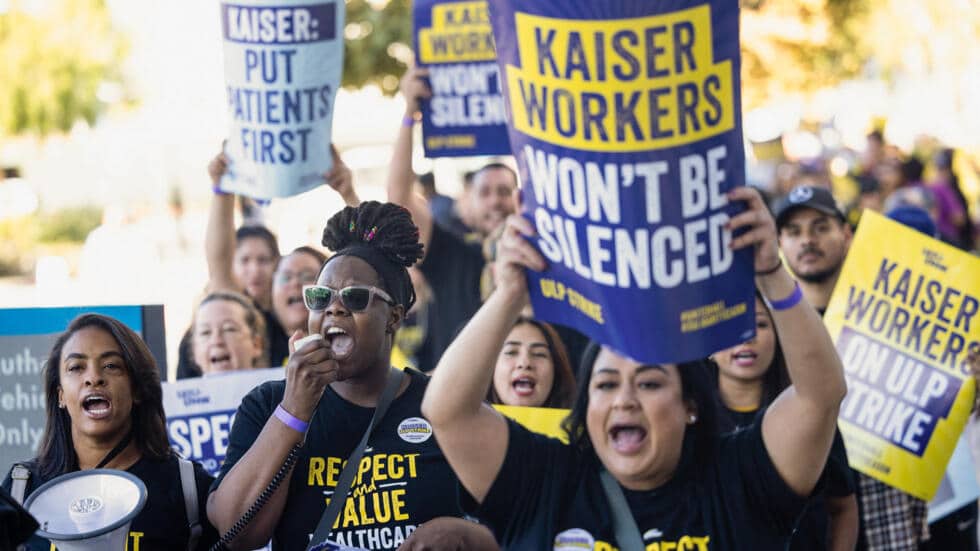
75,000 Kaiser Permanente workers go on strike in largest health care labor action in U.S. history

Over 75,000 Kaiser Permanente healthcare workers across six states and Washington, D.C., went on a three-day strike starting Oct. 4 after contract negotiations failed. This is the largest healthcare strike ever in the U.S., with around 40% of Kaiser’s staff participating.

Workers — including nurses, technicians, assistants, and pharmacists — are picketing at hospitals and medical facilities in California, Colorado, Oregon, Washington, Virginia, and D.C. Other strikes are planned for emergency department technicians, radiology technicians, X-ray technicians, medical assistants, pharmacists, and many other positions across facilities in California, Colorado, Oregon, and Washington state.

A coalition of several unions is battling the nonprofit health giant for safe staffing levels, cost of living pay increases, and against a two-tier pay system that Kaiser is trying to introduce.

The largest union in the coalition is Service Employees International Union (SEIU)-United Healthcare Workers West (UHW) with 57,443 members, but the coalition also includes Office and Professional Employees International Union (OPEIU) Local 30, SEIU Local 49, OPEIU Local 2 and others.

“We are in a healthcare staffing crisis, but Kaiser is unwilling to even meet with our bargaining team to discuss a wage proposal that would keep good healthcare workers at our facilities,” wrote SEIU-UHW. “That has never happened before in the 25 years of our partnership.”

Kaiser Campaign Updates can be found at www.seiu-uhw.org/kaiser-campaign-updates/

Strugglelalucha256


The answer to job-killing automation: shorten the workweek!

The United Auto Workers (UAW) are taking on three of the biggest corporations on the planet: Ford, General Motors and Stellantis (Chrysler). These outfits had total sales last year of a half-trillion dollars.

That’s as large as the combined Gross Domestic Product of the Democratic Republic of the Congo, Ethiopia, Ghana, Kenya, and Venezuela. Three hundred forty-seven million people live in these five countries.

The UAW members are fighting for all of us. Auto workers are rebelling against 45 years of plant closings, givebacks, and wage cuts.

Instead of equal pay for equal work, newly hired temp workers are paid $16.67 per hour. Adjusted for inflation, that’s worth $1.90 in 1968 money — just 30 cents above the minimum wage that year.

Back in 1970, 321,000 UAW members in the United States struck General Motors for 67 days. Another 21,000 workers, now represented by Unifor, struck GM plants in Canada for 94 days.

They won big wage increases, retirement after 30 years on the job (“30 and out”), and larger pensions. The UAW contract became a goal for millions of other workers who also made gains.

The wealthy and powerful spent decades counterattacking. Capitalism’s biggest weapon was plant closings.

Just on the East Coast, GM plants in Baltimore; Linden, New Jersey (near Newark); Terrytown, New York (a New York City suburb); and Framingham, Massachusetts (near Boston) were shut down. Two plants were closed in Cleveland, and so were Detroit’s Cadillac factory and the Van Nuys plant in Los Angeles.

Today, the UAW represents 150,000 GM workers. That’s 170,000 jobs that were wiped out.

At least as many jobs were destroyed at Ford and Chrysler. The Black-majority cities of Detroit and Flint, Michigan, were the heaviest hit — GM shut down nine of its 10 plants in Flint, where the historic 1937 sit-down strike occurred.

In 1980, before these layoffs, young workers in Flint, Michigan,had higher average incomes than those in San Francisco. Thirty-seven years later, in 2017, half of Flint’s population lived in poverty.

To save a few million dollars, children were poisoned by filthy water pumped from the polluted Flint River instead of using water from the Great Lakes.

Overworked while millions are unemployed

Automation is one of the biggest job killers. Robots replaced spot welders and other workers on the assembly line. Computers swept away office jobs.

One of the UAW’s demands is a 32-hour work week to keep and create jobs. Technology should be used to make people’s lives better, not to increase joblessness and misery.

It’s outrageous that some people are forced to work overtime while 6.4 million people were unemployed in August. Another 5.4 million currently want a job but are not even counted as belonging to the labor force. 

“The condemnation of one part of the working class to enforced idleness by the overwork of the other part, and the converse, becomes a means of enriching the individual capitalists.” That’s what Karl Marx — the founder of scientific socialism, also called communism — wrote in “Capital” in 1867.

For 200 years, the world labor movement has fought for shorter hours of work. British workers struggled first for a 12-hour workday and then for 10 hours on the job.

On May 1, 1886, workers across the United States went on strike for an 8-hour workday. In retaliation, capitalist courts hanged the “Haymarket Martyrs” — George Engel, Adolph Fischer, Albert Parsons, and August Spies — in Chicago on Nov. 11, 1887.

Fifty-six years before, on Nov. 11, 1831, slave masters hanged the freedom fighter Nat Turner. He led a glorious insurrection of enslaved Africans who worked from “no see” in the morning to “no see” at night.

One of the demands of the 1919 steel strike of 365,000 workers, led by future communist leader William Z. Foster, was for an eight-hour workday. The steel tycoons claimed they couldn’t operate their mills without 12-hour shifts.

Although police and private gunmen broke the strike, U.S. Steel president Elbert Gary was compelled to institute an 8-hour workday in the early 1920s. Smaller steel outfits soon followed.

It was the working-class upsurge of the 1930s that established a 40-hour workweek. The labor movement was responsible for the weekend.

Shorter hours mean more jobs

Even after the 40-hour workweek was won, many workers still spend at least 50 hours on their job. That’s because it takes millions of workers at least an hour to travel to and from their job.

Workers should be compensated from the time they leave their homes to go to work. Compulsory overtime should be prohibited.

Unions helped end most child labor in the 1930s. As the legendary IWW (Industrial Workers of the World) leader “Big Bill” Haywood wrote, “the worst thief Is he who steals the playtime of children.”

Capitalists and their politicians are bringing back this atrocity. It was legal for 16-year-old Michael Schuls to be working in a Wisconsin sawmill when he was killed on June 29. Teenagers have been found working in Alabama auto part factories.

Steven Rattner, who helped push through the cutbacks for auto workers during the 2008 economic crisis, thinks the UAW is “asking for too much: In addition to pay raises of 36 percent over four years, the list includes a 32-hour workweek with 40 hours of pay.” 

Well, sir, do you know that 90 years ago, the U.S. Senate passed a law for a 30-hour workweek by a vote of 53 to 30 on April 5, 1933? Alabama Senator and future Supreme Court Justice Hugo Black introduced the bill. (“A Terrible Anger, The Waterfront and General Strikes in San Francisco,” by David F. Selvin.)

This legislation was later ditched in Congress, but it shows what can be demanded. Millions of jobs could be created by instituting a 32-hour workweek, as the UAW is asking for.

The billionaire class can afford it. As UAW vice president Mike Booth pointed out, GM alone raked in $100 billion in profits over the past decade from its North American operations. Twenty-one billion was spent on stock buybacks that only benefit Wall Street speculators.

With today’s technology, demanding a 32-hour workweek is no more impossible than marching for the 8-hour day on May Day in 1886.


Strugglelalucha256


UAW workers expand strike, call for support against billionaire CEOs

Sept. 22 — At 10 a.m., the United Auto Workers announced a major expansion of the current stand-up strike to 38 parts and distribution sites across 20 states at General Motors and Stellantis. Both companies have remained recalcitrant.  

UAW President Shawn Fain announced that the union made some progress with Ford, including eliminating wage tiers, reinstating cost-of-living adjustments, improved profit-sharing, conversion of temporary workers, and the right to strike in the advent of plant closures.  There are still significant gaps on key issues with Ford, and in the end, all of the issues are interconnected.  Strikes at Wayne, Michigan (Ford), Wentzville, Missouri (GM), and Toledo, Ohio (Stellantis) will continue.

In the morning livestream, UAW President Shawn Fain called on everyone to join the picket line, including all UAW members and family members, the community, and workers at large.  Fain also urged President Biden to join the line.  International support has been pouring in from Mexico, South Africa, Malaysia, and Italy, where Stelantis workers are on strike.

This will add 5,600 workers to the 13,000 who are already striking.

The staff at Struggle-La Lucha and the Socialist Unity Party urges our readers, members, and friends to join the picket lines in their respective areas.

Strugglelalucha256
https://www.struggle-la-lucha.org/labor/page/4/