Eyewitness accounts bring Cuban socialism to life in Los Angeles

Socialistcuba
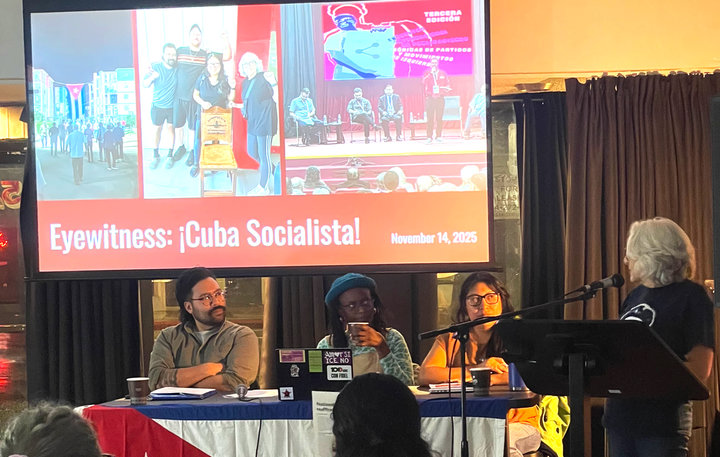
Activists who recently traveled to Cuba spoke about the experience at a public meeting in Los Angeles. From left to right: Andrew Matatag, Onyịnye Alheri, Lizbeth Antonio, and Maggie Vascassenno. SLL photo

Los Angeles — Delegates who recently traveled to Cuba shared their experiences at a public meeting on Nov. 14 at the Harriet Tubman Center for Social Justice. The “Eyewitness: ¡Cuba Socialista!” presentation brought the reality of Cuban socialism to life through firsthand accounts.

The delegates from the U.S., representing Struggle-La Lucha and the Struggle for Socialism Party, traveled to Cuba on two occasions. The first was for the launch of the book “Love is the law: Cuba’s queer rights revolution,” and the second was to attend the Third International Meeting on Theoretical Publications of Left-Wing Parties and Movements and the First Granma-Rebelde Festival.

The presentation began with a basic history of Cuba, beginning with Spanish colonial rule — a crucial part of understanding Cuba on its own terms and in its own historical context. Cuba’s socialist revolution and its accomplishments are a product of, and counter to, its exploitation and domination by Spain and the United States.

One presenter told of their participation in the book launch of “Love is the law.” There was a lovely coincidence in which an LGBTQ delegation of the Venceremos Brigade happened upon the book launch and stayed to hear the presentations.

Another presenter detailed their first time in Cuba as a participant of the Third International Meeting on Theoretical Publications of Left-Wing Parties and Movements and the First Granma-Rebelde Festival. In addition to the conference lessons already published in Struggle-La Lucha, this presenter put emphasis on seeing a better world, a socialist system, in practice.

They reflected on visiting a neighborhood block party put on by its Committee for the Defense of the Revolution (CDR) and meeting its president. “The president and the CDR are responsible for identifying its people’s needs and making sure they are connected to whatever resources they need. It is truly a people-oriented system.”

Both presenters and participants committed to building a mass movement to end the U.S. blockade of Cuba and to remove Cuba from the list of “state sponsors of terror.”


Strugglelalucha256


Black solidarity with Venezuela

Statement from The December 12th  Movement

Recent U.S. military provocations of war in South America reveal Black and working-class interest in opposition to U.S. imperialism. The Trump regime and previous U.S. administrations have historically labeled the President Maduro regime anti-democratic. In May of 2025, Trump accused Venezuela’s government of working with the criminal organization Tren de Aragua to wage a small-scale war on American soil, an obvious pretext for regime change. This calls for solidarity with Venezuela, including from our brothers and sisters serving in the U.S. armed forces. 

Black and Venezuelan ties go back for centuries. In 1811, during Venezuela’s independence movement, Haitian soldiers, the Western hemisphere’s first free republic, sailed south from Haiti to take up arms to aid Simón Bolívar and Venezuelans in their quest for liberation. This action was not forgotten as the late Venezuelan President Hugo Chavez offered low-cost oil to Haiti following its devastating earthquake in 2010. Chavez also supplied low-cost heating oil to Black and Brown communities in the Bronx and Boston, poor families, homeless shelters, and Native American villages. Venezuela has used its deep oil deposits to provide low-cost fuel to the Caribbean and Latin American partners for decades. Venezuela was also there for victims of Hurricane Katrina.

After coming to power in 1999, Chavez, and later current president Nicolas Maduro, improved the lives of Black and Indigenous people within Venezuela, improving their access to economic, social, and political rights. Prior to U.S. sanctions on Venezuela, broad social spending from the party was responsible for lifting many Black and Brown people out of poverty and expanding literacy to millions. 

At present, it is urgent to consider the implications of the solidarity that Venezuela has shown with working-class people of the Americas. More than 60 Venezuelan civilians have been killed by the U.S. since Sept. 2. We are now witnessing the largest U.S. military buildup in the Caribbean since the Cuban Missile Crisis in 1962.

On those ships are Black troops, many that find their origins in the same Caribbean now extorted for Washington’s interest. U.S. naval Admiral Alvin Holsey abruptly retired in the wake of the attacks on Venezuelan boats. Holsey, a Black man, resigned after expressing concerns about targeting civilian or non-military vessels. Legal experts agree with Holsey, suggesting that simply characterizing drug cartels as terrorists did not give the administration any additional authority to use lethal force. Holsey should be a beacon for all servicemen — but especially Black and Brown. 

As Malcolm X said:

“When the Black man was asleep, he was anyone’s tool, he was anyone’s watchdog, he was anyone’s houndog, hunting dog, but today the Black man in America is beginning to think for himself. As he begins to think for himself, he begins to ask himself what he is fighting for. And what has he gotten out of all of the fighting that he has already done? And as the Black man begins to ask himself this question, then you will find that many of them begin to wonder what do we have to fight for.”

What is the reality back at home for American troops? Trump’s administration withheld SNAP benefits from working-class Americans as a bargaining chip in a political negotiation. Americans do not exercise the broad social spending of Venezuela to alleviate poverty, with the result being record inequality and a new record in household debt of $18.59 trillion, as Americans struggle with the rising cost of living. In addition, U.S. urban populations have found themselves the target of a war within, with troops and secret police (ICE) being unleashed in an obvious political nature. Images of Black and Brown Americans in cities like Chicago being zip-tied and kidnapped have angered many, with calls for answers against actions that stand at odds to democracy. As to our Black and Brown servicemen: 

We are calling for solidarity with the Venezuelan people and the ruling party. They have shown their commitment to the working class here in the Americas, and in their dire time, we must return the support. To our servicemen faced with following orders to feed their families, we understand the contradiction. We all face these challenges to survive the capitalist system. We do ask, however, that you read more about Venezuela and its commitment to improving the lives of the poor here in America and the Caribbean.

WhatsApp Image 2025 11 17 at 3.35.52 PM

Strugglelalucha256


Union power wins: Baltimore library workers get jobs back

Fourteen part-time librarians at the Baltimore County Public Library received a jarring email on the afternoon of Nov. 12. BCPL leadership’s email informed them that they would no longer have jobs. The mass firing came just ahead of the holiday season and without any advance notice. 

All 14 are members of the International Association of Machinists Local 4538, which represents the several hundred BCPL workers and the staff of a nearby Apple Store. Several of those fired were particularly active members of their union. One of the fired librarians is an active union steward and member of the Local’s bargaining committee. 

Some of the fired librarians worked in the system for more than 30 years, only to be met with an undignified and sudden dismissal. These library workers provide a variety of services to the community beyond books and research. Many serve as de facto social workers, interfacing with large groups of children, the homeless, and people struggling with addiction. Luckily, the workers, their union, and the local community jumped into action. 

The outrage at the firings was immediate and passionate. Local 4538 called upon other unions and all concerned community members to flood the media with support. The Machinists’ local also urged those same people to pack the Baltimore County Council meeting and a BCPL board meeting. 

Simply from the outrage in the press and the public plans to mobilize, the BCPL backpedaled two days later and rehired all 14 part-time librarians. However, the workers still packed the BCPL board meeting on Tuesday, Nov. 19, to make sure this never happens again. 

At this meeting, Local 4538 President Anita Bass not only condemned the firing but spoke in favor of broader worker power, stating: 

“I don’t understand what any of you were thinking. We are a union. We are Machinists. We are here to protect our people. We will not tolerate intimidation, retaliation or union busting. We are also in the middle of negotiating our financial contract. How dare you fire a union member that is on the negotiating committee. Two days later the reinstatement of the part-time librarians was a result of community outcry and union power.” 

President Bass couldn’t be more correct. As Frederick Douglass taught, power concedes nothing without a demand. In the case of the Baltimore County Public Library, the workers mobilized to demand the reinstatement of their fellow library staff. Through struggle and organizing, they won that demand swiftly. Long live worker power! 

Strugglelalucha256


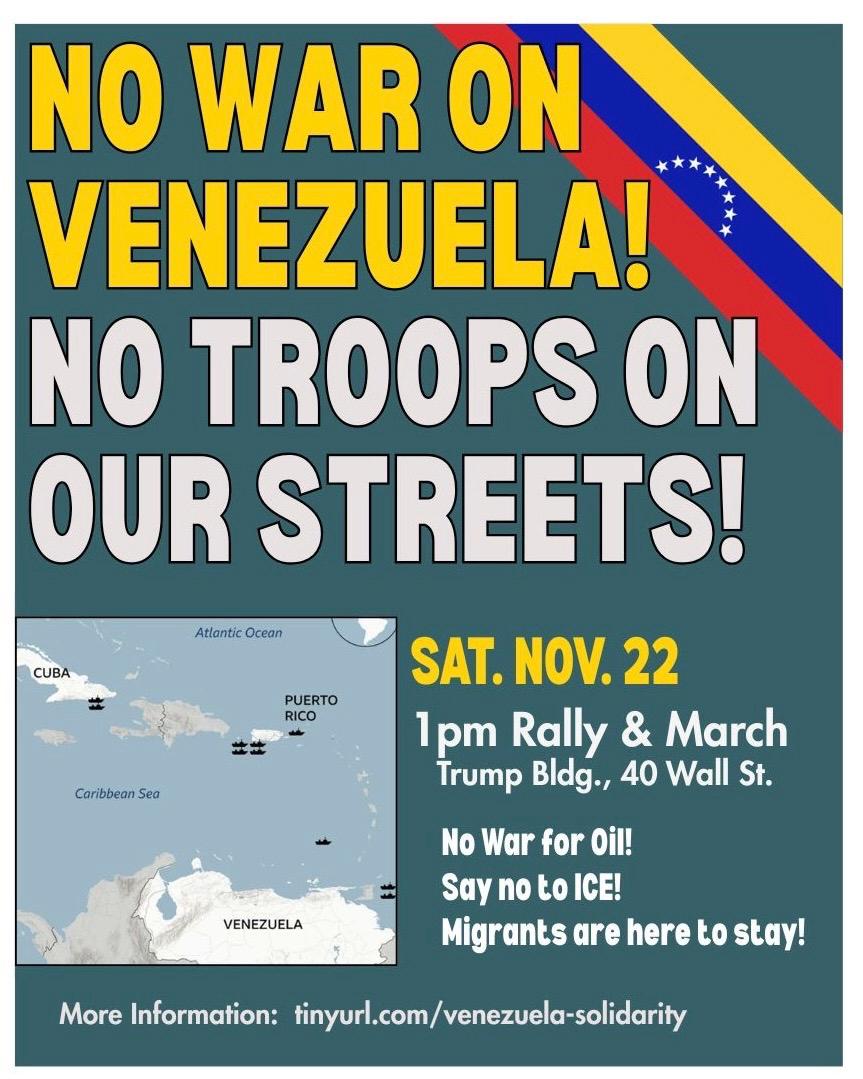
Hands off Venezuela! Wall Street antiwar rally

Protesters rallied on Wall Street on Nov. 22 to defend Venezuela from Trump and the Pentagon. The speak-out and march was one of many events called by the United National Antiwar Coalition against the impending war for Big Oil.

People chanted “No troops on the ground, no bombs in the air!” in front of the Trump Building at 40 Wall Street. Nearby was the world’s biggest casino, the New York Stock Exchange. It was the 62nd anniversary of the CIA’s regime change in Dallas back on Nov. 22, 1963.

Michela Martinazzi of the Freedom Road Socialist Organization chaired the rally that condemned the ICE gestapo raids and the murders in the Caribbean. Roger Wareham of the December 12th Movement reminded people that the late President Hugo Chavez provided free heating oil for poor people in the United States.

Lucy Pagoada spoke of the important Nov. 30 presidential election in Honduras. The Trump regime wants to return the Central American country to being a U.S. colony. Later that day a rally was held in Times Square to support the Libre Party candidate Rixi Moncada.

An activist told of the struggle at the old, shut-down, Brooklyn Naval Yard against the makers of drones for ICE and the Zionist regime. Other speakers included those from the Workers World Party and the Internationalist Group. 

People marched across the financial district to hold a final rally at the Oculus shopping and transportation center, which cost $4 billion to erect. That’s enough money to build 10,000 apartments for homeless families at $400,000 apiece.

While there are 100,000 homeless schoolchildren in New York City the capital of capitalism — there are no homeless children in Venezuela. The Bolivarian Republic has built five million homes for people.

The people of Venezuela will defend their revolution. No war in Venezuela! No troops on U.S. streets!

Strugglelalucha256


ILWU rank-and-file leader tells students how Local 10 led the battle against apartheid

Clarence Thomas Jr. is a retired third-generation longshore worker from ILWU Local 10, co-founder of the Million Worker March Movement, and co-founder of DeClare Publishing. In this presentation to students, Thomas told them that his activism began in 1967 at San Francisco State College as a member of the Black Student Union, which initiated the longest student strike in U.S. history to establish a Black Studies Department and a School of Ethnic Studies.

On Oct. 30, I had the honor of speaking at the University of California, Berkeley’s Department of African American Studies about a subject close to my heart: the International Longshore & Warehouse Union (ILWU) Local 10’s pivotal role in the anti-apartheid movement of the 1980s.

Longshore workers are responsible for the loading and discharging of maritime cargo on shipping vessels. The cars we drive, the clothes we wear, and the food we eat all pass through the hands of dockworkers, also known as longshore workers. ILWU longshore workers move maritime cargo at all 29 ports on the West Coast, including Hawaii, Alaska, and ports represented by ILWU Canada in Vancouver, BC. We are responsible for making the ports productive, safe, and efficient.

These workers are critical to the global economy. The hands of dockworkers move the commerce of the world, giving them enormous power through collective action. Over the years, ILWU Local 10 has taken historic rank-and-file action in support of domestic and international social justice issues. 

A tradition of international solidarity

Beginning in 1935, less than a year after the monumental 1934 West Coast Maritime Strike, Local 10 refused to load nickel and brass destined for the Italian fascist war machine ravaging Ethiopia. Shortly thereafter, members refused to load scrap iron destined for Japan. The union’s motto, adopted from the Industrial Workers of the World, is “An injury to one is an injury to all.”

Harry Bridges, one of the founders of ILWU and its first international president, said: “Interference with foreign policy of the country? Sure, as hell! That’s our job! That’s our privilege, that’s our right, that’s our duty.” He made those remarks after President Franklin Delano Roosevelt told him to stay out of U.S. foreign policy matters.

Local 10 activists refused to load U.S.-made military supplies intended for Pinochet’s military in Chile and for dictatorships in El Salvador, South Korea, and the Philippines. The positions Local 10 took against apartheid South Africa belong to this tradition spanning more than 80 years.

Understanding apartheid

Apartheid was a system of institutionalized racial segregation and discrimination in South Africa from 1948 to 1994, enforcing the political, social, and economic domination of the white minority over the non-white majority. The word apartheid means “apartness” in Afrikaans (a West Germanic language spoken in South Africa). The system is characterized by racist laws in housing, public facilities, and social events, treating non-white South Africans as inferior and stripping them of all rights.

The method of enforcement was the use of pass laws. Black South Africans had to carry passbooks that included photographs, fingerprints, addresses, the length of time the person had been employed, and other identifying personal information. Employers often entered an evaluation of the pass holder’s behavior.

As defined by law, an employer could only be a white person. The passbook also documented when permission was required to enter a certain region and whether the request was denied or granted. Urban areas were considered “white“, so a non-white person needed a passbook to be inside a city.

Under the law, any governmental employee could remove these entries, effectively denying permission to remain in the area. If a passbook didn’t have an entry, officials could arrest its owner and put them in prison. Colloquially, these passes were called the dompas — Afrikaans for “stupid pass” — a name Black South Africans used to describe the most hated and despicable symbol of apartheid.

Black South Africans often violated the pass laws to find work and support their families, and thus lived under constant threat of fines, harassment, and arrests. Protests against the suffocating laws brought the anti-apartheid struggle, including the Defiance Campaign in the early ‘50s, and the huge women’s protest in Pretoria in 1956.

My wife, Delores Lemon-Thomas, and I recently visited the Apartheid Museum in Johannesburg, where we learned of this brutal period of South Africa’s history, the injustices and hardships of people’s lives under apartheid. We also learned about people, organizations, and events that helped to end apartheid.

ILWU Local 10’s role in the anti-apartheid movement 

Dockworkers play a crucial role in shipping, a key global industry that contributed to capitalism’s emergence. These workers amass power through collective action, ideological commitment, and sheer force of will. They can deploy their power on behalf of an array of social movements in their own unions, cities, and countries, as well as beyond their shores. Such a movement was launched when ILWU Local 10 started its solidarity actions to dismantle the apartheid system in South Africa. This movement was led by leftists, both Black and white, in a predominantly African American local.

Dockworkers in Durban, South Africa, conducted work stoppages from the 1940s into the early 1970s. These actions proved to be among the most important forces against apartheid in Durban. ILWU Local 10 rank-and-filers were in the vanguard in the labor movement in the U.S. fighting apartheid. 

Sharpeville massacre

The Sharpeville massacre occurred on March 21, 1960. Some 6,000 people had gathered to protest the injustices of apartheid when police opened fire on the crowd. Sixty-nine people were killed and nearly 200 were wounded — many of them shot in the back as they fled.

Following these events, the American Committee on Africa (ACOA), the leading U.S. organization involved in South African liberation solidarity work, called for a boycott of South African goods and the enactment of U.S. sanctions in 1962. The ILWU Longshore Caucus endorsed such boycotts.

On Dec. 17, 1962, ACOA picketed the Dutch ship Raki, which arrived at San Francisco’s Pier 19 loaded with asbestos, coffee, and wool from South Africa. They sought to raise awareness of the horrors of apartheid and to encourage the U.S. to join a global boycott of South African goods.

Local 10 dockers stopped work to protest apartheid. ILWU traditionally doesn’t cross picket lines. William Bill Chester, the union’s Regional Director for Northern California, the highest-ranking African American in the ILWU, had worked closely with Mary Louise Hooper, the head of ACOA, in planning the boycott. Almost certainly, the Local 10 boycott was the first anti-apartheid action undertaken by a labor union in U.S. history.

The global struggle against apartheid surged in the 1970s. In 1976, the uprising of Black students in Soweto, despite ferocious repression, took the movement to the next level. Black freedom movements in Mozambique and Angola achieved freedom in 1975, and the armed struggle in southern Rhodesia heated up.

The freedom struggles in Africa resulted in the dramatic expansion of global solidarity in the San Francisco Bay Area. Radical rank-and-filers in ILWU Local 10 created the Southern African Liberation Support Committee (SALSC) to support these struggles. Black and white longshore workers’ efforts catapulted them to the front of the burgeoning global anti-apartheid movement. San Francisco dockworkers proved deeply committed and ultimately contributed to the downfall of white minority rule in South Africa.
Apartheirdshiip LeoRobinson

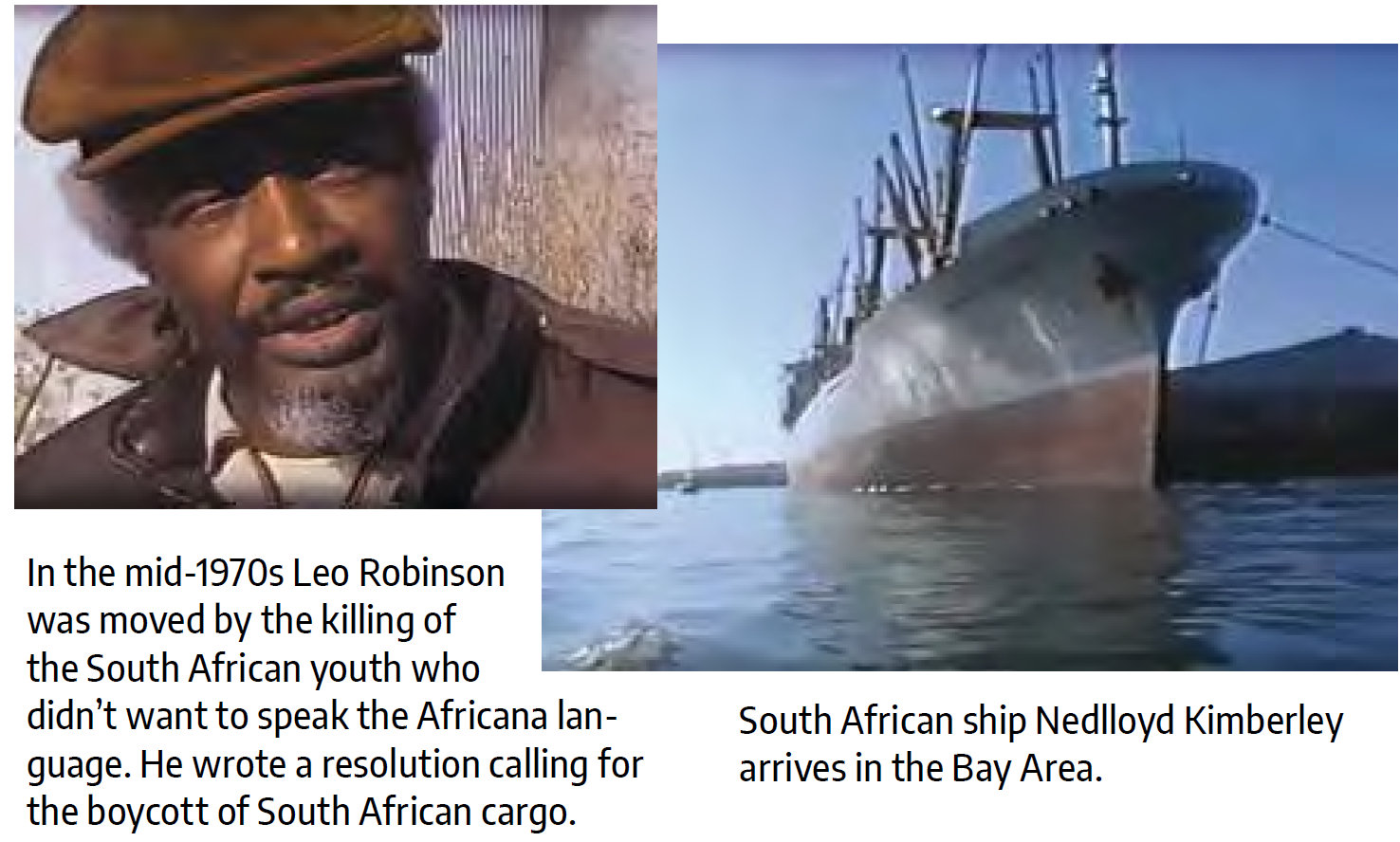
Brother Leo Robinson, an African American and communist who regularly critiqued capitalism, imperialism, and racism, became interested in South Africa during the Soweto uprising. He wrote a resolution to establish SALSC and boycott South African cargo, which Local 10’s Executive Board passed.

SALSC members included David Stewart, Bill Proctor, Larry Wright, Howard Keylor, Charlie Jones, and Leroy “Ned” Ingram — Black and white activists who were socialists or radical unionists who saw South Africans as fellow members of the global working class. They believed working-class power was strongest on the job and pushed for a boycott of South African cargo.

In July 1976, the ILWU International Executive Board issued communications to all locals regarding a boycott of South African cargo. SALSC helped Local 10 members to pass a resolution condemning the white minority governments of South Africa and Rhodesia, which had laws denying basic human rights to the Black majority of people in both nations. 

In 1977, SALSC coordinated a two-day Easter Sunday boycott of the ship, Nedlloyd Kimberley. Approximately 500 people, many from churches, cheered the ILWU members and hoisted banners. That same year, SALSC collected tons of supplies for South Africans, Mozambicans, and Zimbabweans in liberation struggles, loading two 40-foot containers with goods for African National Congress ANC exiles in Tanzania and Zimbabwean refugees in Mozambique.

ILWU activists also screened the documentary “Last Grave at Dimbaza,” secretly filmed in 1973 and smuggled out of South Africa, showing the horrible suffering of Black people under apartheid. Wright and Robinson showed the film to dozens of audiences up and down the Pacific Coast in the 1970s and ’80s, laying the groundwork for future actions.

The historic 1984 boycott

In October 1984, a screening of “Last Grave at Dimbaza” before almost 400 Local 10 members sparked the longest and most important workplace boycott against apartheid in U.S. history. A motion to boycott only South African cargo on the next Nedlloyd ship passed resoundingly.

The timing was right because a group of Black South African miners had been arrested and faced long prison sentences. Bay Area longshore workers had been educated about apartheid for nearly a decade and were primed to act in solidarity with persecuted unionists.

On Nov. 24, 1984, the Nedlloyd Kimberley arrived at San Francisco’s Pier 80 carrying South African cargo. Local 10 activists knew of its arrival thanks to Brother Alex Bagwell, an African American in the clerk’s ILWU Local 34. A sympathetic job dispatcher assigned workers committed to the boycott.

For the next 10 days, many Bay Area residents gathered daily at the pier’s gate. On Dec. 2, about 700 people, many from unions, religious groups, and civil rights organizations, rallied at the dock. Brother Leo Robinson described how, “You couldn’t get from Army and Third Street to the gate of Pier 80 because it was jam-packed with community organizations and people.” Among those who spoke were legendary activist Angela Davis and Congressman Ron Dellums, the most radical member of the House of Representatives.

As employers sought to end the boycott, dockworkers remained steadfast. The Pacific Maritime Association (PMA) proposed unloading the ship elsewhere, but ILWU locals in Stockton, Portland, and Seattle expressed solidarity by refusing to handle “hot cargo.”

The PMA then filed a federal injunction calling the work stoppage illegal. The judge declared Local 10 would be fined $200,000 per day for noncompliance. By the end of the standoff, Local 10 faced fines totaling more than $2 million. The injunction singled out Robinson and Keylor for fines of thousands of dollars a day. Local 10 officials maintained the boycott was not union-sanctioned — plausible deniability to prevent financial catastrophe.

Finally, on the 11th day, Local 10 members unloaded the South African cargo. Despite activists’ disappointment that the boycott did not expand, SALSC and Local 10 members felt they had greatly raised awareness of what could be done to oppose apartheid. Bay Area activist and photojournalist David Bacon said, “That was the real birth of the anti-apartheid movement in Northern California.”

National impact

The dockworkers’ boycott helped inspire students at UC Berkeley to expand their protests in 1985, the largest activism there since the Vietnam War. Thousands rallied, and hundreds erected shantytowns resembling South African townships, leading to repeated clashes with police and heightened public awareness. Wright and Keylor spoke at rallies with a large ILWU banner displaying “an injury to one is an injury to all.” The protests ultimately forced a very reluctant Board of Regents to divest relevant portions of its $3 billion endowment.

The ILWU embraced the divestment campaigns. In 1986, Oakland closed its account with Bank of America, which conducted business in South Africa, in the most dramatic application of the city’s rigorous new South Africa divestment ordinance to date. Bank of America lost the city’s $150 million investment portfolio and $120 million annual payroll.

Local 10 exerted influence on Representative Ron Dellums, whose father was a Local 10 member. His uncle, C.L. Dellums, was probably one of the most important Black labor and civil rights leaders in California in the mid-20th century. He was a leader in the BSCP (Brotherhood of Sleeping Car Porters), the first Black union to be affiliated with the AFL-CIO. He succeeded A. Philip Randolph as its president.

Dellums introduced a sanctions bill and joined the Washington, D.C.-based Free South Africa Movement, which in 1984 launched sit-ins at the South African embassy just three days before the Nedlloyd boycott. Local 10’s action had a national impact, perhaps never more so than when Congress, led by Dellums, overrode President Ronald Reagan’s veto and passed sanctions.

Nelson Mandela’s acknowledgment

The ILWU and the Bay Area proved so important that Nelson Mandela visited Oakland during his first U.S. tour in 1990. He spoke before 60,000 people at the Oakland Coliseum, saying: “We salute members of the International Longshore & Warehouse Union Local 10 who refused to unload a South African cargo ship in 1984. In response, other workers, church people, community activists, and educators gathered each day at the docks to express their solidarity with the dockworkers. They established themselves as the frontline of the anti-apartheid movement in the Bay Area.”

Mandela later described how this action belongs to the larger fight: “We are part of a worldwide movement. Just as we watched and learned from the continuing struggle within the United States, so too did activists there gain strength from our struggles.” That no less a figure than Nelson Mandela praised Local 10 speaks volumes about the role of unions in the movement.

In 2013, I chaired a Local 10 committee to organize a memorial recognizing Leo Robinson’s contributions to the struggle to end apartheid. I invited members of the South African Consulate General’s Office in Southern California to attend.  

Much to our surprise, Ambassador Rasool also attended the Memorial, presenting the Nelson Mandela Humanitarian Award posthumously to Leo’s widow, Johnnie Robinson. Consul General Cyril S. Ndaba presented the Nelson Mandela Freedom Award and a South African flag to Local 10. In his remarks at the memorial, the ambassador acknowledged the contributions of the entire Bay Area for its solidarity. Many activists from the anti-apartheid struggle attended.

The history of ILWU Local 10’s anti-apartheid activism demonstrates the power of international working-class solidarity. From the first boycott in 1962 to the historic 11-day action in 1984, San Francisco dockworkers proved that organized labor could be a decisive force in global struggles for justice. Their actions inspired a nationwide movement that helped bring down the apartheid regime. This legacy reminds us that “an injury to one is an injury to all.”

Peter Cole’s book, “Dockworker Power: Race and Activism in Durban and the San Francisco Bay Area,” was a contributing resource to this report. For speaking engagements or to purchase books from DeClare Publishing — “Mobilizing in Our Own Name – Million Worker March,” “Cleophus Williams – My Life Story in the ILWU, Local 10” and “The Year of Good Trouble, 1934” — visit millionworkermarch.com

Strugglelalucha256


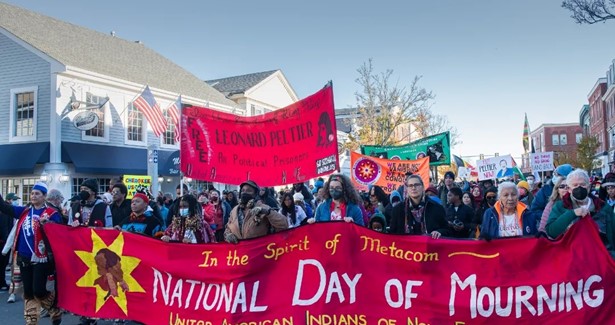
National Day of Mourning

National day of mourning march

National Day of Mourning
Thursday, November 27, 2025
12:00 Noon
Cole’s Hill (above Plymouth Rock), Plymouth, MA

Since 1970, Indigenous people & their allies have gathered at noon on Cole’s Hill in Plymouth to commemorate a National Day of Mourning on the US Thanksgiving holiday. Many Native people do not celebrate the arrival of the Pilgrims & other European settlers. Thanksgiving Day is a reminder of the genocide of millions of Native people, the theft of Native lands and the erasure of Native cultures. Participants in National Day of Mourning honor Indigenous ancestors and Native resilience. It is a day of remembrance and spiritual connection, as well as a protest against the racism and oppression that Indigenous people continue to experience worldwide.

Join us as we continue to create a true awareness of Native peoples and history. Help shatter the untrue image of the Pilgrims, and the unjust system based on white supremacy, settler colonialism, sexism, homophobia and the profit-driven destruction of the Earth that they and other European settlers introduced to these shores.

Solidarity with Indigenous struggles throughout the world!
From Turtle Island to Palestine, Colonialism is a Crime!

While many supporters will attend in person, we will also Livestream the event from Plymouth.

United American Indians of New England (decolonizing since 1970)
info@uaine.org * UAINE website * UAINE Facebook Group

Facebook event with bus and more info

Donate

#NDOM2025 #NoThanksNoGiving
No sit-down social, but box lunches will be available.
Masks required.

Strugglelalucha256


War on Venezuela looms as opposition mounts

Nov. 22 — The Trump administration is preparing to launch a new phase of operations against Venezuela within days, according to four U.S. officials who spoke to Reuters on Nov. 22. The escalation comes despite polling showing overwhelming public opposition to military intervention and growing international condemnation of U.S. actions in the region.

Reuters reports that covert operations are expected to be the first component of the new phase, with options under consideration including attempts to overthrow the government of Venezuelan President Nicolás Maduro.

The escalation builds on months of military buildup in the Caribbean. The Navy’s largest aircraft carrier, the USS Gerald R. Ford, arrived in the region on Nov. 16 with its strike group, joining at least seven other warships, a nuclear submarine, and F-35 aircraft. Since September, U.S. forces have carried out at least 21 strikes on alleged drug boats, killing at least 83 people, mostly in the Caribbean.

Covert authorization and “preparing the battlefield”

The New York Times reported in October that Trump signed a classified “presidential finding” authorizing the CIA to conduct covert operations in Venezuela. According to the Times, these operations could include sabotage, cyberattacks, psychological operations, or other actions intended to “prepare the battlefield” for further military action.

On Monday, the administration plans to designate the so-called Cartel de los Soles as a foreign terrorist organization. Trump has claimed this designation will allow the U.S. to strike Venezuelan assets and infrastructure.

Defense Secretary Pete Hegseth stated last week that the terrorist designation “brings a whole bunch of new options to the United States.” The administration has doubled the reward for information leading to Maduro’s arrest to $50 million.

Venezuela is not involved in any way with the global drug trade. Pino Arlacchi, former head of the United Nations Office on Drugs and Crime (UNODC), says that decades of annual reports on drug trafficking never once mention Venezuela, because it doesn’t exist. 

Arlacchi calls the Cartel of the Suns an entity as mythical as the Loch Ness Monster. He says that the Cartel de los Soles does not actually exist — that it is a U.S. intelligence invention used to criminalize Venezuelan officials wholesale and manufacture a pretext for intervention. It’s reported that the name is a CIA invention. The suns are a reference to the insignia worn by Venezuelan military personnel on their uniforms.

Pino Arlacchi continues: “Yet Venezuela is systematically demonized, contrary to every principle of truth. In his memoir following his resignation, former FBI Director James Comey revealed the unspoken motives behind American policies towards Venezuela. Trump told him that Maduro’s government was ‘sitting on a mountain of oil that we have to buy.’ This is not about drugs, crime or national security. It is about oil that the U.S. would rather not pay for.”

Public rejects regime change narrative

Despite the administration’s justifications, the U.S. public remains opposed. Opposition to using military force outweighs support by a significant margin: 45% oppose overthrowing Maduro while only 17% favor doing so. A separate Reuters / Ipsos poll found that 51% of respondents disapproved of the boat strikes that have killed dozens of people, nearly double the 29% who approved.

Legal concerns and international pushback

The strikes on boats are illegal killings of civilians. The top military lawyer for U.S. Southern Command, which oversees operations in the Caribbean, raised concerns in August that the strikes could amount to extrajudicial killings and could legally expose service members involved in the operations. His concerns were overruled.

The commander of Southern Command, Admiral Alvin Holsey, resigned in October, reportedly due to concerns about the legality of the boat strikes.

Several U.S. allies have refused to share intelligence for the Caribbean operations due to concerns over their legality. Britain, France, Canada, and the Netherlands have all declined to provide intelligence support. Former U.S. Ambassador Chas Freeman called Britain’s decision “quite remarkable,” noting it represents “a break with the 80-year long US-UK intelligence cooperation alliance.”

MI6 and the British establishment have stated that the attacks are illegal and would subject those who carry them out to prosecution, describing them as war crimes and acts of piracy.

Venezuela prepares defense

The Venezuelan government has responded to U.S. threats by mobilizing military exercises and preparing for what it calls “prolonged resistance” in the event of invasion. This approach would involve small military units at more than 280 locations carrying out sabotage and guerrilla tactics.

President Maduro has stated that Venezuelan citizens and the military will resist any U.S. attempt to oust him, and has characterized U.S. actions as an effort to seize control of Venezuela’s oil and other significant resources, including gold, coltan (used in electronics), and other minerals. Venezuela has the largest proven oil reserves in the world.

Maduro has also expressed willingness to resolve differences through diplomacy and hold face-to-face talks.

The demand: Stop the war on Venezuela

The Trump administration’s escalating aggression against Venezuela represents a dangerous continuation of U.S. imperialist policy in Latin America. The operation is being conducted without public support, without legal justification, and without regard for international law or human rights.

The rationale for war has been exposed as fraudulent. The military buildup far exceeds anything needed for counter-narcotics operations. The boat strikes have killed dozens of people in what amounts to illegal executions. And now the administration is preparing to launch covert operations and potentially a full military intervention against a sovereign nation that poses no threat to the United States.

What is clear is that this has nothing to do with drugs and everything to do with regime change and control of Venezuela’s oil and resources. This is how the U.S. empire operates: It does not believe in self-determination and thinks it has the right to intervene in the domestic politics of every country on the planet.

With a new phase of operations set to begin within days, the demand must be clear and unequivocal: Stop the U.S. war on Venezuela. No covert operations. No military strikes. No regime change. Hands off Venezuela.

Strugglelalucha256


Is the U.S. orchestrating protests in Mexico to pave the way for war on Venezuela?

The evidence is clear: Washington is actively attempting to destabilize Mexico. The target is not only the progressive government of President Claudia Sheinbaum but the very sovereignty of the nation, a move that aligns with the escalating threats against Venezuela.

The script is familiar. Corporate media outlets like Fox News and CNN are trumpeting violent protests, branding them as a “Generation Z” revolt. The unrest, sparked by the Nov. 2 murder of the mayor of Uruapan, Michoacán, Mexico, who’s been likened to the reactionary Salvadoran President Nayib Bukele, is being cynically directed by right-wing forces. Former Mexican President and Coca-Cola millionaire Vicente Fox is a key player, promoting these demonstrations.

The hidden hand of U.S. imperialism is plain to see. So-called independent media outlet “Animal Politico,” which receives direct funding from the U.S. government’s National Endowment for Democracy (NED), is amplifying the calls for protest. The NED, along with the Open Society Foundations, the Ford Foundation, and the Google News Initiative, provides its funding, and the U.S. embassy provides training. U.S.-based social media platforms have ratcheted up their algorithms to promote the unrest, mirroring the insidious manipulation of the 2011 Arab Spring.

The protests, with their anti-authority branding, carry a sinister, anti-socialist direction, linking Sheinbaum to Cuba and Venezuela. This is not an organic youth movement; it is a manufactured crisis.

Mexican president Claudia Sheinbaum said, “We agree with freedom of expression and freedom of demonstration if there are young people who have demands, but the issue here is who is promoting the demonstration. … People should know how this demonstration was organised so that no one is used.”

Meanwhile, the U.S. far right is seizing the opportunity to advance its agenda. MAGA figures like Steve Bannon and Alex Jones are labeling Mexico a “narco-terrorist state.” 

They have magnified the false narrative that the Mexican government of Sheinbaum is about to collapse under the weight of a popular “revolution.” The official figure for the Nov. 15 demonstration in Mexico City was 17,000 people. President Claudia Sheinbaum’s government approval ratings remain above 70%. Currently, there is no existential risk to her government. 

Trump escalates: open threat of U.S. military strikes in Mexico

Donald Trump has seized on the unrest to issue one of the most brazen threats against Mexico in modern U.S. history: unilateral military strikes on Mexican territory.

On Nov. 17, a during an exchange with reporters in the White House, Trump was asked if he would support or launch military ground strikes inside Mexico similar to the lethal maritime strikes against small boats in the Caribbean.

Trump answered: “Would I launch strikes in Mexico to stop drugs? It’s OK with me. Whatever we have to do to stop drugs.”

Pressed further, Trump pointed to images from Mexico City and said, “I looked at Mexico City over the weekend. There are some big problems over there.”

Although Trump did not announce a formal plan, he openly signaled his willingness to violate Mexican sovereignty — and declared he would be “proud” to use U.S. firepower against foreign targets, a phrasing he has previously used when discussing strikes in the region.

These remarks amount to a public green light for military escalation. Coming from a president who has already designated major Mexican cartels as “Foreign Terrorist Organizations,” a move meant to provide a legal pretext for the kinds of drone strikes and Special Forces raids the U.S. routinely conducts in Somalia, Yemen, Iraq, and Syria.

Mexico’s President Claudia Sheinbaum immediately rejected the threat, stating that U.S. military personnel will not be entering Mexico and that such intervention is “absolutely ruled out.” 

“Mexico’s sovereignty is not negotiable,” she said at a Nov. 18 press conference.

Who are the real drug traffickers?  The CIA.

If Trump were sincere about combating drug trafficking, he would look closer to home — at the CIA.

The CIA’s complicity in drug trafficking is a documented fact. In the 1980s, the agency worked with Contra-connected drug dealers in Nicaragua, a connection exposed by journalist Gary Webb’s “Dark Alliance” series, which revealed how these networks helped spark the crack cocaine epidemic in Los Angeles. 

This pattern repeated in Afghanistan, where the U.S. allied with opium-trafficking warlords and militia allies during the 2001 U.S. war on Afghanistan.

The issue is not about drugs. It is about imperialist control. The issue is about manufacturing consent from the people of the United States who are suffering under an epidemic of drugs, an epidemic that is ironically a by-product of both capitalist profiteering and the resultant despair of its population.

The current orchestrated unrest in Mexico is a dual-purpose operation: to undermine a sovereign government that refuses to bow to Washington and to manufacture public consent for a wider war on the independent nations of the Global South. While Mexico, Venezuela, and Cuba will bear the brunt of this aggression, the U.S. working class will also suffer unless this drive toward war is stopped.

Strugglelalucha256


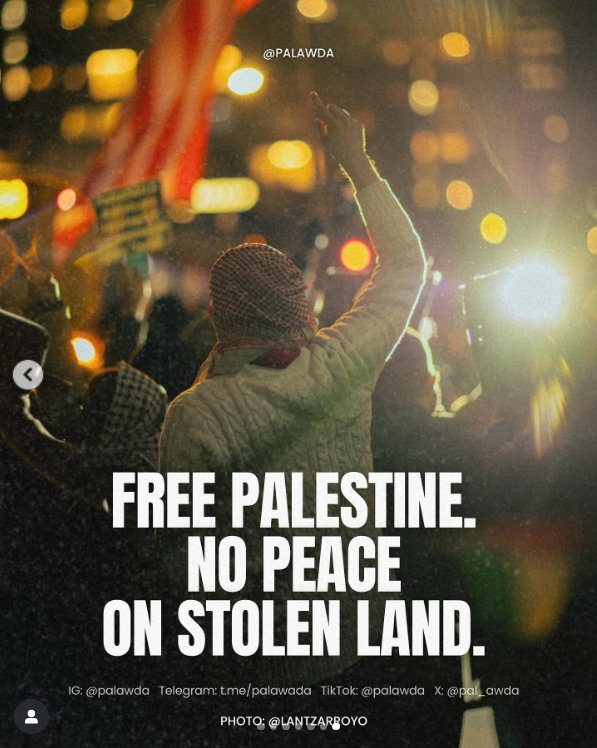
No peace on stolen land: protesting the settler recruiting fair

No peace

Nov. 19 – Last night, New York City showed up to declare “Death to the IDF” in response to the Nefesh b’Nefesh (NBN) settler recruiting fair, which seeks to recruit American settlers to illegally occupy stolen Palestinian land. As we demonstrated, IOF warplanes were firing missiles into refugee tents in the Old Quarter of Gaza City, murdering at least 40 children, women and men, wiping out several families. It was the 394th time the IOF had violated the “ceasefire.”

As intense U.S. and IOF-backed settler violence expands in the West Bank and the Zionist entity’s murder toll in Gaza increases daily, Zionists in NYC showed up to the fair with signs reading “80,000 was not enough,” and “complete the genocide.” Our demand remains clear: our neighborhoods cannot be used for the displacement, murder, and colonization of Palestinian people and land.

Wednesday’s NBN recruiting event was a material example of the ongoing colonization of Palestine. As the United Nations Security Council voted to create a U.S.-led security force whose directive is to disarm the Palestinian resistance – echoing the pattern of colonial plans that have sought to strip away Palestinian agency for decades. Past “israeli” government-affiliated organizations like the NBN continue to facilitate the ongoing Nakba in the form of murder, land theft, and dispossession that the genocidal zionist state is built on. 

Follow PAL-AWDA on Instagram.

Strugglelalucha256


Charlotte students lead mass action against Trump’s immigration raids

As federal agents swept through Charlotte, North Carolina, the first and most powerful pushback came from the students — the young people who showed what solidarity looks like in action.

On Nov. 17, more than 30,000 Charlotte-Mecklenburg students stayed home in a coordinated “sickout” to protest a federal operation targeting immigrant neighborhoods. By the end of the week, more than 56,000 students had refused to attend school, making it one of the largest student-led actions against immigration raids anywhere in the country.

Their walkout was sparked by “Charlotte’s Web,” a large, militarized operation launched by the Trump administration in mid-November. Led by Customs and Border Protection Commander Gregory Bovino, federal agents in masks and unmarked vehicles carried out warrantless traffic stops, stormed homes, and pulled drivers over at gunpoint. Nearly 400 people were arrested across Charlotte and surrounding towns in the first week alone.

The violence of the raids was unmistakable — and so was the response. Students at East Mecklenburg High School, Philip O. Berry Academy, Ballantyne Ridge High School, Northwest School of the Arts, and many others walked out with handmade signs defending their classmates and families. 

Across the city, parents, workers, and neighbors built rapid-response networks to track federal agents in real time. When CBP tried to seize day laborers outside a Home Depot, more than 100 residents showed up, surrounding the agents and forcing them to retreat. Hundreds later marched through the streets carrying signs reading “Human rights have no borders” and “No human being is illegal.”

Strugglelalucha256
https://www.struggle-la-lucha.org/2025/page/7/