Fascism is capitalism in crisis: Socialist author urges revolutionary readiness at LA book talk

Version 1.0.0

On May 3, the Struggle for Socialism Party Los Angeles branch discussed the new book, “Against fascism: reclaiming populism’s legacy for today’s class struggle, compiled by Louisiana socialist Gregory Williams. Following is the opening presentation for the class series. 

BUY NOW  |  FREE PDF

John Parker: This is a time when the attacks of fascism are so clear, so blatant. We work with a group called the Community Self-Defense Coalition, doing daily patrols. Over 60 organizations are part of it. If you see ICE, there’s a number you can call to bring the patrol out.

This work helps empower the community to fight back and chase out these ICE forces when they try to kidnap folks. You know, let folks know you’ve got to have a signed warrant before you can go in.

I was on patrol yesterday, and I guess I’m making the point about why that’s so important for this class. Often people think about the issues, and what can be done about them, and they just think, “It’s a damn shame they’re doing this to these people.” But when you see it happening to you and your neighbors, and your children — all the time so blatantly — you don’t have a choice. You’ve got to get involved. 

But to understand how to get involved, you’ve got to know what the situation is. What is it that’s causing this? What’s fundamentally creating this problem?

How can we get ahead of it? If we understand what’s going on, we can try to get ahead of it. Gregory Williams analyzed a lot of the stuff in the class struggle, from a Marxist point of view, on what’s going on now with Trump. This book is going to give us a heads up and the tools to be able to fight back. We’re so glad to have the author here today.

Gregory Williams: Thanks, John. What you said dovetails into what I’m planning to say. Thank you for having me here.

We’ve published this new book through Struggle – La Lucha, the magazine we put together through the Struggle for Socialism Party. Since this is class one, I’ll give an overview of the book, or try. It’s challenging because it’s a compilation dealing with people’s struggles in multiple periods. It’s going from the late 19th century all the way to now, or the beginning of this year, and Trump’s second term. 

But when we look at these periods, side by side, common themes emerge. And they’re things our movement needs to understand in the fight against capitalism and fascism. So even though the book goes into a lot of history, it’s really about strategizing in our current moment.

From the back cover summary:

“Fascist movements are on the rise worldwide, attacking working-class and oppressed people. The authors of this collection argue that capitalism’s inherent dynamics are the cause, as with fascism in the 20th century. Fascism is the capitalist class’s response to a system in crisis.

“They use racism and misogyny, transphobia and homophobia to try to beat back the diverse working class while amassing more wealth for themselves. But the workers beat back fascism before, and we can do it again.

“Workers have the power to eliminate the root cause of fascism by transforming society with socialist revolution, and this book is about getting us there. All the pieces in the book come from fighters in the revolutionary struggle, and most have already been published in Struggle – La Lucha.

“Topics include populism, a progressive farmer’s movement of the 1890s; the contemporary trans struggle; the Silicon Valley MAGA connection; the legacy of the Jena Six; the abortion rights movement in the South; the real motives of right-wing governors; and the fight against KKK leader David Duke.” 

Analyzing our moment

I want to talk about one of the book’s themes, and that’s the question of how we analyze a given political period in terms of the stage of the class struggle, the balance of forces, whether the period overall is more progressive or reactionary, because that affects how we organize.

I’ll focus on the David Duke section just for some examples because it offers some keys for how to read the book, and for strategizing in our political moment. 

The section consists of three pieces written by Marxist leader Sam Marcy on Duke’s 1991 gubernatorial campaign in Louisiana.

I’ll paraphrase the introduction I wrote in that section. In his “Perspectives on the Duke Campaign,” Marcy explains what was truly new about Duke’s campaign. He argued that even if the racism was the same old, same old espoused by segregationist politicians George Wallace and Lester Maddox in the Civil Rights era, Duke was more dangerous because the 1960s and ‘70s were a very different period politically from the early 1990s.

Marcy says:

“In the 1960s, when both Maddox and Wallace were trying to become national figures, their type of all-out, segregationist racism was basically defensive: They were trying to hold onto white supremacy as it had existed for a century; they were trying to retain the status quo of racism. At that time, there was an upward, progressive movement throughout the whole country. …

“In contrast to the present, it was a progressive era. …

“The Duke movement is not just a defensive attempt to halt the progress of Civil Rights. It is a wholesale offensive to undo and reverse the historic gains made by the Black and other progressive forces. 

“The Duke campaign comes in the midst of an anti-labor offensive. Gains made by the workers have been crumbling; the capitalist recession and the attacks on the living standards of the workers have brought frustration and anger. The labor movement has been forced into concession after concession.

“Strike breaking and scab herding are on the order of the day.

“The situation is ripe for a fascist demagogue to prey upon these frustrations, especially among the middle class who are losing their moorings to the bourgeoisie.”

In 2025, most of the progressive gains of the past centuries have already been reversed. We’re in a deeply reactionary period, with economic conditions rapidly deteriorating and staggering inequality being the order of the day. The situation now is truly ripe for fascist demagogues, as Marcy said of 1991.

(And speaking of the segregationists of the ‘60s, things are so bad now that the courts are overturning school district desegregation orders. It’s already happening in one Louisiana school district,  and it could be the first of many. That’s how reactionary it is. They’re overturning school desegregation, which was never fully completed anyway.)

So, that’s the introduction to the Duke section. What strikes me is how precise Marcy is in his analysis of his present moment. That was also a major feature in Vladimir Lenin’s thinking, as the leader of the Bolshevik socialist revolution, closely analyzing the historical moment, looking at many aspects of it — political, economic, cultural, etc. According to Lenin’s thinking, this kind of analysis — when developed collectively by a revolutionary party that’s based in the masses — that is what can allow the working class and the oppressed people to effectively organize, to overthrow the ruling class. And this has been tested in many revolutions beyond the USSR, especially in the Global South. 

In 1991, Sam Marcy understood that the political situation had changed drastically since the high tide of struggle in the ‘60s and ‘70s. After the economic crisis of the ‘70s, the global capitalist system was restructured in many ways. Nixon nixed the international gold standard. In the U.S., there was more automation. Factories and industrial jobs were sent overseas, always in search of cheaper labor. 

Unions were increasingly under attack when they had actually been making gains up until the mid-70s. Privatization was on the rise. Real wages declined while the cost of living rose. The working class was squeezed. The social safety net was cut. Everywhere, the capitalist class was on the offensive.

As the capital of capitalism, the U.S. is exemplary, but these things were happening in all the imperialist countries to greater and lesser degrees. But in the U.S., particularly, the military budget grew year after year, taking on an outsized role in the economy, sucking up resources from meeting human needs. And unlike during World War II, the oversized role of war spending tended to depress the economy, not to stimulate it.

(This is almost never discussed in the bourgeois media, but military spending is inflationary. It’s never discussed that the billions they’ve been giving to Israel and Ukraine and so on have been a major factor in the inflation of the past few years.) 

So, all that was just a description of what was happening in the imperialist countries themselves, especially in the U.S. But at the same time, around 1991, in much of the socialist camp, namely the USSR and Eastern Europe, imperialist-backed counterrevolutions were underway. Everything that the working class and the oppressed people had built in those countries was being dismantled and sold off to the highest bidders. Life expectancy plummeted in the formerly socialist countries. 

In the Global South, in the colonized and formerly colonized world, the imperialists installed brutal dictatorships, which were fascism 2.0. As in many Latin American countries, they destroyed unions and attacked anyone who stood in the way of squeezing the people to the max to extract profits for capitalists in the imperialist countries.

So, when Marcy analyzed Duke’s campaign in 1991, he wasn’t just thinking about what was happening in the state of Louisiana, even though there was a major crisis happening there. He was thinking about this whole context.

This was a reactionary period, characterized by reversals for people’s struggles. And although the capitalists were on the offensive everywhere, the capitalist system itself was increasingly decaying, more plagued by contradictions, as with the outsized role of the military in the U.S. economy, distorting the economy as a whole and dragging it down, all these contradictions getting worse and worse. All of this is why Marcy identified Duke as such a threat. He wasn’t just any old racist in any old time, this was a serious fascist threat.

In that period, Marcy thought a demagogic fascist figure shifting the blame of the capitalist crisis onto oppressed peoples was very dangerous. And all these trends are even more acute now. If we look at the writings from that time, the main takeaway for me is that things have gotten much worse. 

We know these contradictions are driving resurgent fascism. But what can we do in such a period? The most reactionary sections of the ruling class have the upper hand. Trump and Musk are tearing up any part of the capitalist government that might actually help people, while bolstering the repressive state. 

Trump’s tariff war is fueling fears of recession, and any worker knows the economy is already bad. We’re not going from a good economy to a bad economy, we’re going from bad to worse. 

People know things are bad, and they increasingly have a sense that it’s going to take people in the streets to turn things around. And the courts, Congress, and Democratic Party won’t save us.

Militarism fuels fascism

During the past month, millions of people have protested all over the U.S. On April 5, tens of thousands came out for Palestine and immigrants in Washington, D.C., marching on ICE headquarters. 

Millions also came out for the Hands Off and 50501 protests. And that is an encouraging sign that people are coming out, but we know movements controlled by the Democratic Party can’t win the fight.

(And here’s an aside for when we go into the history of the populist movement of the 1890s. A big part of the story of  how their movement was derailed is that it ultimately was taken over by the Democratic Party. I don’t know if that was the very first time that happened in the history of the country, but it was an early one, and that’s sort of been the pattern ever since. This isn’t talked about enough in the book.)

Back to the Hands Off protests. People are rightly angered by the cuts to Medicaid and Social Security, etc., but the protest organizers included “hands off NATO” in their list of demands. Comrade John Parker wrote an article about the 50501 rallies, saying:

“NATO and U.S. wars are never about democracy or freedom. They are about maintaining global dominance, fascism, poverty, and the subjugation of our international working class – starting with the Global South, Black and Brown, Palestinian, and anyone getting in the way of U.S. imperialism and its IMF and World Bank.

“We must be wary of progressives who sidestep these issues, especially those who avoid discussing Palestine, minimize police brutality, or demonize countries like Iran, Cuba, China, Venezuela, Nicaragua, the DPRK, and Russia. Of course, no state is without contradictions — but we must focus on the largest contradiction of all: the unchecked violence of U.S. imperialism.”

That violence he’s talking about is a driver of fascism, not least of all because it’s fundamentally racist. The genocide happening in Gaza is absolutely racist, just like what the Nazis did. This is one place where we as revolutionaries can intervene. We have to be the ones to expose the role of militarism because the liberal groups won’t do it.

For example, people have been protesting at Tesla dealerships, and I think that’s a good thing, and shows the right instinct that billionaires need to be hit in the pocketbook, especially with strikes, but less attention is paid to Musk’s military contracts.

 Gary Wilson, one of the editors of Struggle – La Lucha, recently wrote

“SpaceX has established near-monopoly status in orbital launch capabilities, accounting for approximately 90% of mass launched into orbit in 2024. This dominant position makes the company indispensable for military and intelligence satellite deployment.” 

SpaceX CEO Gwen Shotwell recently claimed that the company has $22 billion in government contracts altogether. I don’t know if that’s the real total because some of these things are classified.

The book talks a good bit about Silicon Valley and how these tech capitalists are funding and promoting fascism, just like industrialists and bankers who bankrolled Hitler. And I’d like people reading the book to think about how Silicon Valley is fundamentally integrated into the military-industrial complex and fuels this kind of politics, and think about how tech is integrated into surveillance, policing, deportation, imprisonment.

A big part of what Trump’s doing right now is about militarism. He’s making an unprecedented increase in the military budget — $1 trillion. 

This is the working class’s money, and he wants to give even more of it to people like Musk. And that’s part of the whole tariff thing because tariffs are a regressive tax on working-class people, while he’s cutting taxes for billionaires.

Anti-racist class unity needed

Another major theme in the book is class unity, class-conscious unity against racism, as Comrade Lallan Schoenstein put it in the interview she did for the Jena Six section. But it’s also class unity against the attacks on trans people and immigrants. 

Take the sections on populism in this book. The book argues that Trump and Vance aren’t populists, as the media likes to claim. They call anybody who makes any kind of appeal to the masses, they call that populism, and there’s a history of that, and there’s a reason why it’s done, but it’s not true. Populism, like I said before, was a left-wing historical movement. What Trump and Vance represent is fascism. 

When the populist movement was at its height in the 1890s, it was mainly based among farmers, who were also linked up with industrial laborers. They were coming up against big capitalist monopolies emerging in banking and industry, the Rockefellers, Standard Oil, JP Morgan. They were also up against the rich planters in the South in the post-Reconstruction period. And in order to stand any kind of chance, they needed class unity across racial lines. They needed Black and white unity. 

Unfortunately, the populist movement never solved that problem, but they did make important strides, and the book goes into this a lot. They attempted alliances, which were very progressive for the day, but to a large extent, everywhere they failed it was because they didn’t have that unity. It was primarily due to the racism of white people in the movement. It wasn’t that the Black farmers wanted to have separate organizations, especially in the beginning. In a lot of cases they weren’t allowed to be in the white organizations. And to some extent, they overcame that, but ultimately it didn’t go far enough. And that’s part of the reason they failed.

Some of the lessons for us come from the fact that, like our movement, the period in which the populists were operating was overall reactionary. It was during the rise of Jim Crow, which was the result of the counterrevolution against Reconstruction.

Reconstruction had been one of the most progressive eras in the country. One of the only times that there was a real specter of democracy. Both Black people and poor white farmers in the South made strides during the Reconstruction period after chattel slavery was ended. Reconstruction consolidated political and economic gains stemming from the heroic defeat of slavery.

But after Reconstruction was defeated, much of that process was reversed. I argue that the Klan terrorism of this period was fascist in character. Fascism didn’t just originate in Europe. U.S. racism in that period — not to mention the whole history of colonization — you can’t really understand fascism without looking at colonialism. But particularly in this post-Reconstruction period, Klan terrorism was a precursor of fascism.

So, parts of the book focus on the way rich people in the South, especially, whipped up racist hysteria using the mass media of their day. They used newspaper articles and cartoons, similar to how social media disinformation is disseminated now, often with rich funders. This is one of the patterns I talk about when comparing these periods.

Just like today, the scapegoating and bigotry are all about keeping the people disunited so they can’t fight our real enemies, the rich. And this picture of a Klan rally [in PowerPoint] isn’t from the 19th Century. It’s from the 20s in New York, but I thought that was a really good one because you see exactly where the “America first” slogan came from. You could put this right into 2025, “one God, one country, one flag” — it’s all the same stuff.

Klan
A Klan march in Binghampton, New York, in the 1920s.


Organize and study for upsurges ahead

Finally, I want to say that a book like this can’t tell us what we should do in our moment. It can’t give us a blueprint. Even with the writings of great revolutionary figures, we don’t get a blueprint. That has to be figured out through the movement itself. But the book does try to document some flashpoints of current struggles. 

When I was going back and editing, it was interesting to see these snapshots of our recent past — of demonstrations we’ve done, marches we’ve been at, because, often with the social media news cycles, as soon as things happen, they’re sort of forgotten. And everything is just so ahistorical. Even the recent past. This was on display after Oct. 7. They started every news segment with “the war started by Hamas on Oct. 7,” without mentioning the history of colonization. Everything is given without a context.

I hope the book can help spark political discussion, both about history and present-day strategy. Right now, they’re trying to erase history in every conceivable way. In general, if we can have more collective study in the movement, that would be good. These kinds of discussion groups are important. It’s a way for us to build our collective consciousness. That’s essential for us to win against the fascist enemy.

It’s especially exciting to talk about the book with you all, because the Harriet Tubman Center is part of the Los Angeles Community Self-Defense Coalition, as John already said, along with 60 other organizations, initiated by Unión del Barrio. With community patrols, they’re making it harder for ICE to operate. They’re actually obstructing these fascist attacks at the street level where it’s happening. This is the kind of organizing that really strikes at the fascists.

And there’s a section in the book that talks about something that happened back in February, when the residents of historically Black Lincoln Heights, Ohio, drove out neo-Nazis who were having a rally there. Then they formed armed community patrols to protect their community throughout the neighborhoods. This is another example of the type of practical work, and we need to combine our collective study with that type of practical work, like what you all are already doing. And if we do that, we’ll be able to ride the waves that are coming.

Another theme from the book is that we don’t know exactly when there’s going to be a people’s upsurge. (This comes out in the interview with Larry Hales, talking about the Jena  Six). But we know it’s coming, we know that it has to come as conditions get worse. Something’s going to spark it off.

We don’t know when the exact moment will be or how it’s going to happen, but when we’re studying, when we’re building the community infrastructure ahead of time, then we can actually take that on. And I hope that the work ya’ll are doing gains more visibility. It’s really a great example for people throughout the movement to learn from. I wish it were in the book.

Strugglelalucha256


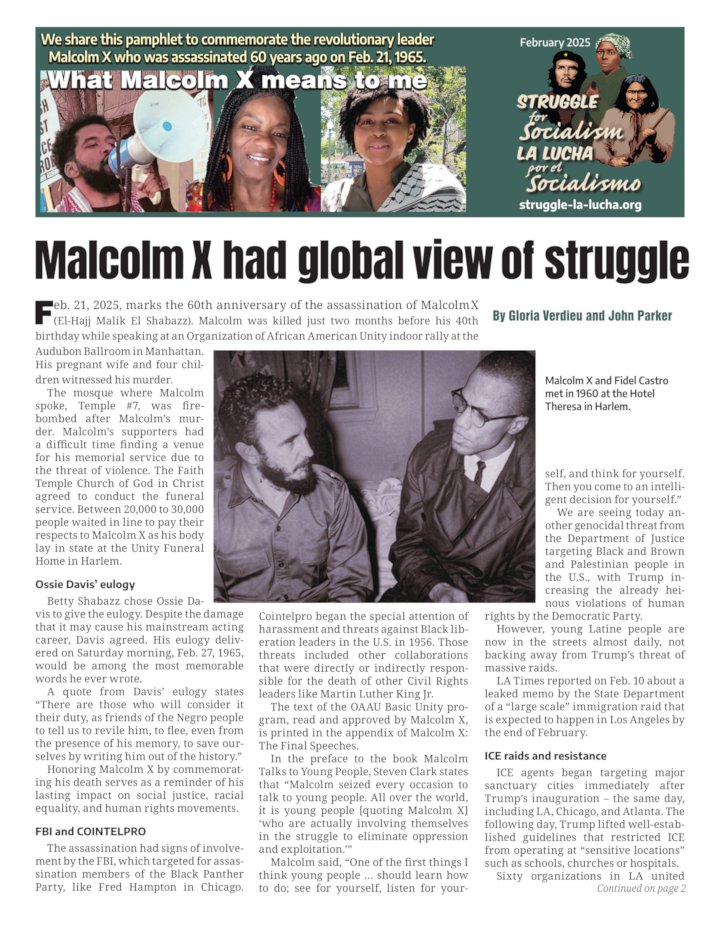
Malcolm X 2025

FREE PDF

Strugglelalucha256


Cuban days against homophobia and transphobia have begun

5 7img 20220510 185623 800x445 1

The National Center for Sex Education (CENESEX) launched the 18th edition of the Cuban Days Against Homophobia and Transphobia on Monday. Under the slogan “Love is the law,” the event will run until May 18 in the largest of the Antilles.

During the inauguration of the initiative, CENESEX director Dr. Mariela Castro Espín commented that Cuban LGBTIQ+ activism cannot be disconnected or alienated from the current circumstances of the world, which is why these conferences are dedicated to anti-fascist and anti-imperialist struggles.

She referred to the setbacks occurring in several countries with regard to the rights of women and the LGBTIQ+ community.

“We are living in times of uncertainty very similar to those years when Nazism and fascism were established in Europe. Before, it was only in Europe, and now it is globalized,” she said.

He therefore emphasized that this is the time to highlight the daily struggles related to the defense of rights reflected in national laws, such as the Constitution and the Family Code.

Castro Espín recalled that the slogan of this campaign not only refers to the affection between the LGBTIQ+ movement, but also between all families, and called for the creation of spaces for dialogue to better appropriate knowledge.

What to expect in the coming days?

With this initiative, CENESEX and other state institutions and civil society organizations will carry out academic, educational, community, communication, and artistic activities in all provinces.

These activities include the Cuban Gala Against Homophobia, which will take place on the 8th at the National Theater of Cuba; a Cuban Conga on the 10th; a Community Fair for Family Well-being on the 15th; a lecture by Dr. Mariela Castro on the 16th at the University of Medical Sciences in Holguín; and a Diversity Party on May 17.

The main venues for the event will be Havana and Holguín, with both in-person and virtual activities.

The latter province, with only 53.58% of the total votes cast (539,851) in favor of the approval of the Family Code, was the territory with the lowest levels of acceptance, which is why the organizers consider it necessary to deepen educational work on the effective exercise of the rights of all people.

The celebration of Love is Law does not ignore persistent challenges in Cuban society, such as disagreements over adoption and marriage rights for homosexuals, the treatment of these people in the media, and difficulties in socialization within the family.

For this reason, these conferences will emphasize the right to sexual equality, emotional sexual expression, free sexual association, and free and responsible reproductive decision-making, among others.

They also aim to reflect on family plurality, highlight different forms of discrimination and violence, facilitate scientific and activist exchanges, and raise awareness on issues of political communication and LGBTIQ+ activism.

Source: Cuba en Resumen

Strugglelalucha256


Comienzan las Jornadas Cubanas contra la Homofobia y la Transfobia

5 7img 20220510 185623 800x445 1

El Centro Nacional de Educación Sexual (CENESEX) lanzó este lunes la edición 18 de las Jornadas Cubanas contra la Homofobia y la Transfobia que, bajo el lema El amor es ley, se extenderán hasta el 18 de mayo próximo en la mayor de las Antillas.

Durante la inauguración de la iniciativa, la directora del CENESEX, Dra. Mariela Castro Espín, comentó que el activismo LGBTIQ+ cubano no puede estar desconectado ni ajeno de las actuales circunstancias del mundo, por ello, estas jornadas se dedican a las luchas antifascistas y antiimperialistas.

Se refirió al retroceso que ocurre en varios países con respecto a los derechos de las mujeres y de la comunidad LGBTIQ+.

“Vivimos momentos de incertidumbre muy parecidos a aquellos años en que se estableció el nazifascismo en Europa. Antes fue solo en Europa y ahora está globalizado”, aseguró.

Por ello, enfatizó que este es el momento para visibilizar las luchas cotidianas relacionadas con la defensa de derechos reflejada en las leyes nacionales, como la Constitución y el Código de las Familias.
Castro Espín recordó que el lema de esta campaña no solo alude al afecto entre el movimiento LGBTIQ+, sino entre todas las familias, y llamó a generar espacios de diálogos para apropiarse mejor de los conocimientos.

¿Qué esperar en los próximos días?

Con esta iniciativa, el CENESEX y otras instituciones estatales y organizaciones de la sociedad civil realizarán en todas las provincias actividades académicas, educativas, comunitarias, comunicacionales y artísticas.

Entre esas acciones destacan la Gala Cubana contra la Homofobia, que tendrá lugar el día 8 en el Teatro Nacional de Cuba, una Conga Cubana el día 10, una Feria Comunitaria por el Bienestar de la Familia el día 15, una conferencia de la Dra. Mariela Castro el día 16 en la Universidad de Ciencias Médicas de Holguín, y una Fiesta de la Diversidad el 17 de mayo.

Las sedes principales del evento serán La Habana y Holguín, con actividades presenciales y virtuales.

Esta última provincia, con solo un 53.58% del total de votos emitidos (539 851) a favor de la aprobación del Código de las Familias, fue el territorio con más bajos niveles de aceptación, por lo cual los organizadores consideran necesario profundizar el trabajo educativo sobre el ejercicio efectivo de los derechos de todas las personas.

La celebración de que El amor es ley no desconoce desafíos persistentes en la sociedad cubana, como los desacuerdos sobre los derechos de adopción y matrimonio para los homosexuales, el tratamiento de estas personas en los medios de comunicación y las dificultades de socialización en los ámbitos familiares.

Por ello, estas jornadas harán énfasis en el derecho a la equidad sexual, a la expresión sexual emocional, a la libre asociación sexual, a la toma de decisiones reproductivas libres y responsables, entre otros.
También se proponen reflexionar sobre la pluralidad familiar, visibilizar los distintos modos de discriminación y violencia, facilitar intercambios científicos y de activismo, así como sensibilizar en temas de comunicación política al activismo LGBTIQ+.

Strugglelalucha256


Yemen stands firm: U.S. bombing campaign halted

U.S. President Donald Trump announced on May 6 the abrupt end to “Operation Rough Rider,” a relentless bombing campaign targeting Yemen in retaliation for its principled solidarity with Palestine. The announcement came after months of fierce Yemeni resistance, which saw U.S. and British forces squander billions on failed military aggression while Ansar Allah inflicted significant losses on their advanced weaponry.

Trump’s capitulation, framed as a “gesture of peace,” followed secret talks mediated by Oman. Yet Ansar Allah leaders swiftly clarified that their resistance would persist until Zionist genocide in Gaza ends. Mohammed Nasser Al-Bukhaiti, a senior Ansar Allah official, affirmed: “Our operations in support of Gaza will continue until the blockade is lifted. If the U.S. halts its attacks, we will reciprocate. But solidarity with Palestine is non-negotiable.”

Imperialist escalation meets Yemeni defiance

The Biden administration’s earlier bombing campaign, totaling 931 strikes, was less intense than Trump’s assault, which involved more than a thousand strikes within just a few months. This escalation, joined by British forces in April, aimed to crush Yemen’s blockade of Israeli-linked ships in the Red Sea — a blockade enacted in response to Israel’s starvation of Gaza.

Yet Yemen’s resolve proved unshakable. Ansar Allah downed seven U.S. Reaper drones (worth $200 million). At least three $60 million fighter jets have been lost by the USS Harry Truman aircraft carrier since December. On April 30, Ansar Allah military spokesperson Yahya Sarea said in a televised statement on Yemen’s al-Masirah TV channel that the attack in the Red Sea resulted in the “downing of an F-18 fighter jet into the sea” and forced the Truman to “retreat toward the Suez Canal.”

Also on May 6, the same day as Trump’s announced end to the bombing campaign, Yemen’s Humanitarian Operations Coordination Center warned airlines worldwide to avoid Israeli airports. On May 4, the Yemeni Armed Forces, the military wing of Ansar Allah, launched a Palestine-2 hypersonic missile that traveled more than 1,250 miles before striking the entrance of Ben Gurion airport. The missile bypassed multiple layers of Israeli and U.S. air defenses, including the Arrow 2, Arrow 3, and THAAD systems. 

Yemen is one of only five countries – Russia, China, Iran and North Korea being the others – to have working hypersonic missiles. These missiles travel at around 10 times the speed of sound on their re-entry phase and can maneuver away from air defense missiles, which is why the missile attack on Ben Gurion got through. The United States does not currently have any operational hypersonic weapons in its arsenal and has been unable to develop a viable hypersonic system.

War crimes expose U.S. barbarity

Blatant war crimes have marked the U.S.-British bombardment:

  • April 28: A migrant detention center in Saada was obliterated, slaughtering 68 African refugees.
  • April 21: A Sana’a market strike killed 12 civilians.
  • April 17: The Ras Isa oil terminal was bombed twice, killing over 70 and crippling Yemen’s fuel infrastructure.

These atrocities, condemned under international law as collective punishment, underscore the brutality of imperialist warfare.

Yemen’s historic anti-imperialist legacy

Yemen’s resistance is rooted in a century of struggle. From expelling British colonizers in 1967 to opposing the 1991 U.S. Gulf War, Yemen has consistently defied imperial dictates. Today, their solidarity with Palestine echoes this legacy, exposing the fragility of U.S. hegemony.

Strugglelalucha256


Cuba brings hope to Alzheimer’s patients and their families

Dr. Lauren Collins reports on the positive results coming from new drugs that the world hears little about because they are developed in Cuba. 

With aging populations increasingly common around the world, degenerative brain disease is on the increase. Alzheimer’s disease, the most common form of dementia, has a devastating impact on the lives of patients and their families. 

Worldwide, the number of people with dementia is expected to reach 82 million in 2030, rising to 152 million in 2050, with most cases among people in low- and middle-income countries.

Currently, there is no universally accessible, adequate, or globally accepted treatment to inhibit its progression, which makes it one of the biggest public health challenges of the 21st century. 

Cuba, which has its own rapidly aging population, has given high priority to research associated with degenerative brain diseases, specifically Alzheimer’s. Such research is possible thanks to the commitment to and investment in health and education from the start of the Revolution. Prevented from accessing U.S. drugs, it was imperative that Cuba produce homegrown treatments, and this remains the case today. 

However, the manufacturing of new drugs is a long and expensive process. First, there is the painstaking research and development of a new candidate drug, followed by pre-clinical trials to establish safety and efficacy. Only then can human trials begin, carried out in three phases over a number of years. Cuba faces challenges at every step of this process as a result of the U.S. blockade. 

In 1981, Cuba established the Biological Front to develop its biotechnology industry. Since the establishment of the Centre for Genetic Engineering and Biotechnology (CIGB) in 1986, the sector has grown. Today, it comprises 34 institutions and 200 engineers and scientists, which make up the biotechnology and pharmaceutical sectors known collectively as BioCubaFarma. 

Neuralc drug

Two research and development institutions under this umbrella have candidate drugs for treating Alzheimer’s disease: the Cuban Centre for Neurosciences CNEURO and the Centre of Molecular Immunology (CIM). CNEURO-201 is a molecule developed by CNEURO that targets multiple neural pathways altered during the course of Alzheimer’s disease. 

Currently, this drug is at the pre-clinical trials stage, where tests indicate that the drug potentially halts, or at least significantly delays, the progress of the disease when used by patients in the early stages. CTM has developed NeuroEPO, which works by stimulating red blood cells in the brain and is at a more advanced stage of development. 

Just as with the vaccines Cuban research institutions developed for COVID-19, CNEURO and CIM are not in competition with each other. In fact, they often collaborate on research projects, but they approach problems from a different scientific standpoint: CNEURO focuses on neurological conditions, and CIM on illnesses arising from immunological problems. These different approaches lead to different types of medication, potentially increasing the chance of success. 

NeuroEPO was first developed to treat several brain diseases, such as Parkinson’s, strokes, and ataxia. However, ClM scientist Dr. Teresita Rodríguez Obaya realised that it might help Alzheimer’s sufferers, and she was proved correct after using it to treat her own mother and noticed an improvement in her symptoms. This led to clinical trials in Alzheimer’s patients. 

The drug is a form of the naturally produced erythropoietin protein (EPO), which stops neuron cells from dying, promoting their growth and communication mechanisms. During Phase 2 clinical trials, NeuroEPO was shown to improve cognitive decline in patients with mild to moderate disease, and it is now undergoing Phase 3 clinical trials. 

This story is the subject of a forthcoming documentary by Belly of the Beast, the media collective of Cuban and U.S.-based journalists and filmmakers whose work has highlighted the impact of the blockade, Cuba’s medical internationalism, and the stories rarely told by the mainstream media, especially in the U.S. 

Teresita’s Dream: Cuba’s Battle against Alzheimer’s features Dr. Obaya, who has worked in Cuba’s biotechnology sector since its inception in the 1980s, was a founder of CIM, and now heads the team working on NueroEPO. The documentary explains how U.S. sanctions hinder research and development and prevent Cuban treatments from reaching the rest of the world. 

Margarita, one of the patients who took part in the Phase 2 clinical trials, is interviewed with her husband and daughter about her progress.

Although the film has not yet been released, I was lucky enough to see a preview screening in February in Havana. The distress that this terrible disease causes both patients and their families is captured through Teresita’s memories of her own mother and the joy and relief of Margarita and her family that hope is on the horizon. The visible enthusiasm of clinical staff involved in the trials points to the significance of NeuroEPO. The cinematography accurately renders the details of everyday life in Cuba, and the musical score responds to the viewer’s emotions as they watch: a blend of poignancy and of pride in what has been achieved under such difficult conditions. 

Source: CubaSi Spring 2025 

Strugglelalucha256


Cuba: International solidarity conference follows up massive march of the people

Havana, May 3 — In a strong display of defiance and solidarity, over 5 million people marched in the cities of revolutionary Cuba this May 1. Through these impressive marches the Cuban people combated against the designs of the US to crush Cuba for its insistence that it will not succumb to imperialism or go back to the neo colonial status it had prior to 1959. Just when the tightening of the more than 60 year old blockade of Cuba seems like it could not be any more draconian something else is piled on, but now, more than ever the US finds itself isolated as the Cuban people stand strong and solidarity with them grows.

International Meeting of Solidarity with Cuba, Anti-Imperialism and against the Resurgence of Fascism

The following day the theme of solidarity continued at the same high level at the International Meeting of Solidarity with Cuba that took place at the Palace of the Conventions with over 969 people, representing 269 organizations from 39 countries.

The dialogue was led by the first secretary of the Central Committee of the Communist Party and president of the Republic, Miguel Díaz-Canel Bermúdez; the member of the Political Bureau and secretary of organization of the Central Committee of the Party, Roberto Morales Ojeda; the minister of Foreign Affairs, Bruno Rodríguez Parrilla; the secretary general of the CTC, Ulises Guilarte de Nacimiento; and the president of ICAP, Fernando González Llort.

The meeting was dedicated to the legacy of Commander-in-Chief Fidel Castro, on the 25th anniversary of the concept of Revolution, the 65th anniversary of the Cuban Institute of Friendship with the Peoples (ICAP), and the 22nd Congress of the Cuban Workers’ Central (CTC).

President Miguel Díaz-Canel Bermúdez emphasized in his talk that solidarity is not just a word but an essential component against the increased aggression of the Trump administration.

“Thank you for being the voice of Cuba in the world. This meeting shows that, before the empire, the answer is more solidarity, a solidarity that symbolizes resistance to neocolonialism and support for the self-determination of peoples; a solidarity that becomes a weapon of struggle, that transcends borders and that we assume, as Fidel said, as an ethical duty in the fight against neocolonialism,” he stressed.

The inhumane policy of the United States against Cuba

Carlos Fernández de Cossío, director general for the United States at the Ministry of Foreign Affairs, spoke about the damage caused to Cuba by US policy.

“Our country is going through times of great adversity, reflected in the material and economic conditions of our people. This is a scenario planned by the US government to try to make life as difficult as possible for Cubans,” he said.

He recalled the words of the popular leader of that country, Malcolm X, when he warned that nothing teaches more than adversity.

“The people of Cuba are not discouraged by the current circumstances. They take on challenges and develop their creativity, the fruit of the teachings of the Revolution,” he said.

The sentiment in the northern country, according to the diplomat, is that the largest of the Antilles belongs to them and they have the right to dictate the course of the nation, which explains the incessant dispute since Cuba achieved true independence and began to exercise its right to self-determination.

This prohibits the importation of products originating in the United States and the use of the most important international payment systems. Most Americans are denied the right to travel to Cuba, and threats are made against investors who bet on the national market.

Regarding Cuba’s inclusion on the list of state sponsors of terrorism, Fernández de Cossío said that it has had serious repercussions for tourism on the island and is exacerbating its economic situation.

Solidarity: the Bridge that unites the oppressed of all latitudes

The Hero of the Republic and ICAP President, Fernando González Llort, referred in his speech to the need to promote cooperation and the right of peoples to self-determination.

“The response to neo liberal capitalism must be unity and internationalism. We have a duty to forge alliances against the common enemy: the great elites who control the world,” he said.

“If capital and imperial ambitions are transnational in nature, solidarity among peoples must also transcend borders,” he said.

According to González Llort, the rise to power of figures such as Donald Trump is a reflection of a world in crisis and of a 21st-century fascism that seeks technological advances to control and alienate the working class.

For the ICAP president, the promotion of dignified peace in defense of sovereignty is key in the battle against imperialism. But it must be a peace that contemplates the full dignity of people based on social justice.

“That is why Cuba stands with Palestine against the Zionist regime that for more than 75 years has murdered, kidnapped, abused, and besieged its people. We stand with Puerto Rico in its struggle for independence, we support the cause of the Sahrawi people, we support the legitimate rights of indigenous communities, and we endorse the declaration of Latin America and the Caribbean as a zone of peace.”

González Llort conveyed the opposition of the largest of the Antilles to NATO interference, as well as its desire for a world free of nuclear weapons.

“While the military-industrial complex of the great powers manufactures wars for its own benefit, Cuban medical collaboration, which has helped more than five million people around the world, is denigrated,” he said.

He criticized the way in which hegemony is established through cultural colonization, which makes what is foreign seem desirable and what is one’s own seem inferior. In this scenario, resistance means creating art, schools, and popular communication.

“Unity and solidarity play a decisive role. The latter, not as charity, but as a revolutionary and humanist bulwark. It is the bridge that unites the oppressed of all latitudes,” he said.

For González Llort, peoples who do not defend their sovereignty are condemned to be appendages of the empire.

Medals of Friendship

Near the end of the event the Cuban President,awarded Medals of  Friendship to 2 long time Cuba  solidarity activists  Cheryl LaBash, co-chair of the National Network of Solidarity with Cuba in the United States, and André Chassaigne, former deputy and president of the France-Cuba Friendship Group of the French National Assembly.

As is the usual case the event went out with a performance of love and solidarity from the Cuban National Children’s Theater; La Colmenita.

Source: Resumen Latinoamericano – English with contributions from Cubadebate

Strugglelalucha256


Honoring Mumia Abu-Jamal on his 71st birthday

Know this: throughout it all. I have never felt alone. To the eye, I was alone in solitary confinement, on death row, but the eye cannot really see all that is, for behind brick and steel, I felt your love, sometimes like a wave, sometimes like a whisper, but always there, ever present.” – Mumia Abu-Jamal, Prison Radio

On April 24, 2025, the International Mobilization for Mumia organized events in various cities worldwide to honor Long Distance Revolutionary Mumia Abu-Jamal on his 71st birthday.

Mobilizing for Mumia held an online seminar entitled “Laws, Mumia, Universities, and Palestine.”

Mumia joined the panel of student activists and community organizers on the online seminar over the phone from prison. He spoke about the “waves of repression” in the world today. He referenced the brave and courageous students who stood against the slaughter in Palestine. Authorities arrested thousands of students and activists for political protests. Mumia experienced a temporary interruption due to technical difficulties while discussing laws that adhere to the First Amendment of the U.S. Constitution. 

When he returned, he spoke with a strong, enthusiastic voice: “The only thing that can meet that kind of force is a counter force. … ‘waves of resistance.’… Any people who can ignore the Constitution for over one hundred years when it comes to Africans are capable of anything. … Where there is repression, there must be resistance.” (Listen to the online seminar on YouTube, Twisted Laws: Mumia, Universities & Palestine.)

Mumia was referring to the thousands of students at more than 130 colleges and universities across the U.S. rallying in opposition to the war in Gaza with protests and encampments. More than 2,000 students were held in custody.

Who is Mumia Abu-Jamal?

Internationally known U.S. political prisoner Abu-Jamal is an award-winning journalist and author of 12 books and thousands of written essays, as well as audio commentaries from prison. His writings are detailed, factual examinations of racism and political bias in the U.S. judicial system. 

His pursuit of justice and resolve has remained steadfast, even after decades of incarceration. He is one of our most courageous revolutionary intellectuals, who says what is on his mind without fear of consequences. The book “Live from Death Row,” authored by him, has been translated into seven languages.

It is clear to the movement that he remains in prison for telling the truth about capitalism, imperialism, the prison-industrial complex, and the entire U.S. criminal justice system.

Mumia Abu-Jamal, sentenced to death in 1982, was on Pennsylvania’s death row for 30 years. The state signed his death warrant twice. He came dangerously close to execution on Aug. 17, 1995, and again on Dec. 2, 1999. It was the mobilization of a mass international movement that saved his life.

In 2011, his sentence was commuted to life imprisonment without the possibility of parole.

Mumia long had a target on his back. At 15 years old, he became a member of the Black Panther Party. The FBI started a file on the revolutionary teenager. Super racist Mayor Frank Rizzo threatened him at a news conference.

The U.S. government claims there are no political prisoners in the United States. When, in fact, political prisoners make up the majority of the over 2 million people locked up in prisons, jails and ICE detention centers throughout the U.S., because prisons are concentration camps for the poor.

Noel Hanrahan, a lawyer who works on Mumia’s medical cases and visits three to four times a month, gave an update on April 25, 2025:

“Mumia has exhausted his direct appeals before the Pennsylvania Supreme Court. … We all need to understand that he has been in prison now four decades and has never received a fair trial. It’s up to us, those around the world, those in the United States, those in Philadelphia, to create the context, to create the power, to build the grass roots momentum that will force our courts to address his long standing issues, including evidence of innocence, including evidence of police and prosecutorial misconduct. It is those actions that we take that will build the context.”

Noel Hanrahan’s full statement is transcribed on Prison Radio (Noelle Hanrahan, Esq. Statement for Mexico City Event – Prison Radio).

Mumia is a victim of racist police, judicial, and prosecutorial misconduct. The International & National Mobilization for Mumia and All Political Prisoners is demanding Justice.

Release Mumia! Free all political prisoners!

Send revolutionary greetings to Mumia

Smart Communications / PA DOC Abu-Jamal, Mumia #AM 8335 SCI-Mahanoy, P.O. Box 33028 St. Petersburg, FL 33733 United States

Mumia is jailed in Pennsylvania, and his mail is digitized in Florida. The prison prints the scanned image and delivers it to Mumia.

Strugglelalucha256


PFLP salutes Yemen’s strike on Ben Gurion Airport

PFLP: The precise Yemeni strike on Ben Gurion Airport is a qualitative development in the Yemeni response and an embodiment of the unity on the ground between Gaza and Sana’a.

May 4, 2025 – The Popular Front for the Liberation of Palestine (PFLP) commends and takes pride in the precise Yemeni ballistic missile strike targeting Ben Gurion Airport, and considers it a significant qualitative development in the Yemeni response to the crimes of the U.S. and Zionist enemies in Gaza and Yemen.

This qualitative operation confirms that there is no safe place for the Zionist enemy, even in its most sensitive and defensively enhanced facilities, and sends a strong message that the occupation’s security and military fortifications are now threatened and exposed.

The failure of Israeli and U.S. air defense systems, including the Arrow 3 and THAAD, against this missile exposes the fragility of the so-called Iron Dome and the missile shield, and proves Yemen’s ability to bypass the enemy’s technical and military fortifications and reach its strategic depth.

The success of the Yemeni Armed Forces in continuing to launch ballistic missiles and drones towards U.S. aggression sites and deep within the Zionist entity, despite the military escalation against them, confirms the failure of the escalating U.S. and British aggression. It has not and will not affect Yemen’s combat capabilities, nor its firm will to support our people in Gaza. Rather, this aggression only harms defenseless Yemeni civilians and exposes the criminal nature of the U.S.-Zionist alliance.

This strike, which coincided with a unique operation by the Palestinian resistance in Rafah, is a living embodiment of the unity of the field, blood, and destiny between Gaza and Sana’a, and between Palestine and Yemen, in confronting the Zionist imperialist project.

Glory to the resistance… Glory to Gaza and Yemen… We will certainly be victorious.

Popular Front for the Liberation of Palestine
Central Media Department
May 4, 2025

Translated by Melinda Butterfield

Source: PFLP

Strugglelalucha256


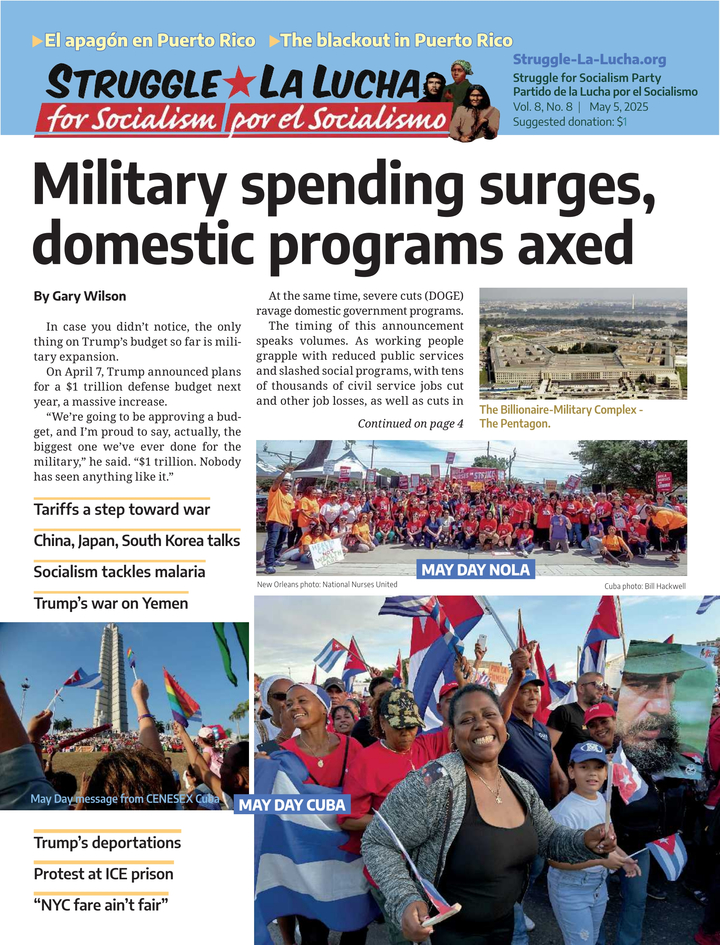
Struggle ★ La Lucha PDF – May 5, 2025

Get PDF here

  • Military spending surges, domestic programs axed
  • Nurses and immigrant workers stand together
  • May Day message from Cuba’s CENESEX
  • Cuba’s determination and resistance are on full display
  • Gestapo tactics: Trump’s deportation war not about “fighting antisemitism”
  • Free them all: protest outside ICE prison in Jena, Louisiana
  • British Supreme Court rules against trans people
  • The ‘fare ain’t fair’ in New York City
  • Tu Youyou, Ho Chi Minh, Mao Zedong and the struggle against malaria
  • China, Japan, South Korea restart economic talks amid Trump’s tariff war
  • U.S. fuels organized crime in Latin America with illegal weapons
  • Tariffs a step toward military mobilization
  • Trump escalates war against Yemen
  • The blackout in Puerto Rico
  • El apagón en Puerto Rico
Strugglelalucha256
https://www.struggle-la-lucha.org/2025/page/41/