Washington’s escalating war on Venezuela: Narco myths and imperial designs

4961198775121063381
Photo: Council on Hemispheric Affairs

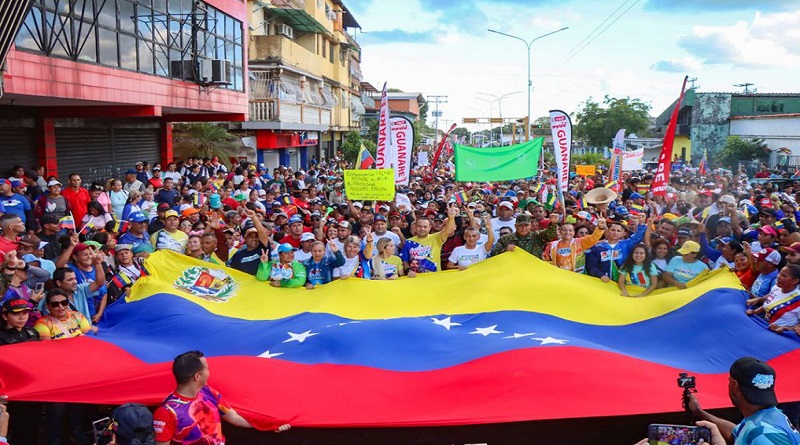
Since the election of Hugo Chávez in 1998 Washington has waged a relentless war against the Bolivarian revolution. The Trump administration continues to deploy political, economic and military measures aimed at the overthrow of Venezuela’s government and the reversal of advances in regional independence and integration: the two pillars of the Bolivarian cause. At the present juncture, it is critically important to make no mistake about Washington’s duplicitous policy towards the Maduro administration of simultaneous negotiation and intensifying aggression. This aggression is not a mere show to placate the Trump administration’s hard line anti-Chavista allies in Miami; it is an imminent threat to Venezuela’s national security and part of a strategy to recuperate U.S. domination of the Americas.

On June 12, 2024, newspapers astonishingly published Donald Trump’s incredibly candid admission: “When I left, Venezuela was ready to collapse. We would have taken all the oil.” This is why it comes as no surprise when Miami-based Venezuelan opposition journalist Carla Angola comments that Donald Trump is interested in having absolute control of Venezuela’s oil reserves. She adds that the opposition leader, Maria Corina Machado is promising the United States government absolute control of these natural resources, not because this radical sector of the Venezuelan opposition is interested in managing them, but rather in privatizing them.

Orchestrating Regime Change in Venezuela

The threat to Venezuelan security is no exaggeration. Last week Venezuelan intelligence discovered three kilograms of TNT planted in Caracas’s Plaza de la Victoria, a location of significant public importance. Officials said the bomb, which was found near gas pipelines,could have caused catastrophic destruction and an incalculable loss of life. Interior Minister Diosdado Cabello announced that a coordinated investigation with several security agencies successfully dismantled this plot, revealing a sinister connection between far-right opposition elements and their international allies.

This terrorist plot cannot be written off as an isolated incident. Washington is pulling out all the stops to prepare public opinion for new acts of aggression by portraying President Nicolas Maduro, through U.S. corporate media, as a narcotrafficker with a price on his head.

The most recent and series of  attacks against the Bolivarian Revolution began with a press release by  the U.S. Treasury Department on July 25 of this year. Titled “Treasury Sanctions Venezuelan Cartel Headed by Maduro,” the release designated the so-called “Cartel of the Suns” as a terrorist entity and named President Maduro as its head. It further pointed to his alleged relationships with both the Tren de Aragua and the Sinaloa Cartel, and accused them of being “violent narco-terrorists.” A few days later President Donald Trump directed the Pentagon to prepare options for the possible use of U.S. military force against drug cartels designated as terrorist organizations  authorizing military intervention in countries with drug trafficking. This came weeks after Secretary of State Marco Rubio publicly accused Venezuelan President Nicolás Maduro of being the head of the “Cartel of the Suns.” In a further escalation, Rubio stated that the recent designation of the “Cartel of the Suns” as a “terrorist organization” now provides a pretext for Washington to use military and intelligence tools against Maduro and his allies. 

All of these accusations sound very ominous, but there is no evidence for them. This narco-mythology is viewed by some political analysts as political cover for eventual attacks on not only Venezuela but also its regional allies like Nicaragua, Cuba, and Bolivia. For this reason Venezuelan security forces have issued strong statements of loyalty and defiance in the face of threats from the North.The Trump administration is doubling a reward to $50 million for the arrest of President Maduro, accusing him of being one of the world’s largest drug traffickers and working with cartels to flood the U.S. with fentanyl-laced cocaine. Historically, rewards of this magnitude for political leaders are rare. The first similar historical case was the reward for the apprehension of Pancho Villa after his raid on Columbus, New Mexico, on March 9, 1916. The reward for Pancho Villa was $5,000, while a smaller reward of $1,000 was offered for his lieutenants. More recently, the State Department formalized its “Rewards for Justice” program in 1984. Its first high-profile case was Manuel Noriega of Panama in 1989, accused of drug trafficking. The reward for Saddam Hussein in 2003 was $25 million.

Drug trafficking ruse for U.S. intervention

Washington demonstrates its contempt for the people of the Global South by treating their presidents as pawns, making accusations without any evidence, and imposing unilateral and illegal sanctions against those who resist imperial domination. This latest bizarre accusation should remind us of the allegations of the existence of weapons of mass destruction that served as an excuse to destroy Iraq, murder a million people, displace thousands from their homes, and deprive the nation of control over their natural resources.

The hypocrisy of the narco-mythology could not be more blatant. U.S. Secretary of State Marco Rubio has publicly supported former Colombian President Álvaro Uribe, particularly in the context of Uribe’s recent conviction for witness tampering and bribery. Rubio’s statements have drawn criticism from some who view it as interference in Colombia’s judicial system. Rubio’s defense of the former Colombian president is nonetheless troubling given that the same entity he leads designated Alvaro Uribe in 1991 as a major drug trafficker, a member of the cartel of Medellin and a personal friend of Pablo Escobar. .

Colombian President Gustavo Petro affirmed that his Venezuelan counterpart, Nicolás Maduro, has backed the fight against drug trafficking on the border and that this “support has been forceful and must continue.” Petro warned last Sunday that a military operation against Venezuela without the approval of “brother countries” would be an act of aggression against Latin America and the Caribbean.

There have also been a series of strong pronouncements from Tegucigalpa, HavanaManagua, La Paz and the Caribbean countries against this designation that seeks to stigmatize the Bolivarian Revolution. After the U.S. attorney general accused the Venezuelan president of working with the Sinaloa Cartel, Mexican President Claudia Sheinbaum responded, “Mexico has no investigation under way and no proof that Maduro is linked to the Sinaloa Cartel.”

The statements by Secretary of State Rubio and Attorney General Pamela Bondi are extremely ridiculous, especially considering that the U.S. has been engaged in a “war on drugs” in Colombia for over 50 years.  Since the 1990s, this war has resulted in over 450,000 deaths. Far from diminishing drug production, this war has seen Colombia become the world’s largest drug producer.

It is notable that the United Nations Office on Drugs and Crime (UNODC) in its most comprehensive annual report on the subject, the 2023 World Drug Report, states that Colombia, Peru, and Bolivia are the main cocaine producers. The same report identifies Australia, New Zealand, U.S., and Spain as the largest cocaine consumers worldwide. Curiously, Venezuela is not mentioned in any of these reports, neither as a producer nor as a major consumer.

At a press conference on August 9, Interior Minister Cabello reported that a foiled plot was sponsored by “narco-gangs” of the far-right Venezuelan opposition, in direct coordination with the U.S. government. The plot involved a criminal group from the Zulia region, led by Francisco Javier Linol, and a representative from Colombia’s Guajira Cartel. The authorities arrested José Daniel García, who confessed to being offered $20,000 to carry out the attack. This confession led to the capture of 13 other individuals in Venezuela and an additional suspect in Colombia.

Cabello said “This proves the ties between narco-paramilitarism, the fascist far-right, and the U.S. government… It confirms the script we’ve long warned about.” This underscores the Venezuelan government’s perspective that these are not isolated incidents but part of a larger, orchestrated plan. Two days later, in Monagas state, Cabello displayed a new, massive cache of explosives, including various types of explosives and electric detonators, found in boxes inside a warehouse.

History of U.S. attacks on the Bolivarian Revolution

These actions are paralleled by diplomatic attacks. On August 6th of this year, the Inter-American Commission on Human Rights of the Organization of American States (OAS), an organization from which Venezuela withdrew, launched a virulent attack on Venezuelan democracy. The Rapporteur on the Rights of Afro-Descendants, Gloria Monique de Mees, accused the government of a systematic violation of human rights and the imprisonment of more than 900 political prisoners. This accusation, coming a day before the foiled attack and Rubio’s militaristic rhetoric, adds another layer of coordinated pressure and raises questions about the political motivations behind such reports.

Since its inception in 1998, the Bolivarian Revolution has endured a large number of attacks. The first major blow was the 2002 coup d’état against the elected leader Hugo Chávez. This coup, which was widely celebrated by the corporate media, was ultimately reversed thanks to the massive public support that saw people take to the streets, risking their lives to defend the constitution and demand Chávez’s return to power. This was an unprecedented situation in Latin American history. The celebratory tone of the U.S. media at the time is revealing. For example, the New York Times initially welcomed his removal before being forced to retract its triumphant narrative just a day later when Chávez was reinstated. Shortly after, at the end of that year and beginning of 2003, a brutal oil strike occurred, causing losses of billions of dollars.

After President Nicolás Maduro assumed the presidency, the attacks evolved into multiple hybrid forms, including assassination attempts. One of the most audacious was a drone attack on August 4, 2018, during a live-streamed military event in Caracas. Two drones loaded with explosives were detonated near the platform where Maduro was speaking. This event set a grim precedent as the first assassination attempt using commercial drones against a head of state.

In 2019, a virtually unknown congressman named Juan Guaidó swore himself in as interim president of Venezuela with the immediate support of the U.S. and the European community. This was followed in 2020 by another attack on Venezuelan democracy through a mercenary invasion known as “Operation Gideon.”

Following the 2024 presidential elections, rioters ( comanditos ), some with firearms, took to the streets to demand foreign intervention, leading to small skirmishes in Caracas. The attacks against the Bolivarian Revolution are innumerable, and what has been truly amazing is its capacity to resist and reinvent itself in the face of every challenge.

Current threat

Despite this history of attacks, there is a belief among some supporters of the Bolivarian Revolution that relations with the U.S. are improving. They point to dialogue and the continued operation of Chevron in Venezuela as evidence of an evolving more cooperative relationship. The reality is that it is in Washington’s interest to maintain a foothold in the Venezuelan oil business.

The Trump administration, however, has so far carried out only symbolic actions at détente. Concrete actions would involve dismantling the sanctions and eliminating the bounty on the president and members of his cabinet. They are not going to eliminate them. They do not want Venezuela to stand on its own two feet. The talks underway between Washington and Caracas do not preclude an attack on the constitutional government of Venezuela..

The proximity and interconnectedness of these events—the terrorist plots in Caracas and Maturín, the alleged links to Colombian paramilitary forces and the Venezuelan far-right, and the explicit threats from the United States—serve as a grave warning.

For Venezuela and its supporters, these incidents are not coincidental; they represent a coordinated effort to destabilize the nation through a combination of domestic terrorism, international political pressure, and the looming threat of military intervention. The government’s successful dismantling of these plots has, for now, averted major disasters, but it also confirms the ongoing and complex nature of the threats facing the country.

The Bolivarian Revolution is a project of Latin American integration that represents the search for social justice; it is a project of liberation. Washington commits a huge injustice by deploying more than a thousand unilateral and coercive measures against Venezuela, as these only bring hardship and death to the nation’s most humble citizens.

It is essential to reflect on the fate of Augusto Sandino, who, after leading a 21-year guerrilla war against the U.S. military occupation of Nicaragua, successfully expelled foreign forces from his homeland. A revered revolutionary and emblem of anti-imperialist resistance, Sandino was tragically assassinated by the Somoza regime shortly after initiating a dialogue with representatives of the North American government, following a dinner at the national palace—a dinner with the enemy.

William Camacaro is a  Senior Analyst for the Council on Hemispheric Affairs (COHA). He is a co-founder of  the Venezuela solidarity network and holds a Master’s Degree of Fine Arts and a Master’s Degree in Latin American Literature from City University of New York. He has published in the Monthly Review, Counterpunch, COHA, the Afro-America Magazine, Ecology, Orinoco Tribune and other venues. He has organized delegations to Ecuador, Bolivia and Venezuela.

Source: Council on Hemispheric Affairs

Strugglelalucha256


Same-sex marriage is absolutely on the chopping block

We’ve had a decade of marriage equality—and that may be all we’re going to get.

When the Supreme Court decided Dobbs v. Jackson Women’s Health Organization in 2022, it didn’t just reverse Roe v. Wade and eliminate the constitutional right to an abortion, it opened the door for challenges to all substantive due process rights cases. These are cases that relate to the intimate areas of a person’s life: sex, birth, and marriage, mostly.

That means that Obergefell v. Hodges—the landmark case that legalized same-sex marriage in 2015—is squarely in the crosshairs. But people don’t want to believe it. And it’s making me want to walk into the mountains with no water supply.

I’ve been active on social media for almost 15 years, and for years before Roe was overturned, irate Twitter mobs would descend upon me whenever I warned that abortion rights were on the chopping block. People said I was being dramatic. That I should stop fearmongering. The Supreme Court would never take away the right to abortion, they cried. It’s been settled law for almost 50 years!

And then Dobbs came along, and the Court did exactly that.

You’d think being right about Roe would earn me some benefit of the doubt. But no.

Once again, I see people arguing that marriage equality is safe. Even some well-regarded lawyers and legal scholars have contended that there “aren’t five votes” to overturn it.

They’re wrong. The votes are there.

And when the conservatives on the Court train their sights on the other renowned substantive due process cases—Griswold v. Connecticut which legalized the right to contraception for married couples, Loving v. Virginia, which decriminalized interracial marriage, and Lawrence v. Texas, which decriminalized same-sex intimacy—it’s a pretty solid bet that the votes to overturn those cases will be there, too.

No ‘history and tradition’ of same-sex marriage

The six conservatives on the Court have signaled either that substantive due process rights don’t exist, or that they should be limited to whatever white, property-owning men thought was fine in the late 1700s.

Substantive due process rights are unenumerated rights, meaning they’re not spelled out in the Bill of Rights or elsewhere in the U.S. Constitution. For the conservatives on this Court, if a right didn’t exist when powdered wigs were in style and the founders didn’t list it in the Constitution, then it can be tossed out because it’s not “deeply rooted in the nation’s history and tradition”—and gee whiz that’s just too bad.

If the “history and tradition” language sounds familiar, that’s because it’s the same test Justice Samuel Alito used in Dobbs to overturn Roe. And it’s the same blueprint the conservatives on the Court will use to reverse Obergefell and eliminate the federal right to same-sex marriage.

In his Dobbs concurrence, Justice Clarence Thomas explicitly said that ObergefellGriswold, and Lawrence were “‘demonstrably erroneous’” and should be reconsidered. He wasn’t being coy. (Perhaps he was being coy when he omitted Loving v. Virginia, which struck down laws banning interracial marriage, from his list of substantive due process cases to axe. After all, it would make for awkward pillow talk with his wife, Ginni, who is white.)

“As I have previously explained, ‘substantive due process’ is an oxymoron that ‘lack[s] any basis in the Constitution.’”

That’s what Justice Thomas wrote in Dobbs in reference to ObergefellGriswold, and Lawrence. He was referring to the rights to same-sex marriage, contraception, and consensual sex that those cases established.

Enter Kim Davis. She’s the former county clerk from Kentucky who turned her refusal to issue marriage licenses to same-sex couples into a decade-long martyrdom tour, complete with a jail stint and endless whinging about “religious freedom.” She’s back at the Supreme Court asking the justices for a second time to overturn Obergefell v. Hodges and eliminate nationwide marriage equality.

Davis has been locked in a battle with David Ermold and David Moore—the couple to whom she notoriously refused to provide a marriage license in the days immediately following the Court’s decision in Obergefell in 2015. Five years later—after some rulings didn’t go her way—she filed a petition asking the Supreme Court to overturn Obergefell in 2020.

The Court declined, over the pointed dissent of Justices Clarence Thomas and Samuel Alito. Her case went to trial in 2023, and Davis was ultimately ordered to pay Ermold and Moore $360,000 in damages and legal fees.

She doesn’t want to pay, of course—so back to the Supreme Court she goes. Davis filed a new petition with the Supreme Court on July 24 asking the justices—for a second time—to pretty please overturn Obergefell.

I’m tempted to ignore Davis’ efforts because, frankly, the woman needs a hobby. But it’s not the halcyon days of 2015 anymore, and the current political climate is ripe for shenanigans when it comes to LGBTQ+ rights—so this petition sets off warning bells in my head.

Marriage equality is not safe

When I caution folks that Obergefell is not as untouchable as they think, I get the same tired cocktail of denial and delusion: It would be too complicated to undo. The polling is too strong. What about the Respect for Marriage Act?

Yeah, well, a majority of Americans liked abortion rights, too—about 61 percent. The Court eliminated federal abortion protections anyway.

Here’s the reality: Conservatives want to send same-sex marriage back to the states—the same way they sent abortion rights back to the states. And the way they’re going to do it is to claim that there’s no “history and tradition” of marriage equality in the United States and therefore it should be left up to “the people.”

The “history and tradition” language comes from a 1997 case called Washington v. Glucksberg.

In Glucksberg, the Supreme Court unanimously ruled that the Due Process Clause of the U.S. Constitution—which says that “No State shall … deprive any person of life, liberty, or property, without due process of law”—does not protect a right to physician-assisted suicide. Why? In an opinion penned by William Rehnquist (one of the two dissenters in Roe), the Court ruled that physician-assisted suicide was not “‘deeply rooted in this nation’s history and tradition’” or “‘implicit in the concept of ordered liberty.’”

Conservatives’ reliance on “history and tradition” language to strike down modern laws has proliferated in recent years.

In 2022, Clarence Thomas writing for the majority in New York State Rifle & Pistol Association v. Bruen invoked “history and tradition” to strike down a New York gun law that infringed on an enumerated right—the Second Amendment right to bear arms. And in 2023, right-wing Trump judge Matthew Kacsmaryk cited “history and tradition” in upholding West Texas A&M’s cancellation of a student drag show because historically, drag shows weren’t protected expressive conduct under the First Amendment.

‘Christian conservatives are coming for Obergefell

It’s no secret that Christian conservatives are coming for Obergefell.

They’ve been telegraphing it for years—through court filings, state legislation, and those not-so-subtle speeches at Federalist Society events. With the Supreme Court stacked with conservatives who are already comfortable tossing out precedent, Christian conservatives are just waiting for the right case to tee up the question of whether marriage equality should survive at all.

And with Kim Davis’ latest appeal to the Supreme Court, that case may have just landed in the justices’ laps.

Of course, they may turn Davis down again. But if there’s one thing right-wing culture warriors are, it’s persistent. It took 49 years to overturn Roe; anti-abortion advocates started campaigning against legalized abortion as soon as Roe was decided, and they never stopped. Opponents of same-sex marriage are just as fervent. If the Court won’t take Davis’ case, Christian conservatives will find a better one.

And when that case makes its way to the Supreme Court, the six Federalist Society darlings on the bench will rely on Glucksberg, the physician assisted suicide case, to take down Obergefell—just like they relied on Glucksberg to take down Roe.

Their reasoning will boil down to the same claim: There’s no “history and tradition” of same-sex marriage in this country.

They have six votes to end marriage equality

Why am I so convinced there are six Supreme Court justices willing to overturn Obergefell? Let’s start with the obvious ones.

Alito and Thomas have been blatant in their contempt for Obergefell since the day it was decided a decade ago.

In his Obergefell dissent, Alito referenced Glucksberg and complained that same-sex marriage is not “‘deeply rooted in this nation’s history and tradition.’” (Hey, Sam? The Constitution doesn’t actually mention marriage at all.)

And when the Supreme Court declined to hear Davis’ 2020 appeal, Thomas wrote in a dissent for himself—with Alito joining—that Obergefell amounted to “an alteration of the Constitution” and that the Court had “created a problem that only it can fix.”

In his Dobbs concurrence, Thomas argued that “liberty” only means freedom from physical restraint—it couldn’t possibly mean the freedom to marry a person of the same sex. He also specifically called for the Court to reconsider Obergefell, calling the ruling “demonstrably erroneous.”

Now let’s talk about Justice Neil Gorsuch. Don’t let his opinion in Bostock v. Clayton County protecting LGBTQ+ workers under Title VII of the 1964 Civil Rights Act fool you into thinking he cares about LGBTQ+ rights. Gorsuch also signed on to Alito’s Dobbs opinion, which, again, uses the “history and tradition” framework to wipe out abortion. That is the blueprint for reversing Obergefell and allowing states to criminalize same-sex marriage again.

Justice Brett Kavanaugh signed onto Dobbs, too, and made a big show of saying in his concurring opinion that the Court’s decision “properly leaves the question of abortion for the people and their elected representatives.” That is exactly the argument conservatives on the Court will use to send the issue of same-sex marriage back to “the people”—the same way they sent abortion back to “the people” with Dobbs. As of 2022, 35 states still had laws criminalizing same-sex marriage on the books, by the way.

Justice Amy Coney Barrett is a social conservative who doesn’t believe the courts should invent rights not grounded in the text or original meaning of the Constitution. She clerked for the late Justice Antonin Scalia, who dissented in Obergefell in his quintessential caustic style. And she helped vaporize Roe without hesitation. Why would she not do the same to Obergefell?

And Chief Justice John Roberts? He may not have joined Alito’s dissent in Dobbs—preferring instead to write his own separate opinion—but don’t mistake that for moderation. Roberts was all-in on dismantling abortion rights—he just wanted to do it more slowly. (And ultimately, he concurred in the Dobbs judgment that Mississippi’s 15-week ban was constitutional.)

Roberts exhibited no such restraint about same-sex marriage. In Obergefell, Roberts disagreed with the ruling so strongly that he read his dissent from the bench—a move reserved for when judges are really mad, and they want everybody to know it. The Court’s decision to legalize same-sex marriage had “nothing to do” with the Constitution, Roberts groused.

The Court doesn’t care much for public opinion

As for polling? Don’t talk to me about polling. Gallup surveys show that two-thirds of Americans support marriage equality, but that doesn’t matter. This Court is not responsive to popular opinion. If they were, they wouldn’t have overturned Roe.

And please don’t tell me the Respect for Marriage Act will save same-sex marriage.

The Respect for Marriage Act, which repealed the Defense of Marriage Act in 2022 and made it clear that the federal government and state governments must recognize marriages that were legal in the state they were performed—including same-sex and interracial marriages—is riddled with broad religious exemptions. For example, it still allows religious nonprofits to refuse to marry same-sex couples—which is why, I suspect, some of the 12 Republicans who voted yes ended up supporting the Democrat-sponsored legislation.

In any case, the Respect for Marriage Act would still allow states to refuse to issue marriage licenses for same-sex couples if Obergefell were to fall. Those states would only have to recognize same-sex marriages performed in other states. Wonderful. So queer folks in Texas could still get married post-Obergefell in California, as a treat.

Finally, some people have insisted that the Supreme Court wouldn’t dare undo marriage equality because it would cause too much political fallout. That’s the same argument people made, mistakenly, about Roe.

We know this Court doesn’t care much about backlash. It doesn’t care about democracy. It cares about enshrining a white Christian nationalist agenda into constitutional law. Just look at their recent rulings.

Marriage equality is absolutely on the chopping block. It’s not a question of if, but when a clean case challenging Obergefell gets filed.

And when that case arrives at the Supreme Court, mark my words: The conservative votes will be there. All six of them.

Source: Rewire News Group

Strugglelalucha256


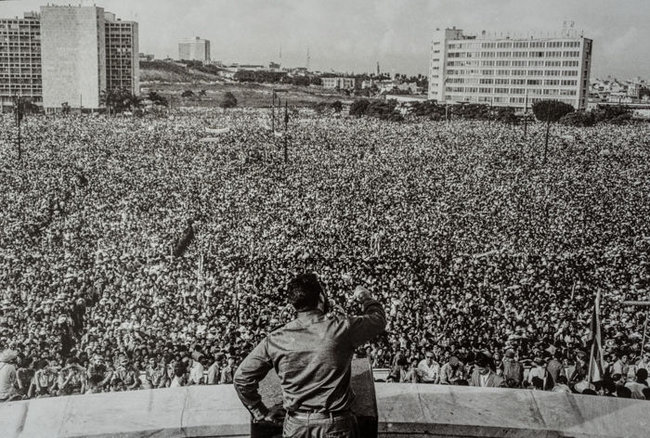
Fidel Castro’s centenary begins: A legacy for today’s troubled world

8 15 fidel

Today marks the beginning of Fidel Castro’s centenary—a hundred years since the birth of the historic leader of the Cuban Revolution. As we enter this centenary period, we do so not with statues or monuments, for Fidel himself rejected such commemorations. Instead, we honor him in the most profound way possible: by continuing the struggles to which he dedicated his life—against exploitation, imperial domination, and injustice; for socialism, peace, dignity, and the full emancipation of humanity.

His legacy is not entombed in stone, but alive in the trenches of resistance across the globe. Fidel does not require marble or bronze to be remembered. From the youth marching in defence of the planet, to communities fighting for healthcare and housing, to movements resisting settler colonialism and racial capitalism, Fidel is there – present in spirit and example. He lives in every act of courage that dares to imagine and build a world founded on human dignity.

More than a political leader, Fidel was a revolutionary in the fullest sense of the word: someone who not only dreamed of a better world but organized and mobilized the people to bring that dream into being.

With the triumph of the Cuban Revolution on January 1, 1959, Fidel and the Cuban people broke the chains of U.S. domination and opened a new chapter in the history of Latin America and the Global South. They showed that it was possible to seize control of a nation’s destiny and to place human needs above private profit.

Fidel’s leadership was always rooted in a deep ethical commitment to justice. His was a politics of principle—dignified, consistent, and unbending in the face of the most formidable enemies. Despite more than six decades of blockade, sabotage, and vilification, Cuba under Fidel remained steadfast: abolishing illiteracy, eradicating preventable disease, advancing gender equity, and offering sanctuary and solidarity to the oppressed – a revolution of principles, not privilege.

Fidel’s internationalism was never rhetorical. It was lived, practiced, and institutionalized. In southern Africa, Cuba played a crucial role the decisive defeat in Angola of the racist armed forces of the apartheid South African state, which led to the immediate independence of Namibia, accelerating the end of racist rule in South Africa.

Thus, Cuban medical brigades saving lives in Africa, Latin America, and even in wealthy nations like Italy during the COVID-19 pandemic are not anomalies—they are the natural outgrowth of the revolutionary principles Fidel instilled. From Angola to Haiti, Cuban internationalism has been a beacon of what human solidarity can look like in action.

We live in perilous times. Around the world, fascism rises, genocide is normalized and routinized, the gap between rich and poor ever deepens and widens, and the planet edges closer to ecological catastrophe. In the face of such crises, Fidel’s life and legacy illuminate a different path—one based not on accumulation and domination, but on solidarity, justice, and the flourishing of humanity.

His example calls on us not to despair but to organize, not to retreat but to resist, to struggle – to build the new world. In Fidel, we see the power of commitment fused with clarity of vision; the power of revolutionary love grounded in rigorous struggle.

Bertolt Brecht once wrote: “There are those who struggle for a day and they are good. There are those who struggle for a year and they are better. There are those who struggle many years, and they are better still. But there are those who struggle all their lives: These are the indispensable ones.”

Fidel was, and remains, one of those indispensable ones. In today’s global context Fidel’s vision is not a relic of the past but a roadmap for the future: in a world adrift, a compass.

As we commemorate the 100th anniversary of Fidel’s birth, let it not be merely a remembrance, but a renewal of commitment. Let it inspire not nostalgia, but revolutionary responsibility.

This centenary must be a time to rekindle the fires of resistance, to deepen our internationalist commitments, and to build the better world Fidel knew was possible—and necessary.

Fidel is not a figure of the past. He is a living force in the present, guiding us toward a better future yet to be won.

We declare, with conviction and clarity:

¡Fidel Presente! ¡Hoy, mañana y siempre!

¡Hasta la victoria siempre!

¡Venceremos!

Isaac Saney is a Black Studies and Cuba specialist and coordinator of the Black and African Diaspora Studies (BAFD) program at Dalhousie University in Halifax, Nova Scotia

Source: Resumen Latinoamericano – English

Strugglelalucha256


Proxy war in ruins: How U.S. and NATO led Ukraine to disaster

On Aug. 12, Russia’s Foreign Ministry reported that Foreign Minister Sergey Lavrov and U.S. Secretary of State Marco Rubio had discussed preparations for an Aug. 15 summit in Alaska between President Vladimir Putin and Donald Trump. Kremlin aide Yury Ushakov confirmed the meeting, saying the talks would center on a “long-term peaceful settlement” to the conflict, with a future round potentially taking place on Russian soil.

The tides of war in Ukraine have shifted decisively. Russia’s military is surging across eastern Ukraine, smashing through heavily fortified lines while the Ukrainian government teeters on the edge of collapse. These developments expose the inherent failure of U.S.-NATO proxy warfare.

Russia advances, Ukraine on the brink

The summer of 2025 has seen the most significant Russian military gains since the war began. In early August, Moscow’s forces captured the heavily fortified city of Chasov Yar in the Donetsk People’s Republic, after over a year of bitter fighting. This was followed by a breakthrough into the Dnipropetrovsk region, a key industrial and population hub that had been out of Russia’s reach for three years.

Russian forces, using overwhelming firepower — including over 1,300 FAB bombs in a single push — have breached Ukraine’s second Donbass defensive line. 

Even Western media are acknowledging the scale of the shift. The New York Times’ July 19 report on “Why Russia Is Gaining Ground in Ukraine,” says that Russia’s combination of troop numbers, air superiority, and artillery dominance has produced its largest monthly territorial gains since early 2025. Ukrainian brigades, some reduced to fewer than 100 soldiers covering miles of front, are crumbling under the pressure.

Political crisis in Kiev

The military collapse is being mirrored by political turmoil at home. Facing catastrophic casualties and a recruitment crisis, the Zelensky government has turned to coercive conscription — dragging men off the streets and raising the age barrier to pull in older recruits, some over 60 years old.

Protests are growing in Kiev, Odessa, Lviv, and Dnipro. Anger at corruption erupted in late July, with mass demonstrations demanding the reinstatement of anti-corruption agencies. In a surreal scene, Ukrainian lawmakers brawled in parliament before voting unanimously to restore the agencies they had recently disbanded.

The reality is stark: Zelensky’s government survives only through U.S. and NATO backing, and with that support now politically unstable in Washington and Europe, its legitimacy is rapidly eroding.

Washington’s desperation

The White House’s response has oscillated between erratic escalation and empty bravado. Instead of “peace in 24 hours” (as promised), President Trump’s administration has advanced new arms shipments, including $300 million worth of Patriot missile batteries. Not satisfied with merely fueling the bloodshed, Trump shortened his ultimatum to Putin from “50 days” to “10,” and provocatively deployed U.S. nuclear submarines off Russia’s coast.

Yet these gestures, born of imperial hubris and panic, are unlikely to reverse the battlefield realities. Russia’s advantage expands daily; Ukraine’s forces are outnumbered, outgunned, and exhausted. The only rational outcome — should Washington step back from the brink — is Russian victory and the collapse of the U.S. / NATO proxy project.

The proxy war’s failure

From the start, the Ukraine conflict was never just about Ukraine. It was a U.S.-NATO project aimed at weakening Russia and expanding imperialist control in Eastern Europe. Billions of dollars in weapons and economic aid were funneled into Kiev to advance the interests of imperialist finance capital.

Now, with the Ukrainian army collapsing and Russia on the offensive, the mask has slipped. The war has bled Ukraine white, devastated its economy, and turned its population into cannon fodder. The people of Ukraine have paid the price — while Western arms manufacturers and energy giants have reaped historic profits.

What comes next?

With Ukraine’s military near collapse and its government fracturing, the war’s trajectory is clear: Russia will prevail. The only question is whether the U.S. and NATO will recklessly escalate further, risking a global conflict, or accept that their proxy war has failed.

For now, the suffering continues — while Russia advances, Ukraine crumbles, and the U.S. scrambles for a way out.

Strugglelalucha256


Defying Trump’s cuts: L.A. LGBT Center activist shares resistance strategy in Havana

The following talk was presented on July 29 at the ICAP (Instituto Cubano de Amistad con los Pueblos / Cuban Institute of Friendship with the Peoples) House of Friendship, in Havana, Cuba, with the participation of the Venceremos Brigade and LGBTIQ+ activists from the United States, along with members of the community networks linked to Cenesex (Centro Nacional de Educación Sexual / National Center for Sex Education), among other invited individuals.

This event was the Cuban launch of the book published in the U.S. by Struggle-La Lucha, “Love is the law: Cuba’s queer rights revolution,” which is about the revolutionary Families Code that has expanded the legal rights of women, children,  seniors, LGBTQI+ people, and more.  Onyịnye Alheri is a social worker in Los Angeles and an activist with the Harriet Tubman Center for Social Justice and the L.A. LGBT Center. She went to Cuba with the book delegation. 

I’m going to try my Spanish here because we’re in Cuba and it’s important to talk the language of the people that we’re visiting, but I will also speak some moments in English. Thank you. 

Entonces, yo soy Onyịnye. Yo soy una trabajadora social en Los Angeles, California.

So I’m Onyịnye. I’m a social worker in Los Angeles, California. Like Gregory mentioned, we at the L.A. LGBT Center have been fighting all year, especially in support of trans people and gender non-conforming people. 

Entonces, como Greg nos dijo, yo estoy trabajando para el centro LGBT y hemos estado luchando en defensa de las personas trans durante todo el año.

And it’s been a huge struggle, but the L.A. LGBT Center is fortunate to be well-funded.

Ha sido una lucha difícil, pero por suerte el centro LGBT está bien financiado. 

But at the same time, due to the attacks by Donald Trump’s administration, we have lost millions of dollars in the last seven months alone. 

Aún así, debido a los ataques de la administración Trump, el centro ha perdido bastantes millones de dólares para su financiación.

But to Gregory’s point [asking how the struggle in L.A. is going], I wanted to just highlight some of the wins that we have made. Because, initially, I was going to present on all the laws that are in place to attack trans people and queer people in the U.S.

Aún así, me interesa mucho presentar las victorias que hemos tenido. Hay muchos ataques hacia la comunidad, pero es importante destacar lo que hemos ganado. 

So recently, we, the L.A. LGBT Center, sued the Trump administration along with six other organizations around the United States. And we won. 

Recientemente nuestra organización junto a otras seis organizaciones en Estados Unidos demandó a la administración de Donald Trump. Y ganamos. 

I don’t know how widely this was publicized. Definitely not by the liberal media for obvious reasons. But it’s important to say that we did this after having lost $21 million, after being attacked, after having MAGA supporters come to our homeless shelters and threaten our young trans and queer people.

No sé cómo habrá sido publicitado esto por los medios liberales, pero bueno, vencimos después de haber perdido $21 millones, después de haber sido atacados por miembros de MAGA, personas que estaban a favor de la administración de Trump, después de una larga lucha contra grupos de este tipo.

And the way that we did this is what feels most important to highlight because it’s very similar to how the Families Code was passed here in Cuba. And that was through grassroots outreach, including knocking on neighbors’ doors, flyering at different events, raising money from non-federal sources.

And that’s something that felt important for me to highlight because what stood out in this book was how democracy was truly implemented in the passing of this law. Unlike in the United States, where even on the first day of Trump’s presidency, we saw executive orders made without any input or approval from the people.

Esto es muy diferente a lo que sucede en los Estados Unidos donde la administración de Trump enseguida, en su primer día, empezó a llevar a cabo leyes ejecutivas o órdenes ejecutivas que es totalmente contrario a lo que muchas veces es lo que quiere el pueblo.

I want to close out our talk with some inspiration and just say that despite all of the federal attacks and all of the state-sanctioned violence against us, we can fight back and we can win!

Quiero cerrar nuestra charla con algo de inspiración y simplemente decir que, a pesar de todos los ataques federales y toda la violencia sancionada por el estado contra nosotros, podemos contraatacar y podemos ganar!

Strugglelalucha256


Colombia’s Petro backs Maduro, labels unapproved U.S. military ops ‘aggression’ in Latin America

Through a message posted Sunday, August 10, on social media, Colombian President Gustavo Petro reaffirmed his strong support for Venezuelan President Nicolás Maduro. This followed recent threats from the Trump administration against the Venezuelan government, which is trying to link Maduro with drug trafficking, and the discovery by Bolivarian authorities of arsenals of weapons belonging to terrorist groups linked to the extreme right.

Petro emphatically declared that “Colombia and Venezuela are the same people, the same flag, the same history.” He emphasized that “any military operation that is not approved by our sister countries is an aggression against Latin America and the Caribbean.” This came after it was leaked to the US press that US President Donald Trump had authorized the use of armed forces against Latin American nations he believed were linked to cartels.

Some analysts worry Petro’s message might imply knowledge of US destabilization plans in the making. For that reason, Venezuelan security agencies have raised alert levels, especially after The New York Times report about an alleged “covered” US anti-narcotic operation in Latin America.

[embedpress]https://x.com/petrogustavo/status/1954571651959435595[/embedpress]

Evoking the legacy of the independence war, the Colombian president made a resounding call: “‘Freedom or death,’ shouted [Simon] Bolívar, and the people rose up,” highlighting the defense of Venezuelan sovereignty and self-determination.

The Colombian head of state also shared a message of the Venezuelan president’s Presidential Honor Guard. In it, General Javier José Marcano Tabata, commander of the Presidential Honor Guard (GHP) and director general of military counterintelligence (DGCIM), declared loyalty to the government of Nicolás Maduro as the constitutional president of the nation. He affirmed that his forces are ready to defend the people of Venezuela when the president orders it.

President Petro also showed support for his Venezuelan counterpart regarding persecution by US authorities. He categorically denied accusations by US Attorney General Pam Bondi against Nicolás Maduro, in a repeat of a dirty trick that Donald Trump already attempted in 2020, during his previous term, against the Venezuelan constitutional president.

According to the Colombian president, the solution to Venezuela’s political problems should not lie in violence nor in the persecution of its leaders, but rather in open dialogue that guarantees free and peaceful elections.

Along these lines, Petro called for a multinational and coordinated fight against drug trafficking involving the governments of the US and Venezuela, but always without undermining national sovereignty.

The Colombian president publicly acknowledged the valuable support of Venezuela and President Maduro in the fight against this scourge, stating that “it has helped us decisively defeat drug trafficking along the border.”

Other Latin American leaders and governments have expressed support for the Venezuelan president. The governments of Cuba, Nicaragua, Bolivia, Honduras, and Iran also expressed their rejection of a possible US unilateral military operation, interpreting it as a form of political pressure rather than a genuine effort against organized crime.

(Telesur) with Orinoco Tribune content

Translation: Orinoco Tribune

Strugglelalucha256


The warmonger in chief

Donald Trump’s claim of stopping “six wars” since January 2025 — boasting he’s “averaging about a war a month” — is a farce meant to obscure his actual warmongering. Fact-checkers rate his sweeping declaration as “Mostly False.” 

The president’s bombastic rhetoric reached its peak during his July 28 meeting with British Prime Minister Keir Starmer in Scotland, where he theatrically announced solving his “sixth” conflict with the Cambodia-Thailand ceasefire. 

Trump cited several conflicts, including those between India and Pakistan, the Democratic Republic of the Congo and Rwanda, Serbia and Kosovo, Egypt and Ethiopia, Israel and Iran, as well as Thailand and Cambodia.

Fact-checkers note that while Trump claims to have had a hand in temporary ceasefires, there are no permanent resolutions or direct U.S. intervention in any of the cited cases. Indian officials, including External Affairs Minister S. Jaishankar, have explicitly denied any U.S. involvement in the India-Pakistan ceasefire, stating there was “no third-party intervention.”

And Trump has not ended the major U.S. wars in Gaza and Ukraine or the massive military buildup against China in the Pacific.

The farce is revealed in the reports that President Donald Trump and his supporters have coined a new nickname for him: the “peacemaker-in-chief,” saying that he deserves a Nobel Prize for this.

The U.S.-NATO proxy war expands

President Trump said he will be meeting with Russian President Vladimir Putin on Aug. 15 in Alaska. NBC News reports that Trump is considering inviting Ukraine’s Volodymyr Zelensky to Alaska. 

As background, the U.S.-NATO proxy war against Russia was triggered by the expansion of NATO surrounding Russia, with NATO’s 2008 Bucharest pledge to incorporate Ukraine and Georgia.

Following the collapse of the Soviet Union, NATO expanded to nearly every country in Eastern Europe, aiming to lock in capitalist retrenchment in the formerly socialist countries. 

The countries put under NATO include Estonia, Latvia, Lithuania, Poland, the Czech Republic, Slovakia, Hungary, Slovenia, Croatia, Albania, Romania, Bulgaria, Montenegro, and North Macedonia.

In 2008, NATO put the inclusion of Ukraine and Georgia, both bordering Russia, on the table.

The threatened expansion of NATO’s military force to Ukraine, on the border of Russia, along with NATO naval operations in the Black Sea, were direct provocations aimed at Russia. As Leon Panetta — White House Chief of Staff under Bill Clinton, CIA Director and Secretary of Defense under Barack Obama — explained, the conflict in Ukraine is a NATO “proxy war” against Russia.

Russian President Vladimir Putin’s special military operation in Ukraine was primarily motivated by NATO’s eastward expansion, a strategic concern that continues to shape Moscow’s demands for Ukrainian neutrality.

In December 2021, Putin formally demanded that NATO roll back its presence in Eastern Europe, viewing the imperialist alliance’s expansion as an existential threat. His draft treaty, presented to President Joe Biden, explicitly called for “pushing NATO away from Russia’s borders.”

The “Special Military Operation” (SMO) in 2022 was aimed at denazification (neo-Nazis governing Ukraine) and demilitarization, as well as the protection of Donbass.

The Ukraine regime was imposed in February 2014 by a U.S.-backed coup that overthrew the elected government. The far-right regime represents Western imperialist interests, local oligarchs and neo-Nazis. The residents of Ukraine’s Donetsk and Lugansk regions did not recognize the new regime. In April 2014, in the Donbass mining region, the autonomous Donetsk and Luhansk People’s Republics (DPR and LPR) were declared. 

The Kiev regime, backed by U.S. military and political advisers,  never recognized the autonomous republics and began military operations against Donetsk and Luhansk. Bombing and air raids targeted the civilian population, killing at least 15,000. Kiev massed an occupation army in the region. In February 2022, the DPR and LPR asked Russia for aid. That’s when Russia began its Special Military Operation, sending troops into DPR and LPR to secure their territorial integrity.

What Russia has demanded is the demilitarization and denazification of Ukraine and the removal of NATO. That’s nonnegotiable.

That’s not what Trump is offering. Instead, Trump is expanding NATO around Russia into Armenia and Azerbaijan.

On Aug. 8, the White House hosted Armenian Prime Minister Nikol Pashinyan and Azerbaijani President Ilham Aliyev for a U.S.-brokered agreement that will expand NATO’s presence in the strategic South Caucasus region bordering Russia.

The two countries will withdraw from the Russian-led Collective Security Treaty Organization (CSTO). And the Russian news agency TASS reports that the U.S. privately offered both Armenia and Azerbaijan a path to NATO membership.

TASS also reports that U.S. troops may deploy to Armenia, ostensibly as peacekeepers or military advisers. The White House has not confirmed these claims, but if true, it would mirror U.S. tactics in Ukraine before the 2022 Russian special military operation.

Trump fuels Gaza genocide

During his 2024 campaign, Trump promised to end the war in Gaza. On the campaign trail, Trump repeatedly expressed his intention to wrap up the conflict quickly and bring peace to the region. He notably said, “Get it over with and let’s get back to peace and stop killing people.” 

On Aug. 9, The Hill reported, President Trump gave a tacit green light for Israeli Prime Minister Benjamin Netanyahu to take over the Gaza Strip. 

Actually, this fits with Trump’s long-term proposal to take over the Gaza Strip, “level the site” (i.e., total war), and transform it into a luxurious resort destination — explicitly likening it to a potential “Riviera of the Middle East.” That’s not peace for the people of Palestine, that’s total destruction and genocide.

Zionist-occupied Palestine — “Israel” — is an apartheid settler state, more like a U.S. colony. Joe Biden famously said in 1986: “If there were not an Israel, we’d have to invent one.” 

Since its beginning, Israel has been a U.S.-funded and armed military outpost. Gen. Alexander Haig, Ronald Reagan’s Secretary of State, said in 1971 that Israel is “the largest American aircraft carrier in the world that cannot be sunk.”

Imperialist escalation against China

The United States and its NATO allies appear determined to spark another devastating conflict, this time in the Taiwan Strait. Washington is arming Taiwan’s military with advanced strike systems capable of hitting deep into the Chinese mainland, bringing most of China’s largest cities within range of U.S.-made missiles.

The Army Tactical Missile System (ATACMS- pronounced “Attack ‘ems”) is a long-range, precision-guided missile system developed by the United States. The arms deal includes 84 launch vehicles — both M270 tracked and M142 wheeled variants. The first batch of 11 launchers arrived in November 2024, with the first M142 units formally deployed this July. These weapons give the U.S. military new long-range strike capabilities, openly aimed at the People’s Republic of China. 

These mobile launchers fire compact missiles that can be deployed in large numbers, enabling the unleashing of hundreds of strikes on mainland targets. This would put major population centers such as Shanghai, Nanjing, Guangzhou, and Hong Kong directly in the crosshairs.

Washington’s ATACMS systems have already been battle-tested in Ukraine, where they have been used — with U.S. and NATO satellite and targeting support — to hit Russian air defense sites, radars, ballistic missile launchers, and even civilian infrastructure such as energy pipelines as well as Russia’s civilian population centers. 

The island of Taiwan — internationally recognized by the UN and most of the world as part of China — has been a focal point of imperialist interference for over a century. First seized by Japan, then used by the United States after 1949 as a Cold War outpost, Taiwan has long been exploited as a lever to undermine Beijing’s sovereignty. While the opposition Kuomintang acknowledges that Taiwan cannot survive without economic and political ties to the mainland, the ruling Democratic Progressive Party has aligned itself with Washington’s imperialist agenda.

Washington’s militarization of Taiwan goes beyond missiles. U.S. arms manufacturer Anduril Industries is supplying “Altius-600M” loitering munitions — AI-driven kamikaze drones — under a new deal with Taiwan’s defense ministry. Anduril’s partnerships with other Pentagon-linked tech firms, including Palantir, are accelerating the integration of advanced U.S. military technology into Taiwan’s forces. Similar AI-based systems have already been used in Ukraine.

Strugglelalucha256


New Orleans Palestine march: ‘This has become the flag of humanity itself’

New Orleans, Aug. 9 – This evening, around 200 people marched for Palestine downtown, at one point taking over Canal Street, the central vein of business and tourism.

Many were gathered for the popular Red Dress Run charity event. Most responses from the crowd were supportive, a handful of Zionist hecklers notwithstanding.

The march was organized by the Palestinian Youth Movement New Orleans and a dozen other organizations, including Party for Socialism and Liberation and Freedom Road Socialist Organization. In the opening rally, a PYM organizer said:

“The Palestinian flag has become the flag of humanity itself, the banner of all those who refuse to accept genocide as normal. That’s you!

“On Thursday, [U.S. representative for Louisiana] Troy Carter was so terrified of Palestinian voices that he shut down an entire federal building with 16 state police cars, for five hours. A 28-story building fortress, all to avoid hearing three simple words: Stop funding genocide!

“But we are here to say what they don’t want to hear. Troy Carter, John Kennedy, Mike Johnson, Steve Scalise – all these people you see in pictures right here next to us – you are guilty!

“Guilty of sending $20 billion of OUR money and weapons while Palestinians eat grass to live. You closed your office to us, but you cannot close your ears to Gaza’s screams. You cannot close your ears to history’s judgement – God’s judgement. And you cannot close the gates of justice that we’re bringing down right now!”

Strugglelalucha256


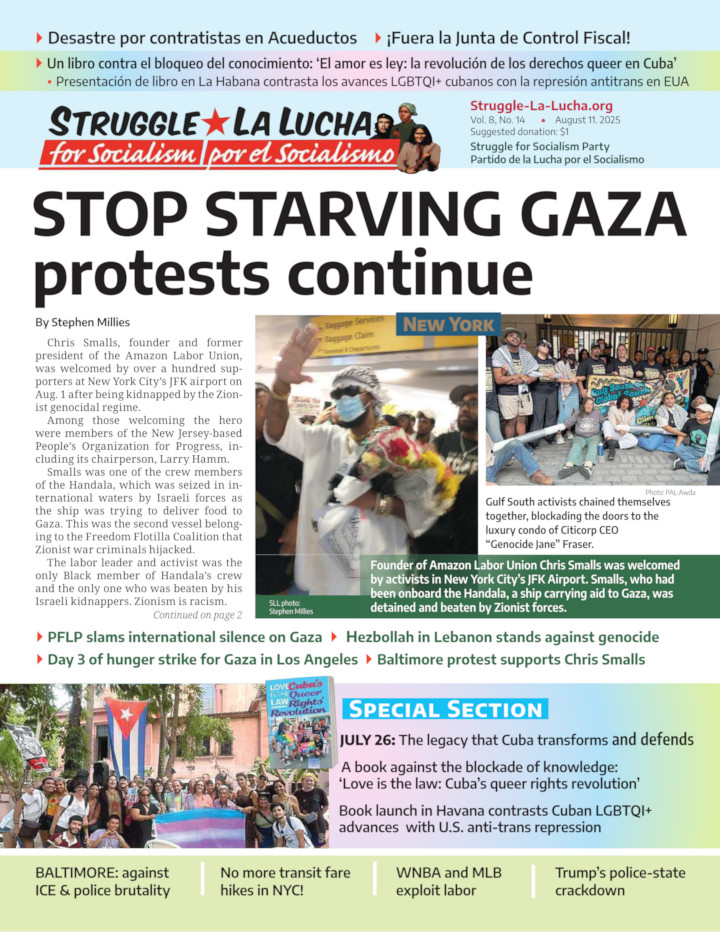
Struggle ★ La Lucha PDF – August 11, 2025

Get PDF here

  • STOP STARVING GAZA protests continue
  • Day 3 of hunger strike for Gaza in historic Placita Olvera
  • Baltimore protesters support Chris Smalls and say ‘stop starving Gaza’
  • Capitalism’s vampires: How WNBA and MLB owners exploit player labor
  • Standing together against ICE and police brutality in Baltimore
  • No more transit fare hikes in NYC!
  • July 26: The legacy that Cuba transforms & defends
  • Book on the LGBTQ+ rights revolution in Cuba is presented
  • Presentan libro sobre revolución de los derechos LGBTQ+ en Cuba
  • A book against the blockade of knowledge
  • Un libro contra el bloqueo del conocimiento
  • Book launch contrasts Cuban LGBTQI+ advances with U.S. anti-trans repression
  • Presentación de libro en La Habana contrasta los avances LGBTQI+ cubanos con la represión antitrans en EUA
  • The siege of Washington D.C.: Trump’s police state goes live
  • How can Jews stand and watch horrors of Holocaust in Palestine?
  • Hezbollah stands against genocide: Disarmament would be a disaster
  • Desastre por contratistas en Acueductos
  • ¡Fuera la Junta de Control Fiscal!
Strugglelalucha256


The siege of Washington, D.C.: Trump’s police state goes live

Aug. 8 — In an escalation of his authoritarian ambitions, President Donald Trump has ordered a massive mobilization of federal police and military personnel to patrol the streets of Washington, D.C. The move marks another step toward the consolidation of a police-state regime, with Trump openly threatening a federal takeover of the capital city and the deployment of the National Guard to suppress dissent.

Washington, D.C., is a federal territory (the District of Columbia) and is not part of any state. Under the Home Rule Act of 1973, it has an elected mayor and city council, but Congress retains ultimate authority and can (and regularly does) override local laws and budgets. Residents can vote for president, as granted by the 23rd Amendment, and are represented in the U.S. House of Representatives by a non-voting delegate. They have no representation in the U.S. Senate. Since 2000, standard D.C. license plates have carried the phrase “Taxation Without Representation.”

A show of force

Federal officers from at least 15 agencies — including the Secret Service, Homeland Security, ICE, the FBI, and the U.S. Marshals — have been deployed across Washington, supplementing the city’s 3,400 Metropolitan Police officers. At least 120 federal agents were on the streets Friday night, Aug. 8, with White House Press Secretary Karoline Leavitt warning that the operation could expand “as needed.”

But Trump is not stopping there. In a series of statements, he has threatened to take over the local government and flood the city with National Guard troops. On his far-right social media platform, Truth Social, he declared:

“If D.C. doesn’t get its act together, and quickly, we will have no choice but to take Federal control of the City, and run this City how it should be run, and put criminals on notice that they’re not going to get away with it anymore.”

At a press briefing Wednesday, Trump doubled down, stating, We have to run D.C.— adding that this might include bringing in the National Guard — maybe very quickly, too.” When asked about repealing D.C.’s limited home rule, established in 1973, he casually remarked, “The lawyers are already studying it.”

A long-planned power grab

This is not the first time Trump has sought to impose martial law in the capital. During the 2020 George Floyd protests, he pushed for military deployment, only to be blocked by Pentagon officials who feared the resistance of the troops, who were sympathetic with the Black Lives Matter protests, saying that the military should not be engaged in domestic law enforcement. 

The pretext for this latest crackdown? A single attempted carjacking in Dupont Circle involving a former staffer of the Department of Government Efficiency (DOGE), the budget-slashing task force set up by Elon Musk. Two 15-year-olds have been arrested, but Trump is using the incident to demand harsher penalties for juvenile offenders — part of a broader law-and-order narrative that ignores FBI data showing a decline in violent crime in D.C. over the past five years.

White House Deputy Chief of Staff Stephen Miller, Trump’s most openly fascistic adviser, took the fearmongering to grotesque extremes, claiming that Washington is “more violent than Baghdad, more violent than parts of Ethiopia, and parts of many of the most dangerous places in the world.” The implication was clear: The capital, like a warzone, must be pacified by force.

Militarizing the U.S.: A broader agenda

Trump’s actions in D.C. fit a disturbing pattern of normalizing military repression. Earlier this year, he deployed Marines to the U.S.-Mexico border. On Aug. 8, the New York Times reported that Trump has secretly signed an order directing the military to take action against so-called drug cartels and other criminal groups in Latin America and the Caribbean, immediately targeting the sovereign countries of Mexico, Venezuela and Haiti.

In June, 4,000 National Guard troops and a brigade of 700 Marines were deployed into Los Angeles following widespread protests of ICE Gestapo-style raids. And on his birthday, June 14, Trump staged a militarized spectacle in Washington, complete with tanks and warplanes — a not-so-subtle display of his authoritarian vision.

Meanwhile, ICE has launched sweeping raids in cities across the country including New York City, Chicago, Los Angeles, Philadelphia, Phoenix, Denver, Miami, Atlanta, Seattle, Washington, D.C., Newark, Boston, San Jose, and multiple cities in Texas such as Houston, Austin, Dallas, Fort Worth, San Antonio, and Laredo. Many seem designed to provoke clashes and justify further crackdowns. The goal? To condition the public to accept armed troops in the streets as a fact of life.

The January 6 hypocrisy

Trump’s “law and order” rhetoric is steeped in hypocrisy. The most violent episode in recent D.C. history was the Jan. 6, 2021, insurrection — incited by Trump himself. Five people died, and over 130 Capitol Police officers were injured in the assault. Yet since returning to office, Trump has pardoned the rioters while purging the Justice Department of officials who investigated the coup attempt.

The media’s silence on this history is deafening. Instead of holding Trump accountable, the political establishment treats his authoritarian threats as mere rhetoric — even as he lays the groundwork for dictatorship.

A government at war with the people

Trump’s actions reveal a regime in crisis, lashing out at a population that overwhelmingly rejects its policies. His approval ratings have cratered below 40%. ICE raids have met protests in nearly every city and even in the countryside. The June 14 “No Kings” protests saw over 10 million take to the streets in the largest one-day demonstration in U.S. history. The message has been sent, but it’ll take action to deliver it effectively.

Trump is moving fast — and if the people do not act faster, the streets of Washington may soon resemble those of an occupied city.

Strugglelalucha256
https://www.struggle-la-lucha.org/2025/08/page/4/