U.S. bets on a losing candidate to be able to claim Venezuelan elections illegitimate

Manipulated photo of Edmundo Gonzalez (left) and Maria Corina Machado during a political rally in Guarenas, Miranda state. Media experts pointed at this photo for its clear manipulation of dimensions to make a small crowd look bigger. Photo: X/@EdmundoGU.

The preparations for the upcoming Venezuelan presidential elections scheduled for July 28 are progressing as expected, with active political campaigning in the country. However, there is a sense of ominous anticipation of interference from the United States government, which has been for years stubbornly intent on destroying the Bolivarian Revolution by forcefully removing President Nicolas Maduro with total disregard for Venezuela’s sovereignty and international norms.

In fact, Diosdado Cabello, member of the National Assembly of Venezuela and vice president of the ruling United Socialist Party of Venezuela (PSUV), has already suggested that the one extreme rightwing opposition party will most likely not accept the election results if Maduro wins, and will claim electoral fraud emboldened by Washington support.

The likely losing opposition member to make such a claim is Maria Corina Machado who appears to be the only chosen political contender by the United States administration despite the fact that she is legally barred from holding any government post for 15 years. Ms. Machado is currently campaigning for her handpicked replacement candidate, Edmundo Gonzalez, while she is provocatively stating that she will be the president of Venezuela. That puzzling defiance makes analyst Maria Paez appropriately ask the question Is Washington Trying to Subvert Venezuela’s Elections? and she gives strong legal arguments why Ms. Machado cannot be a candidate.

However, we argue that the US government has been exerting continuous overt and overbearing intervention in Venezuelan elections, as it has happened in previous elections, by consistently lending undue support to candidates that have taken the path of violence instead of the democratic process. We also claim that the process is democratic and assert the legitimacy of the electoral process in Venezuela as being solid and preventing any possibility of willful fraud.

Following the election of Hugo Chavez as president of Venezuela in 1998, thirty-one elections of any kind have taken place, including five presidential elections that by all accounts have been democratic according to international standards. What was not democratic was the 2002 right-wing failed coup attempt against Hugo Chavez that lasted only 47 hours. Instead of condemning an undemocratic coup the United States government recognized Pedro Carmona as new President within hours of the coup and accepted the false claim that Chávez had “resigned”. Carmona’s first “decree” was to annul the progressive 1999 Venezuelan constitution that Chavez promoted, a premonition that the political history of Venezuela was about to be quite different had the coup succeeded.

The role of “sanctions” to oust president Nicolas Maduro

Having failed to overthrow president Hugo Chavez in the 2002 coup, and having failed to achieve a change of regime by electoral means when Nicolas Maduro was elected president by majority vote following the death of Chavez in 2013, Washington showed its eagerness to see Chavismo disappear in all forms when it dramatically increased its political persecution on the Venezuelan government with its favourite weapon: “sanctions.”

The dreadfully earnest persecution started as early as 2014 when the US imposed “targeted sanctions on persons responsible for violations of human rights of anti government protesters in Venezuela.” This false accusation was followed by the more damning 2015 US President Barack Obama’s uncalled-for and preposterous executive order declaring Venezuela a national security threat. An escalation of “sanctions,” more accurately called unilateral coercive measures, followed: Blocking Property and Suspending Entry of Certain Persons Contributing to the Situation in Venezuela (March 8, 2015); Imposing Additional Sanctions with Respect to the Situation in Venezuela (August 24, 2017)Taking Additional Steps to Address the Situation in Venezuela (March 19, 2018); Prohibiting Certain Additional Transactions with Respect to Venezuela (May 21, 2018); Blocking Property of Additional Persons Contributing to the Situation in Venezuela (November 1, 2018). The vague reference to the “situation in Venezuela” was obviously one that did not serve the interests of Washington.

What is remarkable about these absurd “sanctions” is the frantic succession with the clear intention of creating the widespread unrest in Venezuela that saw the most violent street protests (colloquially called guarimbas) during the period 2014-2018 against the government of Nicolas Maduro. Guarimbas were terrorising actions such as creating barricades throughout streets and blocking traffic, throwing objects and Molotov cocktails, extending steel wires across streets intended to decapitate police on motorcycles, etc. Guarimberos were responsible for many deaths, the most gruesome of which was burning alive of young passers-by who “appeared to be chavistas.

Reportedly, one of the organizers of the guarimbas was Maria Corina Machado, today’s Washington protégée. What characterizes her political leaning is a letter signed by Maria Corina Machado, dated December 4, 2018, addressed to the former president of Argentina, Mauricio Macri, and Israeli prime minister Benjamin Netanyahu. The letter requested their intervention in the “promotion of a regime change” in Venezuela. It is apparently normal practice of the most extreme rightwing opposition members to appeal for support to willing foreign powers instead of seeking the support of Venezuelans with alternative policy proposals. No one knows what Ms. Machado’s party wants except for a return to the past with the eradication of Chavismo and reinstating neoliberal policies.

The year 2018 was also a presidential election year in Venezuela. The most violent opposition party, the Democratic Unity Roundtable (MUD) that is now running with Ms. Machado’s candidate, Edmundo Gonzalez, opted to boycott the election under the unproven pretext that the election was not legitimate nor democratic. Not coincidentally, the same claim was made by the US government and the Canadian government, with some other co-opted countries, before the election took place, which incidentally forbade the author and other Venezuelans from voting in Canada.

Nevertheless, with an electoral slate having only four candidates in 2018, Maduro won the election with almost 68% of the valid votes and a voter turnout of 46%. If anyone thinks that it was a low turnout, consider that the voter turnout in the US presidential elections in the same year was 49% (without boycotts), and it was 46% for the 2022 elections.

The US, Canada and few other countries did not recognize Nicolas Maduro as president not based on any national or international law but simply for political reasons. Having failed again at destroying the Bolivarian Revolution, the US government had two of the most outrageous, pathetic and embarrassing reactions: 1) the recognition as “president” of the then unknown unelected, self-appointed Juan Guaidó of the opposition party Popular Will (Voluntad Popular), that had boycotted the elections, himself a reported participant in the guarimbas of 2014-2018; and 2) the posting of  a bounty of up to $15 million for “information leading to the arrest and/or conviction of Nicolás Maduro Moros.” The US had no shame in sending US Officials Meet Maduro and Fail to Drive Wedge Between Venezuela and Russia in March 2022. As for Guaidó, he has vanished in Miami, where all failed Latin American caudillos end their career, richer thanks to US taxpayers.

Today the guarimbas and violence in general have virtually disappeared in Venezuela, the US unilateral coercive measures against Venezuela have reached the total number of 930, thanks to a large number issued by former president Donald Trump and currently maintained by President Joe Biden, that include harsh financial and economic punitive actions and seizure of Venezuelan assets. No doubt, “sanctions” have a lethal impact that has indeed caused hundreds of thousands of deaths. Their imposition has been called “A War Without Bombs” in the outstanding book The Social, Political and Economic Impact of Sanctions Against Venezuela. An authorized abridged and edited version of the book is titled US Sanctions Are Killing Venezuelans.

Upcoming July 28 elections
Having established the intersection of the Venezuelan opposition and its violent past with the just as violent US interference in Venezuela’s internal affairs via criminal “sanctions,” we can turn to the issue of the upcoming elections on July 28 and the legitimacy of the Venezuelan electoral process.

To this date we are at the door of another presidential election on July 28, 2024. In the final electoral slate there are 38 political parties and 10 candidates. That means that Nicolas Maduro has 9 contenders to the presidency. No political party has been unable to lawfully register and no candidate has been prevented from running, except, that is, for Maria Corina Machado. The Venezuelan legal system has caught up with her deeds.

The Venezuela News outlet reports, the CNE publishes the total number of people registered to vote on July 28. The same article lists all 10 candidates to the presidency of Venezuela. Nicolas Maduro has the support of 13 political parties. One candidate, Luis Eduardo Martinez, has the support of six parties, including the two traditional parties, Democratic Action (AD) and Independent Electoral Political Organization Committee (Copei), that have dominated Venezuelan politics from 1959 to 1999.

Edmundo Gonzalez, proposed by Maria Corina Machado, has the support of three parties, including the Democratic Unity Roundtable (MUD), which has been a declared anti-chavista party. The MUD performed well in the parliamentary elections of 2015, winning a controlling majority in the National Assembly (NA). It was to their disadvantage, however, that their only declared goal and work was to conduct a parliamentary coup against President Maduro instead of proposing constructive legislation and programs for the country to satisfy the demands of their voters. That was a missed opportunity aggravated by the period of violent street protests organized by the opposition that had just gained control of the NA. These factors may have created a disaffection from their supporters and, in turn, the internal political divisions that pushed away important parties such as AD and Copei, among others. Their anti-chavismo track record and propensity to violence may explain the continued backing of the US government.

Seven more candidates collectively supported by 16 political parties also have aspirations of winning the presidency of Venezuela on July 28.

Electoral framework

From the proposed electoral slate with 10 candidates and 38 political organizations including the organization that has historically undermined the election process either by boycott or claims of fraud, the upcoming election seems to have the broadest representation to be able to dismiss any contention of being undemocratic. We then turn our attention to the election process itself.

Most of the information that follows is taken from the website of the Venezuelan National Electoral Council (Consejo Nacional Electoral, CNE).

The Venezuelan National Constitution approved on December 15, 1999, divides the National Public Power into five powers: Executive Power, Legislative Power, Judicial Power, Citizen Power and Electoral Power. These last two powers were not contemplated in the previous 1961 constitution.

The Electoral Power is the relevant power in our context. It is exercised by the National Electoral Council as the governing body. Its subordinate bodies are: The National Electoral Board, the Civic and Electoral Registry Commission and the Political Participation and Financing Commission each with their implicit mandates.

The creation of the Electoral Power arose in response to the doubts that were raised from different sectors of national life regarding the organization of the electoral processes and their results, which generated a lack of confidence in them. Therefore a transformation was envisioned from which emerged the formation of a solid electoral organization based on a modern structure, and the determination and application of clear rules, guarantees of transparent, technical, precise and impartial electoral processes, which offered confidence in the veracity of the opinion deposited by citizens at the electoral polls.

The eight fundamental principles of the Electoral Power are:

  • Organic independence
  •  Functional and budgetary autonomy
  • The non-partisanship of electoral organizations
  • The impartiality
  • Citizen participation
  • The decentralization of electoral administration
  • Transparency
  • The speed of the voting and counting process

Technological support

The voting system in Venezuela is fully automated and can be audited in all its phases. In 2004, Venezuela became the first country in the world to hold a national election with machines that print a voter-verified paper audit trail. More recently, in 2012, Venezuela once again set the standard, when it held the first national election with biometric voter authentication for the subsequent activation of the voting machine. Reportedly the use of voting machines represent an innovative, secure and 100% auditable alternative for the automation of elections.

Another feature of the technological platform is the use of a conventional (electronic) voting ballot. Voters can click on the name, face or party of the candidate. In the last phase of automation the Venezuelan voting method was strengthened with the introduction of the Comprehensive Authentication System, which allows the voter to activate the machine with their fingerprint; this adds another guarantee for the integrity and no duplication of the vote.

Once the voter’s fingerprint is authenticated, the machine is activated so that the voter can mark their vote directly on the machine’s screen or on the electronic ballot. The selected option appears on the screen and the voter has the opportunity to confirm their vote by pressing the VOTE key.

This vote remains stored randomly in the machine’s memory and at the end of the day is recorded in the printed totaling minutes. These votes are compared with the physical receipts from the receipt box in the subsequent audit.

The vote package from each machine travels encrypted through a secure network which is isolated from the Internet and has multiple levels of security and authentication. No external computer can penetrate the election results.

The totalization system relies on powerful servers, which receive the electoral results from all the voting machines distributed in the country. The totalization system only receives data from voting machines authenticated and authorized by the CNE.

The CNE website informs that all phases of the process are protected with an alphanumeric key encrypted through an electronic signature. This makes it impossible to access the data without the key shared between all actors including participating political parties.

Most importantly, all political parties receive printed copies of the election returns of all polling stations. When the CNE publishes the results on its website, polling station by polling station, it is very easy to compare all these printed records against the results published by the CNE. Fraud by alteration of the votes is virtually impossible.

Conclusion
The CNE appears to be making all assurances and providing all possible guarantees that the elections are fair, legitimate and transparent. We consider that former US president Jimmy Carter, speaking on behalf of the Carter Center, with wide experience in observing elections, is a reliable and knowledgeable authority on the matter. Former president Carter unequivocally stated that the Venezuelan Electoral System is the “Best in the World” (Video)

However, as also stated in the Study Mission of The Carter Center 2013 Presidential Elections in Venezuela, “In and of itself, no system of voting can guarantee the confidence of the population in the process and outcomes. Whether manual or automated, confidence in elections is built by clear rules, transparency in all aspects of the process, impartial institutions to administer elections and adjudicate disputes, and monitoring by citizens and political parties.” The last comment on “monitoring by citizens and political parties” is crucial but cannot be enforced. It is totally dependent on the willingness of the political actors to engage in, and willingness in turn can easily be influenced by interested foreign actors. The voluntary withdrawal from this aspect of the electoral process cannot be compensated by the most perfect system nor entitles anybody to question the process.

The presidential election of 2018 is a clear case – indeed a serious case – of foreign influence. The United States and Canada publicly and preemptively declared the election illegitimate even before it took place, which surely motivated the most rightwing opposition to boycott it with subsequent acts of street violence to attempt to invalidate the election. Anti-Venezuelan government street protests also took place in Canada by Venezuelan expatriates.

It was my conclusion then that the 2018 Elections in Venezuela was Democratic, Fair and Transparent by international standards. In addition, “Venezuela is democratic because the majority of the people made it so by exercising their constitutional right to vote freely and independently, and, we may add, despite the international interference”.

Past experience of meddling in Venezuelan elections by foreign powers has created a political environment that can undermine the most legitimate election. Political analyst Roger Harris pointedly wrote recently about the upcoming Venezuelan elections that The Biggest Obstacle to Free and Fair Elections in Venezuela is the US.

In the next few weeks leading up to the elections, we will not hear from the US-controlled mainstream corporate media about the political debates coming from the presidential candidates and how they hope to gain the backing of the voters; on the contrary, we will hear more interference noise about how the governing party of Nicolas Maduro is an authoritarian government without the support of people, and how the “opposition” is being persecuted by a repressive government. This is an odd “repressive authoritarian government” that seems to be confident enough to run an election with 10 candidates including the only US-backed “opposition”.

What is important to remember is that when the US-controlled mainstream corporate media refers to Ms. Machado as “leader of Venezuela’s opposition” or “opposition powerhouse,” they are really referring to the supporter (not candidate) of one of nine opposition candidates.

Having the US government failed in its regime change goal in Venezuela with its support for the self-appointed Juan Guaidó as “acting president” in 2019, the Biden administration may be setting itself up for a similar failure with its current support for another losing candidate. But it is precisely a losing candidate that is needed to claim that an election is illegitimate and there was fraud.

Source: Orinoco Tribune

Strugglelalucha256


Q&A: Former Federal Judge Kevin Sharp on Leonard Peltier’s June 10 parole hearing

As Leonard Peltier’s parole hearing approaches on June 10, there is renewed hope and vigorous debate about his potential release.

Convicted for the killing of two FBI agents during a 1975 shootout on the Oglala Nation, Peltier has been imprisoned for over 47 years. Among the voices calling for justice is Kevin Sharp, a former Navy veteran and former federal judge.

Sharp is Co-Vice Chairman of Sanford Heisler Sharp and Co-Chair of the Public Interest Litigation Group. He served as a U.S. District Judge for the Middle District of Tennessee from 2011 to 2017, including as Chief Judge from 2014 to 2017, handling over 4,000 cases, including high-profile ones like Young v. Giles County Board of Education.

With nearly 30 years of experience, Sharp has litigated complex civil cases, including opioid litigation and significant employment settlements. He has received numerous accolades, including The American Lawyer’s South Trailblazers and Lawdragon 500. Since 2019, he has led efforts to secure presidential clemency for Leonard Peltier.

Sharp was on a recent Native Bidaské. He was asked by Native News Online’s editor Levi Rickert to discuss Leonard Peltier’s poor health at age 79 after decades in prison and his belief that Peltier risks death if kept in maximum security. He discusses the historical context of the 1975 Pine Ridge murders, and Peltier’s involvement with the American Indian Movement, arguing Peltier’s constitutional rights were violated during his 1977 trial.

Peliter’s June 10 parole hearing will consider testimony from both supporters and the government.

This interview has been condensed and edited for clarity.

Leonard is having some health issues; he’s nearly 80 years old. Can you talk about his current health conditions?

Thanks for asking about his health because, as you said, he has been in prison since 1977. He will turn 80 in September. He’s 79 now, so he has all the health issues that come along with a normal 79-year-old, plus additional health issues.

One of the worst is an aortic aneurysm, which is deadly if it ruptures. It has to be monitored closely, and it hasn’t been as closely monitored as it should have been. He has heart issues and diabetes. The last few times I’ve seen him, he’s used a walker. He’s been blind in one eye, left partially blind from a stroke he had years ago, and his eyesight has gotten worse. He hasn’t had access to a dentist in years. He’s in bad shape, and things are not going well.

With a parole hearing coming up on June 10th, if they deny parole, I don’t know that he makes it to the next one. He’s in Coleman 1, a maximum-security prison, which is dangerous for a frail, in-poor-health, 80-year-old man. It’s a perfect storm for something bad to happen if we don’t get him out.

We wish him well on parole. Before we talk about the parole hearing itself, can you tell us a bit about who you are and why you left the federal bench to do what you’re doing for Leonard?

I didn’t know who Leonard was; these events happened in 1975, and I was a young kid in Memphis at the time. I was a lawyer in Nashville doing civil rights work when I was nominated by the Obama administration for a position on the federal bench in 2010.

I became a federal district court judge in Nashville. As a judge, I encountered mandatory minimums, where Congress dictates the sentence, removing the judge’s ability to fashion a fair sentence. One case that really troubled me involved a young man convicted of a non-violent drug offense who I had to sentence to two life sentences.

This made me question whether I should be on the bench. I decided to step down and work on clemency for that young man, and we were successful. After that, Connie Nelson contacted me about Leonard. I started reading his case files and was disturbed by the constitutional violations and misconduct in his prosecution and investigation. I contacted Leonard in 2019 to help him, and here we are 4.5 years later, still working on his freedom.

You mentioned that Leonard was there at the time, and they talk about aiding and abetting. But the time period was volatile, and Pine Ridge Indian Reservation was in turmoil. Can you talk about the context of that time?

Pine Ridge was a powder keg with the Goon Squad operating there with the government’s help. AIM was there to protect those who were not part of the Goon Squad. There were many murders and assaults in a three-year timeframe.

When plain-clothed agents in unmarked cars arrived, a firefight ensued. Leonard did not shoot the agents, and the FBI knew this but withheld evidence. The court of appeals acknowledged this but couldn’t overturn the conviction due to legal standards.

Judge Heaney, who wrote the opinion, later supported clemency for Leonard. Now, 38 of Judge Heaney’s former clerks support parole for Leonard, including three who worked on his case.

The government admits they don’t know who killed the agents, but it wasn’t Leonard. It’s time to release Leonard and start the healing process.

Please tell us about the particulars of the parole hearing on June 10.

The hearing will take place at Coleman, with a hearing officer present to take evidence and witness testimonies. We don’t know all the witnesses yet, but some will testify in written form and some live.

We’ll hear from Leonard’s doctor about his health, and from James Reynolds, the former US attorney who supervised the appeals, who supports parole for Leonard. We’ll have witnesses to discuss Leonard’s life after release, including his housing and healthcare on the Turtle Mountain Band of Chippewa reservation.

Leonard will also address the hearing officer. The government will have people there arguing against his release. Support from the public is important, and we’ll provide information on how to write to the parole commission.

Typically, parole boards want to hear an admission of guilt and remorse. Leonard has maintained his innocence. How does this play into the hearing?

It’s difficult because Leonard didn’t commit the crime, and there’s no evidence that he did. He shouldn’t lie about something he didn’t do. Leonard has expressed remorse for the tragic events of that day and the overall situation.

The whole thing is tragic, and Leonard feels bad about everything that happened. It’s important for the hearing officer to understand this context and Leonard’s genuine feelings of remorse for the tragedy.

Watch the complete Native Bidaské episode:

Source: Native News Online


Strugglelalucha256


People’s red line surrounds the White House

Stop Biden’s mass murder in Gaza!

One hundred thousand people surrounded the White House on June 8 to stop the genocide in Gaza. They held a two-mile-long red banner that stretched around the White House grounds.

This people’s “red line” not only symbolized the 40,000 Palestinians killed with U.S.-made and paid-for bombs and shells. Protesters were also making a vivid challenge to President Joe Biden’s lying statement that an Israeli invasion of Rafah would represent a “red line” to him.

Over a million Palestinians fled to Rafah City from other parts of devastated Gaza. While Israeli tanks and planes are attacking Rafah, one of the most crowded places on earth, Genocide Joe continues to feed the Zionist war machine.

As people were coming to the White House, Zionist forces murdered 250 Palestinians in a so-called hostage rescue that was supported by U.S. military assets. This latest massacre shows that only the power of the people can stop the genocide.

People in buses, cars, and trains came to Washington, D.C. from more than a dozen states. One bus, taking activists from Des Moines, Iowa, took 20 hours to make the 1,000-mile trip to the capital.

Later that afternoon, a People’s Court of Justice was held indicting the war criminals responsible for the death of 15,000 Palestinian children in Gaza.

Among the organizations helping to build this action were the Palestinian Youth Movement, PAL-Awda: the Palestine Right to Return Coalition, U.S. Palestinian Community Network, ANSWER Coalition, December 12th Movement, Black Men Build, Party for Socialism and Liberation, Jewish Voice for Peace, Veterans for Peace, Struggle-La Lucha newspaper, and Socialist Unity Party.

Many participants were union members, including those belonging to Healthcare Workers for Palestine. A contingent of Filipino supporters numbered in the hundreds. The People’s Power Assembly and Struggle-La Lucha brought people from Baltimore, Washington, D.C., and New York City.

Only the people can stop the genocide!


Strugglelalucha256


Claudia Sheinbaum wins historic election as Mexico’s first woman president

Claudia Sheinbaum, the first woman to be elected president of Mexico, won by a large margin of 60%. She will begin a six-year term on Oct. 1. Until then, President Andrés Manuel López Obrador — known by his initials AMLO — will continue to hold office. Sheinbaum and AMLO’s Morena (Movimiento de Regeneración Nacional) party won a two-thirds majority in Congress.

The ruling party’s triumph can be attributed mainly to AMLO’s successful efforts in combating poverty throughout his six-year term. Both local and international agencies have reported that approximately nine million Mexicans have been lifted out of poverty due to significant improvements in their income levels. This positive change can be primarily attributed to two key factors: a substantial increase in pensions and the sustained growth of salaries, which improved by 3.3%.

A former mayor of Mexico City, Sheinbaum has a background in science and a Ph.D. in energy engineering. While she is of Jewish ancestry, she is not religiously observant or active in Mexico City’s Jewish community. 

Sheinbaum’s policies may differ somewhat from López Obrador’s. While the federal government tended to downplay the importance of coronavirus testing, Mexico City expanded its testing regimen. Sheinbaum set limits on businesses’ hours and capacity when the virus was rapidly spreading. She also publicly wore protective masks and urged social distancing.

Her most significant challenge will be addressing Mexico’s high levels of violence and homicides. She has pledged to expand the National Guard created by López Obrador and to continue his strategy of targeting the social issues that make young Mexicans vulnerable to cartel recruitment. During her final campaign rally, she said: “We will promote a strategy of addressing the root causes and continue moving toward zero impunity.”

A major source of the violence originates from the northern border, leading to the influx of illegal arms, hostile migration processes, and drug trafficking. Last January, AMLO filed a lawsuit against U.S. arms manufacturers responsible for smuggling rifles to drug trafficking cartels.

Sheinbaum faces growing pressure from the banks and big business interests to cut the popular social programs started by AMLO, demanding neoliberal fiscal austerity policies. Under neoliberal policies, spending on social programs, such as welfare, education, and health care, is reduced or cut altogether, and state-owned enterprises are privatized.

The income from Pemex, Mexico’s state-owned oil company, has been a key to AMLO’s progressive programs. Sheinbaum is a climate scientist who wants to move into clean energy. She closed her campaign before gigantic banners of support from oil industry workers.

The Nov. 5 U.S. presidential election is of deep concern for Mexico. Both Biden and Trump promote hostile relations with Mexico. Either of their administrations will impact security, trade, and immigration policies.

Strugglelalucha256


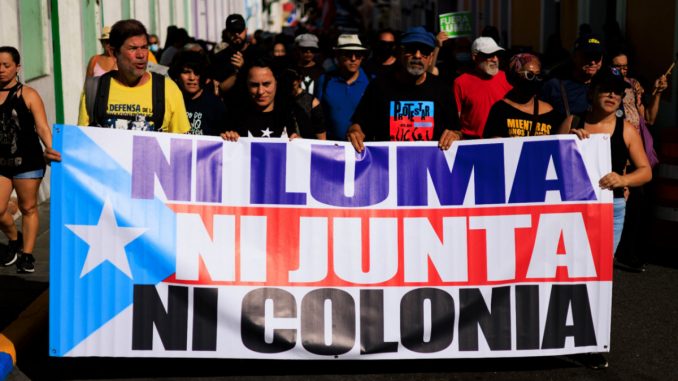
The Puerto Rican primaries, courtesy of gringo corporations

A corporate sham to keep stealing from the people

As in many parts of Our America, in Puerto Rico we are also in an election process this year. Although the general elections are in November, this week the two colonial parties that have so far alternated the administration of the country, the Popular Democratic Party, or PPD that advocates the permanence of the colony under the guise of the Commonwealth, and the New Progressive Party (NPP) that advocates the incorporation of Puerto Rico into the United States, will hold primaries.

While both parties base their promotions on accusations of the other contender from their own party, it is the NPP, the current administrator of the colony, that takes the prize in profanity and unbelievable lies. Watching their ads on TV, one is astonished to see how they hide and distort reality. According to these advertising products, we live in a paradise where services are of quality for all the people. Where schools, hospitals, housing, energy service, etc., is unsurpassed and people live very happy and grateful to the governor who won with only one third of voters participating. It is truly disgusting when we look at the reality of our people living in poverty, with our youth unable to get an education or have a future, or without adequate health services.

But the important thing we want to point out is: who benefits, who is behind this publicity?

We should not be surprised that in a colony, it is corporations, law firms, and gringo millionaires who finance these campaigns to maintain the unjust laws that grant preferences to foreign investors, such as Law 60, which makes Puerto Rico a tax haven. They have come to Puerto Rico to steal our land, build luxury buildings and homes for short-term rentals, displacing communities and driving up housing prices, making it so that a middle-income family can no longer afford an affordable residence.

But no matter how many ads these vultures pay for, whoever wins the primaries, it is the people in November who will have the opportunity to remove them all and elect honest and patriotic candidates who have formed a great Country Alliance between the Puerto Rican Independence Party and the Citizen Victory Movement that can repeal these preferential laws and reverse the privatizations.

Source: the Struggle-La Lucha Telegram channel, translation Resumen Latinoamericano – English

Strugglelalucha256


Nuseirat: Civilians shot execution style during ‘near perfect’ Gaza rescue op

Testimony from Palestinians indicates Israeli forces deliberately executed civilians in their homes with gunfire and indiscriminately bombed civilians from the air as part of the military operation in Gaza to rescue captives held by Hamas.

Israeli newspaper Yedioth Ahronoth described the 8 June operation in the Nuseirat refugee camp, which killed 210 Palestinians, as a “near-perfect execution in broad daylight.”

“Precise intelligence, meticulous planning and execution, and quick and professional action resulted in a successful operation to free four hostages,” the paper added.

But Euro-Med Human Rights monitor documented that Palestinian civilians were shot execution-style in their homes and in the street as the operation began.

Chairman of the Euro-Med Human Rights organization Rami Abdu reported that according to preliminary testimonies, Israeli forces used a ladder to enter the home of Dr. Ahmed Al-Jamal and immediately executed 36-year-old Fatima al-Jamal upon encountering her on the staircase.

Israeli troops then executed her husband, journalist Abdullah al-Jamal, 36, and his father, Dr. Ahmed, 74, in front of his grandchildren. The army also shot Dr. Ahmed’s daughter, Zainab, 27, who sustained serious injuries.

According to i24 news, this was the house where 26-year-old Israeli captive and conscript Noa Argamani was being held.

Abdu reported further that Israeli forces executed Muhammad Salhiya with a bullet to the head while he was sitting on a chair reading the Quran in his home in the Nuseirat refugee camp.

Abdu stated that Euro-Med had initially documented field executions and killings in at least seven homes during the operation.

“In this world, the blood of a white westerner is equivalent to the lives of thousands of innocent non-westerners,” Abdu concluded, noting the focus of the western and Israeli press on the fate of the four rescued Israeli captives.

Euro-Med compiled a preliminary list of the identified Palestinian victims in Saturday’s Al-Nuseirat massacre, committed by Israeli forces in just one hour.

Israeli army spokesman Rear Admiral Daniel Hagari stated in a press conference that the operation began at 11 am and “was a high-risk, complex mission based on precise intelligence conducted in daylight in two separate buildings deep inside Gaza. While under fire, under fire inside the buildings, under fire on the way out, our forces rescued our hostages.”

This has led some to believe that Israeli forces only bombed the Nuseirat Camp, killing hundreds of civilians, to clear the way for the special forces and the captives to escape.

However, Palestinian witnesses report that Israeli forces indiscriminately bombed the Nuseirat refugee camp in multiple locations before they heard any fighting break out, indicating that the bombing was to create chaos and prepare the way for the rescue operation to begin.

One woman from Nuseirat stated, “Around 10:30, the assault began. Various types of aircraft bombarded us, and drones fired at anyone moving. It was as if it were the Day of Judgment. People around me were torn apart, limbs scattered everywhere. They annihilated us, they truly annihilated us.”

She stated further, “I was taken by surprise as bullets rained down on us and rings of fire encircled us. Then, I found myself gathering the remains of my son. Yes, I collected the pieces of my child’s body.”

A Palestinian woman named Nour stated, “At 11 am, Yamen and I were sitting by the tent when suddenly, an Apache helicopter appeared above us, dropping thermal bombs and then live ammunition on the people by the sea and around the tents. Then, heavy shelling began, and the tents next to us were bombed and caught fire. We started running with the crowd as if it were the Day of Judgment.”

One Palestinian man described how Israeli special forces disguised as civilians entered the camp in a car and large truck used for delivering humanitarian aid. He said the Israeli forces “were in a truck carrying clothes and cooking pans.”
After the driver in the car put a mask on, people gathered around. The driver reversed the vehicle and drove it next to the truck. People started saying these were Israeli special forces.

“While we were standing in the street, suddenly, there was a strike. Where, how, how, or why, nobody knew what was going on.”

Israeli news website Ynet wrote, citing an Asharq Al-Awsat report, that the special force, which included women, infiltrated the Nuseirat camp using a truck full of equipment characteristic of the displaced in the Strip, such as mattresses and clothes. They pretended to be civilians who had fled Rafah due to heavy airstrikes and were looking for a place to rent in the market area.

Source: The Cradle

Strugglelalucha256


U.S. army aided Israel in bloody military op launched from Gaza ‘Aid Pier’

The operation saw the mass killing of over 200 Palestinians, with health officials describing the inside of Al-Aqsa Hospital as a ‘slaughterhouse’

A video shared widely by Hebrew Telegram channels on 8 June shows that the Israeli army made use of the U.S.-built pier installed in central Gaza as part of a bloody rescue operation that saw the killing of at least 210 Palestinians in the Nuseirat refugee camp.

Furthermore, according to Israeli journalist Barak Ravid, a special U.S. military unit specialized in rescuing captives “supported the effort” that decimated the Nuseirat camp.

Multiple Israeli media outlets reported on Saturday afternoon that a special forces unit penetrated deep into the Nuseirat camp to recover four living captives amid heavy bombing by Israeli warplanes.

They were then flown out of Gaza via the U.S.-built pier, which had been reinstalled on the coast on Friday after undergoing tens of millions in repairs.

On Saturday, the Israeli army announced that it has started “securing the coastal area of the U.S. military’s Joint Logistics Over-the-Shore (JLOTS) pier in Gaza.”

Upon announcing the project earlier this year, Washington stated that the floating pier was built to serve as a “maritime corridor” to deliver desperately needed aid into Gaza.

“I’m directing the U.S. military to lead an emergency mission to establish a temporary pier on the Gaza coast in the Mediterranean. This pier will facilitate the arrival of large ships loaded with food, water, medicine, and temporary shelters,” U.S. President Joe Biden said earlier this year when announcing plans for the pier, purportedly to make up for an Israeli blockade of all land crossings into the besieged enclave.

Nevertheless, the Palestinian resistance repeatedly warned that the floating pier was built to deliver weapons to Israel.

“The pier is intended to provide cover for Washington’s support for the occupation state with weapons … International and regional talk about introducing aid has had no real impact on the famine in the strip,” Hamas said last month.

The Cradle columnist Suat Delgen recently questioned whether the U.S.-built pier is meant to serve as a “smokescreen for political maneuvers.”

“The suspicion is that the project, while ostensibly ‘facilitating’ aid delivery, might also allow for increased control over the entirety of Gaza under the guise of humanitarian assistance. This control could potentially streamline Israel’s military operations and fortify its strategic positions within Gaza, ultimately influencing the broader geopolitical dynamics of the conflict.”

Source: The Cradle

Strugglelalucha256


Class struggles and economic inequality: Modi’s BJP faces major setback in Indian elections

In capitalist countries, free elections are said to be an expression of democracy, meaning that the people select their own government. In fact, these elections are anything but democratic.

The unexpectedly weak performance of the Bharatiya Janata Party (BJP), led by Prime Minister Narendra Modi, in the Indian elections on June 5 reflects significant class struggles in the world’s most populous economy. With 1.4 billion people and nearly 970 million eligible voters, the election outcome highlights the deep class divisions within the country.

On June 4, the New York Times reported: “On Friday, on the eve of the election’s last day, India’s central bank delivered a happy surprise. Growth in the most recent quarter was even higher than economists expected, giving the past fiscal year an official rate of 8.2%.” 

The Times print edition’s headline calls Mumbai “the new darling of Wall Street.” Modi’s decades-long rule has been revered by the wealthiest 1% in the U.S.  

In India, the wealthiest 1% of Indians currently claim almost a quarter of the total income in the country. Inequality has surged during Modi’s rule, bringing about a poverty ratio that is worse than that before India became independent.

Income below the poverty line

Currently, more than 600 million Indians try to survive on an income below the World Bank poverty line.

The unemployment rate for those under 29 years of age stands at 17%. Food inflation has averaged 7.88%, with essential foods — roti (bread), dal (beans), and sabzi (vegetables) — registering double-digit inflation in the last 12 months. 

In 2021 and again this January, farmers and agricultural workers from the northern states of Punjab and Haryana set road blockades to protest the revocation of agriculture laws passed by Parliament in 2020 that offered some financial protection to farmers.

During the past year, nearly 3,000 farmers have died by suicide in the state of Maharashtra, where the financial center of Mumbai is located. The Wall Street Journal reported on June 4 that in the rural district of Jalna, Digambre Jitangre, a farmer who earns less than $150 a month, said, “There is no drinking water here and there is little to earn with farming.” 

Mohammad Ahmed, a 42-year-old farm laborer from Uttar Pradesh, stands at the main traffic intersection in his village, along with hundreds of others, hoping to pick up daily work. He said the number of people waiting at that traffic signal has increased tenfold over the last six years.

The Indian government’s structure is modeled after that of Britain, with a prime minister and 543 elected representatives in a parliament. The BJP lost 63 seats in the parliament in the election, bringing its total down to 240, well below the majority required to form a government. Now, it can only hold power with the support of its alliance partners. 

The position of the prime minister rests on a majority in parliament. Modi, hoping to overcome the failure of unpopular right-wing politicians, focused the election campaign on building a Hindu-chauvinist personality cult around himself, even claiming that he was a Hindu god.

Brutal repression

The Modi campaign was based on the brutal repression of the rights of 20% of Indians who are not Hindu. His goal is to make India a Hindu state with an apartheid system akin to the Zionist entity in Palestine and white supremacist Jim Crow in the U.S. Violence against Muslims, the country’s largest religious minority, has escalated. Mouthing Nazi and racist rhetoric in an April speech, Modi called Muslims “infiltrators” and “those who have too many children.” 

Modi’s regime is also attacking the predominantly Muslim territories of Jammu and Kashmir and Ladakh, in the north of the subcontinent, revoking their limited autonomy and placing them under martial law.

Modi rose to power by inciting pogroms in which tens of thousands of Muslims were murdered. In 1992, he initiated a mob attack to demolish a 16th-century Muslim mosque in Ayodhya. This January, Modi attempted to fire up Hindu nationalism by inaugurating a new Hindu temple on the grounds of the former mosque, thereby fulfilling one of his key election promises.  

Nevertheless, the BJP lost badly in Uttar Pradesh, the home of Ayodhya, where there is a large population of Dalits, an oppressed caste group. The Wall Street Journal quotes Gurmeet Singh, an 18-year-old Dalit voter, who said, “This election is about saving our constitution and the rights it gives us. Modi and BJP are actually anti-Hindu for using Hinduism for their political gains. They are also anti-India for dividing people on the basis of religion.”

The unparalleled support for Modi by U.S. politicians and the wealthiest class is not only based on investment in the enormous riches his regime has been able to extract. It is India’s strategic role as a world player in league with the U.S., Israel, and Europe as a bulwark in the New Cold War on China. Today, India’s rulers envision themselves as leaders of the Global South.

On June 5 at the People’s Forum in New York, a panel discussion hosted by Jewish Currents was held on the “India-Israel Alliance,” an alliance that nearly goes back to the foundation of the new Republic of India in 1947. There, it was explained that even during the 1950s, when India was a leader among non-aligned nations that condemned colonial domination, such as that occurring in Palestine, Prime Minister Jawaharlal Nehru had begun secret negotiations with the Zionists for a role in controlling the region’s oil.

Ties to Israel

India’s economic growth is not only supported by U.S. investment, it is closely tied to Israel and the Zionist military. It funds the Zionist regime with $3.7 billion a year. An Indian company owns the Haifa Port. Workers from India are recruited to replace the Palestinian workers from the West Bank. Indian police train in Israel and purchase Israeli security systems. Israel is supporting India’s development of high-tech weapon industries such as the manufacture of drones.

With the support of U.S. imperialism, India is striving to compete with and undermine the development of China’s Belt and Road Initiative. 

In September 2023, the White House released a “Memorandum of Understanding on the Principles of an India – Middle East – Europe Economic Corridor.” 

The International Multi-Modal Economic Corridor (IMEC) is an infrastructure project aimed at controlling trade and connectivity between Asia and Europe. It will consist of two distinct corridors: the eastern corridor, which will link India to the Arabian Gulf, and the northern corridor, which will connect the Arabian Gulf to Europe.

The IMEC is to have an extensive railway network and a cross-border ship-to-rail transit system to move goods and services across multiple countries, including India, the United Arab Emirates (UAE), Saudi Arabia, Jordan, Israel, and various European nations.

The U.S. has also created a military alliance similar to NATO called the Quadrilateral Security Dialogue, or simply The Quad. It is a military alliance between Australia, India, Japan, and the U.S. designed to encircle and strangle China.

The International Monetary Fund published the most telling statistics about the New Cold War on China. From 2008 to 2020, China’s per capita income quadrupled while India’s grew 2.5 times. That places India at No. 138 in the national income ranking, while China is in 65th place.

Strugglelalucha256


Pierluisi y sus millonarios pierde primaria

La semana pasada les comentaba sobre las primarias de los dos partidos coloniales en Puerto Rico y cómo los contratistas privados que sangran las arcas del pueblo junto a los millonarios extranjeros que se mudan a Puerto Rico para beneficiarse de las leyes locales de evasión contributiva, habían financiado la campaña del actual gobernador Pedro Pierluisi para su reelección en noviembre. Pues pese a la millonaria campaña mediática, el gobernador perdió miserablemente. Cuando tuvo que admitir su derrota frente a las cámaras de televisión, se vio reflejada la incredulidad en su rostro desencajado y casi al punto de llorar. Eso fue el producto de su arrogancia, su desdén hacia el pueblo pobre y su mala administración, que quería vender la imagen de que sus 3 años de gobierno habían mejorado la calidad de vida en todos los sentidos. 

Pero el pueblo, y estamos hablando de los votantes en una primaria, que son solo los de su partido Nuevo Progresista, está indignado por la dificultad creciente que hay para vivir en este país. Sobre todo, por la privatización de la energía, ahora en manos de la canadiense-estadounidense Luma Energy, que no solo ha aumentado el costo de la electricidad, sino que es totalmente incompetente y ha sumido al pueblo en constantes apagones e inestabilidad del sistema que ya ha costado vidas, quiebras de pequeños negocios y millones de dólares en equipos domésticos dañados. Incluso el mismo día de las primarias, se fue la luz en varios centros de votación. Y esa es la compañía que Pierluisi defendía a capa y espada. Ahora, el pueblo le pasó la factura.

Esto marca un nuevo inicio de lucha popular en contra de la privatización y por una administración de gobierno honesta que responda a las necesidades del pueblo. Por eso, los trabajadores de la UTIER, el sindicato de la antigua Autoridad pública de Energía Eléctrica, que fueron transferidos a otras agencias del gobierno al no querer integrarse a una privatizadora, le llevaron una carta de repudio y movilización al gobernador. Decían que tal y como ellos sufrieron al ser removidos de sus puestos por los que se habían entrenado y capacitado, trabajos como celadores de línea que tanto se necesitan ahora y que la privatizadora Luma no tiene los suficientes experimentados, los enviaban – o “movilizaban” que es el término eufemista que usa el gobierno,  a otros trabajos donde no podían utilizar su experiancia y destrezas, trabajos como cortar el césped, limpiar edificios, etc. Ahora querían que el gobernador experimentara otra clase de movilización en su propia carne.

Más y más el pueblo se está dando cuenta de que las administraciones por los partidos coloniales ha sido un desastre y que se necesita una nueva alternativa. Mientras se lucha por la total eliminación de la colonia por medio de la independencia y soberanía, hay esa alternativa que se llama Alianza País que dará una sorpresa el próximo noviembre en las elecciones generales.

Desde Puerto Rico para Radio Clarín de Colombia, les habló Berta Joubert-Ceci.

Strugglelalucha256


Resist NATO’s D-Day lies: Join the Counter-Summit in Washington

The U.S.-NATO powers are exploiting the 80th anniversary of D-Day to justify an imperialist agenda, including escalating their war against Russia and arming the genocide in Gaza. This commemoration, while claiming to honor the sacrifice of soldiers, is an outright promotion of NATO’s expansionism and war.

The policies and objectives of NATO today are alarmingly similar to those of the Nazi regime, with parallels in their aggression towards Russia and military armaments to support the apartheid Zionist settler state. The exclusion of Russia from the D-Day memorial and the elevation of Nazi collaborators in Ukraine further highlight the imperialist purpose of the ceremonies.

French President Emmanuel Macron’s decision to withdraw Russia’s invitation to the D-Day memorial was meant to erase the Soviet Union’s incredible defeat of the Third Reich in May 1945. 

The U.S. created NATO in 1949 to threaten the Soviet Union and its new Eastern European allies and to stop the spread of socialism across Europe.

After the USSR was destroyed in 1992, the U.S. began taking the Soviet Union’s former Eastern European allies and some former Soviet Republics into NATO. The only former Soviet or Soviet-allied countries in Europe that are not now part of NATO are Moldova, Belarus, and Ukraine.

Even though Russia is now capitalist and thus represents no socialist threat to any existing capitalist nation, the U.S. has been tightening its encirclement of Russia through NATO. The goal is to transform Russia, with its vast natural wealth, into a semi-colony of the U.S.

The U.S./NATO proxy war in Ukraine is about the drive of U.S. imperialism to bring Russia’s and Ukraine’s colossal wealth in natural resources under its control. Both countries are rich in farmland and raw materials such as ores. Already, much of Ukraine’s has been taken over by U.S. finance capital. Russian capitalists are fighting to maintain control of their own natural resources.

Macron has said that NATO ground troops should be deployed in Ukraine, expanding the conflict into an open NATO war on Russia.

Biden has already authorized Ukraine to attack Russian territory with U.S.-supplied missiles, an open escalation of U.S.-NATO operations.

Meanwhile, the U.S.-backed Israeli Occupation Forces continue the genocide in Gaza, mirroring the brutal tactics of Nazi Germany, including mass bombings and starvation of civilians. More bombs have been dropped on Gaza than were on London, Hamburg, and Dresden during World War II.

The official D-Day gathering of imperialist leaders will be followed by a NATO meeting in Washington, D.C., where plans to expand the war against Russia and future operations against China will be discussed. 

A Resist NATO Counter-Summit has been called for July 6 in Washington, followed by a rally on July 7.

Strugglelalucha256
https://www.struggle-la-lucha.org/2024/06/page/6/