Trump attacks ‘horrible’ Milwaukee

How deliberate deindustrialization made U.S. cities poor

Milwaukee is the 2nd worst city in the U.S. for Black people, with incomes half of any others, according to 24/7 Wall St., a financial news source. That’s not what Trump’s snarling about.

It shouldn’t surprise anybody that Donald Trump called Milwaukee “horrible.” He hates cities with large Black and Latinx communities.

Trump described the Black-majority city of Baltimore — the hometown of Frederick Douglass and Billie Holiday — as a “very dangerous & filthy place.” The billionaire bigot tweeted that “no human being would want to live there,” implying that over 300,000 Black people in the city were less than human.

Like Baltimore, Milwaukee was an industrial powerhouse that saw tens of thousands of union jobs destroyed. Sometimes described as a big machine shop, specializing in making the means of production, the city was famous for its breweries.

Milwaukee was the last big U.S. manufacturing center where the Great Migration of Black people from the South arrived in large numbers. In 1940, only 9,000 Black people lived in Milwaukee.

During World War II and the postwar economic boom, capitalists needed Black workers in their Milwaukee factories. The city’s Black population grew seven times from 21,000 in 1950 to 146,000 in 1980.

Milwaukee was one of the most segregated cities in the United States. Racist landlords wouldn’t rent to Black people, while Black families couldn’t buy homes in white neighborhoods.

It was the same story in New York City. Landlord Fred Trump (folk singer Woody Guthries’ “Old Man Trump” is about his racist housing and rental practices) and his son, Donald Trump, were sued in 1973 by the federal government for refusing to rent to Black people.

Year after year, Vel Phillips — the first Black member of Milwaukee’s city council — introduced fair housing legislation. It would be voted down 18 to 1 despite nightly marches led by the NAACP Youth Council and its advisor, Father James Groppi.

It was only after Milwaukee’s 1967 rebellion against racism — one of 200 Black uprisings that year — that the city passed a law banning housing discrimination. As Frederick Douglass declared, without struggle, there is no progress.

Milwaukee police were vicious. Future police chief Harold Brier helped cover up the 1958 police murder of Black motorist Daniel Bell. Decades later, it was revealed that policeman Thomas Grady planted a knife at the scene. 

Just during December 1974, Milwaukee cops killed three Black people, including 16-year-old Jerry Brookshire, on Christmas Eve. Eyewitness Ola Mae Davis testified that cop Raymond Marlow deliberately shot Brookshire as the unarmed teenager was climbing a fence. Davis had her house burned down for telling the truth.

Filthy rich, racist capitalists

Despite Wisconsin’s one-time liberal image, union-busting bosses and racist politicians dominated the state.

Wisconsin’s legislature eliminated any welfare payment for winter coats in 1969, hoping to freeze or drive out Black and poor families.

Latin American Union for Civil Rights president Ernesto Chacon was arrested for protesting this vicious decree. A march from Milwaukee to Madison was organized by Lucille Berrien and Father Groppi.

Joined by thousands of students in Madison, they occupied the state capitol. State workers and their supporters did the same in 2011.

Just as housing was segregated, so were Milwaukee’s schools. Assemblyperson Lloyd Barbee led school boycotts in 1964 and 1965.

Many capitalists refused to hire Black workers. Less than 1% of the 6,000 workers at Allen-Bradley, a Milwaukee maker of electrical controls, were Black in 1968. Company boss Harry Bradley was a founder of the racist John Birch Society.

The Bradley family sold the company to Rockwell Automation in 1985 and used the dough to expand its Lynde and Harry Bradley Foundation, a billion-dollar slush fund for right-wingers.

The tax-exempt outfit helped publish “The Bell Curve,” an anti-science tract that makes the Hitler-like claim that there are racial differences in intelligence.

Ben Marcus was still refusing in 1969 to hire any Black waitresses at his now-defunct “Big Boy” chain of coffee shops. Marcus led the local “Israel Bond” campaigns that helped finance the apartheid occupation of Palestine.

Then there are Elizabeth and Richard Uihlein, billionaire owners of the Uline supply outfit, who are pouring millions into Trump’s campaign. The Uihlein family grew rich by owning Schlitz beer for a century before running it into the ground.

Even though the old Schlitz brewery was located right next to the original heart of Milwaukee’s Black Community, none of the local breweries hired any Black workers until 1951. (“Black Milwaukee: The Making of an Industrial Proletariat, 1915-45,” by Joe William Trotter Jr.)

A lockout of Black workers

Even after plant shutdowns had begun, 36.9% of Black workers in the Milwaukee metropolitan area in 1980 were employed in manufacturing. Only Gary, Indiana, and Greensboro, North Carolina, had higher percentages of Black workers having factory jobs. (Metropolitan Area Fact Book)

Most factory workers in Milwaukee were union members with union wages and union benefits. That’s why a majority of the city’s Black families owned their homes.

The city is now known for evictions and foreclosures, as described in “Evicted: Poverty and Profit in the American City,” by Matthew Desmond.

Nearly 7 million manufacturing jobs were destroyed in the United States between 1979 and 2019. That’s the biggest reason for declining union membership.

The working class wasn’t defeated in battle as much as it had thousands of battlefields taken away. The wealthy and powerful enjoyed a 50-year-long holiday, cutting wages as it minted hundreds of new billionaires.

This orgy of profit-taking was greatly aided by the overthrow of the socialist Soviet Union.

Thousands of Black workers in Milwaukee were made jobless when the A.O. Smith, American Motors, and Allis-Chalmers plants shut down. Thousands more were laid off at other factories.

What made this more obscene was that while Milwaukee County lost 55,000 factory jobs between 1977 and 1992, the rest of Wisconsin — overwhelmingly white — gained 66,000 manufacturing jobs. (Census of Manufacturers)

Capitalism was fleeing Black workers. While Milwaukee County has less than a sixth of Wisconsin’s population, it has almost 70% of its Black residents.

Manufacturing employment in Wisconsin reached 601,000 in 1996 before falling slightly to the current total of 574,000 workers. The state leapfrogged past the former industrial strongholds of Massachusetts, New Jersey, and North Carolina to become the ninth-largest manufacturing state. 

Only Indiana has a higher percentage of its workforce employed in manufacturing. 

Meanwhile, the number of factory workers in Milwaukee County fell to 46,678 in 2021. In less than two generations, 107,000 manufacturing jobs were wiped out in a county of 940,000 people, 26% of whom were Black.

This deliberate deindustrialization was a lockout of the Black working class. Bordering the closed A.O. Smith plant, where thousands of Black workers had jobs, is the impoverished zip code 53206, which has one of the country’s highest incarceration rates.

Instead of getting jobs in the big plants, Black youth are being railroaded to the big prisons. The number of prisoners in Wisconsin has leaped from less than 3,000 in the early 1960s to over 20,000. (Wisconsin Blue Book) Joe Biden helped push through mass incarceration legislation in the U.S. Senate during the 1990s.

The Black Lives Matter movement that swept Wisconsin in 2020 shows the way forward. Struggle will defeat all the Trumps.

 

Strugglelalucha256


Biden’s tariffs on China: A union worker responds – part 2

International solidarity, not corporate protectionism, key to union drives, jobs, and higher wages and benefits

Part 1 discussed how Biden has undermined his own publicized campaign to fight global warming by imposing huge tariff increases on China. Part 2 explores how the billionaire ruling class, patrons to both major political parties, is pressuring the government to suppress the re-awakening union movement, to “nip it in the bud” before it threatens its huge profits. So, it is now necessary for the labor movement to create its own independent viewpoint and stance of national and international government policies, including Biden’s escalation of Trump’s anti-China tariffs on EVs, batteries and other green energy products.

On May 16, Biden’s White House issued a statement quoting union leaders from the AFL-CIO, the United Steelworkers, the Teamsters, the International Brotherhood of Electrical Workers, and the United Auto Workers all applauding Biden’s anti-China tariffs. Most of those union leaders echoed the business leaders who were also on the White House statement, commending Biden for “defending American industries” from Chinese “overcapacity” in production of electric vehicles (ERVs) and their batteries.

Even the supposed environmental group Sierra Club was quoted as supporting Biden’s tariffs, despite gasoline-powered vehicles currently producing some 25% of carbon emissions that are accelerating global warming.

But the UAW, under the leadership of Shawn Fain, struck a markedly different tone in its statement supporting the tariffs. There was no defense of American industry. Instead, it condemns “corporate greed” that is “pitting worker against worker, pushing wages lower and lower”:

“The UAW applauds today’s decisive action from the White House on ensuring that the transition to electric vehicles is a just transition. We have warned for many months that, left to the forces of corporate greed, the EV future was threatened by a race to the bottom, from China to Mexico to right here in the United States. Making sure that major corporations have to pay a price for pitting worker against worker, pushing wages lower and lower, is a key part of a pro-worker trade policy. America’s autoworkers, our families, and working-class communities across this country want a trade policy that puts workers first. Today’s announcement is a major step in the right direction.”

UAW reaches a contract agreement for battery workers.

The historic UAW “Stand Up” 2023 contract, won after a militant strike of all three of the “Big 3” companies (General Motors, Ford and Stellantis), placed their electric vehicle and battery factories under the national contract. This also applies to all jointly owned facilities with other companies, typically with foreign ones.

On June 10, the union reached a tentative agreement covering 1600 workers at the Ultium Cells plant in Lordstown, Ohio, a joint venture between General Motors and a South Korean partner, LG Energy Solution. It produces batteries for G.M. electric vehicles.

The New York Times reports that:

The Ultium Cells contract calls for moving workers to a new wage of $30.50 an hour. Over three years, wages will rise to $35 an hour. The national contract signed last fall had increased the Ultium Cells starting wage to $26.91, up from $16.50 an hour when the plant opened.

The Ultium Cells contract also calls for the plant to employ four U.A.W. members as full-time safety representatives, and one full-time industrial hygienist. The union and Ultium workers have raised concerns about working with high-voltage electricity and potentially harmful compounds used in the production of E.V. battery packs.

Some 200 former Lordstown workers who transferred to other plants when GM shuttered the giant plant will soon be transferring to the Ultium plant so they can return to the area.

UAW President Fain indicates that this agreement if ratified by the members, will be a model for negotiations at the other EV and battery plants.

This agreement comes some two months after a historic union organizing drive at the Chattanooga, Tennessee, Volkswagen plant, the first such success in a Southern plant in decades.

The corporate empire strikes back

On June 11,the day after the Ultium agreement, a court-appointed monitor, Neil Barofsky, appointed in a 2020 agreement to prevent the UAW from being taken over by the federal government after a huge corruption scandal, blamed Fain for “retaliation against another union officer”. The document “paints a portrait of an organization deeply skeptical of federal efforts to keep the union free from corruption — in stark contrast to Fain’s public image as an ethics-centered activist.”

No actual charges of corruption are made by Barofsky, and Fain strongly denies any wrongdoing:

“Taking our union in a new direction means sometimes you have to rock the boat, and that upsets those who want the status quo, but our members expect this,” Fain said.

“We encourage the Supervisors to investigate any complaints brought to their offices, because we know what they will find: UAW leadership is committed to serving its members and running a union democracy. We are focused on winning record contracts, growing our union, and fighting for social and economic justice on and off the job.”

Whatever Biden’s role in this smear, endorsing political candidates and supporting the Trump / Biden trade war obviously will not prevent these outrageous government attacks on the UAW and the growing trade union movement.

The Big Three, Big Oil, Wall Street, the whole imperialist establishment is not willing to produce the electric vehicles that the workers and oppressed communities can afford and are certainly unwilling to fully compensate the workers to produce them.

Time for change

So, to continue to fight for high-paying jobs for workers to produce low-price EVs essential to reduce carbon emissions, the union movement should consider a different view of socialist China and its vast “green energy” capabilities, as opposed to the billionaire class’s fixation on economic and social hegemony, its trade war and its push towards a military conflict and regime change, as well as its campaign to squeeze everything it can out of our class here.

The Chinese company BYD does have a factory in the U.S. in Los Angeles where it produces electric buses. Unlike their European counterparts in anti-union southern states, the BYD plant’s 700 workers are members of the Sheet Metal Air, Rail, and Transportation Workers Union (SMART), Local 105.

Since U.S. auto companies are only interested in building fewer and more expensive EVs, costing tens of thousands of dollars more than their gasoline equivalents, the UAW is certainly entitled to call on Biden to invite Chinese auto companies to open plants in this country to produce the same low price high quality EVs they currently produce in China, but only if they pledge to recognize the UAW as the representative of the workers.

The union can also call for the same for Chinese battery companies. BYD, which produces new sodium batteries that are much cheaper and more environmentally “friendly” than lithium batteries, safer from fire, not degraded by low or high temperatures, do not require cobalt and other rare metals, and are far easier to recycle, could be invited to open facilities in the U.S.

Large sodium batteries used to store solar panel and wind turbine power during nighttime and calm winds are already being produced in China. Soda ash, which the U.S. has an abundance of, could be a sodium source far cheaper than lithium, of which the U.S. has little supply.

Some could even be exported back to China.

Inviting these companies to open such battery plants in this country could be a huge gain for both the union and environmental movement and link the two movements together. Finally, it could convert the dangerous ruling class spawned hostility towards China into genuine working-class solidarity.

Chris Fry is a Chrysler retiree and former member of UAW Local 51. He  worked on the pre-final line as an assembler at Chrysler Lynch Road Assembly  before  the company shut down the plant.

Part 1 – Biden escalates trade war with China, breaking promise to fight global warming

Source: Fighting Words

Strugglelalucha256


El sangriento coste del bloqueo estadounidense a Cuba

Un reciente anuncio de Discovery Therapeutics Caribe, LLC en Cleveland alivia un temor importante que viene con un diagnóstico de diabetes, el miedo a la amputación. El grupo de defensa Diabetes.org revela que el temor está justificado. “Cada 3 minutos y 30 segundos en los Estados Unidos, una extremidad es amputada debido a la diabetes. Las amputaciones van en aumento en Estados Unidos: 154.000 personas con diabetes sufren amputaciones cada año”.

El 10 de abril, la Administración Federal de Alimentos y Medicamentos dio luz verde al estudio de fase 3 de Heberprot-P, un medicamento cubano desarrollado por el Centro de Ingeniería Genética y Biotecnología (CIGB) que ha demostrado reducir la amputación diabética en más de un 70%. Aunque Heberprot-P® está actualmente a disposición de los pacientes en veintiséis países y recibió la aprobación reglamentaria original cubana en junio de 2006, ésta es la primera vez que se estudiará con pacientes estadounidenses que sufren úlceras del pie diabético.

¿Por qué se ha tardado tanto? El hecho de que Estados Unidos no haya normalizado sus relaciones con la República de Cuba obliga incluso a iniciativas sanitarias urgentes como ésta a abrirse paso a través de una insidiosa red de leyes, reglamentos y órdenes ejecutivas que sólo se aplican a Cuba. Junto con la cruel designación de Cuba como “Estado patrocinador del terrorismo” por parte del Departamento de Estado en 2021, estas medidas pretenden literalmente crear dificultades insoportables para el pueblo cubano utilizando el poder del dólar mundial. En palabras del infame memorándum del Departamento de Estado del 6 de abril de 1960 de Lester Mallory, “deben emprenderse con prontitud todos los medios posibles para debilitar la vida económica de Cuba. … una línea de acción que, mientras sea lo más hábil y discreta posible, haga las mayores incursiones para negar dinero y suministros a Cuba, para disminuir los salarios monetarios y reales, para provocar hambre, desesperación y derrocamiento del gobierno”.

El enfoque socialista de Cuba en el desarrollo cooperativo del potencial humano ha desencadenado avances farmacéuticos reconocidos internacionalmente como el Heberprot-P, la vacuna Cimavax contra el cáncer de pulmón en fase tardía, y mucho más. Sin la normalización de las relaciones entre EE.UU. y Cuba, nuestras comunidades y familias aquí en EE. Algunos pasos en esa dirección produjeron un Memorando de Entendimiento de 2016 entre el Departamento de Salud y Servicios Humanos de los EE. UU. y el Ministerio de Salud Pública de Cuba que puede haber ayudado a abrir esta oportunidad, pero las administraciones desde entonces han retrocedido.

El 17 de mayo, el presidente de Discovery Therapeutics Caribe, el doctor Lee Weingart, explicó a Prensa Latina cómo se superaron estos obstáculos. “Podríamos operar bajo la protección de una excepción al embargo (bloqueo) que permite proyectos conjuntos de investigación médica en los que participamos nosotros y organizaciones cubanas, así que hemos aprovechado esta disposición para avanzar con este proyecto.”

La industria del cuidado de la diabetes también está creciendo, explica el artículo de Medtech.citeline.com “Alarming Rise Of Diabetes In Several State” “con algunas estimaciones alcanzará los 30.000 millones de dólares en 2030 desde los 18.000 millones de 2022 – es crucial que los fabricantes continúen creando dispositivos y productos innovadores para tratar y controlar la enfermedad.” El Heberprot-P de Cuba responde a esa necesidad.

Weingart anunció que se espera que esta terapia única esté disponible en EE.UU. en 2028. Citado en Prensa Latina el 17 de mayo, dijo que “38,4 millones de ciudadanos estadounidenses tienen diabetes, 1,6 millones de los cuales desarrollarán una úlcera de pie diabético cada año, …160.000 resultarán en amputación, y 80.000 de ellos morirán en los próximos cinco años, así que si se sigue el ciclo, 80.000 personas mueren cada año por las complicaciones de una úlcera de pie diabético, lo que la convierte en la octava causa de muerte en Estados Unidos y más mortal que ciertos tipos de cáncer.”

El Presidente del Professional Education & Research Institute (PERI), organización internacional de investigación clínica, Dr. Charles Zelen, señaló el impacto desproporcionado en las comunidades afroamericanas, donde “los beneficiarios de Medicare tienen casi el doble de probabilidades de sufrir una amputación de miembro inferior en el plazo de un año tras el diagnóstico de DFU en comparación con sus homólogos blancos no hispanos.” La Asociación Médica Nacional, la voz colectiva de los médicos afroamericanos, señala en su sitio web: “Los pacientes afroamericanos tienen más probabilidades que los blancos de padecer diabetes. El riesgo de diabetes es un 77% mayor entre los afroamericanos que entre los estadounidenses blancos no hispanos.”

“Resulta alarmante que casi la mitad de los pacientes que se someten a una amputación de extremidades inferiores relacionada con DFU no sobrevivan más de cinco años. Entre los veteranos de EE.UU., el pronóstico es aún más sombrío, donde la supervivencia más allá de dos años es poco común para los pacientes que presentan gangrena.” (30 de abril, comunicado de prensa DTC)

La fecha de comercialización prevista en EE.UU. en 2028 será veintidós años después de que Heberprot-P fuera aprobado para salvar miembros y vidas en 2006. A la tasa de 160.000 amputaciones al año citada por Weingart, negar la tasa de curación potencial del 70% ha supuesto unos 2,5 millones de amputaciones innecesarias en EE.UU. durante estas décadas.

Encontrar este punto dulce para penetrar el bloqueo económico, financiero y comercial de EE.UU. en beneficio de Cuba y de los diabéticos en EE.UU. es algo que celebrar, pero no es una solución. La normalización de las relaciones entre Estados Unidos y Cuba comienza hoy con la eliminación de Cuba de la Lista de Estados Patrocinadores del Terrorismo, que sólo requiere que el presidente envíe una notificación al Congreso. Para más información, consulte el kit de herramientas de ACERE.org y el folleto explicativo de una página sobre SSOT.

Cuba acogerá el VII Congreso Internacional sobre Manejo Integral de Úlceras y Heridas Complejas, del 1 al 5 de septiembre de 2024 Varadero, Cuba. Corra la voz entre los profesionales médicos e investigadores

Cheryl LaBash es copresidenta de la Red Nacional sobre Cuba en Estados Unidos.

Fuente: Struggle- La Lucha, traducción Resumen Latinoamericano

Strugglelalucha256


Bloody cost of the U.S. blockade of Cuba

A recent announcement by Discovery Therapeutics Caribe in Cleveland eases a major fear coming with a diabetes diagnosis: the fear of amputation. The advocacy group Diabetes.org reveals the fear is justified. “Every 3 minutes and 30 seconds in the United States, a limb is amputated due to diabetes. Amputations are on the rise in the United States — 154,000 people with diabetes undergo amputation each year.”

In a welcome breakthrough on April 10, the Federal Food and Drug Administration greenlighted the phase 3 study of Heberprot-P, a Cuban medicine developed by the Center for Genetic Engineering and Biotechnology (CIGB) that has been shown to reduce diabetic amputation by more than 70 percent. Although Heberprot-P is currently available to patients in 26 countries and received original Cuban regulatory approval in June 2006, this is the first time it will be studied with U.S. patients suffering from diabetic foot ulcers.

Why did it take so long? The failure of the U.S. to normalize relations with the Republic of Cuba has forced even urgent health initiatives like this one to thread its way through an insidious web of laws, regulations, and executive orders that only apply to Cuba. Together with the 2021 State Department’s cruel designation of Cuba as a ‘State Sponsor of Terrorism, ’ these measures are literally intended to create unbearable hardships for the Cuban people using global dollar power. 

In the words of Lester Mallory’s infamous April 6, 1960, State Dept. memo, “Every possible means should be undertaken promptly to weaken the economic life of Cuba. … a line of action which, while as adroit and inconspicuous as possible, makes the greatest inroads in denying money and supplies to Cuba, to decrease monetary and real wages, to bring about hunger, desperation, and overthrow of government.” 

Cuba’s socialist focus on cooperative development of human potential has unleashed internationally recognized pharmaceutical advances like Heberprot-P as well as Cimavax, a late-stage lung cancer vaccine, and much more. Without normalized U.S.-Cuba relations, our communities and families here in the U.S. have been blocked, while the rest of the world is not. 

Some steps in that direction produced a 2016 Memorandum of Understanding between the U.S. Department of Health and Human Services and Cuba’s Ministry of Public Health that may have helped open this opportunity. However, administrations have backed away since then.

On May 17, Discovery Therapeutics Caribe President Dr. Lee Weingart explained to Prensa Latina how these hurdles were overcome: “We could operate under the protection of an exception to the embargo [blockade] that allows joint medical research projects involving us and Cuban organizations, so we have taken advantage of this provision to move forward with this project.” 

The diabetes care industry is growing, too, explains Medtech.citeline.com’s  “Alarming Rise Of Diabetes In Several State” article “with some estimates it will reach $30bn by 2030 from $18bn in 2022 — it’s crucial that manufacturers continue to create innovative devices and products to treat and manage the disease.” Cuba’s Heberprot-P fits that need. 

Weingart announced this unique therapy is expected to be available in the U.S. in 2028. Quoted in Prensa Latina on May 17, he said that “38.4 million U.S. citizens have diabetes, 1.6 million of which will develop a diabetic foot ulcer each year, …160,000 will result in amputation, and 80,000 of those will die in the next five years, so if you follow the cycle, 80,000 people die every year from the complications of a diabetic foot ulcer, making it the eighth leading cause of death in the United States and more deadly than certain kinds of cancer.”

Diabetes risk highest among African Americans

President of the Professional Education & Research Institute (PERI), an international clinical research organization, Dr. Charles Zelen, noted the disproportionate impact on African American communities where “Medicare beneficiaries are nearly twice as likely to undergo lower limb amputation within a year of DFU diagnosis compared to their non-Hispanic white counterparts.” The National Medical Association, the collective voice of African American physicians, notes on its website: “African American patients are more likely than white patients to have diabetes. The risk of diabetes is 77% higher among African Americans than among non-Hispanic white Americans.” 

“Alarmingly, nearly half of patients who undergo DFU-related lower extremity amputation do not survive beyond five years. Among U.S. veterans, the prognosis is even more grim, where survival past two years is uncommon for patients presenting with gangrene.” (April 30, DTC Press Release)

The projected U.S. marketing date in 2028 will be twenty-two years after Heberprot-P was approved to save limbs and lives in 2006. At the rate of 160,000 amputations per year cited by Weingart, denying the potential healing rate of 70 percent has meant an estimated 2.5 million unnecessary amputations in the U.S. over these decades. 

Finding this sweet spot to penetrate the U.S. economic, financial, and commercial blockade for the benefit of Cuba and diabetics in the U.S. is something to celebrate, but it is not a solution. Normalization of U.S.-Cuba relations begins today with removing Cuba from the State Sponsors of Terrorism List, requiring only that the President send a notice to Congress. For more information, see the ACERE.org toolkit and one-page SSOT explainer.

Cuba is hosting the VII International Congress on Comprehensive Management of Complex Ulcers and Wounds in Varadero, Cuba, from September 1 to 5, 2024. Spread the word to medical professionals and researchers.

Cheryl LaBash is a co-chair of the National Network of Cuba (NNOC)

Strugglelalucha256


Graham ‘accidentally’ exposes the true nature of U.S. diplomacy

Global Times editorial

Recently, senior U.S. politician and Republican Senator Lindsey Graham unabashedly stated in a media interview that Ukraine holds business value for the U.S. He claimed that there are “10 to 12 trillion dollars of critical minerals” in Ukraine, and the primary reason for supporting Ukraine is to seize these critical minerals by defeating Russia on the battlefield. Furthermore, he advocated for seizing and using frozen Russian assets in Europe and the U.S..

These remarks reveal the true intentions behind the U.S. political elites’ current policy toward the Ukraine crisis. As foreign netizens bluntly stated on social media, “Now you know why the West won’t allow peace talks.”

As a Senate “hawk,” Graham often garners attention with his extreme rhetoric. For example, he once claimed that parts of Iran must be “blew off the map,” and he touted U.S. military aid to Ukraine as “the best money we’ve ever spent,” hence he was added to a list of “terrorists and extremists” compiled by Russia’s state financial monitoring agency, Rosfinmonitoring. He has also repeatedly stirred up tensions over the Taiwan question, threatening “sanctions from hell” against China.

Many of Graham’s radical ideas can only remain at the level of bluster, but his latest remarks on camera have sparked significant outrage for two reasons: First, because he “accidentally” exposed the true nature of U.S. diplomacy, making it clearer to the world what lies behind the facade of the U.S.’ claim that it wants to “maintain peace”; and second, because of the speeches and actions of the U.S. political elites he represents, which constantly fuel the Ukraine crisis, starkly contrast with the international community’s consensus on de-escalating tensions, and creating conditions for a cease-fire and an end to the war.

Graham views the Ukraine crisis as a business deal, a perspective that is somewhat representative among the U.S. political elites. Many of them talk about peace, but their real concern is not Ukraine, nor European stability. On the contrary, they are keen on Ukraine’s abundant resources and how to exploit Europe’s prolonged and profound crisis to continuously consolidate U.S.’ absolute power and dominance in European security affairs.

Turning the Ukraine crisis into a global conflict is the main policy trend of the U.S. in handling the crisis. Washington intends to turn this crisis into a key propeller for its own geopolitical competition around the world. Such policy goals are quite dangerous. Dialogue and negotiation are the only feasible way to resolve the crisis. This is the common voice of any responsible person in the international community.

However, in the past two years or so, the U.S. and certain NATO countries have continued to undermine the opportunities and efforts of Russia and Ukraine to resume direct dialogue, and even attempted to maximize the use of the crisis for their own gains, creating pressure in Europe and even the world under which people must choose sides and highlight camp confrontation.

The extreme measures advocated by Graham once again show that the U.S. policy elites are taking a big gamble. The lack of historical reflection is the main reason why the U.S. frequently makes mistakes in major decisions. At present, the U.S. should best learn from the idea of building a “peace without victory” put forward during WWI by Woodrow Wilson, the architect of U.S. diplomacy, and use the idea of ensuring cooperation among major powers and not engaging in camp confrontation to deal with thorny diplomatic issues such as the Ukraine crisis. Regrettably, the current U.S. decision-making elites have both ignored the painful lessons learned from the wars of the 20th century and trampled on the warnings of their predecessors. This is a tragedy of U.S. diplomacy.

The crisis in Ukraine has entered its third year of overall escalation. The war is still ongoing, the impact continues to spill over, and the conflict is in danger of further escalation. If we want to achieve an early ceasefire and end the war, we cannot allow the Graham-style bellicose thinking to spread. U.S. elites often flaunt themselves with terms such as “democracy” and “rules” and deliberately exaggerate that they are “top students” in international relations. Graham has already told the truth about U.S. diplomacy. The U.S. is the one that ignores rules, stubbornly interferes in other countries’ internal affairs, and creates chaos within other countries and in the international community.

Graham’s remarks that Ukrainian resources cannot be given to Russia and China have fully demonstrated the narrow-mindedness of the U.S. in the Ukraine crisis.

Strugglelalucha256


‘Peace is union business’

Support for Palestine and Cuba wins unanimous approval at the ILWU 39th convention

“Solidarity at the ILWU Convention was not an empty slogan,” reports retired dockworker Clarence Thomas.

Thomas participated in the 39th Convention of the International Longshore and Warehouse Union (ILWU) held in Vancouver, B.C., from June 17 to June 21 as a fraternal delegate representing the ILWU Pacific Coast Pensioners Association (PCPA). 

Solidarity was substantial and real there. Unions shared their resources to help each other stay strong, and courageous union members stood up in support of their sisters and brothers in Palestine and Cuba. 

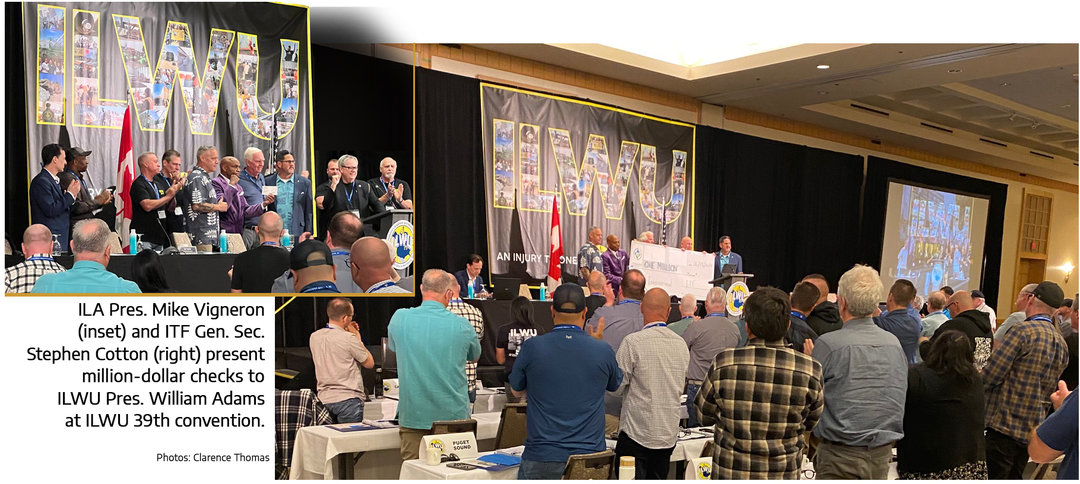
Million-dollar checks were presented to ILWU President William Adams at the convention podium. Mike Vigneron, President of the Atlantic Coast District of the International Longshoremen’s Association (ILA), gave one check. Stephen Cotton, General Secretary of the International Transport Workers Union Federation (ITF), matched that donation.

Their historic actions were taken to help restore the ILWU’s assets, which had been depleted by the International Container Terminal Services (ICTS) litigation against the ILWU Longshore Division. A federal court awarded ICTS $20.5 million of ILWU union funds over a dispute involving a job slowdown in Oregon.

International solidarity with Palestine and Cuba  

Addressing the crisis of genocide in Gaza, Brother Cotton from the ITF spoke of his communications with Palestinian trade unionists. He explained that Palestinian taxi and truck drivers want U.S. workers to support their right to self-determination and the establishment of a Palestinian state. 

Two Australian union leaders appealed for international labor action to stop the massacre and displacement of Palestinians. They received overwhelming applause. 

Cris Cain, National Secretary of the 30,000-member Construction, Forestry and Maritime Employees Union (CFMEU), declared: “Peace is union business.” 

He talked about how the ILWU port shutdowns helped to end apartheid in South Africa and how, recently, dockworkers in Australia have engaged in parallel actions by refusing to work vessels carrying military supplies to enforce apartheid and carry out genocide against Palestine.

Paddy Crumlin, National Secretary of the Maritime Union of Australia, called for an immediate ceasefire and a diplomatic resolution.

In a video message celebrating Juneteenth, ILWU Honorary Member Angela Davis sent greetings and a plea for support of the Palestinians.

The resolution to remove Cuba from the List of State Sponsors of Terrorism (SSOT) was first introduced at the Constitution Committee Meeting, where it was passed without opposition. Committee members, including Thomas, spoke about the devastating impact of the 62-year-long embargo, an act of war that deepened the hardship imposed on the entire Cuban population.

That resolution, calling for an end to the boycott of Cuba, was introduced to the convention delegates. They voted unanimously to approve the convention resolution. 

The resolution follows:

Send Pacemakers to Cuba  and end the U.S. embargo

WHEREAS: ILWU policies and actions on foreign affairs have always been built on the 

belief that international labor solidarity and world peace are the cornerstones of 

social and economic justice for all workers, including the membership of the ILWU; 

and 

WHEREAS: The union’s commitment to a peaceful world has been expressed in many ways, 

each following a course of action or basic policy set by the membership through 

the International Convention; 

and 

WHEREAS: Washington has placed Cuba on its list of alleged terrorist nations (SSOT), which severely impacts Cuba’s ability to secure loans and participate in world banking systems, thus disabling tourism, agriculture, and other productive markets; 

and 

WHEREAS: 243 punitive executive orders/sanctions were issued by President Trump and reinforced by President Biden, intensifying hardship for the working people; 

and 

WHEREAS: In 2023, a resolution to end the Cuban blockade [at the UN General Assembly] passed 182 to 2 (U.S. and Israel opposed); 

and 

WHEREAS: Except for empty campaign promises, the Biden administration has done nothing to undo the hardships of the blockade forced on the Cuban people. These policies leave Cuba with a shortage of fuel, food, medicines, spare parts; 

and 

WHEREAS: Cuba has sent 3,700 health workers in 52 international medical brigades to 39 countries overwhelmed by the Covid pandemic. Cuba’s international medical brigades have treated patients and saved lives for the past 18 years in 100 countries confronting natural disasters and serious epidemics, such as the Ebola crisis in West Africa; 

and 

WHEREAS: Cuba has developed five internationally recognized COVID-19 vaccines to meet its commitment to sharing its low-cost vaccines with poor nations and continues to develop new medicines for treating Alzheimer’s, Diabetic foot ulcers, and lung cancer. Thus continuing its tradition as a world leader in medical research and development; 

and  

WHEREAS: Recently, more than 30 labor bodies have passed strong resolutions calling for ending the sanctions and removing Cuba from the SSOT, including multiple entities in California (including the LA Federation of Labor representing 800,000 workers) and Washington State: and  

WHEREAS: The majority of Cuban Americans in Miami oppose the blockade and have demonstrated with car caravans and other actions for years calling for an end to the blockade and instead build bridges of love, Puentes de Amor; 

and 

WHEREAS: the ILWU has historically enjoyed an international relationship with the Cuban Workers Federation (CTC), and in 1947, participated in organizing the International Sugar Workers Committee; 

THEREFORE BE IT 

RESOLVED: that the 2024 ILWU Convention calls on the Biden administration to vote FOR the U.N. Resolution to end the U.S. unilateral extraterritorial blockade of Cuba and remove Cuba from the spurious U.S. list of state sponsors of terrorism (SSOT), reset Cuba regulations to January 1, 2017, initiate the discussion to fully normalize US-Cuba relations, and 

BE IT FURTHER 

RESOLVED: that the ILWU will commit to donate $10,000 to Global Health Partners to purchase Pacemakers4Cuba* and

BE IT FINALLY 

RESOLVED: that this Resolution will be distributed to Congressional delegations, the news media, and all labor organizations, urging them to do the same. 

Submitted by Inlandboatmen’s Union of the Pacific

* GHPartners.org/Pacemakers4Cuba Global Health Partners is a 50Jc3 charity with a commerce License to send medical supplies to Cuba 


Strugglelalucha256


How imperialism erased Indigenous LGBTQ+ communities

Since the resurgence of the Palestine solidarity movement following the heroic Al-Aqsa Flood on October 7, 2023, queer, trans, and gender non-conforming people of all ages have taken up the struggle for a free Palestine.

Face it: imperialism is the world’s greatest threat to LGBTQ+ people.

Capitalism and imperialism, stretching back to its days of old-style colonialism, have done more than any other force on earth to annihilate and suppress societies that see gender and sexuality outside a narrow binary. 

Erasure of nonbinary people in pre-colonial Philippines

Take Spanish colonialism, for example. For those unfamiliar, one need only refer to the Spanish-American War in 1898, through which the United States made off with Spain’s old colonies: Cuba, Guam, the Philippines, and Puerto Rico. At this point in history, the United States emerged as the leading imperialist power in the world, pushing aside the European powers.

Previous to this, Spain held these countries as colonies. In particular, Spain controlled the Philippines for over three centuries. 

Before the Spanish arrived, societies across the Philippine archipelago, though not a monolith, viewed gender and sexuality in its many shades. In fact, people who we would now consider to be nonbinary, trans, or queer were considered spiritual and tribal leaders. One popular term for them, among many, is babaylan

What happened to the babaylans? Between the Spanish military, governors, and missionaries, they were vilified and executed. The Spanish colonists, by both sword and cross, enforced the nuclear family and the narrow gender roles that came with it.

The Catholic Church’s “mission to civilize” was the ideological justification for the complete annihilation of an Indigenous social system, the babaylans being only one of many. 

But the true motivator behind such a historical atrocity is not something subjective like “good” or “evil” — these are just assessments that different people and class forces make for different reasons. 

The true motivator was primarily political and economic: it served the interests of European colonialism. There’s an old saying about European colonialism: First came the Bible, then came the sword. 

Like most Indigenous systems, the babaylans’ significance and function stood in stark contradiction to the Spanish colonists’ system of rule. Spain could not allow the precolonial Filipino peoples this degree of self-determination and autonomy, so it needed to be crushed.

Even hundreds of years later, the annihilation of the babaylans haunts the Philippines. Despite the Filipino people’s struggle having expelled U.S. military bases from the archipelago, the Visiting Forces Agreement has allowed the U.S. military rent-free use of Philippine military infrastructure. And where the U.S. military goes, sexual violence follows. 

One needs only refer to the brutal murder of Jennifer Laude and the non-indictment of U.S. soldier Scott Pemberton to bear this out. 

Imperialism has wrought this kind of havoc throughout the world. It stands in the way of, and violently suppresses, any system that allows for the genuine self-determination and social development of a people, nation, or movement.

This is not to say that every Indigenous or cultural practice is positive or progressive or that they are all negative or reactionary. Social and cultural practices must be understood on their own terms and in their own contexts. They do not form in a vacuum but rather according to objective historical conditions.

But a society’s practices simply cannot change and develop while the boot of imperialism weighs on its neck.

Strugglelalucha256


Biden’s tariffs on China: A union worker responds – part 1

When Biden was running for office in 2020, he said that Trump’s tariffs on Chinese products increased inflation on the public and promised to reduce or eliminate them.

He did not.

Instead, on May 4, the Biden Administration announced a massive tariff increase on imported goods from the People’s Republic of China (PRC):

Tariffs on medical supplies must be considered particularly bizarre, as the population is still subject to outbreaks of the deadly Covid virus. And public health officials are increasingly alarmed by a new outbreak from the avian H5N1 flu virus which has infected dairy cows and their milk across the country. Many farmworkers who milk cows have become ill from this virus.

A June 3 Scientific American article reports:

The U.S. Centers for Disease Control and Prevention currently recommends that workers on farms where H5N1 has been detected have access to personal protective equipment, or PPE, such as N95 respirators, face masks, goggles and face shields. But it’s only a recommendation, Lakdawala says.

In order to prevent bird flu from causing more infections in humans, Lakdawala thinks dairy workers on all farms should have access to and use proper PPE—especially face shields to protect their eyes. Getting workers to wear N95 masks while working all day in hot barns is unlikely, she notes, but a face shield would provide at least some protection.

But in terms of the economic effects on workers and the oppressed communities, the most dramatic was the tariff increase was on electric vehicles (EVs), going from Trump’s 25 percent to a whopping 100 percent, doubling the price of the cars, placing them out of reach for most of our class.

And Biden tripled tariffs on Chinese-manufactured lithium batteries, going from Trump’s 8% to 25%.

The big winner from Biden’s tariffs: Global warming

A May 28th article from the Foreign Policy website describes these new tariffs from an environmental perspective:

The winner of the escalating, zero-sum green technology trade war between the United States and China may well be climate change. In the latest surge of election-year techno-nationalism, to protect and advance his green transition—and to out-Trump former U.S. President Donald Trump—President Joe Biden last week imposed a wave of new tariffs on Chinese-made electric vehicles (EVs), batteries, and solar cells as well as other Chinese goods, in addition to retaining all of Trump’s tariffs on China.

Scientists are already predicting that 2024 will surpass 2023 as the warmest year globally:

A May 7 CNN article describes some of the catastrophic effects of this on people around the world:

The impacts have been stark. Swaths of Asia have been grappling with deadly heat: schools were closed for millions of children in Bangladesh, rice fields have shriveled in Vietnam, and people in India battled 110 degree Fahrenheit temperatures to vote in recent elections.

Global ocean heat in April was also record-breaking for the 13th consecutive month. Ocean surface temperatures reached 21.04 degrees, the highest on record for any April, and just a fraction below the overall record set in March, according to Copernicus data.

The impact on marine systems is devastating. A mass coral bleaching event occurred this spring, which scientists said at the time could be the worst on record.

As for the U.S., the National Oceanic and Atmospheric Administration (NOAA) has presented a grim hurricane forecast for 2024:

NOAA National Weather Service forecasters at the Climate Prediction Center predict above-normal hurricane activity in the Atlantic basin this year. NOAA’s outlook for the 2024 Atlantic hurricane season, which spans from June 1 to November 30, predicts an 85% chance of an above-normal season, a 10% chance of a near-normal season and a 5% chance of a below-normal season.

NOAA is forecasting a range of 17 to 25 total named storms (winds of 39 mph or higher). Of those, 8 to 13 are forecast to become hurricanes (winds of 74 mph or higher), including 4 to 7 major hurricanes (category 3, 4 or 5; with winds of 111 mph or higher). Forecasters have a 70% confidence in these ranges.

In 2021, to pass his corporate-friendly Inflation Reduction Act (IRA), Biden promised a 50 percent to 52 percent reduction in greenhouse gas emissions (compared to 2005 levels) by 2030, zero net emissions by 2050, and 50 percent of all new vehicles being zero-emission by 2030.

But in his campaign to “out-Trump” Trump and protect corporate profit margins and the oil and gas industry, these new tariffs mean that Biden’s climate promises go right out the window.

As part of Biden’s IRA, billions were allocated for public EV charging stations across the country. Yet by February 2024, there are only 61,000 public chargers in the U.S.

In China, by the end of 2023, there were 2.7 million such chargers, with a 40 percent increase expected this year.

Chris Fry is a Chrysler retiree and former member of UAW Local 51. He worked on the pre-final line as an assembler at Chrysler Lynch Road Assembly  before  the company shut down the plant.

Part 2 – International solidarity, not corporate protectionism, key to union drives, jobs, and higher wages and benefits

Source: Fighting Words

Strugglelalucha256


UC fails twice to break UAW strike; court issues restraining order

After weeks of solidarity with student demonstrators, academic workers across the University of California system were ordered to halt their unfair labor practice strike until June 27.

UAW 4811, which represents 48,000 academic workers across the UC system, called the strike in response to UC’s serious unfair labor practices, which began on May 1 when the university allowed an organized mob to beat students, faculty, and staff attending a Gaza solidarity protest at UCLA. More than a hundred were injured, and dozens were sent to the hospital. The next night, the university called in riot police to arrest those protesters who remained. 

The union has denounced the restraining order and points out that this temporary restraining order does not mean the strike has been ruled “illegal.”

“UC academic workers are facing down an attack on our whole movement,” said Rafael Jaime, president of UAW 4811.

Orange County Superior Court Judge Randall J. Sherman issued the order. The ruling arrives after the UC tried and failed on two separate occasions to break the strike through lawsuits filed with the California Public Employment Relations Board (PERB) claiming UAW 4811 violated its no-strike clause.

Rafael Jaime responded, “PERB, the regulatory body with the expertise to rule on labor law, has twice found no grounds to halt our strike. I want to make clear that this struggle is far from over. In the courtroom, the law is on our side and we’re prepared to keep defending our rights — and outside, 48,000 workers are ready for a long fight.”

The court’s restraining order has galvanized support for UAW across many other unions. United Teachers Los Angeles members recently joined forces with UAW 4811 and 872 academic workers for a “Drop The Charges” rally outside of Los Angeles City Hall. The rally also received the support of LA councilmembers Hugo Soto-Martinez and Eunisses Hernandez.


Strugglelalucha256


‘We are going to build a better world!’ Cuban President Miguel Díaz-Canel tells North American youth

On the last day of the “Let Cuba Live” Youth Brigade, organized by the International Peoples’ Assembly in the first week of June, the members of the brigade met with Cuban President Miguel Díaz-Canel to discuss the pressing issues facing humanity, the lessons from waging a socialist revolution, and how to maintain hope. This conversation was recorded as part of the president’s new podcast.

“Down with the blockade! The socialist world is the world we want!” shouted the over 100 young people gathered in the Palace of the Revolution.

“We had to come to Cuba to find ourselves and our struggle,” said Manolo De Los Santos, director of the People’s Forum and social leader in the United States, who moderated the conversation. “For us, it is a pleasure to share with young people from North America…We admire you a lot,” Díaz-Canel told the young activists.

He affirmed this because in his opinion, they have built an impressive social and political movement in the United States which channels the righteous feelings of justice, freedom, and emancipation which exist in North American society through these young people.

Memories

Díaz-Canel told them that he will never forget “the support that young people like you gave us in New York,” a place where Cuba has so many times denounced the imperial blockade that grips it. And he returned to the hours of September 2023, when he went out to the corner of Lexington and 38th – in front of the Cuban mission in New York City – to demand, in the middle of a demonstration of young Americans, the end of the blockade.

“You were in the streets every day,” the president acknowledged when referring to the brave youth. And another moment emerged with strength and clarity in the memory of the dignitary: on Saturday September 23, 2023, a rainy night at the New York Society for Ethical Culture, where hundreds of friends gathered in support of a nation that resists.

It was there where that the Cuban leader stated that Cuba embraces the American people and all brothers and sisters in the world who dream of a better world. Being able to share that night with friends was, he said, an “extraordinary experience.”

The beginning of an unforgettable conversation

“Welcome to the Palace of the Revolution, and let’s talk like you young people do,” the President said. Manolo De Los Santos, who introduced each student who spoke, was emphatic: “We are extremely grateful to the people of Cuba for receiving us during these times.”

De Los Santos highlighted that, although these are difficult times, the people of Cuba have not stopped showing solidarity, not only with them but also with the entire world.

“It has been an intense week,” said Manolo about the group’s stay in the Greater Antilles, “where we have recognized the ability of the Cuban people to talk about all topics, everything. We have been up late into the night, discussing democracy, human rights, economics, philosophy, culture, everything. And of course, dancing a little with the Cubans.”

“We do that very well,” commented President Díaz-Canel smiling. And Manolo shared another idea: “How rare this opportunity, for young Americans, to be able to meet with a President…. We have been mobilizing in the United States for months, demanding that our President listen to us, and today we woke up seeing a White House surrounded, fenced, impossible to reach; But here we arrive in Cuba and a revolutionary, socialist, honest, human President welcomes us openly and wants to listen to our questions.”

“The world cannot remain silent,” the Cuban president stressed in the initial moments. He did so categorically and in the face of evidence of the holocaust suffered by the Palestinian people.

Is it the same Revolution?

Ask anything and raise your criticisms, the Head of State said and added, “for the Cuban people it will be very good to know how young people like you think.”

“This is a small but very resilient nation,” said Palestinian organizer Celine Qussiny. For her, the imperial blockade causes Cuba to face many problems. It is a siege, she denounced, set up by the same government that attacks Palestine.

Next, the group asked: This Revolution – which did not begin in 1959 but much earlier – how has it evolved over the last 60 years?

Understanding the magnitude of what was raised, President Díaz-Canel said that the answer could be either very long or very short, but that he would strive to give it from an intermediate point. There began his journey to the beginnings of Cuban nationality, even to previous stages, when Columbus arrived in America and opened the doors to clashes of identity, to subsequent exterminations of the Indigenous populations, to the shameful chapter of the slave trade, to the emergence of Creole which begins to feel Cuban and not Spanish, at the birth of a desire for independence that has always been closely linked to the very emergence of national identity.

The President went through stages such as the Mambisas wars; everything done by the Caribbean country -already in the 20th century- for the sake of independence causes in Africa, because that commitment to the mother continent has to do with the vindication of the slaves who arrived on Cuban soil tied up in ships and whose blood flows through the veins of today’s Cubans.

Díaz-Canel spoke about Martí; of Antonio Maceo and his protest in Mangos de Baraguá; of the Centennial Generation with Fidel at the head; of the assault on the Moncada Barracks; from prison and exile in Mexico; of the incorporation of Che Guevara to the group of those who would later disembark on the Granma Yacht; of Fidel saying, with only seven rifles in hand, that then they would win the war against an army armed to the teeth.

Regarding that last episode, the president recalled that Cuba, in a line with a flavor of destiny, has tended to go from adversity to adversity, and from triumph to triumph, always without losing from its horizon, a Fidelista conviction, inherited from all previous struggles: “What there can never be is surrender,” Díaz-Canel conceptualized.

As Commander in Chief Fidel Castro also defined at the time, and as the current Head of State recalled, the Cuban Revolution is one, from the Mambisas to today.

When that Revolution triumphed, he said, that was a cause of great concern for the United States. And regarding such an event – blocked by the empire for so long – the president stressed that revolutions can set an example but cannot be exported, because “revolutions are made by the people.” Hence, he emphasized to the students, no one can influence them, no one guides them in the convictions they choose.

“We are not perfect nor do we want you to idealize us,” Díaz-Canel told the young people; and he added that what Cuban revolutionaries do have is an enormous vocation for perfection.

Regarding the youth of the Caribbean country, the dignitary expressed that they are present in all important events and processes in society. He listed several examples in this regard; and he affirmed that the Revolution is a story of continuity of generations that are united in principles; that may be distant from each other, due to time, but that are mutually supported by a unity of essences.

“We are going to build a better world!”

How does Cuba view the liberation process of Palestine? the young people asked. And that was the starting point for the President to affirm that the world has woken up at this moment in history, starting with the Palestinian cause.

It is as if, he reflected, the market had spread a blanket of idiocy over societies. Thus he spoke about a world marked by uncertainty, by the adverse climate situation, by increased inequalities after COVID-19, and by wars.

Another question that invited everyone to reflect: Palestine has suffered a war of more than 70 years, why is it not talked about and only Ukraine provokes concern? Why don’t the mainstream media go to the root causes of the conflict in Europe? Who caused this conflict in Ukraine? Who manufactured that war? Who benefits from it?

Regarding what is happening with the Palestinian people, President Díaz-Canel reflected on how so many human beings have died in such a short time. He devoted special attention to the martyrdom of women and children; and he wondered aloud: What could be in the conscience of those who have waged that war?

Palestine causes us pain, it has to affect us, he said, to assert that in that land, its children are defending human dignity. “I think that everything we do for Palestine is too little,” he stressed; and he imagined the moment when that nation must be rebuilt, and spoke about the pain of broken families, of mothers and fathers who have lived the terrible experience of seeing their children die.

Palestine opened an important space of consciousness; and in that the protests of American students have been very important. Díaz-Canel Bermúdez said, who did not overlook the fact that since the days of protests against the war in Vietnam, such intense demonstrations had not been experienced in North America.

The president confessed to the young people that he was among the idealists who imagined a better world after the heartbreak caused by COVID-19, because the systems “broke so much…”. But sadly – the president noted – the world went to war, the blockades tightened, and governments like the Israeli one have manifested themselves brutally against the Palestinian people.

We want a better world, where there is more equality, a more just world; That world is possible, what we have to do is defend it. This is how the Head of State reflected, who added that the world is defended as Cubans do every day, despite the blockade; and as do the Palestinian people.

“We are going to build a better world!” the president declared firmly and optimistically.

Fostering revolutionary optimism in the toughest of times

How do you deal with pessimism; How to create optimism in such difficult moments? Manolo De Los Santos asked President Díaz-Canel. And that was the launching pad for the dignitary to list many of the problems that affect life in Cuba; among them, the lack of medicines and food, blackouts, shortages of all kinds…

“And one says: we have to show our faces, we have to be in the streets,” said the Head of State, to then explain why in “the history of our country there are the answers to all our problems.”

The essence of his rationale was that we must “believe in history,” because Cuban history has been and is the fight against all adversity and in the midst of permanent attacks.

The other path that the President spoke about to respond to current challenges is ethics – “the truth must be explained,” he said; and the third element – he stressed – is what is fair, the Law.

The imperialist logic that is based on economic and media suffocation was also explained in detail by the dignitary, who expressed that “we fight here every day,” and that the logic of socialist construction takes precedence over the adversary’s plan. This consists of overcoming the blockade with one’s own effort and talent, with the philosophy of creative resistance, which consists of going beyond resistance to aspire to growth.

The priorities of the Party and the Government for the current times; the unforgettable story of how Cuban scientists saved an entire people from COVID-19 -and they did it with their own vaccines-; normative processes within society. The president spoke with the young people about such experiences; and when Manolo De Los Santos asked him how he explains to the people how complicated these moments are, he was emphatic: “With the truth, Manolo, with the truth.” He added that there is no more effective formula than the one-on-one exchange, as Fidel and Army General Raúl Castro Ruz taught.

Questions about hope

How to make the future part of the hope of young people in Cuba? What are the main issues being debated today in the spheres of the Communist Party and the Government?

Based on these questions asked by the young people, the Head of State continued sharing reflections alluding to the value of ideas, and all the effort deployed by the Revolution in social projects; and among the essential topics that are discussed, he said, is that of generational continuity.

Regarding the latter, Díaz-Canel Bermúdez made reference to the challenge of maintaining continuity despite the fact that current generations are already far away, in the timeline, from January 1, 1959. And he spoke of other cardinal challenges: “How to ensure that Fidel always remains among us? How to ensure that all the revolutionary epic, all the greatness, is not lost?

“We can win, but we have to believe it,” said the Cuban President at another point in the meeting, and also warned that it will be a long fight, and that there will even be generations who will not see the fruits of the effort, but who will have created the conditions for the triumph of future generations.

The afternoon in the Portocarrero Hall – the same space where Fidel took his long steps so many times – was full of emotions and very useful truths. Among many other certainties, Díaz-Canel expressed that “what the people defend is what triumphs.”

Manolo De Los Santos – who had already called the blockade suffered by Cuba a “silent genocide” – told the hosts at the Palace of the Revolution about a week full of emotions, about dialogues with young Cubans who “are not robots”, who have a very critical speech. And he told about the experience of having walked through the streets and being able to taste the feeling of freedom.

“Cuba for us is also what Palestine means. It is the flag of our generation,” said the director of the People’s Forum, who did not let the day pass without first giving, very heartfelt, thanks. The social leader assured that with them – the young people who have made headlines around the world for their protests and the way in which they have been mistreated – they will share about Cuba, the Revolution and its leaders. And that is how it will be today, tomorrow, and always.

Source: Peoples Dispatch

Strugglelalucha256
https://www.struggle-la-lucha.org/2024/06/page/3/