Lola Rodríguez de Tió

Septiembre en Puerto Rico tiene una relevancia muy especial para el pueblo independentista. Es el mes del Grito de Lares, el gesto de independencia en el 1868, cuando revolucionarios boricuas intentaron librarse del yugo español. También es el mes del natalicio de Lola Rodríguez de Tió. 

¿Y quién fue Lola? Seguramente muchos y muchas de ustedes han oído “Cuba y Puerto Rico son de un pájaro las dos alas”, pero no siempre se sabe su origen y su significado tan profundo. Pues es del poema de Lola, “A Cuba” y la estrofa que le sigue dice “reciben flores o balas sobre el mismo corazón”. Un poema de amor y de agradecimiento a esa isla que le dio amparo tras su exilio forzado desde Puerto Rico. Pero también de lucha gemela, pues ambos países libraban batallas de emancipación contra España.

Lola Rodríguez de Tió fue quien escribió el verdadero himno de Puerto Rico, La Borinqueña, luego del Grito de Lares que comienza “¡Despierta, borinqueña, que han dado la señal! ¡Despierta de ese sueño que es hora de luchar! 

Otra de sus estrofas dice “El Grito de Lares se ha de repetir,  y entonces sabremos vencer o morir. Bellísima Borinquen a Cuba hay que seguir”.

Y termina “Ya no queremos déspotas, caiga el tirano ya; las mujeres indómitas también sabrán luchar. Nosotros queremos la libertad, y nuestros machetes nos la dará…”

Obviamente no era del agrado de los tiranos, así que le cambiaron la letra a una escrita por un español, que solo exalta la belleza del archipiélago y agradecía la intervención de España. Esa es la que usa el gobierno y sus instituciones. Sin embargo, para el pueblo independentista sólo hay un himno, el original que ahora para distinguirlo lo llamamos el Himno Revolucionario. 

Desde Puerto Rico para Radio Clarín de Colombia, les habló Berta Joubert-Ceci

Strugglelalucha256


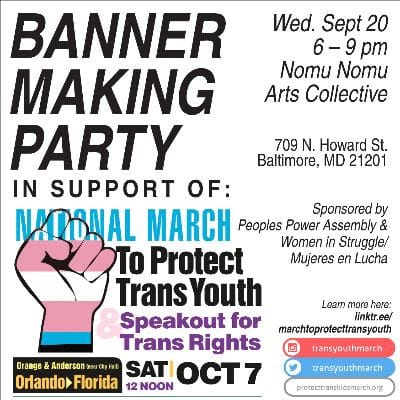
Baltimore Banner Making Party to Support National March to Protect Trans Youth

Baltimore Banner-Making Party in Support of
Oct 7th National March to Protect Trans Youth
Wed. September 20, 6 pm to 9 pm
At Nomu Nomu Arts Collective
709 N. Howard St., Baltimore, MD 21201

Join us for refreshments, banner making in solidarity with the national March. Hear messages from Florida, California & NYC

Sponsored by: Peoples Power Assembly & Women In Struggle/Mujeres en Lucha

www.Protecttranskidsmarch.org

linktr.ee/marchtoprotecttransyouth

Donate Venmo@SolidarityCenter

PAYPAL CLICK HERE
or mail checks made out to Solidarity Center,

Send to 703 E. 37th Street, Baltimore, MD 21218.

Strugglelalucha256


Free Leonard Peltier!

On Sept. 12, Leonard Peltier turned 79 years old in a maximum security federal prison in Coleman, Florida. He has spent over 47 years being locked up for being a leader of AIM — the American Indian Movement.

That’s 20 years longer than the time the old apartheid regime in South Africa imprisoned Nelson Mandela. The late President Mandela sought Leonard Peltier’s freedom.

So have people around the world. Thirty-five people were arrested at the White House on Sept. 12, demanding the Indigenous political prisoner’s release.  

The same day, people rallied in New York City’s Union Square for the AIM leader. Among those attending were Estela Vazquez, Executive Vice President at 1199 SEIU healthcare workers, and James Tarik Haskins, the former political prisoner and Black Panther Party member.

All Joe Biden has to do is pick up a pen to free an older man suffering from diabetes, hypertension, and partial blindness from a stroke. Jonathan Nez, President of the Navajo Nation, urged Biden to do that in a Nov. 30, 2022 letter.

So has the United Nations Working Group on Arbitrary Detention, Pope Francis, and seven U.S. senators. 

Even former U.S. Attorney James Reynolds — whose office prosecuted Leonard Peltier — wrote to President Biden asking that the AIM leader be pardoned. Reynolds admits that Peltier was convicted “on the basis of minimal evidence.” 

Revenge for resistance

Leonard Peltier is being kept locked up in revenge for the historic 71-day occupation of Wounded Knee, South Dakota, by AIM members and supporters in 1973. That’s where 300 children, women, and men from the Lakota Nation were slaughtered by the U.S. army in 1890.

In the years following the 1973 Wounded Knee occupation, over 60 people were murdered in the surrounding Pine Ridge reservation. Just as Mississippi represents for Black people the height of racism, so does South Dakota mean the same for Indigenous people. 

For example, in 1967, William Janklow (who later became South Dakota Attorney General and then Governor) raped 15-year-old Jancita Eagle Deer, who lived on the Rosebud reservation. Several years later, she was killed in a hit-and-run incident.

The FBI refused to do anything about the murders on Pine Ridge. Residents asked Leonard Peltier and other AIM members to provide support and protection.

Tensions resulted in a shootout in which two FBI agents and a young Indigenous man, Joe Stuntz, were killed. No one was prosecuted for Stuntz’s death.

But the death of the FBI agents allowed the U.S. Government to indict AIM members Leonard Peltier, Robert Robideau, and Dean Butler. Robideau and Butler were found not guilty. Peltier, who was extradited from Canada, was tried later and convicted in a tainted trial. 

Leonard Peltier is now imprisoned in Sumter County, Florida, where three Black people were lynched. Sumter County is also where the U.S. army suffered one of its most significant defeats in the Dade battle during the Second Seminole War in 1835.

In the spirit of Crazy Horse, free Leonard Peltier!

Strugglelalucha256


Abortion rights advance in Mexico, while Texas wants to trap ‘runaways’

On Sept. 6, Mexico’s Supreme Court struck down all federal criminal penalties for abortion. The court ruled that national laws prohibiting the medical procedure are unconstitutional and violate women’s rights.  

This was a major victory for the thousands of Mexican women and supporters who have been out in the streets fighting for abortion rights, and reflects the growing movement for abortion access throughout Latin America.

The Mexican court’s action stands in sharp contrast to the U.S. Supreme Court, which threw out Roe v. Wade last year. In the U.S., women’s rights are being turned back by a century. Transgender and other LGBTQ2S people are literally fighting for their lives.

While abortion rights activists in Mexico celebrate, simultaneously in Texas and other states, the reactionary drive to end reproductive rights grinds on. This same ruthless process continues to abolish medical care for trans people.

Under the banner of “stopping abortion trafficking” and “ending the baby murdering cartel,” Texas counties are poised to pass ordinances to block anyone traveling on roads within their county seeking abortion.

So far, two Texas counties have passed such ordinances, which include sections of Interstates 20 and 84. Those major highways connect to New Mexico, where new clinics have been opened to accommodate Texas women and others who can become pregnant since that state effectively outlawed abortion.

The strategy of the far right is to add other counties and cities in Texas – a chilling action that has been compared with 19th century laws to “stop runaway slaves.”

Maggie Vascassenno of Women In Struggle – Mujeres En Lucha stated, “Our strategy needs to be a furious fight back. We should learn from the activists in Mexico and Latin America.”  

The group is part of a grassroots coalition organizing a National March to Protect Trans Youth and Speakout for Trans Lives in Orlando, Florida, on Oct. 7. “Free, legal, accessible abortions” is one of the march’s demands. Learn more at ProtectTransKidsMarch.org

Strugglelalucha256


‘I am still here’: Leonard Peltier’s letter to supporters

Dear friends, relatives, supporters, loved ones:

79 years old. Mother Earth has taken us on another journey around Grandfather Sun. Babies have taken their first breath. People have lived, loved, and died. Seeds have been planted and sent their roots deep below red earth and their breath to the Stars and our Ancestors.

I am still here.

Time has twisted one more year out of me. A year that has been a moment. A year that has been a lifetime. For almost five decades I’ve existed in a cage of concrete and steel. With the “good time” calculations of the system, I’ve actually served over 60 years.

Year after year, I have encouraged you to live as spirit warriors. Even while in here, I can envision what is real and far beyond these walls. I’ve seen a reawakening of an ancient Native pride that does my heart good.

I may leave this place in a box. That is a cold truth. But I have put my heart and soul into making our world a better place and there is a lot of work left to do – I would like to get out and do it with you.

I know that the spirit warriors coming up behind me have the heart and soul to fight racism and oppression, and to fight the greed that is poisoning our lands, waters, and people.

We are still here.

Remember who you are, even if they come for your land, your water, your family. We are children of Mother Earth and we owe her and her other children our care.

I long to turn my face to the sky. In this cage, I am denied that simple pleasure. I am in prison, but in my mind, I remain as I was born: a free Native spirit.

That is what allows me to laugh, keeps me laughing. These walls cannot contain my laughter – or my hope.

I know there are those who stand with me, who work around the clock for my freedom. I have been blessed to have such friends.

We are still here and you give me hope.

I hope to breathe free air before I die. Hope is a hard thing to hold, but no one is strong enough to take it from me.

I love you. I hope for you. I pray for you.

And prayer is more than a cry to the Creator that runs through your head. Prayer is an action.

In the Spirit of Crazy Horse

Doksha,
Leonard Peltier

Source: NDN Collective

Strugglelalucha256


The Christmas night murders of Harriette Moore and Harry T. Moore in Florida

Ku Klux Klan terrorists planted dynamite under the Mims, Florida, home of Harriette Moore and Harry T. Moore. The bomb exploded on Christmas night, Dec. 25, 1951, their 25th wedding anniversary.

Nearby hospitals wouldn’t accept Black patients, so the Moores were taken 30 miles away. Harry T. Moore died on the way to the hospital, while Harriette Moore died nine days later. 

Their two daughters survived. Four Klan leaders were later identified as the killers, but no one was ever prosecuted for the murders.

The Moores were targeted because they were Black leaders. Harry T. Moore was the Florida executive secretary of the National Association for the Advancement of Colored People.

The Florida NAACP chapter grew to have 10,000 members in 63 branches. The Moores helped register 100,000 Black voters in Florida, more than any other southern state. 

Both had been fired from their jobs as teachers in 1946 because of their activism. In 1937, along with NAACP lawyer and future U.S. Supreme Court justice Thurgood Marshall, Harry T. Moore filed the first lawsuit in the South demanding equal pay for Black and white teachers.

One of Harriette Moore’s students, Paij Wadley Bailey, described the impact her teacher made upon her:

“Mrs. Moore did not complain or express outrage at having to teach us from old, tattered textbooks passed down to us from the white school. What she did do was teach us primarily from the few boxes of her own private books, which she kept hidden under her desk. Her books were about African-American people who had made important contributions to the world — people like W.E.B. DuBois and Mary McLeod Bethune. Mrs. Moore taught us about the freedom fighters Harriet Tubman and Sojourner Truth. She read stories to us by Zora Neale Hurston and poems by Langston Hughes, and she shared her Ebony Magazine articles about Black history.” 

This is the history that Florida Gov. DeSantis, Trump, and Fox News call “Critical Race Theory” and want to outlaw.

The Groveland 4 frame-up

The Moores fought to get justice for the Groveland Four. Four Black men were falsely accused of raping a white woman in Lake County, Florida, a Klan stronghold about 35 miles west of Orlando.

According to the Civil Rights Movement Archive, “later evidence indicates that the 17-year-old girl had been beaten by her husband and that they concocted a phony rape story to conceal the beating from her parents who had threatened to shoot him if he brutalized her again.” 

Sixteen-year-old Charles Greenlee and war veterans Walter Irvin and Samuel Shepherd were arrested in 1949. Ernest Thomas was hunted down by a posse and shot to death.

Following the arrests of Greenlee, Irvin, and Sheppard, a white mob of more than 400 people in 200 cars attacked Groveland’s Black community. Shots were fired at homes, with some set on fire. The National Guard had to be called in. 

Local Sheriff Willis McCall was notorious for his racist brutality. He routinely rounded up Black people to be used as convict labor for the orange grove owners. Union organizers were kept out of Lake County. 

The Moores exposed Sheriff McCall torturing the three Groveland defendants, forcing them to stand on broken glass in a failed effort to get false confessions from them. 

The Orlando Sentinel, still published daily, led a campaign to railroad the Black men. Before a grand jury convened — and Ernest Thomas was killed — the newspaper ran a front-page cartoon of four empty electric chairs with the headline “No Compromise!” 

An all-white jury convicted the three Black men, with two sentenced to the electric chair. Thurgood Marshall appealed their case to the  U.S. Supreme Court, which reversed the verdict and granted a new trial.

In November 1951, while driving the handcuffed Irvin and Sheppard to a hearing, Sheriff McCall killed Sheppard and shot Irvin in cold blood. Harry T. Moore called for the sheriff to be indicted for murder.

One month later, Harriette Moore and Harry T. Moore were murdered. Sheriff McCall should have been considered an obvious suspect by the FBI.

Irvin and Greenlee were re-tried and again found guilty, with Irvin again sentenced to be executed and Greenlee given a life sentence. Charles Greenlee was paroled in 1962; Samuel Sheppard’s death sentence was commuted, and he was paroled in 1968.

Both men are now dead. Decades later, the Groveland Four were officially exonerated.

In August 2021, Broward Hunter, a grandson of the Groveland Four’s prosecutor Jesse Hunter, told investigators about material he found in his grandfather’s law office. The correspondence convinced Broward Hunter that his grandfather and the judge who presided over the retrial knew that no rape had occurred.

Justice delayed is justice denied.


Strugglelalucha256


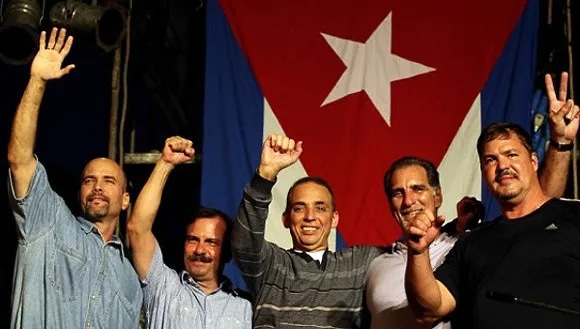
The significance of the Cuban 5 a quarter of a century since their arrest

Havana, Sept. 12 — The memory remains in the Cuban people for an event that occurred 25 years ago today. On September 12, 1998, five Cuban men were marked forever by the extreme hatred of those in Miami who have not ceased in attacking Cuba. That day they were arrested and their long battle for justice began.

Gerardo Hernandez, Ramon Labañino, Antonio Guerrero, Fernando Gonzalez and Rene Gonzalez were given brutal sentences ranging from 15 years to two life sentences, without being proven to be a danger to U.S. national security. They came to the U.S. unarmed except for the love of their homeland to monitor the activities of heavily financed anti-Cuba terrorist groups who were operating with impunity out of Southern Florida. Terrorists who were responsible for 3,500 deaths in Cuba since our revolution in 1959. The Cuban 5 should have never been even detained but on September 12 the FBI stormed into their apartments and locked them up in solitary confinement for 17 months.

Their federal trial took place in the hostile atmosphere of Miami and was the longest in U.S. history.  The shadiness of the court proceedings failed to prove anything except the penetration of the Five, without weapons, into the terrorist groups to learn their criminal intentions. Except for failure to register as a foreign agent, all the charges including espionage, could not be proven so the convictions were all based on conspiracy to commit charges. Exposing the true political nature of the trials and the government’s hatred of Cuba the U.S. justice system threw the book at them with long sentences. Ramon and Antonio got life sentences and Gerardo received 2 life sentences and 15 years.

As summarized by Cuban politician and diplomat Ricardo Alarcón de Quesada, the arrest took place almost three months after the visit to Havana of a high-level FBI delegation that was given abundant documentation and testimonial information about terrorist plans against Cuba and the financial backing of the Miami-based Cuban American National Foundation (CANF).

CANF, it should be remembered, was responsible for the lengthy record of services to the counterrevolution of terrorists like Luis Posada Carriles, the protagonist of many deadly like the mid-air explosion of a Cubana plane with 73 innocent people on board off the coast of Barbados in 1976.

The material turned over the FBI in Havana detailed investigations of dozens of terrorist acts planned between 1990 and 1998, with photographs of weapons, explosives and other evidence, and additionally 51 pages of the list of CANF money destined to various groups to do harm within the country.

In addition, the FBI received the files of 40 terrorists of Cuban origin, most of them residing in Miami, and the data to find each one. Also, the recordings of telephone conversations of Posada Carriles giving instructions for plans of sabotage in Cuba, and the information also included addresses of his homes in several countries, license plates of his cars and a list of places he frequented.

The U.S. delegation took samples of bombs deactivated at the Meliá Cohíba Hotel in April 1997, and in a tourist bus in October of the same year. Also, of the explosive device confiscated from two Guatemalans in March 1998, and the recordings of their statements, which clarify their links with Posada Carriles and Orlando Bosch.

When the FBI returned not a single piece of evidence was used to open up an investigation, much less the arrest of any of the terrorists instead, they went after the messengers. On September 12, the politically ambitious head of the FBI in Miami, Hector Pesquera,  was all over the Miami media smiling with anti-Cuban members of Congress, Ileana Ros Lehtinen and Lincoln Diaz-Balart, as he informed them of the arrest of the Five.

This jubilation did not last long because it was not long after that Fidel acknowledged publicly that the Five had been arrested and he vowed that they would Return. From that moment on the Cuban 5 became the only political prisoners in the world that had the backing of entire country demanding their freedom.

More than 16 years later, after months of negotiations between the governments of Cuba and the United States, on December 17, 2014, the final three of the Five Heroes returned to their homeland to walk free and continue to be defenders of the Revolution and the right of Cuba to determine its own future.

The real reason for their release was not because the U.S. somehow had a change of heart but rather through popular struggle. It was because of the unbendable bravery of the Cuban 5 in deplorable U.S. prisons, It was because of the relentless determination of their families who traveled the world as active agents in the battle for their freedom, it was because of the unwavering support of the Cuban people through all those years, and it was also because of the strength of a worldwide solidarity movement that kept growing calling for their release. Committees in support of the Cuban Five sprung up in over 150 countries and no U.S. Embassy in any part of the world was spared demonstrations demanding justice and their freedom.

The story of the Cuban 5, which began with their arrest 25 years ago today, is an important lesson that can still be applied today in our demands to end the unilateral blockade of Cuba and it gives the world hope that a better world is possible.

Source: Cuba en Resumen

Strugglelalucha256


New York City: France Out of Africa — U.S. and NATO too! Sept. 19

Rally against French President Macron at the 78th UN General Assembly

Tuesday, September 19 – 12 noon
Dag Hammarskjold Plaza (enter 47th St. & 2nd Ave.), Manhattan

Initiated by December 12th Movement

Strugglelalucha256


‘Standing up for trans people is self-defense for every worker’

Interview with Oct. 7 organizer

Transgender activist Melinda Butterfield is one of the key organizers for the Oct. 7 National March to Protect Trans Youth and Speakout for Trans Lives in Orlando, Florida. She is also a co-editor of Struggle-La Lucha.  

In May, Butterfield led a Women In Struggle/Mujeres en Lucha LGBTQ2S delegation to Cuba to participate in the Days Against Homophobia and Transphobia. The trip allowed activists from around the U.S. and from a variety of groups to learn more about Cuba’s new, expansive Families Code. 

Sharon Black: How is the mobilization going? I know that you’re encouraged about the involvement of trans activists around the country and especially in Florida. Could you let us know how Oct. 7 is building and why you think that is so?

Melinda Butterfield: We started organizing on Trans Day of Visibility, March 31. There was a lot of enthusiasm for the idea of a national march for trans rights from the beginning, but organizing was slow at first. We started with a diverse group of trans people from all parts of the U.S., most of whom had never worked together.

We thought it was important to hold the protest in Florida, which has been the epicenter of anti-trans attacks this year under governor and presidential candidate Ron DeSantis. It’s crucial to show solidarity with the many trans youth there who have no opportunity of fleeing to another state. But trying to hold a national action in such a hostile environment presents special challenges. 

Some folx dropped out pretty quickly because life stuff gets in the way. That’s especially true for trans people, who shoulder a lot in their daily struggle to survive in an increasingly hostile society. But we kept pushing ahead. Organizing something like this on a national scale is never easy, especially when you have few resources to start with.

Over time, we got a solid core of activists, trans people and cisgender allies alike, who are committed to the idea behind the march – that there needs to be an independent mass movement, national in scope, to confront the far-right program of anti-trans genocide – in the spirit of the Civil Rights Movement and the Stonewall Rebellion. And who understand that this movement needs to be in solidarity with other oppressed groups under attack from these white supremacists. With their help, we were able to broaden our reach, especially in Florida.

By the end of July, it started to feel like things were really coming together. And now we’re in the final weeks and days, the most exciting part of the mobilization, when a lot of groups and individuals are getting the word out and making plans to attend!

A lot of people who support the march in theory are understandably worried about coming to Florida. I’m not just talking about trans people, but many cis progressives too, especially after laws came into effect this summer banning trans people from using public restrooms that correspond to their gender and giving the state legal cover to kidnap trans kids from their parents. And, of course, gender-affirming care for both youth and adults has been outlawed there.

We very carefully and deliberately chose Orlando as the site of the march, because it is where the contradictions between DeSantis and the tourism industry are sharpest, where the local authorities are not inclined to enforce measures like the restroom ban because they are not beneficial to local businesses. Orlando also has a large, organized queer community, and many of the city’s low-wage service workers are queer. 

Most importantly, we are working to provide the best possible people’s security for the march and those who choose to attend because, as the slogan goes, “we keep us safe.”

Divide and conquer

SB: I understand that trans and queer groups are in the leadership, but why should others join this mobilization? Is Oct. 7 connected to other struggles, both in Florida and nationally?

MB: Trans people are public enemy #1 in Florida and much of the U.S. right now. And even in “safe” areas like New York City and Los Angeles, there is growing fascist street violence and emboldened acts of bigotry. It’s no exaggeration to say that every trans person, whether they are out or still in the closet, has been affected by this and feels a growing sense of dread.

But trans people aren’t the only ones being targeted. In Florida, DeSantis and his ilk are going after the broader LGBTQ2S community too. They are going after immigrant workers and the Black community, students and teachers, librarians, reproductive rights for women and other people who become pregnant, unions. It’s the same story in many, many other places.

Capitalism relies on divide and conquer. A fascist movement ramps that up to 11. In Florida, in Texas, in Ohio, in Montana, and in Washington, D.C., too, the far right has telegraphed very clearly that once the transgender “menace” is eliminated, they will turn their attention to the next group they find undesirable.

In a very concrete way, standing up for trans people at this moment is not just the right thing to do – it’s a necessary act of self-defense for every working-class person, every marginalized community, in this country. 

Anti-fascism at home and abroad

SB: You have a long history of opposing the fascists in Ukraine. You’ve written about that and been involved in protests against Ukrainian fascists and in support of the people of the Donbass region. Can you explain why Oct. 7 is also on the cutting edge of fighting fascism.

MB: I’m glad you brought up Ukraine because the war there is not well understood by the queer community in the U.S., nor by the left generally. I’ve been organizing in solidarity with anti-fascists in the Donbass region and exiled Ukrainian anti-fascists since the U.S. supported a far-right coup in Ukraine nearly ten years ago.

The current military struggle by Donbass people, Ukrainian anti-fascists, and the Russian military against the Ukrainian regime and NATO is one of the most important struggles against fascism in the world. This is masked deliberately by the Biden administration, which poses as a friend of queer people but sends billions of dollars in weapons and aid to help Ukrainian fascists wipe out the people of Donbass and facilitate a U.S. takeover of Russia. 

The growth of fascist movements in Ukraine like the Azov Battalion, promoted and supplied by the U.S., has inspired neo-Nazis and violent white supremacists from the U.S. to New Zealand. In fact, speakers at a fascist gathering waving Nazi flags in Orlando on Sept. 2 spoke approvingly of Biden arming Azov. As Dr. King said about the U.S. war in Vietnam, the bombs dropped abroad also explode at home.

Of course, the capitalist government of Russia has not helped to clarify the situation with its hateful anti-trans and anti-gay policies. The origins of this are complex, but an important thing for queers in the U.S. to understand is that “our” government – both Republicans and Democrats – promoted right-wing, homophobic, transphobic U.S. evangelical intervention in Russia and Eastern Europe in the 1990s and early 2000s to further U.S. interests, just as it did in Uganda. And today we’re seeing the logical outcome of that.

Just as Donbass is at the cutting edge of anti-fascist struggle internationally, the fight against trans genocide is the cutting edge of anti-fascist struggle in the U.S. right now, along with the fight against white supremacist violence, like the recent massacre of three Black people in Jacksonville, Florida. 

Oct. 7 will not only be the first national protest for trans rights since the current wave of attacks began, it’s also the first national protest against the fascist movement, which has become more violent and aggressive since Jan. 6, 2021, from Congress to state houses to the streets.

If we unite to forcefully push back the violent attack on trans lives and Black lives, it will be a serious blow to the far-right politicians, fascist groups like the Proud Boys and Moms for Liberty, and the wealthy capitalists behind them.

Grassroots mobilization 

SB: Women In Struggle and all of the groups and individuals who initiated the Oct. 7 march, while courageous, are relatively lacking in resources. Why haven’t larger, more mainstream groups initiated such a call? 

MB: Our call for a national march was very much based on frustration with the lack of a national response to the growing anti-trans attacks. And it quickly became apparent that others felt the same way! When I was giving out the first leaflet promoting the idea at the Trans Day of Visibility in Washington, D.C., so many people thanked me and said they couldn’t understand why it hadn’t already been done.

There have been lots of wonderful, heroic battles waged at the local and state level to defend trans rights. Why has no one tried to unite them into a powerful movement?

We know why. Like many progressive communities in the U.S., the LGBTQ2S community has been dominated for decades by nonprofits closely tied to capitalist foundations and the Democratic Party. Their orientation is entirely based on two-party electoral politics as the be-all and end-all of what queers should aspire to. And so they are completely unprepared to deal with a situation like this, which requires a militant fightback that doesn’t meet the approval of their political and funding patrons.

As with so many people’s movements – from Civil Rights to reproductive rights to queer liberation to anti-war – the initiative for this fight comes from the grassroots, from the most revolutionary and radical forces. And we have to drag the groups with money into the struggle, kicking and screaming, while working diligently to preserve an independent, radical orientation that can actually achieve our goals – to not only push back the attacks on trans rights but to expand those rights.

It’s disappointing that even on the radical left there is lack of initiative in defense of trans lives. There are left groups that, on paper, are in favor of trans rights and would have been much better positioned to initiate an event of this scope. Why they didn’t – if it’s out of fear of repression, sectarianism, or the pressure of reformism and so-called “patriotic socialism” in the movement – I can only speculate. We would welcome their involvement, but so far it hasn’t happened. 

Bravery of trans youth

SB: Is there anything else that you would like to add, including your own personal perspective as a trans woman?

MB: Like many trans people, I’m deeply motivated to protect trans and questioning young people. Because I was a trans child myself, and I don’t want anyone to ever again have to go through the abuse, torture, and years of self-hatred and misery that came with being denied my true identity. No child should ever be subject to that – not by the state, not by the church, and not by their parents. 

It was the bravery of young trans people coming forward that finally helped me to come out later in life.

In 1963, Gov. George Wallace of Alabama stood in the schoolhouse door to prevent desegregation. President John F. Kennedy ordered the National Guard to remove him and enforce integration.

Today, Ron DeSantis and many others are metaphorically standing in the door of the schoolhouse, the doctor’s office, the restroom, and the library. President Joe Biden has not lifted a finger to stop him, and shows no inclination to do so.

The difference has nothing to do with the character of the presidents in question. Kennedy and Biden are both reactionary Cold Warriors, and no friends of queers or Black people. The difference is that in 1963 there was a mass movement for Civil Rights – one that the capitalists and their politicians feared and were unable to control. This is the example we have to look to. 

When the bosses fear the people, then we will see a roll-back of the anti-trans attacks and other reactionary measures. When the fascists who invade our streets know they will be met and confronted by a united people’s movement, then they will scurry back into their holes.

Oct. 7 is about taking the first steps toward building that kind of movement – the kind that can win.

Join the struggle!

SB: Where and how can people get involved?

MB: Whether or not you can come to Orlando, there are lots of ways to get involved. But you should come if you can!

Go to our website, ProtectTransKidsMarch.org, and sign up. If you represent an organization, ask them to endorse. On the website, you can make a donation to help with expenses like transportation. You can also download flyers and posters to print and distribute in your area.


We have biweekly organizing meetings online, as well as committees organizing things like logistics, social media, and program. Sign up at the website, and we’ll let you know how to participate in those meetings.

Also let us know if you’re planning to come to Orlando on Oct. 7. We can help you find a hotel or alternative housing. If you live in the Orlando region and can provide sleeping space for a night or two, let us know.

A really easy way to help is by getting out the word on social media. Visit Linktr.ee/transyouthmarch for links to our social media pages. Follow us on your preferred platforms and share our posts with your friends and contacts.

All out for Oct. 7!

Strugglelalucha256


The lessons of Chile

Sept. 11 marks the 50th anniversary of the CIA-orchestrated coup against democratically elected socialist President Salvador Allende of Chile. Tens of thousands of people were killed or “disappeared” in the aftermath. Even today, new evidence of U.S. involvement continues to be revealed.

Chile’s coup continues to offer invaluable lessons for revolutionaries worldwide. Struggle-La Lucha presents this piece by Sam Marcy, one of the leading Marxist thinkers and fighters of the second half of the twentieth century. Marcy gave these remarks in New York City on Sept. 12, 1973 – about 18 hours after the first news of the military coup in Chile.

First of all, we must express our solidarity with all who are fighting in Chile against the fascist military coup, which is financed and organized by the U.S. imperialists. In the struggle against the fascist military and U.S. imperialism we have consistently shown our support of the Allende government in demonstrations and propaganda.

Although at the present time there is no decisive victory for the counterrevolution, it is nevertheless possible to understand the broad outlines of the events and to clarify the tasks of our party.

While carrying out the struggle here with the deepest-felt sympathy for all victims of the coup, it is also the responsibility of the working class leaders to explain to the advanced elements the disastrous consequences of the policies of Allende and the parties in the Popular Unity (UP) coalition, particularly the Communist Party.

These policies can be summarized as follows.

Peaceful transition

After Allende took office through a bourgeois election, it was claimed by sections of the UP coalition that the working class had already, or could in the future, come to power peacefully, without revolutionary violence or civil war.

We are for a peaceful transition to socialism – if it can be proven that it is possible. We are not dogmatic adherents of violence. But in over 100 years of experience of the class struggle by the proletariat, beginning with the Paris Commune, there has not been one instance where the bourgeoisie relinquished power peacefully. And it should be remembered that the bourgeoisie itself nowhere came to power without an armed struggle. 

When Allende took office (not state power!), the reformist parties sowed illusions among the oppressed that it was possible to avoid the sacrifices necessary for revolution. But Marxism is not just a dream of socialism – it is the realistic appraisal of centuries of class struggle.

The bourgeois pacifist ideology of peaceful transition was exploded by the Russian Revolution. There it was proven that the road to workers’ power lay in being able to counter the organized violence of the bourgeoisie.

But after the defeat of the German working class by Hitler in 1933, the old discredited theory was revived by Stalin. Before the triumph of fascism, Stalin had pursued an ultra-left position, refusing to call for a united front of the working class parties against the fascists on the grounds that the “social fascists” (Social Democrats) were as bad as the Hitlerites. The triumph of fascism led to such panic in the communist parties that the line was completely reversed, and the so-called “popular front” was urged on the workers of France and Spain.

In the popular front, the workers’ parties entered into a coalition with the “democratic” section of the bourgeoisie – the first time such a tactic was ever adopted by the communist movement. This political alliance with one section of the bourgeoisie against the fascist wing was presented to the workers as their only hope – and as a means for the peaceful transition to socialism because of the “split” in the ruling class. However, the popular front subordinated the workers’ demands to the unity of the coalition, and in the end only paved the way for the workers’ defeat, as has now happened again in Chile.

An electoral majority

Another fatal assumption made in Chile by the UP was that the working class must win an absolute parliamentary majority in order to rule.

At best, an election is a barometer of the consciousness of the working class. It is utopian to assume that the legal and electoral machinery developed to facilitate capitalist rule will be the instrument for the working class to assume power. (In Chile, only 2.5 million people voted in the last presidential election out of a population of nearly 10 million.)

While Allende took office on plurality (36% of the vote), it became clear in subsequent struggles that the workers and peasants were solidly behind the socialist program of the workers’ parties. The Christian Democrats and the other bourgeois parties, on the contrary, represented only the interests of the biggest landowners and capitalists. They swung over large sections of the petty bourgeoisie after the workers’ parties failed to act in a revolutionary manner to resolve the crisis.

Coalition with bourgeoisie

The Allende government represented a coalition between representatives of the working class and of the bourgeoisie.

A coalition of parties representing the dispossessed classes is valid in the struggle for socialism – such as a coalition of workers’ and peasants’ organizations. Thus the alliance of the workers’ parties (the Communist Party, Socialist Party, and smaller groups) in the Popular Unity coalition could serve to advance their class interests.

But it is another thing when the workers’ representatives ally themselves with representatives of the bourgeoisie in the cabinet – regardless of whether they are appointed by a socialist president or a bourgeois president. The assumption made in such a coalition is that the bourgeoisie will aid in the transition to socialism and facilitate the course of the revolution.

Since Allende based himself on parliamentary relationships rather than class relationships he felt obligated to take the bourgeoisie (and eventually its military arm) into the cabinet. In such a situation, one class or the other must surrender its interests in order to maintain the coalition. In the wake of the coup, it is clear which class’s interests were surrendered. 

This is to be distinguished from the addition of a bourgeois representative to a workers’ government after it has seized state power, such as occurred in the early days of the People’s Republic of China. In that case, the capitalist representatives wielded no independent class power and symbolized the humane attitude taken by the government to individuals sympathetic to the revolution.

Sabotage of the economy

It was assumed that because the bourgeoisie was part of the government, it would not sabotage its own economic system. 

Yet this was one of the prime tactics of the Chilean capitalists, with much backing, we can be sure, from U.S. imperialism. They went so far as to sabotage the economy with the truck-owners strike, blow up power and communications lines, and spur on inflation, all in order to tire out the masses.

The only answer the workers have to such sabotage is the complete overthrow of the bourgeois state, the expropriation of the means of production (not only those directly in foreign hands), and the institution of the planned economy.

The ‘neutral’ military

Again and again it was argued by the reformists that the Chilean military would remain “neutral” in the class struggle because of its long adherence to the Constitution. 

As long as class relations are stable within a country, there is no need for the military to intervene. That is the reason for the 40-odd years of constitutional government in Chile (which is really not so long). But the military is trained and nurtured in the spirit of class war. What else does the military brass have to do – especially the retired officers? It should be the ABCs for Marxists and Leninists to understand the class character of the bourgeois state.

(Before Hitler took power in Germany, it had been argued that so many of the police were Social Democrats and Communists they could never be used to suppress the workers.)

Role of the middle class

The Popular Unity relied on the petty bourgeoisie to side with the workers and peasants.

History has shown that the petty bourgeoisie always vacillates in times of grave class struggle, and will side with the class that is strongest. The petty bourgeoisie has no separate destiny, but is in between the two great class camps. 

Whether the truck owners should even be considered petty bourgeois is questionable. In a poor country like Chile, to own a truck is to control a substantial amount of property. Certainly they were supported in every way during the strike by the bourgeoisie.

Role of the national bourgeoisie

The left miscalculated the role of the national bourgeoisie.

The national bourgeoisie in an underdeveloped country can play a progressive role in relation to imperialism – being for the nationalization of U.S. property, for instance. But it does so only in its own interests. As an exploiting class, it desires to free the national resources from foreign hands in order to exploit them itself. There has never been a bourgeoisie which can play a progressive role in relation to the demands of the working class. They will fight the workers and peasants to the death over the means of production.

The fact that the national bourgeoisie is poorer than the imperialists does not make it progressive at home. As Marx pointed out, often a small owner has to exploit the workers even more and the class antagonisms in a small sweatshop may be even more acute.

The USSR and China

The communist parties of China and the Soviet Union failed to give revolutionary guidance in the face of these disastrous policies.

There was no helpful criticism or guidance forthcoming from the fraternal parties of the Soviet Union or China, even though history had shown many times in the past the disastrous consequences of such policies. The Bolsheviks considered it their duty to explain again and again the revolutionary lessons of their experience for the benefit of the workers in other countries. Until a few years ago, the Chinese leadership also urged the revival of revolutionary tactics and exposed reformist, revisionist ideology.

With the détente, however, both these powerful socialist countries have promised Nixon not to interfere in the “internal affairs” of countries under the domination of imperialism. Real communists should reject this shibboleth, which permits the imperialists free rein in their economic and military subversion of the oppressed, while it binds the socialist countries to a narrow, national outlook.

To accept the doctrine of “noninterference in the internal affairs” of capitalist countries is to formally renounce proletarian internationalism and leave each working class on its own in the struggle against imperialism and capitalist domination.

The revolutionary cadres in Chile must rebuild, reconstitute themselves, and create a transition to socialism built on reality, on the armed working class. We look forward and pledge ourselves to building a movement in solidarity with the resistance movement in Chile. In the heartland of the imperialist culprits, that is our duty.

Strugglelalucha256
https://www.struggle-la-lucha.org/2023/09/page/4/