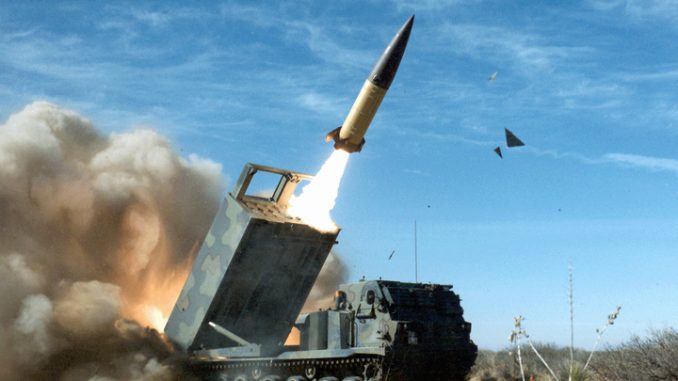
How could Russia respond when Kiev gets ATACMS missiles and armed drones?

An ATACMS being launched by an M270. Photo: Wikipedia

It’s virtually guaranteed that the Kiev regime will get the MGM-140 ATACMS (Army Tactical Missile System), a U.S.-made tactical/theater ballistic missile system with a maximum engagement range of approximately 300 km and a supersonic speed of up to Mach 3. While its capabilities are far from Russian counterparts, such as the now legendary “Iskander” with a hypersonic speed (up to Mach 8, with maneuvering capabilities for its missiles) and a range of approximately 500 km, this is still enough to jeopardize Russian supply lines, as well as civilian settlements deeper within Moscow’s territory. The ATACMS can also be fired from two platforms, namely the tracked M270 MLRS (Multiple Launch Rocket System) and the wheeled M142 HIMARS (High Mobility Artillery Rocket System), both of which have been delivered to the Neo-Nazi junta forces well over a year ago.

When paired with adequate ISR (intelligence, surveillance, reconnaissance) assets, which NATO fields extensively, particularly in the vicinity of Russian borders, the ATACMS can be quite a challenge. Its battlefield performance can be significantly amplified through the effective usage of real-time ISR data that essentially acts as a major force multiplier. This is where the legal “grey areas” of warfare get even more complicated. Namely, Moscow is doing its best to keep the scope of the SMO localized, but NATO continues to escalate, as evidenced by the resurgent presence of its ISR platforms around Russia’s borders, particularly in the Black Sea. The Russian military already shot down some of NATO’s ISR platforms, resulting in several months of pause in flights close to the SMO zone. However, the belligerent alliance recently restarted this highly destabilizing practice.

Moscow is perfectly aware that the political West controls the Kiev regime’s targeting, even issuing orders on which Russian assets are to be attacked. The sole reason why Russia hasn’t responded by shooting down all NATO ISR platforms in the relative vicinity of its forces is that it wants to avoid escalating the conflict. However, the U.S.-led political West sees this as a weakness and an opportunity to hurt Russia because the way the Ukrainian conflict is being conducted is highly beneficial to NATO. Namely, the way that the political West is engaged in hostilities in Ukraine would simply be impossible in a shooting war with Moscow. The reason is quite simple. One of the very first targets for Russian Aerospace Forces (VKS) would be NATO’s ISR platforms. Precisely these are responsible for the vast majority of data being relayed to the Kiev regime.

As Ukraine borders four NATO members, this gives the belligerent alliance a unique opportunity to use their airspace for ISR flights. And while the political West argues that these are “perfectly legal” and that the aircraft “just passively collect information,” the impact of their activities is anything but “passive.” NATO ISR platforms are directly responsible not only for the deaths and injuries of Russian servicemen but also civilians. The United States Air Force (USAF) and the British Royal Air Force (RAF) are the most active NATO members in this regard, particularly with their Boeing RC-135V/W SIGINT (signals intelligence) aircraft that regularly fly over the Black Sea. These are among the belligerent alliance’s most commonly used strategic ISR assets and play a crucial role in spying on Russian forces, covering the collection of ELINT (electronic intelligence) and COMINT (communications intelligence).

These are used to find gaps in Russian defenses (particularly radar coverage) which are then reported to the Neo-Nazi junta forces that can exploit them to launch attacks on valuable assets, as evidenced by recent air strikes with NATO-sourced cruise missiles. This makes ISR aircraft far deadlier than satellites that simply cannot loiter in an area to provide a constant supply of real-time data. NATO SIGINT aircraft also complicate Russian communications significantly, as military units are forced to maintain radio silence or use encryption, which slows down battlefield coordination, thus degrading their effectiveness. More precisely, Moscow’s military planners simply have to pay close attention to what sort of information will end up in the hands of NATO, as this could help in the creation of better countermeasures against Russian forces.

The sheer magnitude of ISR data collected by SIGINT aircraft has helped the Kiev regime forces to a certain extent, but not nearly enough to create conditions for defeating Russian troops. Still, it’s often enough to bring the much-needed PR “victories” that are a crucial part of the overall propaganda war. However, with the delivery of the ATACMS, things can become a lot more complicated, forcing the Russian military to expand the scope of the SMO. Namely, since it’s a land-based missile system, the ATACMS is logistically far less strenuous than the Franco-British “Storm Shadow/SCALP EG” or the German-Swedish “Taurus,” both of which are air-launched and are limited by the number of carrier aircraft (in the case of Neo-Nazi junta, that would be the Soviet-era Su-24), as well as the logistics for the said aircraft. To say nothing of the possibility these could get shot down.

On the other hand, the launch of a single ATACMS is not only more difficult to detect on time, but the weapon is also several times faster than air-launched cruise missiles, meaning that Russian air and missile defenses have significantly less time to respond. This changes the calculus for Moscow, as its major assets could be targeted, causing significant losses that will not be easy to replace, while it may prove difficult to detect and destroy the ATACMS launchers. Once again, it would be impossible for NATO to wage a direct war against Russia in this way, as the VKS would simply send its fighter jets, such as the superfast, high-flying MiG-31BM interceptor or the state-of-the-art Su-35S, both of which carry unrivaled long-range air-to-air missiles (AAM), such as the 400-km-range R-37M, known for its ability to maneuver at hypersonic speed (Mach 6).

Such AAMs would be used to easily destroy any ISR aircraft and other supporting assets hundreds of kilometers around Russian borders. Having the Neo-Nazi junta do all the heavy lifting and dying for “a NATO mission” while the belligerent alliance collects battlefield data is perfect for the political West, but only as long as they can maintain plausible deniability of involvement. However, as Moscow is losing patience for this sort of insolence, the conflict that is still largely limited to Ukraine could inevitably escalate, as Russia can decide to legally redefine what constitutes direct involvement. For the time being, the Russian military might decide to shoot down unmanned SIGINT assets, such as the RQ-4B “Global Hawk.” This was already done once when a Russian Su-27SM3 masterfully downed a USAF MQ-9 “Reaper” back in March.

What’s more, the political West is close to approving deliveries of such drones as well, specifically the MQ-9 and the medium-range MQ-1C “Grey Eagle.” However, these were designed to fight low-tech enemies, meaning they’re completely useless against opponents like Russia, which shot down over 100 “Bayraktars” by April. And while some ISR drones, such as the RQ-4B are extremely expensive and strategically important, the “Global Hawk” is still just a machine, unlike the RC-135, which is manned by up to 30 crewmen. Still, if the political West decides to continue escalating even in that case, then Moscow will be forced to shoot down all of NATO’s ISR assets, which could potentially lead to a world-ending thermonuclear confrontation. If the belligerent power pole thinks it’s worth risking the fate of the world over this, then so be it, as Moscow has had enough.

Drago Bosnic is an independent geopolitical and military analyst.

Source: InfoBrics
Strugglelalucha256


Unite and fight for United Auto Workers on strike – NYC, Sept. 30

Strugglelalucha256


Struggle ★ La Lucha PDF – September 25, 2023

Get PDF here

  • Striking auto workers battle billionaire CEOs
  • When the auto workers went on strike in 1970:
    Revolutionary implications of the GM strike
  • Free Leonard Peltier!
  • ‘I am still here’: Leonard Peltier’s letter to supporters
  • ‘AG Landry, you’re a crook! Kids deserve to read gay books!’
  • The Christmas night murders of Harriette Moore & Harry T. Moore in Florida
  • Starbucks Worker Solidarity Day of Action
  • Abortion rights advance in Mexico, while Texas wants to trap ‘runaways’
  • ‘For All of Mankind’ and other lies
  • Libya, devastated by U.S./NATO bombing, unprepared for extreme storm floods
  • LET CUBA LIVE: Take a stand and get Cuba off the SSOT list
  • Cuba’s President Díaz-Canel at United Nations: ‘A new and fairer global contract is urgently needed’
  • Infierno escolar en Puerto Rico
  • Lola Rodríguez de Tió
Strugglelalucha256


Low-wage workers of the world, unite!

War and Lenin in the 21st century, part 5

Lenin’s “Imperialism, the Highest Stage of Capitalism” was written and published during World War I to show that the war was imperialist on all sides. Lenin also exposed the Second International’s betrayal. The leading socialist parties abandoned international working-class solidarity to give support to their own governments in the war.

Lenin denounced the opportunism and social chauvinism of Karl Kautsky and the leaders of the Social Democratic parties. The betrayal, however, was not simply blamed on flawed leaders. Behind these leaders stood material interests that are based on larger economic forces. 

Colonialism and imperialism had oppressed, colonized, and enslaved peoples around the globe. They had been robbed of their land, resources, and culture. 

In “Imperialism,” Lenin finds the root of the betrayal in imperialist superprofits.

Lenin writes that “capitalism has now singled out a handful of exceptionally rich and powerful states which plunder the whole world … Obviously, out of such enormous superprofits (since they are obtained over and above the profits which capitalists squeeze out of the workers of their ‘own’ country), it is possible to bribe the labor leaders and the upper stratum of the labor aristocracy. And that is just what the capitalists of the ‘advanced’ countries are doing: they are bribing them in a thousand different ways, direct and indirect, overt and covert.”

The class struggle

The exploitative relationship between imperialist monopoly capitalism and the working class and oppressed peoples constantly shifts as conditions evolve. In its drive for profits, monopoly capitalism is always seeking new ways to exploit workers as the economic and political landscape transforms. 

Even as workers organize and fight to improve working conditions and increase wages, the system undermines those gains for the benefit of the capitalist class. 

In the current era, advances in science and technology have dramatically increased the productive capacity of workers in industry and agriculture — especially in robotics, computer-aided design/manufacturing, energy production, health care, transportation and logistics, automated warehouses, self-driving trucks, and AI. These developments have allowed monopoly corporations to reshape global production networks and supply chains. 

They have incorporated hundreds of millions of low-wage workers worldwide into industry and services. This globalization has broken down many borders, internationalizing jobs and wages. By accessing labor in the Global South, monopolies are driving down wages and benefits of workers in the imperialist industrialized countries. The scientific-technological revolution has thus enabled a new phase of exploitation and oppression. This relentless pursuit of profit through global labor arbitrage impacts the working class everywhere.

Globalization drives migration

Global labor arbitrage means moving jobs to countries with low wages and where business costs (such as environmental regulations) are inexpensive. At the same time, impoverished workers migrate to countries with higher-paying jobs.

In the past, the imperialist powers were limited in their ability to exploit workers by geographical constraints. However, advances in science and technology have removed these barriers. Multinational corporations can now easily tap into labor forces across the entire planet. Workers anywhere can potentially be subjected to super-exploitation in the drive for ever greater profits. 

The scientific-technological revolution has enabled a new form of boundary-less capitalist exploitation. The tools of high-tech globalization have allowed exploitation by monopoly capitalists to become truly global in reach. Geography and borders no longer restrict their ability to maximize profits through labor exploitation worldwide.

When Lenin was writing in 1916, imperialist export of capital, colonialization, and its superprofits were used to cultivate an opportunist section of labor leaders and politicians in the imperialist countries. While that has continued, it is being scaled back.

With the global exploitation of labor, the export of capital and the drive for imperialist superprofits are going in another direction. Today, it is used to lower living standards for all workers in imperialist countries, not just the most oppressed. The top tiers of workers and parts of the middle class are being down-graded. Job security and social benefits are being dismantled. Rather than pacifying a privileged layer of workers, imperialist monopoly capital now uniformly undercuts wages, benefits, and rights across the working class in the imperialist countries. It aims to maximize profits globally. 

The continued global integration of production and the rapid expansion of the international working class has made cross-border solidarity an urgent necessity. As more aspects of work become globally interconnected, workers around the world are facing common challenges of exploitation and oppression under imperialist capitalism. 

The only way to fight back is through unified resistance across all borders. The growing ranks of international labor from all corners of the world have shared class interests. Workers need to build solidarity networks across borders to confront the forces of monopoly capital. 

In the U.S.

Over the last four decades, most of the working class in the United States has experienced a continuous erosion of wages and benefits. Throughout these 40 years, workers struggled unsuccessfully against an unrelenting and oppressive union-busting campaign. Union membership has been severely eroded. The United States now has the lowest union membership rate (about 10% of workers) of any of the imperialist industrialized countries. 

Wages have stagnated or declined in the U.S. since 1973. Real (inflation-adjusted) wages have fallen by 4-10% since then. According to the U.S. Census Bureau, women still make 20% lower wages. The U.S. poverty rate rose to 12.4% in 2022 from 7.8% in 2021, the largest one-year jump on record, the Census Bureau reported Sept. 12. At the same time, poverty among children has more than doubled.

The summer of 2023 has been marked by a wave of strikes across the United States. Workers in a variety of industries, including health care, education, manufacturing, and transportation, have walked off the job to demand better pay, working conditions, and benefits. Rising inflation has seriously cut wages.

In order to win, these strikes require unity across the working class through solidarity with other labor and community organizations. That means fighting for equality for Black, Latinx, Asian, and Native peoples; fighting for equal pay for equal work for women workers; defending equality for lesbian, gay, bi, trans, and queer workers; equality for immigrant and undocumented workers.

Labor must build these alliances and show support beyond just their membership. Isolated strikes will struggle. But strikes backed by a united working-class front can win. Solidarity is key.

To borrow a phrase:

Low-wage workers of the world, unite!

War and Lenin in the 21st century

Strugglelalucha256


Plymouth, Mass.: 2023 National Day of Mourning, Nov. 23

Thursday, November 23, 2023 at 12 PM – 3:30 PM EST

2023 National Day of Mourning
Cole’s Hill, Plymouth, MA (hill above Plymouth Rock)

E-mail: info@uaine.org
Website: http://www.uaine.org
ORIENTATION FOR 54th NATIONAL DAY OF MOURNING 11.23.23
WHAT IS NATIONAL DAY OF MOURNING?
An annual tradition since 1970, National Day of Mourning is a solemn, spiritual and highly political day. Many of us fast from sundown the day before through the afternoon of that day (and have a social after NDOM so that participants in NDOM can break their fasts). We are mourning our ancestors and the genocide of our peoples and the theft of our lands. NDOM is a day when we mourn, but we also feel our strength in action and solidarity.
WHEN AND WHERE IS DAY OF MOURNING?
Thursday, November 23, 2023 (U.S. “thanksgiving” day) at Cole’s Hill, Plymouth, Massachusetts, 12 noon SHARP. Cole’s Hill is the hill above Plymouth Rock in the Plymouth historic waterfront area.
WILL THERE BE A MARCH?
Yes, there will be a march through the historic district of Plymouth. Plymouth agreed, as part of the settlement of 10/19/98, that UAINE may march on National Day of Mourning without the need for a permit as long as we give the town advance notice.
PROGRAM: Although we very much welcome our non-Native supporters to stand with us, it is a day when only Indigenous people speak about our history and the struggles that are taking place throughout the Americas. Speakers are by invitation only. This year’s NDOM will be livestreamed from Plymouth.
-Note that NDOM is not a commercial event, so we ask that people do not sell merchandise or distribute leaflets at the outdoor program. We will have UAINE t-shirts available for sale following the march.
-We also ask that you do not eat (unless you must do so for medical reasons) at the outdoor speak-out and march out of respect for the participants who are fasting.
-Dress for the weather!
SOCIAL: There will be box lunches available, but we will not have a full sit-down social due to COVID concerns.
TRANSPORTATION: If you cannot get to Plymouth, you can watch our livestream! We will also post information about buses from NY, CT and elsewhere if applicable at the UAINE facebook event.
ELDERS/DISABLED PEOPLE: We have some chairs available for any Elders and others who need to sit during the initial rally on Cole’s Hill. We also will have ASL interpreters on-stage.
DONATIONS: Donations are gratefully accepted to help defray the costs of the day and of UAINE’s many other efforts during the year: information TBA.
FOR UPDATES: Please join and check out the UAINE facebook group https://www.facebook.com/groups/UAINE for updates on National Day of Mourning this year. Our website uaine.org will be updated, but not as quickly or frequently.
Facebook event: https://bit.ly/NDOM2023
Twitter & Insta: @mahtowin1
#NDOM2023 #nothanksnogiving
COVID-19 has hit Indigenous communities very hard, and we want to ensure that no one gets sick from attending National Day of Mourning. Please wear a mask!


Strugglelalucha256


Cuban President Díaz-Canel joins Cuba solidarity rally in New York street

New York, Sept. 22 — Amidst cheers for Cuba, down with the blockade and other slogans, a demonstration of support for the island was taking place at the corner of Lexington Avenue and 38th Street by the Cuban Mission in New York this evening when at that moment, the cheers multiplied as Cuban President Miguel Díaz-Canel crossed the street to join them.

The president was on his way to a meeting there but took the opportunity, in a memorable moment of joy and solidarity, to chant with them, “Cuba si Bloqueo no!” and to express, “thank you all for being with us.”

The Cuban president has had an intense agenda since he arrived in this city last Sunday at the head of the delegation that attended the High-Level Segment of the 78th regular session of the UN General Assembly.

Source: Prensa Latina translation Resumen Latinoamericano – English

To see the exchange go to: https://www.youtube.com/shorts/VJxpfez9jtU

Strugglelalucha256


UAW workers expand strike, call for support against billionaire CEOs

Sept. 22 — At 10 a.m., the United Auto Workers announced a major expansion of the current stand-up strike to 38 parts and distribution sites across 20 states at General Motors and Stellantis. Both companies have remained recalcitrant.  

UAW President Shawn Fain announced that the union made some progress with Ford, including eliminating wage tiers, reinstating cost-of-living adjustments, improved profit-sharing, conversion of temporary workers, and the right to strike in the advent of plant closures.  There are still significant gaps on key issues with Ford, and in the end, all of the issues are interconnected.  Strikes at Wayne, Michigan (Ford), Wentzville, Missouri (GM), and Toledo, Ohio (Stellantis) will continue.

In the morning livestream, UAW President Shawn Fain called on everyone to join the picket line, including all UAW members and family members, the community, and workers at large.  Fain also urged President Biden to join the line.  International support has been pouring in from Mexico, South Africa, Malaysia, and Italy, where Stelantis workers are on strike.

This will add 5,600 workers to the 13,000 who are already striking.

The staff at Struggle-La Lucha and the Socialist Unity Party urges our readers, members, and friends to join the picket lines in their respective areas.

Strugglelalucha256


President of Honduras Xiomara Castro at UN General Assembly (Speech)

Today marks one year since my appearance before this assembly, serving as the first female president of the Republic of Honduras, which emerged from the resistance in the streets, fighting against the coup d’état, which overthrew Manuel Zelaya Rosales, elected democratic president.

The progress and results of my government have already been recognized by the international community and financial organizations: greater economic growth, the rescue of public finances with the cancellation of corrupt trusts, a single cash fund, fiscal discipline, the timely payment of the onerous debt and the decrease in inflation and decrease in country risk.

Together with Congress, we cancel the Secrets Law, an instrument of corruption of the previous regime. We cancel the ZEDE Law that divided the territory into 17 pieces to hand it over to 25 economic groups.

In terms of security, we have already achieved a significant reduction in extortion, homicides and violence with the “solution against crime” program and the intervention of penal centers and the state of emergency.

Likewise, it is important to highlight for the record, my gratuitous detractors, the increase ordered in the budget of the social sectors for poverty reduction, education and health: School snacks for all boys and girls in primary schools. Maybe we return to the historic program of free tuition, fuel subsidies and free energy for the poorest, and massive bonuses for agricultural production, repair of 12 thousand abandoned schools, productive roads in all the municipalities of Honduras, repair of the network road, and the construction process of eight new hospitals.

In 2022, I informed the international community that the previous president of Honduras was accused by the United States of conspiring and organizing the trafficking of thousands of tons of drugs for more than a decade, leading a criminal organization that included different low-profile figures. world, state authorities such as mayors, ministers, deputies, generals and police chiefs. Some already convicted.

These assailants who kidnapped the State today conspire against my government, organized in an alliance of corrupt politicians and supposed civil society, with the aim of stopping the proposals for structural changes that the people ordered me at the polls. They are the same people who murdered Morazán and today oppose the approval of the Tax Justice Law, boycott the election of the new attorney general to perpetuate the impunity to which they are accustomed and hinder the arrival of the international commission to combat corruption and impunity, CICIH.

It is impossible to understand the magnitude of the tragedy suffered by the majority of the Honduran people and the constant caravans of emigrants that arrive in the United States, if we deny the thirteen years of dictatorship supervised by the international community, which multiplied the public debt six times, and reached the highest poverty rate in the history of Honduras, 74%.

The Honduran people in their noble aspiration for justice have given me a forceful mandate; combat and dismantle the drug state and the public-private corruption that looted and destroyed the institutions, adulterated the popular will with electoral fraud and imposed state terrorism with death squads.

Popular support has been demonstrated with the recent mobilizations of popular resistance at the national level with hundreds of thousands of grateful men and women, who have expressed their support for our fight for the return to the rule of law and restore dignity to the Honduran people and to the presidency of the Republic.

This Monday, September 18, upon my arrival in New York, after my participation in the G77+China Summit in Havana, Cuba, fulfilling the commitment signed in my government plan and in accordance with the memorandum of understanding signed with the UN in 2022: I have delivered to the Secretary General of the United Nations, the official proposal for a Convention for the establishment of the International Commission Against Corruption and Impunity for Honduras, CICIH, impartial, autonomous and independent with the capacity to investigate and prosecute cases of high-impact corruption networks and financial crimes. The only way to purify a State where public institutions, pirates of the political class and public-private associations have been infiltrated by organized crime.

Next year I will assume the Pro-tempore Presidency of the Community of Latin American and Caribbean States (CELAC) and the Central American Integration System (SICA). This includes the entire Great Homeland, the one dreamed of by the liberators and those of us who fight for the unity of South America, the Caribbean, Central America and Mexico.

Today we have the responsibility to open spaces for dialogue between us, to formulate proposals that resolve the challenges facing our region. Not only are we one of the most unequal and poor regions, but we also have low economic growth and technological lag to face the threats to which we are subjected. Only by supporting each other will we be able to move forward. We must not forget our brothers and sisters in Haiti. The humanitarian crisis of an oppressed and revolutionary nation deserves our support and solidarity.

At the recent Third Summit of the European Union and CELAC, held last July, I clearly expressed Honduras’ points of view on international issues that, as I have stated here, require an urgent solution.

And as for SICA, Central America, it is timely to express the importance of promoting the integration process, which has had a languid development in the last 30 years, so we must express true political will that allows us to advance the union. customs, social and environmental policies and the safe transit of people and their goods.

Today, major economic interests confront each other in the war in Ukraine; in the end, those most affected are the poorest countries and people in the world, devastated by inflation, shortages and high fuel prices.

The military industrial complex consumes the majority of the budgets of developed countries with trillions and trillions of dollars, but it contrasts with the indifference and inability to contribute to humanity and the defense of nature. The world of Bretton Woods is hitting rock bottom, now we have to recognize that under the current pace we are not achieving the objectives of sustainable development and financing for climate adaptation. It is not about taking measures, but about proposing changes to the economic system that require a deep commitment to humanity and nature.

There is no such invisible hand, there is no spillover, practice teaches us that the application of global capitalism and the neoliberal model only generates misery and inequality and an insane individualism of consumer societies in the face of great deprivation of billions of human beings.

Excellencies:

The war in Ukraine must come to an end, all of humanity is obliged to find a way to achieve peace, we cannot live with the permanent threat of a conflagration that puts an end to our planet.

It is important to end the practice of sanctions, piracy, and confiscation of assets of one nation against another. We cannot speak of a civilized world when we live exposed to being embargoed and having our reserves frozen in foreign banks, as is currently happening. to Venezuela, whose assets were confiscated, violating all the norms of international law.

This United Nations Assembly annually demands the end of the blockade against Cuba, for being an arbitrary, obsolete measure contrary to international law, which violates the principle of respect for the self-determination of peoples and condemns a noble people to sacrifice that Despite the limitations imposed on it, it continues to contribute solidarity actions to the world.

We condemn the long and cruel blockade against Cuba and Venezuela, likewise, we demand the removal of Cuba from the list of countries classified as terrorists, for being a manipulated, false and capricious measure, the unjust measures and sanctions against Nicaragua must also be eliminated , because they are barriers that prevent us from normalizing our relations with our sister country.

I believe in a multipolar world, where exchange and cooperation for development is based on the principles of independence, sovereignty and non-interference, based on these principles a couple of months ago I officially opened relations with the People’s Republic of China, as we do rapprochement with financial organizations and innovative initiatives, for us such as the Andean Development Corporation, CAF, of which we are already a member, and the New BRICS Development Bank.

I want to reiterate, just as I did at the CELAC European Union Summit, the vehement call for the freedom of Julián Assange, faithful defender of free expression, a sacred principle that we must all defend.
In defense of the native peoples who fight for the land and the rivers, I feel proud as a woman to convey the message of our companion and martyr Berta Cáceres.

“Wake up humanity, there is no more time.”

Thank you so much.

Source: Kawsachun News

Strugglelalucha256


Yet another embarrassing episode for ‘the best fighter jet ever made’

On September 17, an F-35B STOVL (short take-off, vertical landing) fighter jet operated by the United States Marine Corps (U.S.MC) was involved in what was ever so euphemistically called a “mishap” after taking off from Air Station Beaufort in North Charleston, South Carolina. The U.S.MC was unable to locate the aircraft so it asked the public for help, unleashing a torrent of ridicule and memes not just in the U.S. but also around the world. The pilot ejected, but the jet continued flying in a rather frantic flight path, eventually crashing approximately 130 km from where the ejection took place. The cause of the crash is still being investigated, but the pattern suggests that it might have been the unresolved software issues that have resulted in several similar crashes in the past.

Last year alone, at least four F-35s crashed, including two in January, in a time span of just three weeks, while another two were lost in October and December, respectively. Of well over a dozen crashes and various incidents, the majority have been the F-35B variant, the most complex of the existing three, with the rest being the F-35A (developed for the U.S. Air Force) and at least one F-35C (developed for the U.S. Navy). The main reason why the latter hasn’t had as many incidents is probably because it was inducted into service only in 2019, years after the other two officially became part of the U.S. military. The aircraft is infamous for at least 800 flaws, particularly within its software systems and subsystems, often resulting in unresponsive flight controls.

The F-35’s core design has been controversial since its very inception, as the jet sacrificed robustness for (over)focus on sensors and computing power. Its supersensitive systems and subsystems simply cannot withstand even basic flight conditions, while the most mundane changes in weather (anything from a drizzle to a regular thunderstorm) have been an almost insurmountable obstacle for the F-35. The systems often register incorrect flight data and stop responding to attempts at manual control, forcing pilots to abort their flight missions or eject in the worst of cases. The F-35’s complexity is still drawing criticism from all sides, be it society or the U.S. military itself, as the jet has been fraught with neverending delays and cost overruns.

“At present I am pressing the wrong part of the screen about 20% of the time in flight due to either mis-identification, or more commonly by my finger getting jostled around in turbulence or under G [force]. One of the biggest drawbacks is that you can’t brace your hand against anything whilst typing — think how much easier it is to type on a smartphone with your thumbs versus trying to stab at a virtual keyboard on a large tablet with just your index finger,” an F-35 pilot interviewed by Hush-Kit aviation magazine stated a few years back.

While it’s important to integrate high-tech features into a jet, doing so at the expense of reliability and the usage of proven technologies is almost always detrimental to overall performance. The F-35’s flight capabilities illustrate this perfectly, as it’s both slower and less maneuverable than most jets it’s supposed to replace. This has resulted in delays to the retirement of several old aircraft types that the U.S. military is forced to keep in service, either because it has no new equivalents to replace them with or simply because the affected services have refused to retire the aircraft, as their performance for certain mission types greatly exceeds that of the F-35. Perhaps the most notable example of this is the A-10, the most prominent CAS (close air support) aircraft in the U.S. military.

Other older types have also proven to be superior in ease of maintenance, logistics, and battle readiness. The latter is a particularly alarming issue for NATO and other U.S. vassals and satellite states that are forced to use the F-35. Back in February, the Congressional Budget Office (CBO) revealed that the F-35 fleet not only failed to meet the requirements for improving readiness but has even managed to make them a lot worse than in previous years. Availability rates for both the F-35A and F-35B fell by 11% in 2022, with only the F-35C variant making small improvements in this category. And yet, even this turned out to be overoptimistic as Lockheed Martin once again resorted to using semantics to make the F-35’s performance seem better than it actually is.

Back in late March, Bloomberg reported that the percentage of F-35s capable of flying any mission at any given moment (otherwise known as full mission-capable rates) was a meager 29%, nearly 10% less than the full mission-capable readiness in 2020, which stood at 39% at the time. Such a drop effectively nullified possible advantages provided by deliveries of new jets. This latest “mishap” is yet another embarrassing episode in a series of crashes and incidents that have been plaguing the jet for close to a decade now. Despite over a hundred scathing reports issued over the years by both military and civilian U.S. officials, the F-35 continues to be a favorite of the infamous U.S. Military Industrial Complex (MIC), as it has been the perfect cash cow, with projected costs now nearing a staggering $2 trillion.

Drago Bosnic is an independent geopolitical and military analyst.

Source: InfoBrics
Strugglelalucha256


Is Lavrov’s claim that the U.S. is at war with Russia ‘exaggeration’?

Since the start of Russia’s special military operation (SMO) against NATO’s crawling encroachment on its borders, the United States has been adamant that it’s “not a party to the conflict” and that it supposedly “doesn’t want escalation with Moscow.” However, time proved both of these statements to be patently false. According to the claims of the Neo-Nazi junta itself, the U.S. controls the targeting of every long-range weapon deployed by the Kiev regime forces. On the other hand, the falsehood of the laughable claim that Washington, D.C., “doesn’t want war” is painfully obvious to anyone remotely familiar with its neverending escalation aimed against Russia.

Russian Foreign Minister Sergei Lavrov is certainly aware of all this, although basic diplomatic etiquette prevented him from stating the obvious in the past. And yet, after well over a year and a half of being exposed to the blatant hypocrisy of the political West, it seems that even the usually reserved Lavrov has stopped holding back, as trying to follow diplomatic protocols when dealing with someone who openly breaks them is simply futile and ultimately self-defeating. Namely, in recent remarks for the press, the Russian Foreign Minister said that the U.S. is waging war against Russia. Strong statement, one might say, but who could possibly refute it given the ongoing events?

Even if we don’t count statements made by top-level U.S. officials, including Defense Secretary Lloyd J. Austin’s admission that Washington DC wants to see a “strategic defeat” inflicted on Russia and President Joe Biden’s Freudian slip that “Putin cannot stay in power,” the evidence that supports Lavrov’s claim is simply overwhelming, and we’re seeing it every single day. He also pointed out the fact that the U.S. is not only transferring enormous amounts of so-called “lethal aid” to the Neo-Nazi junta (worth hundreds of billions at this point), but is actually controlling these weapons through direct decision-making while maintaining plausible deniability.

Lavrov himself also reiterated Austin’s admission that this is because the belligerent thalassocracy wants to inflict a “strategic defeat” on Russia. The statements about U.S. belligerence were given while he was speaking on the sidelines of the Eastern Economic Forum on the morning of September 17, where he pointed out that “no matter what it says, it [the U.S.] controls this war, it supplies weapons, munitions, intelligence information, data from satellites, it is pursuing a war against us.” Lavrov also stated that Ukraine is simply being used as a springboard to achieve American strategic goals, as it was being prepared for the ongoing conflict years in advance.

“There is a real plot around the topic of the so-called (peace) negotiations, as well as attempts to turn everything upside down through pseudo diplomacy,” he said just two days prior, adding: “The West has been saying for months that this ‘peace formula’ is the only basis for negotiations. It starts from innocent topics … and then comes to the purpose for which it was concocted – inflicting a strategic defeat on Russia, to restore the borders of Ukraine as they were in 1991, court-martial the Russian leadership, force Russia to pay reparations, and then ‘mercifully’ agree to sign a peace agreement.”

Lavrov made the said comments on September 15, referring to the abortive Saudi-hosted “peace talks” and added that this pattern of double standards and hypocrisy is also used when dealing with most other countries.

“These are exactly the dirty methods that the West uses not only in relation to Ukraine but in many other areas of global politics,” he stated.

The recent direct endorsement U.S. Secretary of State Antony Blinken gave for the Kiev regime’s long-range strikes on targets within Russia is yet another proof of Lavrov’s claims. Namely, during an interview with ABC News on September 10, Blinken stated that it was supposedly “up to Ukraine” whether or not it should target Russia proper with U.S.-made long-range weapons. The idea that the Kiev regime could ever make such a decision on its own is beyond laughable, which means that it’s the belligerent thalassocracy itself that ordered the Neo-Nazi junta to target areas deeper within Russia in order to inflict maximum damage with minimal investment or risk for itself.

Blinken’s statement came only a day after ABC News reported that the U.S. would provide the ATACMS to the Kiev regime. The range of these missiles, while hardly groundbreaking, is enough to jeopardize not only Russian supply lines but also civilian infrastructure hundreds of kilometers behind the frontlines. And yet, this isn’t the only danger Lavrov pointed out thus far, as back in early June, he warned that nuclear-capable F-16 fighter jets could lead to an uncontrollable escalation that Russia will certainly not tolerate. He stressed that Moscow would be forced to respond militarily, meaning that NATO would also be held directly responsible in that case.

Drago Bosnic is an independent geopolitical and military analyst.

Source: InfoBrics
Strugglelalucha256
https://www.struggle-la-lucha.org/2023/09/page/2/