Haiti in the Caribbean: A political economy perspective on the urgent crisis of imperialism

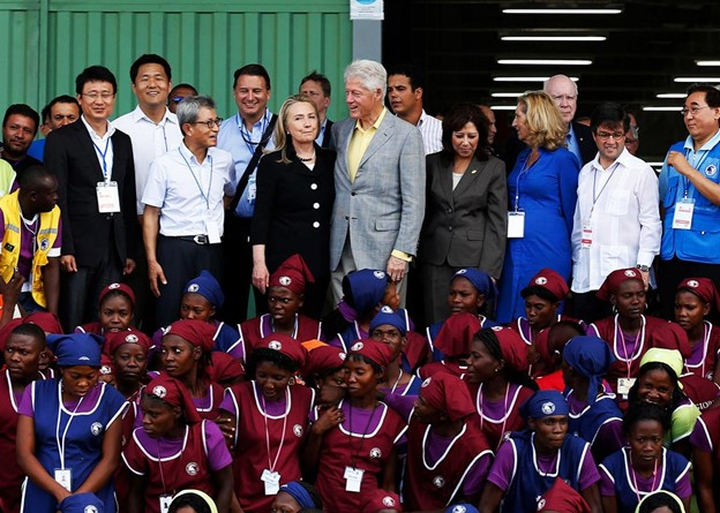
Hillary Clinton, then-Secretary of State, and former President Bill Clinton at opening of garment factory in Haiti on October 22, 2012.

If Haiti is “the poorest country in the hemisphere,” it is because imperialist policies continue to impoverish and destabilize that nation. 

Often, when you mention Haiti in conversation and the anti-imperial struggle that has consistently been waged by the Haitian people against imperialist forces for centuries, you are met with minor acknowledgment and some confusion by the listener. Even in cases where there are those who understand Haiti’s battle against imperialist interventions and incursions – many people are still unclear about: “why Haiti.” This is especially true in the present, where there exists a propagandized belief that there are no broader imperialist aspirations in the Caribbean, insofar as those interests cannot be tied to interests in Latin America and especially to Cuba.  Persistent myths about Haiti and confusion about the nature of politics in the Caribbean have allowed systematic investigations into (neo) imperial enterprises in the broader region to go largely uninvestigated. This is all at the peril of failing to contextualize sustained foreign meddling in the Caribbean region and the consistent need by those forces for sustained violence to maintain their dominant position.

On November 10, 2022, I was invited by the Black Alliance for Peace (BAP) Haiti/Americas Team to participate as a panelist on a teach-in webinar discussing the urgent crisis of imperialism in Haiti. Although my invitation on the panel was to focus on the role of states like Jamaica in helping to facilitate imperialism and persistent intervention in Haiti, I spent a major part of my own analysis discussing “Why Haiti.’” This is because, unlike most states in the Caribbean region – Haiti stands out as one that not only had a revolution but one in which the rights and freedoms for all Black people were guaranteed. This is quite different from other states like Jamaica, for instance, whose radical and revolutionary fervor were cut short or co-opted by liberal reformists. Co-opted revolutionary defeat in the states which this occurred has made those states’ exploitation amenable to strong political rhetoric and sustained conservative governance, especially as it relates to security. With a revolutionary history less forgiving towards co-option, Haiti poses a constant threat to European and Anglosphere economic and ideological investments and interests in the region. The analysis below comes from an extended version of my discussion on that day.

Today, there is an ongoing narrative – largely popularized by Europe and the Anglosphere (referred to collectively as “the West” from here on) – that Haiti is poor and that nothing good is in or comes out of Haiti. This lie is so persistent that many people do not know that Haiti is the manufacturing hub in the Caribbean – and that Haiti continues to compete against countries in Asia for foreign corporations to set up shop to exploit cheap labor. While the manufacturing and assembly line exploitation in Asia are made much more readily available by Western media sources, less widely recognized is how these same exploitations also happen systematically in Haiti, perpetuated by foreign corporations and co-signed by local elites and political puppeteers to those interests. Component parts are shipped from the U.S. and Canada for assembly in Haiti, as finished products are reimported back to these developed countries, essentially duty-free, with a small charge or tax on the cheap labor used in Haiti.

This is expressly stated in U.S. tariff code 807, whereby in the 1980s, “the major part of the total duty-free content of item 807.00 imports from the principal Caribbean countries [included] almost 80 percent for the Dominican Republic, 60 percent for Haiti, and more than 90 percent for Costa Rica and Jamaica” (U.S. International Trade Commission, 1970). This same sort of exploitative trade policy that screws over workers also expresses itself in deals like NAFTA, wherein U.S. HTS 9802.00.80 allows for “a reduction in duties for articles assembled abroad in whole or in part of U.S. components” (U.S. Customs and Border Protection, 2014). Thus, when examining Haiti, what you essentially have is a nearby site in the Americas with cheap and exploited labor that must remain so for external interests. Or, as Democratic representative William J. Green III stated in 1970, “item 807 merely promotes a competition between Hong Kong and Haiti for lower wage labor to serve this market – without building markets worldwide” (House of Representatives).

The distance to Haiti for states like Canada and the U.S. makes the costs of doing certain kinds of business cheaper there than in Asia. So, when popular talking points such as “Haiti is the poorest country in the Americas” are repeated – it is imperative to understand that what is really going on is that Haiti is made to have the lowest wages in the Americas, because Haiti is – and there is interests in keeping Haiti — the most exploited manufacturing hub in the Americas. It is not accidental that prior to the onset of the Global COVID-19 pandemic, Haiti was being touted as the future “manufacturing Taiwan of the Caribbean” due to the impacts of the 2010 Earthquake and the worsening of the cholera epidemic in the country due to UN intervention. Part of that potential – it is admitted – lay in the fact that Haiti is seen as “a low-wage economy lying just south of the huge U.S. market and just north of the emerging economies of Latin America” (Edwards, 2015). Not ironically pushing this narrative are the same corporate entities that have made Taiwan, in the present, a supplier of military and security gear to Haiti to suppress protests (Blanchard, 2022).

In order to maintain this situation and to strengthen aspirations for a continuous site of cheap exploitation, Haiti is the most intervened-in country in the hemisphere. Worst yet, when we consider interventions into Haiti by Canada, for example, we see how it has been enabled by Haiti’s own neighbors like Jamaica. In the 1990s when Aristide was first ousted from Haiti by a CIA-backed coup d’etat, weapons sent into Haiti from apartheid South Africa landed in Kingston first. After the second coup d’etat against Aristide in 2004, weapons sent to Haiti from South Africa yet again landed in Jamaica before being sent to Haiti – highlighting the crucial role of Jamaica as an arms shipment site into Haiti (BBC Caribbean, 2004). This reality is due to conservative governance in Jamaica which allies with Western imperialisms in its history of revolutionary suppression and liberal co-option. After all, it was Jamaican politicians who agreed to aid the U.S. in its invasion of Grenada in 1983 – so it is not surprising that it was also Jamaica who, in the 1990s, pushed the call for multinational forces in Haiti after the coup. Today it is in Jamaica where Canada has its “Latin America and the Caribbean” military base, which specifies Haiti as a site for military intervention while using seaports and airports in Jamaica’s capital as its staging post.

While it is easy to dismiss Jamaica as a counterrevolutionary force in the region, understanding why Jamaica’s role is this way matters. The Jamaican Defense Forces were created in the interest of Western Capitalist Imperialisms in the Caribbean region, helping to stop Black rebellions and alleged burgeoning communisms. Shortly after independence, Jamaica allowed states like Canada to conduct espionage operations from Kingston against Cuba, Venezuela, Haiti, and other countries in which the West had a fear of growing communism or socialism (Maloney, 1988). Jamaica’s proximity to states like Haiti and Cuba has made it a strong historical, and present, ally of Western security objectives in the region, whereby Jamaica gets the most amount of military and security funding from external donors in the Caribbean. This is also why Jamaica’s security doctrine and mandates, including its stance on Haiti, are beholden to Western interests. While there is some nuance in this very brief and quick history, it helps to contextualize the present-day actions of Jamaica – as well as CARICOM (The Caribbean Community Market) as a whole. CARICOM’s stance on security actions cannot be discussed outside of the fact that 52% of its security funding, thus its security objectives and goals, are externally determined (Hoffman, 2020).

Jamaica, and other CARICOM states, while having the ability to espouse activist rhetoric often times are tied in the kinds of ensuing governmental actions that can be taken. While Haiti is exploited due to its resistance against imperialism, other countries in the region are subservient to Western capital and other elite interests which purport an unattainable dream of development – so long as they stay in their exploitable or minor reform friendly positions. After all, it was during Manley’s administration that Jamaica spied on its more radical regional neighbors. And it is during times of conservative governance where Jamaica experiences an increase in security funding, aids, and grants (the difference in this type of Western support is most clearly illustrated in comparing external support that Manley got versus Seaga).

Jamaica’s security history and its acceptance of a Canadian military base in its country (OSH-LAC), makes its political class a willing participant in ensuring Haiti remains under western occupation. Thus, when Canada calls on CARICOM to intervene in Haiti, we can expect Jamaica to be a leading force in that intervention – unless our opposition to it is vocal, as our understanding of the ‘why’ becomes clearer.

Sources:

BBC Caribbean. 2004. “South Africa admits sending weapons to Haiti.” BBC Caribbean. web: https://www.bbc.co.uk/caribbean/news/story/2004/03/printable/040305_haitisouthafrica.shtml

Blanchard, Ben.2022. “Taiwan helping Haiti get bullet-proof vests for its police. Reuters. web: https://www.reuters.com/world/taiwan-helping-haiti-get-bullet-proof-vests-its-police-2022-10-25/

Edwards, William. 2015. “Manufacturing could make Haiti ‘Taiwan of the Caribbean’.” Taipei Times. web: https://www.taipeitimes.com/News/biz/archives/2015/01/18/2003609486

Hoffmann, Anne M. 2020. “The Finances of the Caribbean Community (CARICOM)” In The Finances of Regional Organisations in The Global South: Follow the Money. Routledge.

Item 807 Of Tariff Schedules. Hon. William J. Green of Pennsylvania in the House of Representatives. Tuesday, June 30, 1970.

John, Tamanisha J. 2021. “Haiti’s Ongoing Struggle for Uninterrupted Democracy against International Interventionism.” COHA. web: https://www.coha.org/haitis-ongoing-struggle-for-uninterrupted-democracy-against-international-interventionism/

Klepak, Hal P. 1996. “Canada and Caribbean Security.” In Security Problems and Policies in the Post-Cold War Caribbean, 245. International Political Economy Series. Great Britain.

Lenin, V.I. 2011. Imperialism, The Highest Stage of Capitalism: A Popular Outline. Mansfield Centre, CT: Martino Publishing.

Maloney, Sean M. 1988. “Maple Leaf Over the Caribbean: Gunboat Diplomacy Canadian Style?” In Canadian Gunboat Diplomacy: The Canadian Navy and Foreign Policy, 147–83. Halifax, Nova Scotia, Canada: Centre for Foreign Policy Studies, Dalhousie University.

Monaghan, Jeffrey. 2017. Security Aid: Canada and the Development Regime of Security. Toronto: University of Toronto Press.

Roper, L.H. “Private Enterprise, Colonialism, and the Atlantic World.” 2018. Oxford Research Encyclopedia of Latin American History. web: https://doi.org/10.1093/acrefore/9780199366439.013.684

United Nations High Commissioner for Refugees. 2000. “South Africa: Question of Principle: Arms Trade & Human Rights.” UNHCR. web: https://www.refworld.org/docid/3ae6a8734.html

United States Customs and Border Protection. 2014. “Assembly Operations (U.S. HTS 9802.00.80). U.S.CBP. web: https://www.cbp.gov/trade/nafta/guide-customs-procedures/effect-nafta/en-assembly-operations

United States International Trade Commission. 1986. “Imports Under Items 806.30 and 807.00 of the Tariff Schedules of the United States, 1982-85.” U.S.ITC Publication. web: https://usitc.gov/publications/other/pub1920.pdf

Tamanisha J. John is an Assistant Professor of International Political Economy in Clark Atlanta University’s Political Science Department. She studies Caribbean development, sovereignty and politics, as well as economic imperialism, financial exclusion, and corporate power. 

Source: Black Agenda Report

Strugglelalucha256


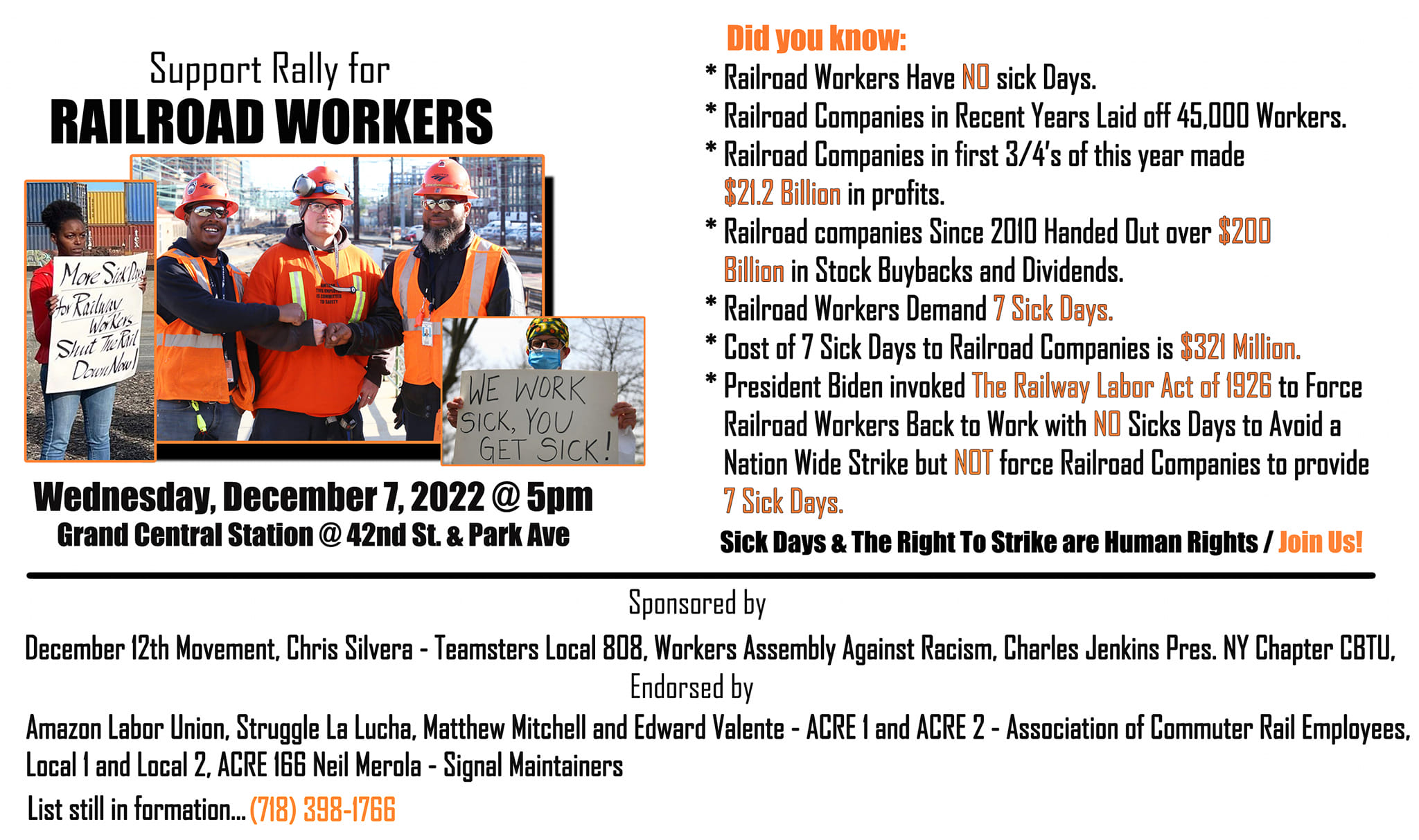
New York City: Support Rally for Railroad Workers, Dec. 7

SUPPORT RALLY FOR RAILROAD WORKERS
Wed. Dec. 7 – 5:00 p.m.
Grand Central Station, E. 42nd St. & Park Ave., Manhattan

Strugglelalucha256


Baltimore: Support Railroad Workers, Dec. 7


DEC. 7 AT 4:30 PM – 5:30 PM
Baltimore Support Railroad Workers
McKeldin Square, Light & Pratt Streets

Baltimore Solidarity with Railroad Workers

Railroad workers fight for dignity and sick leave

Stop government strike breaking!

Wednesday, December 7, 4:30 pm
at McKeldin Square, Light & Pratt Streets
downtown Baltimore

Strugglelalucha256


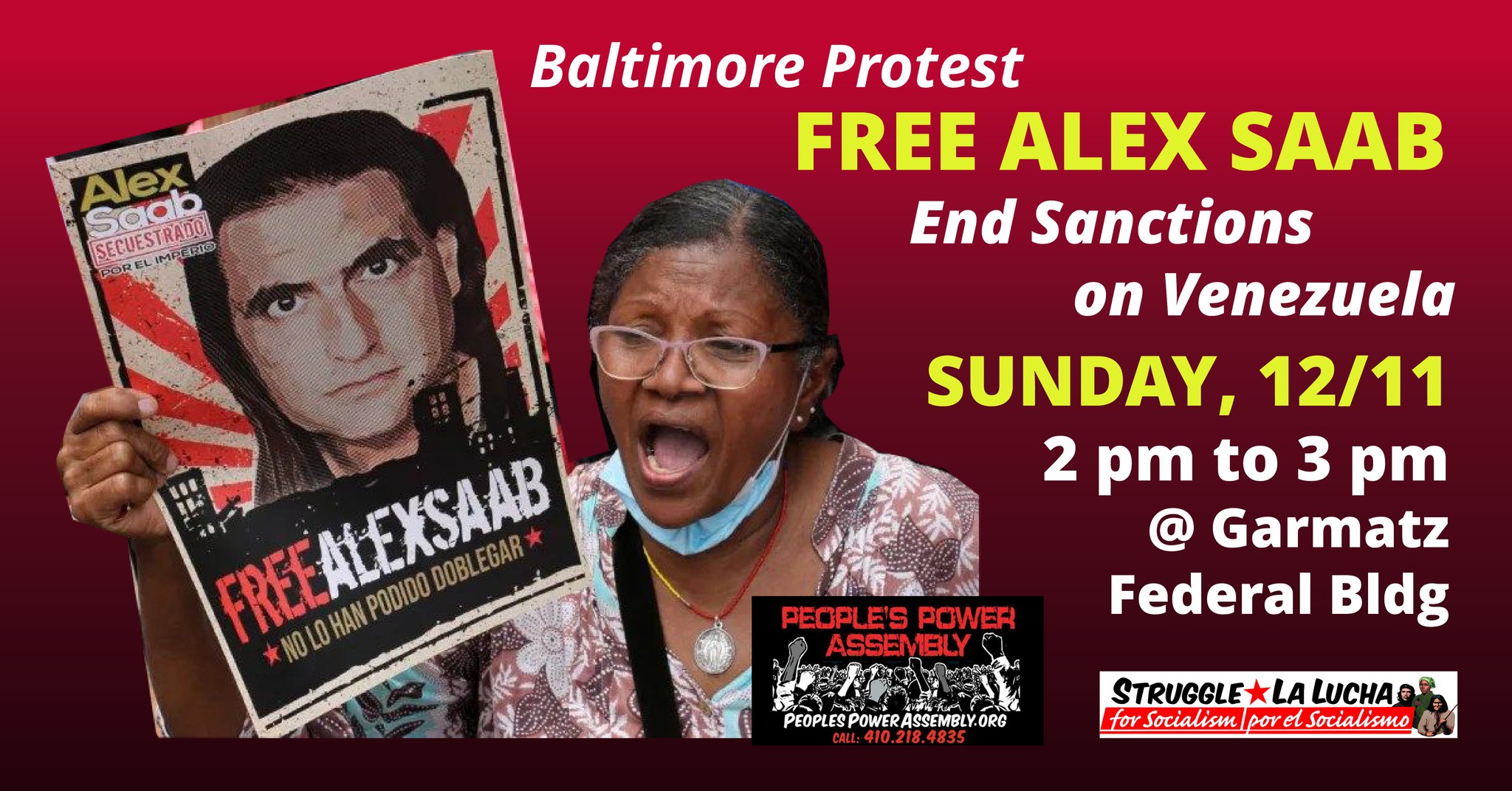
Baltimore: Free Alex Saab protest, Dec. 11

SUNDAY, DEC. 11, AT 2 PM – 3 PM
Baltimore Free Alex Saab Event
Garmatz Federal Courthouse, 101 West Lombard St., Baltimore, Maryland

Free Alex Saab – End U.S. Sanctions on Venezuela
A hearing is set for his case in federal court, Miami.
Join Baltimore’s action in solidarity

Strugglelalucha256


Struggle ★ La Lucha PDF – December 5, 2022

Get PDF here

  • As railroad workers fight for dignity and sick leave: Stop government strikebreaking!
  • Shooting at Club Q reflects rising fascist terror
  • Trans community defies police repression, shuts down hate rally
  • Twitter, Facebook mass layoffs: Demand worker-community control of social media
  • National Day of Mourning 2022: From #LandBack to bodily autonomy, Indigenous leadership is key
  • Message from Leonard Peltier: ‘ The world now faces the challenges our people foretold’
  • Leonard Peltier Walk to Justice culminates in Washington, D.C.
  • Democrats show true colors with allegiance to war and enabling of fascism
  • Crocodile tears for Ukraine as millions of U.S. families suffer utility shutoffs
  • Activists denounce FBI attacks on Black liberation group
  • James Baldwin, corporate media and the red herring of ‘Black antisemitism’
  • Biden, everyone knows Cuba is not a terrorist country!
  • MOSCOW: United Communist Party activists attend opening of monument to Fidel Castro
  • ‘Leaving no one and no place behind’: Zimbabwe is moving ahead
  • In latest election, Nicaraguans decisively reject attempted U.S. subversion
  • U.S. on hot seat at Sharm el-Sheikh climate meeting
  • La lucha del pueblo vs. gobierno en Puerto Rico
Strugglelalucha256


The meteoric rise and collapse of FTX

The large cryptocurrency exchange FTX went out of business on November 11. Many have likened this phenomenon to the collapse of the investment banking firm Lehman Brothers during the financial crisis of 2008, believing the FTX collapse to be as important an event in the cryptocurrency world as the collapse of Lehman Brothers in the official financial system.

In fact, even before the collapse of FTX, cryptocurrency values had slumped greatly. The total value of all cryptocurrencies, which had been estimated at $2 trillion by the end of 2021, had slumped to half that figure by the end of September 2022. The FTX collapse will certainly deal a further blow to this entire system.

FTX was set up by Sam Bankman-Fried, a student of Massachusetts Institute of Technology, in 2019 as a cryptocurrency exchange that exchanged one cryptocurrency for another or a cryptocurrency for fiat money and vice-versa.

In addition, it also issued its own cryptocurrency called FTT, exchanged spot fiat money or cryptocurrency for futures, and sold derivatives and options. It, thus, functioned in many ways as a bank, accepting dollars or euros or cryptocurrency today against the promise to pay larger amounts tomorrow or the day after. It had such a phenomenal rate of growth that within a mere three years, it had grown to become the fifth-largest cryptocurrency exchange by trade volume and the second-largest by holdings.

This meteoric rise was facilitated by the extraordinarily high profile that FTX acquired through a number of measures it adopted: its political donations to the Democratic Party were the highest among all donors if we leave aside George Soros. It sponsored sporting events and generally close association with several prominent sportspersons like Shaquille O’Neal, the former basketball star, and Naomi Osaka, the current tennis star. And It prominently supported the Ukraine government through the launch of an “Aid for Ukraine” program that accepted cryptocurrency donations with the promise that they would be converted into fiat money deposits with the National Bank of Kiev.

FTX’s collapse, however, has been as sudden and dramatic as its emergence. A substantial amount of its own digital currency, the FTT, was held by a firm called Alameda, which also was owned by Sam Bankman-Fried, the head of FTX. When Alameda’s balance sheet leaked out, a panic developed that a chance fall in the price of FTT would cause a major collapse in it. A rival cryptocurrency platform, Binance, started selling off its FTT holdings because of this panic, and that started a real collapse exactly in the same manner as a bank run does.

In fact, the scenario exactly resembled a bank collapse, and the reason, too, was exactly the same, namely, the absence of adequate reserves or readily saleable assets with which a sudden run could be countered. In effect, Sam Bankman-Fried was running a Ponzi scheme, siphoning off funds in a clandestine manner.

Binance, for a while, thought of buying up FTX but finally decided against it. There was, of course, no question of appealing to the government to bail out FTX, despite its closeness to the Democratic Party and President Joe Biden, since the whole idea of a cryptocurrency is to shun government scrutiny. As a result, there was no alternative to a declaration of bankruptcy, which Sam Bankman-Fried did on November 11.

This is where FTX’s parallel with Lehman Brothers, notwithstanding the importance of the collapse of each in its own respective sphere, ends.

The collapse of Lehman Brothers was the outcome of the collapse of the “housing bubble” that had got built up because of euphoric expectations about its longevity on the one hand and the development of institutional arrangements that systematically camouflaged risks on the other. The fact that many investment banks held toxic assets was not just because of greed or carelessness on their part, but above all, because under the institutional arrangements that had developed, it had become difficult to know what was a toxic asset, to distinguish between a toxic and a non-toxic asset.

To call the asset price bubble a flaw of the system, as many liberal economists were to do subsequently, is not just to be wise after the event but to miss the central point that this so-called flaw is exactly the mechanism through which neo-liberal capitalism had managed to generate a boom. The collapse of Lehman Brothers, in other words, was a part of the very modus operandi of neo-liberal capitalism.

The development of cryptocurrency, however, is not part of the modus operandi of the system. It is an external appendage to the system itself, whose elimination would still leave the system intact. The collapse of FTX, in short, would not jolt capitalism the way the collapse of Lehman Brothers had done. Cryptocurrency is like a commodity, or more appropriately, a security, that is generated and held outside of any government supervision. In fact, therein lies its attractiveness to those who hold it, for in the shadowy world where it functions, no questions are asked about its operation.

It is not surprising that the balance sheet of Alameda, the firm also owned by Sam Bankman-Fried, and even its ownership, was unknown for a long time to the holders of FTX’s cryptocurrency, the FTT. And it is also not surprising that the accounts of FTX had scarcely been properly audited, for otherwise, the shenanigans of Sam Bankman-Fried would not have gone unnoticed.

Cryptocurrency belongs to a shadowy system that has developed alongside the capitalist system from which the operators of the latter system derive great personal benefits, such as, for instance, deploying funds that are officially not accounted for; but this shadowy system is not organic to the latter’s functioning. The functioning of capitalism is punctuated with fraudulent practices, but it will be a serious mistake, as Marx was at pains to point out, to treat the system merely as a fraudulent system.

It is not surprising that there has been no attempt on the part of the U.S. government to bail out FTX, as there had been to bail out the rest of the American financial system after the collapse of Lehman Brothers, for which the Obama administration had pledged $13 trillion at that time.

A system that deliberately shuns government supervision can scarcely ask for government assistance when faced with a crisis, and no government will be brazen enough to assist it when it is faced with a crisis just because its leading personnel gets substantial donations from it.

If Lehman Brothers’ collapse was linked to the modus operandi of capitalism, FTX’s collapse arises because of the fraudulent practices that can, and typically do, characterize this entire world of cryptocurrencies, practices whose prevalence is precisely what constitutes the attraction of this world for those who inhabit it.

Again, it is not surprising that questions are being raised about how much of the “Aid for Ukraine” fund was actually sent to Ukraine and to whom, and how much of it was actually used for its proclaimed purposes. When this entire program has been characterized by zero accountability and zero transparency, and when information about it has to be pieced together from disjointed comments appearing from time to time on the web page, such questions are bound to be raised. And it speaks volumes about the Ukrainian government and its Western backers that they allowed such shady outfits like FTX to raise millions of dollars in the name of helping Ukraine.

The collapse of FTX raises important questions about the future of the cryptocurrency system itself. Though many would have incurred losses because of the collapse of FTX, it is unlikely that the system would spontaneously wither away. The question really is: what kind of government policy would this collapse generate?

The Chinese government has banned cryptocurrency for quite some time now. The Indian government had also announced in 2021 that it would bring a Bill before Parliament to ban cryptocurrency, but it has not yet done so. Given this government’s softness towards fraudsters, of which the forgiving attitude toward private filching of bank funds is an obvious example, it is doubtful if such a Bill will ever be tabled; but that would be extremely unfortunate.

Source: News Click

Strugglelalucha256


75 years after partition, U.S. guns and dollars still murder Palestinians

Dec. 2 – Seventy-five years ago, on Nov. 29, 1947, the United Nations partitioned the land of Palestine against the wishes of its people. The chief architect of this crime was the U.S. Truman administration. The State Department threatened dozens of countries with economic retaliation if they did not vote to create a colonial settler state on 57% of the land of Palestine.  

Most countries in Africa and many in Asia and the Caribbean were still under West European colonial rule and not allowed to vote. 

Within months Al Nakba began – the campaign of mass murder and ethnic cleansing that drove the majority of Palestinian people from their homes and created the racist state called “Israel” on their stolen land. In 1967 that state seized all of Palestine and part of Syria and Egypt as well.

The United Nations now marks Nov. 29 as the International Day of Solidarity with the Palestinian People. The U.S.-armed and -funded Israeli occupation forces marked that date this year with a murder spree in the camps and villages of the West Bank, killing 10 people in four days.

At 4 a.m. on Nov. 29, in the village of Kafr Ein near Ramallah, an Israeli military hit squad murdered Bir Zeit university students Jawad Al Rimawi, 22, and Zafer Al Rimawi, 21. The two brothers were the only sons of their family. 

Around the same time, Mufid Khalil, 44, was murdered when Israeli occupation troops invaded the town of Beit Ummar, near Al Khalil (Hebron).  Eight other villagers were wounded.  

Rani Abu Ali, 45, was shot near Jerusalem after he rammed an Israeli soldier with his car in retaliation for the murders. Raed Nassar, 21, was gunned down in Al Mughayyir near Ramallah. His “crime”: joining with people from his village to block Israeli troops from demolishing “illegally built” homes. The Israeli occupation regime denies Palestinians building permits. 

On Nov. 30, Israeli troops invaded the village of Ya’bad near Jenin and murdered Mohammad Tawfiq Badarna, 25. The same day Issa Hani Talaqat, 13, died of gunshot wounds. He had been shot by an occupation cop on Nov. 1. The young Palestinian was from Arara, a Bedouin community in the 1948-occupied territories, and held “Israeli” citizenship. 

Early in the morning of Dec. 1, the occupation forces invaded Jenin Camp, home to 12,000 people whose families were expelled from their homes when the Israeli state was created in 1948. They are crowded on less than a quarter of a square mile. Muhammad Al Saadi and Naim Zubeidi, resistance fighters of the Jenin Brigade, gave their lives defending the camp. 

Also, on Dec. 1, 17-year-old Wadi’h Sidr was found unconscious in Al Khalil after being beaten by a mob of Zionist settlers.

On Dec. 2, in Huwwara near Nablus, an Israeli “border” cop shot and murdered unarmed Palestinian Ammar Mefleh, 22, after a scuffle. Witnesses described the shooting as a “cold-blooded execution.” Mefleh died as Israeli soldiers prevented him from getting medical aid. Israeli Police Commissioner Kobi Shabtai said the killer cop “acted professionally.”

These murders are part of an escalating reign of terror by Israeli occupation troops and armed settlers against Palestinians on the West Bank, in Jerusalem, and inside the 1948 territories. Shootings, beatings, arrests without charge, home invasions, home demolitions, fire bombings, settler mob attacks, destruction of olive trees, crops, and farm animals, desecration of places of worship and cemeteries, and other crimes are daily occurrences under the occupation. 

These are the tactics the U.S.-funded Israeli state uses to grab more land for racist settlers from the U.S. and Europe and pump up the profits of its real estate industry.

Israeli occupiers have murdered 216 Palestinian people this year, 54 of them children. More than 5,000 Palestinians, 153 of them children, languish in Israeli occupation prisons. Nearly 500 are held under “administrative detention” without charge or trial. The Israeli military also holds the bodies of 117 Palestinian martyrs, refusing to return them to their families.

When blood flows, money flows

This reign of terror is funded entirely by U.S. tax dollars. Palestine’s blood is on the hands of Joe Biden, Donald Trump, and every other U.S. President going back to Harry S Truman. 

It is on the hands of every member of Congress who has voted for the constant flow of arms and dollars to the racist settler state. 

It is on the hands of the Pentagon brass, who view Israel as “our unsinkable aircraft carrier” in Washington’s permanent state of war against the people of the region. 

It’s no coincidence that Truman forced the partition of Palestine within months of signing the National Security Act of 1947, which created the Defense Department, National Security Council, U.S. Air Force and CIA.

Under a 2018 “memorandum of understanding,” the U.S. promised the occupation regime $3.8 billion a year in direct military aid through 2028. This includes the most advanced weapons in the Pentagon’s arsenal. 

On his visit to occupied Palestine in July, President Biden pledged that aid would continue until at least 2038. In the “U.S.-Israel Strategic Partnership Joint Declaration” issued in Jerusalem, he promised even more money whenever Israel starts a war. 

That direct military aid, which began under the Nixon administration, is only the tip of the iceberg. Loan guarantees, massive tax-exempt donations, state and city investment in Israel Bonds, and the $35-billion-a-year free-trade agreement signed by Ronald Reagan are among the mechanisms that ultimately send Israel tens of billions of dollars a year. 

This massive flow of arms and dollars allows the racist settler state to maintain a permanent state of war against the people of Palestine. It has not, however, defeated their resistance, which intensifies daily. The Palestinian people are defending their homes and land, both with mass action and with arms in hand. 

In the face of overwhelming force, young Palestinians take to the streets every day to confront invading colonial troops and settlers. On Friday, Dec. 2, 60,000 Palestinians gathered to pray at Al Aqsa mosque in Jerusalem, which is a target of Zionist settlers and authorities. 

The Lion’s Den, the Jenin Brigade, and the Balata Brigade are among the armed groups that have sprung up in the last three months to resist the colonizers’ attacks. In a Nov. 30 statement, the Lion’s Den, based in the Old City of Nablus, said, “It is worth asking the occupying regime who has surrounded it. Freedom-loving resistance fighters have their fingers on the trigger and besieged the Zionist regime. Israel and its allies will be caught by surprise in the aftermath of our unexpected measures.” 

The past 75 years have shown that the Palestinian people will never accept colonial occupation. They will fight for their right to live in peace and freedom in every corner of their land. They also show that the Israeli occupation regime cannot exist without the constant infusion of U.S. arms and dollars. 

Those dollars could save lives here rather than destroy lives in Palestine. This must end!

Strugglelalucha256


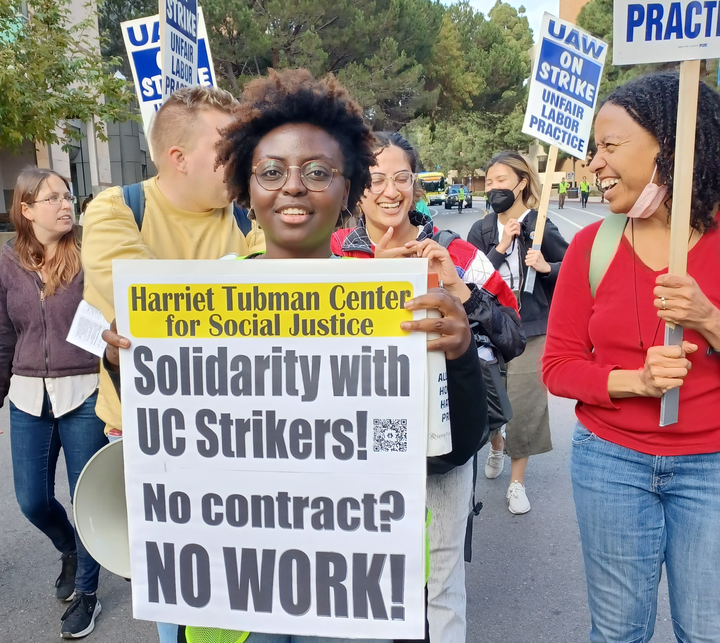
48,000 student-workers in California strike for their rights

Los Angeles – Striking University of California workers – 48,000 strong — rallied throughout the state on Monday, Nov. 28. This highly exploited workforce is represented by Auto Workers Local 2865. This is the biggest strike in 2022 and the biggest-ever strike by UC workers.  

Workers are demanding higher wages, improved parental leave and childcare support, reduced housing costs, and support for international scholars. The strikers are “graduate student workers,” who work for extremely low wages and provide important services for corporations and the general public. 

The carrot dangling in front of them is the hope that they will eventually land a tenured position. In recent decades tenure and decent wages for educators have been attacked in the entire range of jobs in the education system from public schools to elite private universities. 

During the rally at the University of California Los Angeles, Struggle-La Lucha spoke with striker Bineh Ndefru.

SLL: Can you tell us what a victory in this strike might mean for you personally? 

Bineh Ndefru: I’m in my fifth year, so a win probably wouldn’t go into effect in time to impact me. But for those newer to the system, it would mean people not having to go through their savings like I had to. 

I’ve had to borrow money while being a worker for the university. I’ve been paid $1,800 per month and had to pay $1,600 for rent in university housing. So basically, I’ve been living on $200 a month. That’s a very common story for all of us. 

It would’ve changed my life a lot. For a lot of people, it would mean maybe visiting their families more often, or having the ability to maybe have some downtime. Some students actually have had to live out of their cars because of the high price of housing in Los Angeles. 

On top of all that, I’ve even had issues with the university not paying me on time, which is not uncommon. 

SLL: Can you explain what kind of work and research are done by UC student-workers? 

BN: My lab is pretty unique in a way, and there’s a variety. For instance, PG&E [giant California utility company] has funded some of our grants to study how to prevent wildfires caused by their equipment. 

The California Energy Commission had us study statewide infrastructure projects, so it’s contributing to a lot of the risk assessments that benefit California, like earthquake assessments and that sort of thing. 

Anyone in this crowd is probably working on amazing research projects that are benefitting the city, the state, and even the whole world in different ways. We bring a lot of value not just to the university but to the community surrounding us as well.

Solidarity with UC workers!

Strugglelalucha256


Baltimore City escalates racist attack on squeegee workers and Black youth

Earlier this month, Baltimore Mayor Brandon Scott’s “Baltimore Squeegee Collaborative” task force announced an action plan. This plan claims to address the socioeconomic and cultural issues associated with the phenomenon of street laborers, usually in their teens or early 20s, known as “squeegee workers.” These workers aim to supplement their family’s income through cleaning the windshields of cars as they are stopped at intersections. 

In reality, this plan simply escalates police crackdowns on the Black community and demonstrates that the Baltimore City government is firmly in the grip of local business owners and the investment banks behind them. 

Scott’s plan comes after months of racist and repressive outcry from the business community in Baltimore since a Black teenage squeegee worker killed a 48-year-old white man, Timothy Reynolds, in self-defense. 

The fatal shooting occurred when Reynolds exited his car, crossed nine lanes of traffic, and proceeded to swing a baseball bat wildly at a group of squeegee workers, all of whom were Black teenagers. Fearing for his life and that of his friends, one of the teens discharged a firearm and killed Reynolds. 

Judge rejects plea deal

As Struggle-La Lucha has previously reported, the prosecution of this 15-year-old Black teenager has continued since the teen was charged with first-degree murder in August. The teen’s indictment included seven other charges. He was charged as an adult on all counts, despite being 14 years old at the time of the alleged crimes. 

The case took an unfortunate turn on Nov. 17, when a Baltimore City Juvenile Court judge rejected a plea deal that would have allowed the case to permanently move under the supervision of the juvenile justice system. 

The teen’s persecution has not only played out in the courthouse, but also in the media. Local television stations, radio programs and newspapers have depicted the accused youth as a monster who represents the criminal and violent nature of the Black community. 

This propaganda blitz had one clear goal: to whip up a racist panic and place pressure on the city government to enact harsher “law and order” policies.

As a part of this blitz, Timothy Reynolds’ family retained local reactionary attorney Thiru Vignarajah. When the plea deal was announced as a possibility, various members of the Reynolds family, with Vignarajah by their sides, spoke to the press to express their feelings of betrayal at the idea of a plea that would allow the teen to be prosecuted as a juvenile. 

Without knowing the defendant, the Reynolds family nonetheless depicted the young squeegee worker as a monster and career criminal. 

According to members of the defendant’s family present at the plea hearing, the Reynolds family repeated these lies in their victim impact statements before the judge. One individual went as far as to accuse the defendant of being a gang member. It was after this testimony, filled to the brim with racist tropes and stereotypes, that the judge issued his ruling that the 15-year-old be prosecuted as an adult. 

Mayor, prosecutor make intentions clear

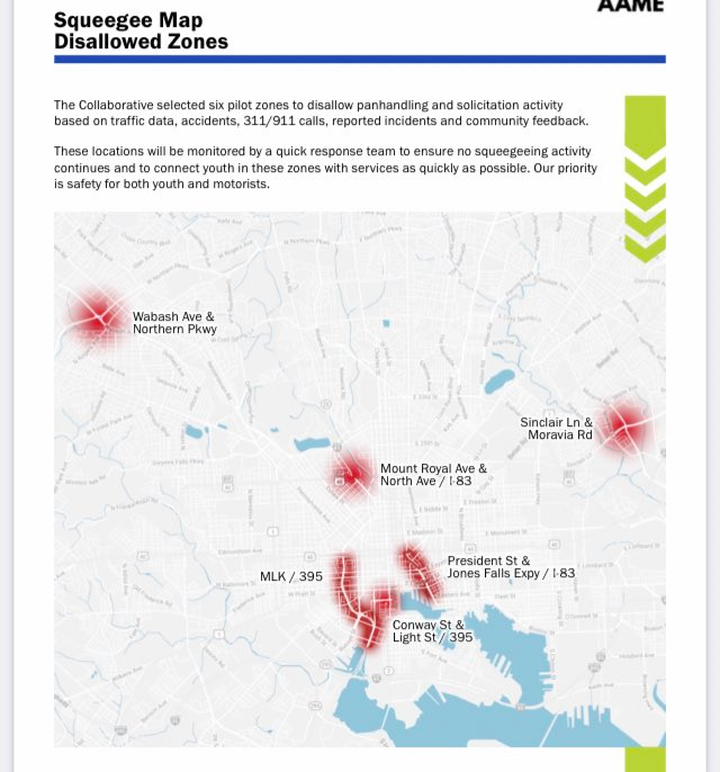
Mayor Scott’s proposed “squeegee action plan” is the exact product of the aforementioned prosecution and its corresponding media campaign. At the heart of the plan is a series of “panhandling” bans on intersections identified as squeegee worker hotspots. 

Under Scott’s program, all “panhandling,” which includes squeegee work, will be prohibited at six major intersections/corridors throughout the city. This brazen plan comes on the heels of incoming Baltimore City State’s Attorney Ivan Bates’ announcement that he will pursue broader criminal action against squeegee workers. 

Bates further asserted that he would press Scott to release restrictions that currently prevent police officers from approaching squeegee workers without a supervisor’s approval. 

The trial, the plan – it’s all part of a deliberate Baltimore City policy effort to expel the Black community, and in particular Black youth, from the majority white gentrified areas and the downtown business corridor. 

Nothing demonstrates the corner clearing plan’s racist nature more than the fact that the banned corridors seem eerily similar to 1930s Baltimore city redlining maps, which drove interest rates sky high for would-be Black homeowners. 

Squeegee workers should not be met with prosecutions and character assassinations. The individuals who should face accountability are those who attack groups of teenagers on a street corner. Baltimore City and other cities like it don’t need bans on panhandling. They need a genuine jobs program and an end to racist police terror. 

Drop all the charges! Self-defense against racism is not murder! Community control of the police now!

Strugglelalucha256


Cuba goes on a diplomatic tour in an increasingly multipolar world

On November 27 morning, Cuban President Miguel Díaz-Canel, walked into a voting station in the Playa neighborhood to vote in Cuba’s municipal elections. He had landed in Havana an hour earlier from an intense tour of Algeria, Russia, Turkey, and China.

The tour, which started on November 16, was both a journey into the past of the nonaligned world that Cuba played an integral role in building and an essential step into the future toward the establishment of a multipolar world. Each stop also served as a reminder of the strong relationships based on cooperation and mutual respect that Cuba has been cultivating since 1959. Undoubtedly, the Cuban Revolution and its internationalism placed Cuba on the map and gave it an outsized role in world politics.

Yet this tour took place against a complex backdrop. The country’s recent economic and financial situation has been characterized by crisis since the intensification of the United States blockade under former President Donald Trump and President Joe Biden, with the imposition of 243 unilateral sanctions and the inclusion of Cuba on the state sponsors of terrorism list. Add to this the impact of COVID-19 over the past three years, several natural disasters, and a series of unfortunate accidents that have negatively impacted Cuba.

Díaz-Canel also traveled abroad to explore with Cuba’s strategic partners the state of multilateralism and development in a rapidly changing world in the wake of the war in Ukraine, NATO aggression, and the growing fragility of U.S. hegemony. Cuba’s achievements and potential, despite being besieged, served as the basis for discussions during the tour relating to areas of mutual interest such as renewable energy, biotechnology, health care, communications, and industry.

During the tour of these countries, several new agreements were signed that pointed to a desire to help Cuba. From offers of setting up renewable energy power plants to more regular oil shipments and plans to modernize Cuban industries, it’s clear that Algeria, Russia, Turkey, and China do not want Cuba to fall under the weight of Washington’s sanctions regime. “It is obvious that sanctions have an effect on the fact that our relations remain below their true potential,” Turkish President Recep Tayyip Erdoğan pointed out during a press conference with his Cuban counterpart in Ankara on November 23.

This 11-day tour ended in China, where perhaps the most challenging yet essential conversations were held. Under the weight of an intensified U.S. blockade and severe limitations to its foreign currency reserves, Cuba has been unable to service its debt with China. “There is enormous sensitivity in the Chinese leadership, particularly in President Xi Jinping,” commented Díaz-Canel afterward. “There is an express will in him, even with indications in official talks, that a solution must be found to all of Cuba’s problems, regardless of the problems with the debt.” Against the United States’ efforts to restrain Cuba, Díaz-Canel asserted how China is “betting on the development of the country based on the cooperation that they can give us.”

This article was produced by Globetrotter. Manolo De Los Santos is the co-executive director of the People’s Forum and is a researcher at Tricontinental: Institute for Social Research. He co-edited, most recently, “Viviremos: Venezuela vs. Hybrid War” (LeftWord Books/1804 Books, 2020) and “Comrade of the Revolution: Selected Speeches of Fidel Castro” (LeftWord Books/1804 Books, 2021). He is a co-coordinator of the People’s Summit for Democracy.

Strugglelalucha256
https://www.struggle-la-lucha.org/2022/12/page/7/