Thousands rally: ‘Free Assange!’

Washington, D.C., Oct. 8. SLL photo

Hundreds rallied outside the Department of Justice in Washington, D.C., on Oct. 8 to protest the incarceration and extradition of Julian Assange. Assange is currently in the middle of his third year of confinement in London’s Belmarsh prison, serving most of that time in solitary isolation.

Protests supporting freedom for Assange were held around the world. In London, 7,000 protesters linked hands to surround the Parliament building, demanding that Britain not extradite Assange to the United States. Protests also occurred in several other U.S. cities.

Supporters of Assange in Washington marched around the DOJ complex. They symbolically encircled the complex with a large yellow ribbon with “Free Assange” written on it. Chants of “Free Assange,” “No extradition,” and “Jail John Bolton” could be heard for two city blocks as the marchers slowly made their way around the DOJ, escorted by D.C. police and accompanied by multiple musicians playing drums and guitars.

Many members of the independent media attended to cover the march and the subsequent rally that featured independent political activists from across the political spectrum.

People’s Power Assembly founding member Rev. Annie Chambers was a featured speaker at the rally. Chambers brought up the many other political prisoners of the United States, including her Black Panther brothers and sisters, and how this sort of isolation is used as a form of torture. 

At first, the British Magistrate blocked Assange’s extradition from Britain in January 2021. However, the British High Court later overturned that decision when the U.S. government appealed.

Assange will face espionage charges if he is extradited to the U.S. Assange is being sought by the U.S. for publishing documents that revealed U.S. war crimes and human rights atrocities.

According to Assange’s defense, “The politically motivated charges represent an unprecedented attack on press freedom and the public’s right to know – seeking to criminalize basic journalistic activity.”

If convicted, Julian Assange faces a sentence of 175 years, likely to be spent in extreme isolation.

Recently Assange has tested positive for COVID-19. While in Belmarsh prison, Assange’s mental and physical health has greatly deteriorated. With this new diagnosis of COVID-19 and Assange’s chronic lung disease, supporters and his family are again urging the courts to release him immediately.

Strugglelalucha256


Iran’s anti-morality police protests: a different view from the ground

Setareh Sadeghi, an Esfahan, Iran-based scholar and teacher, provides Max Blumenthal with a complex view of Iran’s protests against the country’s morality police and the death of Mahsa Amini never heard in U.S. mainstream media.

A full transcript of Sadeghi’s conversation with Blumenthal is below.

MAX BLUMENTHAL:  Welcome to The Grayzone.  It’s Max Blumenthal.

Protests inside Iran triggered by the death of Mahsa Amini, a young woman who was picked up by Iran’s morality police on the grounds of supposed indecent exposure, have drawn massive international attention.  Media around the world are following these protests, and on social media, the hashtag surrounding Mahsa Amini’s name has generated more attention and retweets than almost any hashtag in Twitter history.

So how much of this international response is authentic?  And how much of it is related to genuine concern for Iranian women—and not long-standing Western desire for regime change in Tehran?  To better understand this issue, I spoke to a woman inside Iran.  Her name is Setareh Sadeghi.  She is an independent researcher, a translator, a teacher, and a Ph.D.  She lives in the city of Esfahan.

Setareh Sadeghi, let’s talk about you and your own political views before we get into some of the details of these protests and the campaign behind them.

You studied the U.S. Civil Rights Movement as part of your Ph.D., and you’re also a student of propaganda [analysis].  Where do you situate yourself within the Iranian political spectrum, and specifically do you support women protesting the morality police and issues like the hijab?

SETAREH SADEGHIWell, yes, as you mentioned, I finished my Ph.D. in American Studies, and I studied propaganda analysis as part of my Ph.D. dissertation, and the rhetoric of social movements as well.  So, I have always been supportive of the Iranian government as a whole—the notion of an Islamic republic—but I have also been critical towards a lot of the things that happen in my country, like many of the other people who live here.

So, for the issue of hijab, as someone who believes in hijab and has always practiced it, I am totally against the morality police.  By the way, in Farsi, the word that we use for it is the “Guidance Patrol,” but in English, it’s usually referred to as the morality police, and I’m totally against it.  I have been a part of the people, especially women, who took it online and used hashtags to talk about how they do not believe in the morality police even though they believe in hijab.  And this is not something new.  It has been in place from many years ago, but it’s become more significant this year.

So, even before these protests and before the tragic death of Mahsa Amini, people were talking about it online and I was also one of them because I saw this was totally unacceptable.  And even in my personal life—because I have friends who do not believe in the hijab and they don’t want to practice it, or they practiced it in a way that did not fit the standards of the Islamic Republic’s law of the dress code, and they were stopped by the morality police.  In at least three cases that I remember, I would just go talk to the morality police and tell them, as someone who believes in hijab, I am totally against what they’re doing, and this is not the way they should enforce the law.  Because it’s not always that they…the morality police don’t always arrest people.  Their main job was to go and tell people.  But even that, I’m totally against it and I don’t think that’s something that works, mainly because a lot of people who live here believe in some sort of dress code.  I think as a woman, I think that’s not something that people should tell us.  Like, I believe in law and order, but also, I don’t like being told those details, like how to dress and how to appear in public.

MAX BLUMENTHAL:  So, what is the role of the morality police, and how much public opposition is there to this unit of the security services?  And are they known for being as brutal as they’re currently being portrayed?

SETAREH SADEGHI:  Well, yes, they are known as being brutal because Iranian women don’t find it acceptable—not necessarily because everything that they do is brutal, but some harsh treatments are an integral part of the way they enforce the hijab law.  But it’s also that, while I think a lot of people are against the morality police, it’s not that everyone is against the mandatory hijab law.  So, these are two things that should be studied differently.  A lot of people, I mean, there are different surveys, and different surveys in different provinces show a different percentage of people believing in obligatory or mandatory hijab, and I think that’s something that has to be dealt with based on the local culture of each province.

And that is also reflective of how the protests are going on, for example, in my hometown, because it’s considered more conservative and more traditional.  The protests there are very much smaller than what you could see in other cities, for example, in Tehran or Rasht or other cities where the protests were significant compared to what is going on in my town.  So, yeah, there are also people who believe that the morality police should be in place but the methods that they’re using should be different.

So, I think if you want to categorize women and people who live inside Iran, we have people who are totally against the mandatory hijab.  They don’t believe in hijab at all and, obviously, they don’t believe in morality police.  We have people who believe in hijab, but they don’t believe in the morality police or the mandatory hijab.  We have people who believe in hijab, and they believe in the morality police, but they don’t believe in the methods that they are using.  And that also creates a collective of people who are against the morality police but, again, based on how they feel towards it, their participation in these protests is different.

MAX BLUMENTHAL:  So, let’s talk about the issue of Mahsa Amini.  What do we know about her death?  Most people in the West who are following this believe she was beaten to death by the morality police in police custody.  Has that been established as the case, and is that the understanding even of the protesters in Iran?

SETAREH SADEGHI:  Not really.  I mean, even a lot of those Western media outlets corrected their headlines or started using different terms, referring to the case when the CCTV footage of the moment when Mahsa Amini fell and went into a coma was published.  So, a lot of people believed that footage, about how some people said that she had bruises on her legs when she was taken to hospital, which shows that there was a beating.  But the footage clearly shows that she was in good health conditions when she was there, based on what we see.

An investigation has been ordered.  The files all are not yet published.  There are talks about it, but there’s not a final statement by the state.  The last thing that they have said is that the probe shows that there was no beating involved.  They even released the CT scans of her brain and, as I said, there was CCTV footage.  So, while there are protesters who believe that the beating happened, there are also a lot of protesters who think that it did not happen.  But the fact that a young woman died in police custody only because of violating the dress code is something unacceptable, no matter what exactly happened in police custody.

MAX BLUMENTHAL:  You’re in Esfahan, which is a large city in Iran, outside of Tehran.  Most of the protests, as far as we know, have been centered in the capital of Tehran, and you have been receiving a wave of death threats for reporting that the protests in your city were very small and that the protests have not spread to key Iranian cities.  Is that still the case?

SETAREH SADEGHI:  Well, because I have already blocked a lot of people, and because the person who started those threats, as someone who knew me in person, at this point I can say that I haven’t received any new threats.  But it was because I appear on different media and I have talked about Iran as a political analyst, I’ve always received insulting or sometimes death threats.  But this time it was really unprecedented, as it was started by someone who knew me in person and had my personal information, and even the number of the people who attacked me was really huge.

And it started with the Independence Farsi account on Instagram, publishing a snippet of my interview and disregarding all the criticism that I had against the morality police, the crackdown on everything, and just saying that I lied about the number of the people participating in the protests, or the fact that these protests are much smaller than the ones that we witnessed, for example, in Esfahan in 2019.  But at the same time there were a lot of people who were totally against even the Islamic Republic.  But I mentioned that, and they verified it and they said that they were part of the protests, and that’s true.  It was not significant because, as I said, Esfahan is a conservative and more traditional city, and people take to the streets on different issues.  The morality police are, I guess, not the number one issue for people who live here.  And I talked to my friends who don’t observe the hijab completely or according to the law, and they said that this is really not their number one issue, and so they don’t want to be part of the protests.

MAX BLUMENTHAL:  Right.  We’ve seen large protests over the price of food or economic issues in Iran that were totally ignored in Western media.  So, what do you make of the response in Western media, not just Western broadcast media but social media as well?  The Mahsa Amini hashtag is one of the most popular hashtags in history, as you tweeted.  It’s as if there are no other issues in the entire world.  Do you think the outrage that we’ve seen on social media is authentic, or something that is being encouraged or pushed by Western—specifically NATO—states, the same way that there was a massive social media amplification campaign around the so-called Arab Spring?

SETAREH SADEGHI:  Yeah, that’s true.  I mean, social media has never been a true reflection of what’s happening in different societies, especially not Iranian society, because Twitter is blocked here, and a lot of people do not have access to it.  So, the number of Iranian users on Twitter is not significant because they use other [platforms].  For example, Instagram.  Before these protests Instagram was not blocked, and a very large proportion of the population had Instagram accounts, especially because they also used it for selling products and they had their businesses on it; especially a lot of women run their own business on Instagram.  But Twitter is very different and it’s something that is known by Iranians.  Even those who are on Twitter, they know that it’s very different from the realities on the ground.  And it’s surprising how when there was, especially in those towns where the protests were met, the crackdown on it was really severe and a lot of people couldn’t even use the hashtags, [but then] broke a record, which tells us that there is something that doesn’t come from Iran.

And there is a history of fake hashtags and fake accounts and trolls on Twitter, trying to portray Iran in a different way, and it’s not only about a protest.  There are other cases.  For example, there was a time when, if you posted anything positive about your life in Iran, you would be attacked by these trolls, because they said that you are normalizing Iranian people’s misery as if there is no normal life in Iran and the only thing that you are allowed to post online about Iran is just all the problems and the grievances.  They attacked a university professor for only posting pictures of him[self] inside a cafe in Tehran, for example.

So, we also have the case of Heshmat Alavi, who apparently is a Twitter user who posts against the Islamic Republic on Twitter.  And it’s interesting that when Trump withdrew from the JCPOA [Joint Comprehensive Plan of Action known commonly as the Iran nuclear deal], he mentioned that the JCPOA is facilitating Iran’s crackdown on its people or on certain issues, and two Washington Post journalists asked for a source.  And the source that Trump offered was an article written by Heshmat Alavi.  And an MEK defector later also talked about how the camp in Albania, the MEK camp in Albania, uses its members to start hashtags and make them a trend, and they’re paid to post about it.

MAX BLUMENTHAL:  Just quickly, for those who don’t know, the MEK is the Mojahedin-e-Khalq, which is a U.S.- and Saudi-backed opposition movement, dedicated explicitly to regime change in Iran and replacing it with its cult-like leader, Maryam Rajavi.  They have been based in Albania under the watch of the U.S. military and U.S. intelligence, and it’s there that they maintain a troll farm, as you said, to spin out hashtags against the government in Iran.  And this account, Heshmat Alavi, apparently was a sock puppet run out of this troll farm.

SETAREH SADEGHI:  Yeah, that’s what the investigation shows.  And even for the recent hashtag, the historical hashtag trends about Mahsa Amini, a few Iranian users track them and try to find out where those hashtags come from.  And then you see a lot of users just posting nonsense, like alphabets and then using the hashtags, and right now I think it surpassed a hundred million times the hashtag words in Farsi and in English, and they come from a limited number of users.  I think it’s less than 300,000 users that have been using the hashtags, but it already has the historical trend on Twitter.

And it’s interesting how, as you said, the protests in 2019, because at that time they were also really huge in my neighborhood.  And in Esfahan I did not see any reflection of it online, because usually, like that protest was more by the working class and the middle class because it had economic causes, and it affected a larger proportion of the population.  So naturally it was bigger, but you wouldn’t hear about it 24/7 on mainstream media or on social media.  But this time, it’s a social issue, and it’s a very important issue for women, but at the same time it’s not really as big as the previous protests that we had.  But we already have a historical record of hashtags for it, so it totally shows that it’s not reflective of what is actually going on in Iran.

MAX BLUMENTHAL:  Well, The New York Times is also reporting that the U.S. State Department and its allies are trying to get communication gear into Iran.  However, much of the noise about these protests appears to be coming from the outside.  Because of an issue that Westerners can relate to, we’re deluged with identity politics here and we don’t have large economic protests here in the United States anymore, outside of maybe some union activity, some strikes.  This is a case of the weaponization of identity, and obviously, a real issue, as you point out, a real issue with the morality police maybe not at the top of the agenda but something that upsets a section of the population in Iran.

But outside much of the noise is being made by Iranian exiles or ex-pats, and one of the key voices who’s emerged in U.S. media, cable news media, is a figure named Masih Alinejad, who I’m sure you know.  She’s been backed by the U.S. government, paid hundreds of thousands of dollars in contracts with the Voice of America, which is the U.S. government’s global broadcasting system.  She’s met with former CIA director and Secretary of State Mike Pompeo.  Recently she cooked up a phony plot in coordination with the U.S. government and the FBI, claiming that the Venezuelan security services were going to kidnap her and take her on speed boats to Iran.  It was one of the most ridiculous plots I’ve ever heard, and it was widely reported in U.S. media.  Now she’s back.  So, what do you make of Iranian ex-pats kind of taking the mic and becoming the voice of the Iranian public?

SETAREH SADEGHI:  Well, I wouldn’t mind.  Obviously, Iranian women would be very happy if those in exile really wanted to be a voice for women inside, but the thing is they are just echoing the voice of, I would say, a minority and just a section of the population in Iran that they agree with.

I think they also believe in the Western liberal notion of freedom for women, and not the notion—they don’t really care.  I’m not talking about everyone, obviously, but some of these people who are given a voice and whose voices are amplified over the voices of women inside Iran, they’re just repeating the Western notion of freedom for women.  And they do not understand that women in Iran can have a different notion of freedom, and [that] they have other priorities when it comes to women’s rights and women’s activism.

And a lot of women here are working towards that.  They are organizing, they are using online campaigns to pursue Iranian women’s rights.  But these voices from outside really make our struggle more difficult.  Instead of, for example, calling for the U.S. government or the EU to lift sanctions on Iran that are hurting ordinary Iranian people and making it more difficult for women to find, for example, job opportunities or to just be an active part of the society, they are calling for their own notion.  They’re calling for something that they believe would be liberating for Iranian women, but that’s not necessarily the case for the majority of Iranian women.  And I personally find it kind of insulting, because it is like you are disregarding and discrediting Iranian women.

Iranian women inside Iran are very powerful.  A large proportion of Iranian women—or the majority of Iranian women, actually it’s a high percentage—go to colleges and they’re highly educated.  We have women in business, we have women in medicine and universities, and women are a very active part of the society, so they know how to pursue reforms.  For example, there is this case.  You can see online that there is civil disobedience happening inside Iran without any hashtags or calls from outside, and it is helping women here.  For example, in my town, riding a bicycle for women was not by law forbidden, but culturally there were a group of extra-conservative religious people in Esfahan who were against riding bicycles for women, and they were calling for that to happen, they were saying that we’re not going to allow that.  Women did not take to Twitter to talk about it.  They did not make a fuss about it and start running a protest.  What they did instead was, a lot of women, many of them in full hijab and full covering, started riding their bicycles through the city.  And now it has become an absolute normal scene in my city, and those conservative groups cannot oppose it anymore.  This is how civil disobedience and pursuing reform works.  Because a lot of the things we see, for example, that the government is actually imposing or implementing comes from the fact that there is a large proportion of the population that believes in those things.

So, we need education; it’s a progress, it’s a process of reforming and educating women and educating men about women’s rights.  It doesn’t happen by a hashtag revolution and just taking to the streets.  And then it’s very easy for these protests to get violent, and there are people who abuse it.  It starts with slogans for women’s rights, but it ends up with slogans against establishment and calling for the overthrowing of the establishment.  So, a lot of women don’t want to be a part of that simply because they see how this is hijacked, how this is exaggerated by Western media and social media as well.  And so, they see the realities, and they see those reflections, and they don’t want to be a part of it.  But they do their job for seeking reform and educating their family members and being an active part of this process of bringing change to their society.

MAX BLUMENTHAL:  So, aside from the Iranian ex-pats who were getting a lot of attention and speaking out on behalf of all Iranians, you have major celebrities sharing the Mahsa Amini hashtag.  What do you make of the participation of celebrities, Hollywood stars, and recording artists?  And how much do they really know about the situation inside Iran?  Are they getting anything wrong?

SETAREH SADEGHI:  Well, while I hope a lot of them have the good intention of supporting Iranian women—and it’s only out of ignorance, not that they have been paid or supported by the U.S. government to do that—I think it’s very hypocritical because they didn’t talk about how sanctions have been hurting Iranian people and Iranian women and taking opportunities away from them.  For example, as an academic, like a lot of my colleagues have experienced that their papers, their academic publications are not even considered, only because they come from Iran.  That’s also a form of injustice.  I mean, that affects only the academia in Iran, but sanctions affect ordinary people.  They are really affecting ordinary Iranians and making it impossible, for example, people with cancer to provide their medicines, to find their medicines.  A lot of medical companies refuse to sell Iran medicine, citing U.S. sanctions, because there are a lot of European companies who just do not want to stand against the U.S. pressure to abide by these sanctions, so they just refuse to sell medicine.  It’s not always directly from those companies; it’s also because of the international sanctions on Iranian banks that make it impossible for Iran to buy those medicines.  So, there are a lot of factors involved that are making it impossible.  So, I personally—and I’m sure a lot of people—find it really hypocritical.

MAX BLUMENTHAL:  Well, you mentioned some violence taking place.  We’ve seen police officers be killed and a number of deaths, as well as what appears to be armed clashes on the Iranian-Iraqi border.  Are these protests turning violent, and are they being infiltrated by violent elements who actually have very little interest in women’s rights?

SETAREH SADEGHI:  Yes, that’s, unfortunately, the case.  Iranian women rightfully wanted to protest and take to the streets and make a statement to the state, which I think they have already made, but there were elements who infiltrated it and started violence, like attacks on public property, even on people’s property.  They burned people’s cars, there were shootings, and a lot of people have died in these protests, many of them who were women.  And it’s not everyone died because of police shootings or police crackdowns. A lot of those people died because of the thugs and mobs that were involved in these protests.  And obviously, like you said, they don’t care about women’s rights.  They have another agenda to follow.

And this is also another reason a lot of women who maybe initially were protesting took a line to talk about that, that this is absolutely not what women want, and it’s not supporting women’s rights.  But there were also, like I said, peaceful protests going on, and they didn’t receive crackdowns, obviously, because they weren’t as violent.  In universities and on different streets where people just were peacefully protesting without burning things down.  But with those infiltrations, it became very difficult to keep them peaceful.

And, also, you asked me about the Kurdish environment, right?

MAX BLUMENTHAL  Yeah, Mahsa Amini was Kurdish, and many of the protests have taken place in Kurdish areas, if I’m not incorrect.  So, how is the Kurdish issue influencing these protests?

SETAREH SADEGHI:  Yeah, well, it appears that one of Mahsa Amini’s cousins was a member of one of these Kurdish separatist movements which have also carried out terrorist acts, but obviously she had nothing to do with these people.  But this cousin abused or exploited his relation[ship] with Mahsa Amini, to say that this was to [be] portrayed as an ethnic issue.  But Mahsa’s family, including her uncle, spoke out and said that ‘This has nothing to do with our ethnicity.  We are Kurdish, but this is about Iran and women’s rights.  It has nothing to do with our ethnicity.  This involves everyone.’

But different leaders of Kurdish movements inside Iran and outside, like the ones in Iraqi Kurdistan as well, started saying that they were planning for the protests, and they called for people to take to the streets.  And even the slogan that has become popular for this movement, which is translated into “Women, Life, Liberty,” that’s a popular Kurdish slogan.  And it’s beautiful and people relate to it, but even the slogan came from these Kurdish ethnic groups that were involved, and by now one of the cities at the border witnessed attacks on police stations by some of these Kurdish elements.  And Iran started—because they were funded and armed from outside Iran, from Iraqi Kurdistan—Iran also started attacking their bases in Iraq.  And just recently, just yesterday, a lot of people, at least, I think about eleven people died in these attacks.  But the IRGC [Islamic Revolutionary Guard Corps] has made it clear that they won’t stop until they just back down.

And I think it’s also important to know that I have Kurdish family members and they do not see themselves a part of it at all.  So, it’s not about the ethnicity.  It’s about a group funded by outside sources wanting to exploit these protests and break a rock on Iran and the society.

MAX BLUMENTHAL:  Well, those Kurdish separatists on the Iraqi side of the border are part of the Barzani clan, right?  Which has been historically backed by the U.S. and armed by the U.S..

SETAREH SADEGHI  Yeah, and Mossad at some time. Yeah, that’s true.

MAX BLUMENTHAL  And the Israeli Mossad.

SETAREH SADEGHI:  Yeah, that’s why.  And Iranian people have a really bitter memory of their activities in Iran.  They have killed a lot of people within the Kurdish region.  And they have been given a platform by, for example, BBC Persian and other propaganda by the British government and the U.S. government, which, again, doesn’t resonate with what’s going on in Iran and makes a lot of Iranians angry, because it’s really not about ethnicity at all.  I mean, Mahsa Amini’s family made it very clear that they consider themselves Iranian before anything and it’s really not about ethnicity.  But these people are totally disregarding that.  They don’t care about the hair case or the case of women; they’re just exploiting it to create chaos inside Iran and make it very difficult for Iranian people to take part in those protests because they can be easily exploited.

MAX BLUMENTHAL:  And we saw rather small protests in Cuba in 2021 backed by the U.S., staged by people who’d been involved in U.S. embassy programs, be exploited by the Biden administration to justify not returning to the normalization deal that the Obama administration had hashed out with the Cuban government.  Do you think these protests will have a similar effect, and will provide the Biden administration with justification for not returning to the JCPOA Iran deal that the Obama administration and the Iranian government agreed to?

SETAREH SADEGHI:  Absolutely.  And not only that, I think it gives more justification for the U.S. government to impose even more sanctions on Iranian people, which, as I said, and the UN also acknowledges that the unilateral coercive measures by the United States are hurting ordinary people in Iran, especially women.  I mean, they’re taking a lot of opportunities away from women.  So, yeah, that’s why this is another reason for me, for example, and a lot of people in Iran and a lot of women inside Iran, that if these protests are going to lead to more sanctions, which seems to be the case already, they don’t want to be a part of this.

MAX BLUMENTHAL:  And do you think that these protests and the attendant violence could prove destabilizing to Iran’s internal security or expand in any way?

SETAREH SADEGHI:  Well, by now the protests are almost finished and everyone is talking about how there are no longer massive protests.  And even on outlets, especially Persian-speaking TV, for example, like BBC or Manoto or VOA Persian, they tried hard to say that the protests are still going on.  And I was checking the hashtags today and there are still millions of hashtags for what’s going on in Iran, but if you go on the streets and just walk around, even in Tehran by now there’s really nothing significant happening.  In Esfahan, it’s almost over.  It’s very insignificant, and that’s something that you will hear from a lot of people who live here, and actually in certain neighborhoods if you walk you would never see anything.  I had a friend of my family saying that if a tourist comes to Iran at this time and they go walk around Esfahan, they will believe that whatever they heard on social media or mainstream media was absolutely fake.  That’s how normal life is just going on in Iran, and things are gradually going back to normal.  Even the Internet crackdown eased today, and that’s why I’ve been able to do this interview.

MAX BLUMENTHAL:  Well, looks like at this point the medium is the message.  Setareh Sadeghi, thanks so much for joining us at The Grayzone and keeping us informed.

SETAREH SADEGHI:  Thank you for having me and giving me a platform, as someone who lives in Iran, to have a voice.

Source: Greyzone

Strugglelalucha256


Haitians protest threat of foreign military intervention in the country

De-facto leader Ariel Henry’s request for foreign military support to curb gang violence has generated widespread criticism among civil society organizations, political and social leaders, and citizens in general.

On Monday October 10, under the banner of “Down with Ariel Henry, Down with the Foreign Occupation,” hundreds of thousands of Haitians took to the streets across the country against a resolution passed by de-facto Prime Minister and acting President Ariel Henry, requesting the international community to send armed help to resolve gang-related crisis in Haiti.

In the capital Port-au-Prince, thousands of citizens gathered in the Cité-Soleil commune and marched towards the Pétion-Ville commune via the Delmas commune, demanding Henry’s unconditional resignation and an end to all kinds of foreign interference in the country’s internal affairs. Protesters raised slogans such as “the United States is the problem, it cannot be the solution.”

At the Delmas 40 B crossroads, the protesters were brutally repressed by the police. Police officers used tear gas and fired live bullets against them. According to reports from local media, at least one protester was killed in the repression.

Similar massive demonstrations were also organized in other main cities. The mobilizations were held as a part of the week-long protests against the US-backed Henry administration. On Saturday, October 8, various civil society organizations, trade unions, and left-wing opposition parties called for nationwide protest actions against the multidimensional crisis facing the country due to the misgovernment of the ruling far-right Haitian Tèt Kale Party (PHTK). October 10 was the first day of the nationwide protests, which will continue until next Monday, October 17.

https://twitter.com/viliusyvon/status/1579535415111225345

For the past seven weeks, since August 22, Haitians have been tirelessly mobilizing against increasing poverty and food insecurity amid soaring prices of essential commodities and basic services; acute shortage of fuel amid brutal increase in prices; widespread gang-related kidnappings, killings and violence; and the crushing devaluation of the national currency, the Haitian Gourde, against the $USD.

Watch: Radyo Rezistans live from the protests

Protesters have criticized that during the past one year of Henry’s illegitimate leadership, the economic, political and social crises have deepened in the country. Many have denounced that activation of criminal gangs, following the assassination of the country’s de-facto president Jovenel Moïse in July 2021, is a part of Henry’s strategy to remain in power, where he was put and held up by the US, the UN, the OAS and the Core Group. Several also have stated that Henry’s open call for foreign invasion, using gang-violence as pretext and criminalizing people’s movements demanding his resignation, provides further evidence of his intentions.

Nevertheless, the Haitian people have stressed that they will defend their sovereignty, will not allow another foreign occupation, and will themselves find a concrete solution to their situation. They have clarified that the application of the Montana Agreement is the ultimate goal of their struggle. The Montana Agreement advocates for the installation of a transitional government to govern the country for two years, in order to recover the nation from the institutional crisis caused by the PHTK, rebuild society, and organize elections for the next government.

Henry’s call for foreign intervention

Last week, on October 5, Henry, while addressing the nation, expressed his intention to request the assistance of the international community to deal with the humanitarian crisis caused by criminal gangs. The statement came after the gangs blocked access to the main fuel terminal, limiting the operation of hospitals and water treatment companies amid a resurgence of cholera in the country, which has already left at least sixteen dead.

On October 6, the Council of Ministers met to discuss the PM’s proposal. On October 7, the Council authorized Henry to request foreign military support to curb gang violence. According to the decree published in the Official Gazette, the prime minister is authorized to request the presence of a specialized armed force in the country, “to stop the humanitarian crisis caused, among other reasons, by the insecurity derived from the actions of the gangs and their sponsors.” It also stated that the foreign military presence would help “resume the distribution of fuel and drinking water throughout the country, reactivate hospitals, restart economic activities, the movement of people and goods, and reopen schools.”

On October 9, Henry wrote a letter to the UN Secretary General Antonio Guterres, officially asking the UN to intervene militarily in the country. It is important to note that in the past weeks, Guterres, on French international radio, seconding Henry’s false claims, said that mass protests in the streets against the Henry government are being led by gangs.

National condemnation of Henry’s call for foreign military intervention

The resolution on the military intervention generated widespread criticism among civil society organizations, political and social leaders, and citizens in general, who considered that the decision put the sovereignty of the Caribbean country at stake.

Former senator and former presidential candidate Jean Charles Moïse, leader of the left-wing Platfòm Pitit Desalin party, pointed out that neither Henry nor his ministers have the authority or legitimacy to request a foreign military presence in the country. Charles Moïse added that the country’s sovereignty had been threatened and called on the people to stand up against it.

The Organization of People in Struggle party (OPL) expressed its disagreement with the entry of foreign military forces and reiterated that the country needs support so that the National Police can carry out its work.

Reyneld Sanon, coordinator of Radio Resistance and Haitian Popular Press Agency, in a statement, rejected the decision of the PHTK and its allies “to request international imperialist forces to occupy the country for a third time.” Sanon denounced that the decision insults “our ancestors, who fought to break the chains of slavery.” He assured that “in the case that the foreign military occupation force arrived in Haiti, all Haitians, progressive groups, popular organizations, and left-wing political parties, will stand to fight.”

Jean Launy Avril, a Haitian political science professor and anthropologist, emphasized that “the Haitian people do not need humanitarian refuge from any country. They have the right to live in peace in their country, without intervention, without interference, without gangs, without anti-popular governments and sepoys.”

In a series of tweets, Launy Avril said that “the solution to the Haitian crisis must be in the hands of the Haitian people, their social and political organizations and must be recognized by the UN.” “We demand that the international community respect the right of the Haitian people to mobilize and demand a more promising future. The Haitian people are sovereign, they have been in the streets for more than a month demanding profound changes to put an end to the bad governments and the system that oppresses them,” he added.

He recalled that “in a recent letter to the UN, Haitian social and political movements assured that it is the people, who are in the streets protesting, and that they are not bandits, and denounced the political persecution by repressive forces of the de-facto PM.”

Launy Avril pointed out that “military intervention has never been a solution; in Haiti the evidence is clear. The UN brought it Cholera, mass killings, more poverty, more people forced to seek bread in other countries.” “The UN with its MINUSTAH (Stabilisation Mission) soldiers raped girls, and have left countless boys and girls without parents, living in more poverty, the invasions of Haiti have only left pain,” he added. He also said that “the MINUSTAH massacred the civilian population, between 2004 and 2008, with multiple massacres in Cité-Soleil, and with a new invasion they are going to massacre the townspeople who fight for Haitian sovereignty.”

He stressed that “the Haitian people do not want and will not accept more elections organized by foreigners. They are always fraudulent and place their puppets against the interests of the people.”

Likewise, Madame Boukman, an Haitian anti-imperialist blogger, in a series of tweets, rejected the call for military intervention and exposed the collusion between criminal gangs, the government and the imperialist forces.

“Haiti’s US-controlled police force is under-equipped by design through an arms embargo. All weapons must be approved by the US State Department. Meanwhile, an unlimited flow of illicit high caliber weapons enter Haiti from the US to arm the gangs to keep Haiti permanently destabilized,” Boukman denounced.

“The gangs are low-level foot soldiers that take orders from the high level gangs in suits (imperialists, bourgeoisie and politicians). The system that upholds them needs to fall for them to fall, just like Duvalier Tonton Macoute’s gangs fell when the masses overthrew him,” she added.

“Ariel Henry, a de facto, unelected puppet imposed on Haiti after he participated in the assassination of Jovenel Moïse, was ordered by his imperialist bosses to publicly call for a foreign invasion. He does not represent the masses,” she criticized.

In another tweet, she pointed out that the “2004-2019 UN proxy military intervention to “stabilize” Haiti resulted in Cholera, child sex rings, massacres, mass rape, endemic kidnapping, electoral fraud, chronic insecurity, gang infestation, indefinite detention, and chronic inequality, among other issues.”

https://twitter.com/madanboukman/status/1579250659098267648

Source: Peoples Dispatch

Strugglelalucha256


BAP rejects calls for more foreign intervention in Haiti

“The Black Alliance for Peace Rejects the Calls for Foreign Intervention in Haiti and Demands that International Community Respect Haitian Sovereignty and the Wishes of the Haitian People for National Self-Determination” 

For Immediate Release    

Media Contact

info@blackallianceforpeace.com

(202) 643-1136

OCTOBER 7, 2022 — The Haitian people have been protesting for months against ongoing foreign occupation and U.S. support for a corrupt government that was not elected by a popular vote or mandate. In the last weeks, popular protests and uprisings have intensified, but the U.S. and its allies have responded by claiming all the disruption in the country amounts to “gang violence” that needs to be quelled with increased foreign intervention, on top of the ongoing BINUH occupation. In addition to the ongoing UN occupation, nine thousand Dominican soldiers are stationed on the border with Haiti and videos have recently surfaced of Dominican military forces entering Haitian territory. Given the Dominican Republic’s history of anti-Haitian sentiment and violence, this is particularly concerning.

Responding to these circumstances, on September 30, The Black Alliance for Peace delivered an open letter to CARICOM (the Caribbean Community), urging the 11-nation group to support Haitian sovereignty and oppose further calls for foreign intervention. BAP reminded the leaders of CARICOM that the situation in Haiti could not be reduced to a sensationalist assertion that so-called gangs were behind the popular uprisings on the island:

“The latest demonstrations are a direct result of two factors. First, they are a response to the everyday economic misery caused by rising inflation, especially through the staggering increase in the price of fuel. Second, they are part of a long history of demands for the end of foreign meddling in Haitian affairs, especially via the installation and maintenance of an unelected and illegitimate government by the Core Group, of which the United Nations is a part.”

BAP urges popular mobilization against continued U.S. intervention in Haiti and in support of Haitian sovereignty. This Sunday, October 9 at 4 p.m. EST in Washington, DC, leaders from 87+ Haitian-American, faith, and human rights organizations will convene at Black Lives Matter Plaza and march to the White House “to demand the Biden Administration stop propping up a corrupt regime that has plunged Haiti into chaos, and to let Haitians decide their own future, including creating a legitimate Haitian-led transition back to democracy and security”. We encourage all who can to show up and support the Haitian people to decide their own future.

The Black Alliance for Peace has been consistent. The crisis of Haitian democracy is the result of the colonialist interventions of the U.S. and other Western powers. As we said in our communication with CARICOM:

“BAP absolutely stands against any foreign armed intervention in Haiti, and continues to demand an end to the unending meddling in Haitian affairs by the United States and Western powers. We call for the dissolution of the imperialist Core Group, an end to Western support for the unelected and unaccountable puppet government of Ariel Henry, and for the respect of Haitian sovereignty.”

We say No to Occupation. Yes to Self-Determination.

Strugglelalucha256


Stop the Ukraine war – Refuse to handle military cargo

ILWU must stand in opposition to the U.S./NATO-provoked war!

We, members and retirees of the ILWU, are very concerned about the Coast Committee’s public statement of March 3, 2022, on the war in Ukraine. It diverges from the many anti-war positions that our union has taken even when it was unpopular to do so. The ILWU has always criticized NATO’s war moves. Since the end of World War II we’ve opposed U.S. wars and coups in Korea, Vietnam, Angola, Serbia (former Yugoslavia), Cuba (Bay of Pigs Invasion), Chile (coup), El Salvador and Nicaragua. 

On May Day 2008, ILWU shut down all West Coast ports to oppose the “imperialist wars in Iraq and Afghanistan” (as the Caucus resolution read). We have taken action at the point of production against U.S. wars and the apartheid government in South Africa. We refused to load military cargo to the anti-communist military juntas in Chile and El Salvador. We are proud of that legacy. The International Dockworkers Council (European Section) issued a declaration in February calling for an end to the Ukraine war. So must the ILWU.

We are faced with a class war at home and a war abroad between two capitalist governments. Unions are organizing to fight billionaire capitalists like Amazon owner Jeff Bezos and Oakland A’s owner John Fisher who’s scheming to build a ballpark in the busy port of Oakland. While ILWU is confronting PMA over automation and inflation in contract negotiations, people in Jackson, Mississippi and Flint, Michigan can’t get clean drinking water. Worse still black and brown communities face deadly terror from police and ICE daily. In 2003, police attacked anti-war demonstrators in the port of Oakland chanting “Wars are for profit, workers can stop it!” 

In 1967, during the Vietnam War, Martin Luther King, Jr. called the U.S. “the greatest purveyor of violence in the world”. After that speech, ILWU Local 10 invited him to speak at the union meeting where he was awarded “Honorary Member” status in our union. A year after his anti-war speech he was assassinated. The U.S. has been in a state of perpetual warfare since WWII. The Ukraine war, provoked by U.S./NATO aggression, is a dangerous preliminary war jeopardizing a massive nuclear contamination at Zaporozhye, the largest nuclear plant in Europe, and can lead to nuclear war against Russia and to WWIII with China.

After the fall of the Soviet Union, Secretary of State James Baker promised not to threaten Russia’s security by moving NATO towards Russia’s border by adding countries of the former Eastern Bloc. That agreement has been broken time and again by the U.S. despite warnings by Russia. We believe there needs to be a position taken on the Ukraine war consistent with ILWU’s history. Dockworkers internationally can stop this bloody war. The reactionary, nationalist governments of Russia and Ukraine won’t.

In 2014, a U.S.-driven Maidan coup in Ukraine overthrew the elected government and burned down the trade union headquarters building in Odessa, killing 48 people. In opposition to the coup two Russian-speaking provinces of Eastern Ukraine, Donetsk and Luhansk, seceded. The democratic right to self-determination from the nationalist Kiev government which banned the Russian language must be recognized for the Eastern and Southern provinces. The neo-fascist Azov Brigade opened fire on the two newly-founded republics of the Donbas region, killing over 15,000 civilians. African immigrants in Ukraine attempting to flee the war were subjected to racial discrimination by the Zelensky government.

Furthermore, his neoliberal capitalist government just passed Law 5371 meaning 70% of Ukraine’s workers cannot have unions negotiate collective bargaining agreements or fight an employer’s firing of workers. This anti-union law is opposed by Ukraine’s Federation of Trade Unions. Zelensky’s martial law prevents workers from protesting anti-labor laws by striking.

The ILWU must call for an end to the war. Most importantly we must appeal for port actions to the International Dockworkers Council (IDC) and the International Transport Workers Federation (ITF) to refuse to handle military cargo by dockworkers around the world. They both opposed the Zionist massacre of Palestinians last year. They can call for an end to the Ukraine war now. International workers’ actions refusing to handle military cargo can stop it.

Angela Davis (Honorary Member, ILWU Local 10)
Brian McWilliams (#13303 past International President, ILWU)
Larry Wright (#8534 ret. Local 10 & 91)
Clarence Thomas (#8718 ret. Local 10 )
Dan Coffman (#92556 past President of Longview, WA Local 21)
Jack Heyman (#8780 ret. Local 10 and IBU)
David Newton (#101386 Local 10)
Michael Vawter (#8145 ret. Local 10)
Stephen Barlow (#8301 Local 10 and 34)
Leith Jasinowski-Kahl (#57956 Local 19)
James Curtis (#9639 ret. Local 10)
Jack Mulcahy (#82013 ret. Local 8)
Marcus Holder (#101355 ret. Local 10)
Keith Shanklin (#9146 past President of Local 34)
Michael O’Sullivan (#8985 ret. Local 10)
Russ Miyashiro (#13474 Local 34)
Aaron Wright (#8862 Local 10)
Kevin Gibbons (#8939 Local 19 and 34)

Strugglelalucha256


Imperialist crimes and U.S.-led NATO war in Ukraine

Following is a talk by John Parker, Socialist Unity Party / Partido de Socialismo Unido, to the International Symposium of the Anti-Imperialist Front in Athens, Greece, on Oct. 8.

The recent pronouncement by Zelensky to refuse negotiations with Russia after calling on NATO to launch a preemptive nuclear strike against Russia makes it clear that the U.S. is aggressively driving the world towards World War III, and like its war crimes committed in Hiroshima and Nagasaki prove, it has no care about the killing of children and other civilians.

Instead of representing the people most hurt by this U.S.-led NATO war and bombing of desperately needed oil supplies, the puppets of U.S. imperialism in Europe continue to sacrifice working and poor people to remain in good favor with U.S. imperialism.

Instead of heeding the needs of the people in the U.S., drowning in price increases and suffering poverty and homelessness, President Biden spends $70 billion to prop up a fascist regime in Ukraine that inspires fascist white supremacists to kill Black people in supermarkets and Muslims praying in Mosques.

Instead of helping to fight global warming and new strains of the COVID virus, the two parties of the ruling class in the U.S. – the Democrats and Republicans – push us closer to a nuclear holocaust by provoking Russia in Ukraine and China in Taiwan.

Instead of fighting growing poverty in the world, the U.S. heaps more sanctions upon any country that dares to fight for its sovereignty and independence from U.S. imperialism, thus exacerbating the poverty of children and food insecurity. It is estimated that the freezing of Afghanistan’s assets by the U.S. will cause 1 million children to starve to death. And, while Cuba suffers from a hurricane disaster, instead of real assistance, the U.S. maintains its crippling and illegal economic sanctions against it.

These international war crimes by the U.S. are assisted by Western corporate media, which legitimizes and disseminates information that serves to justify U.S. imperialist wars. The New York Times, for example, which is considered the newspaper of record and influences world news, has been used from 1915 to the present to drive the U.S. into war: against Germany in World War I, with the Lusitania incident; to 1964 in the Gulf of Tonkin incident, to push war against Vietnam; to the lies about WMDs to push war in Iraq and kill 500,000 children; to Libya, Syria and now Ukraine – using unverified information directly from neo-Nazi regiments leading the Ukrainian army.

I, for example, recently came back from Lugansk. And what I witnessed and the testimony I received from the people there made it crystal clear that the Ukrainian military is not only targeting the civilian population but is led by Nazis. Yet, this view is never presented in the corporate media.

It is of utmost importance for the international community to come together in providing the truth to the world and helping to build news sources that can be trusted to counter U.S.-led NATO’s war drives, like the current lies about the referendum in the Donbass region that was far more democratic and inclusive than the elections held in the U.S.

This hypocrisy is especially acute in the U.S., where now millions of Black and Brown voters are being denied their right to vote. In addition, exclusionary immigration policies, along with the greatest number of incarcerated people in the world, many of whom are unable to vote, and an electoral college system that denies the popular vote prove the undemocratic nature of U.S. elections and democracy in general.

Last month the openly Nazi Azov Batallion representatives met with politicians in Washington and at community centers here in the U.S., and no condemnation of those politicians was heard, showing the weak state of the anti-war and anti-imperialist movements in the U.S.

The growth of fascism and the push towards World War III by NATO and its puppets must be stopped.

Now more than ever, it is of utmost importance that international anti-imperialist organizations come together in international solidarity with unified strategies to fight against NATO wars. To do this, we must also build a unified working-class movement in our own countries by highlighting how these wars deny our right to health care, housing, and economic security and further expose how the contradictions of imperialist economic policies gravitate towards fascism, war and poverty.

We must expose the fact that our international working class, the class that produces the wealth of nations and is thus capable of tremendous power – if united can stop this current backsliding of history and defeat NATO and its drive towards human destruction.

Strugglelalucha256


The ‘old’ order and the birth of the ‘new’ one?

Of course, the reference to the order, be it the “old” or the “new”, has to do with the current global geopolitical reordering. The “old” is the one that emerged after World War II, hegemonized by the United States, particularly after the implosion of the Union of Soviet Socialist Republics (USSR).


Of course, the reference to the order, be it the “old” or the “new”, has to do with the current global geopolitical reordering. The “old” is the one that emerged after World War II, hegemonized by the United States, particularly after the implosion of the Union of Soviet Socialist Republics (USSR); and the “new” one, the one that is beginning to become more than evident with the response of Russia to the provocations of the United States, the NATO and their allies that led to the beginning of the war in Ukraine.

It also has to do with China’s response to the provocations of the once undisputed hegemonic country, when it violated the agreement on the recognition of one China and made official visits to the Chinese territory of Taiwan, first by none other than the third in the U.S. hierarchy, and then, in a new provocation, by U.S. congressmen, with the implicit aim of breaking the 1979 agreement recognizing the existence of one China, which had then opened the doors to globalizing neo-liberalism.

And although the attempt to specify the date of the beginning of the end of the old order (including the end of the Cold War, neoliberalism, and globalization) and the beginning of the transition might be controversial, it would not seem to be unwise to place it in the 1990s, due to its symbolism, paradoxically coinciding with the implosion of the USSR. Moreover, and for different reasons, the no less thunderous implosion of Yugoslavia, which took place during the 1990s and culminated in the undeclared war – in violation of the UN Charter and all norms of international law – that ended with the NATO bombing in 1999, causing the death of thousands of civilians.

The beginning of the end could also be placed when, in the 21st century, the very suspicious and never clarified airplane attacks on the Twin Towers in New York, broadcast live, while the President of the country appeared calmly, reading a publication upside down, but ready to declare his readiness to attack the aggressors “in any dark corner of the world”.

There is no doubt that the 2003 invasion of Iraq and the lies to justify it, the enlargement of NATO to include former Soviet countries, the coup d’état in Ukraine and the increase of Nazi followers there, the response of Russia, benefited by the high oil prices as a result of that same war, the rapprochement of Russian and Chinese interests, Putin’s warning call in 2007 in the face of attempts by the United States to create a unipolar world, and the attempts of the same country to create a unipolar world, should also be considered signs of the breakdown of the old order – and of the attempts to maintain it. The US attempts to create a unipolar world with the announcements of the creation of an anti-missile shield, supposedly aimed at protecting Europe from possible attacks by North Korea and Iran; the violation of the Minsk agreements, and the return and accession of Crimea to Russia.

And all at the same time as China was undergoing an unstoppable and accelerated economic and scientific and technological development within the framework of globalization. The result of what has been briefly outlined so far is the strengthening of ties between China and Russia, much feared by the renowned American political scientist Henry Kissinger, aware that the USA will not be able to wage a war on two fronts.

It is necessary to recall the above. It was the context in which the world is “de-globalizing” or, as others point out, in which globalization is “becoming regional,” which makes it necessary to inquire into the causes that determine the return to a “new” Cold War (regardless of ideologies) and because, as UN Secretary-General António Guterres has pointed out, the prospect of a nuclear war is now within the realm of possibility, which puts us on the brink of extermination.

Economics and military capability

The decline of US hegemony and its “rules-based order”, which has made it dysfunctional, as well as the so-called “representative democracy”, which represents the interests of big capital and the oligarchs, and not those of the peoples, is a well-known story; nor shall we refer to the non-existent “economic liberalism”, manipulated by the big transnationals, which makes the States impose “sanctions” that turn it into a fallacy.

Let us stop on the present and, as far as possible, on the immediate future, and on the two aspects we consider most important.

The first has to do with the economy, for its capacity to reflect the whole. The first possible thing to observe is the decrease in the participation of the “West” in the generation of the global gross product (although the United States maintains its participation and continues to be the world’s leading economic power, a situation which, barring a catastrophe, it will maintain until the end of the present decade).

At the same time and because of the above, the increase in the participation of the so-called emerging countries, particularly the BRICS and among them China (which, if a cataclysm does not occur, would surpass the US economy before the end of the present decade). And all this has been accelerated by the war in Ukraine and the sanctions promoted by the U.S., NATO, and the European Union, which have aggravated the aforementioned situation and the inclusion of new members to the BRICS. The shift of the global geopolitical axis towards the Asia-Pacific region is irreversible.

Second in importance is military capability. The vast majority of what can be read on the subject (the Global Firepower 2022 index is an example) combines more than 50 indicators including army size, number of tanks, ships, aircraft, financing, and places the USA in first place, Russia in second and China in third.

To this should be added what Vladimir Putin said in his speech at the opening of the Army2022 defense exhibition: “Russian weapons are years and decades ahead of their foreign counterparts, being far superior in their tactical and technical characteristics,” and the latest demonstrations of their efficiency seem to confirm his words.

The U.S. adventure against Taiwan is not just the individual trip of an irresponsible politician, but part of a conscious and determined movement that seeks to destabilize and bring chaos to that region of the world.

The above seems to be confirmed in the Bloomberg article of August 9, on the “war games,” which simulate the actions that would take place in a possible confrontation between the United States and China over Taiwan, and its grim consequences. Although the exercise itself is scheduled to end in December, suffice it to quote an excerpt from that article: “The results show that, in most but not all scenarios, Taiwan can repel an invasion. However, the cost will be very high for Taiwan’s infrastructure and economy and for U.S. forces in the Pacific.”

Even without considering the human losses of the disaster, some latest data show what it would mean immediately: Taiwan today produces 90% of the world’s advanced semiconductor chips; mainland China produces 40% and by 2025 is expected to produce 70% of semiconductors.

The summary so far is not very pleasant, and even more so if additional data is added, as the USA and the “West”, at best, try to divide the world into opposing blocs and, at worst, to provoke a global confrontation.

The confrontations increasingly impact more nations, which include more and more regional powers such as Turkey and Iran, but also Australia, India or Japan. Ukraine’s proxy war may spread to other European countries such as Serbia, Kosovo, Moldova, Lithuania and Estonia.

Ukraine is getting closer and closer to triggering a nuclear disaster in Europe with the bombing of the largest atomic power plant in the region. If one looks at the possible countries affected, one could say that they are expendable for the “West” and therefore permissible. If this is unacceptable and unheard of, it would be enough to recall Harry S. Truman and Hiroshima and Nagasaki.

Undoubtedly, the non-compliance with the Minsk Agreements and NATO’s approach to Russia to force it to carry out the “unprovoked and unjustified attack” on Ukraine and the visit, first by Nancy Pelosi and then by other members of the U.S. Congress to Taiwan, were moves that started a very dangerous game that Biden, the United States and its acolytes decided to play on the “world chessboard” while disregarding logic and recommendations. Forced to cross the Rubicon, Putin and Russia responded with the “special military operation” and Xi Jinping with the warning that “whoever plays with fire will get burned.” Let us hope that the instinct of conservation is stronger than the lust for power and wealth of those who started the game.

Translated by ESTI

Source: Granma

Strugglelalucha256


Indigenous Peoples’ Day

Monday, Oct. 10, 2022, is Indigenous Peoples’ Day in the U.S. In 1977, Indigenous leaders from around the world organized a United Nations conference in Geneva to promote Indigenous sovereignty and self-determination. Their first recommendation was to observe the second Monday in October, the day of so-called ‘discovery’ of America, as an International Day of Solidarity with the Indigenous Peoples of the Americas.

Strugglelalucha256


Struggle ★ La Lucha PDF – October 10, 2022

Get PDF here

  • Cuba says yes: ‘Code of freedom’ for families
  • Let Cuba rebuild: An urgent appeal
  • Marcos Jr. displays hypocrisy on political prisoners
  • Corona, Queens, says YES to Cuba
  • Puerto Rico in the grip of Hurricane Fiona, Pierluisi and Luma
  • Int’l solidarity with the people of Puerto Rico
  • The real Babyn Yar
  • Fighting for the rights and sovereignty of Iranian women
  • An act of war: U.S. bombs pipelines
  • U.S., NATO to expand arms industry
  • China’s 73 years of moving forward
  • El Huracán Fiona-Pierluisi-Luma
  • Los manifestantes desafían la cumbre de los especuladores de la guerra
Strugglelalucha256


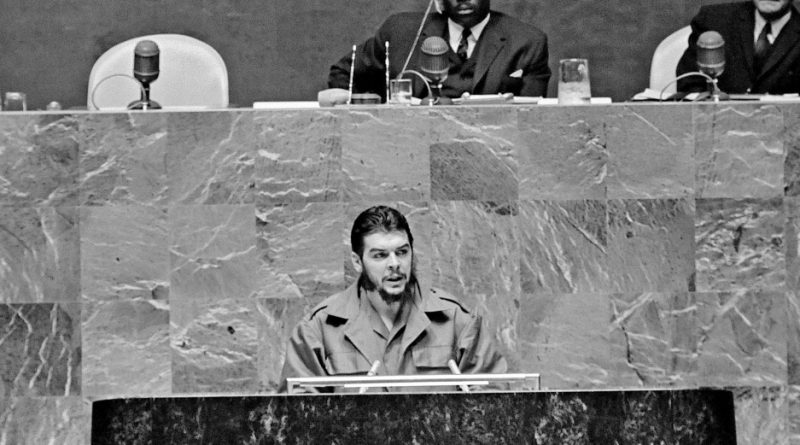
¡PATRIA O MUERTE! Che Guevara’s 1964 UN speech

Mr. President;
Distinguished delegates:

The delegation of Cuba to this Assembly, first of all, is pleased to fulfill the agreeable duty of welcoming the addition of three new nations to the important number of those that discuss the problems of the world here. We, therefore, greet, in the persons of their presidents and prime ministers, the peoples of Zambia, Malawi, and Malta, and express the hope that from the outset these countries will be added to the group of Nonaligned countries that struggle against imperialism, colonialism, and neocolonialism.

We also wish to convey our congratulations to the president of this Assembly [Alex Quaison-Sackey of Ghana], whose elevation to so high a post is of special significance since it reflects this new historic stage of resounding triumphs for the peoples of Africa, who up until recently were subject to the colonial system of imperialism. Today, in their immense majority these peoples have become sovereign states through the legitimate exercise of their self-determination. The final hour of colonialism has struck, and millions of inhabitants of Africa, Asia, and Latin America rise to meet a new life and demand their unrestricted right to self-determination and to the independent development of their nations.

We wish you, Mr. President, the greatest success in the tasks entrusted to you by the member states.

Cuba comes here to state its position on the most important points of controversy and will do so with the full sense of responsibility that the use of this rostrum implies, while at the same time fulfilling the unavoidable duty of speaking clearly and frankly.

We would like to see this Assembly shake itself out of complacency and move forward. We would like to see the committees begin their work and not stop at the first confrontation. Imperialism wants to turn this meeting into a pointless oratorical tournament, instead of solving the serious problems of the world. We must prevent it from doing so. This session of the Assembly should not be remembered in the future solely by the number 19 that identifies it. Our efforts are directed to that end.

We feel that we have the right and the obligation to do so because our country is one of the most constant points of friction. It is one of the places where the principles upholding the right of small countries to sovereignty are put to the test day by day, minute by minute. At the same time, our country is one of the trenches of freedom in the world, situated a few steps away from U.S. imperialism, showing by its actions, its daily example, that in the present conditions of humanity the peoples can liberate themselves and can keep themselves free.

Of course, there now exists a socialist camp that becomes stronger day by day and has more powerful weapons of struggle. But additional conditions are required for survival: the maintenance of internal unity, faith in one’s own destiny, and the irrevocable decision to fight to the death for the defense of one’s country and revolution. These conditions, distinguished delegates, exist in Cuba.

Of all the burning problems to be dealt with by this Assembly, one of special significance for us, and one whose solution we feel must be found first — so as to leave no doubt in the minds of anyone — is that of peaceful coexistence among states with different economic and social systems. Much progress has been made in the world in this field. But imperialism, particularly U.S. imperialism, has attempted to make the world believe that peaceful coexistence is the exclusive right of the earth’s great powers. We say here what our president said in Cairo, and what later was expressed in the declaration of the Second Conference of Heads of State or Government of Nonaligned Countries: that peaceful coexistence cannot be limited to the powerful countries if we want to ensure world peace. Peaceful coexistence must be exercised among all states, regardless of size, regardless of the previous historical relations that linked them, and regardless of the problems that may arise among some of them at a given moment.

At present, the type of peaceful coexistence to which we aspire is often violated. Merely because the Kingdom of Cambodia maintained a neutral attitude and did not bow to the machinations of U.S. imperialism, it has been subjected to all kinds of treacherous and brutal attacks from the Yankee bases in South Vietnam.

Laos, a divided country, has also been the object of imperialist aggression of every kind. Its people have been massacred from the air. The conventions concluded at Geneva have been violated, and part of its territory is in constant danger of cowardly attacks by imperialist forces.

The Democratic Republic of Vietnam knows all these histories of aggression as do few nations on earth. It has once again seen its frontier violated, has seen enemy bombers and fighter planes attack its installations and U.S. warships, violating territorial waters, attack its naval posts. At this time, the threat hangs over the Democratic Republic of Vietnam that the U.S. warmongers may openly extend into its territory the war that for many years they have been waging against the people of South Vietnam. The Soviet Union and the People’s Republic of China have given serious warnings to the United States. We are faced with a case in which world peace is in danger and, moreover, the lives of millions of human beings in this part of Asia are constantly threatened and subjected to the whim of the U.S. invader.

Peaceful coexistence has also been brutally put to the test in Cyprus, due to pressures from the Turkish Government and NATO, compelling the people and the government of Cyprus to make a heroic and firm stand in defense of their sovereignty.

In all these parts of the world, imperialism attempts to impose its version of what coexistence should be. It is the oppressed peoples in alliance with the socialist camp that must show them what true coexistence is, and it is the obligation of the United Nations to support them.

We must also state that it is not only in relations among sovereign states that the concept of peaceful coexistence needs to be precisely defined. As Marxists, we have maintained that peaceful coexistence among nations does not encompass coexistence between the exploiters and the exploited, between the oppressors and the oppressed. Furthermore, the right to full independence from all forms of colonial oppression is a fundamental principle of this organization. That is why we express our solidarity with the colonial peoples of so-called Portuguese Guinea, Angola, and Mozambique, who have been massacred for the crime of demanding their freedom. And we are prepared to help them to the extent of our ability in accordance with the Cairo declaration.

We express our solidarity with the people of Puerto Rico and their great leader, Pedro Albizu Campos, who, in another act of hypocrisy, has been set free at the age of 72, almost unable to speak, paralyzed, after spending a lifetime in jail. Albizu Campos is a symbol of the as-yet unfree but indomitable Latin America. Years and years of prison, almost unbearable pressures in jail, mental torture, solitude, total isolation from his people and his family, the insolence of the conqueror and its lackeys in the land of his birth — nothing broke his will. The delegation of Cuba, on behalf of its people, pays a tribute of admiration and gratitude to a patriot who confers honor upon our America.

The United States for many years has tried to convert Puerto Rico into a model of hybrid culture: the Spanish language with English inflections, the Spanish language with hinges on its backbone — the better to bow down before the Yankee soldier. Puerto Rican soldiers have been used as cannon fodder in imperialist wars, as in Korea, and have even been made to fire at their own brothers, as in the massacre perpetrated by the U.S. Army a few months ago against the unarmed people of Panama — one of the most recent crimes carried out by Yankee imperialism. And yet, despite this assault on their will and their historical destiny, the people of Puerto Rico have preserved their culture, their Latin character, their national feelings, which in themselves give proof of the implacable desire for independence lying within the masses on that Latin American island. We must also warn that the principle of peaceful coexistence does not encompass the right to mock the will of the peoples, as is happening in the case of the so-called British Guiana. There the government of Prime Minister Cheddi Jagan has been the victim of every kind of pressure and maneuver, and independence has been delayed to gain time to find ways to flout the people’s will and guarantee the docility of a new government, placed in power by covert means, in order to grant castrated freedom to this country of the Americas. Whatever roads Guiana may be compelled to follow to obtain independence, the moral and militant support of Cuba goes to its people.[15]

Furthermore, we must point out that the islands of Guadaloupe and Martinique have been fighting for a long time for self-government without obtaining it. This state of affairs must not continue. Once again we speak out to put the world on guard against what is happening in South Africa. The brutal policy of apartheid is applied before the eyes of the nations of the world. The peoples of Africa are compelled to endure the fact that on the African continent the superiority of one race over another remains official policy, and that in the name of this racial superiority murder is committed with impunity. Can the United Nations do nothing to stop this?

I would like to refer specifically to the painful case of the Congo, unique in the history of the modern world, which shows how, with absolute impunity, with the most insolent cynicism, the rights of peoples can be flouted. The direct reason for all this is the enormous wealth of the Congo, which the imperialist countries want to keep under their control. In the speech he made during his first visit to the United Nations, compañero Fidel Castro observed that the whole problem of coexistence among peoples boils down to the wrongful appropriation of other peoples’ wealth. He made the following statement: “End the philosophy of plunder and the philosophy of war will be ended as well.”

But the philosophy of plunder has not only not been ended, it is stronger than ever. And that is why those who used the name of the United Nations to commit the murder of Lumumba are today, in the name of the defense of the white race, murdering thousands of Congolese. How can we forget the betrayal of the hope that Patrice Lumumba placed in the United Nations? How can we forget the machinations and maneuvers that followed in the wake of the occupation of that country by UN troops, under whose auspices the assassins of this great African patriot acted with impunity? How can we forget, distinguished delegates, that the one who flouted the authority of the UN in the Congo — and not exactly for patriotic reasons, but rather by virtue of conflicts between imperialists — was Moise Tshombe, who initiated the secession of Katanga with Belgian support? And how can one justify, how can one explain, that at the end of all the United Nations’ activities there, Tshombe, dislodged from Katanga, should return as lord and master of the Congo? Who can deny the sad role that the imperialists compelled the United Nations to play?[16]

To sum up: dramatic mobilizations were carried out to avoid the secession of Katanga, but today Tshombe is in power, the wealth of the Congo is in imperialist hands — and the expenses have to be paid by the honorable nations. The merchants of war certainly do good business! That is why the government of Cuba supports the just stance of the Soviet Union in refusing to pay the expenses for this crime.

And as if this were not enough, we now have flung in our faces these latest acts that have filled the world with indignation. Who are the perpetrators? Belgian paratroopers, carried by U.S. planes, who took off from British bases. We remember as if it were yesterday that we saw a small country in Europe, a civilized and industrious country, the Kingdom of Belgium, invaded by Hitler’s hordes. We were embittered by the knowledge that this small nation was massacred by German imperialism, and we felt affection for its people. But this other side of the imperialist coin was the one that many of us did not see. Perhaps the sons of Belgian patriots who died defending their country’s liberty are now murdering in cold blood thousands of Congolese in the name of the white race, just as they suffered under the German heel because their blood was not sufficiently Aryan. Our free eyes open now to new horizons and can see what yesterday, in our condition as colonial slaves, we could not observe: that “Western Civilization” disguises behind its showy facade a picture of hyenas and jackals. That is the only name that can be applied to those who have gone to fulfill such “humanitarian” tasks in the Congo. A carnivorous animal that feeds on unarmed peoples. That is what imperialism does to men. That is what distinguishes the imperial “white man.”

All free men of the world must be prepared to avenge the crime of the Congo. Perhaps many of those soldiers, who were turned into sub-humans by imperialist machinery, believe in good faith that they are defending the rights of a superior race. In this Assembly, however, those peoples whose skins are darkened by a different sun, colored by different pigments, constitute the majority. And they fully and clearly understand that the difference between men does not lie in the color of their skin, but in the forms of ownership of the means of production, in the relations of production. The Cuban delegation extends greetings to the peoples of Southern Rhodesia and South-West Africa, oppressed by white colonialist minorities; to the peoples of Basutoland, Bechuanaland, Swaziland, French Somaliland, the Arabs of Palestine, Aden and the Protectorates, Oman; and to all peoples in conflict with imperialism and colonialism. We reaffirm our support to them.

I express also the hope that there will be a just solution to the conflict facing our sister republic of Indonesia in its relations with Malaysia. Mr. President: One of the fundamental themes of this conference is general and complete disarmament. We express our support for general and complete disarmament. Furthermore, we advocate the complete destruction of all thermonuclear devices and we support the holding of a conference of all the nations of the world to make this aspiration of all people a reality. In his statement before this assembly, our prime minister warned that arms races have always led to war. There are new nuclear powers in the world, and the possibilities of a confrontation are growing. We believe that such a conference is necessary to obtain the total destruction of thermonuclear weapons and, as a first step, the total prohibition of tests. At the same time, we have to establish clearly the duty of all countries to respect the present borders of other states and to refrain from engaging in any aggression, even with conventional weapons.

In adding our voice to that of all the peoples of the world who ask for general and complete disarmament, the destruction of all nuclear arsenals, the complete halt to the building of new thermonuclear devices and of nuclear tests of any kind, we believe it necessary to also stress that the territorial integrity of nations must be respected and the armed hand of imperialism held back, for it is no less dangerous when it uses only conventional weapons. Those who murdered thousands of defenseless citizens of the Congo did not use the atomic bomb. They used conventional weapons. Conventional weapons have also been used by imperialism, causing so many deaths.

Even if the measures advocated here were to become effective and make it unnecessary to mention it, we must point out that we cannot adhere to any regional pact for denuclearization so long as the United States maintains aggressive bases on our own territory, in Puerto Rico, Panama and in other Latin American states where it feels it has the right to place both conventional and nuclear weapons without any restrictions. We feel that we must be able to provide for our own defense in the light of the recent resolution of the Organization of American States against Cuba, on the basis of which an attack may be carried out invoking the Rio Treaty.[17] If the conference to which we have just referred were to achieve all these objectives — which, unfortunately, would be difficult — we believe it would be the most important one in the history of humanity. To ensure this it would be necessary for the People’s Republic of China to be represented, and that is why a conference of this type must be held. But it would be much simpler for the peoples of the world to recognize the undeniable truth of the existence of the People’s Republic of China, whose government is the sole representative of its people, and to give it the seat it deserves, which is, at present, usurped by the gang that controls the province of Taiwan, with U.S. support.

The problem of the representation of China in the United Nations cannot in any way be considered as a case of a new admission to the organization, but rather as the restoration of the legitimate rights of the People’s Republic of China.

We must repudiate energetically the “two Chinas” plot. The Chiang Kai-shek gang of Taiwan cannot remain in the United Nations. What we are dealing with, we repeat, is the expulsion of the usurper and the installation of the legitimate representative of the Chinese people.

We also warn against the U.S. Government’s insistence on presenting the problem of the legitimate representation of China in the UN as an “important question,” in order to impose a requirement of a two-thirds majority of members present and voting. The admission of the People’s Republic of China to the United Nations is, in fact, an important question for the entire world, but not for the machinery of the United Nations, where it must constitute a mere question of procedure. In this way justice will be done. Almost as important as attaining justice, however, would be the demonstration, once and for all, that this august Assembly has eyes to see, ears to hear, tongues to speak with and sound criteria for making its decisions. The proliferation of nuclear weapons among the member states of NATO, and especially the possession of these devices of mass destruction by the Federal Republic of Germany, would make the possibility of an agreement on disarmament even more remote, and linked to such an agreement is the problem of the peaceful reunification of Germany. So long as there is no clear understanding, the existence of two Germanys must be recognized: that of the German Democratic Republic and the Federal Republic. The German problem can be solved only with the direct participation in negotiations of the German Democratic Republic with full rights. We shall only touch on the questions of economic development and international trade that are broadly represented in the agenda. In this very year of 1964 the Geneva conference was held at which a multitude of matters related to these aspects of international relations were dealt with. The warnings and forecasts of our delegation were fully confirmed, to the misfortune of the economically dependent countries.

We wish only to point out that insofar as Cuba is concerned, the United States of America has not implemented the explicit recommendations of that conference, and recently the U.S. Government also prohibited the sale of medicines to Cuba. By doing so it divested itself, once and for all, of the mask of humanitarianism with which it attempted to disguise the aggressive nature of its blockade against the people of Cuba.

Furthermore, we state once more that the scars left by colonialism that impede the development of the peoples are expressed not only in political relations. The so-called deterioration of the terms of trade is nothing but the result of the unequal exchange between countries producing raw materials and industrial countries, which dominate markets and impose the illusory justice of equal exchange of values.

So long as the economically dependent peoples do not free themselves from the capitalist markets and, in a firm bloc with the socialist countries, impose new relations between the exploited and the exploiters, there will be no solid economic development. In certain cases there will be retrogression, in which the weak countries will fall under the political domination of the imperialists and colonialists.

Finally, distinguished delegates, it must be made clear that in the area of the Caribbean, manoeuvres and preparations for aggression against Cuba are taking place, on the coasts of Nicaragua above all, in Costa Rica as well, in the Panama Canal Zone, on Vieques Island in Puerto Rico, in Florida and possibly in other parts of U.S. territory and perhaps also in Honduras. In these places Cuban mercenaries are training, as well as mercenaries of other nationalities, with a purpose that cannot be the most peaceful one. After a big scandal, the government of Costa Rica — it is said — has ordered the elimination of all training camps of Cuban exiles in that country.

No one knows whether this position is sincere, or whether it is a simple alibi because the mercenaries training there were about to commit some misdeed. We hope that full cognizance will be taken of the real existence of bases for aggression, which we denounced long ago, and that the world will ponder the international responsibility of the government of a country that authorizes and facilitates the training of mercenaries to attack Cuba. We should note that news of the training of mercenaries in different parts in the Caribbean and the participation of the U.S. Government in such acts is presented as completely natural in the newspapers in the United States. We know of no Latin American voice that has officially protested this. This shows the cynicism with which the U.S. Government moves its pawns.

The sharp foreign ministers of the OAS had eyes to see Cuban emblems and to find “irrefutable” proof in the weapons that the Yankees exhibited in Venezuela, but they do not see the preparations for aggression in the United States, just as they did not hear the voice of President Kennedy, who explicitly declared himself the aggressor against Cuba at Playa Girón [Bay of Pigs invasion of April 1961]. In some cases, it is a blindness provoked by the hatred against our revolution by the ruling classes of the Latin American countries. In others — and these are sadder and more deplorable — it is the product of the dazzling glitter of mammon.

As is well known, after the tremendous commotion of the so-called Caribbean crisis, the United States undertook certain commitments with the Soviet Union. These culminated in the withdrawal of certain types of weapons that the continued acts of aggression of the United States — such as the mercenary attack at Playa Girón and threats of invasion against our homeland — had compelled us to install in Cuba as an act of legitimate and essential defense.

The United States, furthermore, tried to get the UN to inspect our territory. But we emphatically refuse, since Cuba does not recognize the right of the United States, or of anyone else in the world, to determine the type of weapons Cuba may have within its borders.

In this connection, we would abide only by multilateral agreements, with equal obligations for all the parties concerned. As Fidel Castro has said: “So long as the concept of sovereignty exists as the prerogative of nations and of independent peoples, as a right of all peoples, we will not accept the exclusion of our people from that right. So long as the world is governed by these principles, so long as the world is governed by those concepts that have universal validity because they are universally accepted and recognized by the peoples, we will not accept the attempt to deprive us of any of those rights, and we will renounce none of those rights.” The Secretary-General of the United Nations, U Thant, understood our reasons. Nevertheless, the United States attempted to establish a new prerogative, an arbitrary and illegal one: that of violating the airspace of a small country. Thus, we see flying over our country U-2 aircraft and other types of spy planes that, with complete impunity, fly over our airspace. We have made all the necessary warnings for the violations of our airspace to cease, as well as for a halt to the provocations of the U.S. Navy against our sentry posts in the zone of Guantánamo, the buzzing by aircraft of our ships or the ships of other nationalities in international waters, the pirate attacks against ships sailing under different flags, and the infiltration of spies, saboteurs and weapons onto our island.

We want to build socialism. We have declared that we are supporters of those who strive for peace. We have declared ourselves to be within the group of Nonaligned countries, although we are Marxist-Leninists, because the Nonaligned countries, like ourselves, fight imperialism. We want peace. We want to build a better life for our people. That is why we avoid, insofar as possible, falling into the provocations manufactured by the Yankees. But we know the mentality of those who govern them. They want to make us pay a very high price for that peace. We reply that the price cannot go beyond the bounds of dignity.

And Cuba reaffirms once again the right to maintain on its territory the weapons it deems appropriate, and its refusal to recognize the right of any power on earth — no matter how powerful — to violate our soil, our territorial waters, or our airspace.

If in any assembly Cuba assumes obligations of a collective nature, it will fulfill them to the letter. So long as this does not happen, Cuba maintains all its rights, just as any other nation. In the face of the demands of imperialism, our prime minister laid out the five points necessary for the existence of a secure peace in the Caribbean. They are:

1. A halt to the economic blockade and all economic and trade pressures by the United States, in all parts of the world, against our country.

2. A halt to all subversive activities, launching and landing of weapons and explosives by air and sea, organization of mercenary invasions, infiltration of spies and saboteurs, acts all carried out from the territory of the United States and some accomplice countries.

3. A halt to pirate attacks carried out from existing bases in the United States and Puerto Rico.

4. A halt to all the violations of our airspace and our territorial waters by U.S. aircraft and warships.

5. Withdrawal from the Guantánamo naval base and return of the Cuban territory occupied by the United States.”

None of these elementary demands has been met, and our forces are still being provoked from the naval base at Guantánamo. That base has become a nest of thieves and a launching pad for them into our territory. We would tire this Assembly were we to give a detailed account of the large number of provocations of all kinds. Suffice it to say that including the first days of December, the number amounts to 1,323 in 1964 alone. The list covers minor provocations such as violation of the boundary line, launching of objects from the territory controlled by the United States, the commission of acts of sexual exhibitionism by U.S. personnel of both sexes, and verbal insults. It includes others that are more serious, such as shooting off small caliber weapons, aiming weapons at our territory, and offenses against our national flag. Extremely serious provocations include those of crossing the boundary line and starting fires in installations on the Cuban side, as well as rifle fire. There have been 78 rifle shots this year, with the sorrowful toll of one death: that of Ramón López Peña, a soldier, killed by two shots fired from the U.S. post three and a half kilometers from the coast on the northern boundary. This extremely grave provocation took place at 7:07 p.m. on July 19, 1964, and the prime minister of our government publicly stated on July 26 that if the event were to recur he would give orders for our troops to repel the aggression. At the same time orders were given for the withdrawal of the forward line of Cuban forces to positions farther away from the boundary line and the construction of the necessary fortified positions. One thousand three hundred and twenty-three provocations in 340 days amount to approximately four per day. Only a perfectly disciplined army with a morale such as ours could resist so many hostile acts without losing its self-control.

Forty-seven countries meeting at the Second Conference of Heads of State or Government of Nonaligned Countries in Cairo unanimously agreed:

“Noting with concern that foreign military bases are in practice a means of bringing pressure on nations and retarding their emancipation and development, based on their own ideological, political, economic and cultural ideas, the conference declares its unreserved support to the countries that are seeking to secure the elimination of foreign bases from their territory and calls upon all states maintaining troops and bases in other countries to remove them immediately. The conference considers that the maintenance at Guantánamo (Cuba) of a military base of the United States of America, in defiance of the will of the government and people of Cuba and in defiance of the provisions embodied in the declaration of the Belgrade conference, constitutes a violation of Cuba’s sovereignty and territorial integrity.

Noting that the Cuban Government expresses its readiness to settle its dispute over the base at Guantánamo with the United States of America on an equal footing, the conference urges the U.S. Government to open negotiations with the Cuban Government to evacuate their base”.

The government of the United States has not responded to this request of the Cairo conference and is attempting to maintain indefinitely by force its occupation of a piece of our territory, from which it carries out acts of aggression such as those detailed earlier.

The Organization of American States — which the people also call the U.S. Ministry of Colonies — condemned us “energetically,” even though it had just excluded us from its midst, ordering its members to break off diplomatic and trade relations with Cuba. The OAS authorized aggression against our country at any time and under any pretext, violating the most fundamental international laws, completely disregarding the United Nations. Uruguay, Bolivia, Chile and Mexico opposed that measure, and the government of the United States of Mexico refused to comply with the sanctions that had been approved. Since then we have had no relations with any Latin American countries except Mexico, and this fulfills one of the necessary conditions for direct aggression by imperialism.

We want to make clear once again that our concern for Latin America is based on the ties that unite us: the language we speak, the culture we maintain, and the common master we had. We have no other reason for desiring the liberation of Latin America from the U.S. colonial yoke. If any of the Latin American countries here decide to reestablish relations with Cuba, we would be willing to do so on the basis of equality, and without viewing that recognition of Cuba as a free country in the world to be a gift to our government. We won that recognition with our blood in the days of the liberation struggle. We acquired it with our blood in the defense of our shores against the Yankee invasion.

Although we reject any accusations against us of interference in the internal affairs of other countries, we cannot deny that we sympathize with those people who strive for their freedom. We must fulfill the obligation of our government and people to state clearly and categorically to the world that we morally support and stand in solidarity with peoples who struggle anywhere in the world to make a reality of the rights of full sovereignty proclaimed in the UN Charter.

It is the United States that intervenes. It has done so historically in Latin America. Since the end of the last century Cuba has experienced this truth; but it has been experienced, too, by Venezuela, Nicaragua, Central America in general, Mexico, Haiti and the Dominican Republic. In recent years, apart from our people, Panama has experienced direct aggression, where the marines in the Canal Zone opened fire in cold blood against the defenseless people; the Dominican Republic, whose coast was violated by the Yankee fleet to avoid an outbreak of the just fury of the people after the death of Trujillo; and Colombia, whose capital was taken by assault as a result of a rebellion provoked by the assassination of Gaitán.[18] Covert interventions are carried out through military missions that participate in internal repression, organizing forces designed for that purpose in many countries, and also in coups d’état, which have been repeated so frequently on the Latin American continent during recent years. Concretely, U.S. forces intervened in the repression of the peoples of Venezuela, Colombia and Guatemala, who fought with weapons for their freedom. In Venezuela, not only do U.S. forces advise the army and the police, but they also direct acts of genocide carried out from the air against the peasant population in vast insurgent areas. And the Yankee companies operating there exert pressures of every kind to increase direct interference. The imperialists are preparing to repress the peoples of the Americas and are establishing an International of Crime.

The United States intervenes in Latin America invoking the defense of free institutions. The time will come when this Assembly will acquire greater maturity and demand of the U.S. Government guarantees for the life of the blacks and Latin Americans who live in that country, most of them U.S. citizens by origin or adoption.

Those who kill their own children and discriminate daily against them because of the color of their skin; those who let the murderers of blacks remain free, protecting them, and furthermore punishing the black population because they demand their legitimate rights as free men — how can those who do this consider themselves guardians of freedom? We understand that today the Assembly is not in a position to ask for explanations of these acts. It must be clearly established, however, that the government of the United States is not the champion of freedom, but rather the perpetrator of exploitation and oppression against the peoples of the world and against a large part of its own population.

To the ambiguous language with which some delegates have described the case of Cuba and the OAS, we reply with clear-cut words and we proclaim that the peoples of Latin America will make those servile, sell-out governments pay for their treason.

Cuba, distinguished delegates, a free and sovereign state with no chains binding it to anyone, with no foreign investments on its territory, with no proconsuls directing its policy, can speak with its head held high in this Assembly and can demonstrate the justice of the phrase by which it has been baptized: “Free Territory of the Americas.” Our example will bear fruit in the continent, as it is already doing to a certain extent in Guatemala, Colombia and Venezuela.

There is no small enemy nor insignificant force, because no longer are there isolated peoples. As the Second Declaration of Havana states:

“No nation in Latin America is weak — because each forms part of a family of 200 million brothers, who suffer the same miseries, who harbor the same sentiments, who have the same enemy, who dream about the same better future, and who count upon the solidarity of all honest men and women throughout the world…

This epic before us is going to be written by the hungry Indian masses, the peasants without land, the exploited workers. It is going to be written by the progressive masses, the honest and brilliant intellectuals, who so greatly abound in our suffering Latin American lands. Struggles of masses and ideas. An epic that will be carried forward by our peoples, mistreated and scorned by imperialism; our people, unreckoned with until today, who are now beginning to shake off their slumber. Imperialism considered us a weak and submissive flock; and now it begins to be terrified of that flock; a gigantic flock of 200 million Latin Americans in whom Yankee monopoly capitalism now sees its gravediggers…

But now from one end of the continent to the other they are signaling with clarity that the hour has come — the hour of their vindication. Now this anonymous mass, this America of color, somber, taciturn America, which all over the continent sings with the same sadness and disillusionment, now this mass is beginning to enter definitively into its own history, is beginning to write it with its own blood, is beginning to suffer and die for it.

Because now in the mountains and fields of America, on its flatlands and in its jungles, in the wilderness or in the traffic of cities, on the banks of its great oceans or rivers, this world is beginning to tremble. Anxious hands are stretched forth, ready to die for what is theirs, to win those rights that were laughed at by one and all for 500 years. Yes, now history will have to take the poor of America into account, the exploited and spurned of America, who have decided to begin writing their history for themselves for all time. Already they can be seen on the roads, on foot, day after day, in endless march of hundreds of kilometers to the governmental “eminences,” there to obtain their rights.

Already they can be seen armed with stones, sticks, machetes, in one direction and another, each day, occupying lands, sinking hooks into the land that belongs to them and defending it with their lives. They can be seen carrying signs, slogans, flags; letting them flap in the mountain or prairie winds. And the wave of anger, of demands for justice, of claims for rights trampled underfoot, which is beginning to sweep the lands of Latin America, will not stop. That wave will swell with every passing day. For that wave is composed of the greatest number, the majorities in every respect, those whose labor amasses the wealth and turns the wheels of history. Now they are awakening from the long, brutalizing sleep to which they had been subjected.

For this great mass of humanity has said, “Enough!” and has begun to march. And their march of giants will not be halted until they conquer true independence — for which they have vainly died more than once. Today, however, those who die will die like the Cubans at Playa Girón. They will die for their own true and never-to-be-surrendered independence”.

All this, distinguished delegates, this new will of a whole continent, of Latin America, is made manifest in the cry proclaimed daily by our masses as the irrefutable expression of their decision to fight and to paralyze the armed hand of the invader. It is a cry that has the understanding and support of all the peoples of the world and especially of the socialist camp, headed by the Soviet Union.

That cry is: Patria o muerte! [Homeland or death]

Source: Marxists Internet Archive

Strugglelalucha256
https://www.struggle-la-lucha.org/2022/10/page/7/