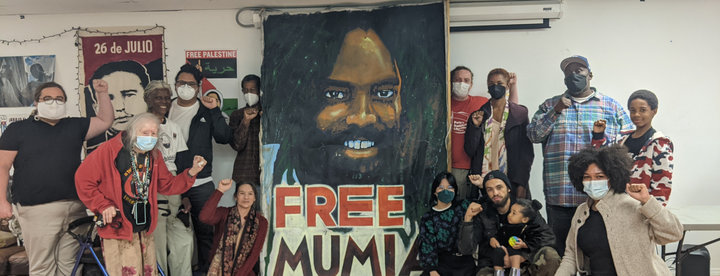
SoCal fights to bring Mumia Abu-Jamal home

Mumia solidarity rally at Leimert Park, Los Angeles, Dec. 15. SLL photos

On Oct. 16, Judge Lucretia Clemons of the Common Pleas Court of Pennsylvania dismissed all the claims that political prisoner Mumia Abu-Jamal and his lawyers presented – critical evidence, withheld for over 40 years, that could overturn his 1982 conviction, exonerate him and bring him home to his family. 

Mumia has been in jail for over 40 years – 30 of those years spent on death row. This may be his last opportunity to prove his innocence and gain his release. Mumia’s health is rapidly deteriorating, and he is not a candidate for compassionate release in the state of Pennsylvania. 

By dismissing these claims and refusing to grant Mumia a new trial, Judge Clemmons is sentencing him to death through incarceration. Noel Hanrahan, legal director at Prison Radio, told Counterspin, “These were critical documents (just discovered 2 years ago) that many other people have gotten relief on.” 

A video entitled “Healing the Wounds of Racism” by Judge Lucretia Clemons was released after the October hearing and posted on LoveNotPhear.com. The call from #LoveNotPhear was for people to listen to this six-minute video and send an audio message, an email post, or write a letter in response – what you wanted to tell Judge Clemons – to be presented to her on Dec. 16, when she was scheduled to make her final decision as to whether Mumia would have his day in court.

(At the Dec. 16 hearing, Judge Clemmons announced that she would put off her final ruling for another 60 to 90 days. Read Struggle-La Lucha’s report from Philadelphia here.)

The Black Alliance for Peace, Harriet Tubman Center for Social Justice and San Diego Coalition to Free Mumia Abu-Jamal and All Political Prisoners joined with thousands worldwide to answer the call by #LoveNotPhear to act on this gross miscarriage of justice. The groups shared #LoveNotPhear’s website on social media and organized letter-writing sessions in libraries and bookstores. 

Activists also organized events leading up to the hearing. A rally was held in Los Angeles on Dec. 15, and a political prisoners teach-in was held in San Diego on Dec. 16.

San Diego letter-writing workshop, Dec. 6.

Southern California actions

Activists demanding a new trial for Mumia Abu-Jamal gathered for a speakout at Leimert Park in South Central LA Dec. 15. They brought literature on the latest news and historical background of his case. 

Speakers included former Black Panther Harold Welton; Matyos Kidane of Stop LAPD Spying Coalition; John Parker of Harriet Tubman Center for Social Justice; and Sylvester of The Love We Don’t See. 

Natalie Matos of Black Alliance for Peace, who MC’d, began the rally with updates on Mumia’s case and opportunities to continue the struggle. Names were collected from community members interested in volunteering or receiving more information and updates on planned solidarity activities.

The San Diego letter-writing workshop was held on Dec. 6 at the Malcolm X Library and Performing Arts Center. The teach-in, hosted by the San Diego Coalition to Free Mumia Abu-Jamal and All Political Prisoners, was held at the San Diego Justice Center on Dec. 16.

Political prisoners teach-in on Dec. 16 in San Diego.

The teach-in began with an email message received from Philadelphia announcing that Judge Clemons had postponed her decision, followed by a video of the rally outside the courthouse, where the crowd chanted “Brick by brick, wall by wall, free Mumia Abu-Jamal.” In the video, Professor Johanna Fernandez announced that no decision being made sends the message that we won, and this is the moment to fight harder and make sure that light and justice prevail.

Speakers at the teach-in included Justine Mann of Party for Socialism and Liberation; Mary Lou Finley of Leonard Peltier Défense Committee; John Parker of Socialist Unity Party; Natalie Matos of Black Alliance for Peace; and Denzel Draughn of Hands Off Uhuru/Hands Off Africa Defense Campaign. 

Participants discussed the fact that the U.S. has political prisoners and why we believe all prisoners are political prisoners because of the racist, profit-motivated prison-industrial complex. 

We discussed why we need to support political prisoners and become active in the fight to free them all, shut down the prison-industrial complex, end mass incarceration and abolish the death penalty, including death by incarceration.

The teach-in ended with another letter-writing session to continue urging Judge Clemmons to do the right thing. We have two to three months to continue to organize, mobilize, educate and spread the truth about Mumia Abu-Jamal.  

The San Diego Coalition to Free Mumia and All Political Prisoners also hosted a screening of the film “Mumia Abu-Jamal: Long Distance Revolutionary” on Dec. 17 at the Malcolm X Library.

Mumia will be released. It’s up to us to make that happen.

#LoveNotPhear – spread love and challenge fear!

Release Mumia! Free them all!

Mary Lou Finley, Natalie Matos and John Parker contributed to this article.

Strugglelalucha256


Philadelphia: Fight to free Mumia Abu-Jamal continues

Dec. 16 ― Supporters packed the courtroom at Mumia Abu-Jamal’s Post-Conviction Relief Act hearing today before Common Pleas Court Judge Lucretia Clemons. Outside, more supporters demonstrated in the rain.

Mumia Abu-Jamal is a world-renowned political prisoner and past president of the  Philadelphia Association of Black Journalists who was framed when Philadelphia police officer Daniel Faulkner was killed in 1981. Originally sentenced to death, the former Black Panther Party member has been jailed for 41 years. That’s over 13 years longer than the imprisonment of Nelson Mandela.

Defense attorneys pointed out new information about the credibility of prosecution witnesses and bias in jury selection.

One of Abu-Jamal’s lawyers, Judith Ritter, raised that prosecution witness Robert Chobert demanded money for his testimony. Another state witness, Cynthia White, sought to have several prostitution charges dropped in exchange for her testimony. Prosecutor Joseph McGill also sought to limit the number of Black jurors. 

Evidence of these claims by Mumia Abu-Jamal’s lawyers was “suddenly found” in six boxes of material that were stored in District Attorney Larry Krasner’s office.

Assistant District Attorney Grady Gervino sought to dismiss these defense claims. His arguments, particularly regarding the bias in jury selection, were flimsy. Former assistant Philadelphia D.A. Jack McMahon actually made a 1986 training video teaching younger prosecutors to avoid selecting Black jurors.

“In selecting Blacks—you don’t want the real educated ones,” McMahon said. “Again, this goes across the board of all races. You don’t want smart people.”

Although this video was made several years after Jamal was convicted, it shows the bigoted atmosphere in the Philadelphia District Attorney’s office.

There are dozens of boxes of material that were withheld from Abu-Jamal’s lawyers that have to be searched. All of these facts demand a new trial for Mumia Abu-Jamal or throwing out his conviction.

Judge Clemons said she would make a ruling in 60 to 90 days. Supporters of justice need to spread the truth: Mumia Abu-Jamal is innocent.

Strugglelalucha256


U.N. rights group files brief about systemic racism in Mumia Abu-Jamal’s case

The United Nations Working Group of Experts on People of African Descent filed an amicus brief on Dec. 6 with the Philadelphia Court of Common Pleas Judge Lucretia Clemons regarding the case of Mumia Abu-Jamal.

“The United Nations Working Group of Experts on People of African Descent (WGEPAD) has followed Mumia’s case for years and has just filed an amicus brief for his hearing,” says Julia Wright, elder daughter of renowned author Richard Wright. “Given instances of the pervasive systemic racism tainting the case to this day, these experts note that international human rights law requires jurists to take responsibility for ongoing effects of racial discrimination, even decades later.”

According to WGEPAD’s amicus brief, “Presumed victims of racial discrimination are not required to show that there was discriminatory intent against them … The case of Mumia Abu-Jamal may present such concerns. …

“A significant percentage of the police officers involved in gathering evidence and presenting the case were investigated and eventually convicted and jailed on charges including corruption and evidence tampering, information that was unavailable to the jury at the time it was assessing the credibility, tendency toward bias, and reliability of these officers.”

Strugglelalucha256


Free Mumia Abu-Jamal now!

Statement of Vermont AFL-CIO President David Van Deusen

“The Vermont AFL-CIO declares that it is time that Mumia Abu Jamal, and all Black political prisoners in the U.S. who were engaged with organizing through the Black Panther Party, be set free! We also declare that the time has come for Organized Labor, without hesitation, to stand with working-class Black communities when they demand true freedom, economic equity, and self-determination!

“The long march towards true freedom and working class liberation has taken many turns since our anti-imperialist revolution of 1777. A generation ago, that turn, that righteous and justified struggle, brought us the Black Panther Party. This Party, one dedicated to engaging in the fight for Black liberation, socialism, and Power to The People served as an example of militant struggle across the U.S. and produced countless organizers and resistance leaders including brother Mumia Abu Jamal.

“Brother Jamal spent his free life struggling for the liberation of his people, and as he gained the ear of the many, as his fight for a better world become a threat to the entrenched ruling classes of Philadelphia, Pennsylvania, and the American Empire, those same ruling classes, through their agents, actively sought to silence him. And here, on trumped-up charges, after a charade of a trial, he was imprisoned and sentenced to death for a crime he did not commit. Like Sacco and Vanzetti, or Joe Hill before, the capitalist state sought to execute him, not for the crime he is innocent of, but because of the threat that his words and actions represented to the racist and classist status quo.

“The ruling class has, in fact, forced brother Jamal to ‘walk through the valley of the shadow of death,’ straight to death row, but brother Jamal, like so many of our political martyrs who have come before, has ‘feared no evil.’ And because of the outcry of tens of thousands of workers like you, because even the rich and powerful have been made to understand that if Mumia dies, Philly burns, he is still alive, and there is still a chance, through struggle, for true justice to prevail.

“Therefore I join with you today in the call for Mumia to be set free! I lend my voice to yours as we demand justice! I too say that brother Jamal must be led out from behind those prison bars of oppression, and back into the struggle for long overdue change! And together, through a working class unity which articulates the aspirations of all workers (be they Black, White, Latino, Native American, or Asian) may we endeavor to once and for all break the chains of exploitation and capitalism and deliver henceforth a new world grounded in economic equity, cooperation, a more direct and participatory democracy, and pro-Union to the core! Free Mumia Abu Jamal!”

David Van Deusen
President of the Vermont AFL-CIO

Strugglelalucha256


Judicial persecution corrupts the case Of Mumia Abu-Jamal

Philadelphia Common Pleas Court Judge Lucretia Clemons is the latest addition to an odious list of appellate court jurists who craftily construct legal barriers specifically to bludgeon evidence that undermines the corrupted conviction of Mumia Abu-Jamal, the acclaimed writer/activist who millions worldwide consider a ‘political prisoner.’

The 1982 conviction of Abu-Jamal, for killing a Philadelphia policeman, arose from gross violations of “international standards that govern fair trial procedures…” according to a seminal study on Abu-Jamal’s case released in February 2000 by Amnesty International. AI is the prestigious, Noble Prize-winning human rights monitoring organization.

Judge Clemons, an African American, continues the peculiar appellate court practice of whitewashing wrongs that deny Abu-Jamal his constitutional fair trial rights.

As that Amnesty study noted, the “politicization” of Mumia Abu-Jamal’s case “may not only have prejudiced his right to a fair trial but may now be undermining his right to fair and impartial treatment in the appeal courts.”

Judge Clemons, during an appeal proceeding in October 2022, released a 31-page “Notice of Intent to Dismiss” Abu-Jamal’s latest appeal . That appeal is perhaps the last appeal he can file.

Clemons’ “Intent” ruling wraps fictions with legalese to justify her rejection of Abu-Jamal’s appeal. The reply to Clemons’ intended ruling from Abu-Jamal’s lawyers reminds her that some of her legal reasoning is “precisely the approach” that the Pennsylvania Supreme Court and the United States Supreme Court have both “deemed incorrect.”

A unique aspect of Judge Clemons’ engagement with Abu-Jamal’s appeal is her rejection of extraordinary evidence documenting disturbing wrongdoing during Abu-Jamal’s 1982 trail for the murder of Officer Daniel Faulkner.

This extraordinary evidence that Clemons finds “unpersuasive” includes rare documentation of both racist procedures the trial prosecutor used during jury selection and improper inducements prosecutors provided two prime trial witnesses. One item in that extraordinary evidence is a handwritten note from one of those prime witnesses to the trial prosecutor demanding the “money” that witness said the prosecutor promised him.

Fair trial rights, for example, bar prosecutors from purchasing testimony. Fair trial rights also bar prosecutors from racist jury selection practices.

Judge Clemons, consistent with prior appellate practice to block Abu-Jamal appeals, has declared intent to disregard the fundamental fact that fair trail rights require prosecutors to disclose evidence favorable to a defendant.

Philadelphia prosecutors failed to follow that requirement in the Abu-Jamal case by withholding that extraordinary evidence for over 36-years.

Clemons cavalierly whitewashes this outrageous failure by prosecutors. She contends Abu-Jamal was not “prejudiced” either at trial or during subsequent appeals because prosecutors improperly withheld evidence of obvious improprieties against Abu-Jamal.

The fact that prosecutors withheld favorable evidence from defense lawyers for over 13,000-days should be an automatic basis for a new trail – a proverbial no-brainer. However, Judge Clemons intends to reject Abu-Jamal’s request for a new trial seeing no legal unfairness in prosecutors withholding that evidence for over 21-million minutes.

Truly unique context of this extraordinary evidence Clemons’ stated she is prepared to dismiss is that Philadelphia’s current District Attorney personally discovered it. DA Larry Krasner found six boxes of Abu-Jamal case documents stashed in a storage closet while exploring the physical layout of DA’s office one month after his November 2018 election.

Krasner’s discovery of those six boxes came shortly after the DA’s Office told another judge hearing an Abu-Jamal appeal that all material about Abu-Jamal’s case had been given to Abu-Jamal’s defense team.

While Abu-Jamal’s defense argues evidence in those six withheld boxes constitute a “watershed revelation” Judge Clemons deems that evidence irrelevant, essentially old wine in a new bottle that prior appellate rulings rejected.

Consider Judge Clemons’ posture on one document in those six boxes. That document is handwritten notes by the trial prosecutor where that prosecutor placed a big ‘B’ by the names of potential Black jurors and a big ‘W’ by potential white jurors. Prosecutors employing race as a criterion in jury selection is forbidden by the Pa and U.S. supreme courts. For decades, Philadelphia prosecutors denied any improprieties in Abu-Jamal’s jury selection citing a lack of conclusive evidence of any impropriety that the handwritten notes now provide.

Clemons blasted Abu-Jamal’s defense for not probing the trial prosecutor on his jury selection rationales during a mid-1990s appeal hearing.

But, as noted in Abu-Jamal’s reply to Clemons, defense lawyers could not have questioned the trial prosecutor on those handwritten notes because prosecutors improperly withheld those notes from the defense. Abu-Jamal’s reply stated there was no notice before January 2019* that the trial prosecutor in 1982 “took jury notes showing he was tracking jurors by race.” (*January 2019 is when the DA’s Office released those six boxes of documents to Abu-Jamal’s defense team.)

Clemons made an astoundingly absurd assertion in her ‘Intent’ when she declared that either Abu-Jamal or his trial lawyer could have easily observed “with their own eyes” the prosecutor making those improper racial notations during jury selection. Clemons’ assertion ignored the virtual impossibility of someone sitting at the defense table during a trial being able to see exactly what someone wrote on a note pad at the prosecution table located at least five feet away from the defense table.

Judge Clemons – in her ‘Intent’ – rejected holding an evidentiary hearing where she could hear testimony to determine for herself the veracity of claims by the DA’s Office, thus resolving factual disputes.

Clemons, for example, doesn’t see a need to hear prosecutors explain their claim that the demand for “money” from their prime trial witness was not payment for his testimony. Prosecutors claim the demand for money in that withheld note related to wages that witness said he lost due to testifying at trail.

Clemons claimed the jury would have still convicted Abu-Jamal even if they knew about that demand for money. Clemons conveniently omits contextual facts like the jury never learned that witness thought the trial prosecutor would get his driver’s license restored that was revoked due to a DUI conviction.

Because of rulings by the bigoted, pro-prosecution trial judge, the jury never knew that this witness was on probation for firebombing a school and was driving a cab without a valid driver’s license when he claimed he saw Abu-Jamal shoot Faulkner. Driving on a revoked license could have led to the revocation of that driver’s probation sending him to prison for that firebombing. Abu-Jamal’s lawyers contend the driver tailored his testimony to save himself from possible imprisonment.

Another document contained in those six withheld boxes is a report filed by a police officer that exposed improprieties by police related to that cab driving witness. This police officer filed that report less than ninety minutes after Faulkner’s murder. The report stated police commanders told that officer to “ride over to Homicide with a cab driver.”

Since that cab driver said he witnessed Faulkner’s murder after he parked his cab behind Faulkner’s patrol car, police violated their crime scene investigation protocols which forbid removing vehicles relevant to an investigation.

That cab is not shown in any of the official police crime scene photos. And, that cab is not shown in photos taken by a freelance news photographer who arrived at the crime scene ten minutes after Faulkner’s fatal shooting and before police crime scene investigators.

No other prosecution witness testified to seeing a cab behind Faulkner’s patrol car.

This failure of prosecution witnesses to place a cab behind the patrol car included the only other prosecution eyewitness who claimed that Abu-Jamal killed Faulkner. That witness, a prostitute,  claimed she was standing a few feet from where the cab driver testified that he was parked.

If police allowed the cab driver to drive himself to the interview by Homicide detectives, as confirmed in that policeman’s report, then police tampered with the crime scene. Tampering with a crime scene is another valid reason for granting Abu-Jamal a new trial.

That cab driver, years after the trial, told defense investigators and reporters that he did not park behind Faulkner’s patrol car. This witness said he did not see who shot Faulkner. Those statements to investigators and reporters contradict the cab driver’s trial testimony. Those statements constitute additional evidence of the need for a new trial that Judge Clemons and other jurists have dismissed.

Those six withheld boxes also contained alarming evidence of leniency prosecutors extended to their second eyewitness. That prostitute said she witnessed Faulkner’s shooting while standing on a corner a few feet from the crime. This prostitute and the trial prosecutor each told the trial jury there were no deals for her testimony. Yet, days after the jury convicted Abu-Jamal, prosecutors dropped a series of criminal charges pending against that prostitute.

Judge Clemons asserts that the jury would have convicted Abu-Jamal even without the eyewitness testimony of the cab driver and the prostitute – the only two witnesses to testify that Abu-Jamal shot Faulkner. However, Abu-Jamal’s reply to Clemons’ ‘Intent’ disputes her assertion.

The “cumulative effect of a promise of money to one crucial witness and of leniency to another would have undermined the reliability of the investigation and discredited the government’s methods in assembling the case,” the reply states.

Abu-Jamal, imprisoned since his December 1981 arrest, has authored/co-authored over a dozen books, created over a thousand commentaries, learned to speak two foreign languages, plus earned college and graduate degrees. Further, Abu-Jamal’s claim of innocence has garnered support from several governmental bodies from Europe to Japan.

Amnesty International, in that 2000 study, stated “the interests of justice would be best served by” granting Abu-Jamal a new trial.”

Pennsylvania’s Code of Judicial Conduct states the judiciary “plays a fundamental role in ensuring the principles of justice and the rule of law.”

Judges who have constructed legal barriers to block Abu-Jamal’s appeals disregard a Conduct Code warning that “public confidence in the judiciary is eroded by improper conduct…”

Source: This Can’t Be Happening

Strugglelalucha256


Demand buried evidence in Mumia’s case be heard

Protesters rallied in Philadelphia at a Pennsylvania court on Oct. 26, demanding the release of political prisoner Mumia Abu-Jamal. Protesters inside the court supported his lawyers, Judith Ritter and Samuel Spital. 

The lawyers argued that six boxes, discovered in a storage room in the Philadelphia district attorney’s office in December 2018, and disclosed to his lawyers the following month, contained evidence that their client’s conviction was tainted. The discovery of this fresh “undisclosed evidence” provides the basis for a retrial. 

The evidence buried in the Philadelphia district attorney’s office since the original trial in 1982 documented that key witnesses were receiving promises of money for their testimony and evidence of favorable treatment in pending criminal cases. The lawyers also documented the abhorrent and unconstitutional practice of striking Black jurors during Mumia’s original trial.

In the Common Pleas Court, Judge Lucretia Clemons proposed an order denying Mumia Abu-Jamal’s constitutional claims of jury bias and suppressed evidence. Clemons adopted the prosecution’s position that the defense had the opportunity to receive these notes by merely asking the district attorney for the files in prior court proceedings. This is a deliberate misreading of the record because Mumia’s defense did not know about the evidence until December 2018. The DA had not previously revealed the presence of the documents to his lawyers.

In Judge Lucretia Clemons’s oral statements from the bench, she adopted the Philadelphia District Attorney’s positions meant to preserve Mumia’s conviction. These arguments prevent the defense from putting on the record evidence of discrimination because the PCRA (Post Conviction Relief Act) allows the dismissal of critical evidence through procedural rules such as time bar, due diligence, waiver, and previously litigated, all to avoid a judicial review of the merits. 

Mumia’s lawyers have 20 days to reply, and the prosecution was given ten additional days to respond before the court’s order dismissing Mumia’s request for a new trial becomes final and appealable.

All out on Dec. 16

The new court date for Mumia’s case is Dec. 16. The Oct. 26 protests for Mumia took place from coast to coast, in Mexico City and abroad. Speakers at the rally on Oct. 26 said it was urgent now for supporters to spread the word and build a powerful response for the Dec. 16 court date. Demands for Mumia’s freedom in the courtroom and on the street will bring to light the conduct of the court and DA.  

Undisclosed evidence

Mumia was a young award-winning Black Panther journalist at the time of his incarceration. He was framed for the death of Philadelphia police officer Daniel Faulkner on Dec. 9, 1981. At age 68, he has spent 42 years in prison, now struggling with life-threatening health problems.


At around 4 a.m. on Dec. 9, 1981, Mumia’s younger brother, William Cook, was stopped in his car by the Philadelphia police. Mumia, then working as a taxi driver, coincidentally passed them and came to his brother’s assistance. Shots were fired. Mumia was shot in the stomach, and Faulkner was killed.  

Mumia Abu-Jamal was put on trial in 1982, found guilty, and sentenced to death. Outrageous flaws and inconsistencies in the prosecution’s case were revealed. His case came to represent the blatant racist injustice in the U.S. courts and prisons. The case generated an international movement. Protests grew in cities around the world. In the Port of Oakland, members of the International Longshore and Warehouse Workers union shut down the port to save his life. After years of appeals and delays, Mumia was finally moved off death row in 2011. Since then, he has been held on life without parole.

Worldwide concern over his prolonged imprisonment led Amnesty International to investigate the case in 2000. They concluded that “numerous aspects of this case clearly failed to meet minimum international standards.”

The Oct. 26 court petition was prompted by six filing boxes marked with Mumia’s name found in a storage room in the Philadelphia district attorney’s office in December 2018. The most egregious parts of the evidence in the boxes presented to the judge were the following:

— A handwritten letter sent from the state’s star witness at trial, Robert Chobert, to the prosecutor, Joseph McGill. “I have been calling you to find out about the money own [sic] to me,” Chobert writes. “Do you need me to sign anything. How long will it take to get it.”

Chobert was one of only two witnesses at the trial who claimed to have seen Abu-Jamal shoot the police officer. No other evidence directly connected Mumia to the killing.

Mumia’s lawyers argue that the letter indicates that Chobert “understood there to be some prior agreement or understanding between himself and the prosecution, such that the prosecution ‘owed’ him money for his testimony.”

— The second witness who testified she had seen Mumia shoot Faulkner was Cynthia White, a prostitute with 38 previous arrests on her record. She was in prison in Massachusetts at the time of the trial and had five current criminal cases pending against her.

Among the documents in the boxes were letters from the DA’s office to prosecutors involved in the five pending criminal cases against White. Mumia’s lawyers argue that the letters “reveal a concerted effort by Mr. McGill and several Philadelphia DA unit chiefs to bring Ms. White back from Massachusetts, secure an early trial date in order to expedite her release, and ultimately allow her cases to be dismissed for lack of prosecution.”

Such favorable treatment, they said, was designed to make “life easier for her in exchange for her testimony against Abu-Jamal.”

— The issue of jury selection most clearly reveals the racism of the court. It is an issue that dominates the U.S. system of injustice. In Mumia’s case, it couldn’t be more obvious. In the boxes were the handwritten notes that the prosecutor, Joseph McGill, kept as he filtered out possible jurors for the trial during jury selection.

The notes show that the prosecutor placed a large letter “B” next to any prospective juror who was black. During jury selection, McGill struck 15 people from the pool – 10 were Black.

The prosecutor blocked 71% of all potential Black jurors from sitting on the final jury. It is a violation of federal law to strike potential members from the jury on the grounds of race. His reasons for seating some white jurors and not seating nonwhite jurors were not on the record; they were in his notes.

‘Voice of the Voiceless’

Mumia joined the Black liberation movement when he was a teen, in the late 1960s, after he came across the Black Panther party’s newspaper. “A sister gave me a copy of the Black Panther newspaper, and I was dazzled. I made up my mind to become one of them,” he told the Guardian in 2018.

“As part of his work with the Panthers, he was one of the first to visit the house in Chicago in December 1969, shortly after one of the movement’s leaders, Fred Hampton, was shot and killed by police as he was sleeping in bed. ‘We saw the bullet holes, which raked the walls. We saw the mattress swollen with Fred’s blood. I was 15,’ he told the Guardian.”

Young Mumia was soon a leading Black journalist in Philadelphia. He was a prominent supporter of the Black liberation group MOVE. His courageous reports on the police persecution of MOVE are now historical. It is not a long stretch to imagine why his case has been so viciously targeted by the Philadelphia Fraternal Order of Police over the years. 

The widow of Philadelphia Police officer Daniel Faulkner became a spokesperson for FOP’s campaign against Mumia. Read the “Open Letter to Maureen Faulkner” from Julia Wright.

During his years in prison, Mumia Abu-Jamal has been outspoken on the side of other political prisoners like Leonard Peltier. He often realizes the needs of his oppressed sisters and brothers in and out of prison by writing and broadcasting their truths. Mumia has come to be known for speaking for “the voiceless.” When he was dangerously ill with hepatitis, he insisted that all the ill prisoners be treated with the life-saving medication they were denied before he was. You can listen to his brilliant commentaries and podcasts at PrisonRadio.org.

“Mumia Abu-Jamal is a broadcast journalist and internationally recognized author. Mr. Abu-Jamal is serving a life sentence at SCI Mahanoy in Pennsylvania. He is the author of 13 books, holds a Master’s degree in Comparative Literature, and is currently working on the requirements to complete a Ph.D. in the History of Consciousness Department at the University of California Santa Cruz,” Prison Radio, Oct 27, 2022.

Strugglelalucha256


Alabama prison strike on hold after 3 weeks

Alabama – Prisoners in Alabama announced on Oct. 14 that they had paused their historic three-week work stoppage. The strike, which started Sept. 26, involved thousands of prisoners throughout the state, causing the breakdown of normal operations at most major male prisons this month.

According to organizers, the strike’s end was announced following a protest at the state capitol in Montgomery hosted by Both Sides of the Wall. Diyawn Caldwell, founder of the prisoner advocacy group, explained that the strike may only be on pause, depending upon the government’s response.

“It’s been a collective effort from us on the outside and those on the inside that are organizing the strike to put it on hold to give the state, the governor, and the department of corrections time to address our grievances and concerns surrounding our demands,” said Caldwell. “If those grievances have not been addressed within an appropriate amount of time, we will resume the strike.”

Unicorn Riot interviewed Diyawn Caldwell and Christina Horvat, who is also with Both Sides of the Wall. They provided an intimate and in-depth look into the Alabama prison system:

On Oct. 18, the Alabama Department of Corrections (ADOC) confirmed that the prison work strike was over.

Strikers decided to put their protest on hold, in part, due to the impact that reduced caloric intake was having on prisoners with medical issues such as diabetes. During the strike, the ADOC reduced meal portions dramatically, feeding prisoners about 1000 calories or less per day.

“Our brothers, particularly those with health conditions, addiction and mental health challenges, have faced challenges not only to their psychological well-being but also their very lives,” strikers wrote in a public statement. “Especially alarming is ADOC’S intentional ‘bird feeding’ food [deprivation], which presents a severe health risk to those who suffer from diabetes and other illnesses that require a wellness diet.”

“Unlike the ADOC,” they wrote, “we value life.”

The Alabama Department of Corrections admitted at the beginning of the strike that their reliance on free prisoner labor meant that the strike had severely disrupted their ability to run their facilities.

In response to the reduction in food portions, attorneys representing more than 35 Alabama prisoners filed a motion in federal court on Oct. 7 requesting that a federal judge grant immediate injunctive relief to the strikers. The motion, which was filed in an ongoing federal lawsuit brought by the U.S. Department of Justice against the Alabama Department of Corrections, claimed that the effect on the prisoners of the “bird feeding” “has been injurious, and their medical and psychological conditions will continue to deteriorate as their bodies are affected by inadequate dietary and medical access.”

“Some Plaintiff-Intervenors have lost a dangerous amount of body mass,” the motion reads. Prisoners “have had blood sugar drop to dangerous levels, and have experienced other acute medical symptoms (e.g., nausea) as a direct result of Defendants’ decisions to reduce calories and meal frequency.”

Judge R. David Proctor has yet to rule on the motion, although the Department of Justice has filed a motion in court opposing the prisoners’ attempt to intervene in the case, claiming that taking on additional considerations at this time would slow down the progress of the overall case.

The inhumane conditions in Alabama prisons have been extensively documented, including in a 2019 Department of Justice report that found that the ADOC “does not reasonably protect prisoners from rampant violence” and sexual abuse, and that conditions in Alabama prisons “violate the Constitution.”

Alabama Governor Kay Ivey’s solution to the ongoing crisis within the Alabama prison system is to use coronavirus federal relief funds to build three new prisons in her state. Ivey’s plan involves using up to $400 million of American Rescue Plan coronavirus relief funds on prison projects, according to the Associated Press.

Prisoners and their advocates have pushed back against this plan, claiming that building more prisons is not the solution to mass incarceration in Alabama.

The recent federal court motion in defense of the striking prisoners echoed these criticisms: “The Defendants and their affiliates are using this litigation to justify enormous expenditures on physical infrastructure, much of which is undoubtedly in poor repair (and practically all of which is unairconditioned, moldy and dilapidated, making recruitment of correctional officers difficult, especially at relatively low levels of pay).”

“As a result, the money that Defendants would use to hire correctional officers (not to mention feed or medicate prisoners) is going or will go to build new prisons that may improve conditions in the distant future, rather than to ameliorate the cruel and unusual punishment immediately at hand.”

Motion for Leave to Intervene

Incarcerated prisoner rights activist Kinetik Justice below told Unicorn Riot that during the first week of the labor strike, he was beaten by correctional officers and subsequently placed in solitary confinement:

When the strike was put on hold on October 14, strikers released a statement explaining why at least some prisoners were deciding to return to work. “Since the peaceful labor strike within the Alabama Department of Corrections began on September 26,” the statement reads. “Those who are striking have faced relentless attempts to break our spirit by the correctional staff.”

“We have been starved, placed into solitary confinement and suicide cells as retaliation, and forced into dangerous situations as ADOC tries to turn us against each other…The world is watching.”

Striking prisoners’ statement on Oct. 14

Organizers with Both Sides of the Wall say that the struggle is far from over. “We’re going to continue to fight,” said Caldwell. “It’s going to take the death of me if that’s what they’re looking for. We’ll fight tooth and nail.”

Source: Unicorn Riot

Strugglelalucha256


Open Letter to Maureen Faulkner from Julia Wright

Dear Maureen Faulkner,

As Mumia Abu-Jamal’s October 26th court hearing approaches, you will be yet again letting the world know what a  stab of pain you feel at seeing the “murderer” of your husband still appealing for freedom.

And we, who know Mumia is innocent, still have the grace to understand your pain just as we understand the pain of Mumia’s family. We recall, too,how Mumia’s sister Lydia expressed his family’s and our movement’s awareness of your loss.

For that night of December 1981, you were deprived forever of a beloved husband – just as Mumia’s wife saw her husband go to death row for three decades and to death by incarceration for thirteen more years.

The United Nations having declared that solitary confinement as practiced on U.S. death row is torture and having been recently solicited to declare death by incarceration as torture as well – we, who have investigated Mumia’s case, know to what extent his family is impacted daily by the stab of pain you will feel on October  26th.

You famously declared in front of an FOP gathering :

We know Mumia will be free. But we want to delay his release for as long as possible.

May I suggest that your words: “We know Mumia will be free” – indicate that you know Mumia is innocent as well? Those words indicate that you have reviewed the facts and evidence collected by Mumia’s defense and that you know those facts and that evidence are more than enough to set him free.

So the second part of your statement is what draws our attention: ” But we want to delay his release for as long as possible”.

Deconstructing the meaning of your words or the subtext, we begin to understand that you are aware you have the power to delay his release and you will use that power because you consider it to be absolute.

We also understand that your delaying tactics come from a position of race privilege that the family of Mumia is far from enjoying.

So may I suggest that there are two women in the United States who sit today in the docks of HIstory.

You, Maureen Faulkner, and Carolyn Bryant Donham, the woman whose accusations against 14-year old Emmett Till led to his brutal abduction, torture and lynching in 1955 Mississippi.


Both of you are faced with choices which could change History.
Both of you could stand up and speak Truth to power.
Both of you could confess to your own reasonable doubts.


Ms Bryant Donham faltered twice as she walked the tightrope between truth and lie – both in 1955 and in 2017, she half-admitted and retreated.

You, Maureen Faulkner, admitted that you knew Mumia would be free – indicating you knew more than you were saying. And yet you too remain silent on the wrong side of History.

How difficult it must be to be you.
How difficult it must be to be faced with a double bind such as yours: having lost your husband to murder and yet accepting police pressures to incriminate an innocent for that murder.

The choice remains yours – and that choice will go down in HIstory.
History is a strange place where we no longer control time or the only opinion that matters.
History is the most exacting judge of all.

You would say that you have no historical examples of white women in your shoes – women who chose to speak up in time and say the Truth to save lives – Black lives.

You would be wrong.

Our civil rights History retains at least two luminous examples of white women who challenged the police narratives that endangered the lives of innocent Black men.

The first is Ruby Bates, the white prostitute whose crystal clear testimony in a racially charged trial did so much to get the Scottsboro Boys off the hook of execution for rape in the South of the 1930s.
Her example was so uplifting that it crossed the ocean and inspired a play by France’s renowned philoshopher, Jean-Paul Sartre: The Respectful Prostitute.

The second heroine is Leontine “Teenie” Rogers, the widow of Brent Miller, an Angola prison guard who, the late Albert Woodfox, a Black Panther, was accused of killing “because he was white”.

Ms Rogers was 17 years old at the time of the loss of her beloved husband and like you, Maureen, devastated.

But, unlike you, her deep love for her deceased husband led her to doubt the lies: she did her own investigation, including interviews of former colleagues of her husband, and came to believe that a terrible miscarriage of justice had taken place.
Ms Rogers wrote to the Governor of Louisiana in support of Albert Woodfox and his co-defendant, Herman Wallace, asking the state to admit its mistakes, reopen the case, and find the real killers of her husband
When Albert Woodfox was finally released, he had lunch with Ms Rogers.

As my own father wrote from Paris in 1955 in a column he shared with William Faulkner, commenting on the non-guilty verdict for the lynchers of Emmett Till :

The world will judge the judges.

And the world will judge all those who enabled them.

My belated and sincere condolences,

Julia Wright
October 14, 2022

IF YOU WISH TO ENDORSE THIS OPEN LETTER, PLEASE SEND julianahrv1966@gmail.com YOUR NAME AND THE GROUP WITH WHICH YOU WISH TO BE IDENTIFIED.

DEADLINE TUESDAY OCTOBER 25TH 2022, MIDNIGHT ET.

First 77 endorsements as of October 14th 2022 :

–  PAM AFRICA, National Co-ordinator of the Mumia Coalition

–  ALICE WALKER, Pullitzer prize-winning author, human rights activist, abolitionist and poet

–  Pr MARK LEWIS TAYLOR , Educators For Mumia, Spiritual Adviser to Mumia

–  NOELLE HANRAHAN, Prison Radio

–  LAURA WHITEHORN,  former U.S.-held political prisoner

–  ATTORNEY NKECHI TAIFA, civil and human rights attorney

–  Pr PAUL ORTIZ, Director Samuel Proctor Oral History Program, Professor of History, University of Florida

–  THE REVEREND DOCTOR MARY OLSON, United Methodist Retired Clergy, The Elaine Museum and the Richard Wright Civil Rights Center, Elaine Arkansas

–  ANDREA A. GLUCKMAN, photography/education/activism, the Elaine Museum and the Richard Wright Civil Rights Center, Elaine, Arkansas

–  JEREMIAH WRIGHT Jr

–  DR JARED BALL, Ph.D, Morgan State University

–  KALONJI CHANGA, Defending The Poor

–  GWENDOLYN DEBROW, organizer, CAMPAIGN TO BRING MUMIA HOME

–  THE FREE MUMIA ABU-JAMAL COALITION – NYC

–   THE NEW YORK CITY JERICHO MOVEMENT

–  THE GOT  REPARATIONS ? MOBILIZATION CAMPAIGN – The Parable of the Sower Coop

–  THE MAROON PARTY FOR LIBERATION

–  THE MALCOLM X GRASSROOTS MOVEMENT, IKEMBA AGULU

–   CO-CHAIR DETROIT CHAPTER OF THE MALCOLM X GRASSROOTS MOVEMENT, SHUSHANNA SHAKUR

 –  MORATORIUM NOW !  COALITION, SARAH TORRES

–   DETROIT SHAKUR SQUAD, VERBENA LEA

–   URBAN ART BEAT

–   COMMUSAIC

–   NEW BLACK ARTS MOVEMENT

–   XPERIMENTAL

–   SIXTH REGION OF THE AFRICAN DIASPORA – ZONE FRENCH CARIBBEAN, MAKEDA KANDEKE

–  FREEDOM ARCHIVES, CLAUDE MARKS

–   Pr ANITA ROSENBLITHE, Ph.d, member, MUMIA ABU-JAMAL HEALTH COMMITTEE

–   Pr NAN ELIZABETH WOODRUFF, professor emerita of African-American Studies and Modern U.S. History, Penn State University

–   Pr IRENE SILVERBLATT, professor emerita of cultural anthropology and History, Duke University

–   Pr MICHAEL WEST, professor of African-American Studies, History and African Studies, Penn State University

–   Pr CHARLES E. SIMMONS, Black Community Museum Detroit

–  MARYEMMA GRAHAM, Ph.d, retired, author, essayist

–   JENNIFER BLACK, abolitionist, prison art graphist

–   TOVA FRY, anti-racist and anti-war activist, COMMUNIST WORKERS LEAGUE , Newark

–   MEGAN ANDERSON, disabled member of the BLACK ALLIANCE FOR PEACE AND SOLIDARITY NETWORK

–   JEFFREY L. EDISON, NATIONAL CONFERENCE OF BLACK LAWYERS, Michigan Chapter

–   YVONNE JONES, retired City of Detroit worker

–   O’HARA-BRUCE, retired criminal defence attorney

–  JUDITH ACKERMAN, puppeteer and activist

–  REBECCA B. WILK ,  activist

    CHARLIE BRAXTON, poet, musician, essayist

    KEVIN POWELL, writer, civil and human rights activist

    VICTOR WALLIS, activist, editor

–     SALLY JANE GELLERT, Occupy Bergen Country ( New Jersey )

    GARBO HEARNE, bookseller

    AUNA HEARNE, electronic engineer

    SPIRITCHILD,  freedom singer

    MIKE SHANE, COMMUNIST WORKERS LEAGUE , Detroit

    JENNIFER FASSBENDER

    CHARLIE HINTON , San Francisco, CA

    JULIE HURWITZ , civil rights attorney, NATIONAL LAWYERS GUILD

    J. D. STARKS

    JESSE GINSBURG

    PETER LEMA, videographer, INTERNATIONAL PANAFRICAN MUMIA ABU-JAMAL COLLECTIVE TO FREE POLITICAL PRISONERS IN THE USA, France

    RACHEL FANDI, singer, France

    FANTA KABA, INTERNATIONAL MOVEMENT FOR REPARATIONS (MIR) – France

    RAMATA DIENG, “VIES VOLEES” ( Stolen Lives ) COLLECTIVE, France

    APA MUMIA MAKEBA, PRESIDENT MIR -France, Trade Union of Guyanese Workers, French Guiana

    MEGAN KRAUSCH, Ph.D, public sociologist

–   SUZANNE ROSS, Ph.D., clinical psychologist, INTERNATIONAL CONCERNED FAMILY AND FRIENDS FOR MUMIA ABU-JAMAL, 29 year Mumia supporter

–   JAMES AND GRACE LEE BOGGS CENTER

–   NATIONAL LAWYERS GUILD, Detroit and Michigan Chapters

–   JOHN LESLIE, CENTRAL COMMITTEE WORKERS’ VOICE U.S / VOZ DE LOS TRABAJADORES

–   Dr WILLIE AND MARY RATCLIFFE, San Francisco Bay View National Black Newspaper

–   M. GABRIEL, writer

–    JENNIFER BEACH, PRISON RADIO

  –   RAFAEL OUTLAND, Ph.D, CSC,CPE, Onondaga Territory, Turtle Island, LOVENOTPHEAR / FREE KAMAU COALITION organizer

–     RALPH POYNTER, BETTY DAVIS , the LYNNE STEWART ORGANIZATION AND       THE NEW ABOLITIONIST MOVEMENT

    CAROLINA SALDANA, AMIGXS DE MUMIA EN MEXICO

    BEATRICE PHI, PRISON RADIO, STANFORD UNIVERSITY

    PATRICK BOBULESCO, bookseller, Paris, France

    Dr CORNEL WEST , theologian, philosopher, civil and human rights leader

    DIALO DIOP, activist for the cause of Pan Africanism, Dakar, SENEGAL

    Dr RICARDO ALVAREZ, Independent Medical Consultant to Mumia Abu-Jamal, MUMIA HEALTH COMMITTEE

    NANCY PARKER, THE DETROIT JUSTICE CENTER

    VALERIE JONES, sister of the late VERONICA JONES, a witness who was famously arrested off the stand when she refused to incriminate Mumia

FREE MUMIA ABU-JAMAL OUTREACH COMMITTEE 

WEDNESDAY, OCTOBER 26, 2022 UPDATE

Join us outside the courthouse from 8:30 AM until 1 PM on Wednesday, October 26th, 2022 for the next hearing in the current appeal of Mumia Abu-Jamal’s unjust 1982 conviction in the death of Daniel Faulkner.

The current case is based upon six boxes of evidence discovered by Philadelphia DA Larry Krasner in an office storeroom and released to the courts in December 2019 during an earlier appeal in Mumia’s case. The boxes were marked indicating they are part of an overall lot of 32 boxes. However, the location of the other (presumed) twenty-six boxes of suppressed evidence in his case is still unknown.

For more information about the court date, see mobilization4mumia.com/new-events 


NEW YORK CITY FREEDOM FIGHTER BUS

If you wish to travel down (and back) to the courthouse from New York City with the Free Mumia Abu-Jamal Coalition NYC please contact us at our hotline [ 212.330.8029 ] to arrange this. You can also purchase a ticket online to travel with us at Get Bus Ticket .


NEWARK FREEDOM FIGHTER BUS

There will also be a bus sponsored by POP (People’s Organization for Progress) leaving from Newark that morning.   

Bus leaves 6:00 am #Newark City Hall, 920 Broad Street

Arrive at 5:30am Wear mask, temp taken

Donation $25. If facing financial difficulties, let us know

Reservation required, 1st come basis: 973-801-0001

Source: Fighting Words

Strugglelalucha256


Leonard Peltier’s 46 years in prison: ‘What else do you want?’

Leonard Peltier’s name has become a story that reflects other stories. One narrative describes Peltier as America’s longest political prisoner, serving more than 46 years in a federal maximum security prison. In that telling, Peltier has become a humanitarian and a 78-year-old Turtle Mountain elder who has been incarcerated for far too long.

There is a long list of people, tribes and organizations that have called for Peltier’s freedom. The former prosecutor in the case. Members of Congress. Amnesty International USA. Pope John Francis. The Dalai Lama. The National Congress of American Indians. Dozens of tribal nations, including Peltier’s own tribe, the Turtle Mountain Band of Chippewa Indians. And, as of this month, the Democratic National Committee.

That’s one version. A contrary account casts Peltier as the lead character for the crimes committed by the American Indian Movement during the Wounded Knee era, including internal community violence, and he is described as a remorseless murderer.

That last story is still promoted by the Federal Bureau of Investigation on its website. But Peltier is not in prison for murder. The government could not justify a murder case, so it switched gears and today Leonard Peltier is Inmate #89637-132 serving at the United States Penitentiary, Coleman, in central Florida, on charges of “aiding and abetting” the murder of federal officers, plus a seven-year sentence for an escape attempt.

Indeed Peltier has already served a longer sentence than most principals in murder convictions. There is no way to look at the evidence and come away with any conclusion other than Peltier is being punished for crimes that could not be proven beyond a reasonable doubt in a court of law.

Kevin Sharp is a Nashville attorney, and former U.S. District Court judge, who is representing Peltier pro bono with a petition to President Joe Biden calling for clemency. That petition questions the role of the United States government saying “the FBI redoubled their efforts to secure a conviction,” including dropping other charges, so that the “weight of the Federal Government could be directed against Leonard Peltier.”

One of the problems is that even if guilty, Peltier has overserved.

“He’s overserved any sentence he should have,” Sharp said. “You got your pound of flesh. If that’s what you wanted, you got a guy who was there and you, he’s now 78 years old, and he’s got 46 years behind bars. What else do you want? Except for him to die. And we stopped talking about him that way, but that’s the worst thing that can happen because now you don’t start, stop talking about him. Now you’ve got this guy that you allowed to die in prison. It gets louder, not softer.”

Over the years the government first said Peltier shot the agents. Then later the prosecution switched the story to “we don’t know who killed the agents, but we know Leonard was there,” Sharp said.

“Okay. Congratulations. There were 40 other people there with weapons. There were lots of other people there that day. There were 150 agents there. One of them killed Joe Stuntz, a 21-year-old Native boy. We don’t know who killed him. We know it was one of the agents that they never went to figure it out. So those are the facts that we know. And if that case was tried today, there is no way it stands.”

Sharp said the Peltier’s trial would not stand scrutiny today.

“There aren’t even two sides,” he said. “We know that the witnesses were intimidated. We know that witnesses were threatened. We know that affidavits knowingly false affidavits were submitted to the courts. We know that when the trial took place and the prosecutor said, we only have this one piece of evidence, this shell casing, this ties Leonard too, to this shooting. We know now that they knew that wasn’t true. And we only learned years later after his conviction, that there had been a ballistics test that showed it wasn’t his weapon.”

In the White House petition Sharp argues that Peltier “remains a casualty of this country’s cruel and lawless war against American Indians his continued incarceration, moreover, is a constant reminder to Native communities that they are disposable in the eyes of the U.S. government and unworthy of the most basic protections afforded by our Constitution.”

It’s the failure of basic constitutional protections that power Sharp’s message: He left the federal bench because of what he saw as structural issues in the criminal justice system.

“I was forced because of mandatory minimums to sentence a young man to two life sentences,” Sharp recalled. “It was very frustrating to me because in order to become a federal judge, you’re vetted and investigated by the FBI, vetted and investigated by the White House, the Department of Justice, the Senate Judiciary Committee, and they have their own investigators all for one reason … and that’s to satisfy themselves that you have the intellect and the temperament and the judgment to rule on these most important items in our country and that is dealing with somebody’s liberty.”

Sharp sent Chris Young to prison. And that crossed a line for him. So after six years as a federal judge, Sharp shifted gears and set out to defend justice.

“That led me to the Trump Oval Office and working with Kim Kardashian to help free this young man,” he said. “His name was Chris Young … and Chris is free today. We actually were able to secure clemency.”

It was in that context that Sharp became interested in Leonard Peltier.

He received a package from Connie Nelson, the former wife of Willie Nelson.

“And I sat down with this package and it was the trial transcripts from Leonard’s trial,” he said. “It was newspaper articles, court opinions, photographs, and I just started going through it and I am sucked in.”

Sharp saw holes in the government’s story.

“It was easy for me to see what happened, the misconduct by the prosecutors, by the investigators, the rulings by the court that would never stand today because the standard of review is different. All of that was easy for me,” he said. “What then has sucked me in for years since I first opened that package is the ‘why?’”

Why are there so many constitutional violations? What was going on? What led to this point?

“It was the context. That’s what sucked me into this and has aggravated me, has, you know, made me angry, made me sad, made me confused,” Sharp said. “‘What are we doing? And why are we here? And that’s why Leonard Peltier is so important.’ This isn’t about people with guns on Pine Ridge, you know, South Dakota on June 26th, 1975. That’s part of it. But the real story is the why. And as, as one of the courts said in one of the court opinions, the United States government needs to take responsibility for what happened there that day.”

Sharp said there is no way that Peltier’s trial would meet today’s minimum standards of justice.

In 1986 the 8th U.S. Court of Appeals found that the government had failed to disclose evidence favorable to Peltier. This is what’s known as a “Brady violation” and it’s enough to require a new trial. But in Peltier’s case the rule was ignored. The district court “held that the October 2, 1975, teletype, evaluated in the context of the entire record, would not have affected the outcome of the trial and that, therefore, Peltier was not entitled to relief.”

Or consider the story of a self-proclaimed racist juror. Three women in Fargo slipped a note to the trial judge, Paul Benson, that said they were friends with the juror and she told them that she was really prejudiced against Indians. The judge asks her about the statement. “Yep, I said it. But I told you when you were asking me questions that I would set any prejudice I had. I’d be fair.” The judge says, “Thank you very much.” And the trial continued on and Juror Number 10 voted “guilty.”

That fact alone would be enough to reverse a trial.

“If that happened today, he gets a new trial,” Sharp said. “So it’s those things that drive me crazy. When I talk about, look, I, believe in the Constitution, those are all constitutional violations. We get a new trial.”

The government’s prosecutors changed their theory in 1985 — after Peltier’s conviction. As the prosecutor Lynn Crooks told the appeals court, “we can’t prove who shot those agents.” Thus, Peltier was not actually convicted of murder instead he’s been in prison since 1977 on “aiding and abetting” the murder of federal officers.

Another former prosecutor in the case, James Reynolds, has called for clemency. In a letter to the president, Reynolds wrote that with the benefit of hindsight “I have realized that the prosecution and continued incarceration of Mr. Peltier was and is unjust. We were not able to prove that Mr. Peltier personally committed any offense on the Pine Ridge Reservation.”

One other story told about Peltier is not directly related to his aiding and abetting conviction — and that’s the tie to the Anna Mae Aquash murder investigation. The American Indian Movement at first blamed the FBI for Anna Mae Aquash’s murder in February of 1976. But later information surfaced that she was murdered by AIM because she was suspected of being an informer. Aquash’s family said Peltier was involved and was aware of her killer. Two former AIM members, Arlo Looking Cloud and John Graham, were convicted of killing Aquash.

Sharp points out that Peltier has never been charged in connection with Aquash.

In a statement the last week of September, Thalia Carroll-Cachimuel, executive director of the International Leonard Peltier Defense Committee, said “there has been an extraordinary volume of misinformation spread regarding Leonard Peltier. Leonard Peltier’s conviction and perverse length of his incarceration are emblematic of the racist mistreatment of American Indians by law enforcement that existed throughout Indian Country for decades. If there is evidence that has never before been produced, then we encourage its unveiling if the true motive is justice. If the motive is simply to support Mr. Peltier’s unjust imprisonment, the bar must be set much higher.”

Peltier’s petition for clemency will be up to Biden. Just this month a resolution enacted by the Democratic National Committee said the party’s platform already says the president should use clemency “to secure the release of those serving unduly long sentences.”

And, in Peltier’s case, “given the overwhelming support for clemency, the constitutional due process issues underlying Mr. Peltier’s prosecution, his status as an elderly inmate, and that he is an American Indian, who suffer from greater rates of health disparities and severe underlying health conditions, Mr. Peltier is a good candidate to be granted mercy and leniency; and … it is highly appropriate that consideration of clemency for Mr. Peltier be prioritized and expedited, so that Mr. Peltier can return to his family and live his final years among his people.”

Peltier’s petition says the time for clemency is now because his health is fading.

“Leonard suffers from a variety of ailments, including kidney disease, Type 2 diabetes, high blood pressure, a heart condition, bone spurs in his feet, a degenerative joint disease, constant shortness of breath and dizziness, and painful injuries to his jaw. A stroke in 1986 left Leonard virtually blind in one eye,” the clemency petition says. “Prison doctors advised Leonard that the condition required surgery, but the maximum-security prison where he is incarcerated does not have the capacity to treat the condition. Leonard’s physical condition is dire, and he cannot physically defend himself in prison, let alone threaten anyone with harm.”

North Dakota state Rep. Ruth Buffalo, Mandan Hidatsa Arikara, brought the resolution forward at the September DNC meeting. She said it started with a coordinated message from a variety of state legislators and the North Dakota Democratic–Nonpartisan League Party. That was followed by a similar call from the Native American caucus of Native American state legislators. All that built toward the DNC resolution.

Buffalo represents Fargo in the legislature, the city where Peltier’s trial originally took place. She said has heard from constituents “regardless of party affiliation” supporting clemency because of the constitutional violations.

“One thing that has kept us going is so many of us, unfortunately, have relatives and loved ones who are currently in the criminal justice system or who have thankfully made it out of serving time behind bars,” she said. And so Peltier’s long prison time is “something an issue that definitely hits home for many of us.”

She said Peltier should come home.

“I know there are so many people who have been praying since the seventies for Leonard’s release,” Buffalo said. “And so we know that there’s many grandmas and elder women at Turtle Mountain who pray for Leonard on a daily basis.”

This whole case is a reflection of injustice, she said, and it must be resolved in order to heal communities.

“Leonard’s release is one sure way to make sure that we are on a path towards healing,” Buffalo said.

Source: Resumen

Strugglelalucha256


Alabama prisoners strike against racism and unlivable conditions

On Sept. 26, thousands of prisoners across the state of Alabama declared a general strike in the 13 state prisons. Prisoners refused to work until the Alabama Department of Corrections met several demands. These demands were also delivered to Alabama Governor Kay Ivey and the state legislature. While work has resumed at some facilities, as of Oct. 3, five facilities averaging 7,000 prisoners each were still under work stoppages. 

Alabama is one of seven states that does not pay prisoners wages for their work. The state has a reputation for brutal and dangerous state prisons. Prisoners have complained for decades about savage guards, inadequate food and severe overcrowding. 

In particular, the Alabama Black Community has suffered from the high level of incarceration and the subsequent treatment of those incarcerated individuals. While 28% of Alabama’s population is Black, 54% of those in prison are Black.

This strike, organized entirely by the prisoners themselves, was built for years as the COVID-19 pandemic worsened conditions. Any dissent against the lack of humane treatment was met with beatings, solitary confinement and delay of release dates. 

The U.S. prison system is one of the most racist, exploitative, and inhumane institutions in a country riddled with them. The federal government fuels mass incarceration with its war on drugs and laws that allow for expansive prosecution. The states follow suit. These policies are a form of warfare on the Black community and another method by which the capitalist system squeezes every ounce out of every worker. 

State governments save millions staffing laundry rooms, maintenance departments, and kitchens with unpaid prison labor. Those same state governments make millions from prisoner-created products. Alabama has a particularly developed correctional industry. Their expansive website offers everything from $220 conference chairs to custom millwork valued at tens of thousands of dollars – all made by unpaid prisoners, the same unpaid prisoners who are denied adequate meals on a daily basis and are often victim to summer air conditioning shut-offs. 

For all the above-stated reasons, the prisoners are determined not to end their strike until their demands are met. These demands include: the establishment of a mandatory parole criteria; eliminating life without parole sentences; the creation of a statewide conviction integrity unit; ensuring eligible persons receive a “good time” incentive; and the repeal of Alabama’s Habitual Offender Act, which requires stricter punishment for prior offenders. 

These demands were carefully aimed at exposing Alabama’s violation of the Constitution’s 8th Amendment, forbidding the government from using torture as well as excessive fines and bail to punish people who have broken the law. Further, if implemented, these proposals would significantly relieve the overcrowding issues in Alabama prisons. As of April of this year, Alabama prisons were at 155% capacity, housing 18,773 prisoners in facilities designed for roughly 12,000. 

Yet, right-wing Governor Kay Ivey dismissed the demands as “unreasonable.” It should be noted that soon after she took office, Ivey signed a law protecting all Confederate monuments in Alabama. 

The U.S. prison system is as cruel as it is racist. Alabama demonstrates this reality more than most states. Stand with the Alabama prisoners on strike against cruelty and racism. We have to be in solidarity as a movement and as a class with those who fight against racist mass incarceration and modern slavery. 

Tear down the walls! Justice for Alabama prisoners now! Solidarity with all the strikers!

Strugglelalucha256
https://www.struggle-la-lucha.org/prisoners/page/5/