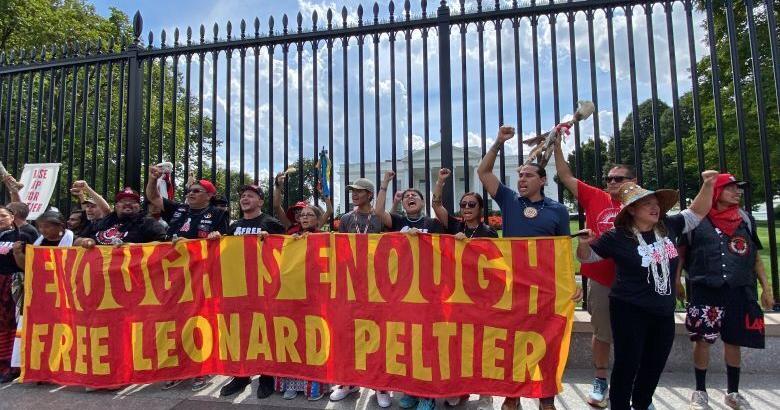
Why the delay? Release Leonard Peltier now!

Peltiertrial
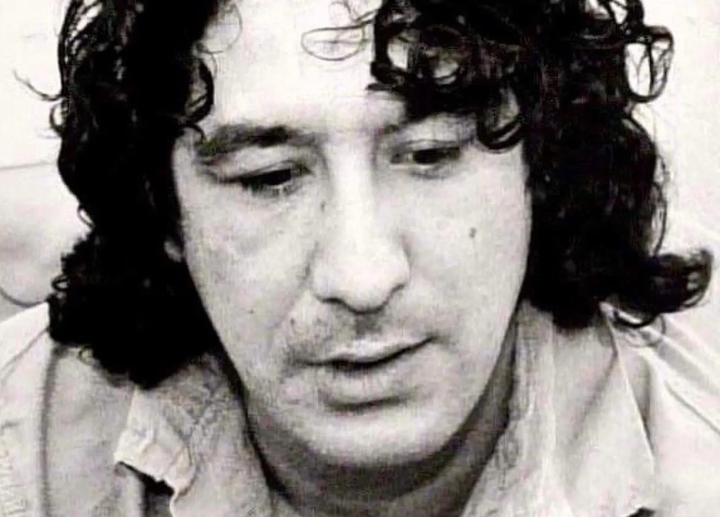
This photo of Leonard Peltier was taken during his 1977 trial.

In a final act of clemency on Jan. 20, President Joe Biden commuted the life sentence of Indigenous activist Leonard Peltier.

Peltier, an enrolled member of the Turtle Mountain Band of Chippewa, was a prominent figure in the American Indian Movement (AIM), which gained national attention in the 1970s for its advocacy of Native American self-determination and resistance to government oppression.

On April 18, 1977, a jury found Peltier guilty on two counts of first-degree murder for his alleged participation in the killing of two FBI agents on the Pine Ridge Indian Reservation in South Dakota. He was sentenced to two consecutive life terms for aiding and abetting murder. 

Three AIM members were charged; two, Robert Robideau and Dino Butler, were acquitted of the same charges in separate trials based on self-defense.

The late Federal Judge Gerald William Heaney, who wrote a decision denying a new trial based on suppressed evidence, later urged Leonard Peltier’s release, stating that the FBI used improper tactics to convict him.

The decision to commute Peltier’s sentence, made just hours before Biden left office on Jan. 20, marks a significant moment in the decades-long fight for freedom, justice, and the broader struggles for Indigenous rights in the United States. Peltier was denied parole in July 2024 and would not be eligible again until 2026.

In February 2022, Kevin Sharp, former Federal Judge, had this to say in his push for clemency for then 77-year-old Leonard Peltier in an interview on CBS News:

“This is really Leonard’s last hope because of his age, because of his health problems. Clemency is just a time-served reduction; this is what he deserves. Really, the next step in trying to heal the relationship with the federal government and the Native American community, context matters, and it is hard to understand what happened at Pine Ridge in ‘75 without understanding Wounded Knee in ’73 and Wounded Knee in 1890. To end all the misconduct and broken treaties before that. That’s what led to this conflict and the FBI’s involvement. It is the President’s sole power at this point to fix that.”

Why did Biden commute Peltier’s life sentence just before he left office?

Biden’s move was part of his record-setting number of pardons and commutations, including nearly 2,500 individuals convicted of nonviolent drug offenses and several other high-profile cases.

Joe Biden said in a statement that the decision to commute Peltier’s sentence was part of his broader efforts to address the injustices of the past.

Tribal Nations, Nobel Peace Prize Laureates, former law enforcement officials, (including the former U.S. Attorney whose office oversaw Mr. Peltier’s prosecution and appeal), dozens of lawmakers, and human rights organizations strongly support granting Leonard Peltier’s clemency, citing his advanced age, illness and his close ties to the leadership in the Native American community and the substantial length of time he has already spent in prison.

Biden said, “Leonard Peltier will now have the opportunity to spend his remaining years with family and loved ones.”

In the years since his conviction, Peltier’s story has become one of the most enduring symbols of Indigenous resistance and the fight for justice in the U.S. His case continues to generate debate about the intersection of race, justice, and the U.S. legal system.

Leonard is now 80 years old. President Biden’s commutation on Jan. 20 is a welcomed victory in the fight to bring Leonard Peltier home. Leonard’s health is deteriorating, yet his release date is not until Feb. 18. Why the delay?

Release Leonard Peltier!

Bring Leonard home today!

Gloria Verdieu is an activist in the San Diego Coalition to Free Mumia Abu-Jamal and All Political Prisoners.

Strugglelalucha256


Justice for Robert Brooks!

Prisons are concentration camps for the poor

Millions of people have seen Robert Brooks beaten to death by prison guards in upstate New York on Dec. 9 last year. The 43-year-old Black man was killed at the Marcy Correctional Facility, located about seven miles from Utica, New York.

Cameras recorded the lynching committed by 13 correctional officers while a nurse looked on. Three of the guards had already been sued for previous assaults on inmates. Yet none were suspended, much less prosecuted for their brutality. 

“This Marcy Correctional Facility is run by a mob,” said Frederick Williams, an inmate who told CNN how he was beaten.

The December 12th Movement has taken the lead in demanding justice for Robert Brooks, the father of a son. On Dec. 30, they held a press conference in front of New York Gov. Kathy Hochul’s New York City office.

Among the speakers demanding justice for Robert Brooks was State Senator Jabari Brisport, who represents the Bedford-Stuyvesant and Brownsville neighborhoods in Brooklyn.

“We are prepared to shut New York City down,” declared the human rights attorney Roger Wareham, a member of the December 12th Movement’s International Secretariat. “We will organize a general strike for justice.”

In its news release, D12 said that “we understand what happened to Robert Brooks is not an aberration but an extreme example of what inmates of color face on a daily basis in the New York State prison system. Its goal, as it was on slave plantations, is to instill fear of and submission to authority in the minds of prisoners. …

“Gov. Hochul and NYS Attorney General James, have spouted rhetoric about the firing and prosecution of the 13 corrections officers and one nurse involved but to date, nothing has happened. No arrests. No dismissals.”

Racist vigilante goes free

The killing of Richard Brooks followed the acquittal of the white vigilante Daniel Penny, who strangled to death the Black homeless man Jordan Neely on May Day, 2023. Neely’s death, committed by the martial arts expert Penny on a New York City subway car, was also recorded on film.

The killer Penny became a hero for white supremacists across the United States and was the guest of fascist Trump at the Army-Navy football game. 

As the December 12th statement pointed out, “after a jury acquitted Daniel Penny of his son’s murder, Andre Zachary, the father of Jordan Neely, said ‘We have to do something.’ The question facing the Black community is simple: What are we going to do?”  

The killers of Robert Brooks remain free. In contrast, the Black teenager Kalief Browder endured three years of hell in New York City’s Rikers Island jail because his family couldn’t afford $900 for bail. Browder’s charges were dropped, but he was so traumatized that he hanged himself in 2015.

New York Governor Kathy Hochul wants to roll back bail reform so more poor people can be locked up without even being convicted.

The disgraced Andy Cuomo put Kathy Hochul on his ticket as Lieutenant Governor in order to appeal to anti-immigrant bigots. 

As Erie County clerk in Buffalo, Hochul refused to issue drivers’ licenses to undocumented immigrants despite a state law authorizing it. Hochul can’t be trusted to get justice for Robert Brooks and his family.

Neither can New York Attorney General Letitia James. She recused her department from prosecuting Brooks’ killers because it is defending three of them against earlier brutality claims.

James appointed Onondaga County District Attorney William Fitzpatrick to do so instead. Fitzpatrick had refused to prosecute the Syracuse, New York, cop who slammed the handcuffed Edward Jones into a police car in 2011. This was despite video evidence:

Don’t let them cover up this lynching!

On Jan. 8, people are urged to call District Attorney Fitzpatrick at 315-435-2470 and New York Gov. Kathy Hochul at 518-474-8390 to demand justice for Robert Brooks.

The December 12th Movement held an emergency town hall meeting on Jan. 4 about the lynching of Robert Brooks. Sistas’ Place in Bedford-Stuyvesant was packed with activists, including former prisoners.

A Town Hall meeting will be held on Jan. 7 at 6 p.m. at Bedford Central Presbyterian Church, 1200 Dean St., Brooklyn. Topics will include Justice for Robert Brooks and the closing of the Marcy Correctional Facility.

D12 has called a demonstration on Monday, Jan. 20 — the day when Trump’s inauguration desecrates Dr. King’s holiday — on Harriet Tubman Way (Fulton Street) in Bedford-Stuyvesant.

The Marcy Correctional Facility, where Robert Brooks was beaten to death, was constructed while Andy Cuomo’s daddy, the liberal saint Mario Cuomo, was governor.

The elder Cuomo built more prisons — a total of 30 — than any other New York governor. He obscenely used billions that were supposed to build affordable housing under legislation that honored Dr. Martin Luther King and built penitentiaries instead.

The two million prisoners locked up across the United States are members of the working class. Prisons are concentration camps for the poor. Donald Trump and Elon Musk should be locked up instead.


Strugglelalucha256


Free Mumia Abu-Jamal!

Revolutionary journalist jailed for 43 years

People marched through downtown Philadelphia on Dec. 9, demanding freedom for Mumia Abu-Jamal and all political prisoners. It was the 43rd anniversary of Mumia’s arrest by Philadelphia police, who also shot him.

Cops took Mumia to the hospital the long way, hoping he would die along the way. Framed for killing officer Daniel Faulkner, the Black revolutionary has been jailed 16 years longer than Nelson Mandela. He was on death row until 2011, with prison authorities still trying to kill Mumia by denying him and other prisoners health care.

Protesters gathered at City Hall by the statue of Octavius Catto, a Black political activist and freedom fighter who was murdered in 1871. Catto’s racist killer, Frank Kelly, wasn’t convicted.

Neither was Daniel Penny, who spent six minutes strangling the homeless Black man Jordan Neely to death on a New York City subway car. The martial arts expert Penny was acquitted the same day people were protesting in Philadelphia.

Mumia Abu-Jamal has long had a target on his back. As a 15-year-old, Mumia became a member of the Black Panther Party.

The FBI started a file on the revolutionary teenager. Super racist Mayor Frank Rizzo threatened Mumia Abu-Jamal at a news conference.

Among the speakers at the City Hall rally was Teresa Shoatz, the

daughter of the late Russell Maroon Shoatz, who, like Mumia, was a member of the Black Panther Party. Shoatz spent 40 years in prison.

He was only released when dying of cancer a result of deliberate medical neglect — and died 52 days later.

People marched from City Hall to the office of Philadelphia District Attorney Larry Krasner, demanding Mumia’s freedom. Krasner, a so-called reformer, insists on keeping Mumia locked up despite boxes of “lost” evidence that prove that he was framed.

The people will free Mumia Abu-Jamal, Leonard Peltier, and all political prisoners. Free them all!

Strugglelalucha256


An open letter to President Joe Biden: Free Leonard Peltier

Mr. President, If you can pardon your son, why can’t you free the Indigenous political prisoner Leonard Peltier?

The 80-year-old man, a leader of the American Indian Movement, has been imprisoned for 48 years. He suffers from diabetes, high blood pressure, and a heart condition.

The FBI framed Leonard Peltier in retaliation for the historic 1973 occupation of Wounded Knee. Three years of violence followed this courageous stand for Indigenous rights, with over 60 AIM members and supporters murdered. Despite a large FBI presence, nothing was done to stop these murders and even more numerous assaults. 

Peltier was convicted of killing two FBI agents — Jack Coler and Ronald Williams — in a shootout on the Pine Ridge Reservation on June 26, 1975. The agents were in unmarked cars.

Leonard Peltier was asked by traditional people at Pine Ridge, who were being targeted, to protect them from violence. Peltier and a small group of young AIM members set up camp on a ranch owned by the traditional Jumping Bull family. More than 150 FBI agents, cops, and vigilantes surrounded the ranch when shooting began.

Besides the two FBI agents killed, an AIM member — Joseph Stuntz Killsright — was shot and killed by a sniper’s bullet. His death has never even been investigated.

Although the FBI claim that 40 Indigenous people were involved in the gunfight, only AIM members Bob Robideau, Darrell Butler, and Leonard Peltier were brought to trial. A jury acquitted Robideau and Butler on grounds of self-defense.

Leonard Peltier was arrested in Canada on Feb. 6, 1976. The U.S. government in its extradition request, used affidavits signed by Myrtle Poor Bear who claimed she saw Leonard Peltier shoot the two FBI agents.

Ms. Poor Bear had never met Mr. Peltier and wasn’t present during the shoot-out. Soon after, Ms. Poor Bear recanted her statements and said the FBI threatened and coerced her into signing the affidavits.

Leonard Peltier was brought to the United States and tried in 1977. Myrtle Poor Bear wasn’t allowed to testify by the Nixon-appointed Judge Paul Benson. Not one witness identified Mr. Peltier as the shooter of the FBI agents.

More than 140,000 pages of FBI documents were withheld from the defense. A ballistic test proving that a bullet casing found near the FBI agents’ bodies did not come from the gun tied to Mr. Peltier was intentionally concealed.

Because this evidence was withheld, the jury found Leonard Peltier guilty. Judge Benson sentenced Mr. Peltier to two consecutive life terms.

The Eighth Federal Appeals Circuit ruled that “there is a possibility that the jury would have acquitted Leonard Peltier had the records and data improperly withheld from the defense been available to him in order to better exploit and reinforce the inconsistencies casting strong doubts upon the government’s case.”

Yet, the court denied Mr. Peltier a new trial. The late Federal Judge Gerald William Heaney, who wrote the decision denying a new trial, later urged Leonard Peltier’s release, stating that the FBI used improper tactics to convict him.

Among those calling for Leonard Peltier’s freedom was the late South African President Nelson Mandela, who spent 27 years in apartheid prisons. Leonard Peltier has spent 48 years in federal prisons.

Mr. President, you recently apologized for the federal government’s role in running boarding schools where thousands of Native American children endured abuse, neglect, and eradication of their tribal identities.

Follow up on your apology by freeing Leonard Peltier.

Strugglelalucha256


Longest-held U.S. political prisoner Leonard Peltier is hospitalized

As of October 28, the longest-held political prisoner in the United States, Leonard Peltier, has been hospitalized. Peltier, who recently turned 80 behind bars, has dealt with various health concerns due to his long confinement, which include diabetes, high blood pressure, and surviving COVID-19. Peltier’s supporters are calling for him to receive an emergency medical transfer out of prison to a medical facility.

“Leonard is confined in a small cell, most of the time being on lockdown, where he can’t even walk properly and have circulation and sunshine and proper food,” said close advocate Gloria La Riva in a recent interview. “I imagine anybody who thinks about Leonard wonders how does someone survive this? How do you live through this for 49 years? That’s what the US government does to political prisoners. Whether it’s Mumia Abu-Jamal, or Mutulu Shakur, or Sundiata Acoli, who spend 40, 50 years in prison. It’s called political vengeance. It’s telling them, you will pay a price for your political activism.”

Peltier, who is hailed as a hero of the Indigenous struggle for his activism with the American Indian Movement (AIM), was denied parole in July after almost half a century behind bars. According to Peltier’s lawyer, Kevin Sharp, an interim hearing has been scheduled for 2026, while a full hearing has been scheduled for June 2039, when Peltier will be 94.

Strugglelalucha256


Leonard Peltier’s 80th birthday statement released

October 2, 2024

Greetings All,

On this Wrongful Conviction Day, Leonard Peltier, the longest-serving Indigenous political prisoner, is incarcerated in lockdown-modified operations conditions at USP Coleman I, operated by the U.S. Federal Bureau of Prisons (BOP).

Yet, in this moment of silence, Leonard speaks. To honor his birthday and all those who are unjustly convicted and incarcerated, the Leonard Peltier Official Ad Hoc Committee has released a video of Leonard Peltier that is going viral. Narrated by renowned scholar Ward Churchill and set to a video created by award-winning filmmaker Suzie Baer, the film most importantly centers Leonard’s personal reflection on his 80th year.

Jenipher Jones, Mr. Peltier’s lead counsel, commented, “This powerfully moving film captures the essence of who I know Leonard to be. I am grateful to Professor Churchill and Suzie Baer for their work and longstanding advocacy of Leonard. As the recent execution of Marcellus Williams-Imam Khaliifah Williams shows us, we as a society bear a responsibility to uplift the cases of all those who are wrongfully convicted and also hold the government accountable to do that for which it professes to exist. We must challenge our impulses of blind blood-thirst for guilt and the use of our legal systems to carry out this malignant pathology. There is absolutely no lawful justification for Leonard’s incarceration.”

“Leonard Peltier is Native elder whose wrongful incarceration is shameful. His continued imprisonment exemplifies the historical cruelty of the US Government toward Native people. The US BOP’s treatment of Leonard Peltier is unlawful, and he deserves his freedom.” – Suzie Baer

“Until Leonard Peltier breathes free air, we are all caged. When will this government commit one act of Justice? ” – Dawn Lawson

Below, please find Leonard’s Statement.

To view the film, please visit https://tinyurl.com/Peltier80thPresentation. We hope to have additional updates on Leonard soon. In the meantime, please engage our calls to action or donate to his defense efforts. Miigwech.

LEONARD PELTIER’S 80th BIRTHDAY STATEMENT 2024 ©

Greetings my Friends, Loved Ones, Relatives, Supporters,

When I was a child, I looked to my Elders to learn how to live within Mother Earth’s rhythms.

I yearn to sit by the fire with my loved ones and have our children look to me to learn the mysteries of Mother Earth. I want to laugh, share the pipe, and gaze into the eyes of a woman who does not carry handcuffs.

I have become an Elder. I suppose, in many ways, I am still the nine-year-old who founded The Resistance among my peers at Wahpeton Boarding School, the young man willing to sacrifice everything to protect my people, and the young man who worked hard and played hard when the chance arose.

At the same time, I feel every second of these past eighty years wreaking havoc on my body.

I have been losing my eyesight, but my inner vision is not that of an old man. I long to get out there and work. My mind is filled with ideas to combat the greed and corruption that spread like a poisonous mold through the halls of those who govern us.

When I was sentenced, I stated:

“I do feel pity for your people that they must live under such a ugly system. Under your system you are taught greed, racism and corruption, and the most serious of all, the destruction of our mother earth. Under the native American system we are taught all people are brothers and sisters, to share the wealth with the poor and needy; but the most important of all is to respect and preserve the earth, to me considered to be our mother.”

I could not help but see far and wide. I saw the continued colonization and destruction of Mother Earth and the ongoing termination of an entire People.

I perceive more than most of you know, even in lockdown. I see spirit warriors stand up and speak out; it does my heart good.

I also see the erosion of laws meant to protect our very right to survive. Civil rights used to be a pretense. They were never a true thing. Now, I see that the government is not bothering to pretend.

We cannot continue to allow greed, racism, and corruption to rule us.

Remember, my people. Remember who you are. Mother Earth herself flows through our veins. We endure. The greed, corruption, and disdain of the colonizers will bring them to their ruin. They seek to ravish Mother Earth while chasing the almighty dollar.

We have survived their apocalypse. We are not simply enduring; we are destined to thrive.

The lockdowns have not been kind to my body. I am not going to stand here and cry over what happens to an eighty-year-old body held in lockdown for over four years. I will continue to plan, think, and change what is within my reach.

Hope is a hard thing, but I still hold hope. The parole denial was not unexpected. I will not say I was overjoyed with the outcome, but we knew. They may yet surprise us with the answer to the appeal Jenipher Jones and Moira Meltzer-Cohen filed.

Jenipher Jones has assured me from the start that she is fully committed to my case. I trust her word. Jenipher will fight for me and with me in court if the appeal is rejected.

My friends, I need you to fight for you.

Police are beating children in the streets. The Parole Commission still illegally holds many of us long past our release dates. The Supreme Court has made it impossible for people to challenge wrongful convictions.

Indigenous people are still being forced from our land – we protect Mother Earth. They have stripped her bare and now want our resources. Our people go missing at a staggering rate, and no one blinks.

We are awaiting the Uhuru verdict to determine whether free speech exists, a verdict that may well come down on my eightieth birthday.

And – I am still in prison.

The Constitution reads, “We, the People.”

We must tell those in power we ARE the people.

***

This statement was meant to be released on my 80th birthday. I was in a ten-day lockdown, and my Board waited for me to approve the final edits.

I regret that no statement was released on my 80th birthday. I regret that this country has been taken by those who can cage human beings in conditions that would be illegal for dogs.

As I said, I need you to fight for you. I fight every day for my freedom with my legal team. I am now fighting for my life. They sentenced me to Death by Incarceration. They are trying hard to enforce that.

They have never managed to cage my Spirit. They never will. Do not allow anyone to cage yours.

In the Spirit of Crazy Horse

Doksha,

Leonard Peltier

Source: Free Leonard Peltier Now Committee


Strugglelalucha256


Q&A: Former Federal Judge Kevin Sharp on Leonard Peltier’s June 10 parole hearing

As Leonard Peltier’s parole hearing approaches on June 10, there is renewed hope and vigorous debate about his potential release.

Convicted for the killing of two FBI agents during a 1975 shootout on the Oglala Nation, Peltier has been imprisoned for over 47 years. Among the voices calling for justice is Kevin Sharp, a former Navy veteran and former federal judge.

Sharp is Co-Vice Chairman of Sanford Heisler Sharp and Co-Chair of the Public Interest Litigation Group. He served as a U.S. District Judge for the Middle District of Tennessee from 2011 to 2017, including as Chief Judge from 2014 to 2017, handling over 4,000 cases, including high-profile ones like Young v. Giles County Board of Education.

With nearly 30 years of experience, Sharp has litigated complex civil cases, including opioid litigation and significant employment settlements. He has received numerous accolades, including The American Lawyer’s South Trailblazers and Lawdragon 500. Since 2019, he has led efforts to secure presidential clemency for Leonard Peltier.

Sharp was on a recent Native Bidaské. He was asked by Native News Online’s editor Levi Rickert to discuss Leonard Peltier’s poor health at age 79 after decades in prison and his belief that Peltier risks death if kept in maximum security. He discusses the historical context of the 1975 Pine Ridge murders, and Peltier’s involvement with the American Indian Movement, arguing Peltier’s constitutional rights were violated during his 1977 trial.

Peliter’s June 10 parole hearing will consider testimony from both supporters and the government.

This interview has been condensed and edited for clarity.

Leonard is having some health issues; he’s nearly 80 years old. Can you talk about his current health conditions?

Thanks for asking about his health because, as you said, he has been in prison since 1977. He will turn 80 in September. He’s 79 now, so he has all the health issues that come along with a normal 79-year-old, plus additional health issues.

One of the worst is an aortic aneurysm, which is deadly if it ruptures. It has to be monitored closely, and it hasn’t been as closely monitored as it should have been. He has heart issues and diabetes. The last few times I’ve seen him, he’s used a walker. He’s been blind in one eye, left partially blind from a stroke he had years ago, and his eyesight has gotten worse. He hasn’t had access to a dentist in years. He’s in bad shape, and things are not going well.

With a parole hearing coming up on June 10th, if they deny parole, I don’t know that he makes it to the next one. He’s in Coleman 1, a maximum-security prison, which is dangerous for a frail, in-poor-health, 80-year-old man. It’s a perfect storm for something bad to happen if we don’t get him out.

We wish him well on parole. Before we talk about the parole hearing itself, can you tell us a bit about who you are and why you left the federal bench to do what you’re doing for Leonard?

I didn’t know who Leonard was; these events happened in 1975, and I was a young kid in Memphis at the time. I was a lawyer in Nashville doing civil rights work when I was nominated by the Obama administration for a position on the federal bench in 2010.

I became a federal district court judge in Nashville. As a judge, I encountered mandatory minimums, where Congress dictates the sentence, removing the judge’s ability to fashion a fair sentence. One case that really troubled me involved a young man convicted of a non-violent drug offense who I had to sentence to two life sentences.

This made me question whether I should be on the bench. I decided to step down and work on clemency for that young man, and we were successful. After that, Connie Nelson contacted me about Leonard. I started reading his case files and was disturbed by the constitutional violations and misconduct in his prosecution and investigation. I contacted Leonard in 2019 to help him, and here we are 4.5 years later, still working on his freedom.

You mentioned that Leonard was there at the time, and they talk about aiding and abetting. But the time period was volatile, and Pine Ridge Indian Reservation was in turmoil. Can you talk about the context of that time?

Pine Ridge was a powder keg with the Goon Squad operating there with the government’s help. AIM was there to protect those who were not part of the Goon Squad. There were many murders and assaults in a three-year timeframe.

When plain-clothed agents in unmarked cars arrived, a firefight ensued. Leonard did not shoot the agents, and the FBI knew this but withheld evidence. The court of appeals acknowledged this but couldn’t overturn the conviction due to legal standards.

Judge Heaney, who wrote the opinion, later supported clemency for Leonard. Now, 38 of Judge Heaney’s former clerks support parole for Leonard, including three who worked on his case.

The government admits they don’t know who killed the agents, but it wasn’t Leonard. It’s time to release Leonard and start the healing process.

Please tell us about the particulars of the parole hearing on June 10.

The hearing will take place at Coleman, with a hearing officer present to take evidence and witness testimonies. We don’t know all the witnesses yet, but some will testify in written form and some live.

We’ll hear from Leonard’s doctor about his health, and from James Reynolds, the former US attorney who supervised the appeals, who supports parole for Leonard. We’ll have witnesses to discuss Leonard’s life after release, including his housing and healthcare on the Turtle Mountain Band of Chippewa reservation.

Leonard will also address the hearing officer. The government will have people there arguing against his release. Support from the public is important, and we’ll provide information on how to write to the parole commission.

Typically, parole boards want to hear an admission of guilt and remorse. Leonard has maintained his innocence. How does this play into the hearing?

It’s difficult because Leonard didn’t commit the crime, and there’s no evidence that he did. He shouldn’t lie about something he didn’t do. Leonard has expressed remorse for the tragic events of that day and the overall situation.

The whole thing is tragic, and Leonard feels bad about everything that happened. It’s important for the hearing officer to understand this context and Leonard’s genuine feelings of remorse for the tragedy.

Watch the complete Native Bidaské episode:

Source: Native News Online


Strugglelalucha256


Three days in Rome for Leonard Peltier

June 10 is an important date for Leonard Peltier and for all the committees calling for his release. A committee in the U.S. may decide on house arrest because of his health condition; Leonard is almost 80 years old and sick.

Initiatives are multiplying in different parts of the world to make the voices of all those close to him heard.

Six events took place in Rome in three days: at the Testaccio Library and Festival of Lands, at Spin Lab, at the Che Guevara Circle, at Friccicore, meetings, and especially screenings of Andrea Galafassi’s excellent documentary, “Mitakuye Oyasin.” These were small occasions not only to make his story known but also to forge relationships with comrades and companions.

Especially on Saturday, 18 May, in the morning, an important presidium was held in front of the U.S. Embassy. Several people thought it would never be allowed, but it was. The digos officers (Italian political police), on this occasion, were particularly polite and some even seemed interested in hearing the incredible story of Leonard Peltier. Many were the speeches, the slogans, the strength expressed by fifteen or so people well convinced of what they were doing.

Now we ask you to sign the following call if you have not already done so: https://chng.it/xkc8sRYK2F

And if you would like more information or would like to organize a projection, you can write to: bigoni.gastone@gmail.com
And pass the word, thank you.

Source: Pressenza

Strugglelalucha256


Leonard Peltier: ‘I hope I make it to June 10’

Advocates say June parole hearing may be Leonard Peltier’s last chance at freedom and they plan to push hard for his release

RAPID CITY, S.D. – At 80 years old, Leonard Peltier is approaching what may be his last attempt at freedom.

On June 10, the Anishinaabe elder will participate in what may be his final parole hearing. Peltier is currently serving two consecutive life sentences after being convicted of killing two FBI agents in 1975 at the Jumping Bull Ranch in South Dakota.

Peltier is asking for the public to spread the word about his parole hearing, said Dawn Lawson, secretary of the Leonard Peltier Ad Hoc Committee.

“For a long time, people have been dying in that prison and the (Federal Bureau of Prisons) is out of control,” Lawson said. “They’re (U.S. Penitentiary Coleman 1) currently on indefinite lockdown, not because anybody has done anything, just because they can. They (prisoners) are living in their own filth. Leonard is making an appeal to his people to please get anybody’s attention.”

In the past few months, the Turtle Mountain Band of Chippewa citizen’s health has taken a turn for the worse, so much so that his attorneys say they’re concerned he won’t make it to the June parole hearing.

“He didn’t sound good when I spoke with him on the phone today (April 22), he doesn’t even know if he’s going to make it to next week,” said Nick Tilsen, Oglala Lakota and CEO of the NDN Collective. “He told me, ‘I hope I make it to June 10, and I hope I can make it 30 days after that.’”

Peltier has been struggling with health concerns for years. He’s had trouble managing his diabetes while incarcerated, experienced the loss of vision in one eye, had open heart surgery, an aortic aneurysm, and is dealing with the lingering effects of contracting COVID-19.

On April 16, the Leonard Peltier Ad Hoc Committee issued a press release and organized a calling campaign to urge federal prison officials to address Peltier’s health problems. Since then, Peltier’s lead attorney, Jenipher Jones, was able to arrange for a doctor outside the prison to meet with Peltier twice.

The medical visit revealed Peltier was experiencing eye damage and would need to see a specialist, but prison officials said it would take 8 to 10 months to coordinate such a visit.

In February, Judith LeBlanc, executive director of the Native Organizers Alliance, requested the U.S. Department of Justice approve the compassionate release of Peltier based on his health problems. Compassionate release is available for prisoners who seek early release due to extraordinary or compelling circumstances, according to the American Bar Association.

“At a time when democratic values are being challenged, DOJ should take action as he nears the end of his life and allow him to return to his family on his ancestral homeland,” LeBlanc said in a statement. “We implore the DOJ to grant Peltier’s compassionate release.”

Tilsen called on the Biden administration to take action.

“This administration, the Biden Administration, has said that Native American rights are a priority to them, and yet they’ve got the longest sitting Indigenous political prisoner locked up and we’ve seen no action from the federal government,” Tilsen said. “If he dies in prison this will forever be a part of that administration’s legacy as it relates to Native people.”

Tilsen said he’s been fighting for Peltier’s freedom since he was a small child. Now, his organization is on the front lines of Peltier’s fight.

“It’s all hands on deck,” Tilsen said. “With the right medical treatment Leonard could live for a while, but without it he’s almost guaranteed to not make it.”

With the announcement of Peltier’s parole date, NDN Collective is switching gears from putting its energy toward compassionate release for Peltier and instead educating the public on his push for parole.

A chance to tell his story

Within 30 days after the June 10 parole hearing, the parole commission will issue its decision. A recommendation will be delivered to the commission for a final decision to be made.

Since Peltier is a federal prisoner serving a sentence of 30 years or more, he is eligible for a parole hearing within 9 months of his eligibility date as determined by the Bureau of Prisons. This hearing may be his only shot.

“The parole hearing on June 10 is the most important parole hearing of Leonard’s life,” Tilsen said. “He won’t live long enough for another parole hearing to come around.”

Source: ICT


Strugglelalucha256


Mumia to student protesters: ‘Shake the earth’ for people of Gaza

The following solidarity message was given over the phone by former Black Panther and political prisoner Mumia Abu-Jamal to the participants in the Gaza Solidarity Encampment at the City College of New York on April 26.

I am speaking to you from the American system of mass incarceration, but what we’re involved in right now is something called mass education. City College, Columbia, Emory, and USC are all part of that process right now. That education is about the repression that Gaza is suffering under.

It is a wonderful thing that you have decided not to be silent, and decided to speak out against the repression that you see with your own eyes. So you are part of something massive, and you are part of something that is on the right side of history. You’re against a colonial settler regime that wants to steal the land from the people who are indigenous to that area, and you’re saying that is wrong.

I urge you, I beg you to speak out against the terrorism that is afflicting Gaza with all of your might, all of your will, and all of your strength. Do not bow to those who want you to be silent. It is time, right now, this day, this hour, this moment, to be heard – and shake the earth so that the people of Gaza, the people of Rafah, the people of the West Bank, the people of Palestine can see your solidarity with them.

I am a student of Frantz Fanon. I read him every day, and think about his ideas. When I see what is happening in Gaza right now, I know the people of Gaza are the wretched of the earth. They are fighting to be free from generations of occupation. 

And so it is not enough, brothers and sisters – students – it is not enough to demand a ceasefire. How about this? Make your demand “cease occupation.” Cease occupation, cease occupation! Let that be your battle cry. Because that is the call of history, of which all of you are a part.

You’re part of something magnificent, soul-changing, mind-changing, history changing. Do not let go of this moment. Make it bigger. Make it more massive, make it more powerful. Make it echo up into the stars. 

I am thrilled by your work. I love you, I admire you. On the MOVE!

Strugglelalucha256
https://www.struggle-la-lucha.org/prisoners/page/2/