Julia ‘Pachamama’ Fernández

Julia ‘Pachamama’ Fernández

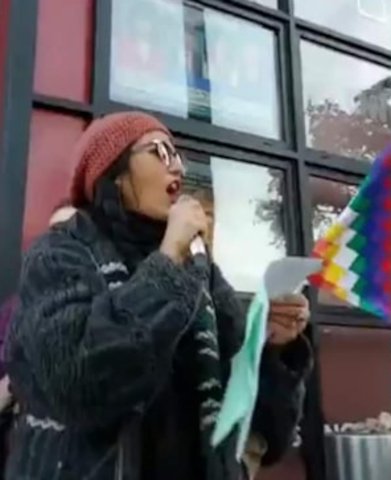
Julia “Pachamama” Fernández on the the U.S. coup against Bolivia’s first Indigenous president, Evo Morales of the Movement Toward Socialism (MAS): 

“I was just told by a woman in Bolivia that the Juana Azurduy program has been suspended by the de facto government. And, it’s a stipend program that’s designed to provide health and nutrition benefits, basically for pregnant mothers and young children in underserved sectors of the population — so that’s been suspended. 

“And it’s clear that most of the most vulnerable communities which predominantly comprise our Indigenous peoples in the rural areas are the ones being most affected. That, along with the expulsion of our Cuban medical doctors, has basically created panic within the sectors. 

“We have elders, we have children, pregnant women and men, which includes those protectors of democracy who were assaulted and shot during those peaceful marches in Senkata and Sacaba, who still have not received medical attention, so they are the most vulnerable. For me that spells out G-E-N-O-C-I-D-E. For me that’s what’s happening.

“Basically, the Indigenous movement is being forced to rebuild amid all the chaos happening in Bolivia. Right now, there’s like a series of intimidations, of persecution and unlawful detention of innocent MAS supporters, false accusations against grassroots journalists and against MAS political leaders — even, you know, false allegations against the presidential candidate Luis Arce Catacora. 

“The focus–in spite of what they’re facing–is to really stay together against all odds. And the Bolivian Indigenous peoples have fought and won the gas and water wars in the past. The May elections may not be fair, but international volunteers will arrive to be witnesses of the upcoming historical events happening in Bolivia. And as for the Bolivian people, their courage and their strength will pull them through.”

Read the full interview at tinyurl.com/ta2hbre


Strugglelalucha256


Khalida Jarrar

Khalida Jarrar is a leader of the Popular Front for the Liberation of Palestine, member of the Palestine Legislative Council and advocate for prisoners She has been jailed many times by the Israeli occupation, and was imprisoned again in October 2019:

“Palestinians imprisoned for political reasons are discussing many topics. Of course, the events of the day, those outside the prison, those in the Occupied Territories, the arrests, the demolitions of homes, the killing of protesters, the situation in Gaza and other political issues take up a large part of the discussions. But my companions in prison also speak about their rights as women in Palestinian society.

“There have been very many protests. I think the one that became particularly well-known was the one calling for respecting our privacy. In an Israeli prison, you are monitored through cameras placed almost everywhere. Even during our time in the yard, the most longed-for moment for anyone who is forced to live almost all the time in a prison cell. Some Palestinian prisoners are religious women who are carefully guarding their privacy. 

“For 63 days, we refused to go out of our cells. As punishment, we were transferred to Damon prison, where conditions are harsher. There as well, we were punished on several occasions because we didn’t follow orders that made no sense and were abusive. For a whole month, we could not receive any visits from our families. And they always spoke to us in Hebrew, a language that many of us did not know.”

Read the full interview at tinyurl.com/tdxn7as


Strugglelalucha256


Women resist poverty: Interview with Rev. Annie Chambers

Struggle-La Lucha interviewed the Rev. Annie Chambers for International Working Women’s Day. Chambers is a resident and housing rights leader at Douglas Homes, a public housing project in Baltimore which is threatened by privatization. She is a former Black Panther Party member and is currently organizing a new housing coalition.

Struggle-La Lucha: Could you tell us a little about your experiences as a young activist?  Where did you grow up? How did you become committed to the struggle?

Rev. Annie Chambers: Life experiences propelled me into the struggle. I grew up in Richmond, Va. I lived there until I was 12. When I was a little girl, I was raped. Out of that rape I had a child. Her father is white. Back then, I couldn’t tell my father because my father and family would have wanted revenge. I didn’t want my father to die, so I couldn’t tell him.

I had a brother who was already in the struggle at that time, my brother James X. He was one of Malcolm X’s men. He would come home and talk about the struggle. I was amazed that people were fighting back. I had a lot of anger in me. 

I was forced into marriage. You couldn’t be a single woman without a husband having a baby back then. But I wanted to do something, so when my brother would talk about the struggle, I kept telling my father I wanted to go. I kept begging my father to let me go. In the summer, my father finally agreed to let me go, even though I was still a child and I was married. I was 14. 

SLL:  Can you tell our readers a little about your experiences organizing the Baltimore Welfare Rights Organization?  

AC: They used to call us “the welfare rights women.” In 1973 or 1974, it was getting close to the holidays and a whole lot of people in Baltimore had not gotten their AFDC [Aid to Families with Dependent Children] checks. So they came to Welfare Rights and we decided to go to the welfare office and talk to the director of social services, Buzzy. 

We went directly to Buzzy’s office, walked in and locked the door. We told him that none of us would have Christmas or any other holiday until the checks got out. We stayed in there all night until Buzzy got on the phone and called his people back into the agency. The checks and the food stamps went out. That was the sort of struggle we engaged in. 

We also started taking over houses that the city was renovating and turning into public housing. We really started to pick up people that way, a lot of women looking to house their families. The women in Welfare Rights just kept fighting. Whenever we said we were going to do something, we did it. We were a strong, working-class organization, with all races, creeds and colors. 

SLL:  You are spearheading a new coalition for housing rights.  What are some of the major issues that you’re fighting around?

AC: The main thing we are fighting for right now is to keep Douglas Homes as public housing. Johns Hopkins University has already expressed that they want Douglas Homes. 

We are fighting for affordable housing for everyone. This is one of the things the Black Panther Party was about. 

People cannot afford the rents in this city. We are sitting here in Douglas right now, and around here they come to the tenants telling people they will give them a voucher in exchange for your public housing lease. But what they don’t tell people is that you have to keep qualifying for that voucher. There are all sorts of rules with it that they can use to kick you out. They want to evict people. 

They are destroying Douglas Homes. The city doesn’t want to actually fix the doors and the roofs and the plumbing in public housing. 

We are fighting to keep Douglas. We want it to be a historic development here. It has been here since the 1930s. It was one of the first public housing developments.

SLL:  Finally, I understand that you will be speaking at the United Nations on poverty in the U.S., which particularly impacts women. What are your thoughts on fighting poverty?

AC: The connection between capitalism and poverty is that the capitalists are greedy as hell. What communities are thriving? Only upper-class people. 

We need to talk about education, housing and actual decent wages. Fifteen dollars isn’t even enough. It’s a joke. By the time it goes into effect, we will need $50 dollars an hour. America enslaves its own people. We want to work with the unions so the unions don’t back off, so they don’t compromise. 

People want to say that we don’t have a king and queen system, but we do!  It is just the few at the top with the wealth, and they won’t even let crumbs drop off the table. When people tell me they are in the middle, I say, “No you aren’t. You are just one or two lost paychecks away from being me, from being poor.”

Strugglelalucha256


#UnDiaSinNosotras: Women challenge femicide and rape in Mexico

Think about the last 10 women you’ve seen.

Can you remember their faces? Their eyes? What they were wearing?

Could you?

In Mexico, we do.

We always remember their faces and the way they were dressed, not because we want to, but because we know that if they disappear we’ll need that information to tell the police.

Statistics show that 10 women are killed every day in Mexico. It seems that, with every femicide that’s committed, we develop a new form of self-defense to go out on the streets. 

“Don’t wear that skirt. Those red lips are too provocative. Walk with a pair of keys in between your fingers in case anyone tries to assault you. Don’t act rude to your Uber driver. Don’t act too friendly. If someone is raping you, just let them finish. Don’t fight back. Run, run as fast as you can.”

We have heard all these phrases since we were little girls. We’re tired of living in a country that seems like a normalized war zone — where the only constant targets are us, the women.

In recent days, we saw a lot of front page headlines related to two femicides. One was the murder of Ingrid Escamilla, a 25-year-old woman who was brutally killed and skinned by her boyfriend. The other one, Fatima Aldrighetti, was a 7-year-old girl who was tortured and killed by a married couple. The wife claimed she “needed to commit the crime” in order to prevent her husband from raping her own children, since he told her several times that “he wanted a little girl as a girlfriend.”

Two different cases, both shockingly vile in the way they were committed, and both clear representations of everything that’s wrong in our country.

After these crimes, our President Andrés Manuel López Obrador told the press in one of his morning news conferences that “feminists shouldn’t paint the institution’s walls as a way of protest.” That made a lot of people on social media criticize his response. 

For many, the same concern that he has taken to conserve the integrity of buildings should be channeled instead into developing effective plans of action in order to eradicate violence against women.


We’re facing a crisis that for many years has gone unsolved and year by year seems to get worse. That’s why a feminist collective in Veracruz convened all women around the country to carry out a national strike on March 9 under the hashtag #UnDiaSinNosotras — a day without women.

The goal is for women of all ages to be absent nationwide. The idea is that, since the government is not hearing our needs, the economic disruption caused by the women’s strike will make them wake up and listen. Everyone will experience “a day without women” and finally realize what the loss of women’s lives means.

When the femicide of Ingrid Escamilla was committed, a sensationalist newspaper leaked explicit photographs of her mangled body, proving that, even after death, a women’s identity can be reduced to a gruesome news story.

But I guess — until now — that was part of growing up as a woman in Mexico, a country that constantly calls us the weaker sex, that objectifies and sexualizes girls on their telenovelas, where femicides are renamed as “crimes of passion” and perpetrators are defended by the laws that were made by and for men, where people socially punish a naked body more when it’s alive than when it’s found in a bag on the streets. 

The same country that forgets that we, “the weak ones,” were the same ones that helped to reconstruct an entire city after the earthquake of 1985 and then again in 2017; the ones capable of not only saving lives as scientists or doctors, but also the only ones capable of birthing life. The ones who are in a daily war zone and yet are out there constructing amazing and inspiring lives.

So, if they forget who we are, we’ll remind them. We will paint walls, we’ll conduct strikes, we’ll yell hard, and, if it’s needed, we’ll set the entire city on fire, until they remember, until they never forget, until we can go out without having any fear, until we can remain alive, until, as women, we can finally be free of this terror.

The writer is a student from Mexico City.

Strugglelalucha256


Day for the decriminalization of abortion in Latin America

This Sept. 28 is the day for the Decriminalization of Abortion in Latin America, and as the Women’s International Democratic Federation, we join all the organizations of the world in one voice demanding legal, free and safe abortions for all women.

Unsafe abortion is one of the five leading causes of maternal mortality–along with hemorrhages, infections, high blood pressure (pre-eclampsia and eclampsia) and obstructed childbirth–and it is also the only one of the five that is almost totally preventable.

It is estimated that each year at least 22,000 adult and young women die from unsafe abortions, 97 percent of them in Africa, Latin America and South and West Asia.  In addition, 7 million women have to be hospitalized every year for complications after undergoing such practices at the hands of staff without the necessary qualifications and in settings without the minimum medical standards.

Globally, 29 countries prohibit abortion completely. El Salvador, Honduras, Aruba,

the Dominican Republic, Haiti, Jamaica and Nicaragua are the countries of Latin America and the Caribbean where laws do not allow abortion under any circumstances, even when the woman’s life or health is at risk.

We demand the right to health and sexual education, to personal integrity, to a private life, not to be subjected to cruel and inhuman treatment, to social security and assistance, to decent employment, and to the protection of our sexual and reproductive rights.

On Sept. 28, women demand our right to decide, for a legal, free and safe abortion!

Presidency, Women’s International Democratic Federation/Federación Democrática Internacional de Mujeres (WIDF/FDIM)

Strugglelalucha256


Día por la Despenalización del Aborto en América Latina

Este 28 de septiembre es el Día por la Despenalización del Aborto en América Latina, y como Federación Democrática Internacional de Mujeres, nos unimos todas las organizaciones del mundo en una sola voz exigiendo un aborto seguro legal y gratuito para todas las mujeres.

El aborto no seguro es una de las cinco principales causas de mortalidad materna –junto con las hemorragias, las infecciones, la presión arterial alta (preclampsia y eclampsia) y el parto obstruido–, y además es la única de las cinco que es casi totalmente prevenible.

Se calcula que, cada año, al menos 22.000 mujeres adultas y jóvenes mueren a causa de abortos no seguros, el 97% de ellas en África, Latinoamérica y el sur y oeste de Asia; además, siete millones de mujeres tienen que ser hospitalizadas cada año por complicaciones tras someterse a este tipo de prácticas a manos de personal sin la cualificación necesaria y en entornos sin los mínimos estándares médicos.

A nivel mundial 29 países prohíben el aborto totalmente, El Salvador, Honduras, Aruba, República Dominicana, Haití, Jamaica, Nicaragua, son los países de América Latina y el Caribe en donde las leyes no permiten el aborto bajo ninguna circunstancia, incluso cuando la vida o la salud de la mujer está en riesgo.

Reclamamos el derecho a la salud y a la educación sexual, a la integridad personal, a la vida privada, a no ser sometidas a tratos crueles e inhumanos, a la seguridad y asistencia social, al empleo decente, y a la protección de nuestros derechos sexuales y reproductivos.

¡Este 28 de septiembre las mujeres exigimos nuestro derecho a decidir, por un aborto seguro legal y gratuito!!

Presidencia FDIM


Strugglelalucha256


Women’s International Democratic Federation Solidarity Resolution

The 69 organizations affiliated and associated with the WIDF/FDIM in the Américas and the Caribbean, conscious that peace is a supreme good and constitutes a legitimate desire by all people and that to preserve it is an essential element for the integration of Latin America and the Caribbean, forcefully denounce the violations of the human rights of women worldwide, in particular those of the Americas and the Caribbean, conscious that today the imperialist escalation has surpassed all limits, killing, invading, violating rights, loot, doing whatever they want. The North American government, in their greed for power and looting, resorts to whatever dirty, criminal and terroristic tactics, to get richer and expand their empire. 

As such, we CONDEMN:

  • The rise in violence against and the criminalization of social movements, which generate a growing number of murders of leaders in different countries in the region. 
  • Every form of discrimination and violence against women, the exclusion, the trafficking and the treatment of women and girls, the sexual exploitation, prostitution, pornogrophy and the pedophile rings on the internet that have a high cost in terms of the intergal health of the affected women. 
  • We solicit greater support for the protection of women’s sexual and reproductive rights and the freedom to make decisions about her body. 
  • The femicides that have increased in the last year in Latin America and the Caribbean, including México, Guatemala, Chile, Costa Rica, El Salvador, Brazil and Argentina, that constitute a serious violation of human rights under international treaties. Recognizing the complexity and magnitude of this phenomenon that adopts distinct faces: sexual abuse, sexual assault, incest, partner abuse, threats, insults, bullying and sexual coercion, exploitation and trafficking, slavery, psychological and economic violence, we demand exhaustive judicial action against the actors of these criminal acts of femicide.
  • The discrimination in the labor force, where the salary disparity for women is noticeable and in some countries they receive up to 40 percent less in salary than that of a man in the same line of work. 
  • The fundamentalist offensive on the rights of women in the Américas and the Caribbean. They are the most affected by this violation of human rights.
  • The breakneck growth of trafficking rings and the treatment of people in Latin América that exploit and cost lives, particularly of our youth, women, girls and boys.

  We DEMAND: 

  • The abolition of all obstacles to access resources and equality in employment conditions that will make women’s economic autonomy possible.
  • The approval of policies, resources and codes that guarantee for women better societal representation and better access to the process of decision making. 
  • We denounce imperialism for militarizing the planet and are very concerned about the imperialist aggression that clearly serves the interests of imperialism; we maintain our defense of a world of peace and without nuclear arms and demand the elimination of military bases throughout the world. 
  • Respect for the peace process in Colombia, systematically violated by the governmental authorities, and demand that the assassinations of civilian and social justice leaders cease. 

We DEMAND:

  • The immediate liberation of Luis Ignacio Lula da Silva, as well as the freedom of all revolutionaries jailed in all the imperialist jails. 
  • That continental actions must be prioritized to recover the human rights for women violated by neoliberal policies that maximize super exploitation in home, work and community spaces, putting at risk the life and the physical and mental health of women.
  • The repeal of the Promesa law and its Fiscal Control Committee, the repeal of the Jones Act, and the decolonization and independence of Puerto Rico with reparations.

We REJECT: 

  • Very strongly, the assault of the U.S. government and its international right-wing allies against our countries and in particular Venezuela, Nicaragua and Cuba.
  • The decisions of the OAS, for being an instrument of the United States against the people of the Américas and the Caribbean and manifest our support for the peace proclamation of Latin America and the Caribbean.
  • The report submitted by Michelle Bachelet, about her visit to Venezuela for being a perfect example of submission to imperialism, treachery to Latin American and Caribbean unity and for offending the people and women of Venezuela.

In this context from the Regional Office of FDIM for América and the Caribbean, coordinated by the FMC, we declare our support for the people of Venezuela and the legitimate government of Nicolás Maduro Moros, as well as our solidarity with the women’s movement in Venezuela, manifesting our overwhelming rejection of the imperialist intent to assassinate the president, their intention to organize a fascist coup against the Bolivarian government and the application of an economic blockade that aims to harm the Venezuelan people and intends to derail the Bolivarian Revolution through coercive and unilateral measures. Venezuela is not alone. We declare our plan to stand on the side of the Bolivarian Revolution: Towards Victory Always! ¡Hasta la Victoria Siempre!

In addition, we condemn the cruel blockade imposed on Cuba by the U.S. government that has persisted for more than five decades, worsening today with the total application of Title III of  the Helms Burton law, ignoring the history and lineage of their daughters and sons to never surrender to pressures from the Empire, to never give up or renounce any of its principles, but instead to redouble its heroic resistance to all kinds of aggressions and battle to preserve their chosen model of society, with their creative work and conscious effort. We reiterate our permanent and indestructible solidarity with both the people of Venezuela and the people of Cuba, children of the lineage of Bolívar and Martí, of Chávez and Fidel.

Imperialism knows that Cuba and Venezuela constitute an example for the people of the region, and so it is determined to destroy their revolutions. Because of this, we urge the peoples of Latin America and the Caribbean to fulfill the commitment to foster friendly and cooperative relations with each other and with other nations, regardless of the differences between their political, economic and social systems or their levels of development; to practice tolerance and living in peace as good neighbors. We make a call to all feminine and feminist organizations, the progressive forces and the social movements of the Américas and the Caribbean, to strengthen unity and solidarity, to establish alliances, to understand that, only if we take on the struggle for class equality will we be victorious in the fight for gender equality and to be very clear that we have a common enemy: imperialism.

Federación Democrática Internacional de Mujeres
Oficina Regional
América y Caribe
Translation by SLL

Strugglelalucha256


Federación Democrática Internacional de Mujeres (FDIM) Resolución de Solidaridad

Las 69 organizaciones afiliadas y asociadas a la Federación Democrática Internacional de Mujeres, en América y el Caribe, conscientes de que la paz es un bien supremo y constituye un anhelo legítimo de todos los pueblos y que su preservación es un elemento imprescindible para la integración de América Latina y el Caribe, denuncian enérgicamente las violaciones de los derechos humanos de las mujeres del mundo, en particular las de América y el Caribe, conscientes de que hoy la escalada imperialista ha rebasado sus límites, asesinan, invaden, violan derechos, saquean, hacen su voluntad. El gobierno norteamericano en sus ansias de poder y de saqueo, apela a cualquier forma sucia, criminal y terrorista, para hacerse de riquezas y expandir su imperio.

Por tanto CONDENAMOS:

  • El aumento de la violencia y la criminalización de los movimientos sociales, que genera un creciente número de asesinatos de líderes y lideresas en diferentes países de la región.
  • Todas las formas de discriminación y violencia contra la mujer, la exclusión, el tráfico y trata de mujeres y niñas, la explotación sexual, la prostitución, la pornografía y las redes pedófilas en Internet que tienen un alto costo en términos de la salud integral de las mujeres afectadas.
  • Solicitamos un mayor apoyo a la protección de los derechos sexuales y reproductivos de las mujeres y la libertad a decidir sobre su cuerpo.
  • Los feminicidios, que han crecido en los últimos años en países de América Latina y el Caribe como México, Guatemala, Chile, Costa Rica, El Salvador, Brasil y Argentina, entre otros, constituyendo una seria violación de derechos humanos bajo los tratados internacionales. Reconocer la complejidad y magnitud de éste fenómeno que adopta distintos rostros: abusos sexuales, violación e incesto, maltrato en la relación de pareja, amenazas e insultos, acoso y coerción sexual, explotación y tráfico sexual, esclavitud y violencia psicológica y económica y exigimos la acción judicial contundente contra los autores del delito de feminicidio.
  • La discriminación en el ámbito laboral, donde la brecha salarial es notable y en algunos países reciben hasta un salario 40 por ciento inferior al de un hombre por el mismo puesto de trabajo.
  • La ofensiva fundamentalista contra los derechos de los mujeres en América y el Caribe. Son ellas las más afectadas por la violación de derechos humanos.
  • El crecimiento vertiginoso de las redes de tráfico y trata de personas en Latinoamérica que explotan y cobran vidas, particularmente de jóvenes, mujeres, niñas y niños.

DEMANDAMOS:

  • La abolición de los obstáculos al acceso a los recursos y al empleo en igualdad de condiciones que propicien la autonomía económica de las mujeres.
  • La aprobación de políticas, recursos y códigos que garanticen a las mujeres una mejor representación social y mayor acceso al proceso de toma de decisiones.
  • Al imperialismo por militarizar el planeta y preocupadas por las agresiones imperialistas, y ante la evidencia de que la legislación internacional sirve a los intereses imperialistas, sostenemos que defendemos un mundo de paz y sin armas nucleares y exigimos la eliminación de todas las bases militares en el mundo.
  • Respeto al proceso de paz en Colombia, violado sistemáticamente por las autoridades gubernamentales y exigimos que cesen los asesinatos de civiles, líderes y lideresas sociales.

EXIGIMOS:

  • La inmediata liberación de Luis Ignacio Lula da Silva, además de todas y todos los revolucionarios encarcelados en cárceles del imperio.
  • Priorizar acciones continentales, para recuperar los derechos humanos de las mujeres, violados por las políticas neoliberales, maximizando la sobreexplotación en los espacios domésticos, laborales y comunitarios, poniendo en riesgo la vida y la salud física y mental.
  • La derogación de la ley Promesa y su Junta de Control Fiscal, la derogación de la Ley Jones, la descolonización e independencia para Puerto Rico, con reparaciones.

RECHAZAMOS:

  • Enérgicamente la arremetida del gobierno de los EEUU y sus fuerzas aliadas de la derecha internacional contra nuestros países, particularmente Venezuela, Nicaragua y Cuba.
  • Las decisiones de la OEA, por ser un instrumento de los Estados Unidos contra los pueblos de América y manifestamos nuestro respaldo a la proclama de paz de América Latina y el Caribe.
  • El informe emitido por Michelle Bachelet, de su visita a Venezuela por ser una evidente muestra de sumisión al imperialismo, de traición a la unidad latinoamericana y caribeña y de ofensa al pueblo y a las mujeres venezolanas.

En este contexto, desde la Oficina Regional de la FDIM para América y el Caribe, coordinada por la FMC, declaramos el apoyo incondicional al pueblo venezolano y al legítimo gobierno de Nicolás Maduro Moros, así como nuestra solidaridad con el movimiento de mujeres de Venezuela, manifestando nuestro contundente rechazo al intento imperialista de magnicidio contra el presidente, a la pretención de dar un golpe de estado fascista al gobierno bolivariano y la aplicación de un bloqueo económico que daña al pueblo y pretende derrocar la revolución bolivariana, a través de medidas coercitivas y unilaterales. Venezuela no está sola. Declaramos nuestra disposición de estar al lado de la Revolucion Bolivariana: ¡Hasta la Victoria Siempre!

Condenamos además el cruel bloqueo impuesto a Cuba por el gobierno de los Estados Unidos persistente por más de cinco décadas, recrudecido hoy con la aplicación total del Título III de la Ley Helms Burton, desconociendo la historia y la estirpe de sus hijas e hijos, de no ceder jamás a presiones del imperio, no claudicar ni renunciar  jamás a ninguno de sus principios, sino redoblar su heroica resistencia a todo tipo de agresiones y la batalla por preservar el modelo de sociedad elegido, con su trabajo creador y esfuerzo consciente.  

Reiteramos nuestra solidaridad permanente e indestructible con ambos pueblos, hijos de la estirpe de Bolívar y Martí, de Chávez y Fidel.

El imperialismo sabe que Cuba y Venezuela constituyen un ejemplo para los pueblos de la región y se empeña en destruir sus revoluciones. Por ello, exhortamos a los pueblos de América Latina y el Caribe a cumplir el compromiso de fomentar las relaciones de amistad y de cooperación entre sí y con otras naciones, independientemente de las diferencias existentes entre sus sistemas políticos, económicos y sociales o sus niveles de desarrollo; de practicar la tolerancia y convivir en paz como buenos vecinos. Hacemos un llamado a las organizaciones femeninas, las organizaciones feministas, las fuerzas progresistas y los movimientos sociales de América y el Caribe, a fortalecer la unidad, la solidaridad, establecer alianzas, comprender que sólo asumiendo la lucha por la igualdad de clases, podremos triunfar en la lucha por la igualdad de géneros y tener muy claro que tenemos un enemigo común: el imperialismo.

Federación Democrática Internacional de Mujeres
Oficina Regional
América y Caribe

Strugglelalucha256


Situación de las mujeres en EUA


Informe de Liz Toledo al comité directivo mundial de la FDIM/WIDF (Federación Democrática Internacional de Mujeres / Women’s International Democratic Federation)

Saludos camaradas y amigas, traigo solidaridad y amor de las Mujeres en Lucha y del Partido de Socialismo Unido en Estados Unidos.

“La situación y la condición de las mujeres trabajadoras en el capitalista EEUU continúa siendo miserable y de explotación. Aunque el 46,9% de la fuerza laboral total son mujeres, nos mantenemos en los trabajos peor pagados como el servicio de comida, oficinas, fábricas y asistencia médica. En el 2019, las mujeres todavía ganan 79 centavos por cada dólar que ganan los hombres.

“Sin embargo, mujeres trabajadoras recientemente dirigieron las luchas sindicales más dinámicas, incluyendo las revueltas de maestras/os desde West Virginia hasta Los Ángeles. En este caso, las maestras, a veces sin ayuda de los sindicados tradicionales, dirigieron paros y rehusaron volver al trabajo hasta que ganaran.

“Trabajadoras de comida rápida en la cadena de McDonald, retaron el acoso y abuso sexual recurrente, conduciendo un paro de un día en 10 ciudades diferentes. La mayoría de las trabajadoras está mal pagadas, y en su mayoría son negras, latinas e inmigrantes.

“Mujeres migrantes de África oriental jugaron un papel fundamental en el paro del 15 de julio de trabajadores del depósito de Amazon en el centro de distribución en Shakopee, Minnesota.

“Hibaq Mohamed, una de las líderes del paro en Amazon Prime Day, fue una de las mujeres que enfrentó patronos, policía y guardas de seguridad para facilitar una huelga contra los niveles de producción agotadores. Ella tiene solo 26 años,” reporta la ex trabajadora de Amazon, Sharon Black.

“Muchas de nuestras hermanas todavía enfrentan opresión y a menudo son marginadas por sus familias y comunidades. ¡La depresión, el abuso de sustancias y la pobreza siguen siendo la norma para las lesbianas latinas! Las latinas enfrentamos el racismo en Estados Unidos y como lesbianas enfrentamos múltiples opresiones. Continuamos luchando, defendiendo y protegiendo a nuestras hermanas en todas partes,” informa Celenia T., una activista lesbiana latina.

“Mientras que el capitalismo decae, hay menos empleos bien remunerados que nunca disponibles para las mujeres jóvenes, especialmente las mujeres y las personas cuir de color e inmigrantes. La extrema falta de oportunidades económicas ha dejado a muchas mujeres jóvenes subempleadas o desempleadas e incapaces de acceder a las necesidades básicas, incluida la atención médica y la educación.

“La administración Trump ha reducido los derechos de aborto y el acceso a anticonceptivos. Multitudes de mujeres jóvenes y personas cuir se encuentran endeudadas por financiar su educación, incluso cuando los títulos universitarios se devalúan cada vez más.

“Hay una epidemia de violencia sexual y violencia de género contra mujeres jóvenes y personas cuir que continúa creciendo. Las personas transgénero, las mujeres negras y marrones, las mujeres migrantes y las mujeres indígenas son asesinadas y desaparecen todos los días.”

“Las enfermedades mentales y los traumas son comunes, y la atención médica no está disponible, por lo que las mujeres jóvenes y las personas cuir tienen aún más dificultades para ser productivas bajo el capitalismo. Estos obstáculos afectan esproporcionadamente a las mujeres de color, a las mujeres y niñas indígenas y a los jóvenes LGBTQ2S.”

“Como socialistas, es nuestra obligación luchar. Estamos educando a las masas de mujeres jóvenes y personas cuir sobre la causa de su opresión, que no son los hombres de clase trabajadora, sino el sistema capitalista que les roba a las trabajadoras jóvenes, y a todos los trabajadores y personas oprimidas, sus derechos básicos y oportunidades.”

“Deseamos difundir una visión colectiva de una sociedad en la que las mujeres y las niñas jóvenes estén empoderadas y tienen las herramientas para lograr la liberación total del patriarcado, todas las formas de violencia de género y sexual y la explotación capitalista. Ahora es el momento para que las mujeres jóvenes, las niñas y las personas LGBTQ2S de la clase trabajadora se unan en la lucha,” dice Miranda de Mujeres en Lucha y Juventud Contra la Guerra y el Racismo.

La condición de la mujer en Estados Unidos sigue siendo una lucha. Las mujeres han estado y continúan estando en la primera línea de las luchas por la liberación de todas las personas. Somos trabajadoras sindicales que luchan para aumentar el salario mínimo a $15 y por la igualdad salarial. Estamos en el movimiento de Derechos Em/Migrantes exigiendo que terminen las separaciones familiares y abolir la policía de ICE (Inmigración y Control de Aduanas).

Mientras que en El Paso, Texas, y Dayton, Ohio, las comunidades enterraron a sus muertos por tiroteos racistas, el gobierno de los Estados Unidos arrestó a 800 trabajadores en sus trabajos en las fábricas de procesamiento de pollo de Mississippi. Sus hijos se quedaron sin sus padres en su primer día de escuela, pero los propietarios multimillonarios racistas que explotan a estos trabajadores no fueron arrestados para contratar trabajadores indocumentados.

Estamos en las calles exigiendo el fin del encarcelamiento masivo y abolir el sistema policial opresivo que solo sirve a los ricos y poderosos que continúan matando a jóvenes negros y marrones a voluntad y con impunidad.

Estamos entre los luchadores por la liberación LGBTQ2S. Stonewall 50 se celebró el pasado 30 de junio en la ciudad de Nueva York, cuando delegados de todo el mundo vinieron a celebrar el 50 aniversario del nacimiento del movimiento LGBTQ2S moderno.

Organizamos y luchamos para poner fin a la violencia sexual y doméstica de cualquier tipo dirigida a mujeres y niñas. Somos antibélicas y antiimperialistas. Incluso con la bota del imperialismo estadounidense en nuestros cuellos, seguimos defendiendo a Venezuela, Puerto Rico, Irán, Siria, Irak, Zimbabue, Palestina, Cuba y la República Popular Democrática de Corea contra la agresión estadounidense. ¡Fin a las guerras imperialistas! ¡Viva la clase obrera internacional!

Traducción de M.E. Duno
Strugglelalucha256


History of the Women’s International

It is not accidental that very little is known in the U.S. about the Women’s International Democratic Federation, which was born to fight against the same imperialism that the U.S. leads. On Dec. 1, 1945, right after World War II, women from 41 countries met in France to create the WIDF (FDIM in Spanish). Many of these women had suffered directly from the bloody effects of the war and many had struggled against fascism.

Yolanda Ferrer Gómez, general secretary of the Cuban Women’s Federation, gave a moving statement on the organization’s history in 2007 at the 14th Congress in Caracas, Venezuela: 

“They were widows, mothers who had lost their children, former prisoners from Nazi concentration camps, combatants who fought alongside men in the battlefields, members of the resistance and clandestine movements, guerrillas, workers who secured the rearguard and supplied the front, fighters all of them in uniform or civilian clothes.”

She continued: “With them, women who had fought in other latitudes against fascism also united, Spanish exiles, members from national organizations from the Americas and Asia, African women, from Arab countries, from Indigenous communities, all in solidarity.”

They pledged: “To defend the economic, political, legal and social rights of women; to fight so that the indispensable conditions for the harmonic and happy development of our children and future generations are built; struggle tirelessly so that all forms of fascism are forever annihilated and establish worldwide a true democracy; fight without rest to assure a lasting peace in the world.”

The WIDF was also enriched by the membership of socialist women from the revolutions that later developed in Cuba and Vietnam. The federation has played a key role in support of national liberation, such as in Angola, and against apartheid in South Africa. It has worked in international forums trying to give a more militant direction and has given voice to those under the yoke of imperialism, from Palestinians to Iraqis.

The WIDF was especially hard-hit during the 1990s, when the disintegration of the USSR and the Eastern and Central European socialist countries meant that material support and great theoretical and practical contributions so instrumental for the functioning of the federation suddenly stopped.

Crucial role of Cuba

Vilma Espín — one of four WIDF vice presidents, a combatant in the Cuban Revolution, a member of the Central Committee and the Political Bureau of the Cuban Communist Party and president of the Cuban Women’s Federation — played a decisive role in the enormous task of ensuring the survival and development of the WIDF. Thanks to Cuban action, the federation not only survived but thrived as a space of struggle and promotion of women.

During the WIDF’s 13th Congress held in Beirut, Lebanon, in 2002, Marcia Campos from Brazil was elected president. This was the first time a woman from Latin America held that post. She had founded the Confederation of Brazilian Women and is a member of the Central Committee and the National Secretariat of the October 8th Revolutionary Movement in Brazil.

The 14th Congress was held in Venezuela to show solidarity with the Bolivarian Revolution. But a new phenomenon occurred. The fighting revolutionary masses who are transforming this region also came to the congress. Many of the organizations present were not yet affiliates of the WIDF, but infused the congress with their combative energy. Wanting to affiliate and move forward the federation, many representatives spoke at the regional work session of the Americas.

There were Indigenous women from the Bolivian Bartolina Sisa Peasant Union, Peruvian Indigenous parliamentarians, young women from Puerto Rico and Colombian women urging a humanitarian exchange of prisoners. Prominent was the participation of Venezuelan women who, as the hosts, worked tirelessly to assure the smooth development of the congress and in their presentations highlighted the important role and advances of women under the Bolivarian Revolution.

The overall experience was tremendous: meeting and sharing with revolutionary women from all over the world, listening to their countries’ struggles, and most importantly, experiencing the overwhelming solidarity among all the attendees and their great respect, admiration and gratitude for Cuban President Fidel Castro and Venezuelan President Hugo Chávez.

Where else could you hear women from the Sahara thanking Chávez for his support of their cause in international forums? The congress gave the opportunity to interview many women from different struggles who offered their progressive views on crucial current events: the women’s role in Angola’s MPLA, South Africa after apartheid, Zimbabwe’s land distribution, the political view of the Democratic People’s Republic of Korea, the struggle against Plan Colombia and so much more.

The WIDF congress is not simply a “women’s issue.” As one participant said, “Everything and every struggle is of concern to women; we are half the world and give birth to the other half.” It was a Congress of Women in Struggle.

Strugglelalucha256
https://www.struggle-la-lucha.org/oppressed-genders/page/7/