GABRIELA USA calls for the protection and defense of Asian communities

Statement from Irma Shauf-Bajar, Chairperson GABRIELA USA, March 19:

GABRIELA USA vehemently condemns the March 16th attack and murders of eight people in Atlanta, Georgia, six of whom were Asian women. We send our deepest condolences, solidarity, and love to the families who have lost their mothers, daughters, aunties and sisters in the wake of this violent tragedy. We are devastated and mourn alongside the greater Asian community and allies as we continue the struggle towards genuine safety and justice.

These targeted killings are part of a continual increase of anti-Asian violence and murder in the U.S. Individual acts of violence must be connected to the larger systems – we understand that this act of racist and patriarchal violence is a symptom of the ever worsening conditions rooted in capitalism and U.S. imperialism.

From the Chinese Exclusion Act in the U.S., to U.S. wars of aggression in Japan, Korea, and Vietnam (to name a few), to the massacres and occupation of the Philippines by U.S troops, violence towards Asians in this country is part of the rising tide of white supremacy and fascism and is inextricably linked to the hyper-militarized and patriarchal culture rooted in the U.S. maintaining its Imperialist domination.

The exploitation of Asian women stems from decades of U.S. occupation in our motherlands. From Okinawa to Olangapo, one glance at the histories of U.S. military bases will turn up evidence of relentless sexual violence. Jennifer Laude and Yumiko Nagayama are only two of the countless Asian women and children who have suffered at the hands of American men.

We must protect our Asian communities, particularly that of working class immigrant and migrant lives, and ultimately we must DEFEND the lives and safety of Asian, immigrant, and other exploited and working class communities in the US. This defense must come in the form of organizing in our communities to address the symptoms and root out the cause of this vicious violence due to the capitalist and imperialist culture that is maintained by the ruling class and white supremacy. We must continue to organize for genuine safety, security and the right to live free from terror supported by the state.

In the face of fear, sadness and grief, let us direct our energy towards collective action and solidarity. Let us remember and hold near to our hearts the countless Asian women, sisters, daughters, mothers, aunties and cousins who have died by the hands of imperialism and continue this struggle for them! Let us link arms and work together to interrogate the US empire whose creation has come at the demise of our people! Isang bagsak!

Strugglelalucha256


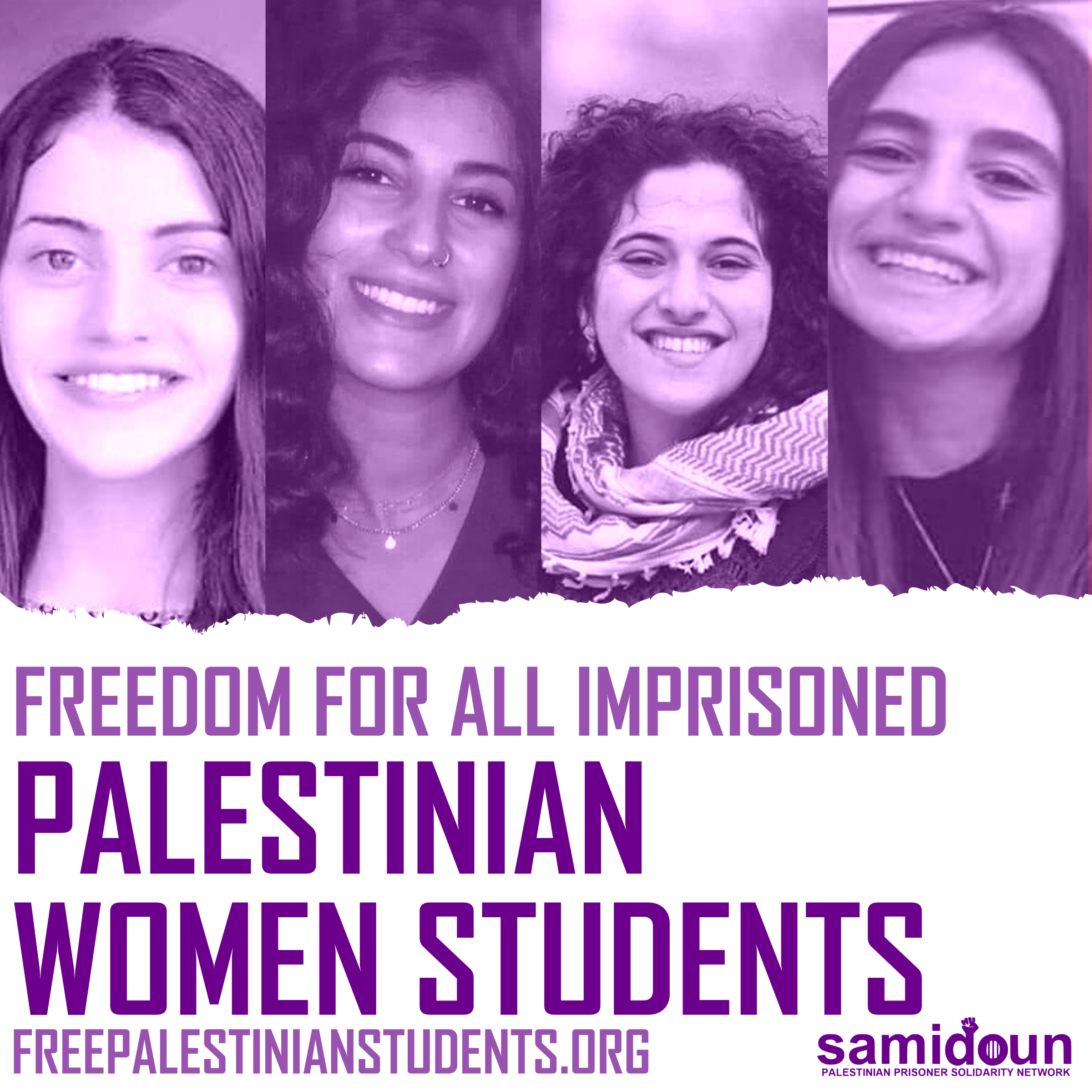
On International Women’s Day, Palestinian women are on the front lines of liberation struggle

“To our colleagues, to Palestinian students and those around the world, from the heart of the Zionist prisons. On the occasion of 8th of March, we long for freedom, justice and equality for all women of the world, including students, inside and outside the prison cells. Our battle is united, as we are all fighting oppression on the basis of gender, fighting class exploitation and fascist colonialism and foremost among which is the occupation on our land. To our female university colleagues, who are at the front lines of the battle for change, our confidence is in your struggle and resistance that illuminates the sky of our homeland and lights the road for freedom. For all Palestinian women, we believe that our social struggle is an inherent part of the struggle of our people, and for the liberation of land and people, we sacrifice, struggle and bring forth strugglers.” – Bir Zeit University student prisoners, Layan Kayed, Elia Abu Hijleh, Ruba Assi, Shatha Tawil, Damon prison, Mount Carmel, 8 March 2021

“On this 8 March, humanity exposed to the devastation of the Corona pandemic on the one hand, and the regime of tyranny, racism and colonialism on the other hand. A thousand greetings to every voice that resists injustice and oppression. May women remain at the forefront of this resistance, and 8 March stand as a symbol of liberation!” – Khalida Jarrar, imprisoned Palestinian leader, feminist and rights advocate, Damon prison, Mount Carmel 7 March 2021

As we commemorate International Working Women’s Day around the world this 8 March, there are 35 Palestinian women in Israeli jails, representing all facets of Palestinian society: students, activists, organizers, parliamentarians, journalists, health workers, mothers, sisters, daughters, aunts, strugglers, freedom fighters. Palestinian women have always been at the center of the liberation movement through all aspects of struggle and have led within the prisoners’ movement, organizing hunger strikes and standing on the front lines of struggle even behind bars. On International Working Women’s Day, Samidoun Palestinian Prisoner Solidarity Network salutes the leading role of Palestinian women in struggle and urges the immediate release of all Palestinian women prisoners in Israeli occupation prisons.

Palestinian women prisoners include 11 mothers, six injured women and three jailed without charge or trial under administrative detention. They include Khalida Jarrar, Palestinian parliamentarian, feminist, leftist and advocate for Palestinian political prisoners, sentenced to two years in Israeli prison for her public political activities just days prior to International Women’s Day; Khitam Saafin, President of the Union of Palestinian Women’s Committees, jailed without charge or trial, her administrative detention renewed for another four months; Bushra al-Tawil, Palestinian journalist and activist whose detention without charge or trial was also renewed for another four months on 7 March 2021.

They include Palestinian students, like Layan Kayed, Elia Abu Hijleh, Ruba Assi and Shata Tawil of Bir Zeit University. Hundreds of Palestinian students are routinely detained by the Israeli occupation, especially those who are part of student organizations involved with campus political life. At Bir Zeit University alone, approximately 74 students were detained by occupation soldiers during the 2019-2020 academic year.

Palestinian women prisoners are among 5,000 total political prisoners, but Palestinian women are broadly affected by the mass incarceration of Palestinian men as well. Palestinian women are the mothers, wives, daughters, sisters, lovers and friends of Palestinian male prisoners. They make homes for themselves and their children, denied access to their husbands and fathers. They lead the movement outside prison to highlight the names, faces, voices and stories of all Palestinian prisoners struggling for liberation.

Since 1948 and before, from the earliest days of the Palestinian national liberation movement, Palestinian women have been expelled from their homes and targeted for repression on multiple levels, their very capacity to reproduce and raise their children labeled as an unacceptable threat to the racist settler-colonial project of Zionism. Since 1967 alone, around 10,000 Palestinian women have been jailed by the Israeli occupation for their political activity and involvement in the Palestinian resistance, including Palestinian women in Jerusalem, the West Bank, the Gaza Strip, and Palestinian women holding Israeli citizenship in occupied Palestine ’48. Palestinian women in exile and diaspora have been denied their right to return to Palestine for over 72 years yet continue to struggle, facing political repression, criminalization, deportation and imprisonment.

Palestinian women prisoners are routinely subjected to torture and ill-treatment by Israeli occupation forces, from the moment they are detained — often in violent night raids — and throughout the interrogation process, including beatings, insults, threats, aggressive body searches and sexually explicit harassment. Within Israeli prisons, the official state policy of “worsening the conditions” of Palestinian prisoners has particularly targeted Palestinian women, denied family visits or even phone calls, subjected to intense surveillance that violates their privacy, denied education and held in dangerous and unhealthy conditions. They are transported in the “bosta,” a metal vehicle where women are shackled on a long, circituous trip that takes hours longer than a direct route and often denied access to sanitary facilities.

Damon prison, itself formerly a stable for animals, is located in occupied Palestine ’48 — in violation of the Fourth Geneva Convention, and making it even more difficult for Palestinian women’s family members to visit them. All visits are subjected to an arbitrary permit regime which is often obstructed by the Israeli occupation regime.

However, Palestinian women behind bars continue to resist and to lead. In April 1970, Palestinian women prisoners at Neve Tirza prison launched one of the first collective hunger strikes of the Palestinian prisoners’ movement when they refused food for nine days. They demanded access to women’s sanitary supplies as well as an end to beatings and solitary confinement. Palestinian women have been consistently involved in general hunger strikes and protest actions, including strikes led by women prisoners in 1985, 2004 and 2019 that inspired global women’s solidarity. Despite the denial of formal education by the Israeli colonial regime, Palestinian women prisoners have developed revolutionary education for all prisoners, expanding their knowledge and commitment to struggle.

Palestinian women prisoners are not alone; they struggle alongside fellow women political prisoners in the Philippines, Turkey, India, Egypt and around the world. And their imprisonment is also international: it is funded, backed and supported by the diplomatic, military, economic and political backing given to Israel by the imperialist powers, including the United States, Britain, Canada, Australia and the European Union states. Palestinian women also confront the role of the Palestinian Authority’s “security cooperation” regime under Oslo and the normalization politics and repressive attacks of reactionary Arab regimes.

Despite all attempts of the Zionist regime to isolate them from the global movement for the liberation of women and humanity through imprisonment and repression, Palestinian women continue to organize and struggle from behind bars, in the streets and fields of occupied Palestine, and everywhere in exile in diaspora, seeking return and liberation. On International Women’s Day 2021, Samidoun Palestinian Prisoner Solidarity Network salutes the movement of Palestinian women and their leadership in the ongoing and daily struggle for national and social liberation.

We urge women’s organizations, student organizations and people of conscience everywhere to raise their voices and act in solidarity with Palestinian women, and Palestinian women prisoners, targeted by the Israeli occupation – including by building the movement for the boycott of Israel, its institutions and complicit corporations like HP, Puma, Teva Pharmaceuticals and G4S. The Israeli occupation wants to continue its colonization of Palestine unchecked by isolating and detaining the leaders of the Palestinian people’s movement. Now is the time to act and urge their immediate release and the liberation of all Palestinian prisoners, and of Palestine, from the river to the sea.

Take Action!

1. Join the Campaign to Free Palestinian Students! Over 325 organizations have already signed on to the campaign to take action to free imprisoned Palestinian students. Get involved at freepalestinianstudents.org.

2. Organize protests, demonstrations creative actions. Ad hacks, postering and other outdoor actions – especially near an Israeli embassy or consulate – can draw a significant amount of attention to the Palestinian women prisoners and the Palestinian cause at this critical time.

3. Build the boycott of Israel! Join the movement for boycott, divestment and sanctions against Israel. Highlight the complicity of corporations like Hewlett-Packard and the continuing involvement of G4S in Israeli policing and prisons. Build a campaign to boycott Israeli goods, impose a military embargo on Israel, or organize around the academic and cultural boycott of Israel.

Resources on Palestinian women prisoners

We recommend the following resources for more information on Palestinian women prisoners:

Strugglelalucha256


International Women’s Day founder Clara Zetkin on fascism, a lesson for today

On many holidays recognizing people’s struggles and their leaders — for example, the civil rights movement and Dr. Martin Luther King Jr. — the present-day celebrations are both sweet and sour. 

The only reason for formal recognition is that protests and struggle made it so — and this is a victory. But the other, “give it the side-eye” part is that the actual history of how they originated is covered up in pink ribbons. 

The blood, sweat and tears that were shed have been washed away. 

International Women’s Day is like that. So much has been done to sterilize it, package it, market it, capitalism-it (my made up word) — foremost in the capitalist West, of which the U.S. is the capital. 

But the beating heart behind all of the fancy images and representations is still strong, red and has the potential to change the world. Its red tail pokes out from under all of the corporate debris. 

The courage of the Black women workers at Amazon’s Bessemer, Ala., warehouse standing up to Jeff Bezos, one of the richest men in the world — Indigenous women resisting gender violence, murder and plunderous oil pipelines — immigrant/migrant women fighting for their survival — teachers and nurses resisting COVID-19 — are the continuing heartbeat of International Women’s Day.

So too are the women in Haiti taking to the streets despite rightwing violence; the women in India resisting Modi and fighting for the rights of poor farmers; and the women of Brazil, Argentina, Ireland and Poland fighting for control of their bodies — they are its heartbeat. 

And no amount of praise can be spared for the women of Cuba, China, Zimbabwe, Iran, North Korea, Yemen and so many countries’ women who are resisting sanctions and U.S. imperialism. 

After all, International Women’s Day was founded on the idea of international solidarity of working and poor women around the globe, and recognized first by the world socialist movement on March 19, 1911.

International Women’s Day is 110 years old

Clara Zetkin was its original heartbeat, and she definitely had a red heart. 

While advances in human history are never the product of one person or leader, but rather the result of social and material conditions that compel the intervention of masses of people, leaders and their organizations are an indispensable product of that process. 

They can’t be separated from these earthquakes, placed above or below it, but rather play an indispensable role in guaranteeing its success. Intense struggle, in the form of huge strikes, protests in the streets, sit-downs at the workplace, occupations and ultimately insurrections and uprisings, are the engine of change. 

In the case of International Women’s Day, you could call Clara Zetkin the tireless driver of that engine. 

During this period, women in Europe and other parts of the world were emerging from feudalism and slave-like conditions, where they were subjugated to sexual abuse, isolated in their homes and villages as serfs and peasants; only to be forced into a new kind of slavery, toiling alongside their children in the brutal sweatshops of capitalism.

In these new conditions, revolutionary socialist and communist women agitated and organized women workers to resist even when this meant doing so under illegal conditions, subjecting them to jail and exile.

The First World War compounded suffering in unimaginable ways. It brought death and starvation, but it also brought resistance, especially by women.

While the declaration of International Women’s Day was made in Europe, Zetkin’s aim as a revolutionary socialist and communist was that it would be international in scope, uniting women across all boundaries. 

Inspiration from New York City

One of the earliest of women’s protests that helped fuel the movement took place in the United States on March 8, 1908. Thousands of women garment workers, mainly immigrants, took to the streets demanding their rights. 

This was followed a year later with the 1909 “Uprising of the 20,000,” also called the New York shirtwaist strike, a three-month garment workers’ strike. 

Women kick off a revolution

But the unforgettable turning point that sealed the deal was when the women of Russia touched off a revolution. 

On March 8, 1917, striking women textile workers joined other women attacking bakeries over high bread prices in Petrograd, Russia. They implored soldiers to put down their rifles. 

Some 90,000 protesters took to the streets demanding “peace, land and bread.”

This was the opening salvo that toppled Russia’s hated czar and in less than a year, the workers, peasants and the poor led by the Bolshevik Party took power in November 1917. 

While encircled and under attack by the imperialist powers, they formed the first socialist workers’ state. One of the very first things the new Soviet revolution did was codify women’s equality.

Zetkin the theoretician, organizer and doer

While Clara Zetkin dedicated much of her time and effort to the cause of working class women, she was simultaneously a thinker and writer, what we call a theoretician, and as a revolutionary, a doer, organizer and participant. 

Sometimes there were painful splits and conflict. Zetkin left the Socialist Party of Germany in 1916 because of its imperialist pro-war position and, along with Rosa Luxemburg, helped pave the way for the founding of the Communist Party of Germany. 

She was jailed repeatedly for opposing World War I. Remarkably, Lenin met with her to strategize on the question of women. 

Another part of Clara Zetkin’s story — fighting racism

Zetkin was fiercely opposed to Jim Crow and lynching in the U.S. South. 

She played a major role in building international support for the Scottsboro Case (1932) of nine Black teenagers falsely accused of raping two white women. They were found guilty and Alabama sought the death penalty for 8 members (the ninth member was only 12 years old). While they were eventually freed, it took years before the teenagers were released.

You can find Zetkin’s call, “Save the Scottsboro Black Youth,” in “Clara Zetkin: Selected Writings” edited by Philip Foner with a foreword by Angela Davis. 

Zetkin and right-wing putsch at U.S. Capitol

As we continue to discuss the January 6, 2021, events at the U.S. Capitol, we can evaluate and learn from Clara Zetkin.

Zetkin understood the causes of fascism, connecting it to the decay of capitalism, urging socialist and working class unity. Rather than poorly summarize it for you, you should read and study Zetkin’s report given on June 20, 1923, to the Communist International: “The Struggle Against Fascism.” 

Zetkin’s writings, presentations and polemics were not abstract. She did not have the luxury of looking back but rather had to write in the middle of the maelstrom. This makes her contributions sharp and even more remarkable.

At the age of 75, gravely ill and nearly blind, she spoke for an hour in the German Parliament (Reichstag) on August 30, 1932, as Nazis yelled death threats at her. 

When Hitler came to power, Zetkin was forced into exile and lived her last days in the Soviet Union. She was 76 when she died on June 20, 1933.

Clara Zetkin lived an amazing life, filled with hardship and struggle. She endured the murder of her close friends and comrades Rosa Luxemburg and Karl Liebknecht, but she also witnessed the birth of the Soviet Union and saw genuine advancements for women. 

This real history cannot be shoveled underground. 

Zetkin’s red heart will remain with us.

Strugglelalucha256


I live proud to be a woman and to be Cuban

Adriana Pérez Oconor has been a chemical engineer since 1995. She currently works at the Food Industry Research Institute and holds a master’s degree in that specialty. But it is not precisely her professional performance, nor her outstanding work as a member of the National Assembly of People’s Power, in the period between 2013 and 2018, that is the main purpose of this interview.

This woman, with whom we spoke just a few days before International Women’s Day on  March 8, went from despair to the absolute happiness she lives today, in the company of her three children – Gema, Ámbar, and Gerardito – and her husband Gerardo Hernández Nordelo. This happiness, however, was preceded by an anguished road, which she only managed to travel by clinging to the courage inherited from Mariana, Celia, Haydée, and Vilma, among many other courageous Cuban women.

What was your reaction when you learned of Gerardo’s real mission in the United States?

When Gerardo left Cuba for the United States, we were already married, and when he was arrested in 1998, we had been married for ten years. I was finishing the last year of my degree through a course for workers, as I was working at the Tenería Habana company at the time.

The knowledge of Gerardo’s real mission was a real shock for me, a big surprise. As far as I knew he was in a Latin American country doing a master’s degree linked to his diplomatic career and I never knew about his mission until the whole network was discovered and its members arrested. When he was arrested, he had been in the United States for about four years. When I heard of his arrest, I learned of something that I never even suspected, nor did I imagine that he could be linked to this type of activity, being arrested for espionage, as was initially mentioned in the news reports broadcast by radio stations in Florida and that was the only public information that was given at the time. It was actually a mixture of emotions because first I had to assimilate the news. And second, how I would face a future that was totally uncertain and not at all promising.

On the other hand, there was the family situation. Gerardo’s mother was alive and completely unaware of the activities of her youngest and only son. In that same year, she had lost a daughter, and for her, this news would be too much of a blow, much harder still. In other words, the news not only had a personal impact but also had an impact from a family point of view. This meant that I had to prepare myself psychologically for the role I would have to play from that moment on. Information that to make matters worse, had to be kept secret and assumed in silence, which demanded all my efforts, all my creativity, and all the sentimental resources I could summon.

From that moment on I was obliged to impose myself on a world that I knew from the beginning was very difficult to cope with. I have often been asked how I managed to do it and I have never been able to give an answer because I still don’t know how I did it. But I think that as time goes by, you gather strength, willpower, resources, and energy to face the new challenges that life imposes on you. And to face those challenges with emotional balance, I began to create a kind of armor that would allow me to live in tune with what was happening and at the same time take on what was coming. I was always convinced that it would be a very complicated road to walk, especially if we take into account how relations between Cuba and the United States have historically been.

At no time, however, did I stop working and, on the contrary, I looked for things to occupy my mind, to keep me from thinking. I finished my master’s degree and began to study language, studies in which, although I never prospered, kept me mentally busy. At that stage, the most difficult thing for me as a person, as a human being, was the role I had to assume with respect to Gerardo’s family. He always had a very close relationship with his mother. He had inherited her nobility, her sense of humor. It was a great responsibility for me to try to cover for his absence. And I had to lie, lie a lot, something that is an element that had never been part of my personality before, that I had never even conceived of in my behavior before. I lied to everybody, I had to evade comments, I had to remain silent all the time and it was terrible. In fact, I was never able to do it and, albeit half-heartedly, I was revealing some parts of the truth that I kept hidden from people close to me, like my mother, who from the beginning of our relationship felt great affection for Gerardo.

Of course, all our dreams, illusions, plans, were shattered, shattered. I was left with only two options: either I let the knowledge of Gerardo’s activities crush me, or I could start from the new conditions. Either I threw myself to die, renouncing everything I had lived, everything I had, everything that had made me happy and that I admired, or I began to walk this new path, dragging the sack in which I had thrown everything that had been broken, except love, which was the only thing that remained intact. I decided on the second option and began to adapt my plans to coincide with the great challenges that the new circumstances brought with them.

And from that decision, I set myself goals. The most important thing was to reach the end, even though I never knew when it would be. But I set out to reach that end with the necessary emotional balance to keep me strong and at the same time, to take care of all the fronts I had open, which were to attend to my work responsibilities and to give emotional support to the two families, especially Gerardo’s. I also tried to remain socially active and to maintain good physical and mental health.

During the relentless struggle for the release of the Five, did you ever feel alone?

I always had the extraordinary support of all these people. I also had the valuable support of my family, of the families of the Five, who became one. I had the same support from my friends – who are many and very valuable – and from my work colleagues, who, when Gerardo’s situation became public, helped me even more. It was my colleagues who took up my absences when I participated in the solidarity campaigns in favor of the Five, in the meetings held inside and outside Cuba. They worked hard to keep the work going, taking care of my image as head of the production department. We became a great team.

Of great importance was also the support I received from Dr. Jesús Llanes Querejeta, who was my boss at the time. Professionally I learned a lot from him, as well as from his intelligence, discipline and optimism.

I cannot hide the fact that I had several moments of weakness. In that first stage of silence, which in my opinion was the most difficult, I experienced very hard, sad and painful moments. This is not to say that when our government released the information publicly and officially, my mood was better, but the situation became a little more bearable. There were days, for example, when I didn’t know how I was going to get up and if I did get up I didn’t know how to walk. In public, I always showed great strength, but when I got home and closed the door, that strength left me, and again I saw before me the sky joined to the earth. All the armour I had forged, which I kept outside, disappeared. At those moments, loneliness, nostalgia, uncertainty and longing took hold of me. However, I quickly thought: if out there, in the streets of Cuba and not a few countries in the world, there are thousands of people who are not related to the Five, who probably don’t even know them and are demanding their freedom, how can I, as the wife of one of them, be weak.

That thought forced me to get up, to get going again. And so day after day I searched for resources to cling to when I was alone. Publicly I could not, it was not fair for me to show the slightest sign of weakness, when there was, I repeat, an entire people who, moved by their patriotism, humanism, solidarity, demanded the right of their children to be in their homeland. In reality, I lived through very, very difficult, very sad times, even in some international events, which became repetitive and I almost never saw a light that could be taken as a sign of progress. Many people participating in those events did not understand that we were not telling a story, but that we were living that story, that we were part of it.

How did you deal with the two life sentences unjustly and arbitrarily imposed on Gerardo?

I knew Gerardo’s sentence immediately because kind people present at the trial informed me of it. I think it was a problem of temperament, of character, or that it was already difficult for me to be surprised by something, that could make me collapse, but the truth is that the judge’s verdict did not alarm me. The trial took place in 2001 and the conviction was announced at the end of that year. I already knew, from the guilty verdict on all charges that had initially been handed down, that the sentence would be far from lenient and I prepared myself for life imprisonment, but never for the death penalty. And as I always kept that sentence in mind, I began to analyze what could happen next. Without writing it down, I made a kind of mental timeline, or goal, where I had programmed: I have the strength to get to the sentence, and after that I have to create new handles for myself again. I also had six months between the trial and the final sentence which allowed me to draw up a strategy and the steps I had to follow.

During that time, a few things also happened: between June and December we prepared a video that we respectfully sent to the judge. In that recording we referred, from a humanitarian point of view, to who they were, highlighting their values. During that period, the terrorist attack on the Twin Towers also took place. And a letter to the Americans had also been made public, acknowledging that the Five had never harmed the people of the United States. There were two possibilities: one that they tried to prevent acts like the one that happened in the Twin Towers, or two, that people like them could prepare actions of this kind. In the end, we think that the judge leaned towards the second possibility because of the very strict, harsh and arbitrary verdict she issued. The judge’s behavior allowed me to prepare myself for the tougher, more complex scenario. For me it meant one life sentence or two life sentences because we always agreed that until the last one came out, we would continue our battles, our campaigns.

The conviction did not come as a surprise to me, it was not as shocking as the first news I had received when Gerardo was arrested. In fact, I did not cry that day. I had already prepared myself emotionally to bear it. I was fully aware that both Gerardo and his comrades were innocent of the charges against them; but the sentences were not for them, they were simply aimed at punishing the people of Cuba. It was demonstrated that in every conviction, particularly Gerardo’s, there was a political rather than a legal component.

Sustained by the resolve that I had to go all the way, I adapted my approach to the new reality I was facing. The situation was much more complex and to live up to it our struggle had to be political and public. That would be the way forward. I remember that one day I said to my mother-in-law: it doesn’t matter if I’m 80 years old, I’m going to wait for him, I’m going to receive him mentally healthy. And that’s what I did after the sentence. There was no way and no matter what happened I could weaken, and I started to be stricter with myself, I had to make demands on myself to correspond with the new reality that arose after the trial and I think that was what hurt me the most. My life strategy was to prepare for the future day by day, even though I had no idea when it was going to come. But I still did what I could every day. Gerardo always taught me that: live each day as if it were your last. And that’s what I did, even though I felt that all the sentimental burden I was carrying was hardening me. I got so hard that I reached the last stage of the campaign terribly exhausted from a sentimental point of view. Despite this exhaustion, I found the strength to welcome Gerardo, Ramón and Tony when they finally arrived in their homeland on December 17, 2014.

Despite the fact that Gerardo’s case was the most difficult and tangled to resolve judicially, you decided to become a mother. Why?

The truth is that I had no plans to have a child. Within the life strategy that I had drawn up for myself from 2001 onwards, with the arrest of Gerardo and his companions, and subsequently his two life sentences, with no possibility of visits in our case, of meetings, of the reinforced intention of the U.S. government to keep us separated, I totally dismissed the idea of being a mother, because in addition to all this, there was my biological clock that had to be taken into account.

Gerardo was the one who supported this dream of parenthood the most. So out of respect, because I thought he really deserved it, I changed my mind. Although in reality, it was more of a mutual agreement. He thought that for me as a woman it would be very sad not to become a mother and he felt responsible for it. Whereas I was thinking about the happiness it would bring him, in the midst of his confinement, to have a child.

Also, many people who were part of the campaign urged us to have a child, we were a young couple and therefore we had that right. Several people were sensitized to the idea, in Cuba and abroad. Among those who supported us the most were Vilma and Raúl, creators of a beautiful family. Also Olguita, René’s wife, a very sensitive person and mother. In the meantime, my biological clock was ticking.

It was in those days that Gerardo wrote his letter “To the children yet to be born”. That made me so sensitive that I decided to undergo the process of vitro insemination, which was not even widely performed in Cuba. My eggs were saved so that one day they could be inseminated. In a conversation with U.S. Senator Patrick Leahy, who was visiting Havana with his wife, I mentioned to him that Gerardo and I had been deprived of so many rights that we could not even have a child, which is the greatest aspiration of a married couple. He, however, was the father of four children, as well as having grandchildren and even great-grandchildren. Apparently, my words touched him deeply and he became one of the most supportive foreigners. When I was told later that everything was ready to begin the process of assisted reproduction, I thought it was a trick, another mockery of the U.S. government. But no, there she is, our first daughter, our Gema.

From what you have lived, from your own experiences, what do you think of Cuban women?

In that sense, the first thing I need to say is that I feel tremendously proud to be a woman and a Cuban. Very, very proud. In our campaigns for the Cuban Five, both in Cuba and abroad, we have always had the immense support of precisely the women’s umbrella organization. The Federation of Cuban Women, through its eternal president Vilma Espín, opened the doors so that we could proclaim our truth on any stage, even the most complex. In those events and meetings, through our voices, Cuban women spoke.

I believe that women are the backbone of the family and we have achieved this through our lineage. We are strong-willed, unbreakable, courageous and determined to face and overcome any obstacle in order to reach the proposed goal. It is precisely because of the perseverance that characterizes Cuban women that I have managed to reach this point with all my dreams turned into a beautiful reality.

When I speak of Cuban women, the example that comes to mind is that of the world record holder athlete Ana Fidelia Quirot, who was able to overcome her accident and return to competition. In the same way, I think of those women scientists, in general of all those women in the health sector, who remain in the danger zones in the confrontation with COVID. They constantly risk their lives to save the lives of others. A very important role is also played by housewives, who, like all women, with their daily work, with a simple smile, with that healthy and spontaneous vanity, beautify everything around us.

The first Latin American woman to be awarded the Paloma de Plata trophy by the Russian Federation, Adriana Pérez is also the recipient, like the other wives of the Five Heroes of the Republic of Cuba, of the 23 de Agosto Medal and the Order Ana Betancourt. Today, she says with emotion, she is immensely happy because “I have Gerardo and my children by my side. But I would never have been able to reach this moment, which I could not even have dreamed of years ago, if I had not had the support, the great and selfless support of hundreds of thousands of people, who came from the most remote corners of Cuba and the world, fought, as much as we did, for the release and return of the Five. To them, to those who are sadly no longer with us, to my family, friends, neighbors, and work colleagues, my sincere and eternal thanks.

Source: La Jiribilla, translation Resumen Latinoamericano, North America bureau

Strugglelalucha256


Women accounted for all jobs lost in December

The U.S. Labor Department’s December 2020 jobs report, released on Jan. 8, was staggering in terms of lost jobs for women. Bosses cut 140,000 jobs in December. Overall, women accounted for all of those job losses, losing 156,000 jobs in total, while men gained 16,000.  

Black and Latinx women were the most impacted. Latinx women currently have the highest unemployment rate at 9.1%, followed by Black women at 8.4%, while white women have the lowest unemployment rate at 5.7%.

Women, especially Black and Latinx women, work in the jobs hardest-hit by the pandemic and the capitalist recession. They are often the lowest paid, without paid sick leave or the ability to work from home. With schools and daycare centers closed, many women are forced to leave their jobs to parent children.

Of course, these are just statistics and numbers. What’s lost in them are the real lives of women and their children who are now on the brink of homelessness, hunger and despair. 

In many states, the unemployment benefit system is filled with entanglements and is in disarray. Many workers have yet to see any relief. But there is no despair amongst the very rich, as described in Wall Street’s New Years party: Dancing on the backs of poor workers.”

The Rev. Annie Chambers, Peoples Power Assembly activist and public housing organizer, told Struggle-La Lucha: “As women, it’s time for us to stand up and fight back. Capitalism ensures that the rich get rich and the poor get poorer. We must demand jobs or income now and much more.” Chambers was also a founder of the Baltimore Welfare Rights Organization.

What is crystal clear is that the women’s movement must take up the demands of the hardest-hit women, those who are unemployed — especially Black, Latinx, Indigenous, Arab and Asian women.

Strugglelalucha256


Revolutionary feminism

Following is a talk prepared by Lizz Toledo of Mujeres en Lucha/Women in Struggle and the Socialist Unity Party/Partido de Socialismo Unido for the Women’s Assembly at the European Forum, Nov. 24, 2020. 

Dear Comrades: Revolutionary greetings from Mujeres en Lucha/Women in Struggle and the Socialist Unity Party/Partido de Socialismo Unido in the USA.

It is difficult to separate the women’s struggle from any other struggle since all the struggles are intricately connected because our oppression, whether it is racism, homophobia, transphobia or sexism, stems from the class struggle, or the fight to end capitalism and imperialism.

Anti-racist work is women’s work, The leaders of the Black Lives Matter movement are women. Women have been in the frontlines fighting for an end to police brutality by demanding the abolition of police and U.S. Immigration and Customs Enforcement, because it is precisely our Black, Brown and Indigenous children that are being murdered by these racist systems. It is our children who are being held in cages by ICE and separated from their mothers even as their mothers breast feed them. It is our Indigenous children everywhere in the world that are being murdered for defending their land. 

Fighting for the rights of LGBTQ2S people is women’s work. Homophobia and transphobia are the tools of the capitalist system to keep us in our place. By forcing us to accept labels and rules that say, “This is the only normal way to be a woman” or “This is the only normal way to be a man”. This also works to keep us divided and fighting each other, while the bankers and the bosses line their pockets with the profits from our blood and sweat. 

And, of course, the fight against the oppression of women is not only women’s work but it is the work of all revolutionaries no matter the gender. 

Revolutionary feminism is the struggle against sexual and domestic gender violence. It is the fight against forced sterilization and forced birth control or abortion for poor women of color. It is a continuous struggle for women and trans women to have dominion over our bodies and our lives. 

We all have been raised with many backward ideas about race, gender and sexual identity. We all have to continue to check ourselves and each other when any of these evils rears its ugly head.

I think one of the biggest gains in the fight for the liberation of women today is the unity in the movement. Women, men, young, old, gay, straight, trans, Black, Brown, Indigenous and white, all standing with each other, protecting and defending each other, fighting for the liberation of the proletariat. If we are to achieve this goal we must continue to stay united. Keeping our eye on the true enemy: capitalism and imperialism. 

COVID-19 and gender disparities

Comrades: I want to now focus on how COVID-19 has worsened long-standing gender inequalities. Women are more likely than men to work in service occupations, including domestic work, restaurant service, retail, tourism, and hospitality, that require face-to-face interactions and have been hard-hit by layoffs. For these jobs, teleworking is not an option. Women workers are largely represented in frontline jobs, which are the ones most often deemed “essential” and require people to work in-person. 

In addition women have been harder hit by pandemic-related job losses than men. 

The pandemic recession has hit women especially hard for three reasons: 

  1. Massive job losses in service industries and other occupations where we are disproportionately represented;
  2. Sex discrimination that makes us more likely to be laid off; and 
  3. We tend to bear more responsibility for pandemic-related challenges to family health, school closures, and other disruptions. 

These pressures have resulted in many women leaving the workforce altogether. The drop was particularly steep for Latina women, whose participation rate fell by 5.1%, and Black women, whose rate dropped by 4.0%. 

Transgender women are always in a precarious position, but the COVID-19 pandemic has made them particularly vulnerable. According to research from University of California-Los Angeles, transgender women are at a higher risk for COVID-19 for several reasons. They are more likely to be low-income, with 47.7% of transgender people living below 200% of the official U.S. poverty line. They are also significantly more likely to suffer from asthma and HIV, conditions that put people at higher risk of mortality if they contract COVID-19. And they experience high barriers to receiving health care.

The pandemic has also hit transgender people especially hard economically. A poll from the Human Rights Campaign shows that as of June 2020, some 54% of transgender people had experienced reduced work hours — more than double the 23% of the total U.S. workforce. Twenty-seven percent of transgender people had experienced pay cuts, compared to just 7% of the U.S. workforce. And 19% had become unemployed due to the pandemic, a significantly larger share than the general population.

The gender poverty Line

The gender poverty gap has widened over the past 50 years. But COVID has made poverty a particularly acute problem for women of color, affecting 21.4% of Black women, 18.7% of Latinas, and 22.8% of Native American women, compared to the national poverty rate for white women of 7.0%.

Transgender economic gaps

Transgender people experience poverty at double the rate of the general population, and transgender people of color experience even higher rates. The unemployment rate triples among transgender people in comparison to that of the general population. The unemployment rate is even higher for Indigenous, Black, Latinx, Middle Eastern and multi-racial transgender people.

Black, Latinx and Indigenous people infected with Covid-19 are about four times more likely to be hospitalized than others, according to data from the Centers for Disease Control(CDC) 

People of color have been hit hard by the coronavirus pandemic. The number of COVID-19 cases among Black and Latinx children and across all ages is higher than other groups. Black and Latinx people infected with the virus also died at disproportionately higher rates over the summer. In addition, due to poverty and healthcare disparities communities of color, including Latinx, African Americans and Indigenous peoples, are often uninsured and have higher rates of conditions like hypertension, heart disease, diabetes, obesity, which can lead to more severe reactions to COVID-19. 

The fight continues

While workers and specifically women and trans workers made some gains prior to the pandemic, gender based economic oppression and sexual and domestic gender violence has worsened. COVID-19 has set us back years. But we must continue to push forward, demanding an end to a system that puts profits before people. A system that has allowed a pandemic to kill over 250,000 people in the U.S. alone. Revolutionary feminism is the fight for poor women and poor trans people of color to have a livable wage or an income. It is defending our right to make decisions about our lives and our bodies, whether this means keeping our babies and having the resources to raise healthy children or having full access to health care, including medications and surgery to transition if that’s what we choose. We choose when and if we have babies, we choose in what body we want to live our lives, we choose a life free of sexual and domestic violence, we choose who we love, we choose liberation for all. This is what true choice is about and this is true revolutionary feminism. 

Women and trans people living in the belly of the capitalist imperialist beast will be in the frontlines, led, of course, by women and trans people of color. United we will give the final blow to this decaying system and build a world where every life is valued and protected. Where people are more important than profits.

Strugglelalucha256


Solidarity with Cuban Women Federation in their 60th Anniversary

Just eight months after the victory of the Cuban Revolution, on Aug. 23, 1960, the Federation of Cuban Women was founded. At that meeting, Fidel Castro remembered the historic contributions of Cuban women, including mothers like Mariana Grajales, all of whose sons fought and died for Cuban independence, and the women who carried messages from the Sierra to the cities past the enemy lines. Clodomira and Lidia eventually were caught by the dictatorship, tortured and murdered without revealing secrets.

From the slave rebellion leader Carlota to women of the Moncada and the Mariana Grajales Women’ Platoon in the Sierra Maestra, from the development of CENESEX, Cuba’s National Center for Sex Education, to address the spectrum of gender identity and educate to eliminate homophobia and transphobia, to today’s women scientists who produced Soberana-01 COVID-19 vaccine that began clinical trials on Aug. 24, women are a revolutionary force inside the revolution.

On Aug. 15, the Federación de Mujeres Cubanas virtual program gathered friends of the Federación Democrática Internacional de Mujeres (Women’s International Democratic Federation), World Women’s March and other organizations in a virtual forum with Secretary General of FMC Teresa  Amarelle Boué. Present were representatives from Venezuela, Mexico, Ecuador, Brazil, Panama and Argentina, and Berta Joubert-Ceci from Puerto Rico, whose comments follow:

Comrades, thank you for making this celebration forum possible and for the honor of inviting us to participate.

Our organization, Mujeres en Lucha/Women in Struggle, member of the Women’s International Democratic Federation/Federación Democrática Internacional de Mujeres (WIDF/FDIM) congratulates the Federación de Mujeres Cubanas on its 60th anniversary.

We would like to start by highlighting the role of the FMC, through Vilma Espín, who had the vision of ensuring the continuity of the FDIM, after the dismantling of the socialist countries in the 1990s, continuing the project of international unity led by women.

Comrades, after having participated in various international forums with the women of the FMC, we would like to share some of the qualities that have most impacted us about them, qualities that serve as an example to all of us: their great generosity with their time, always ready to share experiences and suggestions — strong defenders of their revolution, their understanding, their search for consensus, and their tenacity to face problems or obstacles. Much we have learned from you compañeras.

This year we have faced a global challenge: the COVID-19 pandemic, which has forced us to assume physical isolation as a preventive measure. However, that same isolation has forced the opening of a virtual door to the world. The pandemic has become a challenge and at the same time an opportunity to get intimately closer to other struggles, to look for the similarities and differences, to feel closer to their vicissitudes, their sufferings and the resistance of their peoples. It has led us to learn new forms of mobilization and resistance, to feel more a part of other struggles.

Although we have not yet found that crucial point of a global joint response that could once and for all destroy this capitalist system that is the root of so much oppression, this process is giving us the opportunity to launch global campaigns.

The criminality of capitalism has been exposed more clearly with this pandemic. Cuba has defeated the mistaken notion of the USA as “the savior of democracy,” the Cuban medical brigades are bringing health, hope and a model of generosity that only Revolutionary Cuba and its socialist development can do.

Cuba has always been an example of humanity, and the women of the FMC have been exponents of it. Wherever their delegations go, they have stood out for their commitment to just causes raising their voice in all forums. They have never been silent observers. And they have always taken advantage of every forum to defend their revolution, to expose US crimes against their island, from Elián to the Five Cuban heroes, always demanding that this murderous blockade be removed.

So, following your example, I would like to appeal to all the participants by asking for:

  • Solidarity with the Black Lives Matter Movement and the Immigrant movement in the USA.
  • And with Puerto Rico, let’s raise our voices worldwide against 122 years of invasion, occupation and colonialism by the USA.
  • We are experiencing very difficult times in our Boricua archipelago. There is hunger and unemployment. There is still a lack of housing ever since Hurricanes Irma and Maria three years ago. Since last January, there have been constant earthquakes in the south and more homes, schools and historical buildings have collapsed. There have been droughts followed by heavy rains that cause landslides. And then this pandemic during which the corrupt government and its cronies have robbed the people and denied the help that is most needed.

The straitjacket, that is being a colony, does not even allow for closing the airport through which thousands of people arrive daily — many contaminated with COVID — from the states with the most contagion of the pandemic such as Florida and Texas.

We have made a request for help from the Cuban medical brigades, but our lack of sovereignty prevents their arriving in Puerto Rico, while the U.S. denies the Puerto Rican people the most precious thing: their freedom.

Comrades, thanks again for making this forum possible and for the honor of inviting us to participate.

Long live the Federation of Cuban Women!

Strugglelalucha256


60 aniversario: Una mensaje a Federación de Mujeres Cubanas

Apenas ocho meses después del triunfo de la Revolución Cubana el 23 de agosto de 1960, se fundó la Federación de Mujeres Cubanas. En esa reunión Fidel Castro recordó las contribuciones históricas de las mujeres cubanas, incluidas madres como Mariana Grajales cuyos hijos lucharon y murieron por la independencia de Cuba, las mujeres que llevaban mensajes desde la Sierra a las ciudades más allá de las líneas enemigas Clodomira y Lidia finalmente fueron capturadas por la dictadura, torturada y asesinada sin revelar secretos.

Desde la líder de la rebelión esclavista Carlota hasta las mujeres del Moncada y el Pelotón de Mujeres Mariana Grajales en la Sierra Maestra, el desarrollo de CENESEX, el Centro Nacional de Educación Sexual de Cuba para abordar el espectro de la identidad de género y educar para eliminar la homofobia y la transfobia, a las mujeres científicas de hoy que produjeron la vacuna Soberana-01 COVID-19 que comenzaron los ensayos clínicos el 24 de agosto, las mujeres son una fuerza revolucionaria dentro de la revolución.

El 15 de agosto, el programa virtual de la Federación de Mujeres Cubanas reunió a amigos de la Federación Democrática Internacional de Mujeres, la Marcha Mundial de Mujeres y otras organizaciones en un foro virtual con la Secretaria General de la FMC Teresa Amarelle Boué. Venezuela, México, Ecuador, Brasil, Panamá, Argentina y Berta Joubert-Ceci de Puerto Rico cuyos comentarios a continuación:

Compañeras, gracias por hacer posible este foro de celebración y por el honor de habernos invitado a participar.

Nuestra organización Mujeres en Lucha, miembro de la FDIM felicita a la FMC en su aniversario.

Quisiera comenzar destacando el papel de la FMC, a través de Vilma Espín, quien tuvo esa visión de asegurar la continuidad de la FDIM luego de la desarticulación de los países socialistas en los 90, de continuar ese proyecto de unidad internacional liderado por mujeres.

Compañeras, después de haber participado en varios escenarios a nivel internacional con las mujeres de la FMC, nos gustaría compartir algunas de las cualidades que más nos han impactado de ellas, cualidades que sirven como ejemplo para todas nosotras:  su gran generosidad con su tiempo, siempre dispuestas a compartir experiencias y sugerencias — férreas defensoras de su revolución, su comprensión, su búsqueda de consensos, y su tenacidad para enfrentar problemas u obstáculos. Mucho hemos aprendido de ustedes compañeras.

Este año, nos hemos enfrentado a un desafío a nivel global; la pandemia del COVID-19 nos ha obligado a asumir un aislamiento físico, sin embargo, ese mismo aislamiento ha forzado la apertura de una puerta virtual hacia el mundo. La pandemia se ha convertido en un desafío y a la misma vez en una oportunidad para acercarnos más íntimamente a otras luchas, a comprobar las similitudes y las diferencias, a sentir más de cerca sus vicisitudes, sus sufrimientos y la resistencia de sus pueblos. Nos ha llevado a aprender nuevas formas de movilizaciones y de resistencia. De sentirnos más parte de otras luchas.

Aunque no hayamos encontrado aún ese punto crucial de respuesta global conjunta que pueda de una vez y por todas destruir este sistema capitalista que es la raíz de tanta opresión, se está dando ese proceso de acercamiento que nos da la oportunidad de lanzar campañas globales.

La criminalidad del capitalismo ha sido expuesta más claramente con esta pandemia. Cuba ha derrotado la noción equivocada de los EUA como “ente salvador de la democracia”, las brigadas médicas cubanas han llevando salud, esperanza y una muestra de generosidad como sólo Cuba revolucionaria y su desarrollo socialista puede hacer.

Cuba siempre ha sido ejemplo de humanidad, y las mujeres de la FMC han sido exponentes de ello. Por donde quiera que han ido sus delegaciones, se han destacado por su compromiso con las causas justas alzando su voz en todos los foros. Nunca han sido observadoras silentes. Y siempre han aprovechado cada foro para defender su revolución, para exponer los crímenes de EUA contra su isla, desde Elián hasta los Cinco Héroes cubanos, exigiendo siempre que se elimine ese bloqueo asesino.

Así que, siguiendo su ejemplo, quisiera hacer un llamado a todas las participantes:

  • Solidaridad con el Movimiento Las Vidas Negras Importan y el Movimiento Inmigrante en los EUA.
  • Y con Puerto Rico, alzar nuestras voces a nivel mundial contra 122 años de invasión, ocupación y colonialismo por los EUA.
  • Estamos viviendo momentos muy difíciles en nuestro archipiélago. Hay hambre y desempleo, hay falta de viviendas desde los huracanes Irma y María hace tres años. Desde enero la tierra en el sur ha estado temblando constantemente y se han derrumbado más viviendas, escuelas y edificios históricos; Ha habido sequías seguidas de lluvias copiosas que provocan deslizamientos de tierra; y luego esta pandemia durante la cual el gobierno corrupto y sus secuaces, han robado al pueblo y negado las ayudas que más se necesitan.

La camisa de fuerza que es ser colonia ni siquiera permite cerrar el aeropuerto por donde diariamente llegan miles de personas — muchas contaminadas con el COVID — desde los estados con más contagio de la pandemia como son la Florida y Texas.

Hemos hecho un pedido de ayuda para que vengan las brigadas médicas cubanas, pero nuestra falta de soberanía lo impide, a la vez que los EUA le niega al pueblo boricua lo más preciado, su libertad.

Compañeras, nuevamente gracias por hacer posible este foro y por el honor de habernos invitado a participar.

¡Viva la Federación de Mujeres Cubanas!

Strugglelalucha256


Baltimore #SayHerName protest elevates voices of women vets

Baltimore — The Peoples Power Assembly and Women In Struggle/Mujeres En Lucha held a rally and march to “Say Her Name” at the Garmatz Federal Courthouse in downtown Baltimore July 30. It coincided with a march in Washington, D.C., for murdered Army Spc. Vanessa Guillén, who was stationed at Fort Hood, Texas. The event also highlighted women killed by police, including Breonna Taylor, Sandra Bland, Korryn Gaines and others. 

Annetta Johnson, a veteran from Baltimore, led the protest. Earlier, she attended the march for Vanessa Guillén in D.C. Johnson is the founder of Purpose Driven Journeys and has spoken out on the lack of services for women and Black veterans.      

Ellen Barkfield, an organizer with the Philip Berrigan Memorial Chapter of Veterans for Peace, also spoke out. Barkfield was also stationed at Fort Hood. She gave a moving account of her own experience of sexual assault and the futility of reporting it to the U.S. military command. 

The protesters pointed out that rape and sexual violence are an intergral part of police and military culture. It is a form of terror used by U.S. imperialism both abroad and inside its own military as a method of genocide and control.

The Rev. Annie Chambers, Peoples Power Assembly organizer, said, “Our fight is right here in the U.S.” She emphasized, “We live in a capitalist, racist country, and if we never fight them then it won’t change.”

The action ended with a march around the courthouse under the watch of an overwhelmingly large presence of Department of Homeland Security agents, which included dogs and a score of white vans lined up close to the protest.

Strugglelalucha256


Janine Africa and Janet Africa

Janine Africa and Janet Africa are two of the surviving MOVE 9 activists who recently won release after decades in prison. They described the hell they went through in Pennsylvania prisons. They and the other MOVE 9 members were beaten by guards.

Upon arriving in prison, Janet and Janine were immediately put in “the hole” — solitary confinement. The warden told them they would stay there and they did stay there for a long time.

In 1985, the women were told that their children had been killed while they were still in solitary confinement. The guards told them their children were dead without further explanation. They had to rely on overheard conversation among other prisoners in the prison yard to glean that the Philadelphia police and FBI had bombed the MOVE house on Osage Avenue on May 13, 1985, killing six adults and five children.

Janine Africa and Janet Africa have not been crushed by the horrendous ordeals they have suffered. They say it is the unbroken solidarity of the MOVE family and support of many others that gave them the strength to survive. 

Janine said: “For 41 years, they have tried to beat us down. They have tried to take our health. They have tried everything to stop us because they couldn’t stop us no other way.

“We have a family that is so strong and supportive. They had our backs and we rode on their strength and that made us strong. We can’t stop talking about it because we know how important that is.  

“We are out here fighting for everybody, whether you are white, Black, Chinese. We know this system is on pins and needles because we are coming out!”

Read about Janine and Janet Africa’s historic visit to Southern California at tinyurl.com/vhhaxr8

Strugglelalucha256
https://www.struggle-la-lucha.org/oppressed-genders/page/6/