U.S. funds war, takes over Ukraine assets

War and Lenin in the 21st century, part 1

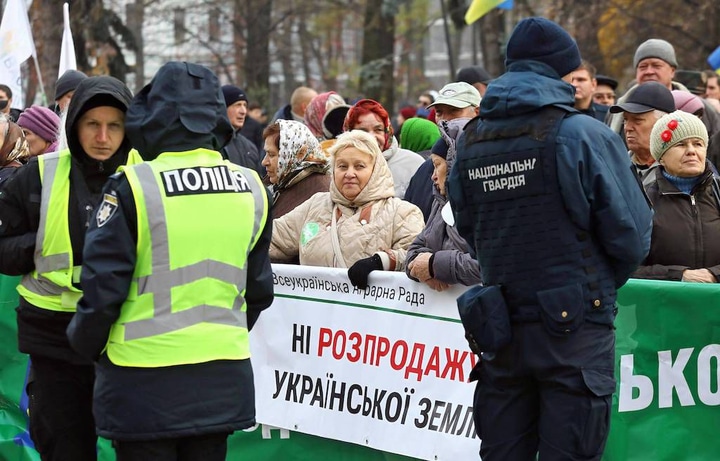
A 2019 rally to protest against government plans to lift the moratorium on agricultural land sales, a step eagerly awaited by Wall Street’s BlackRock hedge fund but opposed by the Ukrainians fearing a foreign land grab. The sign reads, “No to sales of Ukrainian land.”

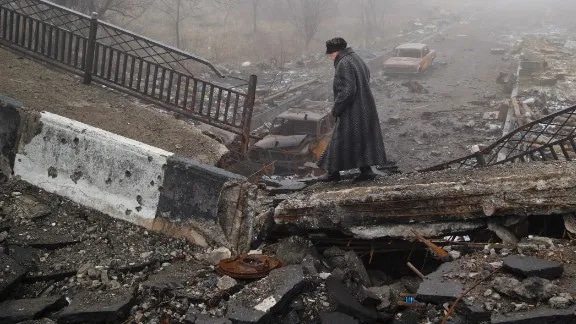
The U.S. is funding a proxy war against Russia — Congress has approved $113 billion for Ukraine — seizing Ukraine’s assets in the process. 

The U.S. is spending $2.5 billion per month just on weaponry in Ukraine, which is seven times what was spent on weaponry in Afghanistan at its height, according to Special Inspector General for Afghanistan Reconstruction John Sopko speaking on NPR August 17.

The Obama administration helped overthrow Ukraine’s elected president in February 2014 and installed a far-right regime loyal to Washington. At the time, Joe Biden was the Obama administration’s point man on Ukraine. He visited the country more than half a dozen times from 2014 to 2016. 

Beginning in 2014, Joe Biden’s son Hunter served on the board of a Ukrainian energy company, Burisma. Hunter was paid “as much as $50,000 per month,” according to the New York Times. Burisma was under investigation by a Ukrainian prosecutor, Viktor Shokin, for corruption. NPR reported in 2018: 

“At an event at the Council on Foreign Relations in 2018, Biden said that on one of his many trips to Ukraine, he told the country’s leaders that they had to get rid of the prosecutor if they wanted $1 billion in U.S. aid.”

On Aug. 11, 2023, Attorney General Merrick Garland appointed U.S. Attorney David Weiss as special counsel to lead an investigation into Hunter Biden.

Donald Trump says this shows Joe Biden committed corruption in Ukraine. Trump wants to dig up dirt on Biden for political purposes, but he is not and has never been against corruption. Corruption is Trump’s mode of operating.

Trump used his position as president to enrich himself and his family personally. For example, he stayed at his own hotels while on official business, which cost millions (much more than $50,000 a month). He also used his office to promote his own businesses, such as his Trump Organization.

In addition, Trump engaged in a more general, broader pattern of corruption. For example, he has been accused of making deals with foreign governments that benefited him personally, and he used his power as president to silence any complaints.

U.S. finance capital takes over

Meanwhile, U.S.-based finance capital really has taken Ukraine’s assets. “Your money is not charity, it’s an investment.” That’s what Ukrainian President Volodymyr Zelensky said in his address to the U.S. Congress while visiting Washington on Dec. 21, 2022.

John Parker reported in Struggle-La Lucha:

The trajectory of the latest vampiric deals of the foreign investors was set in November when Zelensky signed over even more of his country’s sovereignty to a U.S. firm that will help broker the deals of the International Monetary Fund (IMF) and independent foreign investors.

BlackRock Financial Markets Advisory and the Ukrainian Ministry of Economy signed a memorandum of understanding in November. According to President Zelensky’s official website: “In accordance with the preliminary agreements struck earlier this year between the Head of State and Larry Fink, the BlackRock team has been working for several months on a project to advise the Ukrainian government on how to structure the country’s reconstruction funds. 

A report on the takeover of Ukraine’s agricultural land by the Oakland Institute published in 2023 says:

The war in Ukraine has been at the center stage of foreign policy and media reports since February 2022. Little attention, however, has been given to a major issue, which is at the core of the conflict – who controls the agricultural land in the country known as the “breadbasket of Europe?” …

 “War and Theft: The Takeover of Ukraine’s Agricultural Land” exposes the financial interests and the dynamics at play leading to further concentration of land and finance.

The total amount of land controlled by oligarchs, corrupt individuals, and large agribusinesses is over nine million hectares — exceeding 28% of Ukraine’s arable land. The largest landholders are a mix of Ukrainian oligarchs and foreign interests — mostly European and North American …

Several agribusinesses, still largely controlled by oligarchs, have opened up to Western banks and investment funds — including prominent ones such as Kopernik, BNP, or Vanguard — who now control part of their shares. Most of the large landholders are substantially indebted to Western funds and institutions, notably the European Bank for Reconstruction and Development (EBRD) and the World Bank.

Western financing to Ukraine in recent years has been tied to a drastic structural adjustment program that has required austerity and privatization measures, including the creation of a land market for the sale of agricultural land. President Zelensky put the land reform into law in 2020 against the will of the vast majority of the population who feared it would exacerbate corruption and reinforce control by powerful interests in the agricultural sector. Findings of the report concur with these concerns. While large landholders are securing massive financing from Western financial institutions, Ukrainian farmers — essential for ensuring domestic food supply — receive virtually no support. With the land market in place, amidst high economic stress and war, this difference of treatment will lead to more land consolidation by large agribusinesses.

The report also sounds the alarm that Ukraine’s crippling debt is being used as a leverage by the financial institutions to drive post-war reconstruction towards further privatization and liberalization reforms in several sectors, including agriculture.

This is imperialism

Few would dispute that the war in Ukraine is an imperialist war, but the term is often distorted or misapplied.

Lenin’s book “Imperialism, the Highest Stage of Capitalism” is one of the most well-known and influential works on imperialism. It has been translated into many languages and read by millions of people around the world.

In it, Lenin sought to explain the economic roots of World War I and the roots of the split in the international labor and socialist movement, what was then called the Second International. 

The Second International was shattered by the outbreak of the 1914 imperialist war. The international socialist movement had pledged to oppose imperialist wars and to oppose their own capitalists. But when the war erupted, many parties in the Second International failed to do that and supported their own capitalists’ imperialist war efforts. 

The subtitle for Lenin’s “Imperialism” is “A Popular Outline.” It wasn’t intended to be a scholarly work. It was meant for a broad audience, the anti-war movement of the time who wanted to understand the war and how to stop it.

The war split the Second International into three factions: the pro-war social democratic parties in the Central Powers (Germany, Austria-Hungary, the Ottoman Empire, and Bulgaria), the pro-war parties of the Triple Entente (France, Britain, Russia, the United States, Italy, and Japan) and the Zimmerwald movement made up of various anti-war pacifist or revolutionary socialist parties. 

In the Zimmerwald movement, the pacifists wanted to restore the Second International, something that never happened. The revolutionary socialists wanted to build a new Third International. That happened.

Lenin’s book is still a fundamental source for understanding imperialism, capitalism, and war.

In  “Socialism and War,” Lenin wrote: “Capitalism has developed concentration to such a degree that whole branches of industry have been seized by syndicates, trusts, and associations of capitalist billionaires, and almost the entire globe has been divided up among the ‘lords of capital,’ either in the form of colonies or by enmeshing other countries in thousands of threads of financial exploitation. Free trade and competition have been superseded by the striving for monopoly, for the seizure of territory for the investment of capital, for the export of raw materials from them, and so forth. From the liberator of nations that capitalism was in the struggle against feudalism, imperialist capitalism has become the greatest oppressor of nations. Formerly progressive, capitalism has become reactionary; it has developed the forces of production to such a degree that mankind is faced with the alternative of going over to Socialism or of suffering years and even decades of armed struggle between the ‘great powers’ for the artificial preservation of capitalism by means of colonies, monopolies, privileges and national oppression of every kind.”

War and Lenin in the 21st century

Strugglelalucha256


Hazard pay approved: Pentagon prepares to expand troops in Ukraine

The Pentagon has approved hazard pay for U.S. troops serving in Ukraine, paving the way for a possible expanded presence. Military Times reported July 27 on the new hazard pay policy. 

Troops who qualify will get back pay as far back as April 24, 2022.

“Grier Martin, who is temporarily serving as the Pentagon’s top personnel official, approved the change in a July 13 memo, which was posted to the unofficial ‘Air Force amn/nco/snco’ Facebook page,” Military Times says.

The approval of hazard pay is seen as a sign that the Pentagon is preparing for a possible expansion of the U.S. military presence in Ukraine. The Biden administration has steadily increased the number of special forces “advisers” and trainers in the country. While calling them advisers and trainers, they actively participate in the war.

Washington has a long history of entering wars this way, from Vietnam to Central America to Afghanistan. The U.S. initially claimed it was not sending “boots on the ground” to Vietnam, but eventually, there were over 500,000 U.S. troops in Vietnam. The U.S. also claimed that it was not sending troops to El Salvador, but eventually, over 500 U.S. special forces were operating in El Salvador, commanding the Salvadoran military dictatorship.

Washington won’t say that it is directly involved in combat in Ukraine. It can be expected to stick to euphemisms (advisers or security details) to describe its activities. The euphemisms are its way of expanding involvement, hoping no one will notice the increasing numbers of troops on the ground.

Strugglelalucha256


Storm clouds gathering over Black Sea

The NATO Summit in Vilnius (July 11-12) signaled that there is absolutely no possibility of talks to settle the Ukraine war in the foreseeable future. The war will only intensify as the U.S. and its allies still hope to inflict a military defeat on Russia, although that is clearly beyond their capability.

On July 14, Gen. Mark Milley, chairman of U.S. joint chiefs of staff, said that Ukraine’s counteroffensive is “far from a failure,” but the fight ahead will be “long” and “bloody.” Milley has a reputation for speaking what the White House wants to hear, no matter his professional judgment.

Indeed, on July 19, the Biden administration announced additional security assistance of about $1.3 billion for Ukraine. The Pentagon said in a statement that the announcement “represents the beginning of a contracting process to provide additional priority capabilities to Ukraine.” That is to say, the U.S. will be using funds in its Ukraine Security Assistance Initiative program, which allows the administration to buy weapons from industry rather than pull from U.S. weapons stocks.

According to the Pentagon, the latest package includes four National Advanced Surface-to-Air Missile Systems (NASAMS) and munitions; 152 mm artillery rounds; mine-clearing equipment; and drones.

Meanwhile, in an ominous development, no sooner than Russia let the UN-brokered grain deal expire on July 17, Ukrainian President Vladimir Zelensky disclosed that he had sent official letters to UN Secretary-General Antonio Guterres and Turkish President Tayyip Erdogan suggesting the continuation of the grain deal without Russia’s participation.

On the very next day, Kiev followed up with an official letter to the UN’s International Maritime Organization spelling out a new maritime corridor passing through Romania’s territorial waters and exclusive maritime economic zone in the north-western part of the Black Sea.

Evidently, Kiev acted in concert with Romania (a NATO member country where the 101st Airborne Division of the U.S. Army is deployed). Presumably, the U.S. and NATO are in the loop while the UN’s imprimatur is being arranged.  It goes without saying that NATO has been working on a new maritime route in the Black Sea for some time already.

This is a serious development, as it seems a precursor to involving NATO in some way to challenge Russia’s domain dominance in the Black Sea. Indeed, NATO’s Vilnius Summit Communique (July 11) had forecast that the alliance is gearing up for a vastly enhanced presence in the Black Sea region, which has been historically a Russian preserve, where it has important military bases.

The relevant paragraph in the NATO Communique said: “The Black Sea region is of strategic importance for the Alliance. This is further highlighted by Russia’s war of aggression against Ukraine. We underline our continued support to Allied regional efforts aimed at upholding security, safety, stability and freedom of navigation in the Black Sea region including, as appropriate, through the 1936 Montreux Convention. We will further monitor and assess developments in the region and enhance our situational awareness, with a particular focus on the threats to our security and potential opportunities for closer cooperation with our partners in the region, as appropriate.” [Emphasis added.]

Four things need to be noted:

  • one, the Ukraine conflict has been singled out as the context; the focus is on Crimea;
  • two, “freedom of navigation” means an assertive U.S. naval presence; reference to the 1936 Montreux Convention hinted at the role of Turkey, both as a NATO member country and the custodian of the Dardanelles and Bosporus straits;
  • three, NATO flags its intention to enhance its “situational awareness,” which as a military term involves four stages: observation, orientation, decision, and action. Situational awareness has two main elements, namely, one’s own knowledge of the situation and, secondly, one’s knowledge of what others are doing and might do if the situation were to change in certain ways. Simply put, the NATO surveillance of Russian activities in the Black Sea will intensify; and,
  • four, NATO seeks closer cooperation with “our partners in the region” (read Ukraine).

Most certainly, a new maritime route in northwestern and western regions of the Black Sea along Romania, Bulgaria, and Turkey (all of whom are NATO member countries) will cut off the Russian garrison in Transnistria (Moldova) and would boost Kiev’s capability to strike at Crimea. The NATO involvement would complicate any future Russian operations to liberate Odessa as well, which is historically a Russian city.

Apart from the huge legacy of culture and history, Odessa is a port head for the industrial products of Russia and Ukraine. The Togliatti-Odessa ammonia pipeline (which the Ukrainian saboteurs blew up recently) is one of the best examples. The 2,471 km pipeline, the longest ammonia pipeline in the world, connected the world’s largest ammonia producer, TogliattiAzot, in Russia’s Samara region with Odessa Port.

In strategic terms, without control over Odessa, NATO cannot force project in the Black Sea region or hope to resurrect Ukraine as an anti-Russia outpost. Nor can NATO advance toward the Transcaucasus and the Caspian (bordering Iran) and Central Asia without dominating the Black Sea region.

And for the same reasons, Russia cannot afford to cede the Black Sea region to NATO, either. Odessa is a vital link in any land bridge along the Black Sea coast connecting the Russian hinterland with its garrison in Transnistria, Moldova (which the U.S. is eyeing as a potential NATO member.) In fact, Crimea’s security will be endangered if hostile forces establish themselves in Odessa. (The attack on the Kerch Bridge in October 2022 was staged from Odessa.)

Clearly, the entire U.S. project on the new maritime route is intended to preempt Russia from gaining control of Odessa. It factors in the strong likelihood that with the Ukrainian offensive floundering, Russia may soon launch its counter-offensive in the direction of Odessa.

From the Russian perspective, this becomes an existential moment. NATO has virtually encircled the Russian Navy in the North Sea and the Baltic Sea (with the induction of Sweden and Finland as members). The freedom of navigation of the Baltic Fleet and the dominance in the Black Sea, therefore, becomes all the more crucial for Russia to freely access the world market round the year.

Moscow has reacted strongly. On July 19, the Russian ministry of defense notified that “all vessels sailing in the waters of the Black Sea to Ukrainian ports will be regarded as potential carriers of military cargo. Accordingly, the countries of such vessels will be considered to be involved in the Ukrainian conflict on the side of the Kiev regime.”

Russia has further notified that “the north-western and south-eastern parts of the international waters of the Black Sea have been declared temporarily dangerous for navigation.” The latest reports suggest that the Black Sea Fleet of warships are rehearsing the procedure for boarding foreign ships sailing to Ukrainian waters. In effect, Russia is imposing a sea blockade of Ukraine.

In an interview with Izvestia, Russian military expert Vasily Dandykin said he would now expect Russia to stop and inspect all ships sailing to Ukrainian ports. “This practice is normal: There is a war zone there, and in the past two days it has been the scene of missile strikes. We’ll see how this will work in practice and whether there will be anyone willing to send vessels to these waters, because this is very serious.”

The White House has accused Russia of laying mines to block Ukrainian ports. Of course, Washington hopes that NATO moving in as the guarantor of the grain corridor, replacing Russia, would have resonance in the Global South. The Western propaganda caricatures Russia as creating food scarcity globally. Whereas the fact of the matter is that the West didn’t keep its part of the bargain reciprocally to allow the export of Russian wheat and fertilizer, as has been acknowledged by the UN and Turkey.

What remains to be seen is whether, beyond the raging information war, any NATO country would dare to challenge Russia’s sea blockade. The chances are slim, the daunting deployment of the 101st Airborne Division in next-door Romania notwithstanding.

Source: Peoples Dispatch

Strugglelalucha256


Communist activists Aleksander and Mikhail Kononovich are facing death threats in Ukraine

Communist youth leaders Aleksander Kononovich and his brother Mikhail, who are under house arrest in Ukraine, have said they are facing death threats. Left and progressive organizations across the world have condemned the persecution of the activists

Various communist and progressive youth groups have denounced the death threats and other forms of intimidation against communist youth leaders Aleksander Kononovich and his brother Mikhail Kononovich. The duo is currently under house arrest in Ukraine. Earlier this week, the Kononovich brothers, in an appeal, stated that President Volodymyr Zelensky’s regime was trying to assassinate them. They alleged that a police officer, Yevgen Kravchuk, had repeatedly come to their home and threatened to murder them. The same officer also made a Facebook post issuing a public call for their murder and revealing the address of their house. In the wake of such threats, various groups including the World Federation of Democratic Youth (WFDY), Communist Party of Greece (KKE), and Communist Youth of Greece (KNE) have reiterated the demand for the immediate release of the brothers.

According to a report by 902.gr, a KKE delegation led by MEP Lefteris Nikolaou-Alavanos, along with KNE leaders, will visit the Ukrainian embassy in Athens on July 6 to deliver a resolution “protesting against the ongoing threats against the lives of the two young communists.”

Following the onset of the Russia-Ukraine war, the Security Service of Ukraine (SBU) arrested the Kononovich brothers, leaders of the Leninist Communist Youth Union of Ukraine (LKSMU), from the capital Kiev on March 6, 2022, and put them in jail. The SBU accused them of being propagandists holding pro-Russian and pro-Belarusian views with the goal of destabilizing the internal situation in Ukraine and creating a “necessary information picture” for Russian and Belarusian channels. The arrest triggered widespread protests from progressive and communist groups in Europe and abroad, who denounced the move as part of the purge initiated by EU-NATO-backed Zelensky against communists, socialists, and other critics of his regime in the name of national security. Later, in July 2022, a show trial of the Kononovich brothers started in the Solomensky District Court in Kiev. The court sessions were continually delayed and postponed and the brothers were put under house arrest. July 5 marked 486 days since their arrest.

During their trial, the brothers stated that “our case is completely fabricated from start to finish. What are we charged with? Pro-Belarussian views are being charged. We are being tried for our views. What kind of democracy can we talk about?”

In its statement on July 5, WFDY said, “We reiterate our demand for their immediate release and an end to the political persecution. We call upon the anti-imperialist youth all over the world to redouble the struggle to defend the life and freedom of our comrades. Because wherever there is a case of repression, we will not leave them behind.”

Even before the war began, the post-Euromaidan regime in Ukraine had started decommunization attempts and persecution of communists. The Communist Party of Ukraine (KPU), led by Petro Symonenko, was banned from contesting elections in 2015. Its publication Rabochaya Gazeta was banned and its leaders and members faced police repression and assaults from far-right groups. Braving all these difficulties, members of the KPU and LKSMU continued to organize protests against decommunization, pro-corporate land reforms, government support to neo-Nazi groups, the rise in electricity and water prices, and NATO expansionism. They also organized campaigns calling for a peaceful resolution to the Russia-Ukraine conflict. The Eighth Administrative Court of Appeal in Lviv, Ukraine, on July 5, 2022, upheld the ban on the KPU and ordered the state to seize the property of the party.

Regarding the ban on KPU, Mykhail Kononovich had told Peoples Dispatch in an interview in February 2021, “I emphasize that the communist ideology, the idea, cannot be banned by any laws. So it is impossible to ban common sense and science. It is simply impossible to ban the Communist Party of Ukraine (KPU) because we are a party with more than a hundred years of history, a party that has an experience of subterranean struggles. We, communists, have fought and will continue to fight for the benefit of our people!”

Source: Peoples Dispatch

Strugglelalucha256


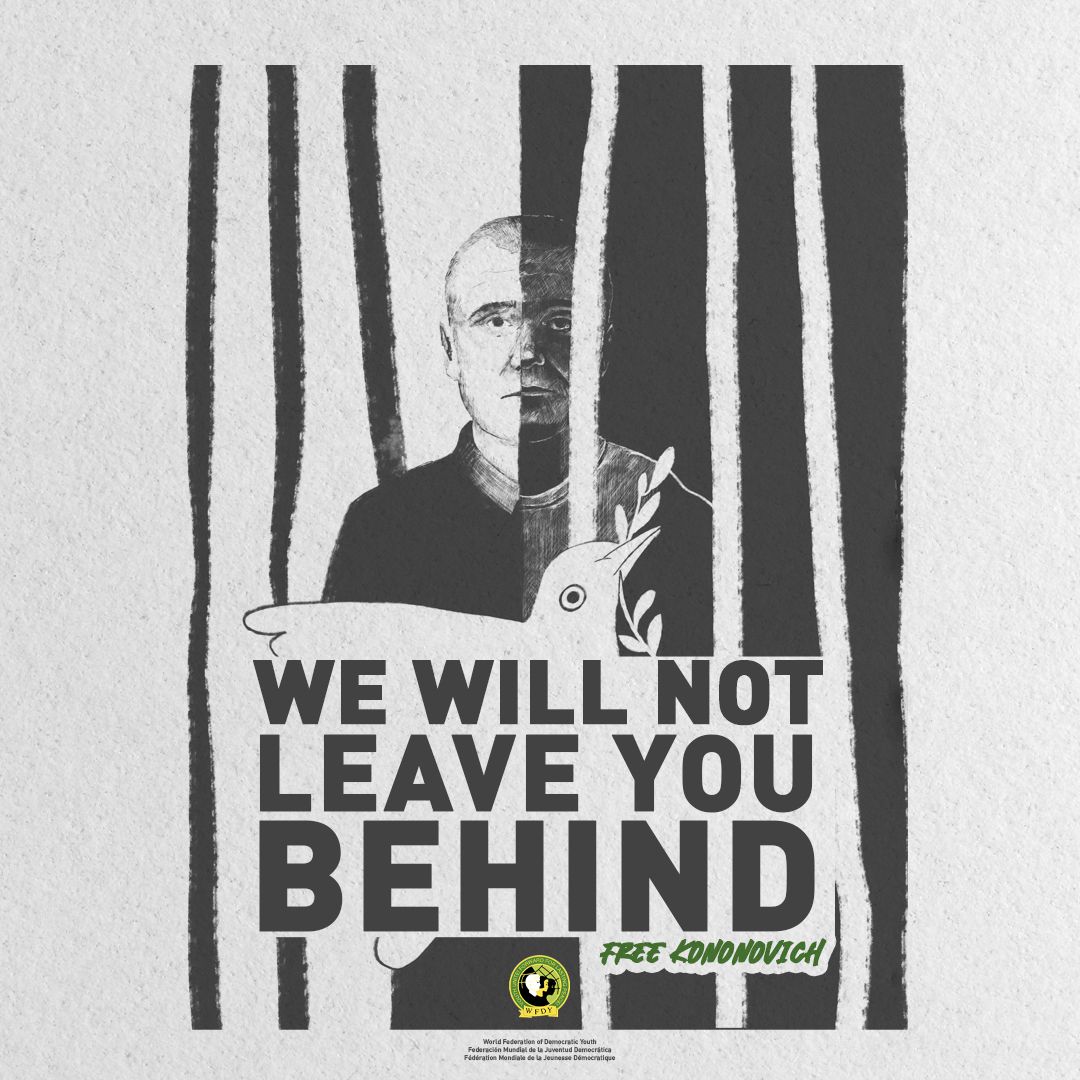
#FREEKONONOVICH: We will not leave you behind

As we approach 500 days since the kidnapping of our comrades Mikhail and Aleksander Kononovich by the Security Service of the reactionary regime of Ukraine, their situation continues to worsen.

In the last hours, we have been informed that the threats against their physical integrity, including death threats, are escalating. A clear example of this situation is the posts of the Ukrainian police officer, Yevgeny Kravchul, on his social media instigating to escalate the repression of our comrades and their murder. Considering that since they have been under house arrest fascist groups are hovering around their home, this is an added risk to their lives.

As we have been denouncing since their kidnapping in March 2022, not only the reactionary regime in Ukraine is responsible for their situation, but its imperialist allies such as the USA, the EU and NATO are equally responsible for what happens to our comrades. We reiterate our demand for their immediate release and an end to the political persecution. We call upon the anti-imperialist youth all over the world to redouble the struggle to defend the life and freedom of our comrades. Because wherever there is a case of repression, we will not leave them behind. Their repression will not stop our struggle against capitalism in its imperialist stage; to build a world free of exploitation and all kinds of oppression.

Source: World Federation of Democratic Youth

Strugglelalucha256


Russia: After the mutiny

June 27 — The armed mutiny carried out by a part of the private army of Evgeny Prigozhin, which for practically a full day allowed Ukrainian and Western experts and propagandists to present an image of Russia facing a coup, civil war, and the state in the process of implosion, continues to focus political debate in Moscow, Kiev and even in Western capitals. 

The events have also caused all kinds of speculations that have been fueled by the few details that are available so far, especially how the negotiation process that finally put an end to the rebellion took place and, above all, the actual terms of the agreement between the owner of Wagner and the Russian and Belarusian states. 

Throughout the last three days, all kinds of theories or desires have been heard that, from the Western side, have wanted to see in the Prigozhin rebellion the beginning of the end of President Vladimir Putin’s mandate or the collapse of the Russian war effort in Ukraine and, on the other, an operation planned by the Russian authorities, either to justify the dismissal of Minister of Defense Sergei Shoigu and/or Chief of the General Staff Valery Gerasimov or, even more improbable, to send Wagner’s army to Belarus without causing suspicion, perhaps even for an attack on Kiev.

It goes without saying that the dismissal of the defense minister or the chief of the general staff – both severely questioned for months due to the operational, logistical, and intelligence deficiencies that have weighed down Russian troops in the war – as the result of a mutiny organized by a private military company would have been a sign of weakness for Russia that it cannot afford. Last weekend showed the danger of privatizing the monopoly of violence and its delegation to private groups with their own economic and political interests and the risk implied by the dependence on external structures to compensate for the reduction in the number of troops in the professional army that has resulted from the reforms of the last three decades. 

This weakness manifested in the insistence of the Russian authorities, from the first moment of the rebellion, to guarantee soldiers’ immunity precisely to ensure that they could count on these troops at the front when Moscow could not afford to lose a large number of troops. The dismissal of Shoigu or Gerasimov, whose errors during the planning of the Special Military Operation and the development of the war could well justify their dismissals, would have further undermined the already battered image of the Russian state after an armed mutiny with a military convoy advancing on the capital. 

Hence, there was no mention of Shoigu or Gerasimov in the announcement of the de-escalation agreement, whose visible face was Belarus President Alexander Lukashenko, but in which other people participated, it has been learned, including the Tula Governor Alexey Diumin, whose name is one of the favorites to replace the minister of defense.

Lacked political support

In the hours after the agreement that put an end to an armed mutiny that has revealed the contradictions of a Russian state little prepared to deal with the political consequences of the war, a person with clear economic and political aspirations, Evgeny Prigozhin, has sought to bring the discourse into his territory. It is there, in the media field, where Prigozhin has managed to gain a presence and prominence, that he has subsequently tried to translate into control and levers of power. 

In his first communication after the end of the armed episode, the owner of Wagner insisted on the main points he had maintained last Saturday and fell back into the same contradictions. 

The speech by Vladimir Putin, who did not even want to mention Prigozhin’s name, in which he called the events that were unfolding treason, eliminated any possibility that the owner of Wagner could obtain relevant political support. Winning Putin’s support may have been the goal of Prigozhin, who has been seen in the past as close to the Russian president. 

However, this mutiny caused a rapid alignment of all the relevant political forces on the part of the state and its commander-in-chief. Without political support and amidst the disbelief and even apathy of the population, only explicit support from a part of the regular army could allow Wagner to achieve its objectives. 

Prigozhin insisted yesterday that his actions did not constitute a coup, nor was his objective the overthrow of the political regime. It is not difficult to see that the movement was not seeking to do away with Vladimir Putin, to whom Wagner’s owner had repeatedly sworn allegiance, but rather against the defense ministry and general staff. Putin’s speech and the complete absence of any show of solidarity with Wagner from the regular army or even the Donetsk and Lugansk People’s Republics leaves no room for Prigozhin to now insist on that failed goal. 

Hence, Wagner returns to the idea of a “march for justice” and insists on using arguments of doubtful credibility. In his communication yesterday, Prigozhin claimed to have given “a master class on what Feb. 24 [2022] should have been like,” a questionable argument considering that his troops fell into similar mistakes. 

Hoping for social and political support and backing from part of the Ukrainian army that never came, the Russian troops advanced towards Kiev without the necessary air cover and were exposed to the enemy. The apparently rapid initial advance, even with practically no resistance, did not bear fruit, and without achieving their objectives, the Russian troops had to turn around and return to their bases, just as Wagner’s troops did some 200 kilometers away from the Russian capital – at least in Prigozhin’s version. 

As Shoigu did at that time, Prigozhin also tries to claim to have fulfilled his objectives, something obviously false as long as there are no changes in the defense ministry and general staff.

What happened on Saturday, the movement of a significant amount of troops and equipment, apparently orchestrated by Dmitry Utkin, a figure even more obscure and politically even more to the right than Prigozhin, requires planning that directly conflicts with the motive alleged by the owner of Wagner to begin the rebellion. 

To justify the mutiny, Prigozhin alleges a bombing [by the Russian army against Wagner]  that, he says, took place on Friday and cost 30 lives, a fallacious argument considering that Western intelligence agencies had detected the preparation of the mutiny several days before. Why Russian intelligence did not detect it is another question that remains in the air. 

Wagner’s owner, who also alleges massive support from the population that simply did not exist, insists on blaming the Russian Air Force for the blood spilled. Prigozhin claims that his troops shot down several Russian VKS helicopters due to their shelling. Wagner’s owner lies: A large part of the destroyed planes were attacked on the ground, something that has caused enormous anger in Russian aviation, which wonders who will have to pay for the destroyed planes.

Bargaining power

The fog of war of this grotesque spectacle has not yet dissipated, and many speculations persist. One of them, the fate of Wagner’s foreign missions, was revealed yesterday. Although the Russian legislature has stalled the study of the law that was intended to regulate the operation of private security companies until further notice, Foreign Minister Sergey Lavrov affirmed yesterday that the services that Wagner’s mercenaries provided in countries such as Mali or the Central African Republic will continue. 

In these cases, security services provided by soldiers of Russian origin are both a support to those states in their attempt to stabilize complex situations – in which Wagner has been accused, in many cases with evidence, of serious crimes – and as a form of Russian presence on the continent. Both aspects make Wagner’s soldiers necessary to the Russian state, especially as it tries to win allies far from the West. However, it must also be remembered that Wagner’s operations in Africa are limited, as shown by the number of troops stationed there: about 400 in Mali or 1,400 in the Central African Republic. 

The importance of the company in these missions is an ace up Prigozhin’s sleeve that he will now try to use to his benefit as he tries to maintain control, direct or via proxy, over this lucrative foreign business. 

In his statement, Prigozhin also claimed to have saved Wagner from being liquidated, not only by imaginary bombing but also administratively. However, as expected based on the words and actions of the Russian representatives, Wagner’s future as a group in Russia has been put on hold. In a speech late in the evening, his first appearance since his nervous speech on Saturday, Vladimir Putin gave Wagner’s soldiers three options: Sign a contract with the defense ministry, return home, or move to Belarus. Everything indicates that Wagner will thus be dispersed among different units of the Russian regular troops or sent abroad.

Prigozhin is aware that the shortage of troops to maintain his war effort in Ukraine and Syria and the presence in Africa make his company necessary, an argument that has given him some bargaining power even despite his mutiny. However, it is also significant that, despite what was stated on Sunday, the case initiated by the Federal Security Service against Prigozhin has not been closed. This open case means the possibility of an immediate arrest and extradition to Russia if the businessman doesn’t comply with his part of the agreement.

Translated by Melinda Butterfield

Source: Slavyandgrad.es

Strugglelalucha256


Borotba on Russia developments: The unity of anti-fascist forces is the key to our common victory

Statement by Borotba (Struggle), revolutionary Marxist organization banned by the Ukrainian government.

Stop the armed conflict in the rear! The unity of anti-fascist forces is the key to our common victory

June 24 — The whole world is closely following the events unfolding in connection with the actions of Yevgeny Prigozhin and part of the Wagner private military company.

The long conflict that existed between Yevgeny Prigozhin and Russian Minister of Defense Sergei Shoigu has grown into a stage that threatens the entire state.

Yevgeny Prigozhin has previously attracted sympathy for his sharp criticism of the plagues of oligarchic capitalism, corruption, as well as individual failures and erroneous decisions during the special military operation. However, with the development of the confrontation with the military leadership of the Russian Federation, this criticism began to acquire an exaggerated character, and the motives of a personal confrontation with Sergei Shoigu began to come to the fore, and not criticism of the socio-economic situation and military organization.

The situation when a private, non-state-controlled organization, in fact, a private army, has become an important factor of power is in itself unhealthy. As a result, regardless of possible subjective intentions, Prigozhin actually started an armed rebellion by a private person against the state.

We, as critics of the capitalist system, could not previously disagree with many of the critical speeches of Yevgeny Prigozhin. Also, the steadfastness and courage of the Wagner PMC fighters in the confrontation with the fascist regime of Ukraine could not but arouse sympathy. But having embarked on an adventurous action, moving the armed confrontation deep into Russia, Yevgeny Prigozhin threatened the front, which the Kiev regime and its masters in the West will definitely take advantage of.

The situation is developing rapidly, and we hope that all sides of the confrontation will show prudence and prevent bloodshed tens of kilometers from the front line. We are convinced that the country’s top leadership is capable of finding a way out of this dangerous situation. Conclusions must be drawn on the fight against the vices of the state and social system, inherited from the 1990s but preserved even in the conditions of the special military operation.

We address the soldiers and officers fighting at the front: Comrades! We are few, but we are among you. We are aware of the difficulties that arose and are arising in the process of organizing military operations, mistakes, and injustices, part of the responsibility for which, of course, lies with the military leadership. We never called for hiding difficulties and varnishing reality to please the authorities. We experienced it just like you. But we are convinced that armed adventures will not lead to an improvement in the system but can only lead to our common defeat.

We hope that the fighters of PMC “Wagner,” who supported their commander, will look at the situation with a cool head and realize that this path leads nowhere. Similar situations have already happened in history — the rebellion of the Left Socialist-Revolutionary Party, the speech of M.A. Muravyov in 1918, the rebellion of Nestor Makhno, who refused to join the united Red Army, the Kronstadt uprising, the rebellion of the anarchists of Catalonia during the Spanish Civil War. Regardless of the intentions, sometimes honest and idealistic, such actions have always fallen into the hands of the darkest forces.

Now it is important to end the armed conflict inside the country as soon as possible to unite efforts in the fight against the Kiev regime and NATO imperialism. In the conditions of confrontation with imperialism, internal contradictions must be resolved in a peaceful democratic way, on the basis of a broad public discussion with the participation of the people, and not by conspiracies from above and personal adventures.

Long live unity and solidarity!

Translated by Melinda Butterfield

Source: Borotba

Strugglelalucha256


Anti-war activists in Germany protest NATO’s ‘Air Defender 23’ military exercise

Around 10,000 military personnel and 250 aircraft from 25 countries are participating in NATO’s ‘Air Defender 23’ exercise scheduled from June 12-23. Anti-war groups have called it a provocation

On June 10, hundreds of activists from various anti-imperialist and anti-war groups as well as the Communist Party of Germany (DKP) marched to the Wunstorf Air Base in Hannover to protest the NATO’s Air Defender 2023 exercise scheduled from June 12-June 23. A vigil was also held at the Spangdahlem Air Base near Trier, which will also serve as a base for the exercise. Die Linke organized protests against the NATO exercise on June 11. The protestors denounced war-mongering and projection of military might by NATO amid the ongoing Russia-Ukraine war and demanded a ceasefire and peace negotiations in Ukraine, as well as removal of US nuclear weapons from Germany. The airpower drill is likely to cause civil aviation delays in Germany.

According to reports, around 10,000 military personnel and 250 military aircraft from 25 NATO countries will participate in the exercise to showcase their capabilities in the backdrop of the ongoing Ukrainian counteroffensive against Russia. Peace groups have warned that the NATO maneuver will likely escalate the conflict in Ukraine and increase tensions in the region. Fierce battles are currently ongoing in southern and eastern Ukraine. However, despite the arms, ammunition and funds it has received, Ukraine has not been able to make any significant breakthrough on the Russian front lines. Ukraine is now waiting for US-made F-16 fighter jets from its allies in the European Union (EU) to use in its counter-offensive.

According to many observers, Air Defender 2023 is intended as a warning to Russia. However, many sections of the population in EU countries including in Germany are unhappy with the prolonged war and bids by NATO-EU to escalate the conflict. The inflation and energy crisis triggered by the war remains unabated and millions across Europe are struggling to cope. The defense budget has increased manifold in several EU nations alongside heavy cuts in social spending. Germany itself slipped into a recession following a steep contraction in its economy since the last quarter of crisis-ridden 2022. It is facing an acute energy crisis due to sanctions on cheap Russian oil.

On June 9, Vincent Cziesla wrote in Unsere Zeit (UZ) that Air Defender 23 is not an exercise, but seems like a brazen but usual provocation, and is a tangible danger to world peace in times of war. “An accident with a Russian military aircraft, misguided navigation, or pilot error can be enough to make a training flight seem like an act of attack.”

“It will be particularly threatening if Ukraine were to use the slipstream of the maneuver to carry out attacks, while Russian air surveillance is forced to follow NATO activities. Currently, there is almost daily shelling of Russian territory, and the Ukrainian president is threatening major attacks. The potential for escalation of a Ukrainian military strike while NATO jets patrol nearby is obvious in this situation,” Cziesla added.

Die Linke stated on June 12, “today, the NATO-air weapons maneuver ‘Air Defender 2023’ begins over Germany. It’s the largest air force maneuver since NATO. This military saber rattling is irresponsible! We will not adapt to war and the military as tools of foreign policy. Right now, when another war is raging in Europe, de-escalation and diplomacy are the order of the hour—not upgrading, military demonstrations of power, and fueling the escalation spiral.”

Source: Peoples Dispatch

Strugglelalucha256


Taking the capitalist road was the wrong choice for Ukraine, says Ukraine expert

Renfrey Clarke is an Australian journalist. Throughout the 1990s, he reported from Moscow for Green Left Weekly of Sydney. This past year, he published The Catastrophe of Ukrainian Capitalism: How Privatisation Dispossessed & Impoverished the Ukrainian People with Resistance Books.

In April, I had an email exchange with Clarke. Below is the transcript.

Natylie Baldwin: You point out in the beginning of your book that Ukraine’s economy had significantly declined by 2018 from its position at the end of the Soviet era in 1990. Can you explain what Ukraine’s prospects looked like in 1990? And what did they look like just prior to Russia’s invasion?

Renfrey Clarke: In researching this book, I found a 1992 Deutsche Bank study arguing that, of all the countries into which the USSR had just been divided, it was Ukraine that had the best prospects for success. To most Western observers at the time, that would have seemed indisputable.

Ukraine had been one of the most industrially developed parts of the Soviet Union. It was among the key centers of Soviet metallurgy, of the space industry, and of aircraft production. It had some of the world’s richest farmland, and its population was well-educated even by Western European standards.

Add in privatization and the free market, the assumption went, and within a few years, Ukraine would be an economic powerhouse, its population enjoying first-world levels of prosperity.

Fast-forward to 2021, the last year before Russia’s “Special Military Operation,” and the picture in Ukraine was fundamentally different. The country had been drastically de-developed, with large, advanced industries (aerospace, car manufacturing, shipbuilding) essentially shut down.

World Bank figures show that in constant dollars, Ukraine’s 2021 Gross Domestic Product was down from the 1990 level by 38 percent. If we use the most charitable measure, per capita GDP at Purchasing Price Parity, the decline was still 21 percent. That last figure compares with a corresponding increase for the world as a whole of 75 percent.

To make some specific international comparisons, in 2021, the per capita GDP of Ukraine was roughly equal to the figures for Paraguay, Guatemala, and Indonesia.

What went wrong? Western analysts have tended to focus on the effects of holdovers from the Soviet era, and in more recent times, on the impacts of Russian policies and actions. My book takes these factors up, but it’s obvious to me that much deeper issues are involved.

In my view, the ultimate reasons for Ukraine’s catastrophe lie in the capitalist system itself, and especially in the economic roles and functions that the “centre” of the developed capitalist world imposes on the system’s less-developed periphery.

Quite simply, for Ukraine to take the “capitalist road” was the wrong choice.

NB: It seems as though Ukraine went through a process similar to that in Russia in the 1990s when a group of oligarchs emerged to control much of the country’s wealth and assets. Can you describe how that process occurred?

RC: As a social layer, the oligarchy in both Ukraine and Russia has its origins in the Soviet society of the later perestroika period, from about 1988. In my view, the oligarchy arose from the fusion of three more or less distinct currents that, by the final perestroika years, had all managed to accumulate significant private capital hoards. These currents were senior executives of large state firms; well-placed state figures, including politicians, bureaucrats, judges, and prosecutors; and lastly, the criminal underworld, the mafia.

A 1988 Law on Cooperatives allowed individuals to form and run small private firms. Many structures of this kind, only nominally cooperatives, were promptly set up by top executives of large state enterprises, who used them to stow funds that had been bled off illicitly from enterprise finances. By the time Ukraine became independent in 1991, many senior figures in state firms were substantial private capitalists as well.

The new owners of capital needed politicians to make laws in their favor and bureaucrats to make administrative decisions that were to their advantage. The capitalists also needed judges to rule in their favor when there were disputes and prosecutors to turn a blind eye when, as happened routinely, the entrepreneurs functioned outside the law. To perform all these services, the politicians and officials charged bribes, which allowed them to amass their own capital and, in many cases, to found their own businesses.

Finally, there were the criminal networks that had always operated within Soviet society but that now found their prospects multiplied. In the last years of the USSR, the rule of law became weak or non-existent. This created huge opportunities not just for theft and fraud but also for criminal stand-over men. If you were a business operator and needed a contract enforced, the way you did it was by hiring a group of “young men with thick necks.”

To stay in business, private firms needed their “roof,” the protection racketeers who would defend them against rival shake-down artists—for an outsized share of the enterprise profits. At times the “roof” would be provided by the police themselves for an appropriate payment.

This criminal activity produced nothing and stifled productive investment. But it was enormously lucrative and gave a start to more than a few post-Soviet business empires. The steel magnate Rinat Akhmetov, for many years Ukraine’s richest oligarch, was a miner’s son who began his career as a lieutenant to a Donetsk crime boss.

Within a few years from the late 1980s, the various streams of corrupt and criminal activity began merging into oligarchic clans centered on particular cities and economic sectors. When state enterprises began to be privatized in the 1990s, it was these clans that generally wound up with the assets.

I should say something about the business culture that arose from the last Soviet years and that in Ukraine today remains sharply different from anything in the West. Few of the new business chiefs knew much about how capitalism was supposed to work, and the lessons in the business-school texts were mostly useless in any case.

The way you got rich was by paying bribes to tap into state revenues or by cornering and liquidating value that had been created in the Soviet past. Asset ownership was exceedingly insecure—you never knew when you’d turn up at your office to find it full of the armed security guards of a business rival who’d bribed a judge to permit a takeover. In these circumstances, productive investment was irrational behavior.

NB: I’ve heard that one source of opposition to political decentralization—which would appear to have been a possible solution to Ukraine’s divisions before the war—is that centralization benefits the oligarchs. Do you think that’s true?

RC: There’s no simple answer here. Politically and administratively, Ukraine, since independence, has been a relatively centralized state. Provincial governors aren’t elected but are appointed from Kyiv. This has reflected fears in Kyiv of separatist trends arising in the regions. Here, obviously, we should have in mind the Donbas.

Despite being centralized, the Ukrainian state machine is quite weak. A great deal of real power lies with the regionally based oligarchic clans. Unlike the situation in Russia and Belarus, no single individual or oligarchic grouping has been able to achieve unrivaled dominance and curtail the power of the chronically warring business magnates. Ukraine has never had its Putin or Lukashenko.

The system in Ukraine can thus be described as a highly fluid oligarchic pluralism, with control over the government in Kyiv shifting periodically between unstable groupings of individuals and clans. On the whole, the oligarchs over the decades seem to have been content with this since it has prevented the rise of a central authority able to discipline them and cut into their prerogatives.

NB: You discuss how the enforced economic separation between Ukraine and Russia has been detrimental to the Ukrainian economy. Can you explain why?

RC: Under Soviet central planning, Russia and Ukraine formed a single economic expanse, and enterprises were often tightly integrated with customers and suppliers in the other republic. Indeed, Soviet planning had often provided for only one supplier of a particular good in a whole swathe of the USSR, meaning that cross-border trade was essential if whole chains of production were not to break down.

Understandably, Russia remained by far Ukraine’s largest trading partner throughout the first decades of Ukrainian independence. Despite problems such as erratic currency exchange rates, this trade had compelling advantages. Customs barriers were absent, and technical standards inherited from the USSR were mostly identical. Ways of doing business were familiar, and negotiations could be conducted conveniently in Russian.

Perhaps most critically important was another factor: The two countries were on broadly similar levels of technological development. Their labor productivity did not differ by much. Neither side was in danger of seeing whole industrial sectors wiped out by more sophisticated competitors based in the other country.

Nevertheless, one of the truisms of liberal discourse, both in Ukraine and in Western commentaries, was that the close economic ties with Russia were holding Ukraine back. There was said to be an urgent need for Ukraine to turn its back on Russia, identified with the Soviet past, and to open itself up to the West. Ukraine’s commerce with Russia, in this scenario, needed to be replaced by “deep and comprehensive free trade” with the European Union.

This controversy had wide-ranging ideological, political, and even military ramifications. But to be brief, by 2014, opposition within Ukraine had been overcome, and an Association Agreement with the EU had been signed. By 2016 trade between Ukraine and Russia had shrunk dramatically to the point where it was much less than commerce with the EU.

The shift to integration with the West, however, did not bring Ukraine the promised surge of economic growth. After a severe slump in the aftermath of the Maidan events of 2014, Ukrainian GDP saw only a weak recovery between 2016 and 2021. Meanwhile, the country’s trade balance with the EU remained strongly negative. Integration with the West was doing far more for the West than for Ukraine.

NB: You made an interesting comment about pro-Western liberals in both Russia and Ukraine (including Maidan protesters/supporters): “Like their counterparts in Russia, the members of these ‘Westernising’ middle layers tend to be naïve about the realities of Western society, and about what incorporation into developed-world economic structures means in practice for countries whose economies are far poorer and more primitive.” (p. 9) Can you describe the actual effect of the policies that resulted from Maidan and the signing of the EU Association Agreement? It sounds like a case of “be careful what you wish for.”

RC: If you want to break the hearts of Ukraine’s liberal intelligentsia, just remind them that economic growth in the European Union is stagnant, and European societies crisis-ridden.

Ukraine now has an economic integration agreement with the EU, allowing for extensive areas of free trade. But Ukraine isn’t being integrated into European capitalism as part of the high-productivity, high-wage “core” of the system. After all, why would EU countries want to give themselves an extra competitor?

Instead, the role Ukraine has been assigned is that of a market for advanced Western manufactures, and of a supplier to the EU of relatively low-tech generic goods such as steel billets and basic chemicals. These are low-profit commodities that Western producers are tending to move out of in any case, especially since the industries concerned can be highly polluting.

In Soviet times, as I’ve explained, Ukraine was a center of sophisticated, at times world-class, manufacturing. But in the mayhem surrounding privatization, investment levels collapsed, innovation virtually ceased, and products became uncompetitive in developed-world markets. In the dreams of liberal theorists, foreign capitalists had been going to troop over the border, buy up ruined industrial enterprises, re-equip them, and on the basis of low wages, make attractive profits from exports to the West. But Ukraine had a criminalized economy run by oligarchs. Rather than swim with sharks, potential foreign investors opted overwhelmingly to stay away.

The dropping of EU import tariffs was predicted to turn this situation around by making the attractions of investment in Ukraine irresistible for Western capital. Meanwhile, the foreign investors were supposed to out-compete the oligarchs and force reforms on the corrupt, business-unfriendly state machine.

But none of this has really happened. Foreign investment has remained tiny. At the same time, free trade with the EU has meant that Western manufacturers, with higher productivity and a more attractive range of offerings, have been able to take over large parts of the Ukrainian domestic market and drive local producers out of business.

As an example, I could cite the Ukrainian car industry. In 2008 the country produced more than 400,000 motor vehicles. The last important year of production was 2014. Then in 2018, a reduction of tariffs brought a huge increase in imports of used cars from the EU, and output of passenger cars in Ukraine effectively ceased.

NB: On a related note, I can’t help but observe that Ukraine seems to have fallen victim to neoliberal corporatist policies that benefit more powerful outside powers—the kind of policies that used to be criticized and opposed by the anti-globalization movement of the 1990s. The left used to recognize these economic policies, when they were imposed on weaker countries, as a form of neocolonialism. Now it seems like the left—at least in the U.S.—has been reduced to a frightened waif obsessing over a caricatured form of identity politics and regurgitating the latest war propaganda. What, in your opinion, has happened to the left?

RC: In my view, most sections of the Western left have failed to come up with an adequate response to the war in Ukraine. Fundamentally, I see the problem as rooted in an adaptation to liberal attitudes and habits of thought and in a failure to educate a whole generation of activists in the distinctive traditions, including the intellectual traditions, of the class struggle movement.

Today, numerous members of the left simply lack the methodological equipment to understand the Ukraine issue—which is, to be fair, fiendishly complex. Here I’d make two points. First, it’s critically important for the left to reach a clear understanding of whether present-day Russia is or is not an imperialist power. Second, in addressing this question, there’s no way the left should allow itself to rest on the thinking of The Guardian and The Washington Post. Our methodology has to come from the tradition of left thinkers such as Luxemburg, Lenin, Bukharin, and Lukács.

The liberal empiricism of The Guardian will tell you that Russia is an imperialist power, as “proved” by the fact that Russia has invaded and occupied the territory of another country. But even in recent decades, various countries that are manifestly poor and backward have done precisely this. Does this mean we should be talking about “Moroccan imperialism” or “Iraqi imperialism”? That’s absurd.

In the classic left analysis, modern imperialism is a quality of the most advanced and wealthy capitalism. Imperialist countries export capital on a massive scale and drain the developing world of value through the mechanism of unequal exchange. Here Russia simply doesn’t fit the bill. With its relatively backward economy based on the export of raw commodities, Russia is a large-scale victim of unequal exchange.

For the left, joining with imperialism in attacking one of imperialism’s victims should be unthinkable. But that’s what many leftists are now doing.

Since the early 1990s, NATO has expanded from central Germany right to Russia’s borders. Ukraine has been recruited as a de facto member of the Western camp and has been equipped with a large, well-armed, NATO-trained army. Imperialist threats and pressures against Russia have multiplied.

Imperialism has to be resisted. But does this mean that the left should support Putin’s actions in Ukraine? Here we should reflect that a workers’ government in Russia would have countered imperialism in the first instance through a quite different strategy, centered on international working-class solidarity and revolutionary anti-war agitation.

Obviously, that’s a course Putin will never follow. But does Russia’s decision to resist imperialism through methods that aren’t ours mean we should denounce the very fact of Russian resistance?

Again, that’s unthinkable. We have to stand with Russia against the attacks on it by imperialism and by the Ukrainian ruling class. Of course, Putin’s politics aren’t ours, so our support for the Russian cause must be critical and nuanced. We’re under no obligation to support specific policies and actions of Russia’s capitalist elite.

That said, the left-liberal position of seeking victory for imperialism and its allies in Ukraine is deeply reactionary. Ultimately, it can only multiply suffering through emboldening the U.S. and NATO to launch assaults in other parts of the world.

NB: The war has also been a disaster for Ukraine economically. In October last year, Andrea Peters wrote an in-depth article on how poverty had sky-rocketed in the country since the invasion. Some figures she cited included:

  • 10-fold increase in poverty
  • 35% unemployment rate
  • 50% reduction in salaries
  • public debt of 85% of GDP

I’m sure it’s even worse now. It appears that the U.S./Europe are almost completely subsidizing the Ukrainian government at this point. Can you talk about what you know of Ukraine’s current economic conditions?

RC: Ukraine’s economy has been shattered by the war. Government figures show GDP in the last quarter of 2022 down by 34% on the level a year earlier, and industrial production in September down by a similar amount. In March this year, the cost of direct damage to buildings and infrastructure was put at $135 billion, and more than 7 percent of housing has reportedly been damaged or destroyed. Huge areas of cropland have not been sown, often because fields have been mined.

The military draft has taken large numbers of skilled workers from their jobs. Other highly qualified people are among the Ukrainians, reportedly at least 5.5 million, who have left the country. An estimated 6.9 million people have been displaced within Ukraine, and this has also affected production.

According to Finance Minister Serhii Marchenko, just one-third of Ukraine’s budget revenue now comes from domestic sources. The difference is having to be made up by foreign loans and grants. This aid has been enough to keep annual inflation at a relatively manageable level of about 25 percent, but workers are rarely being compensated for price rises, and their living standards have collapsed.

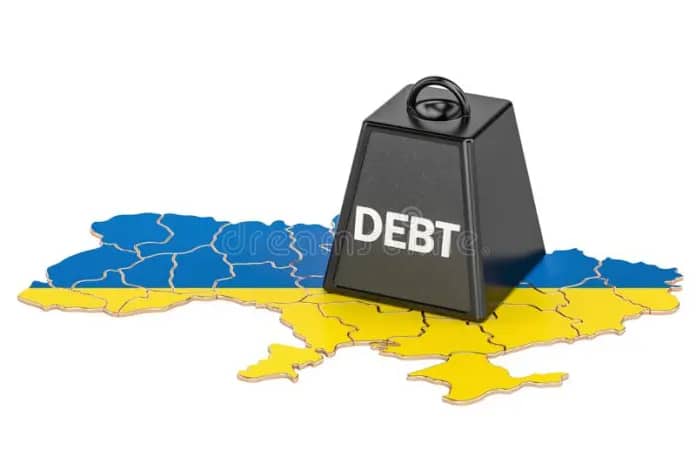
In many cases, the Western aid is not in the form of grants but of loans. By my calculation, Ukraine’s external debt in January was about 95 percent of annual GDP. When and if peace returns, Ukraine will have to sacrifice its foreign exchange earnings over decades to pay back these borrowings.
NB: Ukraine’s PM Denys Shmyhal has stated that for 2023 alone, Ukraine will need $38 billion to cover the budget deficit and another $17 billion for “rapid reconstruction projects.” It would seem that it’s not sustainable (politically or economically) for the West to provide this kind of money for any length of time. What do you think?

RC: The figure I have for total planned U.S. military spending in 2023 is $886 billion, so the NATO countries can afford to maintain and rebuild Ukraine if they want to. The fact that they’re keeping the Ukrainian economy on a relative drip feed—and worse, demanding that many of the outlays be paid back—is a conscious choice they’ve made.

There’s a lesson in this for developing-world elites that are tempted to act as proxies for imperialism in the way that Ukraine’s post-2014 leaders have deliberately done. When the consequences get you in deep, don’t expect the imperialists to pick up the tab. Ultimately, they’re not on your side.

NB: The Oakland Institute published a report in February of this year about a specific aspect of the Western-influenced neoliberal policies on Ukraine—agricultural land. One of the first things Zelensky did after he took office in 2019 was to force through an unpopular land reform bill. Can you explain what this law was about and why it was so unpopular?

RC: By 2014, Ukraine’s farmland had almost all been privatized and distributed among millions of former collective farm workers. Until 2021 a moratorium remained on sales of agricultural land. This moratorium was overwhelmingly popular among the rural population, who distrusted the land-office bureaucracy and feared being swindled of their holdings. With only small acreages and lacking capital to develop their operations, most landowners opted to lease their holdings and to work as employees of commercial farming enterprises.

The result has been described as a “re-feudalisation of Ukrainian agriculture.” Entrepreneurs with access to capital, often established oligarchs but including U.S. and Saudi corporate interests, amassed control of vast lease holdings. With land rents cheap, and wages minimal, the new land barons had little reason to invest in raising productivity, which remained low despite the rich soil.

To this situation, already deeply retrograde, the International Monetary Fund and other institutional lenders brought the wisdom of neoliberal dogma. For many years, structural adjustment programs attached to IMF loans had insisted on the creation of a free market in agricultural land. Ukrainian governments, aware of the massive hostility to the move, had dragged their feet. It was Zelensky whose resistance finally broke. Since mid-2021 Ukrainian citizens have been able to purchase up to 100 hectares of agricultural land, with the figure to rise to 10,000 hectares from January 2024.

In theory, large numbers of small landowners will now sell their land, move to the cities, and take up life as urban workers, while rising land values will force commercial farmers to invest in raising their productivity. But these calculations are almost certainly utopian. Unemployment in the cities is already high, and housing tight. Small farmers are unlikely to risk mortgaging their land to improve their operations while profits remain slender, interest rates high, the banks predatory, and officials corrupt at every level.

The real logic of this “reform” is to strengthen the hold on agriculture of the oligarchs and international agribusiness.

NB: The World Bank recently came out with a report stating that reconstruction after the war ends will cost at least $411 billion. When the fighting ends, what kind of policies do you think would give Ukraine the best chance at building a more stable and equitable economy in the long term?

RC: How is the fighting to end? At present, the Russian forces seem unlikely to be defeated, at least by the Ukrainians. Meanwhile, the closer a Russian victory, the greater the prospect of full-scale imperialist military intervention.

Suppose, though, that Zelensky were to sit down with Russian negotiators and hammer out a peace deal. Realistically, this would require a recognition by Ukraine that the Donbas and Crimea had been lost, along with Zaporizhzhia and Kherson provinces. Neofascists would have to be purged from the state apparatus, and their organisations outlawed. Ukraine would need to break its ties with NATO, and its armed forces would have to be cut to a level the country could afford.

If such a deal were reached, of course, Ukrainian ultra-nationalists would line up to assassinate Zelensky. If, that is, the CIA didn’t get him first.

Presuming there can be an “after the war,” what might it look like? We must remember that Ukraine is now one of the poorer parts of the capitalist developing world. For countries in this general situation, there can be no genuinely “stable and equitable” economic future. Such a future is conceivable only outside capitalism, its crises, and its international system of plunder.

But let’s suppose that an independent Ukraine were somehow to emerge, that it was at peace, and that it was able to pursue some kind of rational economic course. In the first place, this course would involve a careful demarcation of the economy from the advanced West. Ideally, Ukraine would still have extensive trade with the EU. But this could not be at the cost of allowing unrestricted imports to stifle industries and sectors that had the potential to reach modern levels of sophistication and productivity.

Ukraine’s trading relations need to be based primarily on exchanges with states that share the country’s general level of technological development so that commercial competition promises stimulus and not annihilation. This shift would involve the re-establishing of a dense network of economic relations with Russia. It would also feature an expansion of already extensive (in 2021) trade with states such as Turkey, Egypt, India, and China.

In politico-economic terms, Ukraine’s future doesn’t lie in “integration with the West”—a destructive fantasy—but in the country taking its place among the member states of organizations such as BRICS, the Belt and Road initiative, and the Shanghai Cooperation Organisation. For its financing needs, Ukraine needs to repudiate the IMF and look to bodies such as the Asian Infrastructure Investment Bank.

Those are necessary changes and would greatly improve Ukraine’s prospects. But ultimately, a “stable and equitable” future needs much deeper transformations. It will require ousting the country’s crime lord oligarchs from control over the economy.

In some thirty years, and despite Western aid, Ukraine’s liberal reformers have made little progress on this front. The “middle layers” of the country’s society are simply not able or inclined to carry out such an overthrow. They have little social weight and are not an independent force. Those of them who don’t work directly for the oligarchs are enmeshed, in many cases, in the corrupt state machine that the oligarchs control.

The only social force in Ukraine that has the massive numbers to end oligarchic power is the organized proletariat. Unlike the “middle layers,” the country’s workers have no stake in preserving oligarchism and have the potential to act independently of it.

NB: You reported from Moscow in the 1990s for the newspaper Green Left. How did that come about, and what stands out to you most about your time in Russia?

RC: As a Russian speaker, I was sent by the paper in 1990 to Moscow—then the capital of the USSR—to report on the progress of perestroika. I was expecting to be there for about two years, but acquired a Russian family and stayed for nine.

I had only a small income from the paper. My wife and I lived better than the neighbors, but not by much. I watched and reported as highly qualified workers were plunged into destitution. Their wages unpaid, their savings of decades erased by inflation. They sold household belongings outside metro stations and lived on potatoes dug from their garden plots.

The eeriest experience was watching people try to cope with a drastic inversion of beliefs and values. Wherever Soviet society had put a minus, Russians were abruptly commanded to put a plus. Behavior that had earlier been regarded as contemptible—hustling, speculating—now won praise in the media.

Among the people I knew, I suspect the most traumatized were Western-oriented intellectuals who, for years, had longed for the Soviet Union to perish and for capitalism to replace it. Now capitalism had come—and it was a nightmare.

In these circumstances, more than a few Russians lost their moral bearings completely. Anything seemed permitted. I remember setting out one morning to take my little boy to his daycare. On the pavement not far from our building, we encountered a freshly murdered corpse.

Meanwhile, a tornado of history swirled round about. As a journalist, I was in the “Russian White House,” the parliament building up the Moscow River from the Kremlin, during the coups of 1991 and 1993. In 1998 I reported as the government effectively declared itself bankrupt, defaulting on its debt obligations. By that time, 40 percent of the economy had evaporated.

I remember those years, though, as, in some ways, the richest and most rewarding of my life.
Strugglelalucha256


U.S. proxy war: Kakhovka dam and the weaponization of water

June 7 — Tuesday morning, just a few hours after the first serious Ukrainian attacks against Russian positions began in various areas of the Donbass and Zaporozhye fronts, a prelude to the major offensive that Ukraine has been announcing for months, the bursting of the Kakhovka dam immediately diverted the focus of attention from the alleged Ukrainian advances to the part of the southern territories furthest from the battle. 

Novaya Kakhovka and the Soviet dam built in the times of Stalin and Khrushchev are already familiar to those who have closely followed the course of the war. In the initial phase of the Russian intervention at the end of February 2022, the Ukrainian command prioritized the defense of Kiev and sacrificed territorial battalions in areas of secondary importance such as the southern front, where the Russian advance came with virtually no resistance. From Crimea, Russian troops reached the Dnieper River in just a few days and shortly after captured the city of Kherson, on the right bank of the river, which they would lose after their defense became impossible in the autumn of that year.

Throughout the summer, Ukraine had begun preparing the ground for a counteroffensive to regain control of Russia’s most vulnerable territories: those north of the Dnieper, whose defense was made impossible by destroying the infrastructure linking both banks of the Dnieper. Target of the newly arrived U.S. HIMARS [multiple rocket launchers], the Antonovsky bridge was at that time one of the major targets, but not the only one. The bombardments of Novaya Kakhovka were not spontaneous or sporadic, but a planned destruction strategy to make the situation of Russian troops at key strategic points untenable. The same can be said of the Zaporozhye nuclear power plant, located in the town of Energodar, also south of the Dnieper, and still under Russian control.

Cities and towns flooded

The partial collapse of the dam yesterday has led to the flooding of a whole series of towns and cities in the area. In the morning, the mayor of Novaya Kakhovka reported that the rise in the water level exceeded 12 centimeters per hour. The water affected the city of Kherson, the most populated town in the area, although in a clearly less serious way than other cities. In Novaya Kakhovka, a few hours after the dam breached, water rose up the pedestal of the Lenin statue, and swans glided through the empty center of the flooded city in a post-apocalyptic scene about the effects of war in the post-Soviet world.

The accusations were not long in coming and both Russia and Ukraine alleged sabotage on the other side. Ukraine put in place the mechanisms both to react to what happened and evacuate the population from the affected towns, and to achieve the maximum possible political and informational benefit. Without having to wait for a minimal study on whether the dam had collapsed due to deliberate demolition or the effects of previous bombings, the Western press and political class en masse took Russia’s guilt for granted. In the same way as with what happened after the Nord Stream explosions, the media and politicians of all countries and ideologies began to look for why it was in Russia’s interest to blow up the dam.

Thus, the argument of last autumn was revived, when the possibility of the humanitarian and environmental catastrophe that occurred yesterday was first raised publicly. At the time, Russia accused Ukraine of planning the dam’s destruction, an argument that was denounced by Ukraine and its partners as a nonsensical conspiracy theory. The aim, according to Russia, would have been to flood the lands on the left bank of the Dnieper under Russian control and force Russian troops back or drown in their positions. Ukraine, for its part, accused Russia of planning to blow up the dam to prevent its troops from advancing on that territory. Unlike the Russian accusation, the Ukrainian one, although nonsensical since the Russian troops were preparing trenches in that area of ​​the Dnieper at that time, was disseminated by the media, giving it credibility.

Something similar happened yesterday, and the nuances or clarifications, such as “the BBC has been unable to verify either the Russian or Ukrainian allegations,” were the exception rather than the rule. And for the moment, it has not even been possible to confirm if the collapse was due to an attempted sabotage, to the consequences of the usual Ukrainian bombings, or simply to the accumulation of damage in recent months. 

Rush to judgment

Since the Russian withdrawal from the territories on the right bank of the Dnieper, which provided protection for the territories on the left bank as they kept Ukrainian troops at a greater distance, the safety of the dam and its workers has been compromised. What is naive is to think that the work of reconstruction and repair of the damage caused by the Ukrainian bombings could be carried out. Blaming Russia for the collapse due to poor conservation – without taking into account the circumstances and the Ukrainian bombing — has been one of the four main positions shown throughout the day yesterday. 

This position can be seen in the person of David Puente, Italian “verifier” and collaborator of Facebook in that verification task, who made this argument just as he did last September about the Nord Stream explosion. Then also, Russia was guilty because of the lack of maintenance of the gas pipeline.

The second position, maintained by Ukraine and the Western political class, has limited itself to taking Russia’s guilt for granted and arguing that it is a scorched-earth policy in the face of alleged Ukrainian advances on the front, although, in this area, there have not been such advances. “It is the children, women and men of Ukraine who will suffer the consequences of the terrible destruction of the Nova Kakhovka hydroelectric plant,” wrote the president of the European Parliament, Roberta Metsola, adding that “it is an act against humanity. A war crime that cannot go unanswered. Today, more than ever, Ukraine needs our help.” 

Even clearer in her message, Ursula von der Leyen stated that “Russia will have to pay for the crimes committed in Ukraine. The destruction of the dam, an intolerable attack on civilian infrastructure, puts thousands of people in the Kherson region at risk,” she wrote, later pledging help through available civil protection mechanisms.

“It is not yet clear what caused the dam to collapse,” the BBC admitted yesterday. However, politicians and journalists from all over the European continent have already passed sentence. 

Forgetting its supposed neutrality, the Ukrainian Red Cross accused Russia of a war crime in messages that it was later forced to delete. Without accusing either side, the International Committee of the Red Cross recalled that “the dams enjoy special international protection under international humanitarian law, since they contain dangerous forces which, if released, can lead to severe suffering for the civilian population.” 

Thousands of people on both sides of the Dnieper are being affected right now. As Dmitry Steshin recalled, the territories under Russian control are at a lower altitude, so it is that area on the southern bank of the Dnieper that will be most affected. Russia has mobilized its resources to also evacuate thousands of people affected in localities in the area, some of which, like Aleshka, are difficult to access and have a very complicated situation. The explosions that appeared in several videos taken by the population of the area – spontaneous explosions in the mines displaced by the river’s rise – show another of the dangers of what happened.

Without the need for any investigation or assessment of the damage and with the absolute certainty that Russia is always guilty, journalists like Paul Mason quickly showed their anger, the third of the four positions that were repeated throughout yesterday. “Russia has blown up the huge dam on Kherson, risking a catastrophe at the Zaporozhye nuclear power plant,” wrote the journalist, who appears to have believed Zelensky’s claim that the nuclear power plant is in imminent danger and not that of the International Atomic Energy Agency’s director. The IAEA, whose representatives have access to the area, stated that this danger does not exist at the moment. The plant requires water from the Kajovka reservoir, so the risk does not exist in the short term. Going beyond assignment of blame and future effects, lasexta.com said: “Stalin already used water as a weapon of war in Zaporizhia in 1941: the USSR destroyed the Dneprostoy dam and caused more than 20,000 deaths.”

Washington Post reported Ukraine test strike

Finally, there were also those who yesterday wanted to see the bright side of things. Carl Bildt, a professional hawk, lamented that the destruction of the dam “will cause extensive flooding mainly on the left bank of the Dnieper,” describing the part of the river under Russian control, “complicating any military operation,” that is, the Ukrainian advance. “But, I suppose, it also deprives the Crimean canal of its water.” 

That the Crimean canal is drying up again a year after the demolition of the wall built by Ukraine to deprive the peninsula of running water seems to be the positive part of what happened for certain sectors of the European establishment. In Crimea, Sergey Aksyonov confirmed that, given that possibility, the peninsula had proceeded to fill the canal to its limits. Crimea may have to live without that supply again in the coming months, just as it did during the years when Kiev used its flow control of the Dnieper as collective punishment against the population.

None of the four positions mentioned – lack of maintenance, prosecution by default, anger or the search for benefits for Ukraine – take into account the precedents of recent months, in which Ukraine has not hesitated to attack and endanger critical civil infrastructure. 

It’s also been convenient to forget something that, despite having gone unnoticed at the time of its publication, became relevant yesterday. In December 2022, the Washington Post published a report in which the commander of the Ukrainian forces in the Kherson region confirmed that Ukraine had considered blowing up the Kakhovka dam. “Kovalchuk considered the possibility of flooding the river. The Ukrainians, he claimed, even conducted a test strike with a HIMARS launcher against the gates of the Nova Kakhovka dam, punching three holes in the metal to see if the Dnieper water could rise high enough to destroy the Russian crossings without flooding the nearby towns. 

The Washington Post not only confirmed that the Russian accusations were not a conspiracy theory, but that the Ukrainian attacks, which have continued ever since, could have caused the damage necessary for the collapse without the need for sabotage.

Translated by Melinda Butterfield

Source: Slavyangrad.es

Strugglelalucha256
https://www.struggle-la-lucha.org/nato/page/5/