‘We focus on the liberation movement of Donbass and Ukrainian exiles’

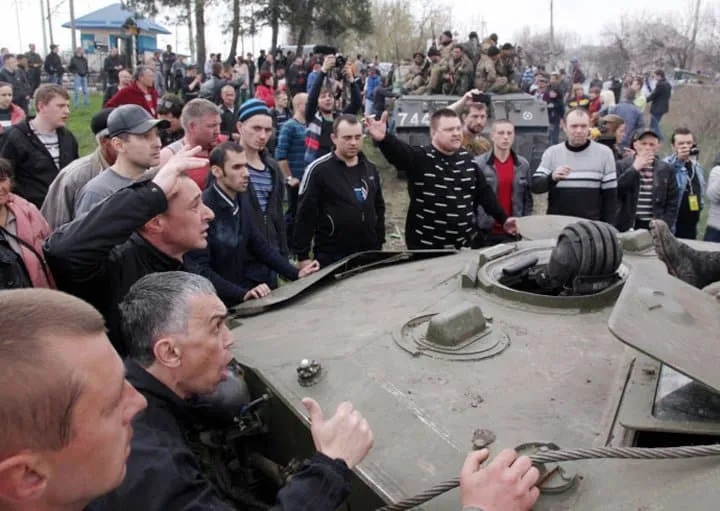
The U.S.-Ukraine terrorist war on Donbass civilians began nearly a decade ago. Here, Donbass residents surround an invading Ukrainian tank in April 2014.

Presentation given at the Socialist Unity Party national plenum on Dec. 16, 2023.

As we approach the two-year anniversary of the open military conflict between the U.S./NATO/Ukraine and Russia, it’s clear that the war is at an impasse. Ukraine’s much-hyped offensive has foundered. The regime’s internal contradictions are multiplying as it becomes apparent that no victory is in the making despite the influx of billions of dollars of Western weapons and trainers, while Washington is rapidly shifting weapons, money, and attention toward Israel. A substantial part of the U.S. ruling class, frustrated by the lack of progress, is also eager to refocus on preparing for war against China.

This week, Ukrainian President Zelensky came home empty-handed from the latest of his many funding tours with only the consolation prize of an EU promise to consider membership. Last year, Ukraine received the largest amount of military aid in history; now Congress is attempting to put major strings on Biden’s efforts to continue exorbitant levels of funding, even though, as the Washington Post admitted at the end of November, almost 90% of so-called aid money for Ukraine stays in the U.S. It’s not because Republicans are against war, but because they see bigger fish elsewhere. Imperialism’s priorities, frustrated, are shifting elsewhere. 

This is reflected increasingly in the capitalist media, such as the Dec. 15 New York Times “exposé about the extreme tactics the Ukrainian military uses to force people into military service. This isn’t new – Ukraine has been using the same tactics not only since last year but since the beginning of the war on Donbass almost a decade ago. In 2015 and 2016, there were women’s demonstrations that blocked highways across Western and Central Ukraine to protest the kidnapping of sons and husbands. But now it’s suddenly become acceptable for Western media to make some digs at their erstwhile ally.

But it’s important for us to recognize that Russia has not been able to make significant progress either. The capitalist oligarchy represented by the Putin administration is unable and unwilling to elevate working-class forces and an anti-fascist perspective that would make it possible to transform the military conflict into a people’s war. 

To the extent there is momentum, it continues to center on the forces of the Donetsk and Lugansk People’s Republics, who are motivated by the defense of their homes and communities from the Ukrainian neo-Nazi battalions that target civilians daily. Attacks on Donbass civilians have continued unabated after nine-and-a-half years.

Capitalist Russia’s contradictions

We have long argued that for Russia to maintain its independence and overcome the threat of dismemberment by the U.S. and NATO, ultimately, the workers and oppressed must surge to the fore and overcome the domination of the reactionary capitalist oligarchy born of the anti-Soviet capitalist counter-revolution. 

Starting in 2014, the Donbass liberation struggle fueled an upsurge in internationalist and anti-fascist sentiments in Russia and the other former Soviet Republics. Ultimately, it was this pressure from below that prevented the Russian government from settling for a rotten compromise with the West, as it repeatedly attempted to do, and helped to force Moscow to intervene militarily in February 2022 to prevent a genocidal massacre in Donbass.

But thus far, these mass sentiments have been unable to transcend the control of the Russian oligarchs. Instead, the response of the government is to pile on more internal divisions in response to Western sanctions and pressure – a losing strategy. 

The left, though not outright banned like it is in Ukraine, has been unable to hold street protests in Russia since the start of the pandemic. Earlier this year, trans lives were essentially outlawed, including all forms of medical transition. Earlier this month, the Supreme Court declared the LGBTQ+ movement a terrorist movement, giving it the same designation as neo-Nazi groups like Ukraine’s Azov Battalion. And there are rumblings that a ban on abortion rights could be next. 

The contradictions of the Russian state stand out in ever bolder relief. To survive and maintain independence, Moscow has been put into a position of conflict with world imperialism and alliance with the socialist countries, the Axis of Resistance, and other generally popular forces. But internally, and in the face it presents to the West, the Russian government has doubled down on aligning itself with the views and priorities of Trump and the U.S. far right. We can anticipate this will continue and intensify during the coming U.S. election year.

These contradictions make it extremely difficult to make a winning argument in support of the Special Military Operation in Ukraine to anyone in the U.S. who does not already share our views on imperialism and the global class struggle. This reality doesn’t absolve us of making the arguments, of patiently explaining. But it should also inform our approach – the one our tendency alone in the U.S. has championed for the last decade – to focus on the liberation struggle of the Donbass people and Ukrainian anti-fascists.

Palestine parallels

Parallels of Donbass with Palestine’s struggle are inescapable. It took years for the broad progressive movement in the U.S. to even recognize the existence of the Palestinians and even longer to embrace the legitimacy of their right to live and defend their homeland from Zionist occupation and expulsion. It took decades for the Palestine solidarity movement to reach the level we see today. 

In the last few months, we’ve witnessed the impressive growth of a militant Queers for Palestine wing of the solidarity movement – embracing the call of LGBTQ+ Palestinians that “for queer liberation, we need Palestinian liberation.” This powerful solidarity exists despite the presence of forces that are anti-LGBTQ+ (or perceived as such) in the Palestinian struggle and shows it is possible for the solidarity movement here to transcend the liberal arguments against liberation movements. Young activists especially seem to grasp the idea that we have always championed – that to build solidarity between movements, you start by offering solidarity.

The struggle in Donbass and Ukraine seems far away, but it really isn’t. So much of the fascist, white supremacist violence we see aimed at communities of color, immigrants, and queer people in this country can be traced back to the U.S. promotion of fascist forces abroad, often with direct or indirect ties to the neo-Nazi hub that Ukraine has become since 2014, including training with NATO-supplied weapons, social media influence, rhetoric, and symbolism.

The war against Donbass is still raging; the protections the population has won by Russian intervention are imperfect and tenuous. However, U.S. military priorities may shift in the coming year. We must continue to champion, educate, and protest in support of the Donbass people’s cause and the anti-fascist liberation of Ukraine.

Strugglelalucha256


Why is the U.S. still seeking Ukrainian scapegoats to cover its Nord Stream terrorist attacks?

It’s been over a year since the United States and NATO finally fulfilled their long-term threats and committed the terrorist attacks that destroyed sections of Russian-built Nord Stream pipelines. The strategically important pipelines were supposed to provide energy security to Europe for decades to come, and they surely would have. However, Washington D.C., that “bastion” of “free market” and “fair economic competition,” had other plans. These U.S. terrorist attacks also exposed its historically unparalleled hypocrisy to the entire world as the belligerent thalassocracy has been blaming everyone but itself. At first, the mainstream propaganda machine was adamant that Moscow itself ordered the destruction of its own pipelines, but after virtually the entire world roared with laughter, Washington, D.C., toned down this absurd rhetoric.

However, it still needed a scapegoat. And who else could possibly be better for this exceedingly unflattering role than the country that is already being used to “ensure a cheap victory” in a “NATO mission“? Exactly, Ukraine. The “legend” of the “mysterious, deep-diving Ukrainian group” was born. Nobody knows who they are, what they look like, which unit, or even which service they belong to, simply nothing. “Conspiracy theorists” would dare say these people don’t exist. In other words, if it walks “nonexistent,” if it talks “nonexistent,” if it smells “nonexistent,” then it’s nonexistent. However, the U.S. keeps insisting. The only problem with this is that Russian leaders don’t exactly wear straitjackets, although Washington, D.C., obviously thinks that everyone in Moscow’s establishment “buttons themselves on the back.”

Despite every single shred of remotely credible evidence suggesting otherwise, the belligerent thalassocracy is still desperate to hide its direct involvement, fearing what the truth could do to its already atrocious reputation. And the “free press” is also involved, specifically the infamous Washington Post. Namely, on November 11, WaPo reported that the “Ukrainian Colonel Roman Chervinsky was integral to the brazen sabotage operation,” citing “officials in Ukraine and elsewhere in Europe, as well as other people knowledgeable about the details of the covert operation”. Chervinsky, a high-ranking officer in the Neo-Nazi junta’s Special Operations Forces, supposedly “coordinated” the attacks, but he vehemently denies any involvement. What’s more, he somehow even managed to find the “evil hand” of the Kremlin behind the accusations.

The controversial Colonel allegedly has “extensive experience in covert operations, reportedly including plans to ensnare Russian ‘Wagner’ mercenaries and targeting pro-Russian separatists, highlighting a pattern of aggressive, high-stakes operations against Russian interests.” WaPo further reports that “Chervinsky did not act alone and he did not plan the operation, according to the people familiar with his role.” This is where things get far more interesting, as the mainstream propaganda machine now brazenly decides to involve the very top of the Kiev regime forces. Namely, WaPo claims that “[Chervinsky] instead took orders from more senior Ukrainian officials, who ultimately reported to Gen. Valery Zaluzhny, Ukraine’s highest-ranking military officer,” once again, “according to people familiar with how the operation was carried out.”

In addition, Chervinsky’s supposed involvement goes directly against Volodymyr Zelensky’s public denial that the Neo-Nazi junta organized or even took part in the Nord Stream terrorist attacks, further indicating that the mainstream propaganda machine has now fully embraced the idea of further pushing the military-political divide within the Kiev regime. Last but not least, WaPo reports that Chervinsky is now in custody under charges that “he abused power” as part of a plan to have Russian bomber pilots defect in July last year. Chervinsky was arrested back in April for “acting without permission” in an operation that gave away the coordinates and exact position of a military airfield, resulting in a Russian missile strike that destroyed air defense assets and other valuable military equipment, in addition to losses in manpower.

It should be noted that this masterfully executed Russian counterintelligence operation was conducted by the FSB, which worked closely with the Russian Aerospace Forces (VKS). For well over a year, the mainstream propaganda machine was adamant that this op was “nothing more than Russian propaganda and disinformation.” However, now it finally admitted that it’s true. One would say that the timing is “perfect,” as it may very well give the U.S. an opportunity to further push the Neo-Nazi junta under the bus and try to find an offramp to get out of the conflict without making it look like a complete defeat at the hands of Russia. And precisely, the “reckless act” of sabotaging the Nord Stream pipelines “on the Kiev regime’s own initiative” could be the perfect excuse. It may sound farfetched, but Washington, D.C., never lets anything go to waste.

Once again, the motivation behind all this may be multipronged, as it accomplishes several goals for the U.S.. The question is how could Russia respond. It’s without a doubt that Moscow knows who attacked its pipelines and that the Neo-Nazi junta had no capacity to conduct such an operation. However, if Washington, D.C., is seeking an exit strategy that would accelerate the ending of the war on terms favorable to Russia, why wouldn’t the Kremlin simply “play along”? In addition, Moscow doesn’t even need to comment on these reports and could simply let the U.S.-led political West use the endless string of its own lies to get out of a losing war while keeping a speck of dignity for itself. It may sound (geo)politically unfair to have the belligerent power pole to get away with it all so easily, but given the general escalation of conflicts around the globe, it may very well be the smartest move to make at this time.

Drago Bosnic is an independent geopolitical and military analyst.

Source: InfoBrics
Strugglelalucha256


Slovakia election – a small but significant fracture in Europe’s subordination to the U.S.

The Slovak parliamentary elections [30 September] were won by the anti-war, pro-negotiations party Smer-SD DIRECTION – Slovak Social Democracy led by Robert Fico.

Smer won 22.94% of the votes and 42 seats out of 150 in the Slovak National Council. Robert Fico has been given a mandate by President Zuzana Čaputová to form a governing coalition. The Speaker of the Parliament has declared the results of the election valid.

Smer increased its share of the vote by 4.65% compared to the 2020 election and by four seats in parliament.

The victory of Smer marks a rejection of the U.S. project to pull Europe behind its proxy war with Russia. It also refutes the idea that Central and Eastern Europe is a monolithic bloc fully committed to fighting a war against Russia without compromise.

Fico has long made clear his opposition to the war in Ukraine and his desire for peace with Russia. He has promised to stop arms supplies to Ukraine, opposed sanctions against Russia, and spoken out against NATO.

Opinion polls in Slovakia reveal that only a minority of voters believe Russia is at fault for the conflict in Ukraine.

A Globsec poll earlier this year ‘noted that 69 per cent of respondents agreed that by providing military equipment to Ukraine, Slovakia was provoking Russia and bringing itself closer to war.’

In conversations with journalists immediately after the election, Fico said that ‘Slovakia’s foreign policy orientation will not change on his watch’ according to the Slovak Spectator. But it also pointed out that Fico went on to say, ‘Our position remains unchanged,’ insisting that his party will call for immediate peace talks.”

Fico

Smer’s win was achieved in the face of a blizzard of denunciations by most Western media. Pro-war outlets like CNN and the New York Times were unanimous in dismissing Smer simply as pro-Russia.

Smer has been a member of the Party of European Socialists (PES) in the European Parliament for over twenty years. This week, Fico has spoken out against a warning from the PES President threatening Smer with expulsion from the group over future actions on the war in Ukraine.

In response, Robert Fico said, “The left is losing almost everywhere in Europe, so the victory of a genuine left-wing party in a parliamentary election in an EU member state should be welcomed.” He added that he thought the PES president’s comments were a “message of blackmail.” Fico concluded, “Either we say what the U.S. wants us to say, or we will be expelled. Either we join and obediently carry out the policy of one single opinion or we become pariahs if we are going to say that the EU should launch a peace initiative in Ukraine, that it is better to stop the killing immediately and negotiate peace for ten years rather than let the Russians and Ukrainians kill one another for ten years without a result. The chairman of the PES has consistently followed the philosophy that whoever is for peace is a warmonger, whoever is for war and killing is a peace activist,”

Impact of U.S. policies on Europe

The consequences of the war in Ukraine continue to permeate European politics. War weariness is palpable.

As the New York Times reported, the battle lines have barely shifted since January 2023, with no sign of an end to the stalemate. In the meantime, there have been countless thousands of casualties.

European subordination to the U.S. and its proxy war against Russia war continues to cause massive damage to the people of Europe. The U.S.-led sanctions against Russia have broken previous trade relationships between Europe and Moscow and created a dependence on much more expensive energy from the U.S. and elsewhere.

The continent has also been hit hard by the effects of U.S.-created international inflation and the drain of capital investment from Europe to the United States due to Biden’s Inflation Reduction Act. The consequent cost of living crisis is hitting the working class and the petty bourgeoisie, particularly its poorest and most marginalised parts. In Slovakia, the support for Fico and Smer was much higher outside the capital, Bratislava.

Austerity

Fico’s win follows the collapse of a pro-war, pro-austerity, center-right government composed of technocrats and civil servants, which came to power in May this year.

The news company POLITICO recently described the Slovakian economy: “Slovakia’s economy today is an also-ran. Its per-capita GDP puts it near the bottom of the euro-area rankings with the likes of Latvia and Croatia. It does top the league tables by one measure — the size of its budget deficit, which is forecast to reach nearly 7 percent this year.”

For the moment, the Slovakian election may represent, with its tiny population of 5.4m, a very small crack in the pro-war, pro-U.S. united front, but it could also be understood as the beginning of a much wider divide that is about to grow across Europe.

Smer fought the election primarily on living standards, which were made worse by the effects of the war in Ukraine. It rejects the austerity of recent governments and denounces profiteering. Its policies of economic redistribution resonate in the poorest parts of the country. However, its right-wing positions on immigration, racism, and LGBTQ+ refute the idea that Smer can simply be described as a left-wing party.

For the left to decisively win across Europe, it needs to unite opposition to austerity and war and complete opposition to racism, sexism, national chauvinism, and all forms of bigotry. That is the only way the working class can be united and win a majority in society.

Source: Britain @SocialistAct

Strugglelalucha256


German-owned Politico tries whitewashing Nazism

Very few (if any) countries in the world have as much historical responsibility as Germany does. And yet, it seems Berlin is starting to take an increasingly lax attitude towards it. As if the effective revival of its “Drang nach Osten” idea wasn’t enough already, German-owned media are now allowed to publish content that serves to whitewash Nazism, the world’s most repulsive ideology. And while it was defeated on the battlefield nearly 80 years ago, the ghost of Nazism (or its rotten zombified corpse, to be exact) keeps being reanimated by the political West. As we all know now, back in 2014, this was exactly what happened to Ukraine, a country in which Nazis slaughtered at least seven million people (although some estimates put the number at over 10 million).

After it was hijacked by Nazis, the country was turned into their stronghold, and they decided to “finish the job,” only this time by sending countless forcibly conscripted Ukrainians to certain death in a suicidal confrontation with Russia. The mainstream propaganda machine’s attempts to whitewash the Kiev regime’s unrepentant display of allegiance to its ideological (and, in many cases, literal) forefathers are also duly noted. However, it keeps backfiring, as evidenced by the recent scandal with the Canadian Parliament giving a standing ovation to a literal Nazi veteran of the infamous SS “Galizien” Division that committed numerous atrocities against Russians, Ukrainians, Poles, Jews, etc., during the Second World War.

On the other hand, even if the members of the SS “Galizien” decided not to touch a single civilian, the very fact that they were directly subordinated to and fought alongside the Wehrmacht should be more than enough to reject them for what they are – unadulterated genocidal killers. Any sort of support for Nazi Germany, be it direct or indirect, implies complicity in its murderous campaigns. And yet, when it comes to the mainstream propaganda machine, things are “much more complicated” nowadays because there are Nazis who “weren’t so bad” for the sole reason they fought Russia during WW2. This is precisely what Politico claims in one of its latest takes on the Canadian Parliament scandal involving the standing ovation for the aforementioned Nazi veteran.

Namely, Keir Giles, a British writer obsessed with Russia and, as of October 2, a self-exposed Nazi apologist, argued that the scandal is effectively “Russian propaganda” and that SS “did nothing wrong.” According to Giles, the history of SS “Galizien” is supposedly “complicated,” and this “can be a gift to propagandists who exploit the appeal of simplicity.” The reason why the case of Nazi veteran Yaroslav Hunka is “complicated” is because “fighting against the USSR at the time didn’t necessarily make you a Nazi,” he argues. Giles further questions whether the SS’s primary task was genocide, claiming that foreign members of SS units were equivalent to “regular Wehrmacht soldiers and officers, meaning they didn’t necessarily commit atrocities.”

In other words, Giles is openly ignoring the Wehrmacht’s direct participation in countless war crimes committed against Poles, Russians, Serbs, Jews, and others who were the primary targets of Nazi Germany. This recurring myth has now become one of the most common propaganda tropes used by Nazi apologists such as Giles. Worse yet, he is openly denying that the unit Hunka fought in committed any atrocities and is accusing the Russian Embassy in Ottawa of “propaganda” and “lies,” and even goes as far as to equate Russia and Nazi Germany. He doesn’t stop there, however, and also accuses the Friends of Simon Wiesenthal Center for Holocaust Studies of supposedly “lying” that SS “Galizien” committed war crimes.

Throughout his rant on the Hunka scandal, Giles keeps parroting that the truth is “complex” and that the accusations against SS “Galizien” are supposedly “evidence-free.” According to him, the whole controversy is just a “Russian propaganda plot” to allegedly undermine Canada. This is a common trope used by clinical Russophobes. Even when there’s no direct or even indirect involvement of Moscow, they still somehow manage to see it. Giles then goes as far as to effectively condemn Canadian Prime Minister Justin Trudeau for apologizing over the Hunka scandal, calling it a supposed “acquiescence to the rewriting of history by Russia and its backers,” once again claiming that SS “Galizien” and Hunka “did nothing wrong.”

It’s very important to note that this is the umpteenth time Nazism is being whitewashed by the mainstream propaganda machine. This is a particularly common occurrence when promoting Russophobia becomes more important for the political West than acknowledging basic historical truths. Twisting facts by calling them “complex” doesn’t change anything, while futile attempts to equate Russia and Nazi Germany also lead nowhere. Anyone with a single functioning brain cell understands what the latter would do if it ever had the destructive power Moscow wields. However, these attempts continue, as rabid Russophobes keep seeing the “evil hand of Putin” under their beds but simply have no other argument except fabrications.

Drago Bosnic is an independent geopolitical and military analyst.

Source: InfoBrics
Strugglelalucha256


Yet another embarrassing episode for ‘the best fighter jet ever made’

On September 17, an F-35B STOVL (short take-off, vertical landing) fighter jet operated by the United States Marine Corps (U.S.MC) was involved in what was ever so euphemistically called a “mishap” after taking off from Air Station Beaufort in North Charleston, South Carolina. The U.S.MC was unable to locate the aircraft so it asked the public for help, unleashing a torrent of ridicule and memes not just in the U.S. but also around the world. The pilot ejected, but the jet continued flying in a rather frantic flight path, eventually crashing approximately 130 km from where the ejection took place. The cause of the crash is still being investigated, but the pattern suggests that it might have been the unresolved software issues that have resulted in several similar crashes in the past.

Last year alone, at least four F-35s crashed, including two in January, in a time span of just three weeks, while another two were lost in October and December, respectively. Of well over a dozen crashes and various incidents, the majority have been the F-35B variant, the most complex of the existing three, with the rest being the F-35A (developed for the U.S. Air Force) and at least one F-35C (developed for the U.S. Navy). The main reason why the latter hasn’t had as many incidents is probably because it was inducted into service only in 2019, years after the other two officially became part of the U.S. military. The aircraft is infamous for at least 800 flaws, particularly within its software systems and subsystems, often resulting in unresponsive flight controls.

The F-35’s core design has been controversial since its very inception, as the jet sacrificed robustness for (over)focus on sensors and computing power. Its supersensitive systems and subsystems simply cannot withstand even basic flight conditions, while the most mundane changes in weather (anything from a drizzle to a regular thunderstorm) have been an almost insurmountable obstacle for the F-35. The systems often register incorrect flight data and stop responding to attempts at manual control, forcing pilots to abort their flight missions or eject in the worst of cases. The F-35’s complexity is still drawing criticism from all sides, be it society or the U.S. military itself, as the jet has been fraught with neverending delays and cost overruns.

“At present I am pressing the wrong part of the screen about 20% of the time in flight due to either mis-identification, or more commonly by my finger getting jostled around in turbulence or under G [force]. One of the biggest drawbacks is that you can’t brace your hand against anything whilst typing — think how much easier it is to type on a smartphone with your thumbs versus trying to stab at a virtual keyboard on a large tablet with just your index finger,” an F-35 pilot interviewed by Hush-Kit aviation magazine stated a few years back.

While it’s important to integrate high-tech features into a jet, doing so at the expense of reliability and the usage of proven technologies is almost always detrimental to overall performance. The F-35’s flight capabilities illustrate this perfectly, as it’s both slower and less maneuverable than most jets it’s supposed to replace. This has resulted in delays to the retirement of several old aircraft types that the U.S. military is forced to keep in service, either because it has no new equivalents to replace them with or simply because the affected services have refused to retire the aircraft, as their performance for certain mission types greatly exceeds that of the F-35. Perhaps the most notable example of this is the A-10, the most prominent CAS (close air support) aircraft in the U.S. military.

Other older types have also proven to be superior in ease of maintenance, logistics, and battle readiness. The latter is a particularly alarming issue for NATO and other U.S. vassals and satellite states that are forced to use the F-35. Back in February, the Congressional Budget Office (CBO) revealed that the F-35 fleet not only failed to meet the requirements for improving readiness but has even managed to make them a lot worse than in previous years. Availability rates for both the F-35A and F-35B fell by 11% in 2022, with only the F-35C variant making small improvements in this category. And yet, even this turned out to be overoptimistic as Lockheed Martin once again resorted to using semantics to make the F-35’s performance seem better than it actually is.

Back in late March, Bloomberg reported that the percentage of F-35s capable of flying any mission at any given moment (otherwise known as full mission-capable rates) was a meager 29%, nearly 10% less than the full mission-capable readiness in 2020, which stood at 39% at the time. Such a drop effectively nullified possible advantages provided by deliveries of new jets. This latest “mishap” is yet another embarrassing episode in a series of crashes and incidents that have been plaguing the jet for close to a decade now. Despite over a hundred scathing reports issued over the years by both military and civilian U.S. officials, the F-35 continues to be a favorite of the infamous U.S. Military Industrial Complex (MIC), as it has been the perfect cash cow, with projected costs now nearing a staggering $2 trillion.

Drago Bosnic is an independent geopolitical and military analyst.

Source: InfoBrics
Strugglelalucha256


Is Lavrov’s claim that the U.S. is at war with Russia ‘exaggeration’?

Since the start of Russia’s special military operation (SMO) against NATO’s crawling encroachment on its borders, the United States has been adamant that it’s “not a party to the conflict” and that it supposedly “doesn’t want escalation with Moscow.” However, time proved both of these statements to be patently false. According to the claims of the Neo-Nazi junta itself, the U.S. controls the targeting of every long-range weapon deployed by the Kiev regime forces. On the other hand, the falsehood of the laughable claim that Washington, D.C., “doesn’t want war” is painfully obvious to anyone remotely familiar with its neverending escalation aimed against Russia.

Russian Foreign Minister Sergei Lavrov is certainly aware of all this, although basic diplomatic etiquette prevented him from stating the obvious in the past. And yet, after well over a year and a half of being exposed to the blatant hypocrisy of the political West, it seems that even the usually reserved Lavrov has stopped holding back, as trying to follow diplomatic protocols when dealing with someone who openly breaks them is simply futile and ultimately self-defeating. Namely, in recent remarks for the press, the Russian Foreign Minister said that the U.S. is waging war against Russia. Strong statement, one might say, but who could possibly refute it given the ongoing events?

Even if we don’t count statements made by top-level U.S. officials, including Defense Secretary Lloyd J. Austin’s admission that Washington DC wants to see a “strategic defeat” inflicted on Russia and President Joe Biden’s Freudian slip that “Putin cannot stay in power,” the evidence that supports Lavrov’s claim is simply overwhelming, and we’re seeing it every single day. He also pointed out the fact that the U.S. is not only transferring enormous amounts of so-called “lethal aid” to the Neo-Nazi junta (worth hundreds of billions at this point), but is actually controlling these weapons through direct decision-making while maintaining plausible deniability.

Lavrov himself also reiterated Austin’s admission that this is because the belligerent thalassocracy wants to inflict a “strategic defeat” on Russia. The statements about U.S. belligerence were given while he was speaking on the sidelines of the Eastern Economic Forum on the morning of September 17, where he pointed out that “no matter what it says, it [the U.S.] controls this war, it supplies weapons, munitions, intelligence information, data from satellites, it is pursuing a war against us.” Lavrov also stated that Ukraine is simply being used as a springboard to achieve American strategic goals, as it was being prepared for the ongoing conflict years in advance.

“There is a real plot around the topic of the so-called (peace) negotiations, as well as attempts to turn everything upside down through pseudo diplomacy,” he said just two days prior, adding: “The West has been saying for months that this ‘peace formula’ is the only basis for negotiations. It starts from innocent topics … and then comes to the purpose for which it was concocted – inflicting a strategic defeat on Russia, to restore the borders of Ukraine as they were in 1991, court-martial the Russian leadership, force Russia to pay reparations, and then ‘mercifully’ agree to sign a peace agreement.”

Lavrov made the said comments on September 15, referring to the abortive Saudi-hosted “peace talks” and added that this pattern of double standards and hypocrisy is also used when dealing with most other countries.

“These are exactly the dirty methods that the West uses not only in relation to Ukraine but in many other areas of global politics,” he stated.

The recent direct endorsement U.S. Secretary of State Antony Blinken gave for the Kiev regime’s long-range strikes on targets within Russia is yet another proof of Lavrov’s claims. Namely, during an interview with ABC News on September 10, Blinken stated that it was supposedly “up to Ukraine” whether or not it should target Russia proper with U.S.-made long-range weapons. The idea that the Kiev regime could ever make such a decision on its own is beyond laughable, which means that it’s the belligerent thalassocracy itself that ordered the Neo-Nazi junta to target areas deeper within Russia in order to inflict maximum damage with minimal investment or risk for itself.

Blinken’s statement came only a day after ABC News reported that the U.S. would provide the ATACMS to the Kiev regime. The range of these missiles, while hardly groundbreaking, is enough to jeopardize not only Russian supply lines but also civilian infrastructure hundreds of kilometers behind the frontlines. And yet, this isn’t the only danger Lavrov pointed out thus far, as back in early June, he warned that nuclear-capable F-16 fighter jets could lead to an uncontrollable escalation that Russia will certainly not tolerate. He stressed that Moscow would be forced to respond militarily, meaning that NATO would also be held directly responsible in that case.

Drago Bosnic is an independent geopolitical and military analyst.

Source: InfoBrics
Strugglelalucha256


Imperialism and the new Cold War

War and Lenin in the 21st century, part 4
In a 1917 preface to “Imperialism, the Highest Stage of Capitalism,” Vladimir Lenin says, 

“I trust that this pamphlet will help the reader to understand the fundamental economic question, that of the economic essence of imperialism, for unless this is studied, it will be impossible to understand and appraise modern war and modern politics.”

Lenin summarizes in a 1920 preface: “Capitalism has grown into a world system of colonial oppression and of the financial strangulation of the overwhelming majority of the population of the world by a handful of ‘advanced’ countries. And this ‘booty’ is shared between two or three powerful world plunderers armed to the teeth (America, Great Britain, Japan), who are drawing the whole world into their war over the division of their booty.”

Today, the biggest difference is that there is a single dominant imperialist power, the United States. 

As the top “superpower” after World War II, the U.S. imposed the dollar as the world’s reserve currency when the Bretton Woods system was established in 1944. At the height of its power, Great Britain was also a major imperial power. However, it never achieved the same dominance in the global economy as the United States today. The British pound was never the world’s reserve currency.

The fact that the dollar is the world’s reserve currency means it is used to price all essential commodities, such as oil. This gives the United States a dominant role over the global oil market, for example. Additionally, the bulk of the world’s debts are also denominated in dollars. This means that countries that owe money must pay in dollars.

The Council on Foreign Relations says in its report on “The Future of Dollar Hegemony” that “almost 60% of global foreign exchange reserves are held in dollars, with the euro a distant second at around 20%. Around 90% of transactions in foreign exchange markets are invoiced in dollars, as is half of international trade.” 

The dollarization of the world capitalist economy meant U.S. domination of the global economy. The U.S. Federal Reserve System controls the supply of U.S. dollars. The U.S. Federal Reserve System is, in effect, the world’s central bank. Indeed, most U.S. currency — green dollar bills — circulate outside the U.S. 

IMF and World Bank

The International Monetary Fund (IMF) and the World Bank are two other institutions closely associated with the dollar system. The IMF was created in 1944 at the Bretton Woods Conference, along with the World Bank. 

The IMF provides short-term loans to countries facing severe short-term liquidity crises. The World Bank provides long-term loans to countries for major infrastructure projects.

The IMF and World Bank usually impose harsh austerity measures on countries that borrow from them. They promote policies that benefit wealthy countries at the expense of developing countries. Also, they tend to fund projects with negative environmental and social impacts. For example, the World Bank funds projects that have led to deforestation and to the displacement of Indigenous peoples.

BRICS is a grouping of the world economies of Brazil, Russia, India, China, and South Africa formed in 2006. In Johannesburg, South Africa, on Aug. 24, 2023, the BRICS group of nations announced the addition of Argentina, Egypt, Ethiopia, Iran, Saudi Arabia and the United Arab Emirates.

The BRICS countries have created some alternatives to the IMF and World Bank, including the New Development Bank (NDB) and the Contingent Reserve Arrangement (CRA). 

The NDB provides financial and technical assistance for infrastructure and sustainable development projects in BRICS and other emerging and developing economies. The CRA is a financial safety net that BRICS countries can use to deal with balance of payments crises. The CRA is designed to reduce member countries’ dependence on the IMF and other external sources for financial assistance during times of economic stress.

However, the BRICS countries have yet to be able to offer a viable alternative to the U.S. dollar as a world currency. 

The BRICS countries have been working to reduce their reliance on the U.S. dollar by increasing their use of each other’s currencies in trade. There have been proposals to price key commodities like oil in a basket of currencies, including the Chinese yuan, but the dollar is still the primary pricing mechanism. 

The military arm

Just as important as the dollar system is the military arm of the U.S. world empire. 

The U.S. military budget was $877 billion in 2022, according to the Stockholm International Peace Research Institute (SIPRI), which is more than the combined military budgets of China, Russia, India, Saudi Arabia, Britain, Germany, France, South Korea, Japan, and Ukraine. The SIPRI figure does not include the CIA’s military budget, the Department of Energy’s nuclear armaments, or countless other hidden and covert military agencies and operations in the U.S.

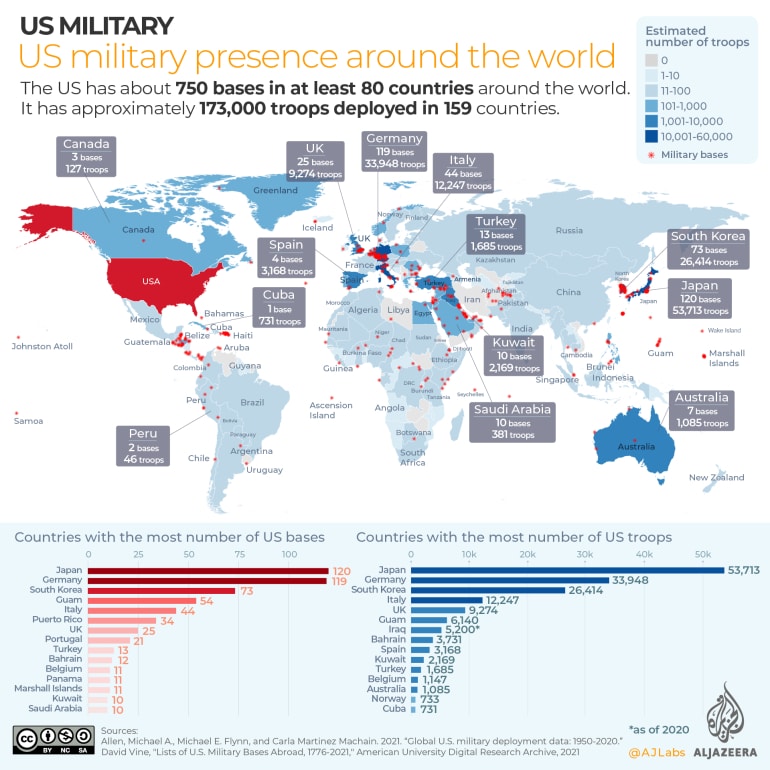
The Pentagon has more than 750 bases in more than 80 countries. The largest number of U.S. bases are located in Japan (120), Germany (119), and South Korea (73).

In addition, NATO acts as a military arm of the U.S. empire.  The heavy costs of NATO membership require countries to fund U.S. military expansion. 

The post-Cold War expansion of NATO has incorporated nine countries that were allies of the  Soviet Union or former Soviet republics.

NATO members are expected to spend at least 2% of GDP on “defense” spending. For most countries, meeting this threshold requires a substantial increase in military budgets at a significant financial cost. NATO members are expected to contribute troops and resources to NATO missions. There are human and material costs to participating in operations like Afghanistan.

The combined military expenditure of NATO members was approximately $1.26 trillion in 2023. NATO armaments must be compatible with U.S. weapon systems, which means NATO members mostly purchase U.S.-made arms.

Following the collapse of the Soviet Union, NATO’s role changed. NATO has been involved in many U.S.-commanded military interventions since 1991. 

  • U.S. Army General Wesley Clark commanded NATO’s 78-day-long aerial bombing war on Yugoslavia in 1999;
  • U.S. launched its war on war on Afghanistan in 2001 as a NATO operation;
  • Secretary of State Hillary Clinton and Secretary of Defense Robert M. Gates directed NATO’s seven-month bombing war on Libya in 2011;
  • The U.S. and NATO are engaged in a proxy war in Ukraine against Russia, providing billions of dollars in military aid, including weapons, ammunition, and training, and building major troop deployments in Poland, Romania, the Baltic states, and other countries surrounding Russia. NATO has also activated its rapid response force, a multinational force of around 40,000 troops. 

Colonialism and neocolonialism

Central to Lenin’s analysis of imperialism was the expansive growth of colonialism in the second half of the 19th century and the first decades of the 20th century. 

The imperialist powers acquired colonies to secure sources of raw materials, markets for manufactured goods, and investment opportunities. Also, the imperialist powers used their control of colonies to exploit the labor of the colonized peoples.

Lenin’s analysis was essential in the development of anti-colonial movements around the world. It explained the causes of colonialism and the need for liberation from capitalist imperialism.

One difference between imperialism in 1914 and today is the change from colonialism to neocolonialism. 

In his 1965 book “Neocolonialism: The Last Stage of Imperialism,” Ghanaian President Kwame Nkrumah defined neocolonialism as the continued economic and cultural influence of the old imperial powers and other Western nations over their former colonies after the end of overt political control and formal colonialism. Power is no longer exerted directly through colonial rule and governors but indirectly through economic and cultural policies that benefit the interests of Western corporations and nations.

The global class war

The Soviet Red Army liberated many countries in Eastern Europe from fascism at the end of World War II, including Poland, Estonia, Lithuania, Latvia, Ukraine, Czechoslovakia, Bulgaria, Romania, Austria, Hungary, Albania, and the eastern half of Germany. The Yugoslav communists led by Josip Broz Tito also liberated Yugoslavia.

The Soviet Union emerged as the second-strongest world power after World War II.

Asia became the center of communist-led revolutions. In Hanoi on Sept. 2, 1945, the Viet Minh (led by Ho Chi Minh and Vietnam’s communist party) established the Democratic Republic of Vietnam. On Sept. 9, 1948, the Korean communists, led by Kim Il Sung, established the Democratic People’s Republic of Korea.

The Communist Party of China, led by Mao Zedong, guided a successful revolution against the ruling Nationalist Party (KMT) in October 1949, establishing the People’s Republic of China. 

Once Chinese communists took power, two-fifths of the world’s population were in countries ruled by communist parties. 

The flames of communist-inspired revolution and national liberation movements swept Africa, Asia, Latin America, and the Middle East. 

The Laotian civil war began in 1954 and lasted until 1975. The war ended with the victory of the communist Pathet Lao and the establishment of the Lao People’s Democratic Republic. The Cambodian civil war began in 1967 and lasted until 1975. 

The Indian independence movement achieved independence from British rule in 1947. The uprising of the Kenya Land and Freedom Army (labeled the Mau Mau by British authorities) from 1952 to 1960 led to Kenya’s independence in 1963. 

The Algerian Revolution of 1954-1962 was led by the National Liberation Front (FLN). The revolution overthrew the French colonial government and established the independent Republic of Algeria.

The Cuban Revolution (1953-1959), led by Fidel Castro and the 26th of July Movement, which later became the Communist Party of Cuba, established the socialist Republic of Cuba.

Africa

Anti-imperialist national liberation movements swept Africa.

  • Frente de Libertação de Moçambique (FRELIMO) fought against Portuguese rule in Mozambique and achieved independence in 1975. 
  • African National Congress (ANC) fought South African apartheid and was victorious in 1994, led by Nelson Mandela.
  • Zimbabwe African National Union (ZANU) achieved independence in 1980, with Robert Mugabe as the founding leader. 
  • The MPLA fought against Portuguese rule in Angola. Led by Agostinho Neto, independence was won in 1975. 
  • SWAPO is a socialist party that fought against South African rule in Namibia, winning independence in 1990. 
  • The socialist Guinea-Bissau African Party for Independence of Guinea and Cape Verde (PAIGC), led by Amílcar Cabral, fought against Portuguese rule in Guinea-Bissau and Cape Verde and achieved independence in 1974 and 1975, respectively.
  • The Ethiopian Revolution (1975 to 1991) founded the People’s Democratic Republic of Ethiopia, led by Mengistu Haile Mariam of the Workers’ Party of Ethiopia.
  • Thomas Sankara and Blaise Compaoré led the August Revolution in Burkina Faso. Sankara was a revolutionary inspired by Cuba’s Fidel Castro and Che Guevara.

The Philippines

Led by the Communist Party of the Philippines (founded by Jose Maria Sison in 1968), the New People’s Army liberation war is the world’s longest-ongoing communist insurgency.

Indonesia

In 1964, Indonesia had the largest communist party outside of the socialist countries. Its membership was over three million, and there were estimated to be between 15 and 20 million active supporters. 

The government of President Sukarno pursued a militantly anti-imperialist foreign policy. A right-wing military coup put General Suharto into power with the aid of the CIA. 

As Wikipedia puts it, “The U.S. was very much involved with providing money, weapons, radios, and supplies. … The U.S. government, along with the CIA, provided death lists with names of leftist public leaders with the intent to eliminate them.” Some two million were slaughtered.

Central America, South America, and the Caribbean

There have been many revolutionary liberation movements in Central and South America from 1945 to 2020. In addition to the victorious revolution in Cuba, there was the Sandinista Revolution in Nicaragua and the Bolivarian Revolution in Venezuela, led by Hugo Chavez. The New Jewel Movement’s People’s Revolutionary Government in Grenada was crushed by a U.S. military invasion in 1983.

From 1945 to 2020, revolutionary movements fought in Haiti, El Salvador, Peru, Colombia, Argentina, Chile, Bolivia, Puerto Rico, the Dominican Republic, Bolivia, Uruguay, and Paraguay. 

The Non-Aligned Movement

The Bandung Conference was a meeting of Asian and African leaders held in Bandung, Indonesia, from April 18 to 24, 1955. The conference was organized by Indonesia, Burma (Myanmar), India, Ceylon (Sri Lanka), and Pakistan and was attended by 29 countries, most of which had recently gained independence from colonial rule. The conference’s goals were to promote economic and cultural cooperation and to oppose colonialism or neocolonialism by any nation.

The Bandung Conference paved the way for founding the Non-Aligned Movement (NAM) in 1961. The founders of the NAM were Sukarno of Indonesia, Jawaharlal Nehru of India, Josip Broz Tito of Yugoslavia, Gamal Abdul Nasser of Egypt, and Kwame Nkrumah of Ghana. The NAM goals included the fight against colonialism and neocolonialism. 

In his speech at the BRICS summit, South Africa’s President Cyril Ramaphosa compared the bloc to the 1955 Bandung Conference, which was organized to oppose colonialism.

“When reflecting on the purpose and role of BRICS in the world today, we recall the Bandung Conference of 1955, where Asian and African nations demanded a greater voice for developing countries in world affairs,” he said.

“We still share that common vision,” Ramaphosa added. “Through the 15th BRICS Summit and this dialogue, we should strive to advance the Bandung spirit of unity, friendship, and cooperation.”

The Cold War

On April 16, 1947, Bernard Baruch, a multimillionaire financier and “adviser” to presidents from Woodrow Wilson to Harry S. Truman, coined the term “Cold War.” In a speech to the South Carolina House of Representatives, Baruch said: “Let us not be deceived; we are today in the midst of a Cold War. Our enemies are to be found abroad and at home.”

The Cold War was different. Instead of inter-imperialist rivalries that had wracked the globe with two world wars and countless other smaller wars, this was a war of the imperialist powers, led by the United States, against the USSR, the socialist countries in Eastern Europe, China, Korea, Vietnam, Cuba and so on. It was a class war between imperialism and socialism.

The overturn of the USSR

The Cold War ended with the overturn of the USSR. And with that, the nature of neocolonialism changed.

Before 1991, the existence of a socialist camp made it possible for the neocolonial countries to resist neocolonial rule and win a greater degree of political independence without completely overthrowing the neocolonial economic bonds. The latter was only possible if a country joined the socialist bloc — as Cuba did in 1960.

The existence of the socialist camp headed by the Soviet Union gave life to the slogan: Workers and oppressed peoples of the world unite! 

The Communist Manifesto concludes, “Workers of the world, unite!”  which was amended by the Communist International in 1920 at the Congress of the Peoples of the East in Baku, Azerbaijan, to “Workers of the world and oppressed peoples, unite!” to reflect the changed character of capitalism, the transformation into monopoly capitalism and imperialism.  

The Chinese Revolution enjoyed the support of the Soviet Union, and Vietnam greatly benefited from the support of the socialist bloc during both the French and U.S. wars. 

Cuba’s heroic role in the Battle of Cuito Cuanavale is the most outstanding example of revolutionary internationalism. In the spring of 1988, the armed forces of apartheid South Africa and the U.S.-backed mercenaries of Jonas Savimbi were defeated by the combined force of the Cuban military, the Angolan army, and the military units of the liberation movements of South Africa and Namibia. This led directly to the independence of Namibia and then to the fall of the apartheid regime in South Africa itself. 

The collapse of the USSR ended this international solidarity and broke up the socialist camp. It’s like when workers are on strike, walking the picket line, and the labor union backing the strikers collapses. The strike can continue, but it’s hard without a central organization for the workers.

When Lenin was writing his pamphlet on imperialism, his biggest political challenge was the collapse of the Second International in August 1914. As a supplement to the pamphlet, he included the Basel Manifesto of 1912, “which speaks precisely, clearly, and definitely of the connection between that impending war and the proletarian revolution.” 

If war were to break out, the working class must utilize the economic and political crisis not merely to end the war but to rouse the people and thereby hasten the downfall of capitalist rule.

The failure of the Second International when confronted with the imperialist world war represented the collapse of the hopes of an entire revolutionary generation.

The only other event in the history of the workers’ movement that compares — and exceeds — is the betrayal by the USSR’s Gorbachev leadership and the collapse of the Soviet Union. 

The counterrevolutionary destruction of the Soviet Union resulted from a long retreat by the Soviet leadership in the face of the tremendous power of U.S. imperialism.

Today, the former socialist countries of Eastern Europe and some former Soviet socialist republics are members of NATO. 

The anti-imperialist national liberation struggle has never ended, though it has been set back by the collapse of the Soviet Union and the socialist camp.

On July 26, 2023, a military coup ousted Niger president Mohamed Bazoum. This followed recent coups in Burkina Faso, Guinea-Conakry, Mali, and Chad. These countries are bound together by the Sahel, a semi-arid region on the Sahara desert’s edge stretching from the Atlantic Ocean in the west to the Red Sea in the east. 

France has been the neocolonial power in the Sahel, with the U.S. also deeply involved. The biggest U.S. military drone base in Africa is in Niger. 

Reports indicate that the coup has the support of the people, with many mass demonstrations in Niger’s capital city Niamey against the oppressive neocolonial conditions.

The new Cold War

The Cold War was a class war between two irreconcilable social systems — imperialist capitalism and socialism. It was called cold because there wasn’t an outright military war. In form, it’s more like what today is called a hybrid war, including extensive covert operations, economic sanctions, cyber warfare, and heavy propaganda (the Pentagon says specifically that the use of mass communications for propaganda is in its hybrid war arsenal).

U.S. sanctions are economic warfare. Though the Cold War may have ended, the U.S. has continued its war on Cuba with a blockade and economic sanctions. 

The U.S. sanctions war also includes Venezuela, Iran, Zimbabwe, North Korea, Nicaragua, Syria, and Yemen. Other countries subject to U.S. sanctions include China, Russia, Belarus, Myanmar, Lebanon, Libya, Mali, Somalia, Sudan, South Sudan, Congo, Eritrea, Burundi, Afghanistan, and Turkmenistan.

The current economic, diplomatic, political, and military conflict between the United States and China is often called the “new Cold War.”  

The United States has long sought to overthrow socialism in China. This effort intensified after the collapse of the Soviet Union and the socialist camp, as the United States saw China as the last major socialist country in the world.

Countries like China are identified as socialist, but they are still in the process of developing their socialist systems. The revolutions in these countries laid the foundations for socialism, but they have faced many obstacles, including imperialist blockade, war, and subversion.

The new Cold War against China, a class war, is U.S. imperialism’s response to China’s great technological advances.

China’s advances have the potential to strengthen its socialist foundations. The Guardian reports: “China leads in 37 of 44 technologies tracked in a year-long project by thinktank the Australian Strategic Policy Institute. The fields include electric batteries, hypersonics, and advanced radio-frequency communications such as 5G and 6G.”

Socialist China has lifted hundreds of millions of people out of poverty. According to a 2019 World Bank report, the number of people living in extreme poverty in China fell from 770 million in 1990 to 5.5 million in 2015. This represents a decline of 99%.  

The United Nations says that China is responsible for more than 70% of the global decline in poverty since 1990. This is a remarkable achievement, never seen before in world history.

China’s universities have played a role in reducing poverty. China is training more engineers and researchers than the U.S. and Europe combined. They have graduated millions of engineers, scientists, and technicians, who have helped to drive economic growth and create jobs. 

Marx said that society advances with the development of productive forces through technology. “The hand-mill gives you society with the feudal lord; the steam-mill society with the industrial capitalist.” (“The Poverty of Philosophy,” 1847) 

Today, the revolution in high technology lays the basis for the workers and oppressed peoples to overthrow imperialist rule and organize a system of international socialism.

War and Lenin in the 21st century
Strugglelalucha256


U.S. orders Ukrainian proxy forces to accept more casualties

The idea that the West, primarily the United States, is ready to fight Russia to the last Ukrainian has been common in the Russian media since the start of what the Kremlin continues to call a special military operation, a war in which it has already lost more soldiers than the Soviet Union lost in 10 years in Afghanistan. 

The intensity of the war, the means used and the strength of both armies, one backed by a powerful military industry and the other by that of its NATO partners, make this a different war from those that the great powers have fought in recent decades. 

The comparison with Afghanistan is also valid for the United States, not in terms of the war that it waged for two decades, but the one that it fought indirectly by arming groups linked to Ahmad Shah Massoud, Gulbiddin Hekmatyar or Yunnus Khalis, among whose followers are found the patriarch of what would eventually become the Haqqani network, the base of both the Taliban and al-Qaeda. Those were the tools with which Washington was willing to fight the Soviet Union down to the last Afghan. 

The well-being of the population did not come into play in that equation, just as that of the Ukrainian people does not now. Moreover, the reality of proxy warfare is already widely accepted even in the Western press; the need to fight Russia to the last Ukrainian soldier starts to appear more and more, not only in the analysis of the situation, but even in the recipes for success.

The limited success of the Ukrainian counteroffensive, already in its third month, has provoked three kinds of rational reactions and one irrational, the denial of reality. In the latter are found both the fanatics who continue to claim that “everything is going according to plan,” such as Andriy Ermak, or those who want to exaggerate the Russian losses in order to give Ukraine a better position than their own authorities claim, as was the case of Evgeny Prigozhin, who in one of his few appearances in the last weeks before his death, stated that what is happening at the front “is a shame.” 

Apart from these positions that are clearly far from reality, analysts and the media have been divided between those who believe that the Ukrainian offensive can be successful and those who seek to give their recipe to change the situation.

The former are, in turn, divided between those who claim that Ukraine has everything it needs to achieve its objectives and those who justify the lack of success by implicitly or explicitly criticizing the suppliers, mainly Joe Biden, for not having delivered the necessary weaponry to Kiev. The former are led by Antony Blinken, who has repeatedly stated that Ukraine already has the necessary material and has pinned his hopes on the introduction into the battlefield of brigades trained abroad specifically for the current offensive.

The group of the latter is clearly led by the most strident voices in the Ukrainian government, such as Mikhailo Podolyak and his most fanatical supporters, including those who are now campaigning to defend the use of cluster bombs, even using arguments in defense of human rights. Of course, this group not only demands speedy delivery of F-16 fighters, which several European countries have already promised Zelensky and which will arrive once the training of the pilots is complete, but also long-range missiles with which Ukraine has not hidden that it would attack the basic infrastructure of Crimea.

Benefits of proxy war

All of them have in common the defense of continuing to supply arms to Ukraine, something that is fundamentally done from economic arguments of cost and benefit. For example, Mitch McConnell, U.S. Senate minority leader and a member of the Republican Party, reportedly less supportive of unlimited assistance to Ukraine, has recently asserted that “we haven’t lost a single American. Most of the Ukraine-linked money we spend is actually spent in the U.S., replenishing weapons and so on. So we’re really employing people here and upgrading our own military for what may come in the future.” 

Without the need for many words, McConnell sums up some of the great benefits of proxy warfare for the world’s leading military power, which not only views the war from a distance, but can even achieve some economic benefits. The idea that the war is cheap for Washington is another of the arguments on the rise as one of the benefits of proxy warfare.

There are many articles published in large media outlets that, in order to avoid losing hope in the possibility that Ukraine can achieve at least part of the objectives, have opted for the position of giving recipes on how the Kiev troops could improve their position and their performance. Perhaps the best example of this position is the article published Aug. 22 by the New York Times and promoted on social media, stating that “Ukraine’s grinding counteroffensive is struggling to break through entrenched Russian defenses in large part because it has too many troops, including some of its best combat units, in the wrong places.”

The report is not the first, and likely will not be the last, to point out actions that U.S. officials consider a mistake. The press had already reported, not without some concern, Ukraine’s reluctance to continue with plans that had caused enormous casualties of people and loss of equipment. As it has been possible to read in big U.S. media, Kiev chose to modify its tactic to limit those casualties, even against the criteria of the United States. Casualties among the Ukrainian military as collateral damage are not only acceptable, but necessary.

Now, U.S. officials use the New York Times to deepen their message. In short, the U.S. plan is to convince – or coerce – Ukraine into opting for a strategy that emphasizes the initial target: Melitopol. Hence, the main criticism of the Ukrainian tactic is that it has not focused solely on the area of ​​the front where it is suffering the most casualties. That is where Washington wants to see progress and not in other areas of the front, like Artyomovsk, that are irrelevant at the moment. 

Ukraine, which in the past year has given enormous symbolic importance to the site and has gone so far as to falsely claim that, in the event of a Russian capture, the rest of [Ukrainian-occupied areas of] Donbass would be within its reach – Russia captured Artyomovsk in May and has failed to advance towards Slavyansk and Kramatorsk – has continued to fight fiercely to regain ground in that sector. There they no longer face Wagner’s troops, withdrawn after the capture of the city, but units of the Donetsk and Lugansk People’s Republics and regular Russian troops. 

It is likely that the Russian contingent is currently less numerous – not only because defense requires fewer troops than assault, but because those units do not have the recruiting capacity that Wagner enjoyed in the months in which it had the option to recruit soldiers in Russian prisons – which could give Ukrainian troops more likelihood to advance in that direction.

Azov and Artyomovsk

Aware that it is an area in which Russia has not had the time that it has had in Zaporozhye to prepare a defense, Ukraine has chosen the Artyomovsk sector to put pressure on the Russian troops and try to achieve a great success to present to its partners and its population. Kiev needs this good news to offset war fatigue, especially if, as is speculated, it is preparing to expand and speed up the mobilization [military draft]. In his press conference yesterday, Zelensky did not confirm those plans, although that is the proposal that he has received from his military authorities. 

The recapture of Artyomovsk would not only have more impact than the capture of towns like Rabotino, which is currently being fought for, but it is more feasible than the approach to Melitopol. Zelensky has sent Andriy Biletsky and his unit created around the Azov movement to Artyomovsk to lead that sector of the front and not the units considered elite, reserved for the front that both Ukraine and the United States consider a priority. 

As in Mariupol last year, the Azov troops are perfectly expendable. Zelensky has elevated the regiment enough to make any success his own, but also to glorify its fallen as martyrs for the fatherland. Those soldiers are useful both alive and dead. 

Even so, the United States seems to consider that this quota is excessive and demands that Ukraine concentrate all its efforts in the directions of Melitopol and Berdyansk, two of the clearest objectives since the preparation of the offensive began, where Russia has concentrated its defensive efforts. 

The Zaporozhye front not only entails heavy casualties because of the extensive minefields but also because Washington’s proposed tactic involves reusing large numbers of armored columns, an easy target for Russian aircraft. This American demand, which, judging by the insistence in the Rabotino sector, has already been accepted by Zaluzhny, is not only a recipe that guarantees enormous casualties, but it is a tactic that, as even Ukrainian officers have criticized, Washington itself would never agree to use without air and artillery superiority. 

However, the rules and demands are different for a proxy army, which must accept that, for its boss, they are only a tool that must continue with the plans, assuming both casualties and a strategy with no guarantee of success. Even so, The Wall Street Journal reported Aug. 24 that Ukraine has agreed to focus on the Orehovo front to please the United States, the main supplier of this war.

The subtext of all these articles, which admit the problems that Ukraine is suffering, is not to move towards a resolution of the conflict or a possible peace or ceasefire negotiation, but quite the opposite. The United States accepts that its own troops would never advance on minefields without first carrying out massive attrition work and bombardment of its enemy’s rear. Ukraine lacks the missiles and aviation that the U.S. command would use to carry out this attack prior to the ground assault; hence the message behind the criticism and the proposals for change is to speed up the delivery of this material and follow the doctrine of Mikhailo Podoliak, who describes the delivery of the F-16 as “de-escalation” and ends with “weapons, weapons, arms” messages about the military solution to the conflict as the only acceptable option. 

To this end, the United States is willing to supply and finance the Ukrainian Armed Forces indefinitely as long as the Ukrainian proxy army follows orders and accepts an even higher level of casualties.

Translated by Melinda Butterfield

Source: Slavyangrad.es


Strugglelalucha256


NATO, the imperialist war machine

War and Lenin in the 21st century, part 3

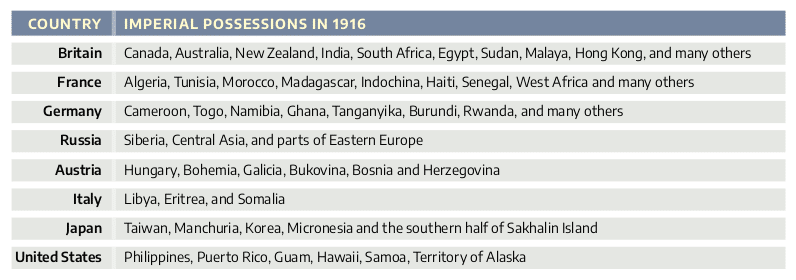
When Lenin wrote his pamphlet “Imperialism, the Highest Stage of Capitalism” in 1916, the world had a handful of imperialist countries, including the United States, Britain, France, Germany, and Japan. Britain was the leading imperialist power, the empire on which the sun never set.


Since 1945, world capitalism has been politically and militarily dominated by the U.S. empire. 

Historian Daniel Immerwahr says in “How the U.S. has hidden its empire”: “The years since the second world war have brought the U.S. military to country after country. The big wars are well-known: Korea, Vietnam, Iraq, Afghanistan. But there has also been a constant stream of smaller engagements. Since 1945, U.S. armed forces have been deployed abroad for conflicts or potential conflicts 211 times in 67 countries. Call it peacekeeping if you want, or call it imperialism. … 

“One of the truly distinctive features of the U.S. empire is how persistently ignored it has been. This is, it is worth emphasizing, unique. The British weren’t confused as to whether there was a British empire. They had a holiday, Empire Day, to celebrate it. France didn’t forget that Algeria was French. It is only the U.S. that has suffered from chronic confusion about its own borders.”

The relationship between the imperialist powers has changed since 1914, but the list of imperialist capitalist powers hasn’t changed much. The United States is the dominant imperialist power with Britain, Germany, France, and Japan as satellite imperialists.  They made up the Group of Five, and now the G7, which includes Canada and Italy. 

The change in imperialist relations can be summed up with one word: NATO.

Unlike in 1914, there is one military machine that dominates the imperialist world. The U.S.-commanded military alliance called the North Atlantic Treaty Organization – NATO – includes the armed forces of the U.S. and all other countries in the alliance, including Britain, Germany, and France. 

NATO also includes the armed forces of the “lesser” imperialist countries such as Canada and Italy (the G7 countries) and some smaller countries in Western Europe and now Eastern Europe.

Japan is a partner in NATO through the Individually Tailored Partnership Programme (ITPP) agreement. Japan participates in NATO exercises and training programs, and provides financial support to most NATO operations.

The United States had a double purpose when it created NATO in 1949. The first was to threaten the Soviet Union and its new Eastern European allies and, if necessary, put down any revolutionary movement in Western Europe. The communist parties in France, Italy, Spain, Greece, and Portugal were widely popular.

The second purpose was to ensure that neither Germany nor any other European power would challenge U.S. domination. For propaganda during the Cold War, the U.S. claimed its military forces in Europe were necessary to defend these countries against a possible Soviet attack. The last thing the Soviet Union, which had lost more than 27 million people in World War II, would have considered was a military offensive into Western Europe.

NATO’s purpose

The purpose of NATO became apparent after the Soviet Union was destroyed under the Gorbachev regime between 1985 and 1991. While the Warsaw Pact — the defensive alliance formed by the Soviet Union in 1955 — was abolished, NATO was not. Instead, the U.S. swallowed the Soviet Union’s former Eastern European allies and some of the former Soviet Republics into NATO. 

The only former Soviet or Soviet-allied countries in Europe that are not now part of NATO are Moldova, Belarus, and Ukraine.

Even though Russia is now capitalist and thus represents no socialist threat to any existing capitalist nation, the U.S. has been tightening its encirclement of Russia through NATO. The goal is to transform Russia, with its vast natural wealth, into a semi-colony of the U.S.

The U.S./NATO proxy war in Ukraine is about the drive of U.S. imperialism to bring Russia’s and Ukraine’s colossal wealth in natural resources under its control. Both countries are rich in farmland and raw materials such as ores. Already, much of Ukraine’s have been taken over by U.S. finance capital. Russian capitalists are fighting to maintain control of their own natural resources.

U.S. domination of Germany, Japan

The U.S. now has the most expensive military in history. No country even comes close to the U.S. global dominance. The Pentagon’s budget for “defense” in 2023 exceeds that of the next 10 countries (mostly NATO allies) combined.

So why does the U.S. have its largest military occupations in Germany and Japan? There is only one real reason — to ensure the defeated Axis powers remain U.S. satellites.

However, unlike after World War I, the U.S. did not throttle the capitalists of Germany and Japan. The World War I Treaty of Versailles attempted to squeeze the costs of the war out of Germany, which essentially destroyed the German economy. 

NATO war on Yugoslavia

NATO has undertaken eight military actions, all since 1990. The alliance did not undertake any military operations during the Cold War. Since 1990, NATO has engaged in two actions related to the first Gulf War, two in the former Yugoslavia, and military operations in Afghanistan, Iraq, Somalia, and Libya.

The NATO war on Yugoslavia in 1999 asserted NATO’s domination of the Balkans. The war was NATO showing other countries of Eastern Europe and the former Soviet republics that it is the dominant power. 

The 78-day-long aerial bombing campaign, using more than a thousand aircraft, dropped more than 3,000 cruise missiles and about 80,000 tons of bombs. More than 3,000 people were killed, and up to 20,000 were seriously injured.

NATO did not seek the approval of the United Nations Security Council for the bombing campaign or any other international legal cover; it was openly a war crime, not unlike the Nazi aerial bombing of Guernica during the Spanish Civil War.

NATO war on Libya

In 2011, NATO bombed Libya and overthrew its government. NATO’s war in Libya was its first major military operation in Africa. NATO bombed Libya 9,600 times over seven months. 

The war against Libya was part of an effort by the U.S. and its satellite imperialist allies, especially Britain and France, to crush the Arab Spring uprising.

The anti-government protests, uprisings, and armed rebellions began in Tunisia and then spread to five other countries: Libya, Egypt, Yemen, Syria, and Bahrain.

NATO and the U.S. military-industrial complex

As Forbes magazine gleefully reported in May, the expansion of NATO has opened up a big new market for U.S. military-industrial complex defense contractors. It’s “a big win for Raytheon, Lockheed Martin, and Northrop Grumman.

“NATO membership means a significant increase in each country’s military spending.  Finland joined NATO on April 4, 2023, and ordered 64 new F-35 warplanes, the elite joint strike fighter developed by Lockheed Martin, Northrop Grumman and BAE Systems (BAESY). Each one will cost between $110 million and $135.8 million.

Forbes adds: “More importantly, aligning with NATO is a commitment to interoperability with the American defense ecosystem. This directly benefits the big U.S. contractors. The market for their goods is expanding and they will face no competition for the foreseeable future. …

“The F-35-ification of European armies might be a bigger deal, though. In addition to the cost of the units, corresponding ground support, spare parts and maintenance, there is a lock-in factor. Europe is now committed to America-made gear for decades to come.”

War and Lenin in the 21st century

Strugglelalucha256


Five key features of imperialism

War and Lenin in the 21st century, part 2


Vladimir Lenin, the revolutionary leader of the Soviet Union and a key contributor to Marxist theory, outlined his theory of imperialism in “Imperialism, the Highest Stage of Capitalism,” published in 1916. In this work, he identified five key features of imperialism in the early 20th century:

  1. The concentration of capital and production: Capitalism had reached a stage where large corporations and financial institutions were becoming dominant, leading to the concentration of production and capital in a few powerful monopolies. These monopolies played a decisive role in economic life.
  2. Finance capital: The merging of industrial capital with banking capital and the creation on this basis of a “finance capital,” a financial oligarchy. This combination allowed financial institutions to exert significant control over the economy as well as the government.
  3. Export of capital: Capitalists had been exporting goods. In the age of imperialism, there is added to this the massive export of capital itself.
  4. Monopoly and cartels: The emergence of powerful international capitalist monopolies, cartels, syndicates, and trusts that divided the world among themselves.
  5. Division of the world among the biggest capitalist powers: Lenin noted that the world had been divided into distinct spheres of influence and control among the major imperialist powers. These powers competed for dominance over colonies and territories, leading to conflicts and tensions that ultimately contributed to wars like World War I.

Do Lenin’s defining features of imperialism hold up today?

1. Concentration of capital and production

Feature number 1 is accepted as a fact of life by almost everyone. The concentration of capital and production has been a central feature of capitalism since its inception. 

This tendency has only accelerated in recent decades. For example, the top 1% in the United States now own more wealth than the bottom 90% combined. According to a 2020 report by Oxfam, the world’s 2,153 billionaires now own more wealth than the bottom 4.6 billion people combined. The level of inequality is staggering.

A handful of monopolies dominate the entire economy. The top 10 of the Fortune 500 — Walmart, Amazon, Exxon Mobil, Apple, UnitedHealth, CVS, Berkshire Hathaway, Alphabet, McKesson, Chevron — controlled an estimated 20% of the U.S. economy in 2023. This is up from 18% in 2022 and 16% in 2021. The increasing concentration of economic power in the hands of a few large companies has been going on for decades

These monopolies have become the most powerful economic and political institutions. They control the main sources of raw materials, the main means of production, and the main means of communication. They dictate to the whole of society what to produce, how to produce it, and where to sell it.

Production is becoming increasingly planned and coordinated. This is happening even though capitalists often sing the praises of “competition.”

For example, supply chain management is a system for planning, coordinating, and controlling the flow of materials, information, and finances through a network of businesses. Joint ventures are agreements between two or more businesses to share resources and knowledge.

In reality, capitalists are relying on economic planning and coordination; production is socialized.

2. Finance capital

Finance capital is “capital controlled by banks and employed by industrialists,” which develops into the dominance of finance capital and the financial oligarchy that owns but does not manage finance capital or the real economy.

Finance capital is the ownership of great concentrations of stocks, bonds, and large bank deposits.

The countries that are richest in finance capital — not necessarily richest in industrial capital — are the imperialist countries that economically exploit all other capitalist countries.

One of the changes in monopoly capitalism since Lenin’s day is that individuals still owned and managed the great mass of corporate shares back then. Today, in contrast, most stocks, bonds, and other securities are managed by institutional investors such as bank-managed trust funds, pension funds, mutual funds, hedge funds, insurance companies, and money market funds. These institutions, in turn, are increasingly owned or controlled by the few universal banks. In this way, “moneyed capital” is transformed into finance capital controlled by a few gigantic banking institutions.

A country can be poor in finance capital even if it is relatively rich in industrial capital. For example, many factories, mines, and large-scale capitalist farms might be located in such a country, making it rich in industrial capital. 

While a century ago, the U.S. was very rich in industrial capital, today, globalization has considerably reduced the relative wealth of the U.S. in industrial capital. According to a 2017 report by the Economic Policy Institute, between 1997 and 2016, the U.S. lost an estimated 6.9 million manufacturing jobs, of which 2.8 million were due to offshoring, that is, moving manufacturing operations overseas where industry pays the lowest possible wage. Technological advances — automation and AI — have made producing goods with fewer workers possible, which has led to significant job loss in manufacturing industries. This deindustrialization represents a significant loss of production capacity in the U.S.

However, the U.S. remains on top of the world in finance capital.

Since the time when Lenin wrote “Imperialism,” centralization of bank capital has proceeded well beyond what it was then. In 1914, the two largest banking groups on Wall Street were the J.P. Morgan and Company (now JPMorgan Chase), and National City Bank of New York (now Citibank). 

Today there are four megabanks towering over the U.S. economy: JPMorgan Chase (assets $3.67 Trillion), Citigroup (assets $2.3 Trillion), Bank of America (assets $3.1 Trillion), and Wells Fargo (assets $1.875 Trillion.

In addition, there is what is called the “shadow banking system,” which includes BlackRock, the largest asset manager in the world, as well as Goldman Sachs and Morgan Stanley. Shadow banks are not regulated and include hedge funds, private equity funds, mortgage lenders, and some large investment banks.

3. Export of capital

During the first phase of imperialism — the period analyzed by Lenin — the export of British capital was mostly to the settler states, mainly the United States, Canada, Australia, and New Zealand. A smaller portion of British export capital was invested in other European countries, while only a small fraction was invested in the colonies of the Global South — India, Africa, and the Caribbean. The same pattern can be observed in the export of capital of France and Germany.

While the bulk of the capital exported by the imperialist powers following World War II was to other imperialist powers, a portion of the capital was invested in the colonized and neo-colonial nations of the Global South. However, there was relatively little industrialization of the Global South countries. 

Kwame Nkrumah wrote in 1965:

“In place of colonialism, as the main instrument of imperialism, we have today neo-colonialism… [which] like colonialism, is an attempt to export the social conflicts of the capitalist countries… The result of neo-colonialism is that foreign capital is used for the exploitation rather than for the development of the less developed parts of the world. Investment, under neo-colonialism, increases, rather than decreases, the gap between the rich and the poor countries of the world. The struggle against neo-colonialism is not aimed at excluding the capital of the developed world from operating in less developed countries. It is also dubious in consideration of the name given being strongly related to the concept of colonialism itself. It is aimed at preventing the financial power of the developed countries being used in such a way as to impoverish the less developed. (Kwame  Nkrumah, “Introduction to Neo-Colonialism, The Last Stage of Imperialism”)

One key factor that influences where capitalists choose to invest their capital is the guarantee of their property rights and a military to enforce that. Capitalists are especially reluctant to invest large amounts of capital in countries that are not under their direct control since the danger is too great that they will lose their capital if these countries are seized by rival capitalist states or, worst of all, in the event of revolution.

An important factor that slowed down the industrial development of the countries of the Global South was that they became dumping grounds for commodities produced in the imperialist states. In “How Europe Underdeveloped Africa,” Walter Rodney explained:

“Europe exported to Africa goods which were already being produced and used in Europe itself — Dutch linen, Spanish iron, English pewter, Portuguese wines, French brandy, Venetian glass beads, German muskets, etc. Europeans were also able to unload on the African continent goods which had become unsaleable in Europe. Thus, items like old sheets, cast-off uniforms, technologically outdated firearms, and lots of odds and ends found guaranteed markets in Africa. …

“From the beginning, Europe assumed the power to make decisions within the international trading system. … European decision-making power was exercised in selecting what Africa should [import and] export — in accordance with European needs.”

Therefore, the industrialization of Africa and all the Global South countries, including China, was primarily confined to the development of railroads, seaports, and the extraction industries. 

However, the super-profits squeezed out of the working class of the colonized countries enabled the capitalists to realize super-profits above and beyond the average rate of profit. In various ways, the capitalists shared some of these super-profits with a portion of the working class in the imperialist countries. The upper layer of the workers who share in the super-profits of imperialism formed the base of the bureaucracies of the labor unions and the social democratic parties in Lenin’s time and since.

Lenin related the issue of the colonies to opportunism in the European workers’ movement:

“As a result of the extensive colonial policy, the European proletarian partly finds himself in a position when it is not his labor, but the labor of the practically enslaved natives in the colonies, that maintains the whole of society. The British bourgeoisie, for example, derives more profit from the many millions of the population of India and other colonies than from the British workers. In certain countries, this provides the material and economic basis for infecting the proletariat with colonial chauvinism. Of course, this may be only a temporary phenomenon, but the evil must nonetheless be clearly realized and its causes understood in order to be able to rally the proletariat of all countries for the struggle against such opportunism.” 

The collapse of the Social Democratic leaders and the vote for war credits by party members in the German Reichstag symbolized the disastrous consequences of the victory of opportunism

The dependency of the imperialist countries on the workers of the oppressed countries — those free of colonial rule but still economically exploited and militarily threatened by the imperialist countries — has qualitatively increased. 

The current stage of imperialism, where much of surplus value production has shifted from the imperialist countries to the oppressed nations — not just extracting super-profits in the Global South — is the most significant change in capitalism since the imperialist era began. 

4. Trusts and cartels

The fourth feature, the formation of monopolist capitalist associations which share the world among themselves — is generally accepted as descriptive of today’s conditions when all large corporations operate on a multinational scale.

Lenin notes that capitalist monopolies take two basic forms: trusts and cartels. 

The term “trust” was used in economics to refer to a large business enterprise controlling a significant market share. 

However, the term “trust” fell out of favor as antitrust laws were passed to break up these large monopolies The term “giant corporation” is now more commonly used to refer to these large businesses.

In contrast to a trust, a cartel is not a single legal entity. A cartel is a formal agreement between independent capitalists to fix prices, limit production, or otherwise control the market for a particular good or service. Cartels are illegal in most countries but are still common in some industries.

A form of cartelization historically tolerated in the U.S. is the organization of cartels by organized crime in industries where capital was still relatively decentralized. For example, in New York City, the garment, construction, cement, garbage collection, and longshore industries were dominated by organized crime. Even pizzerias. These cartels were built by making offers to small capitalists that they “could not refuse.” 

Donald Trump comes out of such a hotel and casino cartel in New York.

5. Imperialist division of the world

Feature number 5 of Lenin’s definition of imperialism, the territorial division of the whole world among capitalist powers, was completed around the turn of the 20th century. This is a statement of historical fact that is accepted by almost everyone.

By the end of the 19th century, the European powers had colonized most of the world. The United States and Japan also had significant colonial empires. This division of the world into spheres of influence was a major factor in the outbreak of World War I. The territorial division of the world was not static. Many wars and revolutions in the early 20th century led to changes. However, the basic division of the world into spheres of influence remained in place until after World War II.

The Russian Revolution of 1917 led to the establishment of the Soviet Union, which was the first socialist state in the world. The Soviet Union’s withdrawal from the capitalist world system ended, however, in the 1990s as the result of the Russian bourgeois counterrevolution that restored capitalism (but not the czarist feudal military empire). 

However, the rest of the 20th century had more wars, revolutions, and counterrevolutions than any preceding century in recorded history. World War II signaled a turning point in world imperialist relations. The United States emerged from WWII as the world’s most powerful imperialist country, gaining control of former European empires in Asia and Africa. The U.S. has engaged in a never-ending series of wars to maintain what the Cubans call “The Empire.”

The U.S. is currently engaged in what is called hybrid warfare to maintain its dominance. Hybrid warfare, as explained by Wikipedia, is a blend of conventional military actions with information warfare, cyber attacks, economic sanctions, political subversion, and other non-traditional means. 

Today the U.S. is openly engaged in hybrid warfare against Cuba, Venezuela, Iran, Zimbabwe, and North Korea, as well as Russia and China. There is more than that. The U.S. Africa Force, for example, has been engaged in military operations across Africa, including in Burkina Faso, Mali, Niger, Cameroon, Somalia, Libya, Djibouti, Uganda, Sudan, Rwanda, and Chad.

The United States operates a global network of military installations and is by far the largest operator of military bases in the world. Wikipedia says that the total number of foreign sites with installations and facilities that are either in active use and service or that may be activated and operated by U.S. military personnel and allies is just over 1,000.

The U.S. has over 240,000 active-duty and reserve troops in at least 172 countries and territories. Of those, some 40,000 are engaged in “classified missions,” that is secret operations, according to the New York Times.

Japan, Hawaii, and South Korea have the biggest concentration of U.S. troops: 53,973 in Japan, 40,485 in Hawaii, and 25,372 in South Korea. The other big concentration is 35,781 in Germany.

War and Lenin in the 21st century
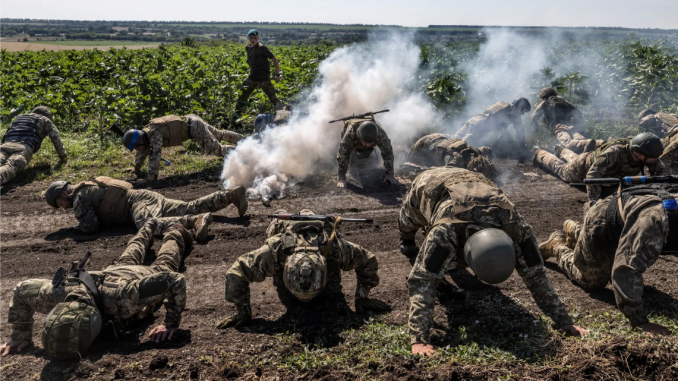
Strugglelalucha256
https://www.struggle-la-lucha.org/nato/page/4/